
Reports
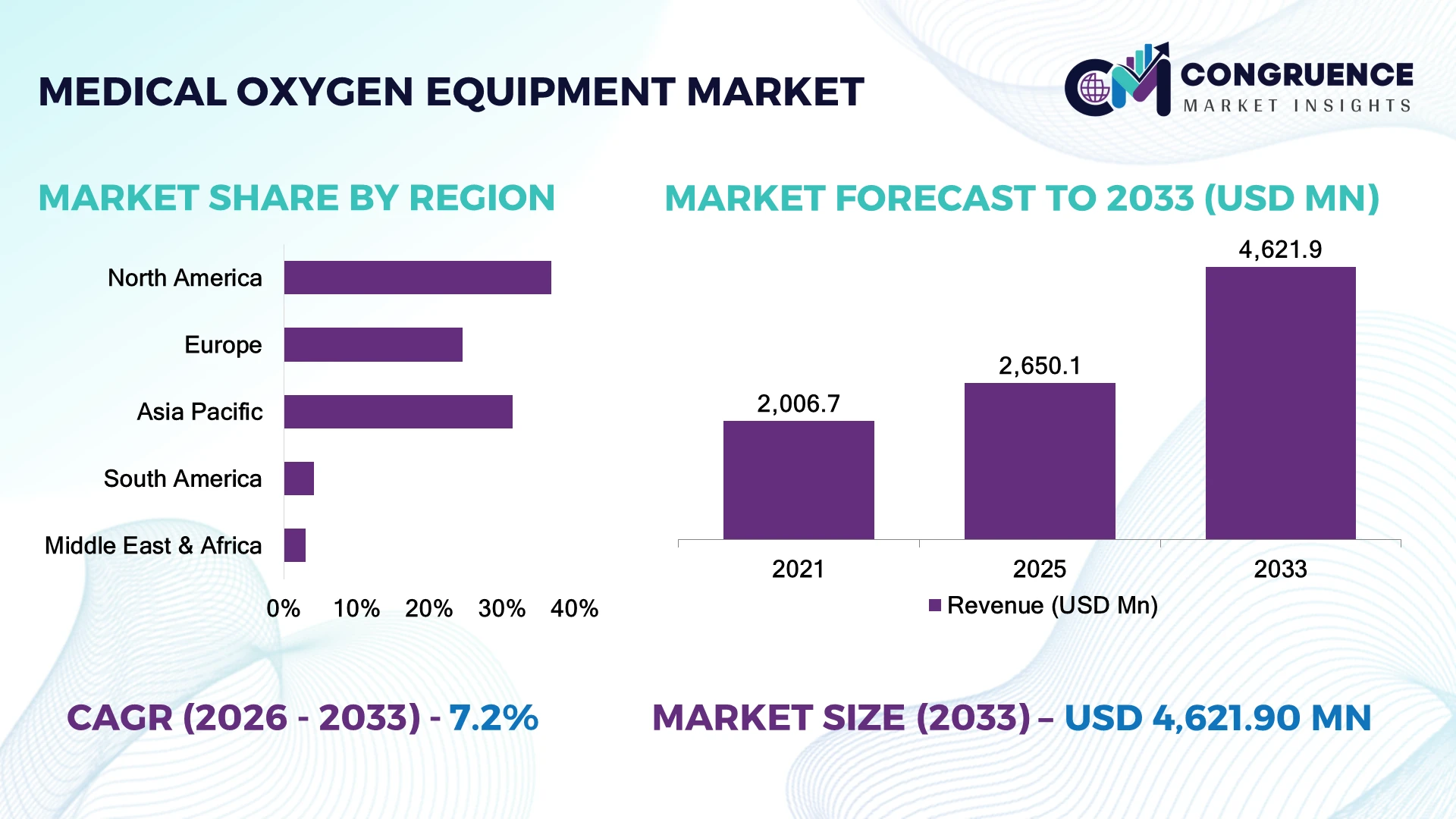
The Global Medical Oxygen Equipment Market was valued at USD 2,650.1 Million in 2025 and is anticipated to reach a value of USD 4,621.9 Million by 2033 expanding at a CAGR of 7.2% between 2026 and 2033. Growth is being driven by decentralized oxygen generation, replacement of aging oxygen-delivery infrastructure, wider deployment of concentrators and PSA systems, and stronger hospital preparedness requirements following supply disruptions exposed during the COVID-19 pandemic.
The United States remains a major high-value market, while India is strengthening domestic oxygen-generation capacity through hospital-based PSA systems and localized medical-device manufacturing. India’s public-health expansion has included more than 1,500 PSA oxygen plants supporting over 400,000 oxygenated beds, with IoT-based performance monitoring also being introduced. By comparison, lower-income healthcare systems continue to face significant access gaps, with fewer than half of health facilities in low- and middle-income countries estimated to have uninterrupted medical oxygen access.
Strategically, suppliers combining reliable oxygen generation, storage, delivery, monitoring, and lifecycle service capabilities are best positioned for resilient healthcare infrastructure procurement.
Market Size & Growth: USD 2,650.1 million in 2025 to USD 4,621.9 million by 2033 at 7.2% CAGR, driven by decentralized oxygen infrastructure.
Top Growth Drivers: Hospital oxygen infrastructure 31%, concentrator adoption 24%, emergency preparedness 19%.
Short-Term Forecast: By 2028, connected oxygen systems target 10–15% lower maintenance downtime and 15% faster fault detection.
Emerging Technologies: PSA generation, high-flow oxygen systems, smart concentrators, IoT monitoring, and remote diagnostics are reshaping oxygen delivery.
Regional Leaders: North America, Europe, and Asia-Pacific lead investment, while emerging markets prioritize decentralized hospital oxygen generation.
Consumer/End-User Trends: Hospitals account for the strongest equipment utilization, with decentralized systems increasingly preferred for facilities requiring continuous oxygen availability.
Pilot/Case Example: India’s oxygen-infrastructure expansion supported more than 400,000 oxygenated beds through PSA plant deployment and monitoring initiatives.
Competitive Landscape: Major suppliers including Philips, Dräger, Invacare, Drive DeVilbiss, and AirSep compete through reliability, portability, oxygen purity, and service coverage.
Regulatory & ESG Impact: Updated technical requirements increasingly emphasize safety, quality assurance, maintenance, and efficient facility-level oxygen management.
Investment & Funding: Public healthcare programs have committed substantial capital to PSA generation, including India’s 162-plant, 154.19-tonne capacity program.
Innovation & Future Outlook: 2026–2030 competition is shifting toward decentralized generation, IoT monitoring, predictive maintenance, energy-efficient concentrators, and integrated oxygen-management platforms.
Medical oxygen equipment is becoming a critical infrastructure category spanning hospitals, intensive-care units, emergency departments, homecare, ambulatory facilities, and remote healthcare centers. Demand is shifting toward integrated systems that combine oxygen concentrators, PSA plants, cylinders, storage, pipelines, flow-control equipment, and monitoring technologies. Approximately 10–15% reductions in maintenance downtime are increasingly achievable through connected monitoring and predictive service workflows. In 2026, healthcare systems are also placing greater emphasis on domestic production and on-site generation to reduce exposure to cross-border logistics disruptions and centralized oxygen-supply bottlenecks.
Medical oxygen equipment is becoming strategically important because oxygen availability directly influences hospital capacity, emergency preparedness, surgical capability, respiratory care, and healthcare-system resilience. The market is shifting from dependence on centralized liquid oxygen and cylinder distribution toward diversified systems combining PSA plants, oxygen concentrators, bulk storage, and pipeline networks. WHO's 2025 guidance emphasizes national oxygen scale-up planning, reflecting the transition toward structured, continuously monitored oxygen ecosystems.
Technology selection is increasingly based on facility economics rather than equipment specifications alone. On-site PSA generation can reduce dependence on recurring cylinder logistics, while modern concentrators offer decentralized deployment where pipeline infrastructure is impractical. Connected monitoring can improve fault identification by approximately 15–25% compared with manual inspection workflows. North America and Europe emphasize reliability, automation, and regulatory compliance, whereas India, Southeast Asia, and African markets place greater emphasis on decentralized capacity and affordability.
A practical example is India's hospital-based PSA expansion, where dedicated plants were deployed to reduce dependence on external oxygen supply and strengthen district-level resilience. Over the next 2–3 years, manufacturers are likely to prioritize integrated oxygen-management platforms, remote monitoring, energy-efficient systems, and localized service networks. Competitive advantage will increasingly depend on delivering dependable oxygen availability across generation, storage, distribution, monitoring, and maintenance rather than selling individual devices in isolation.
Hospital-level oxygen generation is becoming a core infrastructure priority as centralized supply chains remain vulnerable to transport interruptions and emergency demand spikes. PSA oxygen systems can reduce dependence on delivered cylinders by approximately 30–40%, while connected monitoring can improve equipment fault detection by 15–25%. India’s post-pandemic deployment of hospital PSA plants illustrates the structural shift toward localized oxygen production. Healthcare providers are consequently prioritizing on-site generation, pipeline integration, and remote monitoring rather than standalone equipment purchases. Manufacturers are responding through modular PSA systems, higher-efficiency concentrators, and service partnerships with hospitals. The non-obvious advantage is procurement resilience: facilities with diversified generation and storage capacity can maintain oxygen availability even when external logistics become constrained.
Medical oxygen infrastructure remains constrained by upfront equipment costs, specialized installation requirements, and uneven technical-service availability. PSA plants, pipeline systems, storage vessels, and backup equipment can collectively increase project expenditure by 20–35% compared with basic cylinder-based arrangements, while maintenance requirements can account for 10–15% of lifecycle operating costs. Smaller hospitals in India, Africa, and Southeast Asia face additional pressure from limited biomedical-engineering capacity and inconsistent spare-parts access. Semiconductor, compressor, valve, and sensor supply disruptions can further extend equipment lead times. These constraints directly affect deployment schedules and procurement economics. Manufacturers are reducing exposure through localized assembly, multi-source component contracts, standardized modules, and regional service centers, shifting competition from equipment price alone toward total cost of ownership and uptime assurance.
The strongest emerging opportunity lies in combining oxygen generation with digital monitoring, predictive maintenance, and automated flow management. IoT-enabled systems can reduce manual inspection requirements by approximately 20–30%, while predictive diagnostics can improve maintenance response times by 15–25%. In India, Indonesia, and selected African healthcare markets, decentralized PSA deployment creates a substantial installed base for remote asset-management services. Advanced concentrators with oxygen-purity sensing, automated alarms, and cloud connectivity are moving beyond premium hospitals into secondary facilities. Companies are investing in modular architectures, software integration, and service contracts that generate recurring value after equipment installation. A non-obvious opportunity is retrofitting existing oxygen plants with sensors and digital controls, allowing suppliers to monetize aging infrastructure without waiting for complete system replacement.
Scaling intelligent medical oxygen infrastructure requires reliable integration between PSA generators, concentrators, compressors, pipelines, storage systems, alarms, and hospital information environments. Legacy facilities can require 20–30% more commissioning effort because equipment interfaces and monitoring protocols are often non-standardized. Workforce shortages also remain significant: inadequate biomedical-engineering support can increase corrective-maintenance intervals by 15–20%, particularly outside major urban hospitals. Cybersecurity adds another layer as connected oxygen assets increasingly transmit operational data across hospital networks. Companies must therefore invest in interoperable control architectures, cybersecurity safeguards, technician training, and remote-support infrastructure. The strategic challenge is no longer simply producing oxygen; it is maintaining stable purity, pressure, flow, and uptime across interconnected assets. Vendors that solve integration and service consistency will gain stronger long-term hospital contracts.
Connected Oxygen Monitoring Accelerates Medical facilities are increasingly adopting IoT-enabled oxygen monitoring, with connected deployments estimated to improve fault detection by 15–25% and reduce manual inspection workloads by 20%. Hospitals are integrating pressure, purity, flow, and equipment-status sensors into centralized dashboards. Manufacturers are responding with remote diagnostics and predictive-maintenance packages that improve uptime without requiring proportional increases in technical staffing.
PSA Systems Move Decentralized Hospital-based PSA oxygen generation is expanding as facilities seek greater control over supply continuity. On-site systems can reduce delivered-cylinder dependence by approximately 30–40% and lower logistics exposure during demand surges. India’s post-pandemic infrastructure expansion has accelerated this transition, encouraging suppliers to develop modular plants with automated controls, backup storage, and simplified commissioning for secondary healthcare facilities.
Portable Concentrators Gain Ground Lightweight oxygen concentrators are gaining relevance across homecare, ambulatory treatment, and emergency-response applications, with battery-powered configurations increasingly extending operating autonomy by 20–30%. Smaller footprint designs improve deployment flexibility where pipeline infrastructure is unavailable. Manufacturers are prioritizing lithium-battery integration, oxygen-purity sensors, quieter compressors, and remote service capabilities to strengthen adoption beyond traditional hospital environments.
Energy Efficiency Becomes Procurement Metric Healthcare operators are placing greater emphasis on electricity consumption as oxygen equipment becomes more decentralized and continuously operated. New-generation concentrators and PSA systems can deliver approximately 10–15% better energy efficiency than older configurations under comparable operating conditions. Rising energy costs and sustainability targets are pushing suppliers toward variable-speed compressors, heat-management improvements, and automated load optimization, making lifecycle efficiency increasingly important in equipment selection.
Pressure Swing Adsorption (PSA) oxygen generators are estimated to account for approximately 38% of the Medical Oxygen Equipment Market, supported by continuous on-site production, lower dependence on cylinder logistics, and suitability for hospitals with sustained oxygen demand. Their share is strongest in large hospitals and public healthcare systems where pipeline distribution and centralized oxygen management justify higher initial investment. Oxygen concentrators follow at roughly 31%, benefiting from portability, modular deployment, and suitability for smaller facilities and homecare. Liquid oxygen systems and oxygen cylinders remain strategically relevant, particularly where high-volume storage or established distribution networks already exist.
PSA systems are also the fastest-growing type, with adoption expanding as healthcare providers prioritize supply resilience and localized generation. Concentrator demand is increasingly shifting toward higher-flow, energy-efficient, remotely monitored units, while cylinder-based systems remain mature but operationally important for backup capacity. Manufacturers are responding with modular PSA plants, hybrid oxygen architectures, and service contracts, shifting investment toward integrated oxygen infrastructure rather than standalone devices.
In 2025, the World Health Organization issued technical specifications for health-facility medical oxygen systems covering oxygen sources, storage, distribution, quality, and safety, reinforcing standardized procurement and system-level deployment.
Hospitals and clinics represent the leading application, accounting for approximately 58% of market demand, because oxygen equipment is embedded across intensive care, operating rooms, emergency departments, maternity units, and general wards. High patient throughput and continuous oxygen requirements make reliability more important than acquisition price, supporting investment in PSA plants, centralized pipelines, concentrators, and backup cylinders. Home healthcare follows as a smaller but faster-expanding application, supported by chronic respiratory care and the shift toward decentralized treatment. Demand for home-based oxygen equipment is estimated to be increasing its share by 3–4 percentage points as portable concentrators become lighter and more energy-efficient.
Emergency medical services, ambulatory care, and respiratory therapy facilities remain specialized applications, with demand concentrated around portability, rapid deployment, and battery autonomy. Companies are adapting product portfolios accordingly, combining hospital-grade systems with compact concentrators and digitally monitored devices. The business implication is a widening product architecture: suppliers must address both high-volume institutional infrastructure and distributed patient-level oxygen delivery.
The World Health Organization’s 2025 national medical oxygen scale-up guidance emphasizes facility-level assessment, costing, financing, implementation, and continuous monitoring, reinforcing oxygen planning as an integrated healthcare-infrastructure requirement.
Hospitals and clinics constitute the dominant end-user group, estimated at approximately 62% of Medical Oxygen Equipment Market demand, reflecting intensive oxygen utilization, centralized procurement, and infrastructure requirements across ICUs, operating theaters, emergency departments, and inpatient wards. Large hospitals typically favor PSA generators, pipeline systems, bulk storage, and high-capacity concentrators, whereas smaller facilities rely more heavily on modular equipment and cylinders. Homecare providers are the fastest-growing end-user category, supported by decentralized respiratory treatment, aging populations, and increasing preference for portable oxygen delivery. Their share is estimated to be expanding by approximately 4% as care models shift beyond hospital settings.
Ambulatory centers, emergency medical services, and specialized respiratory-care facilities remain smaller but strategically important buyers, prioritizing portability, rapid setup, and dependable backup. Manufacturers are therefore segmenting offerings by utilization intensity, combining high-capacity institutional systems with lightweight connected devices. Pricing increasingly incorporates maintenance, monitoring, consumables, and service guarantees, while partnerships with healthcare networks are becoming important for long-term deployment and aftermarket retention.
The World Health Organization reports that fewer than half of health facilities in low- and middle-income countries have uninterrupted access to medical oxygen, highlighting a substantial infrastructure and equipment-access gap for healthcare providers.
North America accounted for the largest market share at 36.8% in 2025 however, Asia-Pacific is expected to register the fastest growth, expanding at a CAGR of 8.5% between 2026 and 2033.
Hospital modernization shifts procurement toward resilient oxygen infrastructure
North America remains the leading Medical Oxygen Equipment market, supported by high hospital density, established homecare networks, and strong adoption of connected oxygen-delivery systems. The region represented approximately 36.8% of global demand in 2025, with the United States accounting for the largest share of regional installations. Hospital systems are increasingly combining PSA oxygen generators, bulk liquid oxygen, concentrators, pipeline infrastructure, and remote monitoring to strengthen supply continuity. Home-based respiratory care is also reshaping procurement, particularly through portable concentrators and digitally monitored devices. Large healthcare networks are prioritizing lifecycle service agreements and equipment standardization, while manufacturers are expanding distribution and maintenance capabilities. The strategic shift is from individual device procurement toward integrated oxygen ecosystems, favoring suppliers that combine equipment, monitoring, installation, and aftermarket support.
United States Market Outlook: The United States is the region's principal demand center because of its extensive hospital infrastructure, mature durable medical equipment distribution network, and established home respiratory-care ecosystem. Home oxygen services remain a major application, supporting demand for concentrators, liquid oxygen systems, and portable equipment. The country's large healthcare-provider base also supports procurement of high-capacity PSA systems, pipeline equipment, and digitally monitored oxygen infrastructure. Suppliers with nationwide service networks have a strong operational advantage because maintenance response directly affects equipment uptime and patient-care continuity.
Healthcare resilience drives decentralized oxygen capacity
Europe maintains a strong position through sophisticated hospital infrastructure, stringent medical-device requirements, and established medical-gas networks. Demand is shifting toward energy-efficient PSA generation, compact concentrators, automated oxygen monitoring, and equipment capable of supporting decentralized care. Germany, France, Italy, and the United Kingdom represent important deployment centers, while procurement increasingly incorporates lifecycle maintenance and system reliability. European suppliers are strengthening modular oxygen-generation portfolios and international distribution capabilities, while hospitals are placing greater emphasis on equipment interoperability and energy consumption. PSA systems commonly deliver approximately 93–95% oxygen purity, supporting continuous institutional applications. The competitive implication is clear: compliance, serviceability, energy performance, and interoperability increasingly influence purchasing alongside equipment specifications.
Germany Market Outlook: Germany holds a strategically significant position because of its advanced hospital infrastructure, medical-device manufacturing capabilities, and engineering expertise in medical-gas systems. Domestic suppliers increasingly combine PSA generation, compressors, oxygen storage, monitoring, and containerized systems into integrated hospital solutions. Medical oxygen generators commonly operate at approximately 93–95% oxygen purity, supporting continuous institutional use. Germany's engineering ecosystem also strengthens European manufacturing and export capabilities, particularly for modular oxygen-generation systems designed for hospitals and healthcare networks.
Localized oxygen generation reshapes healthcare infrastructure
Asia-Pacific is transitioning from cylinder-dependent supply models toward decentralized oxygen generation, with India representing one of the strongest deployment examples. Large public-health programs have expanded PSA capacity across district and tertiary hospitals, while China, Japan, South Korea, Indonesia, and Southeast Asian markets are strengthening domestic medical-equipment capabilities. India has supported more than 1,500 PSA oxygen plants through government and institutional programs, with these systems designed to support more than 400,000 oxygenated beds. Manufacturers are responding through modular PSA plants, concentrators, remote monitoring, and localized service networks. The region's scale advantage increasingly favors suppliers able to deliver standardized systems rapidly while adapting capacity, installation, and maintenance models to diverse hospital environments.
India Market Outlook: India represents the region's most strategically important deployment market because of its large public hospital network, decentralized healthcare infrastructure, and government emphasis on captive oxygen generation. A major national program allocated ₹201.58 crore for 162 additional PSA plants with combined capacity of 154.19 metric tons across 32 states and union territories. The country's procurement model is strengthening demand for domestic manufacturing, commissioning, training, and long-term maintenance capabilities. Suppliers offering modular systems with localized technical support are particularly well positioned for district-level and tertiary-care deployment.
Healthcare decentralization strengthens localized oxygen supply
South America is increasingly prioritizing reliable oxygen infrastructure across public hospitals, emergency facilities, and regional healthcare networks, with Brazil representing the principal demand center. Procurement is shifting toward PSA generators and oxygen concentrators where centralized liquid-oxygen logistics are less efficient or difficult to maintain across geographically dispersed facilities. Approximately 20–25% of regional demand is associated with decentralized or smaller healthcare facilities, reinforcing demand for modular equipment rather than only large centralized systems. Brazil's extensive hospital network provides the strongest installed-equipment base, while Argentina, Colombia, and Chile offer targeted opportunities around hospital modernization and respiratory-care capacity. Suppliers are responding through distributor partnerships, modular plant configurations, and localized maintenance support. The key business opportunity lies in reducing logistics dependence while maintaining medical-grade purity, pressure stability, and reliable backup capacity.
Brazil Market Outlook: Brazil is the region's most strategically significant market because of its large healthcare system, extensive public hospital network, and geographically distributed medical infrastructure. Demand increasingly favors oxygen concentrators, PSA plants, and integrated pipeline systems capable of serving facilities beyond major metropolitan centers. Suppliers with local technical support and distributor coverage have an operational advantage because maintenance response directly influences equipment uptime. The market also supports differentiated solutions ranging from compact concentrators for smaller facilities to higher-capacity generation systems for major hospitals.
Healthcare infrastructure investment accelerates oxygen-system modernization
The Middle East & Africa market is characterized by sharply different levels of healthcare infrastructure, creating simultaneous demand for advanced hospital oxygen systems and basic oxygen-access equipment. Gulf countries are investing in modern hospitals, centralized medical-gas infrastructure, and digitally monitored systems, while African markets continue to prioritize PSA plants, concentrators, cylinders, and reliable maintenance networks. Medical oxygen service readiness remains a significant operational issue across lower-resource settings, increasing the importance of equipment reliability, local technical support, and spare-parts availability. Suppliers are therefore shifting toward modular systems, institutional procurement partnerships, local assembly, and service-based models. Gulf markets favor higher-specification integrated systems, whereas African healthcare facilities frequently prioritize affordability, modularity, and ease of maintenance. Long-term competitiveness depends increasingly on commissioning, technician training, spare-parts availability, and sustained equipment utilization rather than equipment delivery alone.
Saudi Arabia Market Outlook: Saudi Arabia is the strategically significant country in the region because large-scale healthcare modernization, hospital expansion, and investment in advanced medical infrastructure support demand for sophisticated oxygen-generation and distribution systems. New healthcare facilities increasingly require integrated medical-gas networks, centralized monitoring, and dependable backup capacity rather than standalone oxygen devices. The country's emphasis on hospital modernization also favors suppliers offering turnkey engineering, installation, validation, and maintenance capabilities. This creates opportunities for manufacturers that combine advanced oxygen technology with localized technical support and long-term service agreements.
The Medical Oxygen Equipment market is led by integrated gas-and-device providers such as Air Liquide and Linde, while Inogen, CAIRE, Yuwell, and specialized PSA manufacturers compete in portable and decentralized systems. Global leaders compete on supply reliability and hospital contracts; device specialists compete on portability, energy efficiency, and homecare economics. The top five players are estimated to control about 42% of market value, moderate concentration. Technology differentiation influences roughly 30% of purchasing decisions, while service coverage and supply reliability affect approximately 25% and 20%, respectively. Air Liquide is expanding healthcare networks and oxygen-access programs, while device companies strengthen connected concentrators and localized distribution. The competitive shift is moving from standalone equipment toward integrated oxygen-generation, monitoring, and service ecosystems. High regulatory requirements, validation costs, clinical reliability, and installed service networks create entry barriers. Winning requires consistently certified technology, dependable supply, scalable partnerships that convert equipment sales into long-term hospital and homecare relationships.
Air Liquide
Linde plc
Inogen, Inc.
CAIRE Inc.
Yuwell
Chart Industries
GCE Group
NIDEK Medical Products
Invacare Corporation
Drive DeVilbiss Healthcare
Fisher & Paykel Healthcare
ResMed
Drägerwerk
Taiyo Nippon Sanso Corporation
PSA oxygen generation is the core institutional technology, producing medical oxygen at approximately 93% ±3% purity and reducing dependence on delivered cylinders. Newer variable-speed compressors and optimized adsorption cycles can improve energy efficiency by 10–15% versus older fixed-speed configurations. Connected PSA controllers add pressure, purity, flow, and alarm monitoring, improving uptime visibility and maintenance planning. Digital monitoring adoption is estimated at 25–30% of newly specified institutional systems.
Portable oxygen concentrators are becoming lighter, quieter, and more battery-efficient. Pulse-dose delivery can reduce oxygen consumption by 20–30% compared with continuous-flow operation, while newer lithium-battery architectures extend operating time by 15–25%. CAIRE, Inogen, and Yuwell benefit from this transition because their homecare-oriented portfolios align with decentralized respiratory treatment. AI-assisted predictive maintenance and digital twins are emerging for PSA plants, potentially reducing unplanned downtime by 10–20% through early fault detection.
From 2026 to 2028, interoperability will become more important as oxygen generators, concentrators, hospital information systems, and remote-care platforms converge. Suppliers integrating sensor analytics, automated alarms, and service dashboards will gain an operational advantage. The strategic priority today is shifting from oxygen production alone toward connected oxygen ecosystems, making early investment in monitoring, energy optimization, and modular architectures essential for hospital contracts.
January 2025 Air Liquide signed contracts with 19 hospitals and clinics across six European countries for lower-carbon medical gases, plus a Brazilian hospital agreement. The initiative linked oxygen procurement with emissions reduction, strengthening sustainable hospital supply models. Source: Air Liquide
June 2025 Inogen launched Voxi 5, a stationary oxygen concentrator targeting long-term homecare patients across the United States. The product expanded its portfolio beyond portable devices, improving affordable stationary coverage, strengthening distribution-channel utilization, and broadening addressable homecare demand. Source: Inogen
May 2025 CAIRE launched the Centrox-CR oxygen cylinder refilling station, combining an oxygen generator with a booster for medical applications. The new configuration enables on-site cylinder filling, reducing dependence on external cylinder logistics and expanding decentralized supply capabilities. Source: CAIRE
July 2026 Philips received FDA 510(k) clearance for a reusable SpO₂ sensor achieving 1.6% accuracy root mean square in desaturation studies, versus a 3% recommended level. The improvement strengthens oxygen-saturation monitoring reliability across diverse patient populations and clinical settings. Source: Philips
The Medical Oxygen Equipment Market Report evaluates the industry across oxygen generators, concentrators, cylinders, liquid oxygen systems, storage equipment, delivery infrastructure, and monitoring technologies. Segmentation covers type, application, and end-user, with hospitals and clinics, homecare, emergency medical services, ambulatory facilities, and specialized respiratory-care settings assessed by deployment intensity and procurement requirements. Regional analysis spans North America, Europe, Asia-Pacific, South America, and the Middle East & Africa, with country-level evaluation of manufacturing capacity, healthcare infrastructure, and oxygen-access priorities.
The report examines PSA optimization, portable concentrator innovation, IoT monitoring, predictive maintenance, energy-efficient compressors, and integrated medical-gas systems. Competitive analysis evaluates major manufacturers, gas suppliers, device specialists, distribution networks, and service models. Coverage supports investment planning, geographic expansion, product prioritization, partnership strategy, procurement positioning, and technology roadmaps through 2026–2033, including emerging decentralized oxygen-generation and digitally managed respiratory-care opportunities.
| Report Attribute/Metric | Report Details |
|---|---|
|
Market Revenue in 2025 |
USD 2,650.1 Million |
|
Market Revenue in 2033 |
USD 4,621.9 Million |
|
CAGR (2026 - 2033) |
7.2% |
|
Base Year |
2025 |
|
Forecast Period |
2026 - 2033 |
|
Historic Period |
2021 - 2025 |
|
Segments Covered |
By Type
By Application
By End-User
|
|
Key Report Deliverable |
Revenue Forecast, Growth Trends, Market Dynamics, Segmental Overview, Regional and Country-wise Analysis, Competition Landscape |
|
Region Covered |
North America, Europe, Asia-Pacific, South America, Middle East, Africa |
|
Key Players Analyzed |
Air Liquide, Linde plc, Inogen, Inc., CAIRE Inc., Yuwell, Chart Industries, GCE Group, NIDEK Medical Products, Invacare Corporation, Drive DeVilbiss Healthcare, Fisher & Paykel Healthcare, ResMed, Drägerwerk, Taiyo Nippon Sanso Corporation |
|
Customization & Pricing |
Available on Request (10% Customization is Free) |




