
Reports
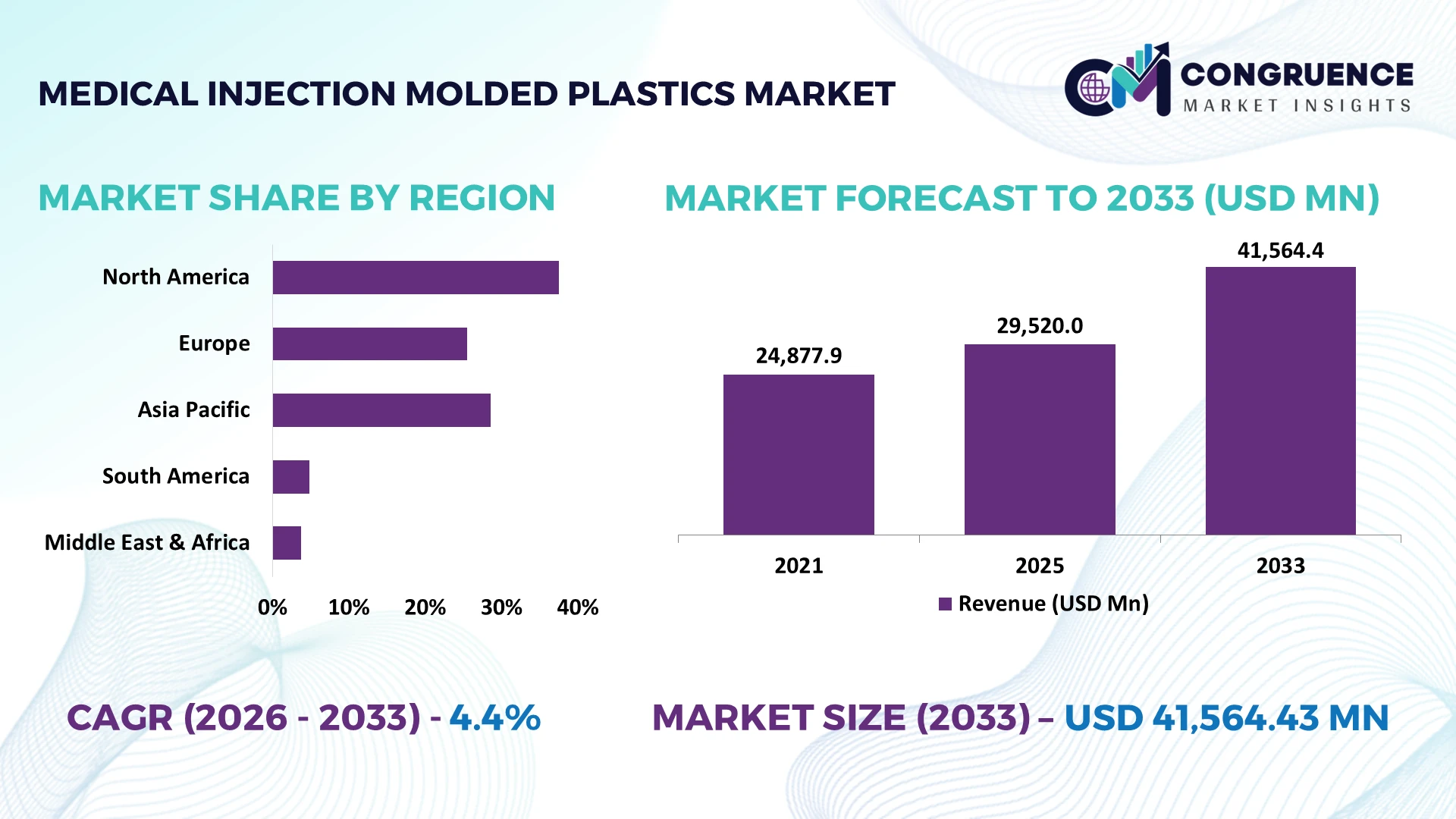
The Global Medical Injection Molded Plastics Market was valued at USD 29,520.0 Million in 2025 and is anticipated to reach a value of USD 41,564.4 Million by 2033 expanding at a CAGR of 4.37% between 2026 and 2033. Increasing production of disposable medical devices, minimally invasive surgical instruments, diagnostic consumables, and precision drug delivery components is accelerating medical-grade plastic injection molding adoption.
The United States leads the market with an estimated 30.5% global share, supported by advanced medical device manufacturing, pharmaceutical packaging, and diagnostic equipment production. Compared with Germany, the U.S. benefits from a larger medical technology manufacturing ecosystem and healthcare expenditure exceeding 17% of GDP. Domestic cleanroom manufacturing investments and supply-chain localization following U.S.–China trade tensions are strengthening production capabilities.
Strategic investments in validated cleanroom infrastructure, automated precision molding, and localized medical-grade polymer supply chains will determine long-term competitive positioning.
Market Size & Growth: USD 29,520.0 Million in 2025, reaching USD 41,564.4 Million by 2033 at 4.37% CAGR, driven by disposable medical devices.
Top Growth Drivers: Disposable medical consumables (40%), precision medical components (35%), and advanced drug delivery systems (25%), based on indicative driver weighting.
Short-Term Forecast: By 2028, advanced automated molding facilities target 15–20% production efficiency improvements.
Emerging Technologies: Three transformative technologies include AI-enabled defect detection, micro-injection molding, and automated multi-material processing.
Regional Leaders: Projected 2033 values include North America (USD 14,963.2 Million; automation), Asia Pacific (USD 13,300.6 Million; capacity expansion), and Europe (USD 9,560.8 Million; precision manufacturing).
Consumer/End-User Trends: Single-use medical components represent an estimated 55% of molded product demand, supporting infection-control protocols.
Pilot/Case Example: A representative 2025 automated molding deployment targets 20% lower rejection rates through integrated machine vision.
Competitive Landscape: Phillips-Medisize holds an indicative 6% share, competing with Jabil, Flex, West Pharmaceutical Services, and Gerresheimer.
Regulatory & ESG Impact: Electric injection molding machines offer potential energy savings of 30–50%, supporting sustainable manufacturing.
Investment & Funding: An illustrative USD 100 Million manufacturing expansion budget prioritizes cleanroom capacity, automation, and precision tooling.
Innovation & Future Outlook: Two strategic priorities include bio-based medical polymers and miniaturized components for connected healthcare devices.
The Medical Injection Molded Plastics Market is increasingly centered on diagnostic cartridges, surgical instruments, implantable components, and wearable drug delivery devices. Advanced micro-molding and multi-component injection technologies enable tighter dimensional tolerances, while electric molding systems offer energy savings exceeding 30% under suitable operating conditions. Medical device traceability requirements are further accelerating validated manufacturing, reshaping strategic investment priorities across the industry.
Medical injection molded plastics are becoming strategically important as healthcare manufacturers prioritize component precision, regulatory compliance, production scalability, and supply-chain resilience. The transition from metal-based assemblies toward lightweight, integrated polymer components is reducing assembly complexity across diagnostic equipment, surgical instruments, and drug delivery systems. Medical device manufacturers are increasingly establishing regional sourcing networks to minimize dependence on geographically concentrated production facilities.
All-electric injection molding machines offer energy consumption reductions of approximately 30–50% compared with conventional hydraulic systems under comparable operating conditions. The United States emphasizes automated cleanroom manufacturing and high-precision components, while China leverages large-scale production infrastructure and competitive tooling capabilities. Between 2026 and 2029, advanced manufacturing facilities are targeting 10–20% reductions in production cycle times through integrated automation and process optimization.
In diagnostic cartridge manufacturing, automated insert molding integrates multiple functional components into a single production sequence, reducing manual assembly and contamination exposure. Companies such as Phillips-Medisize and Gerresheimer are positioning their manufacturing capabilities around integrated device development, precision tooling, and scalable production. Competitive advantage will increasingly depend on combining polymer engineering expertise with validated automation, regional manufacturing flexibility, and early-stage medical device development partnerships.
The transition toward disposable medical devices is accelerating demand for precision injection molded plastics across diagnostic testing, surgical procedures, infusion therapy, and pharmaceutical administration. Single-use products represent an estimated 55% of molded medical component demand, while automated multi-cavity tooling targets productivity improvements of 15–25%. In the United States, infection prevention requirements and expanding outpatient surgical infrastructure are reinforcing consumption of sterile, disposable components. Integrated polymer designs additionally reduce secondary assembly requirements by approximately 10–20% in suitable applications. Manufacturers are responding through cleanroom capacity expansion, high-cavitation tooling investments, and medical device OEM partnerships. The strongest operational advantage lies in producing validated components at scale without proportionately increasing labor and inspection costs.
Medical-grade polymer qualification, specialized tooling, and controlled manufacturing environments create substantial cost pressures for injection molding companies. Under indicative manufacturing cost models, polymer procurement represents approximately 20–30% of production expenditure, while cleanroom operations and quality assurance account for an additional 10–15%. Dependence on specialized polycarbonate, cyclic olefin copolymers, and high-performance engineering resins exposes manufacturers to supply disruptions and material price fluctuations. European manufacturers also face stringent material documentation requirements under the Medical Device Regulation. Switching resin suppliers frequently requires additional validation, restricting procurement flexibility. Companies are mitigating these pressures through dual-source material qualification, long-term procurement agreements, and localized resin sourcing. Supplier qualification flexibility remains essential for protecting margins without compromising product compliance.
Miniaturized diagnostic platforms, wearable drug delivery systems, and minimally invasive surgical instruments are creating opportunities for advanced medical micro-injection molding. Optimized micro-molding processes target material waste reductions of 15–25%, while integrated multi-component designs offer assembly cost savings of approximately 10–20%. Japan and Germany are particularly well positioned through precision tooling expertise and advanced polymer engineering capabilities. Emerging applications in microfluidic diagnostic cartridges and connected drug delivery devices require intricate geometries, consistent surface characteristics, and tightly controlled dimensional tolerances. Manufacturers are expanding research partnerships, investing in specialized micro-molding equipment, and developing application-specific polymer formulations. Early involvement in medical device design creates opportunities to secure long-term manufacturing contracts before commercial-scale production begins.
Maintaining dimensional accuracy, material integrity, and regulatory traceability across high-volume medical injection molding operations presents a significant execution challenge. Advanced facilities target first-pass yields exceeding 99%, while integrated process monitoring systems aim to reduce defect-related losses by 20–30%. The U.S. FDA Quality Management System Regulation, effective February 2026, reinforces alignment with ISO 13485 requirements, increasing the importance of documented process controls. Replicating validated production parameters across geographically distributed facilities remains complex because equipment configurations, tooling conditions, and environmental factors influence component consistency. Manufacturers must invest in digital process monitoring, standardized validation protocols, and specialized workforce training. Long-term competitiveness depends on transferring validated manufacturing processes between facilities without compromising product quality or regulatory compliance.
Closed-Loop Molding Process Control: Manufacturers are integrating cavity pressure sensors, real-time temperature monitoring, and adaptive process controls into medical injection molding workflows. Optimized installations target 15–25% reductions in process variability and 10–20% lower rejection rates. Companies are upgrading existing production lines with sensor-based monitoring to improve batch consistency and reduce dependence on post-production inspection.
Regionalization of Medical Component Supply: Supply-chain disruptions and U.S.–China trade tensions are encouraging medical device manufacturers to establish geographically diversified production networks. Localized sourcing strategies target procurement lead-time reductions of 20–30% and inventory reductions of 10–15%. Contract manufacturers are expanding regional tooling capabilities and establishing redundant production facilities to strengthen supply continuity.
Digital Traceability and Batch Documentation: Electronic batch records, automated material identification, and integrated manufacturing execution systems are replacing manual documentation. Digitized workflows target documentation time reductions of 25–40% and traceability coverage approaching 100%. Manufacturers are integrating production data with quality management platforms, accelerating batch release while strengthening compliance with evolving medical device regulations.
Energy Optimization Across Molding Facilities: Medical plastics processors are replacing conventional hydraulic equipment with servo-electric systems and intelligent cooling infrastructure. All-electric machines offer potential energy savings of 30–50%, while optimized cooling systems target cycle-time reductions of 10–15%. Companies are prioritizing equipment modernization to reduce utility expenditure and improve manufacturing cost predictability.
Polypropylene (PP) leads the Medical Injection Molded Plastics Market with an estimated 32.5% share in 2025, supported by its chemical resistance, lightweight properties, sterilization compatibility, and cost-effective processing. Its extensive utilization in syringes, specimen containers, diagnostic housings, and disposable medical components reinforces demand concentration. Polyethylene (PE) maintains significant adoption across flexible medical components and pharmaceutical containers, while Acrylonitrile Butadiene Styrene (ABS) supports rigid medical equipment housings requiring impact resistance and dimensional stability. Polystyrene (PS) remains relevant across laboratory consumables and diagnostic accessories.
Polycarbonate (PC) is positioned as the fastest-growing type, supported by increasing demand for transparent, impact-resistant medical components and sophisticated diagnostic equipment. Polycarbonate represents an estimated 18.5% market share, while optimized polypropylene processing targets manufacturing cost reductions of 10–15%. Other specialized polymers, including PEEK and cyclic olefin copolymers, address demanding biocompatibility and precision requirements. Companies are expanding medical-grade resin portfolios, developing sterilization-resistant formulations, and partnering with device manufacturers to improve material performance. Investment priorities are shifting toward application-specific polymers that balance regulatory compliance, manufacturing efficiency, and functional durability.
Medical Components dominate the Medical Injection Molded Plastics Market with an estimated 35.5% share in 2025, driven by extensive utilization across syringe assemblies, diagnostic cartridges, infusion systems, connectors, and surgical equipment. Standardized component geometries and high-cavitation tooling support large-scale production while maintaining dimensional consistency. Cleanroom Supplies represent an estimated 21.5% market share, supported by contamination-sensitive manufacturing environments and sterile handling requirements. Mobility Aids sustain consistent demand for lightweight structural housings, ergonomic handles, and durable mechanical components across rehabilitation and assistive healthcare equipment.
Implants are positioned as the fastest-growing application, supported by advances in biocompatible polymers, patient-specific geometries, and polymer-based orthopedic components. Optimized manufacturing workflows target secondary processing reductions of 10–20%, depending on component complexity. Other applications encompass specialized healthcare packaging and ancillary medical products. Manufacturers are expanding controlled production environments, strengthening material qualification capabilities, and developing dedicated tooling for implantable components. Demand is becoming increasingly concentrated around applications requiring validated precision, material traceability, and reliable performance, creating competitive advantages for manufacturers capable of meeting stringent application-specific regulatory requirements.
Medical Device Manufacturers lead the Medical Injection Molded Plastics Market with an estimated 46.5% share in 2025, reflecting extensive procurement of precision-molded components for diagnostic equipment, surgical instruments, drug administration devices, and healthcare monitoring systems. Large-scale production commitments and stringent supplier qualification requirements encourage long-term manufacturing partnerships. Healthcare Providers maintain substantial demand through continuous consumption of disposable medical products, equipment accessories, and patient-care components. Their purchasing decisions increasingly prioritize product reliability, infection prevention, standardized specifications, and uninterrupted supply availability.
Pharmaceutical Companies are positioned as the fastest-growing end-user group, supported by expanding biologic therapies, combination products, and self-administered drug delivery devices. This segment represents an estimated 24.5% market share, while integrated component designs target assembly cost reductions of 10–15%. Research Institutes contribute specialized demand for laboratory consumables, experimental diagnostic platforms, and customized low-volume components. Manufacturers are strengthening pharmaceutical partnerships, expanding design-for-manufacturing services, and establishing flexible production infrastructure for research-intensive customers. Competitive positioning increasingly depends on supporting customers throughout product development, validation, commercial production, and subsequent manufacturing scale-up.
North America accounted for the largest market share at 37.5% in 2025 however, Asia Pacific is expected to register the fastest growth, expanding at a CAGR of 6.2% between 2026 and 2033.
North America accounted for 37.5% of the global Medical Injection Molded Plastics Market in 2025, supported by established medical device manufacturing clusters, advanced pharmaceutical infrastructure, and extensive consumption of disposable healthcare products. Regional manufacturers are prioritizing automated cleanroom facilities, precision tooling, and integrated component assembly to meet stringent quality requirements. The implementation of the FDA Quality Management System Regulation in February 2026 is accelerating the modernization of manufacturing documentation and process validation systems. Optimized all-electric injection molding installations offer potential energy savings of 30–50% compared with conventional hydraulic equipment. Canada contributes through diagnostic equipment and specialized medical technology manufacturing, while Mexico strengthens regional contract manufacturing capabilities through nearshoring initiatives. Established supplier qualification networks and integrated medical device development capabilities reinforce North America's competitive advantage in high-value polymer components.
U.S. Market Outlook: The United States accounted for an estimated 30.5% of the global market in 2025, supported by established medical technology clusters in Minnesota, Massachusetts, and California. Domestic manufacturers are expanding capabilities in diagnostic cartridges, surgical instruments, and pharmaceutical delivery systems. Strong collaboration between medical device OEMs and specialized polymer processors supports early-stage product development, customized tooling, and long-term manufacturing agreements.
Europe accounted for 25.5% of the global Medical Injection Molded Plastics Market in 2025, driven by established medical technology manufacturing, advanced polymer engineering, and stringent product safety standards. Germany, Switzerland, France, and Ireland contribute significantly through diagnostic equipment, pharmaceutical delivery systems, and specialized medical component production. The European Medical Device Regulation and In Vitro Diagnostic Medical Device Regulation are strengthening requirements for material traceability, manufacturing documentation, and supplier qualification. Manufacturers are integrating automated inspection, closed-loop process controls, and digital quality management platforms to improve production consistency. Optimized cooling and tooling configurations target cycle-time reductions of 10–15%, strengthening manufacturing efficiency despite elevated energy and labor costs. Regional companies are also investing in material-efficient processing and integrated component designs, reducing secondary assembly requirements while maintaining compliance with demanding medical specifications.
Germany Market Outlook: Germany's competitive position is supported by advanced injection molding machinery, precision tooling expertise, and established medical device engineering capabilities. Companies such as ARBURG and ENGEL's German operations support the modernization of polymer processing infrastructure. Manufacturing facilities operating under ISO 13485 quality management frameworks and ISO Class 7 or 8 cleanroom conditions strengthen Germany's position in contamination-sensitive medical components and sophisticated diagnostic applications.
Asia Pacific accounted for 28.5% of the global Medical Injection Molded Plastics Market in 2025, supported by expanding healthcare manufacturing infrastructure, competitive polymer processing capabilities, and growing domestic medical device production. China, Japan, India, and South Korea are strengthening regional supply networks through investments in precision tooling, automated molding equipment, and medical-grade material processing. India's Production Linked Incentive scheme for medical devices carries an approved financial outlay of INR 3,420 crore, supporting domestic manufacturing development. Japan contributes advanced micro-molding technologies, while South Korea benefits from integrated electronics and diagnostic equipment manufacturing capabilities. Regional manufacturers are transitioning from standardized disposable products toward higher-value diagnostic components and sophisticated drug delivery systems. Expanding technical capabilities and localized supplier ecosystems are strengthening Asia Pacific's position as both a manufacturing destination and an independent medical technology market.
China Market Outlook: China benefits from integrated polymer supply chains, extensive injection molding infrastructure, and established medical device manufacturing clusters in Guangdong, Jiangsu, and Zhejiang. The country's volume-based procurement initiatives have generated price reductions exceeding 80% for certain medical consumable categories, intensifying pressure on component manufacturing costs. Domestic processors are responding through high-cavitation tooling, automated material handling, and vertically integrated production strategies.
South America accounted for 4.8% of the global Medical Injection Molded Plastics Market in 2025, supported by expanding healthcare infrastructure, domestic pharmaceutical manufacturing, and increasing procurement of disposable medical products. Brazil and Argentina represent important manufacturing centers for syringes, diagnostic consumables, medical packaging, and patient-care equipment. Regional manufacturers are investing in localized component production to reduce exposure to imported finished products, currency fluctuations, and extended international procurement cycles. Brazil's New Industry Brazil industrial policy targets domestic production of 70% of national healthcare requirements by 2033, creating opportunities for medical-grade polymer processors. However, dependence on imported specialized resins, precision tooling, and advanced molding machinery continues to constrain manufacturing flexibility. Companies are prioritizing regional distribution partnerships, standardized component designs, and selective automation investments to improve production economics while addressing infrastructure and financing limitations.
Brazil Market Outlook: Brazil leads regional demand through its established pharmaceutical manufacturing sector, extensive hospital network, and domestic medical device industry. The country's Unified Health System provides healthcare coverage to a population exceeding 200 million, supporting sustained procurement of diagnostic and disposable medical products. Local manufacturers are strengthening relationships with healthcare distributors and expanding ANVISA-compliant production capabilities to improve domestic supply reliability.
Middle East & Africa accounted for 3.7% of the global Medical Injection Molded Plastics Market in 2025, supported by healthcare infrastructure modernization, pharmaceutical manufacturing investments, and increasing demand for diagnostic and disposable medical components. Saudi Arabia, the United Arab Emirates, and South Africa are developing domestic manufacturing ecosystems to reduce dependence on imported healthcare products. Saudi Arabia's healthcare transformation strategy targets increasing private-sector participation in healthcare provision to 65% by 2030, supporting opportunities for medical equipment suppliers and localized manufacturing partnerships. Established petrochemical infrastructure across Gulf countries provides access to polymer feedstocks, although medical-grade resin qualification and specialized tooling capabilities remain comparatively limited. Companies are pursuing technology transfer agreements, regional distribution partnerships, and selective cleanroom manufacturing investments to strengthen supply continuity and address growing institutional procurement requirements.
Saudi Arabia Market Outlook: Saudi Arabia is strengthening domestic medical manufacturing through Vision 2030, industrial localization programs, and government procurement initiatives. The country's National Biotechnology Strategy targets establishing Saudi Arabia as a regional biotechnology hub by 2030, supporting pharmaceutical production and advanced healthcare technologies. Investments in specialized industrial zones and medical manufacturing partnerships are creating opportunities for precision-molded diagnostic components, pharmaceutical packaging, and disposable healthcare products.
Phillips-Medisize, Jabil, Flex, West Pharmaceutical Services, and Gerresheimer compete through integrated medical component manufacturing, precision tooling, and validated production infrastructure, while specialized regional molders challenge established suppliers through customization and competitive pricing. The market remains fragmented, with the top five players collectively holding an estimated 25.5% share. Automated molding systems target production efficiency improvements of 15–25%, while integrated component designs reduce secondary assembly costs by approximately 10–20%. Phillips-Medisize and Jabil emphasize integrated product development and scalable contract manufacturing, whereas West Pharmaceutical Services and Gerresheimer strengthen pharmaceutical packaging and drug delivery capabilities. Flex leverages diversified manufacturing infrastructure and established healthcare OEM relationships. Competition is shifting toward vertically integrated production, regional supply networks, and digitally validated manufacturing processes. Stringent material qualification requirements, cleanroom investments, and lengthy customer approval cycles restrict market entry. Winning requires combining precision polymer engineering, regulatory expertise, automated manufacturing, and reliable supply commitments with cost-efficient, scalable, and application-specific production capabilities.
Phillips-Medisize
Jabil Inc.
Flex Ltd.
West Pharmaceutical Services, Inc.
Gerresheimer AG
Nypro Healthcare alternatives: Nolato AB
TE Connectivity plc
Freudenberg Medical
Röchling Medical
GW Plastics alternatives: Tessy Plastics Corp.
Technimark LLC
Sanner Group
Spectrum Plastics Group
MedPlast successor: Viant Medical
All-electric injection molding, automated material handling, and closed-loop process control are transforming medical polymer manufacturing. Compared with conventional hydraulic machines, all-electric systems offer potential energy savings of 30–50%, while optimized multi-cavity tooling targets productivity improvements of 15–25%. Commercial deployment is established across advanced cleanroom facilities manufacturing diagnostic consumables, surgical components, and pharmaceutical delivery devices. Integrated sensor networks enable continuous monitoring of cavity pressure, temperature, and dimensional consistency.
Emerging technologies include artificial intelligence-based visual inspection, digital twins, and advanced micro-injection molding. Automated inspection systems target defect-related losses reductions of 20–30%, while simulation-driven tooling development aims to shorten qualification timelines by 15–20%. Early commercial deployments concentrate on complex medical components requiring stringent tolerances and documented manufacturing consistency. Integrated manufacturing execution systems strengthen electronic batch traceability, accelerating quality verification and supporting regulatory compliance across geographically distributed facilities.
Between 2026 and 2028, multi-material molding, robotic insert molding, and advanced polymer formulations will increasingly influence manufacturing investment decisions. Integrated component designs target assembly cost reductions of 10–20%, supporting competitive advantages for manufacturers serving pharmaceutical and medical device OEMs. Established contract manufacturers benefit from combining validated automation with application-specific engineering capabilities. Early technology investment strengthens supplier qualification, reduces operational variability, and improves scalability across increasingly sophisticated medical manufacturing programs.
November 2026, Phillips-Medisize announced the acquisition of its complete 58,963-square-meter Chippenham facility in the United Kingdom, strengthening its Global Inhalation Center of Excellence. The acquisition expands capacity for combination product development, clinical manufacturing, and industrial scale-up of advanced pulmonary drug delivery devices. Source: phillipsmedisize.com
October 2025, Freudenberg Medical announced plans to consolidate its California thermoplastic and silicone manufacturing operations at Baldwin Park by June 2026. The unified facility incorporates two-shot molding, advanced micro-molding, and AI-enabled factory planning, strengthening engineering collaboration and improving medical component manufacturing scalability. Source: freudenbergmedical.com
July 2025, Gerresheimer confirmed production ramp-up at its Peachtree manufacturing facility, involving an 18,000-square-meter expansion across two stages. The investment targets tripling output by 2028, strengthening precision plastic injection molding and automated assembly capabilities for inhalers, autoinjectors, and other medical devices. Source: gerresheimer.com
June 2025, Sanner commenced manufacturing operations at its 60,500-square-foot Greensboro facility in North Carolina, establishing its first North American injection molding and pharmaceutical desiccant packaging site. The facility strengthens localized procurement, customer responsiveness, and scalable production of critical components for medical devices. Source: sanner-group.com
The Medical Injection Molded Plastics Market Report examines market segmentation by type, application, and end-user, covering polypropylene, polyethylene, polycarbonate, acrylonitrile butadiene styrene, polystyrene, and other specialized polymers. Application coverage includes medical components, cleanroom supplies, mobility aids, implants, and other healthcare products. End-user analysis encompasses medical device manufacturers, pharmaceutical companies, healthcare providers, and research institutes. The report evaluates five major geographical regions: North America, Europe, Asia Pacific, South America, and Middle East & Africa.
The study assesses advanced injection molding technologies, automated cleanroom manufacturing, micro-molding, multi-material processing, and digital quality management systems. It examines segment distribution, competitive concentration, regulatory requirements, manufacturing localization, and emerging opportunities across diagnostic cartridges, implantable components, and drug delivery devices. Forecast analysis between 2026 and 2033 supports investment planning, capacity expansion, technology selection, supplier partnerships, and strategic competitive positioning.
| Report Attribute / Metric | Details |
|---|---|
| Market Revenue (2025) | USD 29,520.0 Million |
| Market Revenue (2033) | USD 41,564.4 Million |
| CAGR (2026–2033) | 4.37% |
| Base Year | 2025 |
| Forecast Period | 2026–2033 |
| Historic Period | 2021–2025 |
| Segments Covered |
By Type
By Application
By End-User
|
| Key Report Deliverables | Revenue Forecast; Market Trends; Growth Drivers & Restraints; Technology Insights; Segmentation Analysis; Regional Insights; Competitive Landscape; Regulatory & ESG Overview; Recent Developments |
| Regions Covered | North America; Europe; Asia-Pacific; South America; Middle East & Africa |
| Key Players Analyzed | Phillips-Medisize; Jabil Inc.; Flex Ltd.; West Pharmaceutical Services, Inc.; Gerresheimer AG; Nypro Healthcare alternatives: Nolato AB; TE Connectivity plc; Freudenberg Medical; Röchling Medical; GW Plastics alternatives: Tessy Plastics Corp.; Technimark LLC; Sanner Group; Spectrum Plastics Group; MedPlast successor: Viant Medical |
| Customization & Pricing | Available on Request (10% Customization Free) |




