
Reports
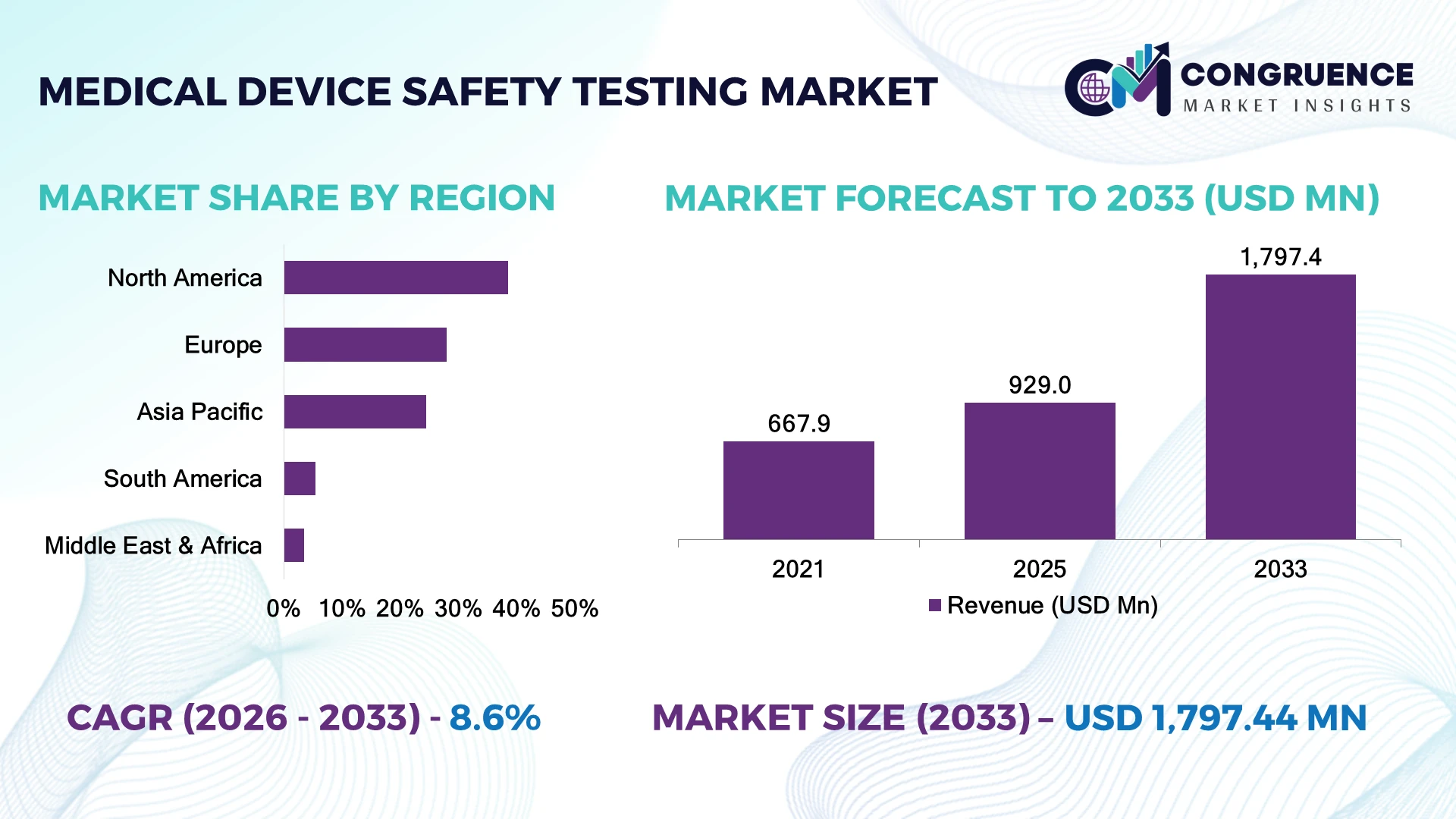
The Global Medical Device Safety Testing Market was valued at USD 929.0 Million in 2025 and is anticipated to reach a value of USD 1,797.4 Million by 2033 expanding at a CAGR of 8.6% between 2026 and 2033. Growth is being driven by tighter premarket validation requirements, rising software-enabled medical devices, and accelerated adoption of biocompatibility, electrical safety, and cybersecurity testing protocols across regulated healthcare markets.
The United States remains the dominant country, accounting for approximately 34% of global medical device safety testing activity, supported by over USD 7 billion in annual medical device R&D expenditure and a medical technology manufacturing base exceeding 8,000 companies. Compared with Germany, where advanced conformity assessment infrastructure supports nearly 12% of European testing demand, U.S. laboratories process significantly higher volumes of electrical and software verification projects. Increased adoption of AI-enabled diagnostics, with digital health integration exceeding 40% among newly launched device categories, further strengthens testing requirements. The continuing emphasis on healthcare supply-chain resilience following post-pandemic regulatory reforms reinforces market leadership.
Strategic implication companies with scalable validation capabilities, cybersecurity expertise, and regulatory readiness gain stronger access to high-value commercialization pathways.
Market Size & Growth: USD 929.0 Million in 2025 reaching USD 1,797.4 Million by 2033; expansion supported by software-driven device validation and stricter compliance frameworks.
Top Growth Drivers: Cybersecurity testing demand +32%, connected medical devices +28%, biocompatibility assessments +24%.
Short-Term Forecast: By 2028, automated testing workflows improve laboratory throughput by nearly 25% while reducing validation cycles by 18%.
Emerging Technologies: AI-assisted validation, automated risk assessment platforms, and digital twin simulations improve testing precision by over 20%.
Regional Leaders: North America (~USD 560 Million by 2033), Europe (~USD 470 Million), Asia-Pacific (~USD 430 Million); each driven by digital device adoption and regulatory modernization.
Consumer/End-User Trends: More than 45% of newly developed devices incorporate software functions requiring expanded verification protocols.
Pilot/Case Example: In 2024, automated verification deployment reduced testing turnaround times by approximately 22% across selected medical technology facilities.
Competitive Landscape: Leading providers hold nearly 18% combined share; key participants include TÜV SÜD, Eurofins Scientific, SGS, Intertek, and UL Solutions.
Regulatory & ESG Impact: Enhanced compliance frameworks improved traceability metrics by nearly 30% while strengthening product safety documentation.
Investment & Funding: More than USD 1.2 Billion has been directed toward laboratory expansion, automation, and specialized testing infrastructure.
Innovation & Future Outlook: AI-enabled compliance analytics and cybersecurity validation platforms are reshaping advanced global testing ecosystems.
Medical device safety testing is increasingly focused on connected healthcare equipment, implantable technologies, diagnostic imaging systems, and software-based medical platforms. Automated validation tools and AI-assisted risk assessment solutions are improving testing efficiency by approximately 20%. Growing cybersecurity compliance requirements and supply-chain qualification programs are creating new demand streams, particularly as manufacturers accelerate digital device launches and regulatory scrutiny intensifies worldwide, setting the stage for broader strategic transformation.
Medical device safety testing has become strategically critical as healthcare systems deploy increasingly complex connected devices, software-enabled diagnostics, and implantable technologies. Regulatory authorities are strengthening verification requirements, while manufacturers face growing pressure to shorten commercialization timelines without compromising compliance. Digital health adoption and cybersecurity oversight are reshaping competitive dynamics, making testing capabilities a core differentiator rather than a procedural requirement.
Technology modernization is materially changing operational performance. AI-assisted testing platforms can reduce validation cycle times by approximately 20% compared with conventional manual workflows while improving defect detection consistency. The United States leads large-scale deployment through extensive laboratory infrastructure and digital health innovation, whereas countries such as Singapore and South Korea are accelerating adoption through advanced regulatory frameworks and smart healthcare initiatives. Over 40% of newly launched medical device categories now incorporate software components requiring expanded verification procedures.
A practical example is the deployment of automated compliance management systems that integrate risk assessment, documentation, and performance testing into unified workflows. Companies are expanding specialized laboratories, forming regulatory partnerships, and investing in cybersecurity validation capabilities. Over the next two to three years, increased automation and digital compliance integration will strengthen operational efficiency, positioning testing providers with advanced technical expertise as preferred partners across the global medical technology value chain.
The rapid proliferation of connected and software-driven medical devices is increasing the scope and complexity of safety validation requirements. More than 45% of newly introduced medical devices now contain embedded software functions, while cybersecurity-related assessments have risen by nearly 30% over the past three years. Regulatory agencies in the United States and Japan are requiring expanded verification of device interoperability, software reliability, and cyber resilience. This shift directly increases demand for specialized laboratories capable of conducting integrated performance, electrical safety, and cybersecurity testing. In response, leading testing providers are expanding accredited facilities, investing in automated validation platforms, and establishing partnerships with medical technology developers. A key strategic insight is that software assurance capabilities are becoming as important as traditional physical safety testing in competitive procurement decisions.
Increasing regulatory fragmentation creates significant operational pressure for device manufacturers and testing providers. Compliance requirements can vary by more than 25% across major jurisdictions, while documentation workloads have increased by approximately 20% for advanced medical technologies. Manufacturers exporting from China, India, and other production hubs frequently encounter duplicative testing and certification requirements, extending approval timelines. The resulting compliance burden affects deployment schedules, resource allocation, and profitability. To mitigate these constraints, companies are diversifying certification pathways, strengthening regulatory affairs capabilities, and localizing testing operations near key manufacturing clusters. A notable operational insight is that organizations with multi-market certification expertise can reduce approval bottlenecks and improve commercialization efficiency despite growing regulatory complexity.
Artificial intelligence and advanced automation technologies are creating new value opportunities across medical device safety testing workflows. AI-assisted validation systems can improve anomaly detection rates by over 20%, while automated documentation platforms reduce administrative effort by approximately 30%. Countries such as South Korea and Singapore are encouraging digital compliance initiatives that support faster verification and traceability processes. Emerging digital twin technologies also enable virtual performance assessments before physical testing begins, improving resource utilization. Testing providers are responding through targeted R&D investments, software partnerships, and integrated compliance ecosystems. A less obvious opportunity lies in predictive testing analytics, which can identify potential failure patterns earlier and reduce downstream remediation costs for manufacturers launching complex healthcare technologies.
As medical devices incorporate artificial intelligence, cloud connectivity, and cybersecurity functions, testing environments are becoming significantly more complex. Specialized engineering roles have experienced vacancy rates exceeding 15% in several advanced healthcare technology markets, while validation requirements for connected devices have expanded by nearly 25%. Integrating software, hardware, cybersecurity, and regulatory assessment within unified testing frameworks remains a major execution challenge. Laboratories must continuously upgrade technical capabilities and infrastructure to maintain accreditation standards. Companies are addressing these issues through workforce development programs, university collaborations, and investment in digital testing environments. A critical strategic challenge is maintaining consistent testing quality across increasingly sophisticated technologies while ensuring scalability and long-term competitiveness in a rapidly evolving regulatory landscape.
AI-Driven Validation Workflows Testing laboratories are rapidly integrating AI-assisted validation platforms, with automated test execution increasing by nearly 28% and defect identification accuracy improving by 22%. U.S.-based device manufacturers are deploying machine-learning tools to accelerate software verification and documentation review. This operational shift reduces manual intervention, shortens approval cycles, and improves resource utilization. Companies are scaling digital testing infrastructure and partnering with compliance software providers to standardize high-volume validation processes.
Cybersecurity Testing Expansion Connected medical devices have increased cybersecurity assessment requirements by approximately 30%, while software-enabled device submissions now represent more than 45% of new product evaluations. New security-focused regulatory expectations are pushing manufacturers to embed penetration testing and vulnerability assessments earlier in development workflows. The result is stronger product resilience and reduced remediation costs. Testing providers are expanding specialized cyber laboratories and restructuring service portfolios around secure-device certification programs.
Laboratory Automation Acceleration Automated testing equipment deployment has risen by 25%, while sample processing efficiency has improved by nearly 18% across advanced testing facilities. Persistent technical labor shortages and rising validation volumes are driving workflow modernization. Automated electrical safety, biocompatibility, and performance testing platforms are increasing throughput while improving consistency. Companies are investing in robotics-enabled laboratories and centralized testing hubs to optimize operational capacity and reduce turnaround times.
Supply-Chain Qualification Focus Supplier qualification assessments have expanded by 20%, and component traceability requirements have strengthened by nearly 27% as manufacturers seek greater supply-chain visibility. Device producers are conducting broader material verification and reliability testing to reduce disruption risks. A notable shift is the growing use of continuous supplier-monitoring frameworks. Companies are strengthening partnerships with testing organizations and implementing digital traceability systems to improve compliance and procurement resilience.
Biocompatibility Testing remains the leading segment, accounting for approximately 34% of global demand due to its mandatory role in evaluating material interactions with human tissue and ensuring regulatory compliance for implantable and patient-contact devices. Its dominance is supported by broad applicability across cardiovascular, orthopedic, and diagnostic product categories. Electrical Safety Testing follows as a mature segment, representing nearly 24% of testing activity because of increasing adoption of powered and connected medical equipment. Sterility Testing continues to hold strategic relevance as healthcare providers emphasize infection prevention and product reliability across critical care environments.
Cybersecurity Testing is the fastest-growing segment as software-enabled and connected devices become central to healthcare delivery. Testing volumes in this category have expanded by more than 30% in recent years. Performance Testing and Chemical Characterization Testing are also gaining importance as manufacturers accelerate innovation cycles and shorten product development timelines. Companies are expanding specialized laboratories, investing in automation platforms, and developing integrated validation services to capture demand from increasingly complex device ecosystems. Investment priorities are steadily shifting toward software assurance, risk management, and multidisciplinary compliance capabilities.
Premarket Approval Testing leads the market with an estimated 41% share, reflecting stringent validation requirements before commercialization. Manufacturers prioritize this application because regulatory agencies increasingly require comprehensive evidence covering safety, functionality, biocompatibility, and software reliability. Demand remains concentrated within implantable devices, diagnostic equipment, and digitally connected healthcare technologies. Design Verification & Validation represents another significant application area, supporting product performance optimization and compliance readiness before large-scale deployment.
Post-Market Surveillance Testing is emerging as the fastest-growing application segment as manufacturers expand monitoring programs to address device performance, cybersecurity vulnerabilities, and field reliability concerns. Activity levels have increased by nearly 26%, driven by stricter oversight and lifecycle management requirements. Failure Analysis and Product Certification Testing continue to gain importance as enterprises seek faster root-cause identification and streamlined market access. Companies are responding by integrating automated reporting tools, expanding monitoring infrastructure, and deploying digital compliance platforms. Demand is increasingly shifting from one-time validation activities toward continuous product assurance frameworks that support long-term operational performance.
Medical Device Manufacturers represent the largest end-user segment, accounting for approximately 52% of overall demand. Their leadership stems from continuous product development cycles, extensive regulatory obligations, and the need for comprehensive verification before commercialization. Large manufacturers operate complex global product portfolios that require ongoing testing for software, hardware, biocompatibility, and performance compliance. Contract Testing Organizations also maintain a substantial position by providing scalable expertise and specialized laboratory infrastructure that supports outsourced validation strategies.
Contract Testing Organizations are among the fastest-expanding end-user groups as outsourcing activity rises and manufacturers seek operational flexibility. Outsourced testing volumes have increased by nearly 24%, driven by growing product complexity and specialized compliance requirements. Regulatory Agencies and Healthcare Institutions continue to play important supporting roles through surveillance programs, procurement standards, and performance verification initiatives. Companies are targeting these segments through customized service offerings, long-term testing agreements, and integrated compliance ecosystems. Future demand is increasingly shifting toward specialized external testing partners capable of delivering multidisciplinary expertise and faster validation turnaround.
North America accounted for the largest market share at 38.5% in 2025 however, Asia-Pacific is expected to register the fastest growth, expanding at a CAGR of 10.1% between 2026 and 2033.
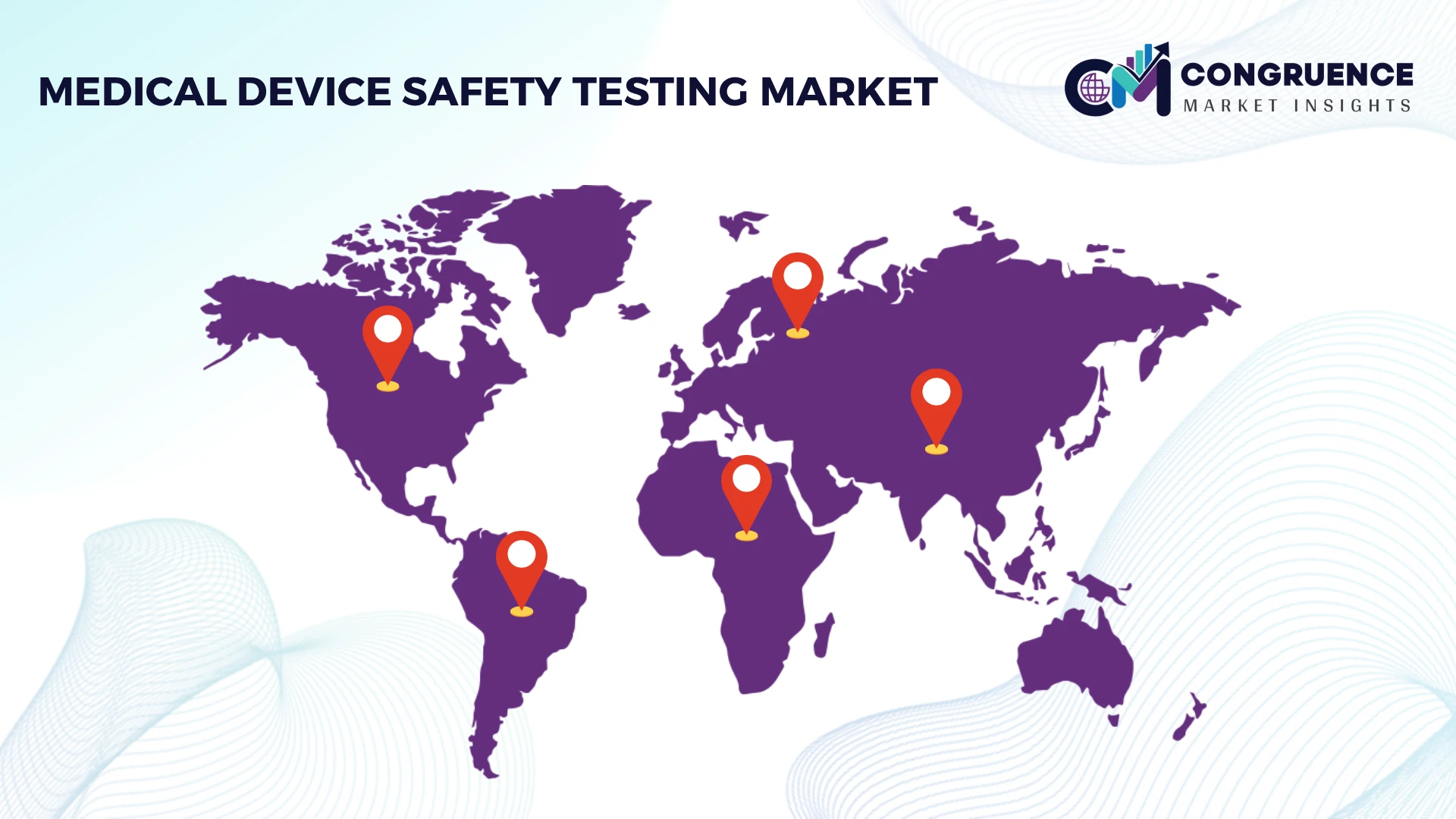
North America remains the largest market for medical device safety testing, supported by a dense concentration of medical technology manufacturers, accredited testing laboratories, and advanced regulatory infrastructure. The region contributes approximately 38.5% of global testing activity, with strong demand for biocompatibility, electrical safety, software validation, and cybersecurity assessments. Increasing deployment of connected medical devices has accelerated the need for integrated testing protocols covering both physical and digital performance requirements. Laboratory automation adoption has exceeded 25% across major testing facilities, improving throughput and reducing validation timelines. Strategic partnerships between device manufacturers and specialized testing providers are expanding service capacity, while investments in cybersecurity verification capabilities continue to strengthen market competitiveness. The region also benefits from extensive R&D activity and a mature healthcare technology ecosystem that supports continuous innovation and compliance readiness.
United States Market Outlook: The United States serves as the operational center of the regional market due to its large medical technology manufacturing base, advanced testing infrastructure, and rigorous regulatory framework. More than 8,000 medical device companies operate across the country, generating substantial demand for validation services. Growing deployment of software-enabled healthcare technologies has increased cybersecurity testing requirements, while laboratory modernization initiatives continue to enhance testing efficiency. Strong collaboration among manufacturers, research institutions, and compliance specialists reinforces the country's leadership position.
Europe represents a highly structured market characterized by stringent compliance requirements, established medical technology manufacturing clusters, and strong conformity assessment infrastructure. The region accounts for approximately 28.0% of global demand, supported by widespread adoption of advanced testing protocols across implantable devices, diagnostics, and digital health systems. Enhanced regulatory oversight has increased documentation and verification requirements, leading to broader demand for performance testing and risk assessment services. Laboratory digitization initiatives have improved operational efficiency by nearly 18% across several leading testing organizations. Companies are expanding specialized testing capabilities and investing in automated compliance workflows to manage increasing validation volumes. The combination of mature healthcare infrastructure and strong regulatory consistency continues to support high-value testing activity throughout the region.
Germany Market Outlook: Germany remains the most strategically important country in Europe due to its strong medical engineering sector, extensive manufacturing capacity, and advanced certification ecosystem. The country hosts a significant share of European medical device production and maintains a highly developed network of testing and inspection organizations. Adoption of automated validation systems has accelerated across major facilities, improving workflow efficiency and compliance management. Strong industrial collaboration and engineering expertise continue to strengthen Germany's role in advanced safety testing services.
Asia-Pacific is emerging as the fastest-evolving market, supported by expanding medical device manufacturing, increasing healthcare investment, and strengthening regulatory frameworks. The region accounts for approximately 24.5% of global market activity and continues to attract testing infrastructure expansion across major production hubs. Rising exports of medical devices from countries such as China, Japan, South Korea, and India are increasing demand for international compliance verification. Testing capacity expansion projects have increased by more than 20% in several key markets, improving local certification capabilities. Companies are establishing regional laboratories, strengthening technical partnerships, and deploying automated testing platforms to support growing validation requirements. The region’s combination of manufacturing scale and regulatory advancement is creating a more sophisticated testing ecosystem.
China Market Outlook: China leads regional market activity through its extensive medical device manufacturing network and rapidly expanding quality assurance infrastructure. The country continues to increase investments in testing laboratories and regulatory modernization initiatives aimed at improving global market access. Domestic manufacturers are placing greater emphasis on product quality, software validation, and international certification standards. Growing exports and increasing adoption of advanced healthcare technologies are generating sustained demand for specialized testing services across multiple device categories.
South America is experiencing steady market development as healthcare providers, manufacturers, and regulatory authorities place greater emphasis on product quality and patient safety. The region contributes approximately 5.5% of global demand and is increasingly investing in testing infrastructure to support domestic production and imported device verification. Growing adoption of diagnostic equipment and connected healthcare technologies is expanding testing requirements beyond traditional compliance categories. Several testing organizations have expanded laboratory capabilities and regional partnerships to improve certification accessibility. Infrastructure limitations and uneven regulatory maturity remain challenges; however, modernization initiatives continue to strengthen operational capacity. Demand is becoming increasingly concentrated around internationally recognized testing standards and risk-management practices.
Brazil Market Outlook: Brazil represents the largest medical device market in South America and serves as the primary center for testing and certification activities. The country benefits from a sizeable healthcare sector, expanding domestic manufacturing capabilities, and ongoing regulatory modernization efforts. Increased deployment of diagnostic systems and hospital technologies is generating additional demand for electrical safety and performance validation services. Continued investment in healthcare infrastructure and compliance frameworks supports Brazil’s leading role within the regional testing ecosystem.
The Middle East & Africa market is advancing through healthcare modernization programs, expanding hospital infrastructure, and increased focus on medical technology quality assurance. The region accounts for approximately 3.5% of global testing demand, with activity concentrated in countries investing heavily in healthcare transformation initiatives. Adoption of advanced medical equipment and digital healthcare systems is increasing the need for performance, electrical safety, and cybersecurity testing services. Several healthcare investment programs have accelerated deployment of new medical technologies, creating additional validation requirements. International testing partnerships and laboratory development projects are strengthening technical capabilities while improving compliance readiness. The market remains relatively fragmented but is gradually building a stronger testing and certification ecosystem.
Saudi Arabia Market Outlook: Saudi Arabia is the most influential market within the region due to its extensive healthcare infrastructure investments, technology modernization programs, and growing focus on regulatory quality standards. Large-scale hospital expansion projects and digital healthcare deployments are increasing demand for advanced testing services. The country continues to strengthen medical technology oversight while encouraging adoption of internationally aligned compliance practices. Expanding healthcare procurement activity and modernization initiatives position Saudi Arabia as a key center for future testing and certification development.
The Medical Device Safety Testing market is led by global assurance and testing specialists including TÜV SÜD, Eurofins Scientific, Intertek, UL Solutions, and SGS. Competition is primarily between global certification leaders and specialized regional laboratories seeking faster turnaround and localized regulatory expertise. The top five players collectively control approximately 42% of market activity. Competitive differentiation is driven by technical capability, accreditation breadth, and validation speed rather than pricing alone. Automated testing platforms improve laboratory throughput by nearly 25%, while integrated digital compliance systems reduce documentation workloads by approximately 20%. Companies are expanding laboratory networks, acquiring niche testing capabilities, and forming regulatory partnerships to strengthen market access. The competitive landscape is shifting toward cybersecurity validation and software assurance services. Regulatory accreditation remains the primary entry barrier. Winning requires advanced technical expertise, global certification coverage, automation-driven efficiency, and strong regulatory credibility.
Eurofins Scientific
Intertek
UL Solutions
SGS
Bureau Veritas
DEKRA
TÜV Rheinland
Element Materials Technology
Nelson Laboratories
NAMSA
QIMA
Charles River Laboratories
WuXi AppTec Testing Division
Medical device safety testing is undergoing a technology transition from conventional manual validation toward automated, data-driven verification environments. AI-assisted testing platforms are improving defect detection accuracy by approximately 22% while reducing review workloads by nearly 18%. Automated documentation and compliance management tools have achieved adoption rates exceeding 35% among advanced testing facilities. These technologies enable faster regulatory preparation, improved traceability, and stronger operational consistency. Organizations with high testing volumes benefit most through reduced cycle times and improved resource utilization.
Emerging technologies include digital twins, predictive failure analytics, cybersecurity simulation environments, and cloud-based validation platforms. Digital twin deployment can reduce prototype testing requirements by nearly 15%, while predictive analytics improves early-stage risk identification by approximately 20%. Compared with traditional validation workflows, AI-enabled testing environments deliver roughly 25% faster execution and more consistent reporting outputs. Large certification organizations and multinational medical device manufacturers are leading adoption due to their need for scalable compliance infrastructure and global regulatory coordination.
Between 2026 and 2028, integrated software assurance, cybersecurity validation, and real-time compliance analytics will become core testing requirements. Adoption of connected testing ecosystems is expected to exceed 45% across advanced laboratories. Companies investing early in automation, AI-driven verification, and digital compliance frameworks will secure stronger operational efficiency, faster certification delivery, and a durable competitive advantage as device complexity continues to increase.
March 2025 – TÜV SÜD expanded its Frankfurt testing laboratory, increasing advanced testing capacity and strengthening electrical and mechanical safety assessment capabilities. The site has grown to nearly 100 employees, enabling higher throughput, broader certification coverage, and improved customer access to specialized validation services. Source: TÜV SÜD
July 2025 – Intertek expanded its EU MDR Medical Notified Body designation by adding 16 new MDR codes, significantly broadening certification coverage across multiple device categories. The expansion improves manufacturer access to regulatory assessments and strengthens Intertek’s competitive position in European medical device compliance services. Source: Intertek
March 2025 – UL Solutions opened an expanded 36,000-square-foot Songshan Lake IoT Laboratory in China. The facility substantially increases testing capabilities for connected and wireless technologies, supporting growing validation requirements for medical and smart devices while enhancing market-access services for manufacturers. Source: UL Solutions
September 2024 – Eurofins Scientific completed the acquisition of Infinity Laboratories, adding eight laboratories and approximately 100 employees to its testing network. The move strengthens microbiology, sterilization, package testing, and medical device testing capabilities while expanding operational reach across the United States. Source: Eurofins Scientific
This report provides comprehensive analysis of the Medical Device Safety Testing market across major testing types, applications, end-user groups, and regional markets. Coverage includes biocompatibility testing, electrical safety testing, sterility testing, cybersecurity testing, performance testing, and related validation services. The assessment examines demand distribution, deployment patterns, laboratory modernization trends, software-enabled testing adoption, and evolving regulatory requirements influencing market development. Regional analysis spans North America, Europe, Asia-Pacific, South America, and the Middle East & Africa, highlighting operational dynamics, infrastructure development, and competitive positioning.
The report evaluates strategic developments across manufacturers, testing laboratories, certification organizations, and healthcare technology stakeholders. More than 45% of newly introduced device categories now involve software-related verification requirements, making digital validation and cybersecurity assessment increasingly important. The study supports investment planning, expansion strategy, partnership evaluation, competitive benchmarking, and technology adoption decisions. It also identifies emerging opportunities in automated testing, AI-enabled compliance workflows, connected device validation, and advanced regulatory assurance initiatives expected to influence market direction between 2026 and 2033.
| Report Attribute / Metric | Details |
|---|---|
| Market Revenue (2025) | USD 929.0 Million |
| Market Revenue (2033) | USD 1,797.4 Million |
| CAGR (2026–2033) | 8.6% |
| Base Year | 2025 |
| Forecast Period | 2026–2033 |
| Historic Period | 2021–2025 |
| Segments Covered |
By Type
By Application
By End-User
|
| Key Deliverables | Revenue Forecast; Market Trends; Growth Drivers & Restraints; Technology Insights; Segmentation Analysis; Regional Insights; Competitive Landscape; Regulatory & ESG Overview; Recent Developments |
| Regions Covered | North America; Europe; Asia-Pacific; South America; Middle East & Africa |
| Companies Profiled | TÜV SÜD; Eurofins Scientific; Intertek; UL Solutions; SGS; Bureau Veritas; DEKRA; TÜV Rheinland; Element Materials Technology; Nelson Laboratories; NAMSA; QIMA; Charles River Laboratories; WuXi AppTec Testing Division |
| Customization & Pricing | Available on Request (10% Customization Free) |




