
Reports
The Global Medical Courier Service Market was valued at USD 7,198.4 Million in 2025 and is anticipated to reach a value of USD 11,473.2 Million by 2033 expanding at a CAGR of 6.0% between 2026 and 2033. Growth is driven by expanding temperature-controlled specimen logistics, decentralized clinical trials, specialty-pharma distribution, and tighter delivery requirements for biologics, diagnostics, and time-sensitive healthcare materials.
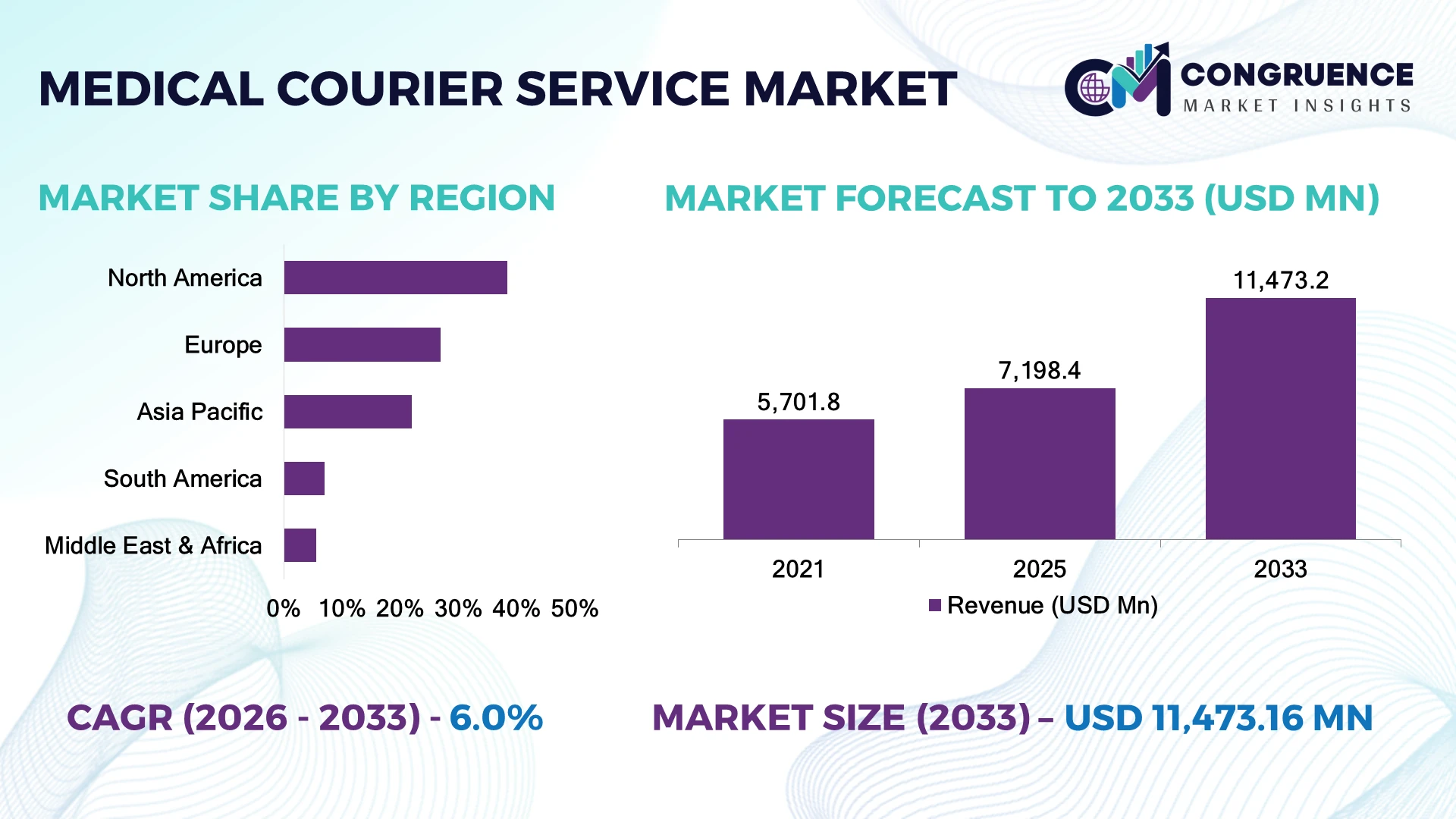
The U.S. represents approximately 34% of global medical courier activity, supported by extensive clinical-trial networks, hospital systems, specialty pharmacies, and laboratory outsourcing, while China accounts for roughly 16% with rapid cold-chain expansion across pharmaceutical manufacturing and diagnostics. U.S. operators are deploying GPS, IoT temperature monitoring, and automated dispatch across more than 60% of specialized routes, while Asia-Pacific investment increasingly targets validated cold-chain infrastructure.
The strategic priority is to combine validated temperature control, regulatory compliance, route intelligence, and rapid-response capacity to secure high-value healthcare logistics contracts.
Market Size & Growth: USD 7,198.4 million in 2025 to USD 11,473.2 million by 2033 at 6.0% CAGR, driven by specialty pharmaceuticals and time-critical diagnostics.
Top Growth Drivers: Clinical trials 8–10%, specialty-pharma distribution 7–9%, and diagnostic specimen volumes 6–8% annually.
Short-Term Forecast: By 2028, automated dispatch and dynamic routing reduce delivery-related operating costs 8–12% while improving fleet utilization 10–15%.
Emerging Technologies: AI route optimization, IoT temperature monitoring, electronic chain-of-custody, and automated proof-of-delivery systems reshape high-value medical logistics.
Regional Leaders: North America reaches approximately USD 4.0 billion, Europe USD 2.8 billion, and Asia-Pacific USD 2.6 billion by 2033, with cold-chain adoption accelerating across all three regions.
Consumer/End-User Trends: Hospitals, laboratories, pharmaceutical companies, and specialty pharmacies increasingly allocate 25–35% of outsourced medical logistics to temperature-sensitive and time-critical shipments.
Pilot/Case Example: In 2025–2026, automated dispatch deployments across laboratory courier networks cut route-planning time by approximately 30% and reduced empty vehicle miles by 10–15%.
Competitive Landscape: Marken leads specialized clinical-logistics activity at approximately 10–12% share, competing with QuickSTAT, World Courier, Medical Couriers, and FedEx healthcare logistics.
Regulatory & ESG Impact: Electronic chain-of-custody and route optimization reduce documentation errors by 20–30% while lowering unnecessary vehicle mileage and associated emissions.
Investment & Funding: More than USD 1.5 billion in combined fleet, cold-chain, digital-platform, and healthcare-logistics expansion is being directed toward specialized infrastructure and strategic partnerships.
Innovation & Future Outlook: Next-generation services combine predictive routing, autonomous monitoring, validated packaging, electric fleets, and integrated data platforms, shifting competition toward measurable reliability and compliance performance.
Medical courier services are expanding across clinical laboratories, hospitals, specialty pharmacies, biotechnology firms, and decentralized clinical trials, with temperature-controlled shipments representing more than 35% of specialized delivery activity. IoT monitoring, GPS-enabled chain-of-custody, and AI dispatch are improving shipment visibility. Healthcare supply chains are also shifting toward regional fulfillment hubs, strengthening demand for validated, rapid-response courier networks.
Medical courier services are becoming a strategic healthcare infrastructure layer because pharmaceutical products, diagnostic specimens, clinical-trial materials, and biological samples increasingly require controlled handling rather than conventional parcel delivery. The shift toward decentralized trials and specialty medicines is restructuring healthcare logistics around speed, traceability, temperature integrity, and documented chain-of-custody.
Technology is materially changing operating economics. AI-assisted route planning combined with GPS and IoT monitoring can reduce route-planning workload by approximately 30% and delivery-related mileage by 10–15% compared with manually coordinated networks. North America maintains the largest specialized logistics base, while Asia-Pacific is expanding faster through laboratory outsourcing, pharmaceutical manufacturing, and urban cold-chain infrastructure. Over the next 2–3 years, digitally monitored shipments are positioned to exceed 60% of specialized medical-courier activity in major developed markets.
Operationally, courier companies are expanding validated cold-chain fleets, regional hubs, electric vehicles, and integrated healthcare-logistics platforms. Partnerships between laboratories, pharmaceutical manufacturers, hospitals, and specialist couriers are becoming central to network expansion. Competitive advantage will increasingly depend on combining regulatory reliability with measurable delivery performance, data visibility, and scalable temperature-controlled capacity.
The shift toward specialty pharmaceuticals, decentralized clinical trials, and outsourced diagnostics is increasing demand for validated medical courier networks. Temperature-controlled shipments now represent roughly 35–40% of specialized healthcare deliveries, while clinical-trial logistics volumes are expanding around 7–9% annually. In the U.S., pharmaceutical and laboratory networks are increasingly using dedicated courier capacity for same-day specimens and biologics. IoT temperature monitoring and electronic chain-of-custody can improve shipment visibility by 20–30%. Companies are responding by expanding regional depots, refrigerated fleets, and digitally integrated dispatch platforms. The non-obvious advantage is higher route density: combining hospital, laboratory, and pharmacy shipments improves vehicle utilization while protecting service-level commitments.
Medical courier profitability remains constrained by temperature-controlled handling, specialized packaging, and fragmented delivery infrastructure. Refrigerated operations can carry 15–25% higher operating costs than ambient routes, while validated packaging and temperature-monitoring requirements add approximately 8–12% to shipment preparation costs. In India, smaller healthcare facilities outside major cities still face limited access to qualified cold-chain pickup networks, increasing transfer distances and delivery complexity. Fuel, refrigerant, packaging, and labor costs can fluctuate 5–10% across operating cycles. Companies are mitigating exposure through multi-year fleet contracts, localized depots, reusable packaging, and shipment consolidation. The key operational constraint is not courier availability itself but maintaining validated temperature integrity across fragmented last-mile handoffs.
AI dispatch, predictive ETA platforms, reusable smart packaging, and automated chain-of-custody systems are creating new efficiency pools in specialized healthcare logistics. Automated routing can reduce planning workload by 25–35%, while shipment consolidation can lower empty vehicle mileage by 10–15%. In China, expanding pharmaceutical manufacturing and laboratory outsourcing are supporting demand for digitally coordinated regional courier networks. Electric refrigerated vehicles also offer an opportunity to reduce urban fleet energy consumption by approximately 15–25% where charging infrastructure is available. Companies are investing in logistics-control towers, partnering with healthcare providers, and developing integrated visibility platforms. A particularly valuable opportunity is converting courier data into compliance analytics, enabling providers to sell measurable quality assurance rather than transportation alone.
Long-term scalability depends on integrating courier fleets with laboratory information systems, pharmacy platforms, hospital workflows, temperature sensors, and electronic documentation. Data-integration projects can require 10–20% additional implementation effort, while fragmented APIs and legacy systems frequently create duplicated shipment records and manual exception handling. Cybersecurity requirements are also intensifying as connected devices transmit patient-linked logistics information; digitally managed shipments increasingly require role-based access, encryption, and audit trails. U.S. healthcare operators are therefore prioritizing interoperable platforms rather than isolated courier software. Companies must invest in API standardization, cybersecurity controls, workforce training, and automated exception management. The strategic challenge is achieving network-wide data continuity without allowing technology complexity to slow time-critical specimen or pharmaceutical deliveries.
Smart Chain-of-Custody Adoption: Digitized proof-of-delivery, GPS tracking, and temperature sensors are moving beyond premium clinical shipments, with digitally monitored routes reaching roughly 60% of specialized activity at leading operators. Automated records can reduce documentation errors 20–30%, while real-time exception alerts shorten response times. Companies are integrating courier platforms with laboratory and pharmacy systems rather than maintaining separate tracking workflows.
Micro-Hub Logistics Expansion: Healthcare providers are increasingly using smaller urban fulfillment points to support same-day specimen and pharmacy deliveries. Micro-hub deployment can reduce average final-mile distance by 10–20% and improve dispatch responsiveness by 15–25%. U.S. laboratory networks and specialty-pharmacy operators are restructuring routes around dense medical clusters, reducing dependence on long-distance depot-to-facility movements.
Electric Fleet Deployment Accelerates: Electric vans and compact refrigerated vehicles are gaining traction for predictable urban healthcare routes, particularly where daily mileage and depot charging are controllable. Fleet pilots can reduce vehicle energy consumption approximately 15–25% and maintenance requirements 10–15%. Companies are prioritizing fixed hospital-laboratory corridors before expanding electrification to less predictable rural routes.
Exception Management Becomes Predictive: Courier operators are shifting from tracking completed deliveries toward predicting temperature excursions, traffic delays, missed handoffs, and capacity shortages. Predictive alerts can reduce manual intervention 20–30% and improve on-time performance by 5–10%. This is especially relevant for biologics and clinical specimens, where a single failed handoff can compromise an entire shipment. Companies are therefore investing in control towers and automated escalation workflows.
Lab specimens represent the leading type, accounting for approximately 34–38% of medical courier activity, supported by recurring movement of blood, tissue, genetic, microbiology, and pathology samples between collection centers and testing laboratories. Their dominance reflects high shipment frequency, strict stability windows, and mandatory chain-of-custody controls. Pharmaceuticals and medical supplies/equipment collectively represent another 45–50%, with pharmaceutical shipments carrying higher value per consignment and requiring increasingly sophisticated temperature management.
Blood and organs remain smaller but operationally critical categories, generally accounting for 8–12%, because specialized handling and extremely short delivery windows limit network standardization. Medical records and other healthcare materials retain relevance in institutional workflows but are gradually losing logistics intensity to digital records. The fastest-growing shift is toward biologics, specialty medicines, and temperature-sensitive laboratory materials, increasing demand for 2–8°C, frozen, and ultra-low-temperature capabilities. Companies are therefore investing in validated packaging, IoT monitoring, dedicated vehicles, and specialized handling teams rather than expanding conventional courier capacity alone.
India’s 2025 ICMR-NIRRCH procurement specification covered biological samples from multiple collection centers, including remote locations, with requirements spanning room temperature, 4°C, −20°C, and dry-ice transport.
Diagnostic specimen transport accounts for approximately 32–36% of medical courier applications, making it the largest operational segment because centralized laboratories depend on frequent, predictable collection routes from hospitals, physician offices, collection centers, and clinics. Clinical-trial logistics and pharmaceutical distribution together represent roughly 30–35%, with demand concentrated around biologics, investigational medicines, and controlled-temperature materials. Routine scheduled delivery remains the mature operating model, while rush, STAT, and on-demand services are gaining importance as healthcare providers prioritize shorter diagnostic turnaround times.
Clinical-trial and specialty-pharma applications are among the fastest-expanding areas, with digitally monitored shipments increasingly integrated into broader supply-chain control systems. Temperature-controlled applications account for approximately 35–40% of specialized courier activity, strengthening requirements for validated packaging, continuous monitoring, and exception management. Home healthcare and medical-equipment delivery are also expanding as treatment shifts outside hospitals. Companies are responding by building dedicated routes, 24/7 dispatch capabilities, reverse-logistics workflows, and integrated tracking platforms. The business implication is a shift from basic point-to-point delivery toward application-specific logistics contracts priced around service-level performance and compliance.
In 2026, medical courier specifications in India included same-day or next-day delivery for biological samples, with consignments ranging from 1 ml to 10 kg and coverage extending to remote collection locations.
Hospitals and clinics constitute the leading end-user group, representing approximately 34–38% of medical courier demand because they generate continuous specimen, pharmaceutical, blood-product, medical-supply, and interdepartmental transport requirements. Diagnostic laboratories follow at roughly 20–24%, supported by centralized testing models that require high-frequency collection from distributed healthcare facilities. Pharmaceutical and biotechnology companies account for approximately 15–19%, but their shipments carry higher compliance and temperature-control requirements, increasing logistics value per consignment.
Pharmaceutical and biotechnology companies are among the fastest-growing specialized buyers as clinical-trial networks, biologics, and specialty therapies require validated logistics across multiple temperature ranges. Blood and tissue banks remain smaller at around 6–9% but require highly responsive networks because inventory is time-sensitive. Pharmacies and home-healthcare providers are also expanding direct-to-patient delivery, creating demand for scheduled, traceable, temperature-controlled fulfillment. Companies are responding with dedicated healthcare contracts, embedded courier teams, regional micro-hubs, and API-connected visibility platforms. The competitive shift favors providers capable of serving multiple healthcare workflows through one integrated network rather than maintaining isolated courier services for individual buyer groups.
A 2026 healthcare logistics deployment in India demonstrated the scale of specialized networks, with coverage extending across more than 450 cities and 35 air routes while maintaining 2–8°C cold-chain capability.
North America accounted for the largest market share at 38.4% in 2025 however, Asia-Pacific is expected to register the fastest growth, expanding at a CAGR of 7.4% between 2026 and 2033.
Specialty-pharma logistics drives network sophistication
North America represents approximately 38.4% of global medical courier activity, supported by dense hospital networks, centralized diagnostic laboratories, clinical-trial infrastructure, and specialty-pharmacy distribution. The U.S. dominates regional demand, with temperature-controlled and time-critical shipments representing an estimated 40% of specialized courier activity. Decentralized clinical trials are increasing demand for direct-to-site and direct-to-patient logistics, while AI dispatch and IoT temperature monitoring are becoming standard components of premium contracts. Major operators are expanding dedicated healthcare fleets, regional hubs, and 24/7 control-tower capabilities. The region's mature healthcare infrastructure also supports higher-value services such as biologic transportation, reverse logistics, and validated packaging, shifting competition from basic delivery capacity toward compliance, visibility, and service-level performance.
U.S. Market Outlook: The U.S. accounts for roughly 34% of global medical courier demand and has the strongest concentration of pharmaceutical manufacturers, biotechnology companies, laboratories, hospitals, and specialty pharmacies. More than 60% of specialized courier networks operated by leading providers increasingly incorporate digital tracking and electronic proof-of-delivery capabilities. Investment is concentrating on cold-chain capacity, clinical-trial logistics, electric urban fleets, and integrated healthcare supply-chain platforms.
Regulated healthcare logistics accelerates digital traceability
Europe contributes approximately 27% of global medical courier activity, supported by sophisticated pharmaceutical manufacturing, cross-border clinical research, centralized laboratory networks, and stringent handling requirements. Germany, the United Kingdom, France, Switzerland, and the Netherlands form important logistics and life-sciences corridors. Temperature-controlled shipments account for an estimated 35–40% of specialized activity, strengthening demand for validated packaging and continuous monitoring. Pharmaceutical manufacturers are also expanding regional distribution models to improve resilience following recent supply-chain disruptions. European operators are investing in electric delivery fleets, reusable packaging, digital chain-of-custody, and automated routing, with urban electrification programs targeting 10–20% reductions in fleet energy consumption on suitable routes.
Germany Market Outlook: Germany is a major pharmaceutical and laboratory logistics hub, supported by extensive hospital infrastructure and dense manufacturing clusters around Frankfurt, Munich, Berlin, and North Rhine-Westphalia. Its position within European pharmaceutical distribution corridors supports high-frequency temperature-controlled shipments. Operators are increasingly integrating route optimization and electronic documentation, while urban fleet modernization is encouraging greater use of electric vehicles for predictable healthcare delivery routes.
Pharmaceutical manufacturing meets rapid logistics digitization
Asia-Pacific accounts for approximately 22% of global medical courier activity and represents the fastest-changing demand base, driven by pharmaceutical manufacturing, laboratory outsourcing, clinical research, and expanding private healthcare networks. China, Japan, India, South Korea, and Singapore are establishing increasingly sophisticated healthcare logistics corridors. China contributes roughly 16% of global medical courier demand, while India's diagnostic and pharmaceutical ecosystems are expanding specialized delivery requirements. Temperature-controlled logistics represents approximately 30–35% of specialized activity across major markets. Companies are investing in regional cold-chain depots, GPS-enabled fleets, automated dispatch, and airport-linked healthcare logistics infrastructure to support faster movement between manufacturing, laboratory, hospital, and pharmacy nodes.
China Market Outlook: China combines large pharmaceutical manufacturing capacity with rapidly expanding diagnostic and hospital networks, creating strong demand for specialized courier infrastructure. Pharmaceutical and biotechnology shipments increasingly require controlled-temperature handling, real-time tracking, and documented chain-of-custody. Operators are expanding around Shanghai, Beijing, Guangzhou, Shenzhen, and major pharmaceutical clusters, while digital dispatch and automated monitoring are improving utilization across dense urban healthcare networks.
Diagnostic centralization reshapes healthcare delivery networks
South America represents approximately 7% of global medical courier activity, with Brazil accounting for more than half of regional demand because of its large healthcare system, diagnostic laboratory base, pharmaceutical industry, and geographically dispersed population. Medical courier networks remain concentrated around São Paulo, Rio de Janeiro, Brasília, and other major healthcare centers. Diagnostic specimen transport is particularly important, representing roughly 35–40% of specialized courier activity. Companies are strengthening regional consolidation hubs and scheduled collection routes to manage long distances and infrastructure variability. Cold-chain modernization is also supporting pharmaceutical and biologic distribution, although fragmented road connectivity and uneven healthcare infrastructure continue to increase delivery complexity outside major metropolitan corridors.
Brazil Market Outlook: Brazil dominates South American medical courier demand through its extensive private healthcare, laboratory, pharmaceutical, and biotechnology ecosystem. São Paulo serves as the principal commercial and healthcare logistics hub, linking manufacturers, laboratories, hospitals, and pharmacies. Specialized operators are increasingly using temperature monitoring and centralized dispatch, while scheduled multi-stop routes can improve vehicle utilization by approximately 10–15% compared with fragmented point-to-point operations.
Healthcare modernization expands specialized logistics capacity
The Middle East & Africa region contributes approximately 5.6% of global medical courier activity, with demand concentrated in the Gulf states, South Africa, Egypt, and major metropolitan healthcare corridors. Healthcare infrastructure modernization, pharmaceutical imports, specialty hospitals, and laboratory expansion are strengthening requirements for controlled and time-sensitive deliveries. Saudi Arabia and the UAE are investing heavily in healthcare infrastructure and digital supply-chain systems, while international pharmaceutical companies increasingly use regional distribution hubs. Temperature-controlled shipments represent approximately 25–30% of specialized courier activity in developed Gulf markets. Companies are responding through airport-linked cold-chain facilities, dedicated healthcare fleets, digital shipment monitoring, and partnerships with hospitals and pharmaceutical distributors.
Saudi Arabia Market Outlook: Saudi Arabia is emerging as a major healthcare-logistics investment market through hospital expansion, pharmaceutical localization, biotechnology development, and national healthcare modernization programs. Riyadh and Jeddah are key distribution centers, while pharmaceutical and laboratory networks increasingly require validated temperature-controlled transportation. Investment in digital healthcare infrastructure is supporting electronic tracking and centralized dispatch, strengthening the country's position as a regional hub for specialized medical logistics.
Marken, World Courier, FedEx, DHL, QuickSTAT, and specialist couriers compete across clinical-trial, specimen, pharmaceutical, and healthcare logistics. Global leaders compete through owned networks and validated cold-chain infrastructure, while specialists differentiate through speed, local coverage, and flexible pricing. The top five players collectively account for approximately 42% of global specialized medical courier activity. Competition centers on delivery speed, temperature integrity, technology, and customization; digital tracking can improve shipment visibility 20–30%, while route optimization can reduce mileage 10–15%. Players are expanding through regional depots, healthcare control towers, strategic partnerships, and vertically integrated packaging and storage. Marken consolidated specialist capabilities in 2025, while integrators continue adding healthcare infrastructure. The competitive shift is toward end-to-end precision logistics rather than standalone transportation. Entry barriers include validated cold-chain assets, regulatory qualifications, healthcare contracts, and dense delivery networks. Winning requires compliance, rapid response, technology integration, handling, and scalable infrastructure that converts service quality into customer outcomes.
Marken, UPS Healthcare Precision Logistics
World Courier
Federal Express Corporation
DHL
QuickSTAT
Medical Couriers
Dropoff
CitySprint
Aramex
SF Express
Kuehne+Nagel
CEVA Logistics
February 2025 Marken unified MNX and Polar Speed under one brand, creating a 220+ country healthcare network handling 6.6 million annual shipments. The consolidation expanded time-critical capabilities and integrated clinical logistics, strengthening global scale and compliance reliability and resilience. Source: marken.com (Marken.)
April 2025 World Courier opened its sustainable Stuttgart facility, using two outdoor engines for four temperature zones instead of eight. The configuration reduces energy requirements while maintaining pharmaceutical temperature control, strengthening compliant low-carbon specialty logistics for healthcare operations networks globally. Source: worldcourier.com (World Courier)
February 2026 FedEx broke ground on a 300,000-square-foot automated air cargo hub at Navi Mumbai, backed by ₹2,500 crore investment. The facility strengthens Western India connectivity and expands healthcare-capable export and cold-chain infrastructure for healthcare and pharmaceutical trade. Source: newsroom.fedex.com (newsroom.fedex.com)
April 2025 IATA marked 10 years of CEIV certification, reporting 699 participating companies, 250,000 trade lanes, and 10,000 trained professionals. The milestone reinforces standardized pharmaceutical-handling practices and raises compliance expectations for medical logistics providers across healthcare logistics worldwide. Source: iata.org (iata.org)
Medical courier technology is shifting from GPS-only tracking and manual dispatch toward AI route optimization, IoT temperature sensors, electronic chain-of-custody, and cloud control towers. Automated dispatch can reduce planning workload 25–35%, while real-time temperature monitoring cuts manual exception handling 20–30%. Adoption is strongest among clinical-trial and specialty-pharma networks where shipment visibility directly affects compliance and product integrity.
Smart packaging and connected data loggers are replacing passive labels for high-value temperature-sensitive shipments, particularly biologics and advanced therapies requiring narrow stability windows. Compared with conventional manual checks, continuous monitoring can improve exception detection by 30–40% and reduce response time 20–30%. Reusable thermal packaging can also lower packaging waste 15–25%. Providers combining packaging, tracking, and courier execution gain stronger contract retention because customers receive one auditable chain of custody.
During 2026–2028, predictive analytics, API integration, electric refrigerated fleets, and automated control towers will become more commercially important. AI-enabled forecasting can improve vehicle utilization 5–10%, while integrated platforms reduce duplicate data entry 15–25%. Technology leaders with dense healthcare networks and validated cold-chain assets benefit most, but regional couriers can compete through interoperable platforms rather than proprietary systems. The priority now is integration: connecting dispatch, temperature, inventory, compliance, and proof-of-delivery data into one operational layer.
The Medical Courier Service Market Report covers specialized transportation of lab specimens, pharmaceuticals, medical supplies and equipment, blood products, organs, and other time-critical healthcare materials. Analysis spans diagnostic logistics, clinical-trial shipments, specialty-pharma distribution, home healthcare, and on-demand medical deliveries across hospitals, laboratories, pharmaceutical and biotechnology companies, pharmacies, and blood and tissue banks.
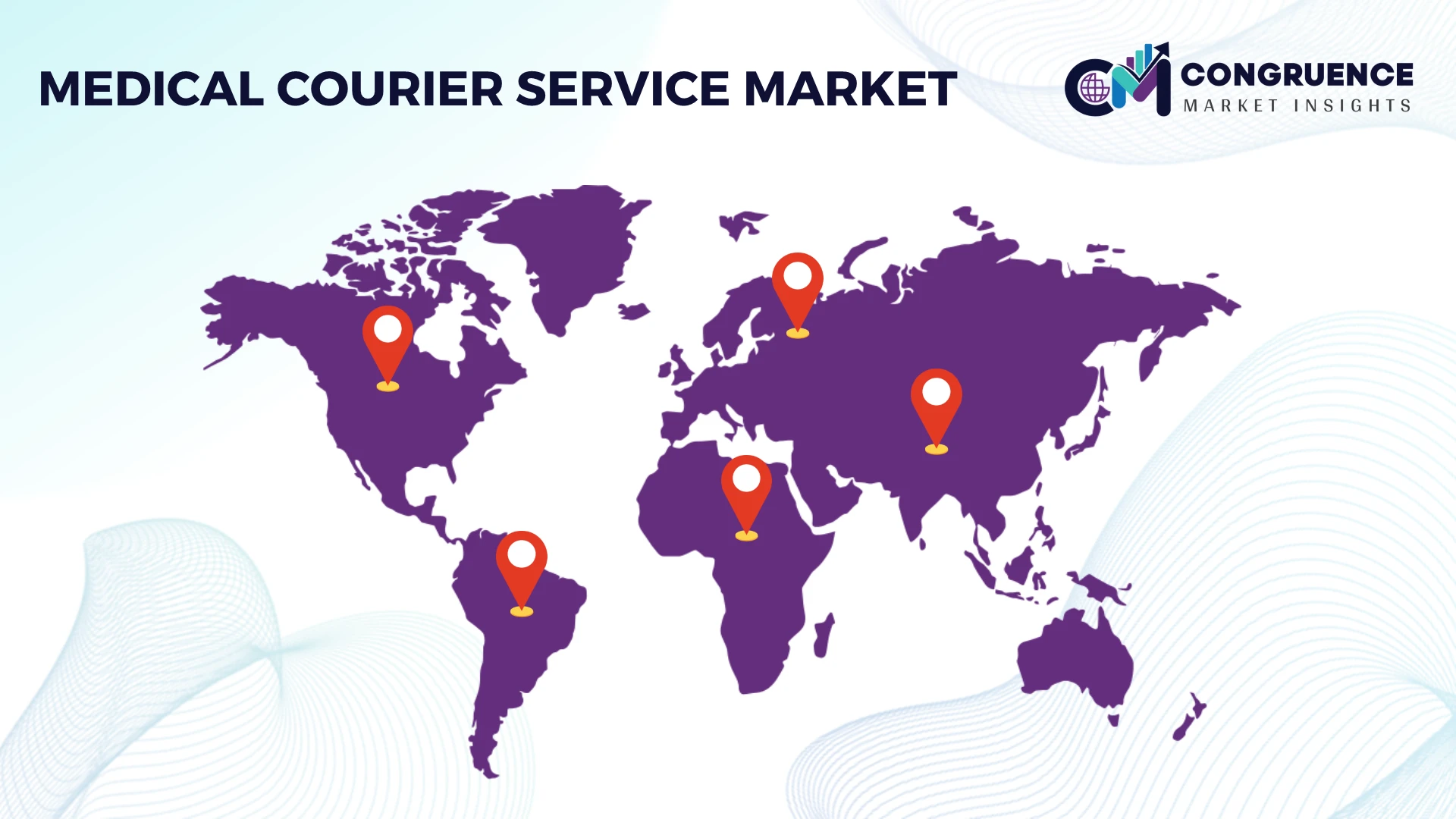
The report evaluates North America, Europe, Asia-Pacific, South America, and Middle East & Africa, with country-level assessment of major healthcare logistics hubs. Technology coverage includes AI dispatch, GPS and IoT monitoring, electronic chain-of-custody, temperature-controlled packaging, automated control towers, and electric delivery fleets. With temperature-sensitive shipments representing roughly 35–40% of specialized activity, the analysis identifies infrastructure priorities, adoption patterns, competitive positioning, partnership opportunities, and expansion pathways supporting investment planning and operational decisions through 2026–2033.
| Report Attribute/Metric | Report Details |
|---|---|
|
Market Revenue in 2025 |
USD 7,198.4 Million |
|
Market Revenue in 2033 |
USD 11,473.2 Million |
|
CAGR (2026 - 2033) |
6% |
|
Base Year |
2025 |
|
Forecast Period |
2026 - 2033 |
|
Historic Period |
2021 - 2025 |
|
Segments Covered |
By Type
By Application
By End-User
|
|
Key Report Deliverable |
Revenue Forecast, Growth Trends, Market Dynamics, Segmental Overview, Regional and Country-wise Analysis, Competition Landscape |
|
Region Covered |
North America, Europe, Asia-Pacific, South America, Middle East, Africa |
|
Key Players Analyzed |
Marken, UPS Healthcare Precision Logistics, World Courier, Federal Express Corporation, DHL, QuickSTAT, Medical Couriers, Dropoff, CitySprint, Aramex, SF Express, Kuehne+Nagel, CEVA Logistics |
|
Customization & Pricing |
Available on Request (10% Customization is Free) |




