
Reports
The Global Medical Artificial Intelligence Market was valued at USD 35,147.6 Million in 2025 and is anticipated to reach a value of USD 295,651.3 Million by 2033 expanding at a CAGR of 30.5% between 2026 and 2033. Growth is driven by rapid integration of generative AI, medical imaging, clinical decision support, precision medicine, and AI-enabled workflow automation across hospitals, pharmaceutical companies, diagnostic laboratories, and medical-device manufacturers.
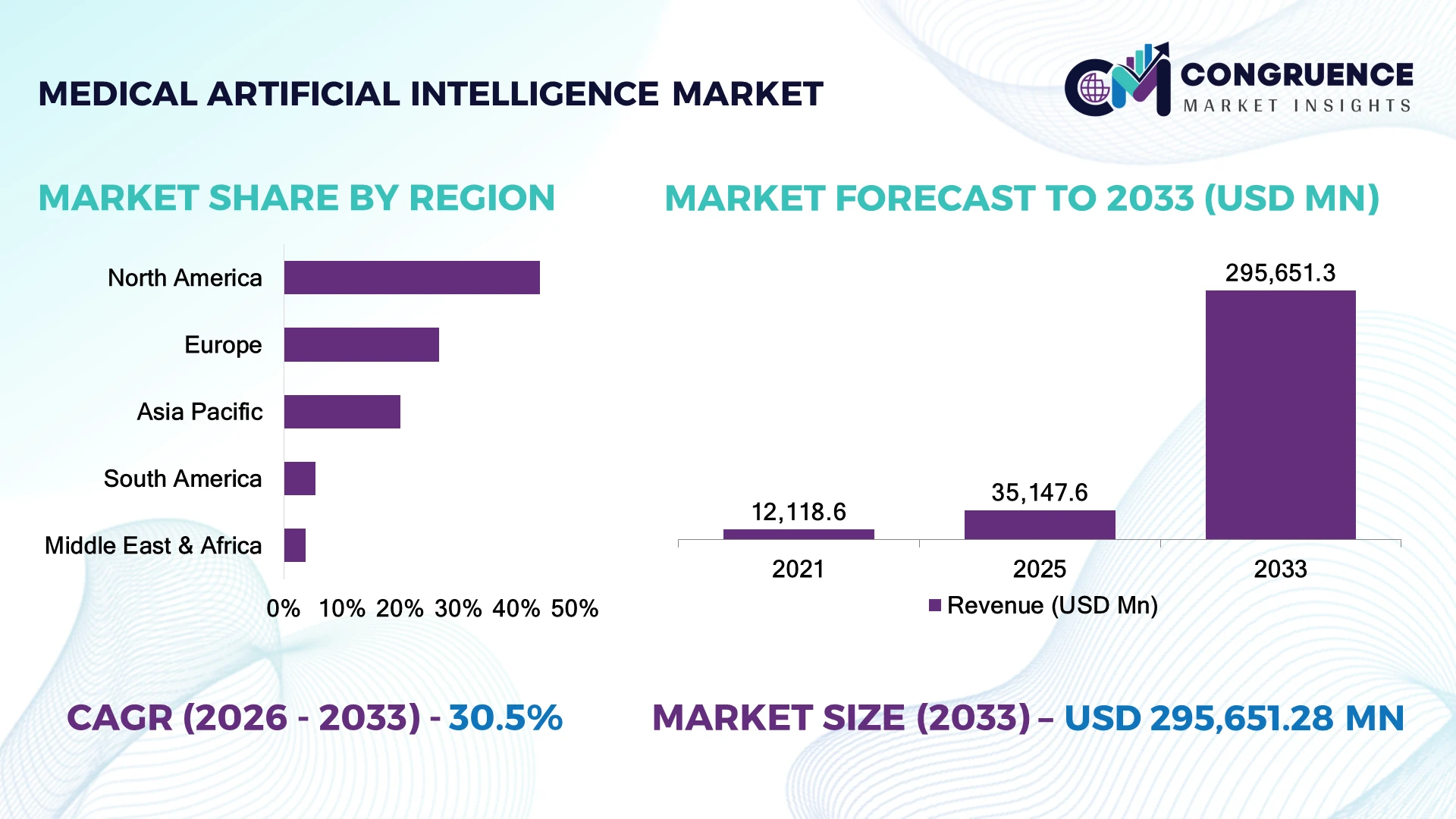
The United States dominates medical AI adoption, accounting for approximately 42.9% of global market activity, supported by major health-system investments, advanced cloud infrastructure, and a large installed base of AI-enabled medical technologies. Europe represents about 26.7%, while Asia-Pacific contributes approximately 21.4% and is accelerating deployment. In 2026, U.S. hospitals are moving from experimentation toward enterprise integration, with 31.5% already using EHR-integrated generative AI and another 24.7% planning adoption within one year.
Strategically, companies that combine clinically validated algorithms, interoperable infrastructure, regulatory readiness, and scalable deployment capabilities will capture the strongest medical AI opportunities.
Market Size & Growth: USD 35.15 billion in 2025 to USD 295.65 billion by 2033 at 30.5% CAGR, driven by clinical AI and workflow automation.
Top Growth Drivers: 42.9% U.S. share, 54.8% predictive-AI EHR usage, and 31.5% generative-AI hospital adoption.
Short-Term Forecast: By 2028, enterprise AI deployment is positioned to increase administrative efficiency by 15–25% as documentation and workflow automation scale.
Emerging Technologies: Multimodal AI, foundation models, ambient documentation, and AI-enabled imaging are moving from pilots toward integrated clinical workflows.
Regional Leaders: North America could exceed USD 130 billion by 2033, Europe USD 79 billion, and Asia-Pacific USD 63 billion, with Asia-Pacific scaling fastest.
Consumer/End-User Trends: Healthcare providers held 63.6% of medical-AI end-use demand, reinforcing provider-led procurement.
Pilot/Case Example: In 2024, 31.5% of U.S. hospitals used EHR-integrated generative AI, demonstrating rapid enterprise deployment.
Competitive Landscape: North America leads at 44.0%, with NVIDIA, Microsoft, IBM, GE HealthCare, Siemens Healthineers, and Philips competing across platforms.
Regulatory & ESG Impact: The FDA had listed 1,016 authorized AI/ML-enabled medical devices by December 2024, raising validation and lifecycle-governance requirements.
Investment & Funding: Harrison.ai secured USD 112 million in 2025, illustrating continued funding for diagnostic AI and international expansion.
Innovation & Future Outlook: By 2026–2028, multimodal models, autonomous workflow agents, and clinical copilots will shift competition toward integrated, validated healthcare AI ecosystems.
The Medical Artificial Intelligence Market is expanding across medical imaging, pathology, drug discovery, clinical documentation, remote monitoring, and decision support. More than 80% of surveyed healthcare leaders had deployed at least one generative-AI use case by 2026, while regulatory scrutiny increasingly emphasizes validation, transparency, and post-deployment monitoring. This transition is moving AI procurement from isolated tools toward integrated clinical platforms and enterprise governance.
Medical AI is becoming strategically important because healthcare organizations are shifting from isolated algorithm purchases toward enterprise-level intelligence embedded within clinical and administrative infrastructure. Competitive advantage increasingly depends on who can connect AI models with electronic health records, imaging systems, laboratory platforms, and operational workflows while maintaining clinical governance and measurable productivity gains.
The deployment pattern is already changing. In the United States, 31.5% of hospitals reported EHR-integrated generative-AI use in 2024, while another 24.7% planned adoption within one year. Predictive AI was already used by 52.2% of hospitals, establishing a stronger foundation for advanced generative applications. By comparison, Asia-Pacific is emphasizing rapid infrastructure expansion and localized AI development, while North America retains stronger enterprise-scale deployment and commercialization capabilities.
Over the next 2–3 years, ambient documentation, multimodal models, imaging AI, and clinical copilots will move deeper into routine workflows. A practical example is automated clinical documentation, where AI converts consultations into structured records, reducing repetitive physician workload. Companies are responding through platform integration, strategic partnerships, cloud infrastructure investment, and specialized model development. The winners will be organizations that translate model accuracy into interoperable, regulated, scalable healthcare operations.
Healthcare organizations are shifting AI from isolated diagnostic tools toward EHR-integrated clinical and administrative workflows. In the United States, 31.5% of hospitals reported generative-AI integration, while 52.2% used predictive AI capabilities, creating a substantial installed base for broader deployment. Administrative automation, imaging interpretation, and clinical documentation are attracting enterprise budgets because they address measurable workflow bottlenecks. The 2026 transition toward governed, enterprise-scale AI is accelerating vendor investment in interoperability and clinical validation. Companies are responding through healthcare-specific foundation models, cloud partnerships, and EHR integrations. The strategic advantage is shifting from algorithm accuracy alone toward deployment across multiple hospital workflows.
Fragmented healthcare data environments remain a structural constraint, particularly where legacy EHRs, imaging platforms, and laboratory systems operate through incompatible architectures. Although 52.2% of U.S. hospitals use predictive AI, only 31.5% reported generative-AI integration, demonstrating a meaningful deployment gap between algorithm availability and enterprise embedding. Regulatory documentation, model validation, cybersecurity controls, and data-governance requirements add implementation overhead. Companies are reducing exposure through standardized APIs, federated-learning architectures, private cloud environments, and localized compliance teams. The operational pressure is significant: vendors unable to integrate with existing clinical infrastructure face longer procurement cycles and higher customization costs, making interoperability capability as commercially important as model performance.
Multimodal AI creates a higher-value opportunity by combining clinical notes, medical images, laboratory results, genomics, and patient histories within unified inference systems. In 2026, more than 80% of surveyed healthcare leaders reported at least one generative-AI use case, establishing a strong foundation for broader multimodal deployment. India and China present particularly attractive opportunities as healthcare digitization and domestic AI infrastructure expand. Ambient documentation, clinical copilots, and multimodal diagnostic platforms can target administrative workloads alongside clinical decision support. Companies are increasing R&D, forming health-system partnerships, and integrating foundation models into specialized applications. The non-obvious opportunity is monetizing one AI platform across several hospital departments instead of selling isolated algorithms.
Moving validated AI from controlled pilots into heterogeneous clinical environments creates persistent execution complexity. Hospitals operate different EHR configurations, imaging standards, network architectures, and clinical protocols, while AI performance can vary across patient populations and deployment settings. With 31.5% of U.S. hospitals already integrating generative AI and 24.7% planning adoption, implementation volume is increasing faster than standardized operating models. Companies must address model drift, cybersecurity, workforce training, monitoring, and lifecycle validation through continuous infrastructure investment. The key challenge is maintaining clinical reliability after deployment: vendors need automated monitoring, transparent audit trails, retraining protocols, and hospital-level governance to protect performance and sustain enterprise contracts.
Ambient Documentation Becomes Operational: U.S. health systems are increasingly deploying AI scribes to convert consultations into structured clinical notes, with generative-AI adoption reaching 31.5% of hospitals and another 24.7% planning deployment. The shift is reducing documentation friction rather than simply adding another software layer. Vendors are integrating ambient systems directly with EHR workflows, while health systems are prioritizing measurable physician-time recovery and faster record completion.
Clinical Copilots Gain Workflow Depth: Predictive AI is already used by approximately 52.2% of U.S. hospitals, creating an installed base for generative clinical copilots supporting diagnosis, summarization, coding, and care coordination. Adoption is shifting from single-task algorithms toward multi-step assistance. Technology providers are combining foundation models with clinical datasets and enterprise controls, increasing platform value while reducing the need for separate point solutions.
Medical Imaging Gets Multimodal: AI imaging is moving toward models that interpret scans alongside patient histories, pathology, and laboratory information. FDA-authorized AI/ML medical devices exceeded 1,000 by late 2024, demonstrating expanding regulatory maturity. In 2026, developers are prioritizing multimodal validation and workflow integration rather than standalone image classification. This improves clinical context and strengthens differentiation for companies with proprietary datasets and hospital deployment partnerships.
Governance Becomes Procurement Criterion: Healthcare buyers are increasingly evaluating model monitoring, explainability, cybersecurity, and auditability alongside accuracy. More than 80% of healthcare leaders reported at least one generative-AI use case by 2026, increasing pressure for standardized governance as deployment scales. Vendors are responding with private deployment options, usage controls, model-risk frameworks, and continuous monitoring, turning compliance infrastructure into a competitive product feature rather than a back-office requirement.
Deep learning remains the leading technology type, accounting for approximately 57.4% of AI-enabled medical imaging applications in 2025, supported by superior pattern recognition across radiology, pathology, and diagnostic workflows. Machine learning remains widely deployed for predictive analytics and risk stratification, while natural language processing is gaining momentum through clinical documentation and unstructured-record analysis. The commercial advantage increasingly comes from integrating multiple AI methods rather than deploying isolated algorithms.
Generative AI represents the fastest-moving technology shift, particularly for clinical summarization, documentation, and conversational interfaces. In the United States, 31.5% of hospitals had already integrated generative AI with EHRs, while 24.7% planned adoption within one year. Companies are therefore shifting investment toward multimodal models, healthcare-specific foundation models, and EHR integration, while established deep-learning vendors strengthen their platforms through partnerships and workflow expansion.
Industry insight: A 2025 national study covering 2,174 U.S. hospitals found that 31.5% were already using EHR-integrated generative AI and another 24.7% were fast followers, confirming that enterprise deployment is moving rapidly beyond experimentation.
Medical imaging and diagnostics represent the leading application, accounting for approximately 14.9% of the broader medical AI market in 2025. High-volume imaging workflows provide structured datasets and repeatable interpretation tasks, making them particularly suitable for deep-learning deployment. Drug discovery, clinical decision support, patient monitoring, and administrative automation remain important applications, but imaging retains stronger commercialization because established diagnostic infrastructure enables faster integration and measurable workflow benefits.
Clinical workflow automation is emerging as a major adoption shift as healthcare organizations move AI beyond image interpretation. Coding, clinical-note summarization, and AI-assisted documentation are gaining traction alongside diagnostic applications. In 2025, coding and document summarization represented 55% of reported generative-AI use cases among surveyed healthcare and life-sciences organizations, while medical chatbots and AI agents reached 53%. Companies are responding by integrating AI across imaging, EHR, and operational platforms rather than maintaining disconnected applications.
Industry insight: A 2025 healthcare and life-sciences survey found generative AI adoption at 54% overall, with coding and clinical-document summarization accounting for 55% of reported use cases, demonstrating the growing commercial importance of workflow automation.
Healthcare providers represent the dominant end-user group, accounting for approximately 63.6% of the Medical Artificial Intelligence Market in 2025. Hospitals concentrate imaging equipment, EHR infrastructure, clinical datasets, and specialist workflows, giving them the strongest economic case for enterprise AI deployment. Pharmaceutical and biotechnology companies form the next important buyer group, where AI is increasingly embedded in drug discovery, molecular analysis, and clinical-development workflows. The contrast is increasingly between infrastructure-rich providers and specialized life-sciences users.
Pharmaceutical and biotechnology adoption is becoming the fastest-moving commercial segment as generative AI expands beyond documentation into research workflows. In 2025, 69% of surveyed pharmaceutical and biotechnology respondents reported generative-AI use, compared with 44% among payers and providers. Companies are consequently tailoring solutions by buyer: health systems receive EHR-integrated clinical platforms, while life-sciences customers receive research, discovery, and evidence-analysis capabilities. This segmentation is shifting competitive investment toward verticalized AI ecosystems rather than generic software.
Industry insight: A 2025 industry survey reported generative-AI use among 69% of pharmaceutical and biotechnology respondents versus 44% among payers and providers, highlighting stronger near-term commercial momentum in research-intensive end-user environments.
North America accounted for the largest market share at 44.0% in 2025 however, Asia-Pacific is expected to register the fastest growth, expanding at a CAGR of 33.2% between 2026 and 2033.
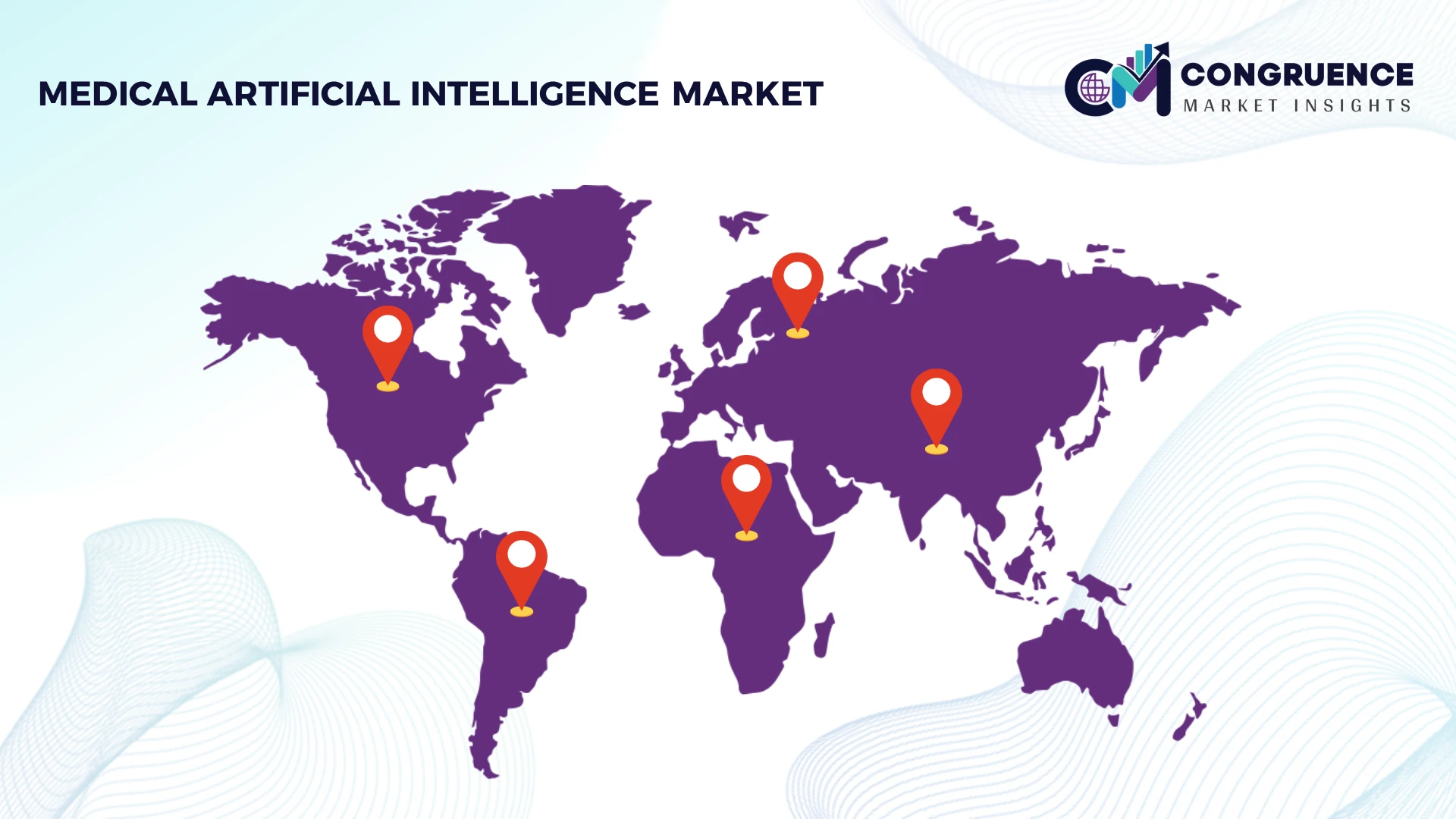
North America commands approximately 44.0% of the Medical Artificial Intelligence Market, supported by extensive EHR penetration, cloud infrastructure, medical-device innovation, and concentrated health-system purchasing. The United States remains the principal deployment center, with 31.5% of hospitals reporting EHR-integrated generative AI and 52.2% using predictive AI. Enterprise adoption is shifting from individual algorithms toward multimodal platforms spanning imaging, documentation, clinical decision support, and revenue-cycle workflows. In 2026, healthcare organizations are strengthening governance and interoperability requirements as AI moves into production. Technology providers are responding with healthcare-specific foundation models, ambient documentation platforms, strategic cloud partnerships, and integrated clinical ecosystems.
United States Market Outlook: The United States maintains the strongest combination of AI research capacity, venture funding, hyperscale computing infrastructure, and healthcare data availability. More than 1,000 AI/ML-enabled medical devices had received regulatory authorization by late 2024, demonstrating substantial commercialization depth. Leading health systems are increasingly evaluating AI through enterprise productivity, clinical validation, cybersecurity, and interoperability metrics, creating strong opportunities for vendors with scalable deployment architectures.
Europe represents approximately 26.7% of global Medical Artificial Intelligence demand, with Germany, the United Kingdom, France, and Italy forming major adoption centers. European deployment increasingly emphasizes trustworthy AI, data governance, interoperability, and lifecycle monitoring alongside algorithmic performance. The regulatory environment is pushing vendors toward stronger documentation, risk classification, transparency, and human oversight. Germany's hospital modernization and France's investment in digital health infrastructure support expanding clinical applications, while the United Kingdom remains influential in health-system AI deployment. Companies are adapting through localized compliance capabilities, partnerships with healthcare institutions, and explainable-AI architectures that simplify enterprise procurement.
Germany Market Outlook: Germany offers a strong combination of university hospitals, medical-device manufacturing, research institutions, and digitally enabled clinical infrastructure. Its approximately 2,000 hospitals create a substantial addressable deployment base, although fragmented procurement requires localized implementation strategies. Companies are emphasizing interoperability with established hospital information systems, clinical validation, and regulatory documentation to secure institutional contracts. Germany's industrial AI ecosystem also supports collaboration between healthcare providers, technology developers, and medical-device manufacturers.
Asia-Pacific is the fastest-expanding major market as China, Japan, India, South Korea, and Australia combine growing healthcare digitization with substantial AI investment. China is advancing domestic healthcare AI capabilities through hospital digitization and local model development, while India is expanding AI-enabled diagnostics and digital-health infrastructure. Japan and South Korea emphasize robotics, medical imaging, and precision medicine. Companies are establishing regional development centers, forming hospital partnerships, and localizing AI models for language and clinical-data requirements. The strategic advantage is scale: high patient volumes generate large datasets that strengthen model training and deployment economics.
China Market Outlook: China is the region's most strategically significant country because of its extensive hospital network, large clinical datasets, domestic AI ecosystem, and strong technology manufacturing base. AI-enabled imaging, clinical decision support, and intelligent hospital operations are receiving increasing attention. Chinese technology companies are developing localized foundation models and healthcare platforms, while international suppliers increasingly pursue joint development and institutional partnerships. Large-scale hospital digitization provides a substantial environment for validating AI across high-volume clinical workflows.
South America remains a developing Medical Artificial Intelligence market, with Brazil accounting for the largest share of regional commercial activity through its extensive private hospital networks, diagnostic laboratories, and digital-health ecosystem. Adoption is concentrated in São Paulo, Rio de Janeiro, and other major healthcare hubs where cloud infrastructure and specialist capabilities are stronger. Approximately 40% of large healthcare organizations in the region are actively evaluating or deploying AI-enabled solutions, with diagnostic imaging and administrative automation leading implementation. Companies are prioritizing distributor partnerships, localized software integration, and lower-complexity deployment models to address infrastructure differences and reduce implementation costs.
Brazil Market Outlook: Brazil provides the strongest commercial platform because its healthcare system combines large patient volumes with established diagnostic and private-hospital networks. São Paulo is particularly important for AI deployment because of its concentration of hospitals, technology companies, research institutions, and specialist clinicians. Companies are targeting imaging, clinical documentation, and operational analytics while partnering with healthcare providers to build local validation datasets. Infrastructure reliability and data-governance capabilities remain important differentiators for sustained deployment.
Middle East & Africa is emerging through concentrated investment in advanced hospitals, national digital-health programs, and AI-enabled healthcare infrastructure. Saudi Arabia and the United Arab Emirates lead regional commercialization, while South Africa provides an important African technology and healthcare hub. Saudi Arabia's healthcare transformation programs are accelerating digital hospital capabilities, predictive analytics, and intelligent diagnostics. Approximately 30% of healthcare organizations across leading Gulf markets are actively implementing or piloting AI applications, creating demand for cloud platforms, clinical decision support, and medical imaging. Companies are responding through government partnerships, localized deployment teams, and regional data-center investment.
Saudi Arabia Market Outlook: Saudi Arabia represents the region's strongest strategic opportunity because healthcare modernization is closely linked with national digital-transformation initiatives. Major tertiary hospitals are adopting analytics, imaging AI, and workflow automation as infrastructure becomes increasingly digitized. The country is also developing domestic AI capabilities and attracting technology partnerships, creating opportunities for global vendors to combine cloud infrastructure, clinical applications, and localized implementation. Companies that establish government and hospital relationships early can strengthen long-term market access.
Global leaders NVIDIA, Microsoft, GE HealthCare, Siemens Healthineers, and Philips compete with specialist innovators such as Tempus and Aidoc; OEMs leverage installed clinical infrastructure while AI-native firms compete through specialized models and faster deployment. The top five players collectively hold approximately 35% of market value, leaving room for challengers. Competition centers on technology, integration, customization, and implementation speed: AI-enabled diagnostic performance gains of 20–30% can influence procurement, while interoperability can reduce deployment friction by roughly 15–20%. GE HealthCare is expanding AI through health-system collaborations and cloud-first software, while Philips is embedding AI into imaging and pathology workflows. NVIDIA strengthens the infrastructure layer through model-computing partnerships, whereas Tempus competes through multimodal oncology data and foundation models. The competitive shift is toward vertically integrated ecosystems combining models, data, devices, and workflow software. High clinical-validation, regulatory, data-access, and integration barriers pressure entrants. Winning requires validated AI, interoperable deployment, proprietary data, and enterprise-scale execution.
NVIDIA Corporation
Microsoft Corporation
IBM Corporation
GE HealthCare Technologies Inc.
Siemens Healthineers AG
Koninklijke Philips N.V.
Medtronic plc
Johnson & Johnson MedTech
Tempus AI, Inc.
Aidoc Medical Ltd.
IQVIA Holdings Inc.
Stryker Corporation
Abbott Laboratories
Lunit Inc.
Medical AI is shifting from standalone predictive algorithms toward multimodal foundation models, ambient clinical documentation, and AI-enabled imaging. Ambient copilots can reduce documentation workload by roughly 20%, while multimodal systems improve information retrieval by integrating notes, images, laboratory results, and longitudinal records. In 2024, 31.5% of U.S. hospitals reported EHR-integrated generative AI, signaling production adoption rather than experimentation.
AI imaging remains the mature deployment layer, while foundation models and agentic systems represent the disruptive frontier. Compared with conventional rule-based workflows, generative clinical copilots can deliver approximately 15–25% faster information synthesis, particularly for documentation and patient-record review. Cloud-native architectures improve scalability, whereas edge AI supports lower-latency imaging and device applications. Companies with proprietary clinical datasets, EHR connectivity, and validated workflows gain the strongest competitive position because integration becomes harder to replicate than model access alone.
Between 2026 and 2028, investment will concentrate on multimodal clinical copilots, autonomous imaging, genomic AI, and workflow agents. Philips and NVIDIA are developing foundation-model capabilities for MRI, while GE HealthCare is expanding AI-driven hospital operations. Healthcare buyers increasingly prioritize productivity, interoperability, cybersecurity, and governance. The strategic imperative is clear: deploy technologies that connect to clinical workflows, generate measurable efficiency, and scale across departments rather than isolated demonstrations.
March 2025 GE HealthCare expanded its NVIDIA collaboration toward autonomous X-ray and ultrasound AI, extending a 16-year relationship. The initiative targets automated imaging workflows, supporting faster interpretation and reducing clinician workload while strengthening GE’s AI-enabled imaging portfolio commercially. Source: gehealthcare.com
April 2025 Tempus expanded strategic agreements with AstraZeneca and Pathos to develop a multimodal oncology foundation model using de-identified clinical data. The collaborations include $200 million in data-licensing and model-development fees, strengthening Tempus’s precision-medicine platform and therapeutic-development position. Source: tempus.com
February 2025 Philips and Mass General Brigham launched collaboration to combine live medical-device streams with data and AI analytics. The program targets near-real-time insights across bedside devices, laboratories, and records, strengthening surveillance and creating infrastructure for algorithm development. Source: philips.com
July 2025 Siemens Healthineers and Prisma Health expanded Value Partnership with a $50 million investment in radiation therapy. The program includes AI-driven adaptive radiotherapy, enabling treatment plans to respond to tumor and anatomical changes while supporting cancer care. Source: siemens-healthineers.com
The report evaluates Medical Artificial Intelligence across major technology types, including machine learning, deep learning, natural language processing, generative AI, and multimodal systems, alongside applications spanning medical imaging, clinical decision support, drug discovery, patient monitoring, and workflow automation. Coverage includes hospitals, pharmaceutical and biotechnology companies, diagnostic providers, research institutions, and other healthcare organizations.
Geographic analysis covers North America, Europe, Asia-Pacific, South America, and Middle East & Africa, with country-level assessment emphasizing deployment maturity, infrastructure, regulatory conditions, and investment activity. The report also examines emerging areas such as foundation models, ambient documentation, autonomous imaging, genomic AI, and agentic healthcare workflows. With 31.5% of U.S. hospitals reporting EHR-integrated generative AI, the analysis supports investment planning, expansion decisions, competitive positioning, technology prioritization, and strategic market direction through 2033.
| Report Attribute/Metric | Report Details |
|---|---|
|
Market Revenue in 2025 |
USD 35,147.6 Million |
|
Market Revenue in 2033 |
USD 295,651.3 Million |
|
CAGR (2026 - 2033) |
30.5% |
|
Base Year |
2025 |
|
Forecast Period |
2026 - 2033 |
|
Historic Period |
2021 - 2025 |
|
Segments Covered |
By Type
By Application
By End-User
|
|
Key Report Deliverable |
Revenue Forecast, Growth Trends, Market Dynamics, Segmental Overview, Regional and Country-wise Analysis, Competition Landscape |
|
Region Covered |
North America, Europe, Asia-Pacific, South America, Middle East, Africa |
|
Key Players Analyzed |
NVIDIA Corporation, Microsoft Corporation, IBM Corporation, GE HealthCare Technologies Inc., Siemens Healthineers AG, Koninklijke Philips N.V., Medtronic plc, Johnson & Johnson MedTech, Tempus AI, Inc., Aidoc Medical Ltd., IQVIA Holdings Inc., Stryker Corporation, Abbott Laboratories, Lunit Inc. |
|
Customization & Pricing |
Available on Request (10% Customization is Free) |




