
Reports
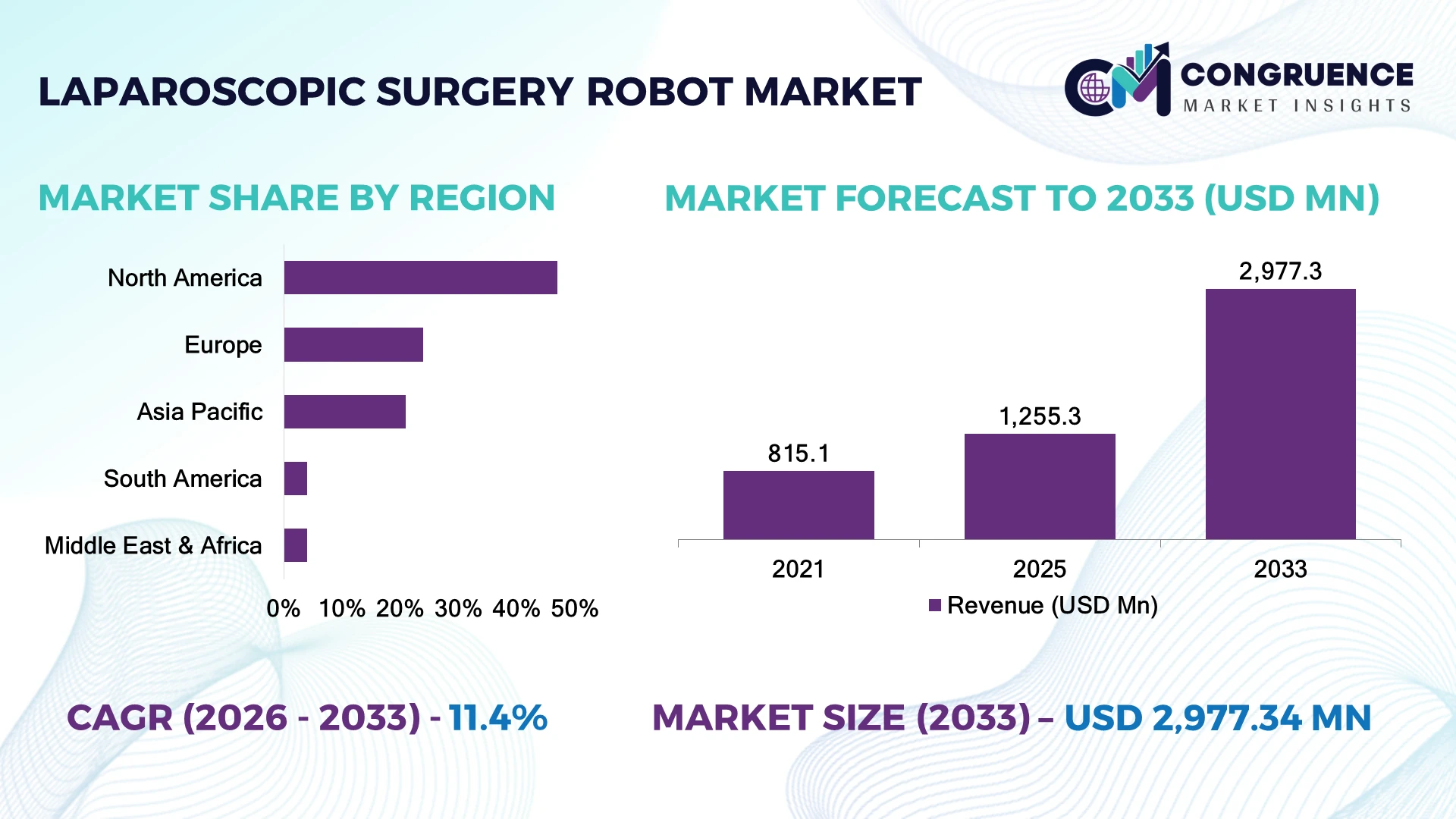
The Global Laparoscopic Surgery Robot Market was valued at USD 1,255.3 Million in 2025 and is anticipated to reach a value of USD 2,977.3 Million by 2033 expanding at a CAGR of 11.4% between 2026 and 2033. Growth is driven by wider robotic adoption in general surgery, gynecology, urology, and colorectal procedures, supported by improved instrument control, advanced visualization, and expanding surgeon training programs.
The United States remains the principal deployment center for robotic-assisted surgery, supported by extensive hospital infrastructure and established surgical training pathways. At the end of 2025, approximately 6,364 da Vinci systems were installed in the country, representing about 57% of the company’s global da Vinci installed base of 11,106 systems. Europe had 2,168 systems, while Asia had 1,993. These figures describe one manufacturer’s installed base rather than total market share. The expansion of robotic surgery in India and South Korea highlights the growing importance of international deployment.
For investors and manufacturers, competitive advantage depends on expanding procedure utilization and clinical access while addressing acquisition costs, training requirements, and hospital-level economics.
Market Size & Growth: The market is valued at USD 1,255.3 million in 2025 and projected to reach USD 2,977.3 million by 2033, supported by expanding robotic use in general surgery and minimally invasive procedures.
Top Growth Drivers: Robotic-assisted procedures performed using da Vinci systems increased approximately 18% globally in 2025; US procedures grew 15%, while procedures outside the US increased 23%.
Short-Term Forecast: For 2026, Intuitive Surgical projected 13–15% growth in worldwide da Vinci procedures, indicating continued demand for operating capacity, instruments, and clinical training.
Emerging Technologies: Force feedback, single-port access, improved imaging, instrument integration, and digital surgical workflows are shaping next-generation platform development.
Regional Leaders: North America leads established deployment, Europe combines advanced surgical infrastructure with regulatory oversight, and Asia-Pacific is expanding adoption. Comparable regional market-value forecasts require further validation.
End-User Trends: Hospitals remain the core buyers because they manage surgical volumes, operating-room scheduling, specialist teams, and capital budgets. Utilization and procedures per system increasingly influence purchase decisions.
Deployment Example: In 2025, Intuitive Surgical placed 1,721 da Vinci systems, including 870 da Vinci 5 systems, reflecting stronger uptake of its latest platform generation.
Competitive Landscape: Intuitive Surgical competes with Medtronic, Johnson & Johnson, CMR Surgical, Asensus Surgical’s technology portfolio, and other regional developers. Comparable audited market shares are not consistently disclosed.
Regulatory & ESG Impact: Regulatory clearances determine eligible procedures and geographic availability. Reusable instruments and optimized operating-room workflows influence resource use, although sustainability benefits depend on each system’s design and utilization.
Investment & Funding: Investment is shifting toward next-generation systems, surgeon training, service networks, and flexible purchasing models. In 2025, 1,721 da Vinci systems were placed, approximately 13% more than in 2024.
Innovation & Future Outlook: Competition is moving beyond hardware toward instruments, digital integration, procedure-specific capabilities, training, and lifecycle support that improve utilization and strengthen hospital economics.
The global laparoscopic surgery robot market is shifting from a hardware-led purchasing model toward a utilization-led surgical ecosystem. Hospitals increasingly assess robotic platforms through procedure volumes, training requirements, instrument costs, and operating-room capacity. In 2025, da Vinci procedures grew approximately 18%, while placements of its latest da Vinci 5 platform rose to 870 systems. These operational signals reinforce the importance of clinical adoption and service support in determining long-term competitiveness.
Laparoscopic surgery robots are becoming strategically important as hospitals seek to expand minimally invasive procedures, strengthen surgeon recruitment, and standardize complex operations. Robotic-assisted procedures performed using da Vinci systems increased approximately 18% in 2025, with international procedures growing 23%. This expansion highlights the commercial importance of surgeon training, procedure-specific instruments, and operating-room utilization alongside system placement.
The technology shift involves more than replacing conventional laparoscopic instruments. Robotic platforms combine three-dimensional visualization, articulated instruments, motion scaling, and increasingly integrated digital functions. However, clinical and economic advantages vary by procedure, patient profile, and institutional experience. Conventional laparoscopy can remain more economical for routine operations, while robotic systems offer particular capabilities in selected complex or technically demanding procedures. Hospitals must compare total treatment costs, setup time, instruments, maintenance, and clinical outcomes rather than assuming universal savings.
During 2026–2028, platform differentiation will increasingly depend on broader procedure indications, improved instrument functionality, and financing models that lower adoption barriers. Manufacturers are expanding training, service coverage, and system availability across established and emerging markets. The strongest competitive position will belong to suppliers that demonstrate clinical value, sustain high system utilization, and make robotic surgery financially workable for hospitals beyond the largest specialist centers.
Expansion across general surgery, gynecology, urology, and colorectal procedures is strengthening demand for laparoscopic surgery robots. In 2025, da Vinci procedures grew approximately 18% globally, while US general surgery procedures using the platform increased 18%. International general surgery procedures grew approximately 31%, reflecting increased use in selected colorectal and hernia operations. These figures indicate procedure expansion on a major platform, not the growth rate of the entire market. Hospitals are responding by increasing robotic capacity, broadening surgeon training, and allocating systems to specialties with sufficient case volumes. Manufacturers are expanding procedure indications and improving instruments to support additional use cases. The strategic driver is cumulative utilization: a system used across more specialties can strengthen the business case for capital investment and recurring instrument purchases.
High acquisition costs, recurring instrument expenditure, service contracts, and training requirements limit adoption among hospitals with constrained capital budgets. The financial case weakens when systems remain underused or procedure volumes cannot support the associated operating costs. Intuitive Surgical reported approximately 11,106 da Vinci systems installed at the end of 2025, demonstrating the scale of infrastructure already supporting one established platform; this installed base also underscores the importance of service and lifecycle management. Hospitals must account for operating-room preparation, staffing, instrument replacement, and maintenance rather than evaluating purchase price alone. Vendors are responding with leasing, usage-based arrangements, and expanded service packages. A key restraint is the mismatch between system affordability and hospital throughput: procurement decisions increasingly depend on a credible multi-specialty utilization plan.
Opportunities are expanding in countries where private hospital investment, specialist training, and minimally invasive surgery programs are growing. India and South Korea recorded strong international da Vinci procedure growth in 2025, illustrating the importance of surgeon acceptance and institutional readiness outside the United States. Single-port platforms and procedure-specific instruments also create opportunities to address operations where access requirements differ from conventional multi-port approaches. Manufacturers can accelerate adoption through regional training centers, partnerships with hospital groups, and financing models aligned with surgical volume. Flexible purchasing arrangements can help hospitals begin with a defined set of procedures before extending use to additional specialties. The less obvious opportunity is improving utilization at existing sites: better scheduling, training, and instrument availability can increase the value of installed systems without requiring equivalent growth in hardware purchases.
Scaling robotic surgery requires coordinated development of surgeon proficiency, bedside-assistant skills, operating-room workflows, and technical support. Deployment alone does not guarantee utilization: hospitals must establish credentialing, training pathways, maintenance procedures, and protocols for selecting appropriate cases. Intuitive Surgical’s installed base reached approximately 11,106 da Vinci systems at the end of 2025, illustrating the service and training infrastructure required to sustain a large installed fleet. Expansion into new countries adds regulatory approvals, local-language training, instrument logistics, and reimbursement differences. Manufacturers are investing in education, simulation, technical support, and procedure-specific guidance. The strategic challenge is to maintain consistent performance as systems spread across hospitals with different levels of experience. Competitive success requires implementation support that turns equipment availability into repeatable clinical use.
Next-Generation Systems Gain Traction
In 2025, Intuitive Surgical placed 870 da Vinci 5 systems, compared with 362 in 2024. The newer platform is being introduced alongside an established installed base, making upgrades and trade-ins important purchasing pathways. Hospitals are evaluating added functionality against training needs, operating-room integration, and lifecycle costs before expanding deployment.
International Procedure Volumes Accelerate
Da Vinci procedures outside the United States increased approximately 23% in 2025, compared with 15% growth in the United States. India and South Korea contributed to international momentum. Suppliers are expanding clinical education, local support, and system availability as hospitals build robotic programs and extend use beyond established specialties.
Single-Port Surgery Expands Platform Choice
Intuitive Surgical reported an installed base of 377 da Vinci SP systems at the end of 2025. Single-port access offers a different approach from multi-port platforms and broadens procedure-specific options. Manufacturers are developing specialized instruments and pursuing additional indications, while hospitals assess clinical suitability, training, and economics before adopting the approach at scale.
Utilization Becomes a Procurement Priority
Da Vinci system utilization increased approximately 3% in 2025, measured as procedures per system annually. This reinforces the importance of case scheduling, surgeon availability, and multi-specialty use. Hospitals are focusing on throughput and lifecycle economics, while suppliers strengthen training, service, and usage-based purchasing models to support sustainable deployment.
Robotic systems are estimated to account for approximately 60% of the laparoscopic surgery robot market by product type, reflecting the capital investment required for surgical consoles, robotic arms, vision systems, and integrated operating-room platforms. Their dominance stems from the central role they play in enabling robotic procedures and establishing long-term relationships between hospitals and manufacturers. Instruments and accessories represent the recurring-use category, covering procedure-specific tools, end effectors, consumables, and supporting components. Although their initial purchase value is lower than that of complete systems, recurring replacement and expanding procedure volumes create a durable demand stream. Established platforms benefit from installed-base advantages, while emerging suppliers compete through differentiated instrument designs, system compatibility, and more flexible purchasing arrangements.
Instruments and accessories are positioned for faster recurring-demand expansion as hospitals increase utilization of existing robots. Intuitive Surgical reported approximately 18% growth in da Vinci procedures during 2025, reinforcing the commercial importance of procedure-linked consumables. As a planning estimate, recurring instruments and accessories could represent 35–45% of product-category demand, depending on market definitions and accounting boundaries. Manufacturers are prioritizing broader instrument portfolios, improved durability, and workflow integration. The business implication is a shift from hardware placements alone toward lifecycle value, utilization, and recurring customer engagement.
Urological surgery is estimated to account for approximately 30% of application demand, supported by established robotic use in prostatectomy and selected kidney procedures. The specialty benefits from mature surgeon experience, defined procedural workflows, and an extensive evidence base for robotic-assisted operations. General surgery is an important growth area as robotic platforms extend into colorectal procedures, hernia repair, and other abdominal operations. Gynecological surgery remains a mature application, particularly for hysterectomy and selected complex procedures, while colorectal surgery increasingly overlaps with broader general-surgery programs. Other applications contribute through procedure-specific use cases and evolving clinical adoption. For manufacturers, specialty coverage influences instrument design, training requirements, and the clinical evidence needed to support wider use.
General surgery is positioned for faster expansion as hospitals seek to use installed robotic systems across more specialties and increase utilization. Intuitive Surgical reported approximately 31% growth in international da Vinci general-surgery procedures in 2025, particularly in colorectal and hernia repair. This platform-specific result indicates momentum rather than the growth rate of the total application market. As a directional estimate, general surgery could account for 20–25% of application demand, with its share increasing as indications and surgeon experience expand. Manufacturers are strengthening procedure-specific instruments, training, and clinical support. Hospitals increasingly assess whether additional applications can improve system utilization and justify capital expenditure.
Hospitals are estimated to represent approximately 80% of end-user demand, reflecting their ability to support major capital purchases, specialist surgical teams, dedicated operating rooms, and complex postoperative care. Large academic medical centers and tertiary hospitals also provide the clinical infrastructure needed for training, evaluation, and expansion across multiple specialties. Ambulatory surgical centers represent an emerging buyer group where procedure suitability, patient selection, reimbursement, and operating efficiency support adoption. Specialty clinics remain a more selective segment, generally dependent on partnerships with hospitals or access to suitable surgical facilities. Other end-users contribute through specialized institutions and settings with procedure-specific requirements. These differences mean vendors must tailor procurement models, service coverage, training, and system configuration to each facility’s operational scale.
Ambulatory surgical centers are positioned for faster adoption where robotic procedures can be delivered safely and economically within outpatient pathways. As a directional planning assumption, hospitals account for 75–85% of end-user demand, while ambulatory centers remain a smaller share constrained by capital requirements and case mix. Intuitive Surgical reported approximately 18% global growth in da Vinci procedures during 2025, supporting the importance of expanding utilization beyond new system placements. Vendors are responding with flexible leasing, training programs, and workflow support. Future demand will depend on procedure suitability, reimbursement, and the ability to maintain sufficient case volumes without compromising patient selection or clinical standards.
North America accounted for the largest market share at an estimated 47.0% in 2025; however, Asia-Pacific is expected to register the fastest growth, expanding at an estimated CAGR of 16.5% between 2026 and 2033.

North America leads the laparoscopic surgery robot market through established robotic-surgery programs, specialist training infrastructure, and strong hospital purchasing capacity. The United States dominates regional deployment, supported by high procedure volumes, advanced operating rooms, and established manufacturer service networks. In 2025, Intuitive Surgical reported 987 da Vinci system placements in the United States, representing approximately 57% of its global placements that year. Hospitals are increasingly evaluating robotic platforms through procedure throughput, instrument expenditure, and system utilization rather than acquisition price alone. Canada contributes through tertiary hospitals and specialist surgical centers, while adoption in Mexico is more sensitive to affordability and access to trained teams. Manufacturers are expanding training, service coverage, and flexible purchasing options. Sustained growth depends on translating installed capacity into repeatable clinical use and financially viable multi-specialty programs.
United States Market Outlook: The United States remains the region’s principal center for robotic-surgery deployment, clinical training, and platform innovation. Its large hospital networks and established minimally invasive surgery programs support adoption across urology, gynecology, colorectal surgery, and general surgery. In 2025, da Vinci procedures performed in the country increased approximately 15%, reflecting continuing use across established and expanding applications. Manufacturers are prioritizing next-generation systems, procedure-specific instruments, and usage-based purchasing arrangements. Hospitals increasingly favor suppliers that combine clinical support with reliable maintenance and measurable utilization outcomes.
Europe represents an established market for laparoscopic surgery robots, supported by tertiary hospitals, specialist surgical centers, and structured clinical evaluation. Germany, France, Italy, and the United Kingdom are important deployment markets, although purchasing capacity and adoption vary with healthcare funding and hospital priorities. Intuitive Surgical reported 342 da Vinci system placements in Europe during 2025, compared with 309 in 2024, indicating continued expansion of its installed base. European hospitals increasingly assess clinical evidence, training requirements, instrument costs, and service availability when evaluating new platforms. Regulatory compliance and procurement scrutiny favor manufacturers with documented performance and dependable regional support. Suppliers are investing in surgeon education, platform upgrades, and specialty-specific applications to strengthen adoption.
Germany Market Outlook: Germany benefits from advanced hospital infrastructure, a strong medical-technology sector, and established minimally invasive surgery capabilities. More than 500 da Vinci systems were installed across Germany, Austria, and Switzerland by the end of 2025, reflecting a mature regional base for robotic-assisted procedures. German hospitals prioritize clinical evidence, operating-room integration, and predictable lifecycle costs when selecting surgical platforms. Manufacturers can strengthen their position through specialized training, responsive technical service, and instruments tailored to high-volume procedures.
Asia-Pacific is positioned for comparatively rapid expansion as hospitals increase investment in advanced surgery and domestic manufacturers develop competing robotic platforms. China, Japan, South Korea, and India represent distinct adoption environments, ranging from established robotic-surgery programs to rapidly developing private hospital networks. Intuitive Surgical reported 269 da Vinci system placements in Asia during 2025, compared with 321 in 2024, showing that regional demand can vary despite expanding procedure adoption. South Korea and India recorded strong growth in da Vinci procedures during the year. Competition is intensifying around local service, procurement affordability, surgeon training, and product differentiation. Manufacturers are strengthening regional partnerships and adapting commercial strategies to national approval pathways and hospital budgets.
China Market Outlook: China is strategically important because of its large hospital network, medical-device manufacturing base, and development of domestic surgical robotics. Local manufacturers compete with international suppliers through product localization, hospital relationships, and pricing strategies. However, procurement scrutiny and tender delays can affect purchasing schedules. In 2025, Intuitive Surgical reported fewer system placements in China than anticipated amid heightened tender scrutiny and stronger domestic competition. Suppliers must therefore combine regulatory readiness, local technical support, and differentiated clinical performance to sustain adoption.
South America remains an emerging market for laparoscopic surgery robots, with deployment concentrated in major private hospitals, specialist centers, and selected academic institutions. Brazil leads regional opportunities because of its healthcare scale and established network of tertiary facilities, while Argentina, Chile, and Colombia provide additional demand. Adoption is constrained by equipment costs, currency volatility, uneven reimbursement, and limited access to specialized training outside major cities. Hospitals typically prioritize robotic systems for procedures and patient groups that support sufficient case volumes. Manufacturers are responding through distributor partnerships, surgeon education, and service arrangements designed to reduce operational uncertainty. The near-term opportunity lies in expanding utilization at existing sites and strengthening access to maintenance and instruments rather than assuming uniform adoption across the region.
Brazil Market Outlook: Brazil is the most strategically significant market in South America, supported by major private hospital groups, specialist surgical centers, and a substantial public healthcare system. Leading urban facilities provide a foundation for robotic-assisted urology, gynecology, and general surgery, while access remains uneven outside major metropolitan areas. Currency exposure and capital constraints influence procurement decisions. Suppliers can improve market reach through local partnerships, surgeon training, flexible financing, and dependable instrument distribution, particularly where hospitals seek to increase utilization before committing to additional systems.
The Middle East and Africa market is developing unevenly, with robotic-surgery deployment concentrated in well-funded hospitals and specialist centers. Saudi Arabia, the United Arab Emirates, and South Africa are important markets because of tertiary-care infrastructure, private hospital investment, and demand for advanced surgical services. Elsewhere, capital limitations, specialist workforce shortages, and service-network gaps constrain adoption. Hospitals evaluating robotic platforms must consider surgeon training, maintenance coverage, imported instrument availability, and the number of procedures needed to support operating costs. Suppliers are building regional distributor relationships and offering clinical education to support deployment. Commercial success depends on targeting institutions with adequate surgical volume and infrastructure rather than treating the region as a uniform market.
Saudi Arabia Market Outlook: Saudi Arabia is a strategically significant market because of healthcare modernization, investment in specialist hospitals, and the development of advanced surgical services under Vision 2030. Major tertiary hospitals offer a foundation for robotic-assisted procedures across urology, gynecology, and general surgery. Procurement decisions remain closely tied to clinical requirements, training capacity, maintenance arrangements, and total ownership costs. Manufacturers can strengthen their position through partnerships with hospital groups, local technical support, surgeon education, and reliable instrument supply as robotic programs expand.
Intuitive Surgical competes through the da Vinci installed base and recurring instruments, while Medtronic’s Hugo, CMR Surgical’s Versius, and Johnson & Johnson’s investigational OTTAVA challenge it through modular architecture and system flexibility. Regional developers compete on affordability and localization; OEMs rely on clinical evidence, surgeon familiarity, service reach, and consumables ecosystems. The top five suppliers’ combined share is not reported in a laparoscopic-robot-specific dataset; any precise figure would be misleading. Competition centers on platform performance, ownership cost, training, procedure coverage, and operating-room fit. Intuitive reported 18% growth in da Vinci procedures in 2025, while da Vinci 5 placements rose from 362 to 870 systems, showing how upgrades and utilization reinforce installed-base advantage. Medtronic secured US clearance for Hugo, and CMR prepared Versius Plus for US commercialization. Regulatory evidence, capital intensity, and service infrastructure constrain entry. Winning requires validated outcomes, high utilization, reliable support, and competitive lifecycle cost—not hardware novelty alone.
Robotic laparoscopic platforms combine 3D visualization, wristed instruments, motion scaling, and surgeon-controlled cameras. Intuitive’s da Vinci 5 adds force feedback and more than 150 enhancements; preclinical testing reported up to 43% less force applied to tissue than earlier systems. Medtronic’s Hugo uses modular arms and an open console, while CMR’s Versius emphasizes compact, portable units. These designs address different operating-room layouts.
Digital integration includes instrument tracking, system analytics, simulation, and connected operating-room tools to monitor utilization and standardize training. Intuitive reported 3.15 million da Vinci procedures in 2025, up 18%; da Vinci 5 placements rose from 362 in 2024 to 870 in 2025. That signals next-generation uptake, but not proof of efficiency gains. A 1–2% improvement in room turnover remains a local target, not an established industry result.
Across 2026–2028, modular architecture, force feedback, data integration, and procedure-specific instruments will shape competition. Medtronic benefits from its broader surgical portfolio; CMR targets flexible deployment; Intuitive leverages its installed base and instrument ecosystem. No universal cost-saving percentage is established against conventional laparoscopy. Hospitals should benchmark procedure duration, conversion rates, instrument costs, and cases per system before investing. Suppliers proving outcomes, service reliability, and training support will be better positioned as adoption expands.
January 2026 Intuitive Surgical reported 3.15 million da Vinci procedures worldwide in 2025, up 18%, and 1,721 system placements overall. The results underscore growing utilization and strengthen the commercial case for rapid next-generation platforms and recurring instruments. Source: Intuitive Surgical.
February 2026 Medtronic’s Hugo system completed its first US commercial surgery at Cleveland Clinic, a robotic prostatectomy with discharge the following day. The milestone moved the recently cleared platform into US clinical use and initiated commercial competition. Source: Cleveland Clinic.
May 2026 Johnson & Johnson reported OTTAVA study results from 30 gastric-bypass patients. All procedures were completed robotically without conversion, and primary safety and performance endpoints were met through 30 days, advancing its surgical robotics program. Source: Johnson & Johnson.
July 2025 Lee Health introduced Moon Surgical’s Maestro platform, designed to assist minimally invasive surgery while preserving surgeons’ preferred instruments and workflow. Its robotics program included 31 robots across hospitals and outpatient facilities, signaling investment in surgical support. Source: LeeHealth.org.
The report evaluates laparoscopic surgery robots by system architecture, including multi-port, single-port, and modular robotic platforms, alongside instruments, accessories, and supporting technologies. Application coverage includes urological, gynecological, general, colorectal, and other laparoscopic procedures. End-user analysis covers hospitals, ambulatory surgical centers, specialty clinics, and academic medical centers. Regional assessment spans North America, Europe, Asia-Pacific, South America, and the Middle East and Africa, accounting for differences in hospital investment, surgeon training, regulatory access, and deployment maturity.
Technology coverage includes three-dimensional visualization, force feedback, articulated instruments, digital integration, simulation, and procedure-specific tools. Competitive benchmarking examines established platforms and emerging developers, including differences in installed-base scale, system flexibility, service networks, and purchasing models. With da Vinci procedures increasing approximately 18% in 2025, utilization and recurring instrument demand are important decision factors. The report supports investment planning, geographic expansion, supplier selection, and competitive positioning while assessing adoption pathways and strategic priorities through 2033.
| Report Attribute/Metric | Report Details |
|---|---|
|
Market Revenue in 2025 |
USD 1,255.3 Million |
|
Market Revenue in 2033 |
USD 2,977.3 Million |
|
CAGR (2026 - 2033) |
11.4% |
|
Base Year |
2025 |
|
Forecast Period |
2026 - 2033 |
|
Historic Period |
2021 - 2025 |
|
Segments Covered |
By Type
By Application
By End-User
|
|
Key Report Deliverable |
Revenue Forecast, Growth Trends, Market Dynamics, Segmental Overview, Regional and Country-wise Analysis, Competition Landscape |
|
Region Covered |
North America, Europe, Asia-Pacific, South America, Middle East, Africa |
|
Key Players Analyzed |
Intuitive Surgical, Medtronic, Johnson & Johnson MedTech, CMR Surgical, KARL STORZ, MicroPort MedBot, SS Innovations International, Moon Surgical, Distalmotion, Medicaroid, Edge Medical, Ronovo Surgical |
|
Customization & Pricing |
Available on Request (10% Customization is Free) |




