
Reports
The Global IV Tubing Sets and Accessories Market was valued at USD 895.98 Million in 2025 and is anticipated to reach a value of USD 1375.05 Million by 2033 expanding at a CAGR of 5.5% between 2026 and 2033. Growth is driven by expanding infusion therapy volumes, oncology biologic administration, closed-system medication delivery, smart-pump interoperability, and hospital conversion toward DEHP-free and needleless IV components.
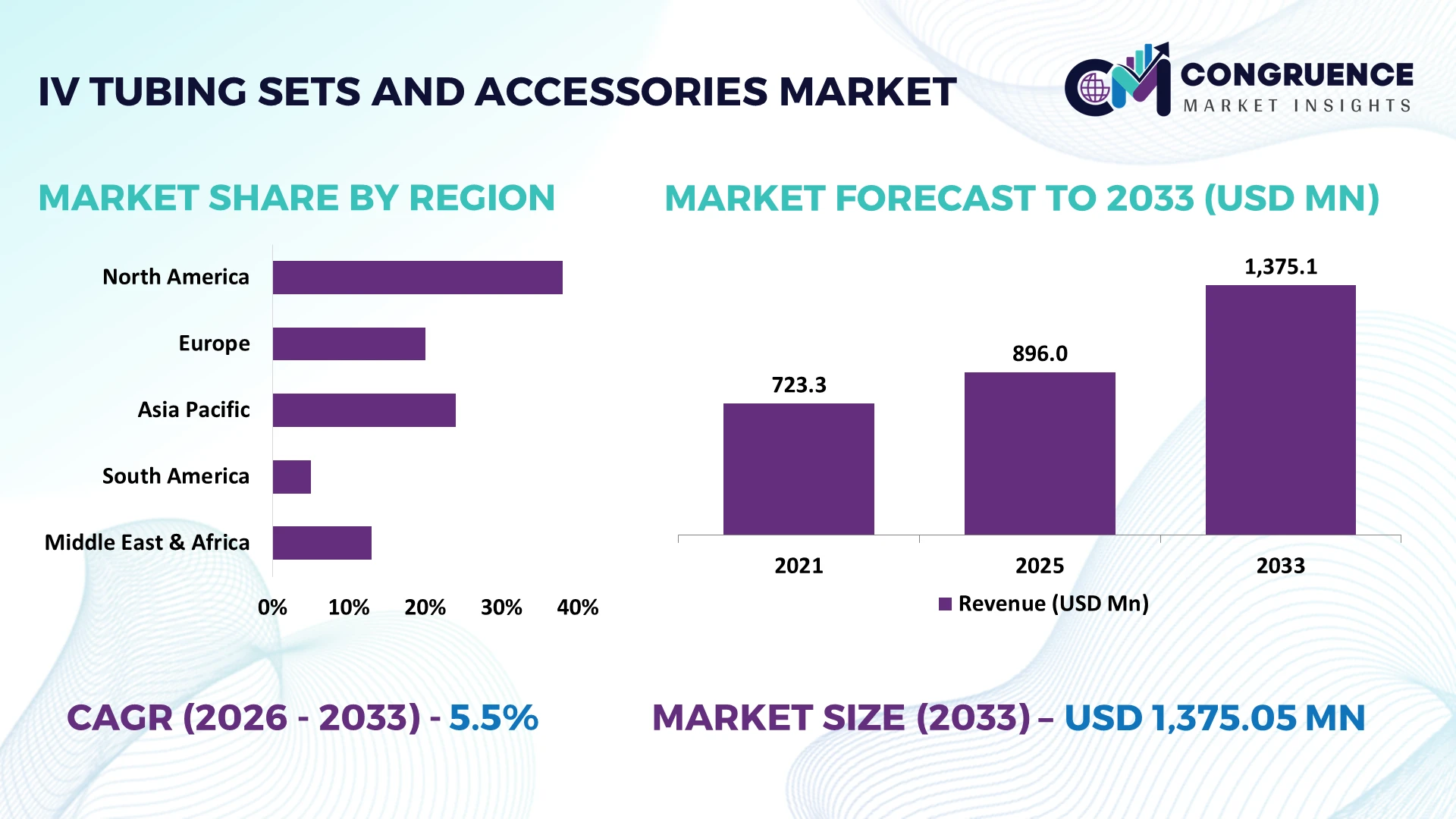
The United States accounts for approximately 38% of global IV tubing sets and accessories demand, supported by more than 6,000 hospitals, large ambulatory infusion networks, and extensive oncology and critical-care capacity. Smart infusion pumps operate across most major hospital systems, increasing requirements for compatible primary, secondary, extension, and specialty tubing. Germany maintains lower absolute consumption but stronger PVC-free procurement momentum under European chemical regulation. Following pandemic-era medical supply disruptions and continuing geopolitical freight uncertainty, U.S. providers have increased emphasis on domestic inventories and multi-supplier sourcing for high-volume disposables.
Strategically, suppliers should prioritize smart-pump-compatible sets, material safety, domestic inventory resilience, and high-volume hospital contracts where recurring disposable consumption determines competitive scale.
Market Size & Growth: USD 895.98 million in 2025 reaches USD 1,375.05 million by 2033 at 5.5% CAGR, supported by infusion automation and recurring disposable utilization.
Top Growth Drivers: Infusion-center expansion 18%, oncology infusion volumes 15%, and smart-pump integration 12% strengthen global tubing consumption.
Short-Term Forecast: By 2028, standardized tubing-pump integration targets 15% fewer setup errors through automated programming and interoperable medication workflows.
Emerging Technologies: RFID tracking, smart connectors, and closed-system transfer components target 10–20% improvements in traceability, medication safety, and workflow control.
Regional Leaders: By 2033, North America approaches USD 520 million, Europe USD 360 million, and Asia-Pacific USD 340 million as automated infusion infrastructure expands.
Consumer/End-User Trends: Hospitals represent approximately 65% of consumption because continuous inpatient medication, hydration, anesthesia, and critical-care workflows require recurring tubing replacement.
Pilot/Case Example: 2025 smart-infusion interoperability programs demonstrated approximately 20% fewer manual programming interventions in digitally integrated hospital medication workflows.
Competitive Landscape: B. Braun holds approximately 15% share, competing with Baxter, BD, ICU Medical, and Fresenius Kabi through integrated infusion ecosystems.
Regulatory & ESG Impact: DEHP-free tubing conversion targets 100% elimination of restricted plasticizers in affected product portfolios, accelerating alternative-material procurement.
Investment & Funding: More than USD 500 million in broader infusion manufacturing and supply-chain investments supports automation, capacity localization, and disposable-device resilience.
Innovation & Future Outlook: Next-generation tubing targets 15%+ workflow improvement through closed connectors, digital traceability, automated identification, and pump-set interoperability.
The IV Tubing Sets and Accessories Market is anchored by hospitals, oncology infusion centers, surgical departments, intensive-care units, and expanding ambulatory therapy networks. Product innovation increasingly centers on needleless connectors, anti-free-flow protection, closed medication systems, DEHP-free materials, and tubing engineered for smart infusion platforms. Hospitals represent approximately 65% of consumption, making recurring disposable utilization and pump compatibility decisive procurement factors. Supply disruptions affecting medical-grade polymers and sterile disposables have also strengthened dual-sourcing and localized inventory strategies, while digital medication management is pushing tubing from a basic consumable toward an integrated component of safer infusion workflows.
IV tubing is becoming strategically important as hospitals treat infusion disposables as medication-safety infrastructure rather than commodity procurement. Hospitals represent approximately 65% of consumption, while oncology, critical care, anesthesia, and biologic administration generate recurring set replacement. Supply-chain restructuring after sterile-device shortages is pushing U.S. providers toward dual sourcing, higher safety stocks, and domestic inventory, while European chemical regulation accelerates PVC- and DEHP-free material conversion.
Smart-pump-compatible tubing combined with electronic medication workflows can reduce manual programming interventions by approximately 15–20% versus disconnected legacy infusion processes. North American hospitals lead interoperability deployment, whereas India and China prioritize scalable sterile production and expanding infusion infrastructure. Through 2026–2028, needleless connectors, closed systems, RFID identification, and standardized pump-set compatibility will increasingly influence procurement specifications.
A practical oncology deployment connects barcode medication verification, smart pumps, primary tubing, and closed connectors within one administration workflow, reducing handling steps and exposure risk. Manufacturers are investing in automated molding, sterile capacity, alternative polymers, and pump-compatible portfolios while forming hospital supply partnerships. Competitive advantage will depend on combining consumable scale with digital compatibility, material compliance, and resilient supply.
Rising infusion intensity across oncology, critical care, surgery, and biologic therapy is increasing recurring consumption of primary sets, secondary sets, extension tubing, and needleless accessories. Hospitals account for approximately 65% of market utilization, while cancer represents nearly 10 million deaths globally each year, sustaining large chemotherapy and supportive-infusion workloads. Smart infusion systems are deployed across more than 80% of large U.S. hospitals, increasing demand for compatible disposable configurations. Medication-safety programs are simultaneously shifting procurement toward standardized tubing-pump ecosystems. Manufacturers including B. Braun, BD, Baxter, and ICU Medical are expanding integrated infusion portfolios, automated production, and hospital contracting. A critical commercial insight is that installed pump fleets effectively influence years of downstream disposable-set purchasing, making platform compatibility a recurring-demand mechanism rather than simply a technical specification.
IV tubing economics remain exposed to medical-grade PVC, non-PVC polymers, connectors, sterilization capacity, and internationally distributed component supply. Raw-material and logistics disruptions can raise landed disposable costs by 10–20%, while switching validated polymers can require months of testing, regulatory documentation, and production requalification. Because hospitals generate approximately 65% of consumption, large tenders impose substantial pricing pressure even as suppliers absorb higher resin, labor, and sterilization expenses. Recent hurricane-related disruption to U.S. intravenous-product manufacturing demonstrated how geographically concentrated medical supply chains can rapidly affect hospital inventories. Suppliers are responding through dual sourcing, regional warehousing, longer procurement contracts, alternative polymers, and manufacturing localization. The non-obvious constraint is validation lock-in: changing a low-cost tubing material can create disproportionately high regulatory and operational expenses.
The next opportunity is transforming IV tubing from passive disposable hardware into a traceable component of digitally managed infusion workflows. RFID or barcode-enabled identification, smart-pump interoperability, closed connectors, and automated inventory systems can reduce manual identification and setup activity by approximately 15–20%. Hospitals already represent roughly 65% of demand, creating a large installed environment for digitally identifiable sets. India is expanding hospital and infusion capacity while strengthening domestic medical-device manufacturing, creating opportunities for localized high-volume production. Through 2026–2028, manufacturers are investing in machine-readable components, DEHP-free polymers, closed-system engineering, and partnerships with infusion-pump and medication-management platforms. A strategically overlooked opportunity is inventory intelligence: serialized consumables can improve expiry control and utilization forecasting while simultaneously strengthening supplier relationships through data-linked replenishment programs.
Scaling advanced tubing ecosystems requires compatibility across pumps, connectors, electronic medication systems, drug libraries, sterilization methods, and hospital purchasing standards. Large hospitals can operate thousands of infusion pumps, so even a 5% incompatibility rate can create significant inventory duplication, retraining, and bedside workflow disruption. Smart infusion technology is already present in more than 80% of large U.S. hospitals, raising expectations for standardized disposable interfaces and reliable system integration. At the same time, conversion toward alternative plasticizers and non-PVC materials requires performance validation for flow accuracy, chemical compatibility, bonding, and sterilization. Manufacturers must invest in interoperability testing, human-factors engineering, cybersecurity-aware connected systems, and clinician training partnerships. The strategic challenge is maintaining universal usability while adding digital functionality; proprietary complexity can increase switching costs but simultaneously weaken hospital acceptance and multi-vendor compatibility.
DEHP-Free Materials Reshape Procurement: Hospital procurement is moving toward DEHP-free and alternative-plasticizer tubing as material-safety requirements tighten. PVC still represents a substantial share of disposable medical tubing, but leading suppliers are expanding non-DEHP portfolios across primary and extension sets. European regulatory pressure and sustainability programs are accelerating conversion, while manufacturers are reformulating polymers, revalidating sterilization processes, and scaling compliant production lines to protect long-term hospital contracts.
Needle-Free Connections Gain Standardization: Needle-free connectors are becoming standard components within infection-control workflows, particularly across intensive care, oncology, and long-duration infusion. Central-line bloodstream infections carry mortality rates approaching 25% in severe cases, making connection integrity operationally significant. Hospitals increasingly standardize closed-access configurations across multiple wards. Suppliers are redesigning connectors, reducing component complexity, and integrating needle-free technology directly into extension sets to simplify purchasing and nursing workflows.
Sterile Supply Networks Become Regionalized: U.S. hospitals are raising safety-stock requirements after weather-related disruptions exposed dependence on concentrated intravenous-product manufacturing. Large health systems increasingly maintain 30–60 days of critical disposable inventory rather than relying exclusively on lean replenishment. Manufacturers are adding regional warehouses, qualifying secondary production locations, and automating packaging. The non-obvious shift is procurement power moving toward suppliers capable of guaranteeing continuity across complete infusion ecosystems, not merely offering lower unit prices.
Specialty Sets Gain Workflow Specificity: Oncology, blood administration, dialysis, and parenteral-nutrition workflows are increasing demand for application-specific tubing. Chemotherapy protocols can involve 2–4 sequential infusions per treatment visit, increasing secondary-set and connector utilization. Suppliers are responding with low-priming-volume tubing, light-protective configurations, filtered sets, and closed connectors. Standardized procedure kits reduce preparation steps while helping hospitals control inventory complexity and nursing workload.
Primary tubing sets account for approximately 36% of type-level demand because they provide the core connection between infusion containers, pumps, and vascular-access devices across inpatient medication and fluid administration. Their high replacement frequency and compatibility with gravity and pump-based delivery reinforce procurement scale. Secondary tubing sets remain important for intermittent medications and piggyback administration, while extension sets improve access flexibility in intensive-care, anesthesia, and ambulatory workflows. Manifold sets serve multi-line delivery where simultaneous medications require controlled connections.
Needle-free sets represent the fastest-growing type as hospitals strengthen sharps prevention and closed-access infection-control practices. Adoption is particularly strong in critical care and oncology, where repeated line access raises contamination risk. Blood administration sets retain specialized demand through filters and blood-component compatibility. Suppliers are investing in integrated needle-free connectors, DEHP-free materials, low-priming-volume designs, and standardized pump compatibility. With hospitals representing roughly 65% of overall consumption, portfolio breadth increasingly determines contract competitiveness and recurring disposable volumes.
Drug infusion represents approximately 38% of application demand because antibiotics, analgesics, biologics, cardiovascular drugs, and other intravenous therapies require recurring primary and secondary tubing across hospital departments. Fluid replacement remains a high-volume mature application, particularly in emergency medicine, surgery, and critical care. Blood transfusion requires dedicated filtered sets, while parenteral nutrition depends on controlled administration and material compatibility. Hemodialysis represents specialized recurring demand associated with repeated treatment schedules and tightly controlled fluid pathways.
Chemotherapy is the fastest-growing application as oncology shifts toward complex infusion regimens, biologics, and combination protocols. Individual treatment visits can involve 2–4 sequential infusions, increasing utilization of secondary tubing, extension sets, and needle-free connections. Manufacturers are expanding low-priming-volume sets, closed connectors, filtered tubing, and configurations compatible with hazardous-drug workflows. Investment priorities increasingly favor specialty administration sets because higher clinical specificity creates stronger differentiation and reduces direct price competition compared with standard fluid-delivery tubing.
Hospitals account for approximately 65% of end-user demand because emergency departments, operating rooms, intensive-care units, oncology departments, and inpatient wards continuously consume primary, secondary, blood, and extension sets. Centralized purchasing and large installed infusion-pump fleets favor standardized product families and multi-year supply agreements. Ambulatory surgical centers generate concentrated perioperative requirements but operate with smaller inventories, while specialty clinics increasingly purchase application-specific sets for oncology, biologics, and other recurring infusion therapies. Dialysis centers maintain predictable tubing consumption linked to scheduled treatment volumes.
Home healthcare represents the fastest-growing end-user segment as infusion therapy shifts toward outpatient and home-based administration for antibiotics, nutrition, hydration, and selected specialty drugs. Home configurations prioritize simpler connections, portability, and fewer manipulation steps, while hospital sets emphasize broad pump interoperability. Suppliers are developing compact administration kits, needle-free connections, patient-friendly packaging, and distribution partnerships. Competitive positioning is consequently extending beyond institutional tenders toward reliable last-mile fulfillment and standardized home-infusion ecosystems.
North America accounted for the largest market share at 38% in 2025 however, Asia-Pacific is expected to register the fastest growth, expanding at a CAGR of 6.8% between 2026 and 2033.
Supply Resilience Reshapes Hospital Procurement
North America represents approximately 38% of global IV tubing sets and accessories demand, anchored by more than 6,000 U.S. hospitals, extensive ambulatory infusion infrastructure, and high utilization of smart infusion pumps. Primary sets, secondary tubing, needle-free connectors, and extension sets generate recurring consumption across oncology, intensive care, surgery, and emergency departments. Hurricane-related disruption to U.S. intravenous-solution manufacturing exposed concentration risk across infusion supply chains, prompting hospitals to increase inventory buffers and qualify alternative suppliers. Large health systems increasingly target 30–60 days of critical disposable coverage rather than depending exclusively on lean replenishment. Manufacturers are responding through regional warehousing, automated sterile production, dual sourcing, and broader pump-compatible portfolios. Procurement advantage is shifting toward suppliers capable of maintaining uninterrupted tubing, connectors, pumps, and related infusion consumables across multi-hospital networks.
United States Market Outlook: The United States combines approximately 6,100 hospitals with large oncology, critical-care, surgical, and home-infusion networks. Smart infusion technology is established across most large acute-care systems, strengthening demand for standardized tubing-pump compatibility. Suppliers that integrate primary sets, secondary lines, needle-free connectors, safety components, and dependable domestic inventories gain stronger leverage in enterprise procurement contracts.
Material Compliance Accelerates Portfolio Redesign
Europe accounts for approximately 27% of global demand, with Germany, France, the United Kingdom, Italy, and Spain concentrating hospital infusion consumption. Procurement is increasingly shaped by chemical safety, medical-device regulation, waste reduction, and migration toward DEHP-free or alternative-plasticizer tubing. Germany's large hospital infrastructure supports high-volume consumption across intensive care, oncology, surgery, dialysis, and parenteral nutrition, while centralized procurement strengthens requirements for validated materials and product traceability. European suppliers are redesigning PVC formulations, expanding non-PVC alternatives, and automating molding and assembly to protect unit economics during material conversion. Regulatory pressure on hazardous substances makes polymer selection a strategic purchasing criterion rather than a secondary specification. Manufacturers combining compliant materials with established sterilization validation and broad connector compatibility are positioned to capture hospital conversions without imposing major workflow changes.
Germany Market Outlook: Germany operates roughly 1,900 hospitals and maintains sophisticated infusion, oncology, dialysis, and surgical infrastructure. Its combination of strict medical-device compliance and large institutional purchasing volumes creates a demanding market for validated tubing systems. Suppliers are prioritizing DEHP-free materials, low-priming-volume configurations, needle-free access, and standardized sets compatible with established infusion-pump fleets.
Manufacturing Scale Meets Hospital Modernization
Asia-Pacific represents approximately 24% of global IV tubing demand, combining large-volume manufacturing with rapidly modernizing hospital infrastructure in China, India, Japan, and South Korea. China provides substantial polymer-processing, medical-device assembly, and export capacity, while India is expanding domestic device manufacturing and hospital networks under healthcare localization initiatives. Japan and South Korea support premium demand for precise, safety-engineered infusion components and closed connectors. India has more than 70,000 public and private hospitals across a highly fragmented healthcare system, creating substantial requirements for cost-efficient disposable administration products. Manufacturers are adding automated extrusion, molding, assembly, and packaging capacity while localizing connector and tubing production. The strategic shift is from export-oriented low-cost manufacturing toward locally consumed, higher-specification products incorporating needle-free access, alternative materials, filtration, and pump compatibility.
China Market Outlook: China combines large-scale medical consumables manufacturing with more than 38,000 hospitals and expanding oncology, dialysis, and critical-care capacity. Domestic production provides procurement and logistics advantages, while higher-tier hospitals increasingly demand closed connectors and pump-compatible sets. Suppliers capable of combining manufacturing scale with international-quality validation and differentiated specialty tubing hold the strongest positioning.
Public Procurement Concentrates Volume Demand
South America represents approximately 6% of global IV tubing consumption, led by Brazil, Argentina, Colombia, and Chile. Brazil dominates operational demand through its Unified Health System, private hospital networks, oncology centers, and dialysis infrastructure. More than 7,000 Brazilian hospitals create a substantial installed base for primary tubing, extension sets, blood administration products, and needle-free accessories. However, imported polymer components, currency volatility, fragmented procurement, and uneven hospital budgets increase pricing pressure outside premium private institutions. Domestic and international manufacturers are strengthening local distribution, tender participation, inventory management, and cost-optimized product configurations. Public procurement favors dependable high-volume supply, while private hospital groups increasingly specify safety connectors and pump-compatible products. The commercial divide therefore rewards suppliers capable of supporting both price-sensitive standardized sets and higher-value specialty configurations without duplicating distribution infrastructure.
Brazil Market Outlook: Brazil combines Latin America's largest healthcare system with extensive infusion demand from hospitals, oncology facilities, dialysis centers, and surgical services. The country's more than 7,000 hospitals create recurring disposable requirements. Local warehousing, regulatory execution, competitive tender pricing, and dependable sterile-product availability remain decisive advantages for manufacturers serving both SUS procurement and private hospital networks.
Hospital Investment Expands Infusion Infrastructure
Middle East & Africa accounts for approximately 5% of global demand, with Saudi Arabia, the United Arab Emirates, South Africa, and major urban healthcare hubs concentrating advanced infusion consumption. Saudi Arabia's healthcare transformation is expanding private hospitals, oncology services, day-care infusion centers, and specialized treatment capacity, increasing requirements for pump-compatible administration sets and needle-free accessories. The UAE similarly emphasizes premium hospital technology and internationally standardized medical consumables. South Africa provides the strongest sub-Saharan private-hospital and dialysis infrastructure, while broader African adoption remains constrained by procurement budgets and fragmented distribution. Manufacturers are expanding distributor partnerships, regional inventories, clinical training, and standardized disposable portfolios. Import dependence makes inventory availability strategically important: suppliers maintaining local stock and regulatory support can outperform lower-priced competitors exposed to longer international replenishment cycles.
Saudi Arabia Market Outlook: Saudi Arabia operates more than 500 hospitals while expanding specialist and private healthcare capacity under Vision 2030. Growing oncology, surgery, intensive-care, and ambulatory infusion infrastructure strengthens demand for advanced tubing configurations. Suppliers are prioritizing local distribution, hospital tender access, pump-compatible portfolios, needle-free connectors, and dependable inventory to capture modernization-led procurement.
B. Braun, Baxter, BD, ICU Medical, and Fresenius Kabi compete through integrated infusion platforms, while specialized tubing suppliers challenge them on customization, price, and contract manufacturing. The top five participants collectively represent approximately 55% of market activity, reflecting advantages from pump installed bases and recurring disposable contracts. Competition centers on material safety, connector design, supply reliability, and pump compatibility. DEHP-free conversion can raise material costs by 5–15%, while automated assembly can reduce production labor requirements by approximately 20%. Integrated suppliers use hospital contracts, proprietary pump compatibility, manufacturing automation, and regional inventories to secure recurring volumes. Specialized manufacturers counter through rapid customization and lower-cost private-label production. Competition is shifting from unit-price bidding toward supply continuity and digitally compatible infusion ecosystems. Regulatory validation, sterile manufacturing, polymer qualification, and hospital switching costs remain formidable entry barriers. Winning requires validated materials, scalable automation, dependable inventory, broad connector compatibility, and procurement integration across hospital networks and specialty infusion channels.
B. Braun
Baxter International
BD
ICU Medical
Fresenius Kabi
Nipro
Terumo
Cardinal Health
Medline Industries
Vygon
Smiths Medical
Angiplast
Polymed
Zyno Medical
Current IV tubing technology centers on needle-free connectors, anti-free-flow clamps, in-line filtration, low-priming-volume tubing, and pump-dedicated administration sets. Microbore designs reduce residual drug volume, while pressure-sensing and closed-system configurations improve infusion control. Compared with conventional open-access tubing, integrated needle-free and closed connectors can reduce manipulation steps by approximately 15–20%. Deployment is strongest in acute-care hospitals, where smart infusion platforms standardize compatible disposable sets across medication workflows.
Emerging technology combines machine-readable identification, smart-pump interoperability, alternative plasticizers, non-PVC materials, and advanced multilayer tubing for drug compatibility. Barcode-enabled set identification can reduce manual product-selection steps by roughly 10–15%, while low-priming designs lower medication waste in high-cost biologic and pediatric infusions. Adoption is expanding through oncology and intensive-care protocols. Integrated suppliers benefit because pump installed bases create recurring demand for validated compatible administration sets.
Through 2026–2028, disruptive development will focus on digitally traceable consumables, automated manufacturing inspection, closed hazardous-drug pathways, and sensor-enabled flow verification. Machine-vision inspection can improve defect detection by 15–25% versus manual sampling, strengthening quality control. Manufacturers investing now gain lower recall exposure, faster lot traceability, and stronger hospital contracting leverage. Competitive advantage will increasingly depend on combining material safety, pump compatibility, manufacturing consistency, and data-enabled inventory management within one infusion ecosystem.
December 2024 Baxter initiated a recall covering four lots of Duo-Vent Solution Sets after identifying inverted slide-clamp assembly that could reverse tubing orientation. The corrective action strengthened manufacturing-control requirements for pump-compatible disposable administration sets. Source: FDA
February 2025 Fresenius Kabi Canada placed three Volumat IV administration-set codes on 100% allocation based on historical demand through April 30, 2025. The action protected supply continuity while demonstrating active inventory controls for essential infusion consumables. Source: Fresenius Kabi
September 2025 BD expanded its voluntary Class I recall to 15 additional discontinued Alaris pump infusion sets following performance testing under specific use conditions. The action intensified hospital inventory management and reinforced performance validation across pump-set combinations. Source: BD
May 2026 ICU Medical investigated black specks, discoloration, and particulate matter in certain IV tubing-set drip chambers; no serious injuries or deaths were reported by May 15. Hospitals intensified visual inspection and product segregation procedures. Source: ONS
The IV Tubing Sets and Accessories Market Report evaluates primary tubing sets, secondary tubing sets, extension sets, manifold sets, needle-free sets, and blood administration sets across drug infusion, fluid replacement, blood transfusion, parenteral nutrition, chemotherapy, and hemodialysis. End-user analysis covers hospitals, ambulatory surgical centers, specialty clinics, home healthcare, and dialysis centers, with hospitals representing approximately 65% of consumption.
Regional coverage includes North America, Europe, Asia-Pacific, South America, and Middle East & Africa, alongside country-level procurement and manufacturing dynamics. Technology assessment covers needle-free connectors, low-priming tubing, filtration, DEHP-free materials, smart-pump compatibility, machine-readable identification, closed systems, and automated manufacturing inspection. The report supports 2026–2033 investment planning through supplier benchmarking, manufacturing localization, product-development priorities, hospital contracting, geographic expansion, supply-risk assessment, and positioning across emerging home-infusion and specialty-therapy channels.
| Report Attribute/Metric | Report Details |
|---|---|
Market Revenue in 2025 | USD 895.98 Million |
Market Revenue in 2033 | USD 1375.05 Million |
CAGR (2026 - 2033) | 5.5% |
Base Year | 2025 |
Forecast Period | 2026 - 2033 |
Historic Period | 2021 - 2025 |
Segments Covered | By Type
By Application
By End-User
|
Key Report Deliverable | Revenue Forecast, Growth Trends, Market Dynamics, Segmental Overview, Regional and Country-wise Analysis, Competition Landscape |
Region Covered | North America, Europe, Asia-Pacific, South America, Middle East, Africa |
Key Players Analyzed | B. Braun, Baxter International, BD, ICU Medical, Fresenius Kabi, Nipro, Terumo, Cardinal Health, Medline Industries, Vygon, Smiths Medical, Angiplast, Polymed, Zyno Medical |
Customization & Pricing | Available on Request (10% Customization is Free) |




