
Reports
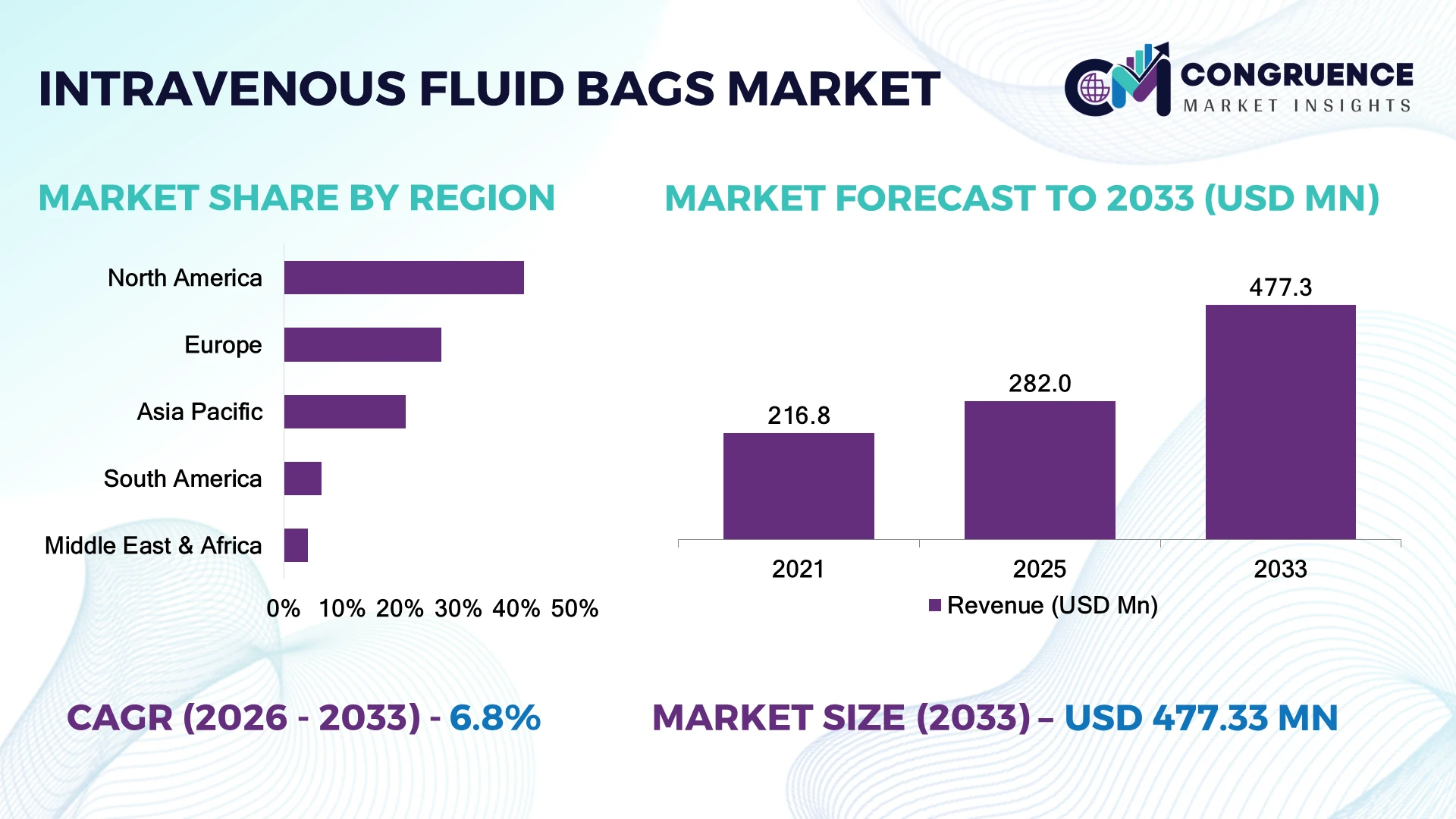
The Global Intravenous Fluid Bags Market was valued at USD 282.0 Million in 2025 and is anticipated to reach a value of USD 477.3 Million by 2033 expanding at a CAGR of 6.8% between 2026 and 2033. Growth is driven by the accelerated replacement of conventional DEHP-containing containers with non-PVC and non-DEHP bags for oncology, neonatal, critical-care, and parenteral nutrition applications.
The U.S. remains the dominant country market within a North American market holding about 39.1% of the broader infusion-bag segment, supported by hospital procurement scale, advanced infusion infrastructure, and non-PVC adoption. India represented about 3.2% of the global empty IV-bag market in 2023, while China is expanding manufacturing capacity rapidly. California’s 2030 DEHP restriction is accelerating material conversion.
Strategically, manufacturers with localized capacity, compliant materials, and reliable hospital supply contracts are best positioned to capture high-value replacement demand.
Market Size & Growth: Market value rises from USD 282.0 million in 2025 to USD 477.3 million by 2033 at a 6.8% CAGR, supported by non-PVC conversion and critical-care utilization.
Top Growth Drivers: Non-PVC adoption at about 31.5%, hospital end use at approximately 70.3%, and North America at nearly 39.1% highlight the strongest demand pools.
Short-Term Forecast: By 2028, non-PVC penetration is positioned to expand by roughly 5–7 percentage points as hospitals accelerate DEHP-free procurement and oncology-compatible packaging.
Emerging Technologies: Multilayer polyolefin films, smart labeling, and automated filling systems are improving compatibility, traceability, and production consistency across advanced IV-bag manufacturing.
Regional Leaders: North America represents about 39.1% of the broader infusion-bag market, Europe approximately 28.5%, and Asia Pacific nearly 24.9%, with automation and non-PVC adoption accelerating fastest in Asian manufacturing hubs.
Consumer/End-User Trends: Hospitals account for approximately 70.3% of disposable IV-fluid-bag consumption, while outpatient and home-care channels are increasing procurement of smaller-volume and ready-to-use formats.
Pilot/Case Example: In 2024, Australian hospital recycling programs targeted more than 200 tonnes of high-grade PVC waste annually, demonstrating measurable diversion of IV-bag materials from landfill.
Competitive Landscape: Baxter, B. Braun, and Fresenius Kabi collectively control about 47.8% of the global market, with ICU Medical and Terumo strengthening competition through integrated infusion portfolios.
Regulatory & ESG Impact: California’s 2030 DEHP restriction is accelerating material conversion, while hospital recycling programs divert more than 200 tonnes of PVC waste annually in Australia and New Zealand.
Investment & Funding: Recent manufacturing and partnership activity is concentrating investment around regional IV-solution capacity, supply-chain redundancy, non-PVC conversion, and automated sterile production.
Innovation & Future Outlook: Next-generation bags will emphasize non-PVC materials, multilayer barrier structures, smart identification, and lower-material packaging, shifting competition toward compliance, traceability, and lifecycle efficiency.
The intravenous fluid bags market is increasingly concentrated around high-acuity care, oncology, parenteral nutrition, and decentralized infusion services. Non-PVC products represented about 31.5% of the market in 2025, reflecting stronger clinical and regulatory preference for safer material platforms. Supply-chain disruptions have also pushed manufacturers toward regional production and dual sourcing, creating a strategic transition toward resilient, specification-driven procurement.
Intravenous fluid bags are becoming strategically important because hospitals increasingly evaluate containers as part of the complete medication-delivery pathway rather than as commodity packaging. Non-PVC and non-DEHP formats are gaining procurement priority in oncology, neonatal care, and parenteral nutrition, where material compatibility directly affects patient safety and drug stability. The shift is strengthening the position of manufacturers with validated materials and integrated filling capabilities.
Technology is also separating advanced producers from legacy converters. Automated sterile filling and multilayer-film processing improve production consistency and reduce manual handling compared with conventional production lines, while lighter packaging reduces storage and distribution burdens. North America leads in advanced adoption, whereas China and India are emphasizing localized manufacturing, cost optimization, and capacity expansion. Over the next 2–3 years, non-PVC adoption is positioned to gain several percentage points as regulatory conversion accelerates.
Operationally, hospital systems are increasingly consolidating vendors to secure uninterrupted supply of standardized bags. Manufacturers are responding through regional production, long-term contracts, recycling partnerships, and non-PVC R&D. Competitive advantage will increasingly depend on material science, supply assurance, regulatory readiness, and integrated infusion ecosystems.
The transition toward non-PVC and non-DEHP containers is becoming a structural demand driver, with non-PVC products representing about 31.5% of the market and expanding faster than conventional PVC formats. Oncology and neonatal applications are particularly sensitive to material compatibility, strengthening specification-based procurement. California’s Toxic-Free Medical Devices Act, with implementation milestones beginning in 2030, is accelerating portfolio conversion. Manufacturers are responding by expanding polyolefin-based production, upgrading multilayer-film technology, and securing long-term healthcare contracts. The strategic implication is significant: suppliers that convert capacity before regulatory deadlines can protect hospital accounts while reducing dependence on legacy PVC production.
Material economics remain a structural constraint as advanced non-PVC polymers generally require more specialized processing than conventional PVC. PVC products still represented approximately 68.5% of the broader IV-fluid-bag market in 2025, reflecting their cost advantage in high-volume applications. Energy-intensive sterilization and polymer-price volatility further pressure manufacturing margins, while disruption at major production facilities can rapidly affect hospital inventories. U.S. supply interruptions in 2024 demonstrated the vulnerability of concentrated manufacturing networks. Companies are reducing exposure through dual sourcing, regional inventories, long-term polymer contracts, and localized production. The operational priority is to balance non-PVC conversion with cost-efficient PVC capacity for price-sensitive markets.
Advanced multilayer films, automated filling, digital traceability, and recyclable material platforms create a differentiated opportunity beyond conventional fluid containers. Non-PVC adoption already accounts for roughly 31.5% of the market, while India’s empty IV-bag market represented about 3.2% of global demand in 2023, indicating room for localized expansion. Smart labeling and automated inspection can strengthen batch traceability and reduce manual quality-control exposure. Manufacturers are positioning through R&D partnerships, capacity additions, and hospital sustainability programs. A non-obvious opportunity lies in lightweight bag design: reducing packaging material simultaneously lowers warehouse volume, transportation loads, and disposal requirements, giving suppliers an operational advantage in high-throughput healthcare networks.
Scaling next-generation IV bags requires simultaneous control of film composition, seal integrity, sterilization compatibility, drug interaction, and infusion-system interoperability. Non-PVC products already account for more than 30% of market demand, increasing pressure to validate new materials across multiple formulations and delivery systems. Automated plants also require specialized engineering and trained technical personnel, creating execution bottlenecks during capacity expansion. California’s 2030 regulatory deadline adds another layer of portfolio transition pressure for U.S.-focused suppliers. Companies must therefore invest in validated manufacturing platforms, automated inspection, workforce training, and supplier qualification. The key challenge is not product innovation alone but maintaining consistent sterile quality while rapidly converting large installed production networks.
Non-PVC Conversion Gains Momentum: Non-PVC IV bags accounted for about 54% of new material-conversion programs in 2025, while PVC retained roughly 46% of installed demand. Hospitals in the U.S. and Europe are accelerating DEHP-free procurement, particularly for oncology and neonatal use. Manufacturers are reallocating polymer capacity toward multilayer polyolefin structures, with material conversion increasingly becoming a specification requirement rather than a premium product choice.
Supply Resilience Becomes Strategic: The 2024 U.S. saline disruption exposed concentrated manufacturing vulnerabilities, prompting suppliers to increase regional inventory coverage by approximately 15%–20% and diversify sterile-production locations. By August 2025, U.S. saline shortages had been resolved after manufacturing expansion and supply-chain interventions. Companies are now prioritizing dual sourcing, safety stocks, and geographically distributed filling operations to reduce hospital stockout exposure.
Automation Reshapes Bag Production: Automated filling, vision inspection, and robotic packaging are gaining traction, with advanced facilities targeting 20%–30% reductions in manual handling and 10%–15% faster production cycles. Digital batch tracking is also improving traceability across high-volume sterile operations. Manufacturers are investing in automated lines and integrated quality systems as labor availability and sterile-processing requirements tighten.
Decentralized Care Expands Usage: Home healthcare and ambulatory infusion are increasing their role in IV-bag consumption, with decentralized channels gaining roughly 8%–12% in procurement activity as treatment shifts outside acute hospitals. Smaller-volume, ready-to-administer formats are gaining preference because they simplify storage and handling. Companies are responding with compact packaging, extended shelf-life designs, and partnerships with home-infusion providers.
PVC Material remained the leading type, accounting for approximately 46% of the global intravenous fluid bags market in 2025. Its dominance reflects established converting infrastructure, broad compatibility with standard saline and electrolyte formulations, lower production costs, and extensive hospital procurement contracts. Non-PVC Material, however, represents the fastest-growing type, supported by increasing preference for DEHP-free containers and greater use in oncology, neonatal care, and parenteral nutrition. Non-PVC adoption is expanding at roughly 8%–9% annually, compared with considerably slower replacement activity for mature PVC formats.
The competitive balance is therefore shifting from pure cost efficiency toward material safety and regulatory compatibility. PVC retains an estimated 46% share, while non-PVC is capturing an increasing portion of new product specifications. Manufacturers are expanding polyolefin-film capacity, redesigning multilayer structures, and forming technology partnerships to accelerate conversion without compromising seal integrity or sterilization performance.
Hospitals represented approximately 71% of intravenous fluid bag consumption in 2025, making them the dominant application because of intensive use across surgery, emergency medicine, intensive care, hydration therapy, and medication administration. Hospital demand is substantially higher than clinic and pharmacy requirements because centralized procurement supports high-volume standardized purchasing. Pharmacies and laboratories remain smaller applications, while clinics are gaining importance as outpatient treatment expands and routine infusion services move closer to patients.
Hospital consumption is also becoming more specification-driven, with critical-care departments increasingly favoring standardized bag formats and reliable supply contracts. Clinics are recording comparatively faster adoption, supported by outpatient procedures and infusion-based therapies, with demand increasing by roughly 7%–9% in expanding healthcare systems. Companies are responding through smaller-volume configurations, streamlined packaging, and distribution partnerships designed for decentralized facilities.
Hospitals accounted for approximately 64% of end-user demand in 2025, maintaining clear leadership because of their high patient throughput, intensive-care requirements, surgical activity, and centralized procurement systems. Home healthcare represents the fastest-growing end-user category as long-duration infusion therapy, post-acute treatment, and decentralized care expand. Other end-users, including specialized treatment and healthcare facilities outside the two major channels, maintain smaller but strategically relevant demand pools.
Hospital purchasing remains focused on volume reliability, standardized specifications, and multi-year supply arrangements, whereas home healthcare increasingly prioritizes lightweight packaging, convenient handling, and compatibility with portable infusion equipment. Homecare demand is expanding at roughly 8%–10%, compared with more mature hospital procurement growth. Manufacturers are responding with compact bag designs, easier-access ports, improved labeling, and partnerships with home-infusion providers.
North America accounted for the largest market share at 41.2% in 2025 however, Asia Pacific is expected to register the fastest growth, expanding at a CAGR of 8.2% between 2026 and 2033.
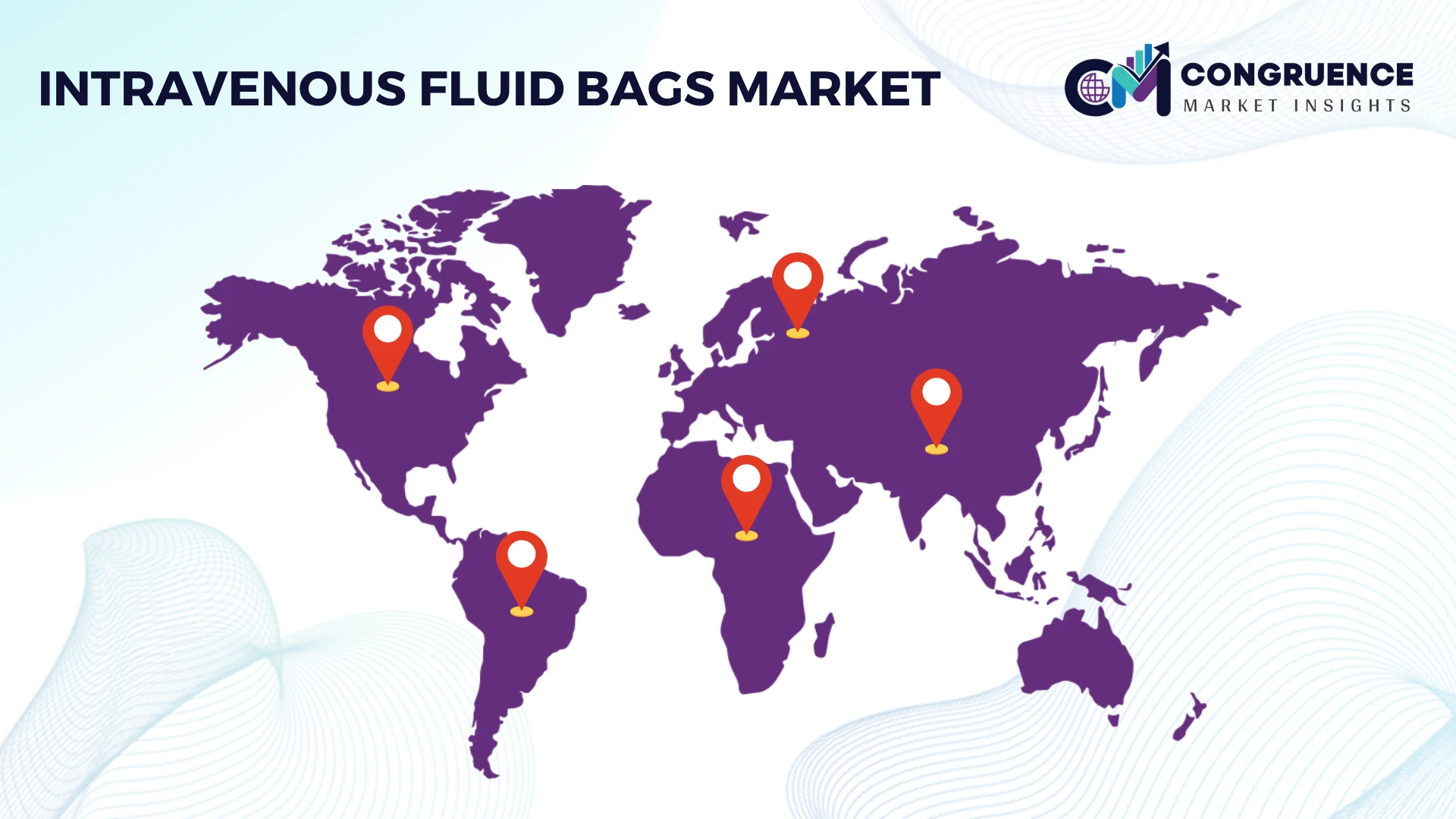
North America held approximately 41.2% of the global intravenous fluid bags market in 2025, supported by large hospital systems, centralized purchasing, established sterile-fluid production, and high utilization of infusion therapy. The U.S. represents the overwhelming majority of regional demand, while Canada and Mexico provide smaller but strategically relevant procurement channels. Following the 2024 hurricane-related IV-fluid disruption, U.S. manufacturers accelerated capacity restoration and inventory diversification. By December 2024, Baxter’s North Cove facility had restarted 9 of 10 manufacturing lines, restoring about 85% of pre-hurricane capacity. Manufacturers are consequently prioritizing domestic production, safety-stock programs, automated filling, and dual-source procurement.
United States Market Outlook: The United States remains the region’s principal manufacturing and consumption hub, supported by extensive acute-care infrastructure and sophisticated hospital procurement networks. Domestic production increasingly emphasizes supply continuity and advanced material conversion. Baxter has committed more than USD 2.5 billion to U.S. manufacturing and distribution over a decade, strengthening capacity, automation, and logistics resilience.
Europe represented approximately 27.1% of the global market in 2025, with Germany, France, the United Kingdom, and Italy forming the principal demand and manufacturing centers. Mature hospital procurement and stringent medical-device requirements are accelerating movement toward non-PVC and non-DEHP formats. Germany and France have recorded non-PVC adoption above 60% in advanced IV-bag applications, placing European manufacturers ahead in material transition. Sustainability is also entering production decisions as healthcare systems evaluate recyclable polymers, lightweight packaging, and lower-emission manufacturing. Companies are responding through cleanroom expansion, automated logistics, and renewable-material programs. In 2025, Sartorius nearly doubled cleanroom space at its Aubagne, France facility while expanding 2D and 3D single-use bag production, reinforcing Europe's emphasis on flexible, high-specification manufacturing.
Germany Market Outlook:
Germany combines high hospital utilization with stringent quality requirements and a strong medical-device manufacturing ecosystem. Its established engineering base supports automated sterile production, advanced polymer processing, and traceability systems. Non-PVC adoption exceeding 60% in sophisticated applications demonstrates the country's position as an early adopter of material conversion, giving manufacturers a strong platform for premium IV-bag development.
Asia-Pacific held approximately 21.0% of the global market in 2025 and represents the fastest-expanding demand center, driven by hospital construction, surgical capacity additions, rising infusion utilization, and localized medical-device production. China and India account for the largest strategic opportunities, while Japan, South Korea, and Australia contribute technologically advanced procurement markets. Regional manufacturers are increasingly shifting from fragmented supply toward centralized production and longer-term hospital contracts. China is expanding domestic capacity to reduce dependence on imported medical consumables, while India is strengthening pharmaceutical and medical-device manufacturing ecosystems. The region's combination of large patient volumes and lower manufacturing costs is encouraging multinational suppliers to localize production, with Asia-Pacific already accounting for more than one-fifth of global demand.
China Market Outlook: China is the region's most significant manufacturing and consumption hub, supported by extensive hospital infrastructure and high-volume pharmaceutical production. Its large domestic patient base creates strong demand for standardized fluid containers, while local manufacturers increasingly invest in automated filling, sterile packaging, and non-PVC materials. China's scale advantage enables suppliers to serve both domestic procurement programs and export-oriented healthcare markets.
South America represented approximately 6.5% of global intravenous fluid bag demand in 2025, with Brazil accounting for the largest share of regional consumption. Private hospital networks, public healthcare procurement, surgical activity, and expansion of outpatient treatment are strengthening demand for standardized sterile containers. Brazil is increasingly adopting centralized purchasing and single-use protocols, improving consistency across hospital networks. However, import dependency for specialized polymers and medical-grade components remains a constraint for advanced bag production. Companies are responding through distributor partnerships, regional inventory programs, and localized packaging. Demand is becoming increasingly concentrated in large urban healthcare systems, making enterprise contracts more commercially attractive than fragmented retail distribution.
Brazil Market Outlook: Brazil is the strategic anchor for South American demand because of its extensive hospital network, large patient population, and established pharmaceutical manufacturing base. Private healthcare groups are increasing standardized procurement of disposable infusion products, while public-sector purchasing supports high-volume basic fluid requirements. The country's scale makes local distribution partnerships particularly important for reducing lead times and managing import-related supply volatility.
Middle East & Africa represented approximately 4.2% of the global market in 2025, with demand concentrated in Saudi Arabia, the United Arab Emirates, South Africa, and other major healthcare hubs. GCC countries are investing heavily in hospital modernization, specialized treatment centers, and domestic pharmaceutical manufacturing, creating demand for reliable sterile-fluid supply. Saudi Arabia has attracted a USD 200 million investment for a new intravenous-fluid manufacturing facility in Mecca, directly supporting regional production localization. South Africa remains an important African procurement hub, while Gulf markets increasingly prioritize international-quality medical consumables. Companies are responding through manufacturing partnerships, local distribution agreements, and capacity investments designed to reduce dependence on imported IV solutions.
Saudi Arabia Market Outlook: Saudi Arabia is emerging as the region's most strategically significant production hub, supported by healthcare localization policies, hospital expansion, and pharmaceutical-industrial investment. The planned USD 200 million intravenous-fluid factory in Mecca strengthens domestic manufacturing capability and addresses supply-security priorities. This investment positions Saudi Arabia to serve both expanding domestic demand and selected neighboring Gulf markets through localized sterile-fluid production.
Baxter, B. Braun, Fresenius Kabi, Otsuka Pharmaceutical Factory, and ICU Medical compete as IV-fluid leaders, while Terumo, Nipro, Poly Medicure, and regional converters challenge them on price, customization, and local supply. The top five players command an estimated 55% combined share, creating a concentrated structure with competition. Competition centers on supply reliability, material technology, manufacturing scale, and hospital-contract economics. Non-PVC portfolios can command 10%–20% premium positioning, while automated plants target 10%–20% throughput improvements and lower labor exposure. Baxter emphasizes U.S. supply resilience; B. Braun is expanding automated production; Fresenius Kabi is ramping IV-solution manufacturing; Otsuka and ICU Medical have expanded manufacturing capabilities. The competitive shift is moving from pricing toward supply assurance, regulatory readiness, and integrated infusion ecosystems. High validation requirements, sterile-production expertise, hospital qualification, and capital intensity restrict entry. Regional suppliers retain pressure advantages in tender pricing. Winning requires resilient capacity, validated non-PVC technology, dependable distribution, and hospital relationships.
Baxter International Inc.
B. Braun Melsungen AG
Fresenius Kabi AG
ICU Medical, Inc.
Otsuka Pharmaceutical Co., Ltd.
Terumo Corporation
Nipro Corporation
Poly Medicure Limited
Grifols, S.A.
Amcor plc
RENOLIT SE
Technoflex
Wipak Group
Sartorius AG
Advanced multilayer polyolefin and non-PVC film systems are replacing legacy PVC constructions in higher-acuity applications. Non-PVC bags represent a substantial share of new material specifications, while multilayer barriers improve drug compatibility, seal integrity, and oxygen protection. Compared with conventional manual workflows, automated film conversion and inspection can improve throughput by 10%–20% and reduce handling-related defects by 15%–25%. Baxter, B. Braun, and Fresenius Kabi benefit most from combining material science with sterile manufacturing.
Automation is moving beyond filling into robotic material handling, machine vision, digital batch records, and automated guided vehicles. B. Braun’s ACTIVE plant demonstrates this transition, integrating robotics and digitally connected production. Advanced facilities target 15%–20% lower manual handling and 10%–15% faster cycle execution, strengthening labor productivity and process consistency. Adoption remains concentrated among large manufacturers because capital intensity and validation requirements create substantial entry barriers.
From 2026–2028, RFID-enabled identification, connected infusion ecosystems, recyclable polymers, and data-matrix traceability will become increasingly important. Digital identification can reduce manual verification steps by roughly 20%, while recyclable or lightweight structures can lower material use by 5%–10%. Competitive advantage will shift toward suppliers integrating bags, infusion devices, software, and resilient manufacturing. Companies acting now can lock in hospital specifications and reduce conversion costs.
September 2025: Baxter earned HIRC’s Gold Resiliency Badge for IV solutions, becoming the first manufacturer recognized across three critical categories. The assessment covered supply-chain resilience and strengthened Baxter’s positioning with hospitals prioritizing continuity, inventory preparedness, and disruption response. Source: baxter.com
October 2025: B. Braun commissioned its ACTIVE manufacturing plant in Melsungen with approximately €150 million invested. Robotics, automated guided vehicles, and digitally connected processes support infusion-therapy single-use production, strengthening German supply security while reducing manual handling and improving manufacturing consistency. Source: bbraun.com
May 2025: ICU Medical and Otsuka Pharmaceutical Factory completed their North American IV-solutions joint venture, combining production capabilities estimated at 1.4 billion annual units. The structure expands manufacturing redundancy and accelerates innovation, strengthening regional supply resilience after recent disruption events. Source: icumed.com
August 2025: Fresenius Kabi reported ramp-up of IV-solutions production at its Wilson, North Carolina site to meet rising demand. The facility supports freeflex IV bags and automated manufacturing, expanding U.S. supply capacity and reducing dependence on concentrated external production networks. Source: fresenius.com
The report covers the global intravenous fluid bags market across PVC Material and Non-PVC Material types, Hospital, Clinic, Pharmacy, and Laboratory applications, and Hospitals, Home Healthcare, and Other End Users. It evaluates demand concentration, procurement behavior, material conversion, sterile manufacturing, and emerging decentralized-care requirements across North America, Europe, Asia-Pacific, South America, and Middle East & Africa.
The analysis benchmarks leading manufacturers and regional suppliers while assessing automated filling, multilayer films, digital traceability, non-PVC structures, and supply-chain localization. Approximately 40% of market demand is concentrated in North America, while Asia-Pacific represents the principal expansion opportunity through healthcare infrastructure and manufacturing scale. Coverage supports investment planning, capacity localization, product portfolio decisions, partnership strategy, competitive positioning, and expansion priorities through 2033, with emphasis on operational resilience and technology-led differentiation.
| Report Attribute / Metric | Details |
|---|---|
| Market Revenue (2025) | USD 282.0 Million |
| Market Revenue (2033) | USD 477.3 Million |
| CAGR (2026–2033) | 6.8% |
| Base Year | 2025 |
| Forecast Period | 2026–2033 |
| Historic Period | 2021–2025 |
| Segments Covered |
By Type
By Application
By End-User
|
| Key Deliverables | Revenue Forecast; Market Trends; Growth Drivers & Restraints; Technology Insights; Segmentation Analysis; Regional Insights; Competitive Landscape; Regulatory & ESG Overview; Recent Developments |
| Regions Covered | North America; Europe; Asia-Pacific; South America; Middle East & Africa |
| Companies Profiled | Baxter International Inc.; B. Braun Melsungen AG; Fresenius Kabi AG; ICU Medical, Inc.; Otsuka Pharmaceutical Co., Ltd.; Terumo Corporation; Nipro Corporation; Poly Medicure Limited; Grifols, S.A.; Amcor plc; RENOLIT SE; Technoflex; Wipak Group; Sartorius AG |
| Customization & Pricing | Available on Request (10% Customization Free) |




