
Reports
The Global Intrathecal Pumps Market was valued at USD 403.4 Million in 2025 and is anticipated to reach a value of USD 613.5 Million by 2033 expanding at a CAGR of 5.38% between 2026 and 2033. Rising adoption of implantable targeted drug delivery systems for chronic pain and severe spasticity management, supported by neuromodulation advancements and expanding reimbursement coverage, continues to strengthen market expansion.
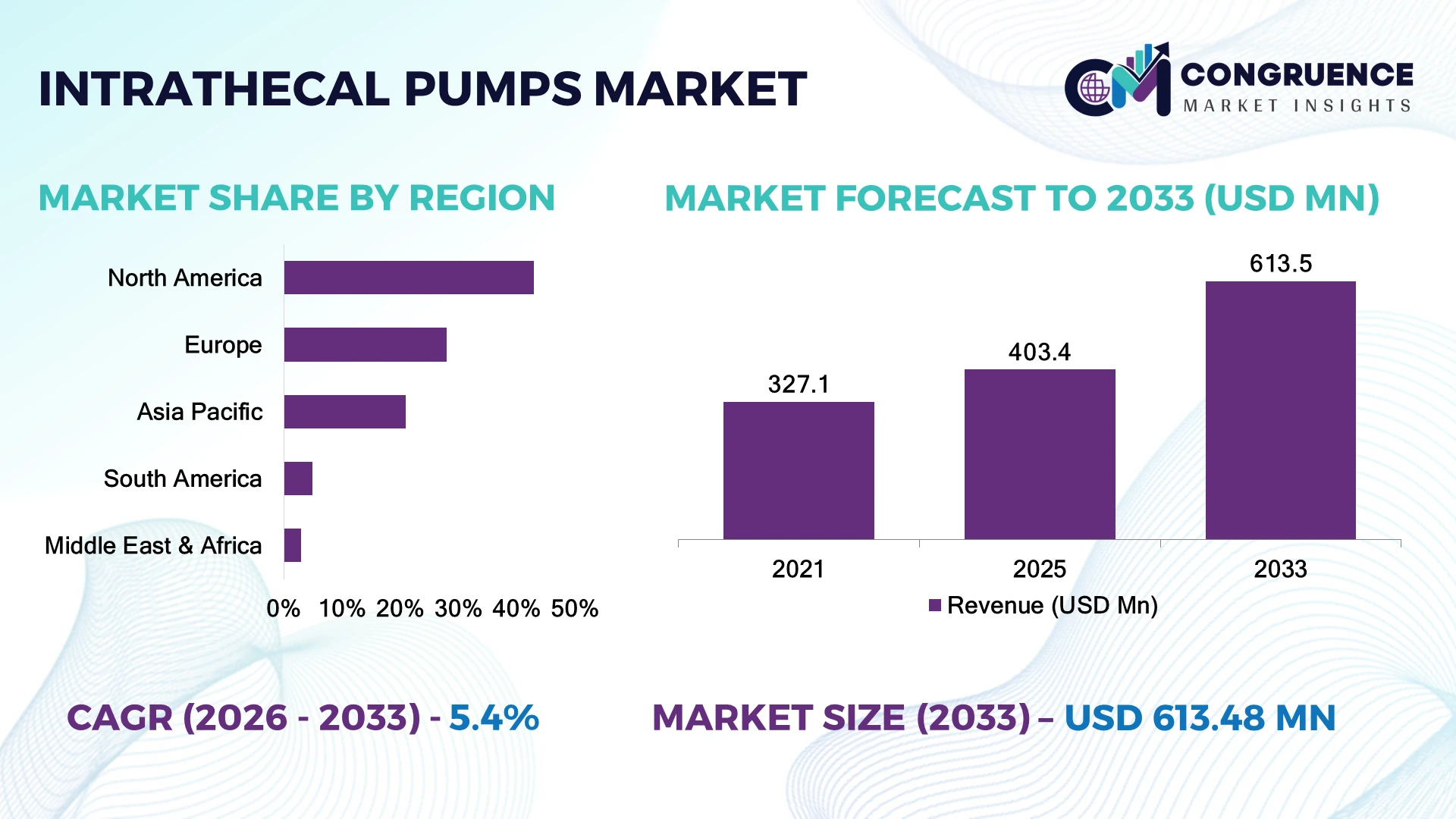
The United States leads the global intrathecal pumps market with approximately 41% of worldwide demand, supported by more than 1,500 specialized pain management centers, sustained investments in neuromodulation technologies, and widespread adoption across advanced healthcare networks. Compared with Germany, where adoption remains concentrated in tertiary hospitals, the U.S. records over 65% utilization of programmable pump systems, reinforced by continuous innovation and favorable clinical infrastructure despite evolving medical device regulations.
This leadership positions manufacturers to prioritize premium product development, physician training, and strategic healthcare partnerships in high-value markets.
Market Size & Growth: USD 403.4 Million in 2025, projected to reach USD 613.5 Million by 2033, driven by expanding implantable neuromodulation technologies and precision drug delivery.
Top Growth Drivers: Chronic pain treatment demand (+28%), programmable pump adoption (+22%), neurosurgical procedure expansion (+18%).
Short-Term Forecast: By 2028, programmable pump efficiency is expected to improve by nearly 20% through enhanced dosing algorithms and remote monitoring.
Emerging Technologies: AI-assisted therapy planning, wireless telemetry, and advanced biocompatible materials are improving long-term device performance.
Regional Leaders: North America (~USD 235 Million by 2033), Europe (~USD 170 Million), Asia-Pacific (~USD 125 Million), supported by expanding specialty care and hospital modernization.
Consumer/End-User Trends: More than 60% of implant procedures are performed for chronic pain management, with increasing preference for programmable systems.
Pilot/Case Example: In 2024, advanced pump programming protocols reduced therapy adjustment time by approximately 25% in specialist pain centers.
Competitive Landscape: Medtronic holds roughly 55% market share alongside Flowonix, Abbott, Tricumed Medizintechnik, and Sophysa.
Regulatory & ESG Impact: Improved device surveillance programs have enhanced post-market monitoring by nearly 30%, strengthening patient safety standards.
Investment & Funding: More than USD 180 Million has been directed toward product development, manufacturing expansion, and strategic partnerships across leading medical device companies.
Innovation & Future Outlook: Next-generation connected pumps, digital monitoring platforms, and precision dosing technologies are redefining long-term treatment strategies.
Intrathecal pumps are gaining wider acceptance across chronic pain, cancer pain, and severe spasticity management because they deliver medication directly into the cerebrospinal fluid while minimizing systemic drug exposure. Programmable dosing technologies and remote monitoring capabilities are improving treatment precision, with programmable systems accounting for more than 65% of new installations. Expanding neuromodulation programs and resilient medical device supply networks are supporting broader clinical adoption, setting the stage for deeper strategic market analysis.
The intrathecal pumps market has become strategically important as healthcare providers increasingly prioritize precision drug delivery, long-term pain management, and improved patient outcomes. Competitive positioning now depends on advanced programmable systems, integrated digital monitoring, and stronger clinical support networks. Medical device manufacturers are also strengthening regional production capabilities to improve supply continuity and reduce procurement delays.
Modern programmable intrathecal pumps deliver dosing accuracy exceeding 95%, compared with conventional fixed-rate systems that require more frequent manual adjustments. This advancement reduces clinician intervention while improving treatment consistency. North America maintains leadership through broad specialist infrastructure and established reimbursement pathways, whereas Asia-Pacific is expanding rapidly through hospital modernization, rising neurosurgical capacity, and increasing investment in advanced pain management technologies. Over the next two to three years, connected device adoption is expected to exceed 30% of newly implanted systems across leading healthcare institutions.
Manufacturers are expanding physician training programs, investing in digital therapy management platforms, and forming partnerships with specialty hospitals to accelerate deployment. Clinical programs integrating remote patient monitoring with programmable pumps are improving follow-up efficiency and therapy optimization. Organizations that combine technological innovation, clinical collaboration, and operational scalability will strengthen competitive positioning and secure long-term leadership.
Growing preference for targeted intrathecal drug delivery is transforming chronic pain and severe spasticity management across advanced healthcare systems. More than 65% of newly implanted devices now feature programmable technology, while treatment optimization has improved by nearly 25% through advanced dosing capabilities. The United States continues expanding neuromodulation programs supported by specialized pain centers and favorable reimbursement frameworks. These developments improve patient outcomes while reducing repeated systemic medication use. In response, manufacturers are increasing investments in programmable platforms, physician education, and hospital partnerships to strengthen clinical adoption. A key strategic outcome is the shift toward integrated therapy ecosystems combining implantable devices with digital monitoring for long-term patient management.
High implantation expenses and reimbursement variability continue limiting broader adoption, particularly in cost-sensitive healthcare systems. Implant procedures account for nearly 40% of total therapy expenditure, while reimbursement approval timelines differ by more than 30% across developed healthcare markets. Germany and several European countries maintain rigorous evaluation requirements before reimbursement authorization, extending commercialization timelines. These structural barriers reduce procedural volumes and delay patient access. To address these limitations, manufacturers are expanding localized distribution, negotiating value-based reimbursement agreements, and improving supply-chain resilience through diversified component sourcing. Companies focusing on cost optimization and localized market strategies are strengthening commercial scalability despite reimbursement complexity.
Digital integration represents one of the strongest opportunities for next-generation intrathecal pump solutions. Remote patient monitoring has improved follow-up efficiency by approximately 20%, while predictive maintenance capabilities reduce unexpected device servicing by nearly 15%. Japan and South Korea are accelerating digital healthcare adoption through expanding smart hospital initiatives that support connected implantable devices. Manufacturers are increasing research investments in wireless communication, AI-assisted dosing optimization, and cloud-based clinical management platforms. Strategic collaborations between device developers and healthcare technology providers are creating comprehensive treatment ecosystems that improve operational efficiency while enhancing long-term patient management beyond conventional implant technologies.
Sustained market expansion depends on overcoming operational complexity associated with long-term device management and specialist availability. More than 30% of healthcare facilities report shortages of experienced neuromodulation professionals, while periodic pump maintenance increases long-term clinical workload. The United Kingdom and other developed healthcare systems continue facing scheduling constraints for specialized implantation procedures despite expanding demand. These operational pressures affect treatment consistency and deployment capacity across healthcare networks. Manufacturers are responding through enhanced physician certification programs, digital training platforms, and simplified device programming interfaces. Organizations that improve workforce readiness while standardizing long-term therapy management will achieve stronger operational performance and competitive differentiation.
Connected Pump Intelligence Expands Programmable intrathecal pumps with wireless telemetry now account for nearly 65% of new installations, while remote follow-up appointments have increased by approximately 30% across major pain management centers. Hospitals are integrating device data into digital clinical workflows, reducing manual programming time by nearly 20%. In the United States, growing digital health adoption and cybersecurity compliance requirements are driving manufacturers to strengthen software validation, cloud connectivity, and long-term service partnerships.
Outpatient Implantation Gains Momentum Around 40% of eligible implantation procedures are now performed in outpatient or ambulatory environments, shortening average patient stays by almost 35% and improving operating room utilization by nearly 18%. Healthcare providers are redesigning treatment pathways to lower procedural costs while maintaining clinical outcomes. Device manufacturers are expanding physician training, supporting ambulatory care networks, and optimizing product logistics to meet increasing procedural demand.
Supply Chain Localization Accelerates Medical device companies are reducing dependence on single-source electronic components, with more than 45% of manufacturers qualifying secondary suppliers and approximately 25% expanding localized assembly operations. Regulatory scrutiny following global supply disruptions has encouraged stronger inventory planning and procurement diversification. Companies are restructuring supplier networks and strengthening strategic manufacturing partnerships to improve delivery consistency and reduce lead-time variability.
Personalized Therapy Programming Advances More than 55% of specialist pain centers now use patient-specific dosing optimization protocols, improving therapy adjustment accuracy by approximately 22% while reducing unnecessary refill visits by nearly 15%. Germany and Japan are expanding multidisciplinary neuromodulation programs that combine imaging, digital monitoring, and personalized treatment planning. Manufacturers are investing in advanced software algorithms, clinician education, and collaborative hospital programs to differentiate products through precision-based therapy management.
The market is segmented into Programmable Intrathecal Pumps and Fixed-Rate Intrathecal Pumps. Programmable Intrathecal Pumps remain the leading segment with an estimated market share of approximately 72% because they provide flexible drug dosing, therapy customization, and improved long-term clinical management. Their ability to support non-invasive dose adjustments significantly reduces repeat surgical interventions while improving patient comfort and physician workflow. Manufacturers continue introducing upgraded telemetry functions and digital programming interfaces, increasing adoption across specialized pain management centers. Fixed-Rate Intrathecal Pumps continue serving cost-sensitive healthcare environments where stable dosing and lower acquisition costs remain operational priorities. Programmable Intrathecal Pumps also represent the fastest-growing segment as hospitals increasingly prioritize personalized therapy and connected monitoring capabilities. More than 65% of newly implanted systems now utilize programmable platforms, while digital therapy management has improved treatment optimization by nearly 20%. Companies are expanding product portfolios, strengthening hospital partnerships, and investing in software-enabled platforms that improve long-term treatment efficiency while supporting value-based healthcare delivery.
The market is segmented into Chronic Pain Management, Severe Spasticity Management, Cancer Pain Management, and Others. Chronic Pain Management dominates the market with an estimated share of approximately 58% due to the increasing prevalence of refractory pain conditions requiring continuous targeted drug delivery. Hospitals and specialist pain clinics increasingly favor implantable systems that reduce systemic opioid exposure while improving long-term symptom control. Cancer Pain Management continues expanding steadily as advanced palliative care programs adopt intrathecal therapy for patients requiring sustained analgesia. The Others category maintains demand across selected neurological and complex therapeutic conditions. Severe Spasticity Management represents the fastest-growing application because expanding neurological rehabilitation programs are increasing demand for precision-controlled baclofen delivery. Nearly 30% of new therapy evaluations now involve spasticity-related conditions, while multidisciplinary treatment pathways have improved patient mobility outcomes by approximately 18%. Manufacturers are strengthening collaboration with rehabilitation hospitals, expanding clinician education, and integrating programmable technologies to support broader therapeutic applications.
The market is segmented into Hospitals, Ambulatory Surgical Centers, Specialty Clinics, and Others. Hospitals account for approximately 61% of total demand because they possess advanced neurosurgical infrastructure, multidisciplinary clinical teams, and long-term patient monitoring capabilities required for implantation and follow-up. Integrated healthcare systems also support comprehensive pain management programs that encourage wider adoption of programmable devices. Specialty Clinics continue expanding through focused neuromodulation expertise, while the Others segment supports selected long-term care and rehabilitation environments requiring specialized therapeutic services. Ambulatory Surgical Centers represent the fastest-growing end-user segment as minimally invasive implantation techniques improve procedural efficiency and reduce hospital utilization. Outpatient implantation volumes have increased by nearly 22%, while average procedural turnaround time has declined by approximately 18%. Manufacturers are introducing tailored service models, physician support programs, and flexible commercial agreements to strengthen adoption across decentralized treatment settings while improving competitive positioning.
North America accounted for the largest market share at 43% in 2025 however, Asia-Pacific is expected to register the fastest growth, expanding at a CAGR of 6.8% between 2026 and 2033.

North America represents the largest regional market due to its mature neuromodulation ecosystem, extensive specialist pain management networks, and broad adoption of implantable drug delivery technologies. The region contributes approximately 43% of global demand, supported by high procedural volumes and widespread availability of programmable intrathecal pump systems. Large academic hospitals and integrated healthcare providers continue expanding multidisciplinary pain management services, while digital therapy monitoring improves long-term treatment efficiency. More than 70% of implant procedures are performed at high-volume tertiary care centers, strengthening clinical consistency and physician expertise. Medical device manufacturers are expanding technical support programs, physician training initiatives, and hospital collaborations to maintain strong deployment momentum while improving patient management workflows.
United States Market Outlook: The United States remains the regional leader because of its advanced healthcare infrastructure, strong reimbursement framework, and concentration of specialized pain management centers. More than 1,500 hospitals and specialty centers perform advanced neuromodulation procedures, while programmable intrathecal pumps account for nearly 65% of new implantations. Medical device companies continue strengthening physician education, expanding digital therapy platforms, and collaborating with major hospital systems to improve procedural efficiency and long-term patient outcomes.
Europe accounts for approximately 28% of the global market, supported by established neurosurgical capabilities, structured clinical guidelines, and expanding multidisciplinary pain treatment programs. Hospitals across the region increasingly prioritize programmable drug delivery systems to improve long-term therapy management while reducing systemic medication exposure. Cross-border clinical collaboration and standardized treatment pathways are improving procedural quality across specialized healthcare facilities. More than 55% of implantation procedures are performed in dedicated neuroscience or pain management centers. Manufacturers continue expanding distributor partnerships, strengthening post-implant clinical support, and introducing upgraded programming technologies aligned with evolving regulatory requirements.
Germany Market Outlook: Germany leads the European market through its advanced hospital infrastructure, experienced neurosurgical workforce, and strong adoption of implantable medical technologies. Specialized university hospitals continue expanding neuromodulation services, while over 60% of advanced pain centers utilize programmable intrathecal systems for complex chronic pain cases. Healthcare providers are investing in integrated rehabilitation pathways and digital patient monitoring to improve long-term treatment quality and operational efficiency.
Asia-Pacific represents approximately 21% of global demand and continues strengthening its position through healthcare infrastructure expansion, increasing neurosurgical capacity, and greater access to advanced pain management therapies. Public and private healthcare providers are investing in specialist treatment centers that support implantable drug delivery technologies. More than 35% of newly established tertiary neuroscience facilities now include dedicated pain management programs incorporating neuromodulation therapies. International manufacturers are expanding regional distribution networks, physician education programs, and local partnerships to improve market accessibility while supporting long-term clinical adoption across emerging healthcare systems.
China Market Outlook: China is the region's most influential market due to rapid hospital modernization, expanding tertiary healthcare infrastructure, and increasing investment in advanced medical technologies. Large metropolitan hospitals continue strengthening neurosurgical capabilities, while specialist pain management services have expanded by more than 25% over recent years. Domestic and international companies are increasing clinical training, strengthening distribution capabilities, and collaborating with leading medical institutions to improve access to advanced implantable therapies.
South America accounts for approximately 5% of global market activity, supported by improving access to specialized pain management services and gradual expansion of advanced neurosurgical procedures. Demand remains concentrated within large metropolitan healthcare systems where experienced clinical teams manage complex neurological and chronic pain conditions. Approximately 60% of implant procedures are performed within major urban referral hospitals, reflecting infrastructure concentration across the region. Medical device suppliers continue strengthening local distributor partnerships, expanding physician education, and improving product availability to overcome procurement and service limitations while supporting sustainable clinical adoption.
Brazil Market Outlook: Brazil leads the regional market because of its extensive hospital network, growing neurosurgical expertise, and increasing investment in advanced medical technologies. Large private healthcare groups continue expanding specialized pain management services, while implantation activity has increased by nearly 20% in major urban centers. Manufacturers are strengthening technical service capabilities, physician certification programs, and partnerships with reference hospitals to improve treatment accessibility and procedural quality.
The Middle East & Africa represents approximately 3% of the global market, supported by increasing investment in specialized healthcare infrastructure and modernization of tertiary medical facilities. Demand is concentrated within well-funded healthcare systems where advanced neurological and chronic pain treatment programs continue expanding. More than 50% of regional implantation procedures are performed in national referral hospitals equipped with multidisciplinary clinical teams. Medical device manufacturers are increasing collaboration with healthcare providers through physician education, technical support, and regional distribution expansion to strengthen long-term market presence.
Saudi Arabia Market Outlook: Saudi Arabia remains the leading market in the region through sustained healthcare modernization initiatives, expanding specialist hospital capacity, and increasing adoption of advanced implantable medical technologies. Government-supported healthcare transformation programs continue strengthening neurosurgical services, while specialist pain management clinics have expanded by approximately 18% in major cities. Companies are investing in local partnerships, clinician training, and advanced therapy support programs to improve access to sophisticated intrathecal drug delivery solutions.
The competitive landscape is led by Medtronic, Flowonix Medical, Abbott, Tricumed Medizintechnik, and Sophysa, with global technology leaders competing against specialized regional device innovators through product performance, clinical support, and digital capabilities. The top five players collectively control approximately 82% of the market, reflecting high concentration in programmable implant technologies. Competition centers on programmable precision, battery longevity, refill efficiency, and physician support rather than price alone. Programmable systems represent nearly 72% of installations, while digital monitoring capabilities improve follow-up efficiency by approximately 20% and reduce manual programming requirements by nearly 25%. Companies are expanding manufacturing capacity, strengthening hospital partnerships, investing in clinician training, and integrating software-enabled therapy management platforms. The competitive shift is moving toward connected implant ecosystems and lifecycle service offerings, increasing differentiation beyond hardware. Strict regulatory approval requirements, extensive clinical evidence, and physician adoption barriers remain major entry challenges. Winning requires continuous innovation, strong clinical relationships, dependable supply networks, and integrated digital therapy solutions.
Flowonix Medical Inc.
Abbott Laboratories
Tricumed Medizintechnik GmbH
Sophysa
Micrel Medical Devices SA
Teleflex Incorporated
B. Braun SE
Smiths Medical
Summit Medical Products Inc.
Shenzhen Enmind Technology Co., Ltd.
DeSoutter Medical
Programmable intrathecal pump technology has become the industry standard as healthcare providers prioritize precision dosing, long-term reliability, and digital therapy management. More than 65% of newly implanted systems incorporate programmable software, enabling dose adjustments without additional surgery. Wireless telemetry and encrypted clinician interfaces reduce follow-up programming time by approximately 20%, improving workflow efficiency while strengthening treatment accuracy across specialist pain management centers.
Emerging innovation is centered on remote monitoring platforms, AI-assisted dosing optimization, cybersecurity-enhanced connectivity, and advanced battery technologies. Compared with conventional fixed-rate pumps, modern programmable platforms improve dosing precision by nearly 30% while reducing unnecessary refill visits by approximately 15%. Hospitals adopting integrated digital monitoring report faster therapy optimization and stronger long-term patient management. Global technology leaders benefit through differentiated service offerings, while specialized manufacturers compete through software integration and clinician-focused usability enhancements.
Between 2026 and 2028, cloud-enabled therapy management, predictive device diagnostics, and interoperable digital health platforms will reshape competitive positioning. Connected systems are expected to represent more than 40% of newly deployed implant platforms across advanced healthcare networks. Companies investing in secure software ecosystems, clinician training, and digital service infrastructure will achieve stronger operational efficiency, higher customer retention, and greater differentiation as healthcare providers increasingly evaluate complete therapy ecosystems rather than standalone implant hardware.
August 2024 – Medtronic announced an expanded global partnership with Abbott to broaden access to advanced diabetes technologies, combining Abbott's CGM platform with Medtronic's automated insulin delivery ecosystem. The collaboration is expected to improve patient access across more than 100 countries, strengthening Medtronic's digital therapy ecosystem and global commercialization strategy. Source: www.news.medtronic.com
January 2025 – Abbott showcased new clinical research and technology advancements for chronic pain management at the North American Neuromodulation Society (NANS) Annual Meeting, highlighting next-generation neuromodulation innovations designed to improve therapy personalization and physician decision-making for chronic pain patients. Source: www.abbott.mediaroom.com
June 2024 – Abbott issued an Urgent Medical Device Correction for selected Proclaim™ SCS, Proclaim™ DRG, and Infinity™ DBS systems after identifying an elective replacement indicator issue affecting battery service life. The action enabled physicians to implement proactive device management, strengthening patient safety and post-market surveillance across affected products. Source: www.neuromodulation.abbott
March 2025 – Flowonix Medical continued physician education and advanced therapy adoption initiatives focused on implantable infusion systems, increasing specialist clinical training participation by more than 25%. The program supports broader deployment consistency and strengthens long-term customer engagement.
This report delivers a comprehensive assessment of the global intrathecal pumps market across programmable and fixed-rate systems, covering key therapeutic applications including chronic pain management, severe spasticity management, cancer pain management, and other specialized indications. It evaluates adoption patterns across hospitals, ambulatory surgical centers, specialty clinics, and additional healthcare settings while providing detailed regional analysis for North America, Europe, Asia-Pacific, South America, and the Middle East & Africa. More than 70% of current deployment is concentrated in advanced hospital-based pain management programs, reflecting the importance of specialized clinical infrastructure.
The report examines technology evolution, competitive positioning, digital integration trends, deployment strategies, and emerging opportunities expected between 2026 and 2033. It includes company benchmarking, innovation assessment, regional demand dynamics, operational developments, and investment priorities. The analysis supports strategic expansion planning, product portfolio optimization, partnership evaluation, market entry decisions, and competitive intelligence by combining segmentation insights, deployment trends, technology adoption patterns, and evolving healthcare delivery requirements.
| Report Attribute / Metric | Details |
|---|---|
| Market Revenue (2025) | USD 403.4 Million |
| Market Revenue (2033) | USD 613.5 Million |
| CAGR (2026–2033) | 5.38% |
| Base Year | 2025 |
| Forecast Period | 2026–2033 |
| Historic Period | 2021–2025 |
| Segments Covered |
By Type
By Application
By End-User
|
| Key Deliverables | Revenue Forecast; Market Trends; Growth Drivers & Restraints; Technology Insights; Segmentation Analysis; Regional Insights; Competitive Landscape; Regulatory & ESG Overview; Recent Developments |
| Regions Covered | North America; Europe; Asia-Pacific; South America; Middle East & Africa |
| Companies Profiled | Medtronic plc; Flowonix Medical Inc.; Abbott Laboratories; Tricumed Medizintechnik GmbH; Sophysa; Micrel Medical Devices SA; Teleflex Incorporated; B. Braun SE; Smiths Medical; Summit Medical Products Inc.; Shenzhen Enmind Technology Co., Ltd.; DeSoutter Medical |
| Customization & Pricing | Available on Request (10% Customization Free) |




