
Reports
The Global Intraosseous Implant Market was valued at USD 120.0 Million in 2025 and is anticipated to reach a value of USD 191.3 Million by 2033 expanding at a CAGR of 6.0% between 2026 and 2033. Growth is primarily driven by rising emergency trauma interventions, expanding military and disaster-response medical preparedness programs, and increasing adoption of rapid vascular access systems in critical care settings.
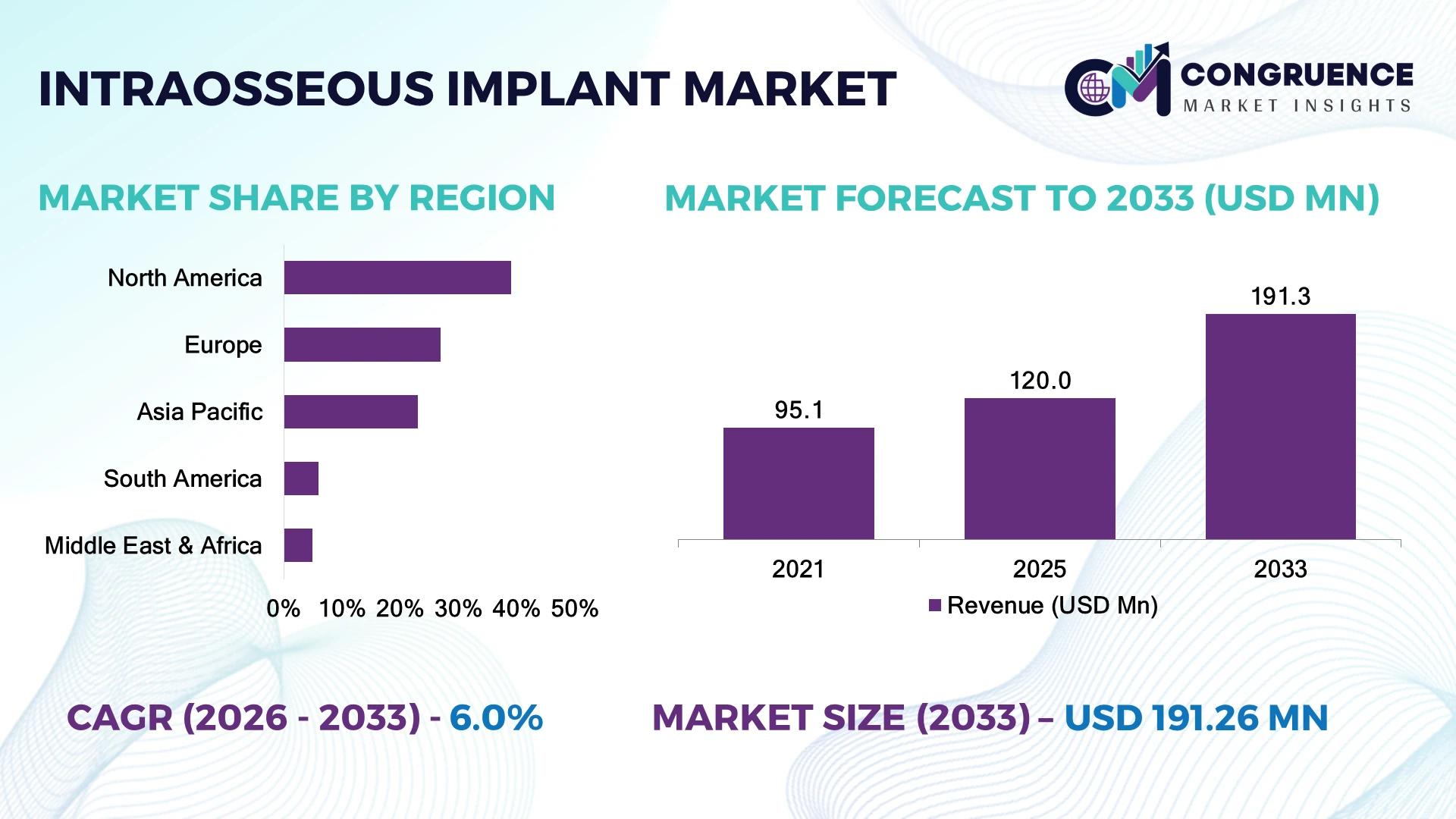
The United States dominates the global market with approximately 38% share, supported by over USD 1.2 billion in annual emergency medicine technology investments and widespread deployment across trauma centers and military healthcare networks. In comparison, Germany accounts for nearly 9% share, benefiting from advanced critical-care infrastructure and high procedural standardization. More than 70% of U.S. Level I trauma centers routinely integrate intraosseous access protocols, while defense-medical modernization initiatives linked to NATO readiness programs continue accelerating adoption across strategic healthcare systems.
Strategically, manufacturers that align product development with emergency preparedness, military healthcare procurement, and advanced trauma-care protocols are positioned to capture the highest-value opportunities.
Market Size & Growth: USD 120.0 Million in 2025 reaching USD 191.3 Million by 2033, supported by expanding emergency vascular-access adoption and trauma-care modernization.
Top Growth Drivers: Trauma admissions (+12%), emergency response deployment (+18%), and military medical procurement (+15%) are accelerating market expansion.
Short-Term Forecast: By 2028, procedure completion efficiency is projected to improve by 20% through advanced powered insertion systems.
Emerging Technologies: AI-assisted training, battery-powered insertion devices, and advanced biocompatible needle materials improve procedural accuracy by 15–25%.
Regional Leaders: North America (~USD 72 Million), Europe (~USD 46 Million), and Asia-Pacific (~USD 38 Million) lead through emergency-care digitization and hospital upgrades.
Consumer/End-User Trends: More than 68% of advanced trauma centers now maintain dedicated intraosseous access kits for critical interventions.
Pilot/Case Example: A 2024 emergency-care deployment program reported a 27% reduction in vascular-access delays during critical trauma events.
Competitive Landscape: Teleflex leads with approximately 22% share alongside Becton Dickinson, Pyng Medical, PerSys Medical, and SAM Medical.
Regulatory & ESG Impact: Standardized emergency-care protocols improved procedural compliance rates by nearly 19% across major healthcare systems.
Investment & Funding: Over USD 300 Million has been directed toward emergency-care technology partnerships, manufacturing expansion, and clinical training initiatives.
Innovation & Future Outlook: Smart connectivity, simulation-based clinician training, and integrated emergency-care platforms are strengthening global deployment strategies.
Intraosseous implant systems are increasingly used across trauma medicine, military healthcare, emergency transport services, and disaster-response operations. Manufacturers are introducing lighter powered insertion devices, improved needle stabilization technologies, and enhanced clinician-training platforms. Nearly 30% of newly procured emergency-access systems now feature digital training support tools. Ongoing healthcare resilience initiatives and localized medical-device supply strategies are further accelerating adoption, setting the stage for deeper strategic market evaluation.
The intraosseous implant market is becoming strategically important as healthcare systems prioritize rapid intervention capabilities, emergency preparedness, and critical-care efficiency. Growing pressure on emergency departments, combined with disaster-response planning and military medical modernization, is increasing demand for reliable vascular-access alternatives. Healthcare infrastructure upgrades and standardized trauma-care protocols are transforming intraosseous access from a specialized procedure into a mainstream emergency-care requirement.
Technological advancement is strengthening market competitiveness. Modern powered insertion systems can reduce access establishment time by more than 40% compared with conventional difficult intravenous access procedures, improving treatment initiation during critical emergencies. The United States continues to lead large-scale deployment through trauma-center networks and defense healthcare programs, while Japan and Germany focus on procedural precision, clinician training, and advanced emergency-care integration. This contrast reflects differences in deployment scale versus operational sophistication.
Recent deployments in air ambulance and emergency medical service fleets demonstrate how organizations are integrating intraosseous systems into standardized response protocols. Companies are expanding training partnerships, strengthening manufacturing resilience, and investing in next-generation insertion technologies. Over the next two to three years, broader emergency-care standardization and increased preparedness spending will reinforce competitive positioning for suppliers capable of delivering reliability, clinical efficiency, and scalable deployment support.
The strongest growth catalyst is the increasing integration of intraosseous access into emergency and trauma-care protocols. More than 70% of advanced trauma centers in the United States maintain formal intraosseous access procedures, while emergency medical service utilization has increased by approximately 18% over the past five years. Military medical procurement programs have expanded by nearly 15%, creating sustained demand for rapid-access devices. Growing focus on mass-casualty preparedness and critical-care response is accelerating adoption across hospitals, air ambulances, and defense healthcare systems. In response, manufacturers are expanding production capacity, introducing powered insertion platforms, and partnering with clinical training organizations. A notable strategic insight is that procurement decisions increasingly prioritize procedural reliability and clinician usability rather than device cost alone.
Limited clinician proficiency and budget-sensitive procurement environments continue to restrict broader deployment. Studies indicate that nearly 25% of healthcare facilities in developing markets lack structured intraosseous training programs, while specialized emergency-care equipment budgets remain constrained in over 30% of secondary hospitals. Dependence on imported medical-device components also exposes suppliers to logistics disruptions and procurement delays. These factors directly affect deployment consistency, purchasing cycles, and operational scalability. To mitigate risks, manufacturers are localizing assembly operations, establishing long-term supply contracts, and introducing simulation-based training solutions. A key operational insight is that training availability increasingly influences purchasing decisions as much as device performance, particularly in emerging healthcare systems.
Significant opportunities are emerging through digital emergency-care ecosystems and next-generation insertion technologies. More than 35% of leading emergency-care providers are investing in simulation-driven clinical education, while smart medical-device integration initiatives have expanded by approximately 22% across advanced healthcare networks. Countries such as India and Saudi Arabia are accelerating emergency infrastructure modernization, creating untapped demand for rapid-access solutions. Manufacturers are developing connected training platforms, enhanced needle designs, and portable emergency-access systems optimized for field operations. A non-obvious opportunity lies in integrating intraosseous devices into broader emergency-response workflows, enabling faster treatment coordination and improved clinical outcomes. Strategic partnerships between device manufacturers and emergency-service providers are becoming increasingly valuable competitive differentiators.
Achieving consistent deployment across diverse healthcare environments remains a major long-term challenge. Variability in emergency-care protocols can exceed 30% between healthcare institutions, while workforce shortages affect critical-care staffing levels in multiple developed markets. Maintaining procedural competency also requires ongoing training and certification investments. As emergency systems become increasingly digitized, integration with clinical workflow platforms introduces additional operational complexity. These challenges affect deployment consistency, healthcare outcomes, and competitive differentiation. Companies must invest in clinician education, digital support tools, and standardized implementation frameworks to ensure sustainable adoption. A critical strategic insight is that long-term market leadership will depend less on hardware innovation alone and more on the ability to deliver scalable training, interoperability, and operational support ecosystems.
Powered Access System Expansion Advanced powered insertion devices are replacing manual alternatives across emergency departments and military medical units. Device deployment increased by nearly 24% during the last two years, while insertion success rates improved by approximately 18% in difficult vascular-access cases. Workforce shortages and faster triage requirements are accelerating adoption. Manufacturers are scaling production, integrating ergonomic designs, and expanding clinician-training partnerships to improve procedural consistency and reduce intervention delays in high-acuity settings.
Simulation-Based Training Integration Healthcare providers are embedding digital simulation platforms into emergency-care workflows to address procedural competency gaps. Training participation rates increased by 28%, while certification completion times declined by nearly 15%. Regulatory emphasis on standardized emergency protocols is reinforcing this transition. Companies are partnering with medical education providers and deploying virtual-learning ecosystems that reduce onboarding costs, improve clinician readiness, and support broader institutional adoption of intraosseous technologies.
Supply Chain Localization Strategies Medical device suppliers are restructuring procurement networks to reduce dependence on single-source manufacturing hubs. Localized component sourcing has increased by approximately 20%, while lead-time variability has fallen by 14%. Ongoing geopolitical trade pressures and healthcare resilience initiatives are driving operational changes. Companies are establishing regional assembly capabilities, diversifying supplier portfolios, and implementing inventory-visibility technologies to strengthen fulfillment reliability and maintain uninterrupted emergency-care device availability.
Integrated Emergency Response Deployment Intraosseous access systems are increasingly embedded within standardized emergency-response kits and mobile care platforms. Deployment across ambulance fleets expanded by nearly 22%, while emergency intervention preparation times declined by 12%. A notable shift involves integrating access devices with broader critical-care protocols rather than treating them as standalone products. Companies are pursuing ecosystem partnerships, expanding field-deployment programs, and aligning product portfolios with emergency-service modernization initiatives.
Powered intraosseous insertion systems account for approximately 58% of total market demand, making them the leading type segment. Their dominance stems from faster insertion performance, reduced operator variability, and strong integration within trauma-care and emergency-response workflows. Healthcare providers increasingly prioritize procedural reliability, particularly in critical-access scenarios where treatment delays directly affect outcomes. Adoption rates among advanced trauma centers exceed 65%, reflecting the operational advantages of powered technologies. Manufacturers continue investing in ergonomic enhancements, battery optimization, and clinician-support programs to reinforce competitive positioning.
Manual intraosseous systems represent the fastest-evolving segment as procurement programs in cost-sensitive healthcare environments seek practical deployment solutions. Utilization across secondary hospitals increased by nearly 17%, supported by lower acquisition costs and simplified maintenance requirements. While powered systems remain the preferred option for high-acuity settings, manual devices retain strategic relevance in emergency preparedness stockpiles, military field operations, and developing healthcare networks. Companies are expanding product portfolios, balancing premium innovation with scalable access solutions, and strengthening distribution partnerships to capture diverse purchasing requirements.
Emergency medicine represents the largest application segment with an estimated 46% share, driven by trauma management, cardiac emergencies, and rapid vascular-access requirements. Demand concentration is highest within emergency departments, ambulance services, and disaster-response programs where treatment speed is critical. More than 60% of emergency-access procedures occur in acute-care environments, reinforcing the segment’s operational importance. Device manufacturers are expanding emergency-focused product lines and supporting standardized protocol integration to strengthen adoption.
Military and battlefield medicine is emerging as the fastest-growing application segment, supported by defense healthcare modernization and enhanced preparedness initiatives. Deployment rates within military medical programs increased by approximately 19%, while training participation expanded by 21%. Pre-hospital care and critical-care transport applications also continue gaining relevance as emergency medical services prioritize rapid intervention capabilities. Companies are investing in ruggedized devices, portable deployment kits, and strategic partnerships with emergency-service organizations. Demand is increasingly shifting toward application-specific solutions that improve workflow efficiency and operational readiness across diverse care environments.
Hospitals account for approximately 62% of total market demand, making them the dominant end-user segment. Their leadership is supported by high patient throughput, advanced trauma-care capabilities, and established emergency medicine infrastructure. More than 68% of large acute-care hospitals maintain dedicated intraosseous access inventories for critical-care interventions. Procurement strategies increasingly emphasize procedural standardization, staff training, and interoperability with emergency-care workflows. Manufacturers continue targeting hospital networks through product customization, long-term supply agreements, and clinical education initiatives.
Emergency Medical Services (EMS) represent the fastest-growing end-user segment as ambulance modernization programs and rapid-response protocols expand globally. EMS deployment increased by nearly 23%, while advanced life-support vehicle integration grew by 18%. Military healthcare organizations and specialty trauma centers also remain important buyers due to mission-critical operational requirements. Companies are responding through portable system development, field-ready device configurations, and collaborative deployment programs. Future demand is progressively shifting toward mobile care environments where rapid vascular access directly supports treatment speed, patient stabilization, and operational effectiveness.
North America accounted for the largest market share at 39.0% in 2025 however, Asia-Pacific is expected to register the fastest growth, expanding at a CAGR of 7.4% between 2026 and 2033.
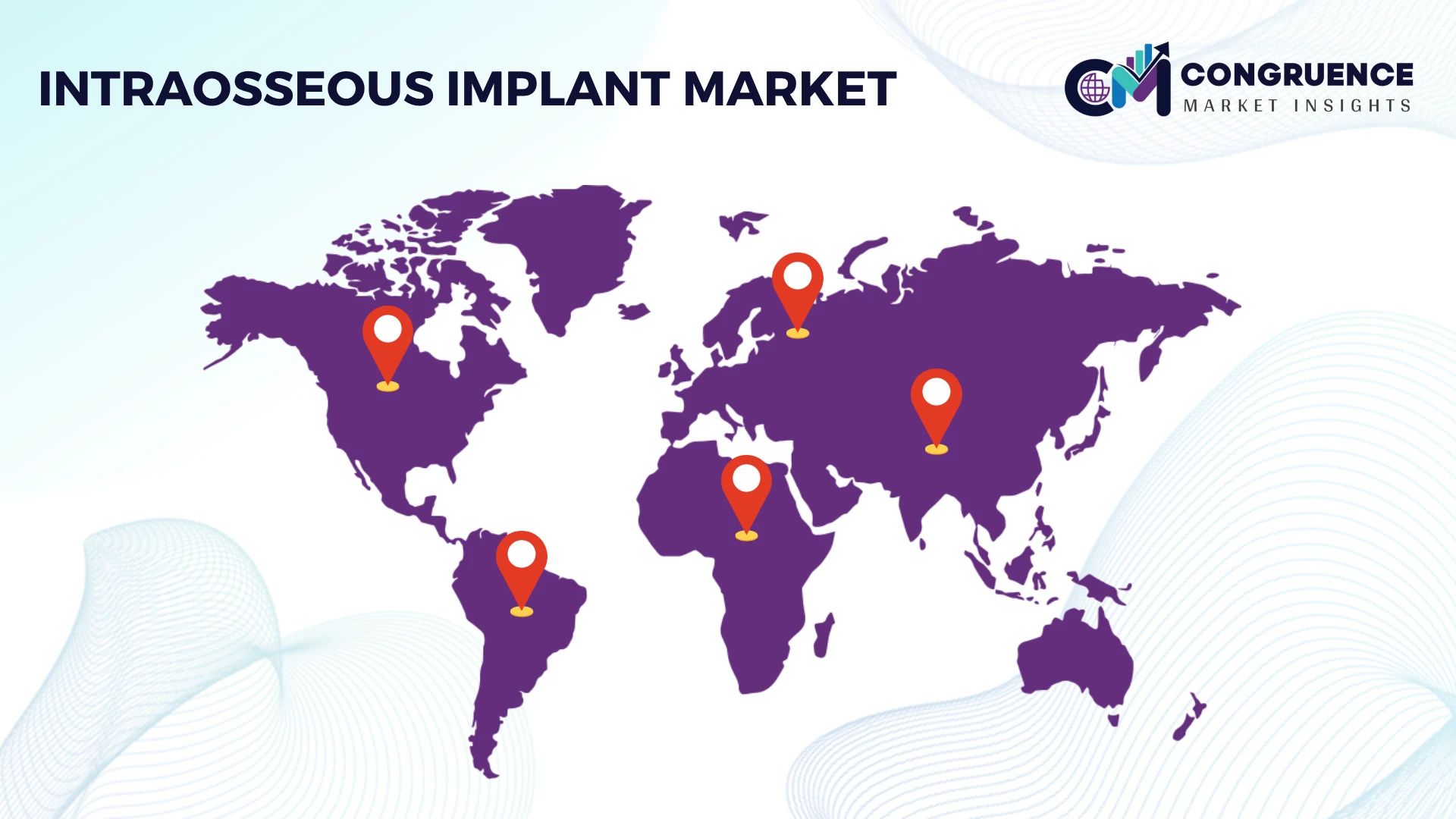
North America represents the largest concentration of intraosseous implant deployment, accounting for approximately 39% of global demand. Market leadership is supported by advanced trauma systems, established emergency medical service networks, and extensive integration of intraosseous access protocols within critical-care pathways. The United States and Canada continue prioritizing rapid-response healthcare infrastructure, increasing procedural utilization across emergency departments, air ambulances, and military medical units. More than 70% of major trauma centers maintain dedicated intraosseous access capabilities, strengthening deployment consistency. Healthcare providers are increasingly adopting powered insertion technologies to improve procedural efficiency and reduce vascular-access delays. Strategic partnerships between device manufacturers and emergency-care organizations are accelerating clinician training and deployment readiness. Continued investment in emergency preparedness programs and healthcare modernization initiatives reinforces North America’s position as the primary market for advanced intraosseous access technologies.
United States Market Outlook: The United States remains the operational center of the regional market due to its extensive trauma-care infrastructure, military healthcare programs, and emergency-response capabilities. Large hospital networks increasingly standardize intraosseous access within critical-care protocols, creating sustained procurement demand. More than 6,000 hospitals and numerous emergency-response agencies maintain advanced vascular-access preparedness programs. Defense healthcare modernization and expanding simulation-based clinician training initiatives further strengthen adoption. Manufacturers continue investing in domestic distribution networks, training partnerships, and next-generation device development to support nationwide deployment requirements.
Europe accounts for approximately 27% of global market activity, supported by highly structured emergency-care systems and strong regulatory alignment across healthcare networks. Hospitals increasingly incorporate intraosseous access into standardized trauma and resuscitation procedures to improve intervention speed during critical emergencies. Adoption is particularly strong within advanced ambulance services and specialized trauma centers. Nearly 60% of tertiary-care facilities across major European healthcare systems utilize formal intraosseous access protocols. Public healthcare modernization programs continue improving equipment availability and clinician competency. Manufacturers are expanding regional training partnerships and supporting compliance-focused deployment strategies. The region also benefits from growing collaboration between emergency-care institutions and medical-device suppliers, strengthening technology integration and procedural standardization across healthcare environments.
Germany Market Outlook: Germany serves as the region’s most influential market due to its advanced healthcare infrastructure, strong emergency-care capabilities, and extensive clinical training ecosystem. The country maintains one of Europe’s highest concentrations of specialized trauma facilities and emergency-response units. More than 80% of leading university hospitals operate comprehensive emergency medicine programs incorporating advanced vascular-access technologies. German healthcare providers emphasize procedural reliability, clinical standardization, and workforce training, encouraging sustained demand. Medical-device companies continue leveraging Germany as a strategic hub for product validation, clinician engagement, and regional market expansion.
Asia-Pacific accounts for nearly 23% of global demand and represents the fastest-evolving regional market. Rapid healthcare infrastructure development, increasing emergency-care investment, and expanding trauma-management capabilities are driving deployment across major economies. Countries including China, India, Japan, and South Korea are strengthening emergency medical networks and upgrading hospital capabilities. Emergency-response capacity expansion has increased by approximately 20% across several major healthcare systems during recent years. Healthcare providers are prioritizing rapid-access technologies to improve treatment efficiency in high-volume clinical environments. Manufacturers are expanding regional distribution, local partnerships, and clinician-training programs to support broader adoption. Rising healthcare accessibility and modernization initiatives continue strengthening long-term market positioning throughout the region.
China Market Outlook: China represents the largest market within Asia-Pacific due to its extensive hospital network, healthcare modernization agenda, and expanding emergency-care infrastructure. Large-scale investments in critical-care facilities and ambulance system upgrades continue supporting deployment growth. Thousands of public hospitals are strengthening emergency-response capabilities through equipment modernization and workforce development programs. The country also benefits from a growing domestic medical-device manufacturing ecosystem, improving supply-chain efficiency and procurement flexibility. Companies are increasingly establishing localized production and distribution operations to support rising institutional demand and regulatory alignment requirements.
South America accounts for approximately 6% of global market activity, supported by ongoing healthcare infrastructure development and emergency-care modernization efforts. Adoption remains concentrated within major urban healthcare systems where trauma treatment capabilities and emergency-response networks are most advanced. Hospitals and ambulance providers increasingly recognize the operational value of rapid vascular-access technologies in high-acuity settings. Emergency medical service upgrades have expanded deployment capacity by nearly 15% across key healthcare networks. However, procurement limitations and uneven infrastructure distribution continue influencing adoption consistency. Manufacturers are addressing these constraints through distributor partnerships, clinician education programs, and targeted deployment initiatives. The market presents meaningful long-term opportunities as healthcare systems continue strengthening emergency preparedness and critical-care capabilities.
Brazil Market Outlook: Brazil serves as the region’s largest market due to its extensive hospital infrastructure, growing emergency medical service network, and healthcare modernization initiatives. Major metropolitan healthcare systems increasingly integrate advanced emergency-care technologies into trauma-management protocols. The country maintains one of the region’s largest ambulance service fleets and critical-care facility networks. Public and private healthcare organizations continue investing in emergency preparedness, workforce development, and equipment upgrades. Medical-device suppliers are expanding local partnerships and training programs to improve clinical adoption and strengthen operational reach across diverse healthcare environments.
The Middle East & Africa region accounts for approximately 5% of global market demand and is increasingly influenced by healthcare transformation initiatives. Governments are investing in emergency-care infrastructure, ambulance modernization, and specialized hospital development to improve healthcare resilience. Several countries are integrating advanced emergency-response technologies into national healthcare strategies, strengthening deployment opportunities. Critical-care infrastructure projects have increased by more than 18% across major healthcare investment programs. Healthcare providers are focusing on procedural efficiency, clinician training, and emergency preparedness capabilities. Manufacturers are responding through regional partnerships, distributor expansion, and targeted education initiatives. While deployment remains concentrated within leading healthcare markets, ongoing infrastructure investment continues improving market accessibility and operational readiness.
Saudi Arabia Market Outlook: Saudi Arabia represents the most strategically significant market within the region due to extensive healthcare investment programs, advanced hospital construction projects, and emergency-care modernization initiatives. National healthcare transformation efforts continue supporting procurement of advanced medical technologies across public and private institutions. Large tertiary hospitals and emergency-response organizations increasingly prioritize rapid-access solutions for critical-care settings. The country has expanded emergency-care infrastructure capacity significantly through ongoing modernization programs. Medical-device manufacturers are strengthening local partnerships, regulatory engagement, and distribution networks to support expanding deployment requirements and long-term healthcare development objectives.
The competitive landscape is led by Teleflex, Becton Dickinson (BD), PerSys Medical, SAM Medical, and Pyng Medical, with global technology leaders competing directly against value-focused regional suppliers and emergency-care specialists. The top five players collectively control approximately 68% of market activity, creating a moderately concentrated structure centered on clinical performance and deployment reliability. Teleflex and BD compete through technology differentiation and institutional contracts, while PerSys Medical and SAM Medical focus on military, pre-hospital, and emergency-response channels. Competition increasingly revolves around insertion efficiency, training support, and procurement integration rather than device pricing alone. Powered systems deliver up to 40% faster vascular access, while standardized procedure kits reduce preparation time by nearly 25%. More than 60% of large healthcare procurements now evaluate training ecosystems alongside device specifications. Manufacturers are expanding distribution networks, strengthening emergency-service partnerships, and introducing workflow-focused innovations. The competitive shift favors integrated solutions, clinician readiness, and supply-chain resilience. Regulatory validation and hospital protocol inclusion remain key entry barriers. Winning requires superior clinical outcomes, scalable training infrastructure, dependable supply execution, and strong institutional relationships.
Becton, Dickinson and Company (BD)
PerSys Medical
SAM Medical
Pyng Medical Corporation
Cook Medical
Biopsybell S.r.l.
Aero Healthcare
Cardinal Health
Merit Medical Systems
Vygon Group
Sarnova
Medax S.r.l.
Zhejiang Geyi Medical Instrument Co., Ltd.
The current technology landscape is dominated by powered intraosseous insertion platforms, advanced needle engineering, and standardized procedure kits. Powered systems are increasingly replacing manual insertion methods because they improve placement consistency by approximately 20% and reduce access establishment time by nearly 40%. More than 65% of advanced trauma centers now utilize powered deployment technologies as part of emergency-access protocols. These systems provide operational advantages through faster intervention, reduced clinician variability, and improved emergency workflow performance.
Emerging technologies focus on digital training ecosystems, simulation-based competency platforms, and connected emergency-care tools. Healthcare organizations implementing simulation-based training programs report procedural proficiency improvements exceeding 25%. Integration of digital learning platforms is accelerating across hospital networks and emergency medical services. Companies investing in clinician-support technologies benefit from stronger product adoption, lower training costs, and improved deployment scalability. The competitive advantage increasingly belongs to suppliers capable of combining hardware performance with workforce readiness solutions.
Between 2026 and 2028, disruptive innovation will center on smart-access platforms, enhanced battery-powered systems, and integrated emergency-response ecosystems. New-generation insertion systems demonstrate approximately 15% greater procedural precision than earlier models. Suppliers that align technology development with emergency-care digitization, preparedness initiatives, and standardized deployment frameworks will secure stronger institutional positioning and long-term procurement advantages.
May 2024 – Teleflex Incorporated expanded its intraosseous vascular access portfolio with the launch of the Arrow™ EZ-IO™ Intraosseous Access Procedure Tray, featuring the first FDA-cleared sterile, single-use battery-powered driver. The system was designed to improve procedural efficiency and sterile-field accessibility across hospitals, strengthening Teleflex’s emergency medicine portfolio. Source: Teleflex Investor Relations Press Release
October 2024 – Becton, Dickinson and Company (BD) launched the BD® Intraosseous Vascular Access System, enabling vascular access in seconds during critical-care situations. The platform introduced integrated passive needle-tip safety and a unique extension-set design intended to improve clinician safety and workflow performance in emergency settings. Source: BD Official Press Release
April 2025 – Becton, Dickinson and Company (BD) expanded commercialization and clinician education efforts around its BD® Intraosseous Powered Driver platform. The initiative highlighted powered insertion technology and integrated safety features designed to support rapid emergency deployment and improve procedural consistency across acute-care environments. Source: BD Product & Technology Update
August 2026 – Teleflex Incorporated received FDA approval for EzPlaz, a freeze-dried plasma product intended for austere and emergency medical environments. The product offers up to 12 months of shelf life without refrigeration, strengthening Teleflex’s emergency and battlefield-care ecosystem while improving trauma-response readiness in remote settings. Source: Teleflex FDA Approval Coverage
This report provides comprehensive analysis of the intraosseous implant market across key product categories, clinical applications, end-user groups, and major geographic regions. Coverage includes powered and manual insertion systems, emergency medicine, military healthcare, pre-hospital care, and critical-care transport applications. The study evaluates deployment patterns, procurement strategies, technology adoption trends, and competitive positioning across North America, Europe, Asia-Pacific, South America, and the Middle East & Africa. More than 60% of market demand remains concentrated within emergency and trauma-care environments, making operational readiness a central assessment factor.
The report also examines technology evolution, training ecosystem development, supply-chain transformation, and emergency-care modernization initiatives shaping future market direction. Strategic insights include company positioning, partnership activity, deployment expansion, and institutional purchasing trends. Coverage extends to emerging opportunities in mobile care, disaster response, military medicine, and digitally enabled training platforms, supporting investment planning, market-entry evaluation, competitive benchmarking, and long-term expansion strategies through 2033.
| Report Attribute / Metric | Details |
|---|---|
| Market Revenue (2025) | USD 120.0 Million |
| Market Revenue (2033) | USD 191.3 Million |
| CAGR (2026–2033) | 6.0% |
| Base Year | 2025 |
| Forecast Period | 2026–2033 |
| Historic Period | 2021–2025 |
| Segments Covered |
By Type
By Application
By End-User
|
| Key Deliverables | Revenue Forecast; Market Trends; Growth Drivers & Restraints; Technology Insights; Segmentation Analysis; Regional Insights; Competitive Landscape; Regulatory & ESG Overview; Recent Developments |
| Regions Covered | North America; Europe; Asia-Pacific; South America; Middle East & Africa |
| Companies Profiled | Teleflex Incorporated; Becton, Dickinson and Company (BD); PerSys Medical; SAM Medical; Pyng Medical Corporation; Cook Medical; Biopsybell S.r.l.; Aero Healthcare; Cardinal Health; Merit Medical Systems; Vygon Group; Sarnova; Medax S.r.l.; Zhejiang Geyi Medical Instrument Co., Ltd. |
| Customization & Pricing | Available on Request (10% Customization Free) |




