
Reports
The Global Intramuscular Injector Market was valued at USD 129.0 Million in 2025 and is anticipated to reach a value of USD 233.7 Million by 2033 expanding at a CAGR of 7.71% between 2026 and 2033. Growth is driven by rising vaccination programs, expanding biologics administration, and increasing adoption of safety-engineered injection devices across healthcare systems.
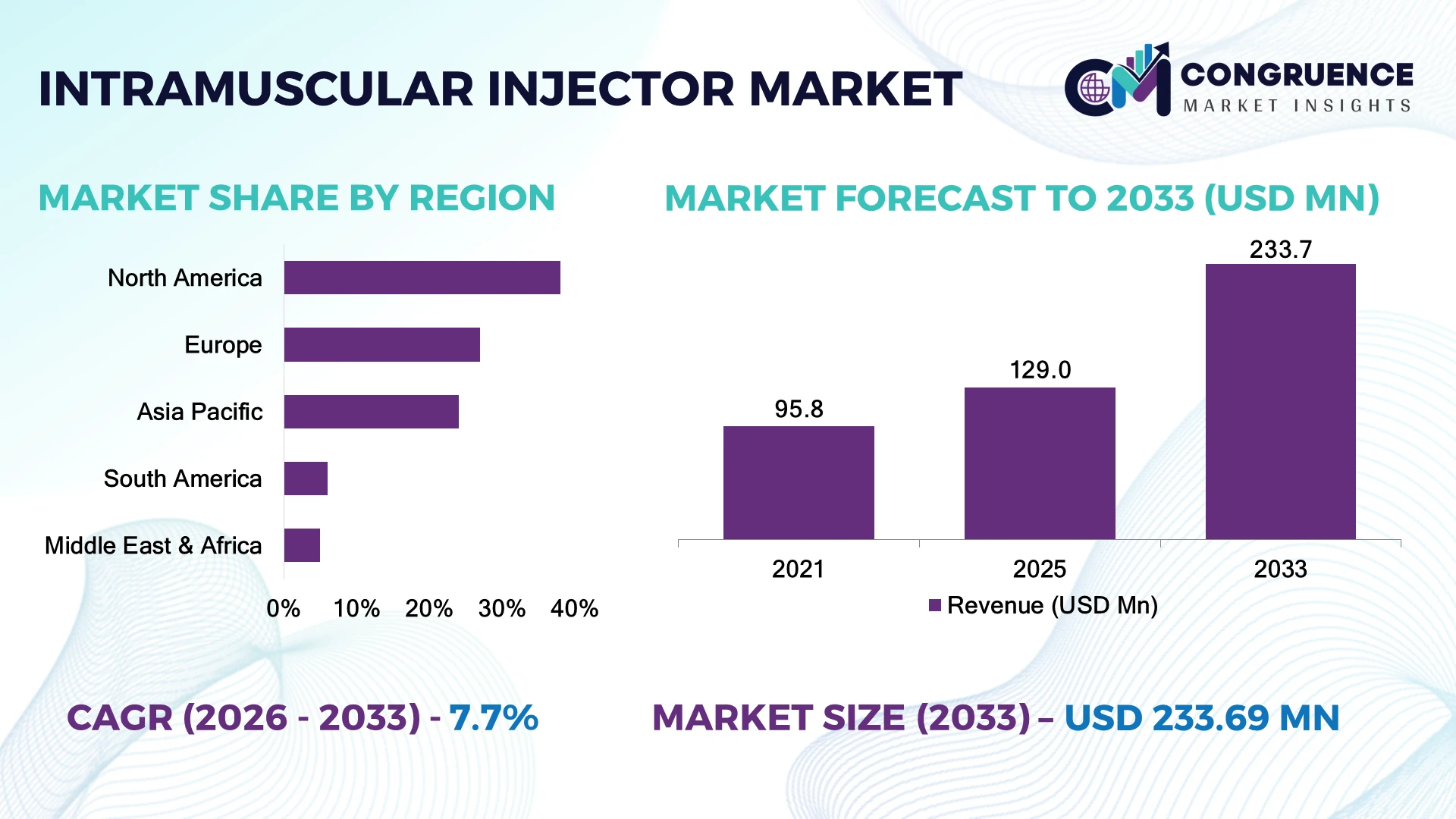
The United States dominates the global intramuscular injector landscape with an estimated 34% market share, supported by over 95% adult vaccination accessibility, strong biologics manufacturing infrastructure, and more than USD 3 billion in annual injectable drug delivery investments. Compared with Germany, where advanced injector adoption exceeds 68% in hospital settings, the U.S. benefits from larger immunization networks and broader outpatient administration volumes. Continued healthcare preparedness initiatives following COVID-era infrastructure expansion further reinforce deployment across public and private healthcare channels.
Strategically, companies that align product innovation with large-scale immunization and biologics delivery programs are positioned to secure long-term procurement advantages.
Market Size & Growth: USD 129.0 Million in 2025, reaching USD 233.7 Million by 2033, supported by expanding biologics administration and advanced injection safety technologies.
Top Growth Drivers: Vaccination coverage expansion (+22%), biologics utilization (+18%), and safety-device adoption (+16%) accelerate market momentum.
Short-Term Forecast: By 2028, injection-related administration errors are projected to decline by 20% through smart safety mechanisms.
Emerging Technologies: AI-assisted dosage verification, automated injector manufacturing, and needle-safety systems improve precision and compliance.
Regional Leaders: North America (~USD 82 Million), Europe (~USD 55 Million), and Asia-Pacific (~USD 48 Million) lead through healthcare modernization and immunization programs.
Consumer/End-User Trends: More than 70% of hospitals prioritize safety-engineered injectors to reduce needle-stick incidents.
Pilot/Case Example: A 2024 hospital-network deployment of smart injection tracking improved administration accuracy by 15%.
Competitive Landscape: BD holds approximately 18% share, alongside Terumo, Nipro, B. Braun, and Cardinal Health.
Regulatory & ESG Impact: Safety-device regulations reduced occupational needle injuries by nearly 30% in compliant healthcare facilities.
Investment & Funding: Over USD 900 Million has been directed toward injectable drug-delivery manufacturing expansion and strategic partnerships.
Innovation & Future Outlook: Connected injection systems, advanced polymers, and digital traceability are strengthening global healthcare supply resilience.
Intramuscular injectors remain essential across vaccination campaigns, biologics administration, and emergency medicine delivery. Manufacturers are integrating safety-lock mechanisms, precision-dose technologies, and advanced polymer components to improve clinical outcomes and user protection. More than 70% of large healthcare facilities now prioritize safety-engineered devices during procurement evaluations. Increasing localization of medical-device manufacturing and stricter healthcare compliance frameworks are also reshaping procurement strategies, creating opportunities for technologically differentiated injector platforms and setting the stage for broader strategic market evolution.
The intramuscular injector market is becoming strategically important as healthcare systems prioritize efficient vaccine delivery, biologics administration, and occupational safety. Competitive positioning increasingly depends on device reliability, safety performance, and manufacturing scalability. Regulatory emphasis on reducing needle-stick injuries and strengthening healthcare preparedness is encouraging hospitals and public health agencies to modernize injection infrastructure and procurement standards.
Technology innovation is reshaping operational efficiency. Safety-engineered injectors reduce accidental needle-stick incidents by nearly 30% compared with conventional devices, while automated assembly systems improve manufacturing productivity by approximately 20%. The United States leads in deployment scale due to extensive immunization infrastructure, whereas Germany and Japan demonstrate stronger adoption of advanced safety-compliant injector technologies within hospital networks. This divergence creates distinct opportunities for manufacturers targeting volume-driven and technology-driven markets.
Over the next two to three years, healthcare providers are expected to expand adoption of digitally traceable and safety-enhanced injector platforms. A practical example is large hospital groups integrating injector tracking systems to improve inventory visibility and administration compliance. Companies are responding through manufacturing expansion, strategic partnerships, and investment in next-generation safety mechanisms. Organizations that combine clinical performance, supply-chain resilience, and regulatory readiness will strengthen competitive advantage and reinforce long-term market relevance.
Rising immunization initiatives and increased biologic drug usage represent the strongest structural driver for intramuscular injector adoption. More than 60% of newly approved biologic therapies require injectable administration, while national immunization programs in several developed countries maintain vaccination coverage exceeding 85%. Healthcare facilities have also reported up to 25% higher procurement of safety-engineered injection devices following stricter occupational safety requirements. The post-pandemic modernization of healthcare preparedness infrastructure has further accelerated demand for reliable injection systems. In response, leading manufacturers are expanding production capacity, strengthening distribution partnerships, and introducing advanced safety features. A notable strategic insight is that procurement decisions are increasingly shifting from unit cost evaluation toward lifecycle safety and compliance performance, favoring premium injector technologies.
Stringent regulatory requirements and rising manufacturing expenses continue to constrain market scalability. Safety-compliant injector designs can increase production costs by 15–25% compared with conventional alternatives, while quality validation and sterilization processes account for a significant portion of operational expenditure. Dependence on specialized medical-grade polymers and precision-engineered components creates supply vulnerabilities, particularly during logistics disruptions. In Europe, compliance documentation requirements have increased approval timelines by approximately 20% for certain device categories. These factors directly affect margins and procurement affordability, especially in cost-sensitive healthcare systems. To mitigate risks, companies are diversifying supplier networks, localizing production facilities, and establishing long-term material contracts. Operationally, firms with vertically integrated manufacturing structures are demonstrating stronger resilience against cost fluctuations.
Digital healthcare integration is creating substantial opportunities for advanced intramuscular injector solutions. More than 40% of large healthcare organizations are evaluating connected medical-device ecosystems capable of improving administration accuracy and inventory management. Smart injector technologies equipped with traceability functions can reduce documentation workloads by nearly 25%, creating measurable operational benefits. India and Saudi Arabia are expanding healthcare infrastructure investments, generating new demand for modern injection delivery systems. Simultaneously, advanced materials and precision manufacturing techniques are extending device reliability and user safety. Manufacturers are accelerating R&D programs, partnering with healthcare software providers, and expanding regional production capabilities. A unique opportunity lies in combining injector hardware with digital monitoring platforms, transforming a traditionally commodity-focused product into a higher-value clinical management solution.
Long-term market development depends on consistent deployment practices and workforce competency. Healthcare organizations report that up to 18% of injection-related procedural deviations stem from inconsistent device handling and training gaps. As injector designs become increasingly sophisticated, training requirements and implementation complexity also increase. Large healthcare networks operating across multiple facilities face standardization challenges that can affect safety performance and procurement efficiency. Additionally, evolving device regulations require periodic operational updates and staff certification processes. These pressures impact deployment consistency and long-term competitiveness. Companies must invest in comprehensive training ecosystems, digital education tools, and clinical support partnerships to address adoption barriers. Strategically, organizations that pair advanced injector technologies with robust user-training frameworks will achieve stronger utilization outcomes and more sustainable market positioning.
Safety-Engineered Device Standardization Healthcare providers are accelerating the transition toward safety-engineered intramuscular injectors, with adoption rates exceeding 72% across large hospital networks and occupational needle-stick incidents declining by nearly 28%. Regulatory compliance requirements and workforce safety initiatives are driving procurement shifts away from conventional devices. Manufacturers are responding by expanding safety-lock portfolios, redesigning injector ergonomics, and increasing automated production capacity to support large-volume institutional contracts while reducing compliance-related operational risks.
Digital Traceability Integration Expands More than 45% of enterprise healthcare systems are incorporating digital tracking capabilities into medication administration workflows, while inventory discrepancies have declined by approximately 18% following implementation. Barcode-enabled and connected injector solutions are improving administration verification and supply-chain visibility. Healthcare organizations are integrating injectors into broader digital health ecosystems, prompting manufacturers to establish software partnerships and deploy interoperable tracking platforms that strengthen operational control and audit readiness.
Manufacturing Localization Accelerates Medical device firms are restructuring supply chains as procurement teams prioritize regional manufacturing resilience. Localized production capacity has increased by over 20% in several strategic healthcare manufacturing hubs, reducing lead times by nearly 15%. Supply-chain disruptions and geopolitical trade uncertainties have accelerated this shift. Companies are investing in domestic assembly facilities, supplier diversification programs, and advanced manufacturing technologies to improve delivery reliability and strengthen contract fulfillment performance.
Biologics Delivery Requirements Evolve Injectable biologic therapies now account for more than 35% of specialty drug administration volumes, creating demand for higher-precision intramuscular delivery systems. Advanced injector platforms have improved dosing consistency by approximately 12% compared with legacy designs. A less obvious trend is the growing alignment between pharmaceutical developers and injector manufacturers during product planning stages. Companies are forming co-development partnerships, optimizing device compatibility, and expanding customized injector portfolios to support increasingly complex therapeutic formulations.
Safety intramuscular injectors represent the leading segment, accounting for approximately 48% of market demand. Their dominance stems from superior occupational safety performance, regulatory alignment, and broad deployment across hospital networks. Healthcare organizations increasingly prioritize devices that reduce accidental needle-stick injuries and improve compliance management. Adoption rates for safety-enabled systems have increased by more than 25% over the past three years, reinforcing their position as the preferred procurement category. Conventional injectors continue to maintain relevance in cost-sensitive healthcare settings, particularly where budget optimization remains a primary purchasing criterion. Auto-disable intramuscular injectors are emerging as the fastest-growing type, supported by large-scale immunization programs and infection-prevention protocols. Utilization within public vaccination initiatives has expanded by nearly 30%, driven by requirements for single-use reliability and contamination control. Prefilled injector formats are also gaining traction due to workflow efficiency benefits, reducing preparation time by approximately 20%. Manufacturers are increasing investments in safety mechanisms, prefilled technologies, and automation-driven production expansion. Strategic priorities are shifting toward premium, compliance-focused injector platforms capable of supporting evolving clinical administration standards and high-volume healthcare delivery environments.
Vaccination applications hold the largest share of the intramuscular injector market at approximately 42%, supported by national immunization schedules, adult booster programs, and public-health preparedness initiatives. High-volume deployment requirements make vaccination the most operationally intensive application segment. Demand concentration remains strongest within government-supported healthcare programs where administration speed, safety, and scalability are critical performance criteria. Pharmaceutical suppliers and healthcare providers continue expanding procurement agreements to support uninterrupted immunization coverage. Biologics and specialty therapeutics represent the fastest-growing application segment, with utilization increasing by nearly 24% as injectable treatments become more prevalent in chronic disease management. Emergency medicine and hospital-based medication delivery remain mature application categories, benefiting from established clinical workflows and extensive infrastructure support. Preventive care and outpatient administration settings are also expanding, supported by broader healthcare accessibility initiatives. Companies are responding through injector optimization, workflow integration solutions, and strategic collaborations with pharmaceutical manufacturers. Demand is increasingly shifting toward applications requiring higher precision, improved traceability, and stronger safety compliance across diverse care environments.
Hospitals remain the largest end-user segment, accounting for approximately 52% of market demand due to their high patient throughput, extensive medication administration requirements, and centralized procurement structures. Large healthcare networks continue to prioritize safety-enhanced and workflow-efficient injector systems, particularly in acute care and emergency treatment settings. Institutional purchasing volumes remain significantly higher than those of other end-user groups, reinforcing hospital leadership in deployment scale and operational influence. Ambulatory care centers represent the fastest-growing end-user category, with adoption increasing by nearly 22% as healthcare delivery shifts toward outpatient treatment models. Clinics are also expanding injector utilization to support preventive care, vaccination programs, and specialty therapy administration. Government healthcare agencies continue to play a critical role through public immunization initiatives, while military and occupational healthcare providers maintain specialized procurement requirements. Manufacturers are targeting these segments through customized product portfolios, distribution partnerships, and flexible pricing strategies. Future demand is increasingly concentrated among decentralized care environments seeking efficiency gains, faster patient throughput, and simplified administration workflows.
North America accounted for the largest market share at 38% in 2025 however, Asia-Pacific is expected to register the fastest growth, expanding at a CAGR of 8.9% between 2026 and 2033.
North America maintains the leading position in the intramuscular injector market due to extensive healthcare infrastructure, large-scale vaccination programs, and rapid adoption of safety-engineered injection devices. The region accounts for approximately 38% of global demand, supported by strong hospital procurement networks and high biologics administration volumes. Healthcare providers continue replacing conventional injectors with advanced safety-enabled systems to improve occupational safety and regulatory compliance. More than 70% of large healthcare systems have incorporated standardized injector procurement frameworks emphasizing safety and administration efficiency. Strategic partnerships between medical device manufacturers and healthcare providers are accelerating deployment of next-generation injection technologies. Continued investment in digital healthcare integration and medication traceability systems is further strengthening operational efficiency across hospitals, outpatient facilities, and public health institutions.
United States Market Outlook: The United States represents the largest national market within North America due to its extensive immunization infrastructure, advanced biologics ecosystem, and large hospital network concentration. More than 95% of acute-care hospitals utilize standardized injection protocols, supporting consistent demand for safety-engineered devices. Strong pharmaceutical manufacturing capabilities and expanding outpatient treatment programs continue driving adoption of technologically advanced intramuscular injectors. Procurement strategies increasingly prioritize compliance performance, workforce protection, and digital medication administration integration.
Europe remains a highly mature market characterized by stringent healthcare regulations, strong occupational safety standards, and broad adoption of advanced medical devices. The region contributes approximately 27% of global market demand and demonstrates strong penetration of safety-engineered injector technologies. Regulatory emphasis on reducing healthcare-associated injuries has accelerated replacement cycles across hospitals and public healthcare systems. Healthcare providers are increasingly deploying injector platforms with enhanced safety mechanisms and improved ergonomic designs. Several healthcare networks have expanded centralized procurement programs, improving purchasing efficiency and product standardization. Modernization of healthcare infrastructure and increased focus on patient safety continue supporting stable demand across both institutional and outpatient care environments.
Germany Market Outlook: Germany serves as the region’s strategic market leader due to its advanced medical technology sector, strong healthcare infrastructure, and high compliance standards. Safety-engineered injector adoption exceeds 65% across major healthcare facilities, reflecting strong regulatory alignment and workforce safety priorities. The country benefits from a robust medical device manufacturing base and extensive hospital modernization initiatives. Continued investment in healthcare digitization and clinical workflow optimization is supporting sustained demand for high-performance injection delivery systems.
Asia-Pacific represents the fastest-expanding regional market, driven by healthcare infrastructure development, expanding vaccination coverage, and increasing domestic medical-device production. The region accounts for approximately 24% of global market demand and continues to strengthen its manufacturing and deployment capabilities. Governments are investing heavily in healthcare accessibility, immunization programs, and local medical technology production. Several major healthcare systems have expanded injector procurement volumes by more than 20% to support preventive healthcare initiatives and specialty treatment delivery. Regional manufacturers are scaling production capacity while international companies increase partnerships and distribution investments to strengthen market presence. Rising healthcare expenditure and improving clinical infrastructure are accelerating adoption across both urban and emerging healthcare markets.
China Market Outlook: China leads the Asia-Pacific market through its extensive healthcare network, large-scale manufacturing ecosystem, and strong medical device production capabilities. Domestic manufacturers continue expanding automated production facilities to improve supply reliability and cost efficiency. Public healthcare initiatives and vaccination deployment programs support substantial procurement volumes across provincial healthcare systems. The country’s growing biologics sector and increasing emphasis on medical-device innovation are strengthening demand for advanced intramuscular injector technologies with enhanced safety and precision features.
South America is experiencing steady development in the intramuscular injector market as healthcare accessibility improves and public immunization initiatives expand. The region contributes approximately 6% of global demand and benefits from growing investment in healthcare infrastructure and disease prevention programs. Government-led vaccination campaigns continue to represent a major demand driver for injector procurement. Healthcare providers are increasingly adopting safety-enhanced devices to improve clinical outcomes and workforce protection. While infrastructure disparities remain across certain healthcare systems, ongoing modernization efforts are improving deployment consistency. Strategic distribution partnerships and localized procurement initiatives are helping manufacturers strengthen market penetration and operational reach throughout the region.
Brazil Market Outlook: Brazil remains the dominant market within South America due to its large population base, extensive public healthcare system, and significant vaccination infrastructure. National immunization programs support substantial annual injector deployment volumes across healthcare facilities and community health centers. Expanding healthcare investments and increasing adoption of safety-focused medical devices are enhancing market opportunities. The country’s healthcare modernization efforts continue encouraging procurement of higher-quality injection delivery technologies designed to improve efficiency and administration reliability.
The Middle East & Africa market is advancing through healthcare infrastructure expansion, public health modernization initiatives, and increasing investment in medical technology capabilities. The region accounts for approximately 5% of global demand and is gradually strengthening its healthcare delivery capacity. Governments are prioritizing healthcare transformation programs aimed at improving treatment accessibility and operational efficiency. Large healthcare projects and expanding hospital networks are creating new opportunities for injector deployment across both public and private healthcare sectors. Strategic partnerships with international medical device suppliers are helping improve technology access and procurement quality. Infrastructure development remains a central factor influencing long-term market expansion and adoption consistency.
Saudi Arabia Market Outlook: Saudi Arabia represents the most strategically significant market in the region due to substantial healthcare investment programs, expanding hospital infrastructure, and ongoing healthcare transformation initiatives. The country continues to increase deployment of advanced medical technologies across public and private healthcare facilities. Large-scale healthcare modernization projects are supporting demand for safety-engineered injector solutions and improved medication administration systems. Strong government support for healthcare capacity expansion and digital transformation is enhancing procurement opportunities while strengthening the operational foundation for long-term market development.
The competitive landscape is led by BD, B. Braun, Terumo, Nipro Corporation, Cardinal Health, and Smiths Medical, with global leaders competing against regional manufacturers and specialized device suppliers. The top five players collectively control approximately 58% of market activity, leveraging established distribution networks, regulatory expertise, and large-scale manufacturing capabilities. Competition centers on safety performance, production efficiency, supply-chain resilience, and clinical workflow integration rather than price alone. Safety-engineered injector adoption has increased by over 25%, while automated production systems have improved manufacturing efficiency by nearly 20% and reduced defect rates by approximately 15%. Companies are expanding domestic manufacturing, forming healthcare-provider partnerships, and investing in advanced safety mechanisms and digital traceability capabilities. The market is shifting toward technology-enabled injection platforms as healthcare systems prioritize compliance and workforce protection. Regulatory approvals, sterilization requirements, and validated manufacturing infrastructure remain major entry barriers. Winning requires scalable production, superior safety outcomes, reliable supply continuity, and strong institutional procurement relationships.
B. Braun Melsungen AG
Terumo Corporation
Nipro Corporation
Cardinal Health
Smiths Medical
Medtronic plc
Retractable Technologies, Inc.
Sharps Technology, Inc.
Gerresheimer AG
SCHOTT Pharma
Hindustan Syringes & Medical Devices Ltd.
ICU Medical, Inc.
Current technology adoption is centered on safety-engineered intramuscular injectors featuring automatic needle shielding, passive locking systems, and ergonomic activation mechanisms. More than 70% of large healthcare providers now prioritize safety-enabled devices during procurement. These systems have reduced accidental needle-stick incidents by nearly 30% while improving administration workflow efficiency by approximately 15%. Manufacturers with advanced safety portfolios benefit from stronger institutional purchasing alignment and higher regulatory compliance performance.
Emerging technologies are focused on digital traceability, smart labeling, and connected medication administration platforms. Around 45% of major healthcare organizations are evaluating integration between injection devices and electronic medication management systems. Digital tracking capabilities improve inventory visibility by approximately 18% and reduce documentation workloads by nearly 20%. Companies investing in software-enabled injector ecosystems are gaining operational advantages through improved compliance management and supply-chain transparency.
Disruptive innovation is increasingly driven by advanced materials, prefilled delivery systems, and precision-dose technologies. Compared with conventional injectors, next-generation prefilled systems reduce preparation time by roughly 25% and improve dosing consistency by approximately 12%. Global manufacturers and pharmaceutical partners are accelerating co-development programs to support injectable biologics and specialty therapies. Between 2026 and 2028, organizations that integrate digital monitoring, advanced safety engineering, and scalable automated production will strengthen competitive positioning and procurement success.
January 2025 – BD expanded U.S. manufacturing capacity for syringes and safety-engineered injection devices, adding new production lines that increased domestic safety-device capacity by more than 40%. The expansion strengthens healthcare supply resilience and supports large-scale vaccination and drug-delivery requirements. Source: www.investors.bd.com
February 2024 – Terumo Medical Corporation broke ground on a new 64,000-square-foot manufacturing facility in Puerto Rico supported by a USD 30 million investment. The expansion enhances production scalability and improves long-term supply continuity for critical injection-related healthcare products. Source: www.terumois.com
March 2024 – Terumo expanded production capabilities at its Yamaguchi manufacturing operations, increasing CDMO production capacity to approximately 3.5 times its original level. The investment strengthens device-manufacturing flexibility and supports rising demand for advanced drug-delivery and injectable healthcare solutions. Source: www.terumo.co.jp
June 2026 – B. Braun and Dräger expanded their strategic collaboration to advance connected acute-care ecosystems through standards-based interoperability. The initiative improves integration across medication management and clinical monitoring workflows, enhancing operational efficiency and supporting broader healthcare digitalization strategies.
This report provides comprehensive coverage of the intramuscular injector market across key product types, applications, end-user categories, and major geographic regions. The analysis evaluates safety injectors, conventional injectors, auto-disable systems, and prefilled formats, while assessing deployment across vaccination programs, biologics administration, emergency medicine, and routine therapeutic applications. The study examines adoption patterns across hospitals, ambulatory care centers, clinics, government healthcare systems, and specialized healthcare providers. More than 50% of demand remains concentrated within institutional healthcare environments where safety compliance and administration efficiency drive procurement decisions.
The report further assesses competitive positioning, manufacturing trends, technology adoption, supply-chain strategies, and regional deployment dynamics across North America, Europe, Asia-Pacific, South America, and the Middle East & Africa. Coverage includes advanced safety technologies, digital traceability integration, automated manufacturing systems, and emerging delivery innovations. Strategic insights support expansion planning, investment prioritization, partnership evaluation, product development decisions, and long-term market positioning through 2033.
| Report Attribute / Metric | Details |
|---|---|
| Market Revenue (2025) | USD 129.0 Million |
| Market Revenue (2033) | USD 233.7 Million |
| CAGR (2026–2033) | 7.71% |
| Base Year | 2025 |
| Forecast Period | 2026–2033 |
| Historic Period | 2021–2025 |
| Segments Covered |
By Type
By Application
By End-User
|
| Key Deliverables | Revenue Forecast; Market Trends; Growth Drivers & Restraints; Technology Insights; Segmentation Analysis; Regional Insights; Competitive Landscape; Regulatory & ESG Overview; Recent Developments |
| Regions Covered | North America; Europe; Asia-Pacific; South America; Middle East & Africa |
| Companies Profiled | Becton, Dickinson and Company (BD); B. Braun Melsungen AG; Terumo Corporation; Nipro Corporation; Cardinal Health; Smiths Medical; Medtronic plc; Retractable Technologies, Inc.; Sharps Technology, Inc.; Gerresheimer AG; SCHOTT Pharma; Hindustan Syringes & Medical Devices Ltd. |
| Customization & Pricing | Available on Request (10% Customization Free) |




