
Reports
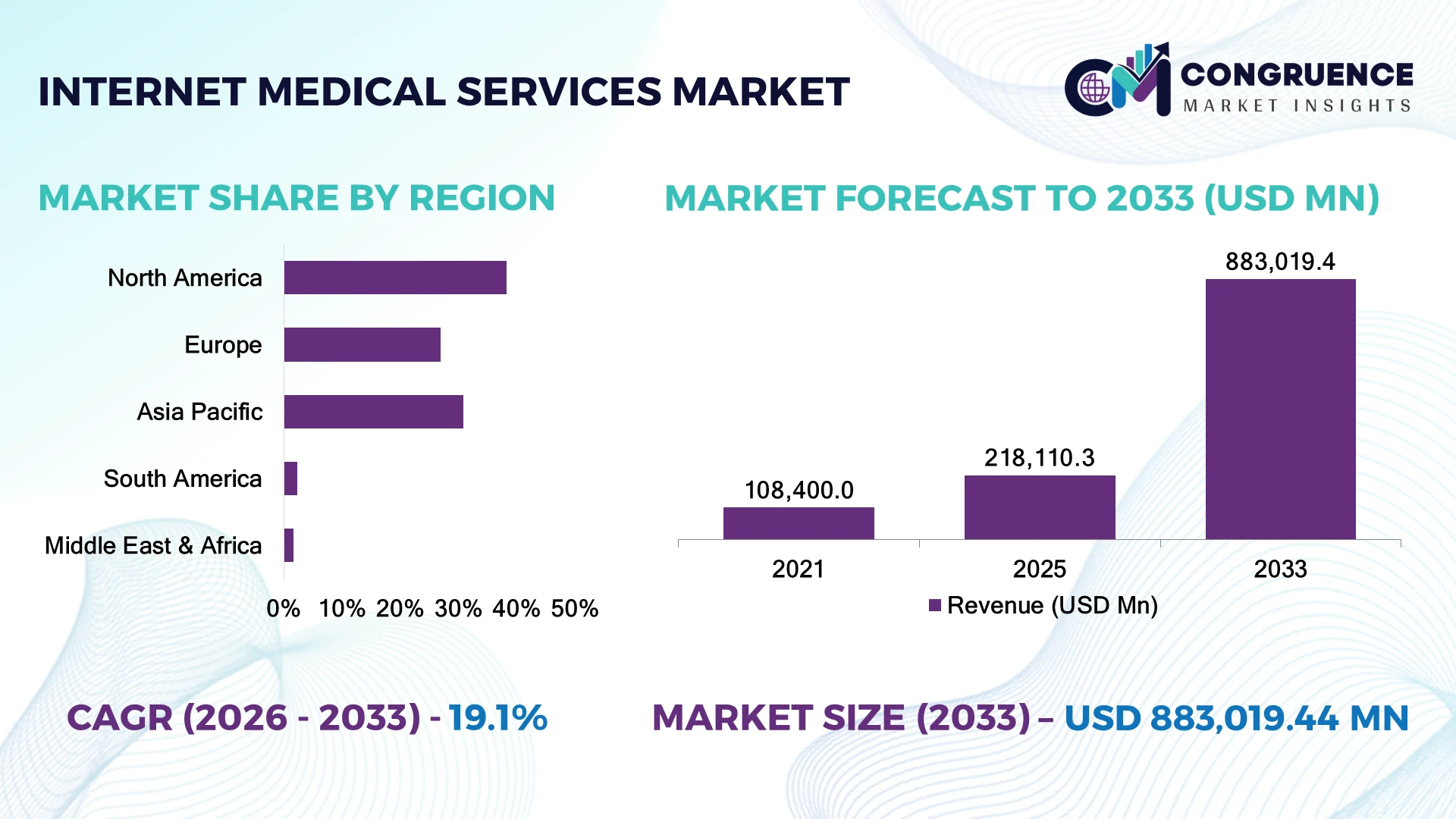
The Global Internet Medical Services Market was valued at USD 218,110.3 Million in 2025 and is anticipated to reach a value of USD 883,019.4 Million by 2033 expanding at a CAGR of 19.1% between 2026 and 2033. Growth is driven by AI-enabled telemedicine platforms, expanding digital prescription ecosystems, interoperable electronic health records, and government-backed virtual healthcare infrastructure.
The United States leads the market with approximately 34% global share, supported by more than 80% electronic health record adoption across hospitals, multi-billion-dollar investments in digital healthcare platforms, and strong deployment across provider networks, insurers, and life sciences. China follows with over 28% of online medical consultations occurring through integrated healthcare super-apps, while accelerated digital health investment reflects ongoing healthcare resilience initiatives following global public health preparedness reforms.
Strategic investment is increasingly concentrated in scalable digital healthcare ecosystems combining virtual care, diagnostics, remote monitoring, and AI-powered clinical decision support.
Market Size & Growth: USD 218,110.3 Million (2025) to USD 883,019.4 Million (2033), CAGR 19.1%, driven by AI-enabled virtual healthcare.
Top Growth Drivers: AI diagnostics 38%, teleconsultation adoption 34%, remote monitoring deployment 29%.
Short-Term Forecast: By 2028, consultation turnaround time falls 32% through automated patient triage.
Emerging Technologies: AI assistants, wearable integration, digital therapeutics strengthen clinical workflows.
Regional Leaders: North America USD 305 billion, Asia-Pacific USD 270 billion, Europe USD 185 billion with expanding digital health programs.
Consumer/End-User Trends: Nearly 61% of chronic disease patients regularly use virtual follow-up services.
Pilot/Case Example: 2026 AI-assisted hospital network reduced outpatient waiting time by 35%.
Competitive Landscape: Top providers control about 42% share through integrated healthcare ecosystems.
Regulatory & ESG Impact: Digital compliance platforms improve clinical documentation efficiency by 26%.
Investment & Funding: More than USD 22 billion supports AI healthcare platforms, partnerships, and cloud modernization.
Innovation & Future Outlook: Predictive analytics and multimodal AI accelerate precision virtual healthcare delivery.
The Internet Medical Services Market continues expanding across teleconsultation, remote patient monitoring, digital pharmacy, and AI-assisted diagnostics. Intelligent symptom assessment and integrated electronic health records improve clinical workflow efficiency by approximately 27%, while strengthened healthcare cybersecurity and cross-border data governance increasingly influence platform architecture. These developments position digital healthcare providers for broader ecosystem integration, setting the foundation for the following strategic assessment.
Internet medical services have become a strategic pillar of healthcare modernization by expanding clinical access, reducing operational costs, and strengthening care continuity. Healthcare providers increasingly integrate virtual consultations, AI-assisted diagnostics, digital prescriptions, and remote monitoring into unified care pathways. Government-backed digital health reforms and nationwide interoperability programs continue accelerating enterprise investment in cloud-based healthcare infrastructure.
Modern AI-supported clinical decision systems process routine patient assessments nearly 40% faster than conventional manual workflows while reducing administrative effort by approximately 30%. North America leads in integrated digital health deployment across hospital systems, whereas Asia-Pacific records faster platform expansion through mobile-first healthcare ecosystems and large-scale public health digitization. More than 65% of large healthcare organizations are expected to expand remote monitoring and virtual specialty care over the next two to three years.
Healthcare providers increasingly deploy unified digital platforms combining telemedicine, pharmacy fulfillment, laboratory scheduling, and electronic medical records within a single patient journey. Companies are expanding strategic partnerships with cloud providers, insurers, and device manufacturers to strengthen ecosystem integration. Organizations that combine scalable digital infrastructure, AI-enabled clinical intelligence, and secure interoperable healthcare platforms will establish sustainable competitive advantage as virtual care becomes a core component of modern healthcare delivery.
Healthcare systems are rapidly embedding AI-driven clinical triage, virtual consultations, remote monitoring, and digital prescription services into routine care delivery. More than 72% of large hospital networks now operate hybrid care models, while AI-assisted patient routing reduces consultation time by approximately 35% and improves physician productivity by nearly 28%. In the United States, reimbursement support for telehealth and digital care continuity continues encouraging enterprise-wide platform deployment. The resulting operational efficiencies are accelerating demand for interoperable healthcare ecosystems. Technology providers are responding through AI investments, cloud infrastructure expansion, and strategic partnerships with hospitals, insurers, and pharmacy networks. A notable strategic shift is the transition from standalone telemedicine platforms toward integrated digital health ecosystems supporting continuous patient engagement across the complete care journey.
Healthcare providers continue facing interoperability gaps between legacy hospital information systems, electronic health records, imaging platforms, and third-party digital health applications. Approximately 41% of healthcare organizations report integration challenges across multiple clinical platforms, while regulatory compliance increases implementation costs by nearly 22%. Cross-border patient data governance requirements further complicate multinational platform deployment, particularly across Europe and Asia. These structural constraints delay enterprise-scale implementation, increase operating complexity, and reduce platform scalability. Companies increasingly mitigate these risks through standardized interoperability protocols, localized cloud infrastructure, long-term cybersecurity contracts, and API-based architecture. Organizations that simplify regulatory compliance while enabling seamless clinical data exchange gain a measurable operational advantage in digital healthcare deployment.
Preventive digital healthcare is emerging as the industry's highest-value opportunity through AI-powered predictive analytics, wearable integration, and continuous patient monitoring. Nearly 60% of healthcare executives plan to expand remote chronic disease management over the next three years, while predictive monitoring reduces avoidable hospital admissions by approximately 20%. Japan and Singapore continue promoting digitally connected healthcare infrastructure that integrates home-based monitoring with national health systems. Companies are expanding ecosystem partnerships linking device manufacturers, diagnostic laboratories, insurers, and healthcare providers into unified digital platforms. A significant strategic opportunity lies in subscription-based preventive care models that generate recurring patient engagement while improving long-term clinical outcomes through continuous health intelligence rather than episodic treatment.
Rapid platform expansion increases operational complexity across cybersecurity, clinical validation, workforce readiness, and infrastructure resilience. Healthcare organizations experience approximately 30% more cyberattack attempts than many other critical industries, while more than 45% report shortages of professionals skilled in health informatics and AI governance. India and several emerging healthcare markets continue expanding digital infrastructure, yet uneven connectivity affects consistent service quality across rural populations. Sustaining trusted virtual care requires investment in zero-trust cybersecurity, resilient cloud architecture, workforce training, and standardized AI governance. Companies that successfully combine secure infrastructure, clinical reliability, and scalable interoperability will strengthen long-term competitiveness as digital healthcare becomes increasingly mission-critical.
AI Clinical Decision Expansion AI-powered clinical assistants now support approximately 48% of enterprise telehealth workflows, reducing physician documentation time by nearly 30% and accelerating patient prioritization by about 25%. Healthcare providers are integrating generative AI with electronic health records, while technology vendors expand strategic partnerships to improve workflow automation and clinician productivity amid increasing care demand.
Remote Monitoring Becomes Standard Connected patient monitoring adoption exceeds 55% among major chronic care programs, improving treatment adherence by approximately 24% while reducing avoidable readmissions by nearly 18%. Growing aging populations and healthcare workforce shortages are accelerating deployment of wearable-integrated monitoring platforms. Providers continue scaling home-based care ecosystems supported by digital pharmacies and virtual nursing services.
Interoperable Digital Health Platforms Hospitals increasingly consolidate telemedicine, laboratory services, digital prescriptions, and electronic medical records into unified platforms. More than 62% of newly deployed enterprise solutions prioritize interoperability, reducing administrative duplication by roughly 27%. Healthcare organizations are restructuring digital infrastructure through cloud migration and standardized API integration to strengthen coordinated patient care across multiple providers.
Cybersecurity-driven Platform Modernization Rising healthcare cyber threats are shifting investment toward zero-trust security architecture, AI-enabled threat detection, and encrypted patient data exchange. Security automation reduces incident response time by approximately 35%, while compliance monitoring improves audit readiness by nearly 20%. Healthcare technology companies increasingly differentiate offerings through secure-by-design platforms that enhance operational resilience without disrupting clinical workflows.
Telemedicine Services accounted for approximately 43% of the market in 2025, leading through scalable cloud infrastructure, integrated electronic health records, and reimbursement support across outpatient care. The segment delivers lower consultation costs, faster physician access, and seamless integration with digital pharmacies and diagnostic services. Remote Patient Monitoring is the fastest-growing type as healthcare providers increasingly manage chronic diseases through connected medical devices and wearable technologies. Monitoring adoption has increased by nearly 26% across enterprise healthcare systems, while AI-supported patient monitoring improves intervention speed by approximately 22%.
Online Pharmacy Services continue expanding through e-prescription integration and automated fulfillment, particularly in urban healthcare ecosystems. Digital Health Information Services remain strategically relevant by supporting patient education, preventive care, and personalized health management. Companies are investing in AI-enabled consultation platforms, expanding virtual specialty care, and forming partnerships with insurers, hospitals, and device manufacturers to build integrated digital healthcare ecosystems. These investments are shifting competitive focus toward end-to-end healthcare platforms rather than standalone digital services.
According to findings published by the American Medical Association during 2025, more than 70% of U.S. physicians work in healthcare organizations offering telehealth services as a routine component of patient care.
Chronic Disease Management represented approximately 39% of the market in 2025, reflecting strong demand for continuous virtual care, medication management, and remote patient monitoring across diabetes, cardiovascular disorders, and respiratory diseases. Integrated care platforms improve patient engagement while reducing unnecessary hospital visits. Mental Health Services represent the fastest-growing application as digital behavioral health platforms expand access to therapy, psychiatric consultations, and AI-assisted mental health screening. Digital mental healthcare utilization has increased by nearly 30% across several developed healthcare systems.
Primary Care Consultations remain a mature application supported by routine virtual physician visits, while Preventive Healthcare and Specialist Consultations continue expanding through personalized screening, digital diagnostics, and multidisciplinary care coordination. Companies are strengthening application portfolios through AI-assisted clinical decision support, automated appointment management, multilingual patient engagement tools, and integrated diagnostic services. Healthcare providers increasingly prioritize applications that deliver measurable clinical outcomes while improving operational efficiency across diverse patient populations.
Industry findings released by the Healthcare Information and Management Systems Society during 2025 indicate that integrated digital chronic care platforms significantly improve patient engagement and continuity of care across enterprise health systems.
Hospitals and Healthcare Providers accounted for approximately 46% of the market in 2025, driven by enterprise-scale deployment of telemedicine platforms, electronic health records, digital diagnostics, and remote patient monitoring infrastructure. Large healthcare networks benefit from integrated clinical workflows, centralized patient data, and coordinated specialty care. Home Healthcare Providers represent the fastest-growing end-user segment as aging populations and chronic disease management increase demand for home-based digital care. Home monitoring adoption has expanded by nearly 28%, while virtual nursing services continue improving care continuity.
Patients and Individual Consumers remain a rapidly expanding user group through mobile health applications, online consultations, and digital prescription services. Insurance Companies and Employers increasingly utilize internet medical services to improve preventive care, claims management, and employee wellness. Companies are developing customized digital healthcare ecosystems through strategic partnerships, subscription-based care models, and integrated reimbursement solutions, positioning themselves around long-term patient engagement instead of episodic healthcare delivery.
An enterprise survey published by the College of Healthcare Information Management Executives during 2026 reported that integrated virtual care platforms remain among the highest investment priorities for large hospital systems pursuing digital transformation.
North America accounted for the largest market share at 38.2% in 2025 however, Asia-Pacific is expected to register the fastest growth, expanding at a CAGR of 21.6% between 2026 and 2033.
Integrated digital care ecosystems reshape healthcare delivery
North America leads the Internet Medical Services market through mature telehealth reimbursement frameworks, enterprise-scale cloud healthcare infrastructure, and widespread integration of electronic health records with virtual care platforms. The region contributes nearly 38.2% of global demand, supported by extensive deployment across hospitals, insurers, and integrated health networks. More than 72% of large healthcare providers operate enterprise telemedicine platforms, while AI-assisted clinical workflows continue reducing administrative processing time. Healthcare organizations are expanding partnerships with technology providers to integrate remote diagnostics, digital pharmacies, and virtual specialty care. Continued investment in cybersecurity, interoperable health data exchange, and value-based care models is strengthening operational efficiency while supporting large-scale digital patient engagement.
United States Market Outlook: The United States remains the regional growth engine through advanced healthcare IT infrastructure, favorable reimbursement policies, and strong investment in digital health platforms. More than 80% of major health systems now provide virtual consultation services integrated with electronic health records. Large healthcare enterprises continue expanding AI-assisted diagnostics, remote patient monitoring, and digital prescription management, strengthening nationwide care accessibility while improving operational efficiency across hospital networks and outpatient care providers.
Regulatory harmonization accelerates digital healthcare integration
Europe continues strengthening its position through interoperable digital health infrastructure, unified electronic health record initiatives, and expanding cross-border telemedicine capabilities. Approximately 27% of global market activity originates from European healthcare systems adopting secure digital consultation platforms and AI-enabled clinical decision support. Public healthcare modernization programs are increasing deployment of remote monitoring solutions, while stricter health data governance strengthens patient confidence. Healthcare providers are investing in integrated virtual care platforms that connect hospitals, pharmacies, laboratories, and primary care providers within standardized digital ecosystems.
Germany Market Outlook: Germany maintains regional leadership through advanced hospital digitization programs, nationwide electronic patient record implementation, and strong healthcare technology investments. More than 65% of large hospitals have expanded digital consultation capabilities alongside integrated clinical information systems. Strong regulatory support and enterprise adoption continue positioning Germany as a leading innovation hub for scalable internet medical services across public and private healthcare providers.
Digital population scale drives platform expansion
Asia-Pacific is becoming the fastest-expanding market through rapid digital healthcare adoption, expanding smartphone penetration, and government-backed health infrastructure modernization. The region accounts for nearly 31% of global deployment activity, with digital consultation platforms serving millions of patients through integrated mobile healthcare ecosystems. Healthcare providers are expanding AI-enabled triage, remote monitoring, and online pharmacy integration to improve access across urban and rural populations. Enterprise investment continues accelerating cloud-native healthcare platforms capable of supporting high-volume patient interactions while reducing operational bottlenecks.
China Market Outlook: China leads regional expansion through large-scale internet hospital deployment, integrated digital payment infrastructure, and strong government support for online healthcare delivery. More than 3,000 licensed internet hospitals operate nationwide, connecting patients with specialist consultations, prescription services, and remote diagnostics. Domestic technology companies continue strengthening AI-assisted healthcare platforms and expanding integrated digital medical ecosystems serving both metropolitan and underserved communities.
Healthcare accessibility fuels digital adoption
South America is expanding internet medical services through increasing broadband availability, growing telemedicine acceptance, and modernization of public healthcare systems. Brazil, Chile, and Colombia continue investing in digital consultation infrastructure to improve specialist access beyond major metropolitan areas. Nearly 45% of newly deployed virtual healthcare programs emphasize primary care and chronic disease management. Healthcare providers increasingly collaborate with technology vendors to integrate appointment scheduling, remote diagnostics, and electronic prescription platforms while addressing geographical barriers to healthcare delivery.
Brazil Market Outlook: Brazil remains the region's largest digital healthcare market through extensive telemedicine implementation, expanding private healthcare networks, and growing adoption of integrated digital consultation platforms. National healthcare providers continue investing in remote patient management and AI-supported triage systems. Strong smartphone penetration and expanding digital health regulations position Brazil as the primary operational hub for scalable internet medical services across South America.
Healthcare modernization supports digital transformation
The Middle East & Africa market is advancing through national digital health strategies, hospital modernization initiatives, and expanding investments in connected healthcare infrastructure. Government-backed healthcare transformation programs are increasing deployment of virtual consultations, electronic health records, and AI-supported patient management. Approximately 40% of newly commissioned smart hospital projects now incorporate integrated telemedicine capabilities. Private healthcare groups continue partnering with digital technology providers to improve specialist access, operational efficiency, and healthcare delivery across geographically dispersed populations.
Saudi Arabia Market Outlook: Saudi Arabia leads regional digital healthcare transformation through Vision 2030 healthcare modernization initiatives, smart hospital investments, and nationwide digital health integration. Public and private healthcare providers continue expanding virtual consultation services, electronic health platforms, and AI-assisted patient engagement. Strong government investment and rapid healthcare digitization position the country as the leading enterprise market for internet medical services across the Middle East.
Enterprise virtual care platforms including Teladoc Health, Amwell, and Doctor Anywhere compete against integrated healthcare IT vendors such as Oracle Health and Epic Systems, while consumer-first digital ecosystems including Ping An Health and JD Health challenge hospital-led networks through platform scale. The top five participants collectively control approximately 44% of global market activity. Competition centers on AI-enabled clinical workflows, interoperability, and care continuity, with automation reducing administrative workload by nearly 35% and cloud-native platforms lowering deployment time by about 30%. Platform providers are expanding through hospital partnerships, payer integrations, digital pharmacy ecosystems, and vertical integration across diagnostics, consultations, and remote monitoring. Competitive momentum is shifting toward AI-powered care orchestration and unified patient records rather than standalone teleconsultation services. Regulatory compliance, cybersecurity certification, and trusted clinical data integration remain the strongest entry barriers. Winning requires scalable interoperable platforms, validated AI capabilities, payer relationships, and seamless hybrid care delivery across the complete patient journey.
Teladoc Health, Inc.
Amwell
Ping An Health
JD Health International Inc.
Doctolib
Practo
Doctor Anywhere
Halodoc
Babylon Healthcare Services
Oracle Health
Epic Systems Corporation
CVS Health
Hims & Hers Health
GoodRx
Artificial intelligence is transforming internet medical services through automated triage, clinical documentation, virtual assistants, and predictive analytics. AI-assisted consultation workflows reduce physician documentation time by approximately 40%, while intelligent scheduling improves appointment utilization by nearly 18%. More than 65% of newly deployed enterprise telehealth platforms now integrate AI-supported decision support with cloud-based electronic health records, creating faster and more coordinated patient care while reducing operational costs.
Cloud-native healthcare architecture, FHIR interoperability, remote patient monitoring, and Internet of Medical Things integration are replacing fragmented legacy telemedicine systems. Compared with conventional standalone virtual consultation platforms, integrated digital health ecosystems improve care coordination by approximately 35% while reducing duplicate clinical documentation by nearly 30%. Hospital networks, insurers, and integrated delivery organizations gain the greatest competitive advantage because unified data environments strengthen care continuity, reimbursement accuracy, and population health management. Adoption of wearable-connected monitoring platforms has surpassed 55% among large digital health providers supporting chronic disease programs.
Between 2026 and 2028, generative AI, ambient clinical intelligence, digital therapeutics, and federated healthcare analytics will reshape service delivery. Automated multilingual consultation support, personalized treatment recommendations, and real-time remote monitoring will strengthen patient engagement while enabling scalable hybrid care models. Organizations investing early in secure AI governance, interoperable digital infrastructure, and enterprise-wide automation will achieve superior clinical productivity, faster expansion, and stronger competitive differentiation across increasingly integrated healthcare ecosystems.
October 2025 Teladoc Health partnered with League to combine AI-powered member engagement with virtual care programs, improving digital navigation and reducing care friction across enterprise healthcare deployments. Business impact strengthens integrated virtual care delivery. Source: Amwell Newsroom
September 2025 Oracle Health introduced AI capabilities within its Patient Portal, enabling patients to understand medical records through conversational summaries. The platform delivers 24/7 AI-assisted interactions, improving patient engagement and reducing administrative workload. Source: Oracle
May 2026 Walmart expanded Better Care Services by integrating Teladoc Health virtual care, providing consumers access to urgent care, dermatology, and nutrition support through a unified digital healthcare experience. Business impact broadens retail healthcare accessibility. Source: Healthcare IT News
February 2026 U.S. legislation extended Medicare telehealth flexibilities through December 2027, preserving nationwide home-based telehealth eligibility and supporting continued provider investment in virtual healthcare delivery. Business impact reinforces long-term reimbursement certainty. Source: Centers for Medicare & Medicaid Services
The report provides comprehensive analysis of internet medical services across consultation platforms, remote patient monitoring, digital therapeutics, online pharmacy integration, AI-enabled healthcare applications, and interoperable clinical information systems. It evaluates market performance by service type, application, end-user, deployment model, and major regions while assessing adoption patterns across hospitals, clinics, insurers, employers, government healthcare systems, and direct-to-consumer platforms. More than 60% of enterprise implementations now integrate cloud-native electronic health records with virtual care capabilities, reflecting accelerating digital healthcare convergence.
The study delivers strategic assessment of competitive positioning, technology evolution, digital infrastructure investment, interoperability standards, cybersecurity readiness, and regulatory developments between 2026 and 2033. It examines deployment trends, enterprise partnerships, AI integration, remote monitoring expansion, and emerging hybrid care ecosystems to support investment planning, product development, regional expansion, acquisition strategy, and long-term competitive decision-making across the global internet medical services landscape.
| Report Attribute/Metric | Report Details |
|---|---|
|
Market Revenue in 2025 |
USD 218,110.3 Million |
|
Market Revenue in 2033 |
USD 883,019.4 Million |
|
CAGR (2026 - 2033) |
19.1% |
|
Base Year |
2025 |
|
Forecast Period |
2026 - 2033 |
|
Historic Period |
2021 - 2025 |
|
Segments Covered |
By Type
By Application
By End-User
|
|
Key Report Deliverable |
Revenue Forecast, Growth Trends, Market Dynamics, Segmental Overview, Regional and Country-wise Analysis, Competition Landscape |
|
Region Covered |
North America, Europe, Asia-Pacific, South America, Middle East, Africa |
|
Key Players Analyzed |
Teladoc Health, Inc., Amwell, Ping An Health, JD Health International Inc., Doctolib, Practo, Doctor Anywhere, Halodoc, Babylon Healthcare Services, Oracle Health, Epic Systems Corporation, CVS Health, Hims & Hers Health, GoodRx |
|
Customization & Pricing |
Available on Request (10% Customization is Free) |




