
Reports
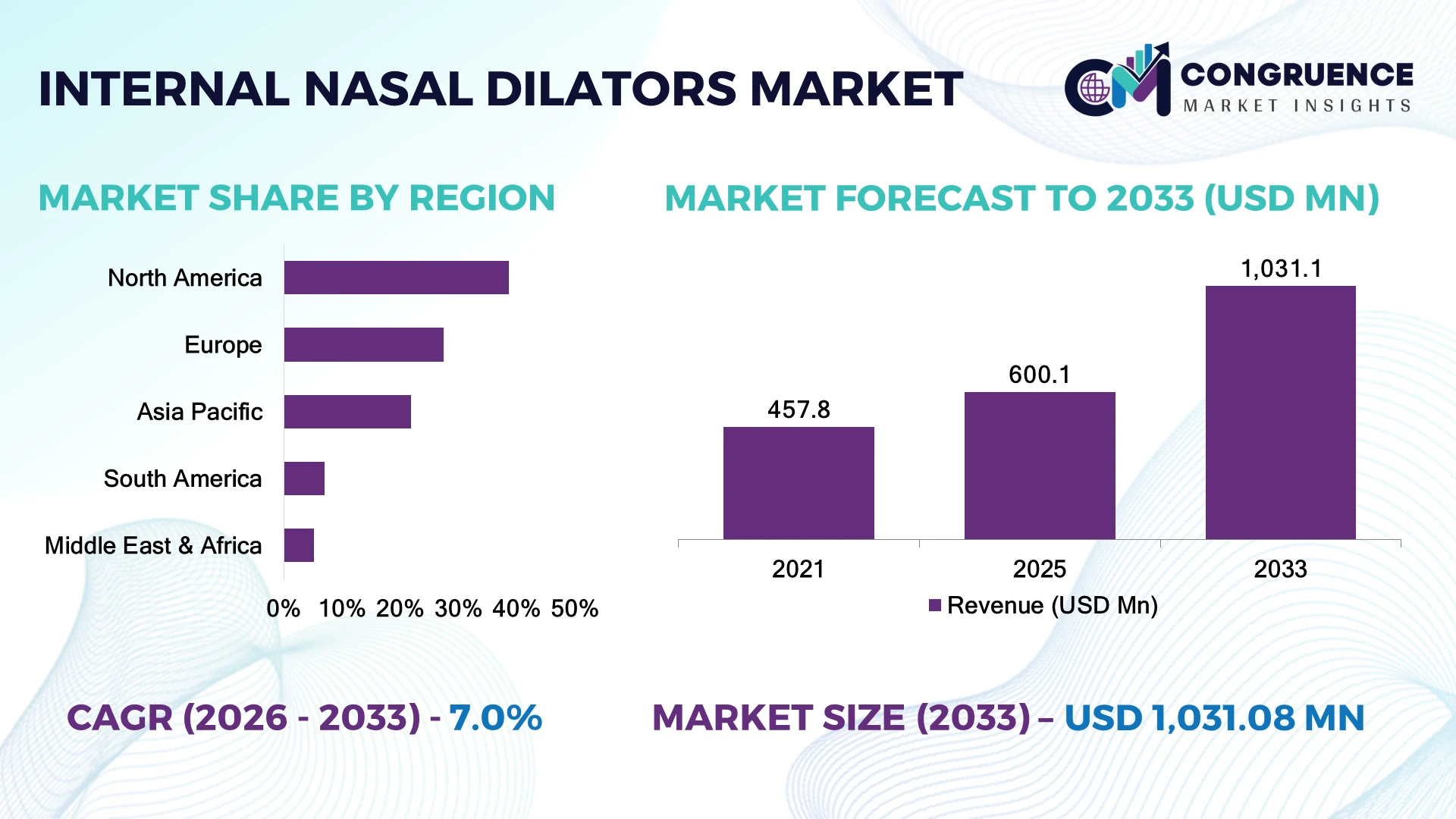
The Global Internal Nasal Dilators Market was valued at USD 600.1 Million in 2025 and is anticipated to reach a value of USD 1,031.1 Million by 2033 expanding at a CAGR of 7.0% between 2026 and 2033. Growth is being driven by rising demand for non-drug nasal airflow solutions, sports-performance products, sleep-related breathing support, and discreet reusable devices.
The United States represents the dominant commercial market, supported by established sleep, sports-recovery, and direct-to-consumer healthcare channels, while Europe emphasizes clinically positioned respiratory products and reusable designs. U.S. adoption of nasal-breathing aids is estimated at roughly 8–10% among relevant consumer groups, compared with approximately 5–7% across major European markets. In 2026, tighter scrutiny of health-product claims is pushing manufacturers toward documented performance and clearer product positioning.
Strategic implication: companies should prioritize clinically credible airflow performance, comfortable materials, reusable designs, and differentiated digital distribution to capture premium demand.
Market Size & Growth: USD 600.1 million in 2025 to USD 1,031.1 million by 2033 at 7.0% CAGR, supported by drug-free nasal airflow solutions.
Top Growth Drivers: Sleep-related breathing demand 8–11%; sports-use adoption 7–10%; reusable-product preference 6–9%.
Short-Term Forecast: By 2028, improved ergonomic designs can reduce reported discomfort by 10–15% and increase repeat-use rates by 8–12%.
Emerging Technologies: Medical-grade silicone, flexible thermoplastic structures, pressure-optimized supports, and digitally guided fitting are reshaping product design.
Regional Leaders: North America approaches USD 275 million by 2028; Europe exceeds USD 180 million; Asia-Pacific approaches USD 150 million as consumer-health distribution expands.
Consumer/End-User Trends: Reusable internal dilators increasingly attract consumers seeking discreet, medication-free nighttime and exercise-oriented airflow support.
Pilot/Case Example: 2026 ergonomic product-development programs are targeting 10–15% lower insertion pressure while maintaining comparable nasal-wall support.
Competitive Landscape: Leading brands such as Rhinomed, Intake, Mute, Noson, and Airmax compete through comfort, airflow performance, materials, and retail positioning.
Regulatory & ESG Impact: Reusable designs can reduce single-use material consumption by approximately 20–40% across repeated-use cycles, strengthening sustainability positioning.
Investment & Funding: Product expansion increasingly targets sports, sleep, pharmacy, and direct-to-consumer channels, with partnerships improving clinical validation and distribution reach.
Innovation & Future Outlook: Next-generation products will emphasize adaptive geometry, thinner structures, improved retention, and personalized fit rather than simply increasing mechanical expansion.
Internal nasal dilators are gaining traction across sleep support, exercise, allergy-related airflow management, and medication-free nasal breathing applications. Flexible silicone structures, low-profile supports, and reusable formats are improving comfort while maintaining internal nasal-wall expansion. Sports users increasingly favor discreet devices that remain stable during movement, while nighttime users prioritize retention and reduced pressure. In 2026, manufacturers are also tightening product-claim language and emphasizing measurable airflow performance as healthcare-product scrutiny increases.
The market is shifting from generic mechanical expansion toward application-specific designs. Products optimized for sleep emphasize comfort and prolonged wear, whereas athletic designs prioritize retention and rapid airflow response. Reusable devices can reduce per-use material consumption by 20–40% compared with repeatedly purchased disposable alternatives. Distribution is also moving toward pharmacy, specialist respiratory channels, sporting-goods retailers, and direct-to-consumer platforms, creating opportunities for differentiated product portfolios and recurring customer relationships.
Internal nasal dilators are becoming strategically important because manufacturers can address nasal airflow without relying on pharmacological ingredients, creating opportunities across sleep, sports, respiratory wellness, and consumer healthcare. Product differentiation increasingly depends on measurable airflow improvement, retention, comfort, and material safety rather than simple expansion force.
Technology is moving from rigid internal supports toward flexible, low-profile geometries using medical-grade silicone and thermoplastic materials. Advanced designs can reduce insertion pressure by approximately 10–15% while maintaining effective nasal-wall support. North America remains commercially mature, supported by established consumer-health and sports channels, while Asia-Pacific is expanding through e-commerce, pharmacy distribution, and growing awareness of non-drug respiratory products.
Over the next 2–3 years, personalized fitting, digitally supported product selection, thinner structures, and application-specific designs will strengthen competitive differentiation. Manufacturers are increasingly separating sleep, athletic, and everyday-use product lines rather than relying on one universal geometry. Partnerships with respiratory specialists, sports organizations, retailers, and digital-health platforms can accelerate market access. The strongest positioning will come from combining validated airflow performance with comfort, repeat-use economics, regulatory discipline, and scalable omnichannel distribution.
Growing preference for non-pharmacological nasal airflow support is strengthening demand for internal nasal dilators across sleep, sports, and respiratory-wellness applications. Product adoption in relevant consumer groups is estimated to be increasing 8–11%, while reusable-device preference is rising 6–9% as consumers seek lower recurring costs. In the United States, direct-to-consumer respiratory products are expanding alongside sleep-health awareness, while Australian and European sports markets increasingly emphasize nasal breathing. Regulatory scrutiny of performance claims is simultaneously pushing brands toward measurable airflow validation. Companies are responding with medical-grade silicone, lower-profile geometries, and application-specific designs. The strategic opportunity is to commercialize validated airflow improvement without pharmaceutical ingredients, positioning internal dilators between consumer wellness products and clinically oriented respiratory devices.
Retention and comfort remain structural constraints because nasal anatomy varies significantly across users. Poorly fitted devices can increase discomfort, pressure, or displacement, with unsuitable designs potentially reducing repeat usage by 10–20%. Rigid structures also face greater adaptation barriers than flexible silicone designs, while premium materials can raise manufacturing costs by 15–25%. In the United States, brands face additional pressure to substantiate respiratory and sleep-related claims without positioning consumer products beyond permitted indications. Companies are reducing exposure through multiple sizes, softer thermoplastic formulations, ergonomic testing, and fit-guidance tools. The operational insight is that reducing returns and abandonment can be more commercially valuable than maximizing mechanical expansion, making fit architecture and comfort testing central to product economics.
Personalized internal nasal dilators represent an underdeveloped opportunity as digital fitting and application-specific design become more accessible. Smartphone-guided sizing and 3D nasal profiling can potentially reduce fitting errors by 15–25%, while adaptive geometries can lower insertion pressure by approximately 10–15%. The United States offers the strongest commercialization pathway through digital-health and sports-recovery channels, while Japan and South Korea provide technologically receptive consumer-health markets. Manufacturers are investing in flexible polymers, modular sizing, and data-assisted product selection rather than relying on universal dimensions. Partnerships with sleep clinics, sports organizations, and respiratory specialists can provide structured validation. A non-obvious opportunity lies in personalized replacement programs: manufacturers can convert fit-specific products into recurring purchases while improving retention and reducing unsuitable-device returns.
Commercial scaling requires manufacturers to balance standardized production with substantial anatomical variation. A portfolio spanning multiple sizes and geometries can increase SKU complexity by 20–30%, while individualized designs can raise tooling and inventory requirements by 10–15%. Digital fitting also introduces data-management and workflow requirements that smaller manufacturers may lack. In 2026, tighter scrutiny of health-related claims increases the need for documented testing, consistent labeling, and controlled product specifications. Companies must therefore invest in ergonomic validation, automated quality inspection, standardized fit protocols, and flexible manufacturing platforms. The long-term competitive pressure is maintaining consistent retention and airflow performance across different nasal anatomies without allowing customization to undermine production efficiency. Scalable personalization, rather than unlimited product variation, will determine sustainable commercialization.
Low-Profile Designs Gain Preference — Manufacturers are reducing device bulk while maintaining internal nasal-wall support, with newer geometries targeting 10–15% lower insertion pressure and approximately 8–12% better wear comfort. U.S. brands are emphasizing discreet nighttime and athletic formats, while flexible thermoplastic and silicone structures increasingly replace rigid constructions. This shift improves repeat-use potential and reduces abandonment linked to physical discomfort.
Sports Formats Prioritize Retention — Athletic users are pushing designs toward stronger positional stability, lighter structures, and rapid insertion. Product-development programs increasingly target 5–10% weight reductions and 10–15% lower displacement during movement. Sports-focused companies are testing devices across running, cycling, and endurance activities, creating a distinct product architecture rather than adapting sleep-oriented designs to athletic use.
Reusable Economics Reshape Portfolios — Reusable internal dilators are gaining commercial relevance as consumers compare recurring costs with disposable alternatives. Repeated-use formats can reduce per-use material consumption by approximately 20–40%, while replacement cycles create recurring demand. Manufacturers are responding with durable silicone formulations, cleaning guidance, multi-size packs, and subscription-oriented distribution rather than relying exclusively on one-time purchases.
Claim Validation Tightens Product Strategy — Health-related marketing is becoming more evidence-led as regulatory scrutiny increases. Companies are increasingly separating comfort, airflow, sleep, and performance claims, with laboratory or controlled-user testing supporting specific product positioning. This can increase validation requirements by 10–20%, but stronger documentation reduces compliance exposure and improves credibility with pharmacies, specialist retailers, and healthcare-oriented distribution partners.
Polymer-based internal nasal dilators represent the leading type, accounting for approximately 65% of 2025 demand, supported by lower manufacturing complexity, flexibility, biocompatibility, and suitability for repeated use. Silicone and other medical-grade polymers also allow manufacturers to produce multiple geometries without major tooling changes. Polymer-plus-alloy designs remain smaller but are gaining traction where stronger structural retention and controlled expansion are required. Their share is estimated at roughly 20–25%, while alloy-supported products are expanding approximately 8–10% annually as users seek stronger performance without substantially increasing device bulk.
The fastest-changing segment is reusable polymer-plus-alloy and advanced polymer construction, where manufacturers are combining flexible materials with structural reinforcement. Companies are investing in multi-size platforms, softer contact surfaces, and improved retention rather than simply increasing expansion force. This shift supports premium pricing of approximately 15–25% for specialized designs and redirects investment toward fit engineering, material science, and repeat-use durability.
Grand View Research estimates polymer-based internal nasal dilators held approximately 41% of the broader product-type market in 2025, while Mordor Intelligence places pure-polymer products at 65.31%, confirming polymer construction as the commercial foundation despite differences in segmentation methodology.
Snoring management is the leading application, accounting for approximately 43% of 2025 demand, reflecting the accessibility of nasal airflow products for consumers seeking non-pharmacological nighttime support. Sleep apnea represents the fastest-growing application, expanding as consumers and clinicians explore adjunctive airflow interventions. Sleep-apnea-oriented demand is estimated to grow around 9%, compared with approximately 6–8% for established snoring applications. Deviated septum, sinusitis, and chronic nasal congestion remain important use cases but are more condition-specific and require clearer product positioning.
Companies are therefore separating product architecture by application rather than marketing one universal dilator. Snoring-focused products emphasize comfort and overnight retention, while sleep-apnea support products increasingly emphasize measurable airflow performance and compatibility with broader sleep-management routines. Nasal-congestion products prioritize rapid insertion and flexible geometry. This application diversification is strengthening specialist positioning, with premium products typically commanding 15–25% higher prices where enhanced fit, materials, or airflow engineering is incorporated.
A 2025 systematic review and meta-analysis covering 17 studies and 496 participants found no significant improvement in objective sleep-apnea severity from nasal dilators, reinforcing the commercial importance of positioning these products as airflow-support or adjunctive devices rather than definitive OSA treatment.
Adult users represent the dominant end-user group, accounting for approximately 85–90% of demand because snoring, nasal obstruction, sleep-related breathing discomfort, and sports-breathing applications are primarily concentrated within adult populations. Pediatric usage remains comparatively limited because anatomical differences and clinical oversight create higher product-selection requirements. Adult-oriented products therefore benefit from broad pharmacy, online, and direct-to-consumer distribution, while specialized pediatric offerings require narrower clinical positioning and sizing.
Sports and fitness users represent the fastest-expanding commercial niche within the adult base, with adoption estimated to increase 8–12% as endurance athletes increasingly experiment with nasal-breathing products. Companies are responding with lighter geometries, stronger retention, and multi-activity positioning. Sleep-focused consumers remain the volume anchor, while athletes provide higher willingness to pay for performance-oriented designs. This creates a two-tier commercial strategy: standardized polymer products for broad adult demand and premium fit-engineered devices for sports, sleep specialists, and consumers seeking enhanced airflow performance.
A 2025 clinical review identified adult snoring and sleep-disordered breathing as the principal populations studied across nasal-dilator research, with 496 participants represented in the pooled evidence base, reinforcing adults as the primary addressable user group.
North America accounted for the largest market share at 38.6% in 2025 however, Asia-Pacific is expected to register the fastest growth, expanding at a CAGR of 8.2% between 2026 and 2033.

Consumer Health Channels Accelerate Premium Device Adoption
North America represents the largest commercial base, supported by established sleep-health awareness, sports-performance consumption, pharmacy distribution, and direct-to-consumer healthcare channels. The region accounted for approximately 38.6% of global demand in 2025, with the United States generating most regional sales. Internal nasal dilators are increasingly positioned across snoring management, nighttime breathing support, endurance sports, and non-drug respiratory wellness. Premium reusable devices command approximately 15–25% higher pricing where ergonomic fit and airflow engineering are differentiated. Manufacturers are expanding retail partnerships, digital fitting tools, and specialist-channel distribution. The strongest operational shift is toward evidence-led product claims and application-specific designs, helping brands reduce product-return rates while improving customer retention.
U.S. Market Outlook: The United States remains the principal commercial hub, combining extensive e-commerce penetration with established sleep clinics, sports-health channels, and pharmacy networks. Manufacturers are increasingly separating sleep and athletic product portfolios to improve positioning. Products incorporating flexible silicone, multi-size configurations, and discreet profiles are gaining preference, while digital product education supports consumer selection. The country's large addressable sleep and wellness market provides a strong platform for premium internal nasal dilator commercialization.
Regulatory Discipline Strengthens Evidence-Led Positioning
Europe accounted for approximately 27.4% of global internal nasal dilator demand in 2025, supported by Germany, the United Kingdom, France, Italy, and Nordic consumer-health markets. European purchasing increasingly favors reusable, medically appropriate materials and clearly defined product claims. Manufacturers are adapting packaging, labeling, and clinical-support documentation to meet stricter health-product expectations. Reusable designs can reduce per-use material consumption by approximately 20–40% over repeated cycles, strengthening sustainability positioning. Specialist pharmacies and online healthcare channels remain important commercialization routes, while sports and sleep applications provide premium niches. Companies are prioritizing softer materials, ergonomic geometries, and localized distribution rather than competing solely on mechanical expansion.
Germany Market Outlook: Germany provides a strong platform for clinically positioned respiratory and consumer-health products because of its mature pharmacy infrastructure and technically sophisticated manufacturing base. Manufacturers targeting German buyers increasingly emphasize material safety, product documentation, and functional differentiation. Reusable silicone designs and multi-size systems are particularly relevant, while specialist retail and healthcare-oriented distribution can support higher-value products. The market favors brands capable of combining validated functionality with disciplined regulatory positioning.
E-Commerce and Wellness Adoption Expand Market Reach
Asia-Pacific accounted for approximately 21.8% of global demand in 2025 but represents the fastest-changing consumer market as e-commerce, sports participation, and sleep-health awareness broaden access to internal nasal dilators. Japan, South Korea, Australia, and China are the principal commercial markets, while India provides a developing opportunity through online healthcare retail. Adoption of non-drug respiratory products is estimated to be increasing 8–12% in major urban consumer markets. Manufacturers are using localized digital marketing, smaller product formats, and competitive pricing to broaden penetration. Japanese and South Korean companies emphasize precision materials and ergonomic design, while Chinese suppliers compete through manufacturing scale and rapid product iteration.
Japan Market Outlook: Japan combines high consumer acceptance of compact wellness products with advanced materials engineering and sophisticated retail channels. Manufacturers can leverage precision molding and medical-grade polymer expertise to produce thinner, more discreet internal dilators. Premium product positioning is supported by Japan's aging population and strong interest in sleep quality and personal health technologies. Companies are increasingly developing reusable products and application-specific geometries for nighttime breathing and everyday nasal airflow support.
Brazil Leads Digital Consumer-Health Expansion
South America remains a developing market, with Brazil representing approximately 55% of regional internal nasal dilator demand. Online healthcare retail and pharmacy networks are improving product accessibility, while consumers increasingly seek non-drug approaches for snoring and nasal airflow management. Demand is concentrated in major urban centers, where e-commerce enables international brands to reach consumers without extensive physical distribution infrastructure. Sports and sleep applications are gaining traction, with specialized products commanding approximately 10–20% pricing premiums over basic designs. Manufacturers are responding through distributor partnerships, localized digital campaigns, and simplified product portfolios. Currency volatility and import costs remain important commercial considerations, making regional inventory and competitive packaging strategically valuable.
Brazil Market Outlook: Brazil offers the strongest commercial base in South America because of its large consumer population, established pharmacy sector, and rapidly expanding e-commerce ecosystem. Manufacturers can use digital channels to introduce premium internal nasal dilators without building extensive physical infrastructure. Products addressing snoring, nighttime nasal obstruction, and sports breathing have the clearest positioning. Local distribution partnerships can reduce import lead times and improve availability while supporting competitive pricing.
Premium Wellness Investment Supports Specialized Demand
Middle East & Africa represents a smaller share of global internal nasal dilator demand, but Saudi Arabia, the UAE, and South Africa are creating stronger commercial opportunities through premium healthcare, wellness, sports, and pharmacy channels. The UAE provides particularly strong access to affluent consumers and digitally enabled healthcare purchasing, while Saudi Arabia's healthcare modernization is expanding specialist retail infrastructure. Premium respiratory-wellness products can command approximately 15–25% higher pricing when positioned around comfort, discreet design, and reusable materials. Manufacturers are increasingly using distributor partnerships, regional e-commerce, and specialist healthcare channels rather than broad mass-market rollout. The strategic opportunity lies in premium positioning supported by reliable local fulfillment.
Saudi Arabia Market Outlook: Saudi Arabia is the region's most strategically significant market because healthcare modernization, sports investment, and expanding consumer-wellness spending are broadening demand for specialized personal-health products. Internal nasal dilators can benefit from pharmacy and digital-health distribution while supporting non-drug positioning for nighttime and athletic breathing. Companies entering the market are best positioned through local distributors, premium product formats, and Arabic-language consumer education, particularly in major urban centers such as Riyadh and Jeddah.
Rhinomed, Splintek, SANOSTEC, McKeon Products, and Scandinavian Formulas compete as branded specialists, while digitally native regional sellers challenge them through low-cost, fast-moving products. The top five are estimated to hold about 55% combined share, leaving room for niche brands. Competition centers on comfort, airflow performance, price, and channel reach; premium designs command 15–25% higher pricing, while multi-size systems can reduce fit-related returns by 10–15%. Rhinomed leverages Mute and Turbine plus major U.S. retail distribution; Splintek emphasizes customizable breathing products; McKeon competes through Airmax; Scandinavian Formulas and SANOSTEC target specialized respiratory applications. WoodyKnows is expanding multi-SKU e-commerce positioning, while emerging brands pursue anatomical designs and reusable formats. The competitive shift is toward faster SKU innovation, regulatory-backed product listings, and channel-specific packaging rather than consolidation. Entry barriers include material safety, product qualification, tooling, brand trust, and retail access. Winning requires validated airflow performance, superior comfort, rapid product iteration, and efficient omnichannel distribution.
Rhinomed Limited
Splintek, Inc.
SANOSTEC Corporation
McKeon Products, Inc.
Scandinavian Formulas, Inc.
HealthRight Products
Hivox Biotek Inc.
Nasanita
RespiFacile
SnoreCare
WoodyKnows
Airware Labs
ASO Medical
Consumer Sleep Solutions LLC
Internal nasal dilators are moving from rigid, standardized structures toward flexible medical-grade polymers, anatomically contoured supports, and multi-size geometries. Modern flexible designs can reduce insertion pressure by approximately 10–15% versus rigid constructions while improving retention. Reusable formats already represent roughly 55% of demand, reinforcing material durability and ergonomic engineering as core product requirements.
Emerging platforms integrate adjustable supports, thinner polymer walls, and digitally guided sizing. Multi-size systems can reduce fit-related returns by 10–15%, while optimized airflow structures target 8–12% performance improvement over basic fixed geometries. Rhinomed benefits from combining differentiated Mute and Turbine designs with broad retail distribution, while WoodyKnows is strengthening multi-SKU online positioning through FDA-registered product variants. The competitive advantage increasingly favors companies controlling both design and distribution.
During 2026–2028, anatomical customization, rapid prototyping, digital fitting, and application-specific geometries will become more commercially important. Compared with conventional one-size products, guided sizing can improve first-use fit by approximately 15–20%. Manufacturers are also incorporating durable silicone and thermoplastic materials to support repeated use and lower per-use consumption. Companies acting now can reduce returns, improve repeat purchases, and create differentiated sleep, sports, and congestion portfolios. The strongest platforms will combine validated airflow, low-profile construction, scalable molding, and channel-specific packaging rather than relying on mechanical expansion alone.
May 2026 WoodyKnows registered 12 internal nasal dilator model groups in FDA GUDID, including ND, MT, BP, SD, and UB series. The expanded portfolio strengthens multi-SKU e-commerce coverage and regulatory visibility, enabling broader segmentation by anatomy, application, and fit.
December 2025 Breathewave added a contoured reusable internal nasal dilator to FDA GUDID, introducing an anatomically differentiated design intended to reduce nasal resistance and increase airflow. The listing expands U.S. product choice and intensifies competition around geometry and reusable-device positioning. Source: FDA
July 2024 Rhinomed launched a fully underwritten rights issue to accelerate commercialization of its Mute and Turbine portfolios across international markets. The funding initiative targeted expansion of reusable nasal-breathing solutions, strengthening distribution and product commercialization capacity.
March 2026 Nasal Dilator LLC received U.S. Patent 12,653,712 for a nasal dilator system, strengthening intellectual-property protection around device architecture. The patent covers technology filed in 2024 and supports continued differentiation through proprietary internal nasal airflow designs. Source: Justia
The Internal Nasal Dilators Market Report covers polymer and polymer-plus-alloy products across reusable and single-use formats, with application analysis spanning snoring, sleep apnea, deviated septum, sinusitis, nasal congestion, and other breathing-related uses. Distribution analysis includes retail pharmacies, online pharmacies, and specialist healthcare channels. Regional coverage encompasses North America, Europe, Asia-Pacific, South America, and Middle East & Africa, with country-level assessment of adoption, product availability, and competitive positioning.
The report evaluates flexible polymers, anatomical geometries, adjustable supports, digital fitting, reusable designs, and airflow-optimization technologies. Reusable products represent approximately 55% of demand, while North America remains the leading regional market. Competitive assessment covers 14 major participants, product portfolios, channel strategies, innovation activity, and regulatory positioning. Findings support investment planning, geographic expansion, product-line prioritization, partnership development, competitive positioning, and market strategy through 2033.
| Report Attribute/Metric | Report Details |
|---|---|
|
Market Revenue in 2025 |
USD 600.1 Million |
|
Market Revenue in 2033 |
USD 1,031.1 Million |
|
CAGR (2026 - 2033) |
7% |
|
Base Year |
2025 |
|
Forecast Period |
2026 - 2033 |
|
Historic Period |
2021 - 2025 |
|
Segments Covered |
By Type
By Application
By End-User
|
|
Key Report Deliverable |
Revenue Forecast, Growth Trends, Market Dynamics, Segmental Overview, Regional and Country-wise Analysis, Competition Landscape |
|
Region Covered |
North America, Europe, Asia-Pacific, South America, Middle East, Africa |
|
Key Players Analyzed |
Rhinomed Limited, Splintek, Inc., SANOSTEC Corporation, McKeon Products, Inc., Scandinavian Formulas, Inc., HealthRight Products, Hivox Biotek Inc., Nasanita, RespiFacile, SnoreCare, WoodyKnows, Airware Labs, ASO Medical, Consumer Sleep Solutions LLC |
|
Customization & Pricing |
Available on Request (10% Customization is Free) |




