
Reports
The Global Intelligent Lithiasis Analyzer Market was valued at USD 10.1 Million in 2025 and is anticipated to reach a value of USD 21.0 Million by 2033 expanding at a CAGR of 9.6% between 2026 and 2033. Growth is driven by AI-enabled stone composition analysis, automated laboratory workflows, and rising adoption of precision diagnostics in urology centers and hospitals.
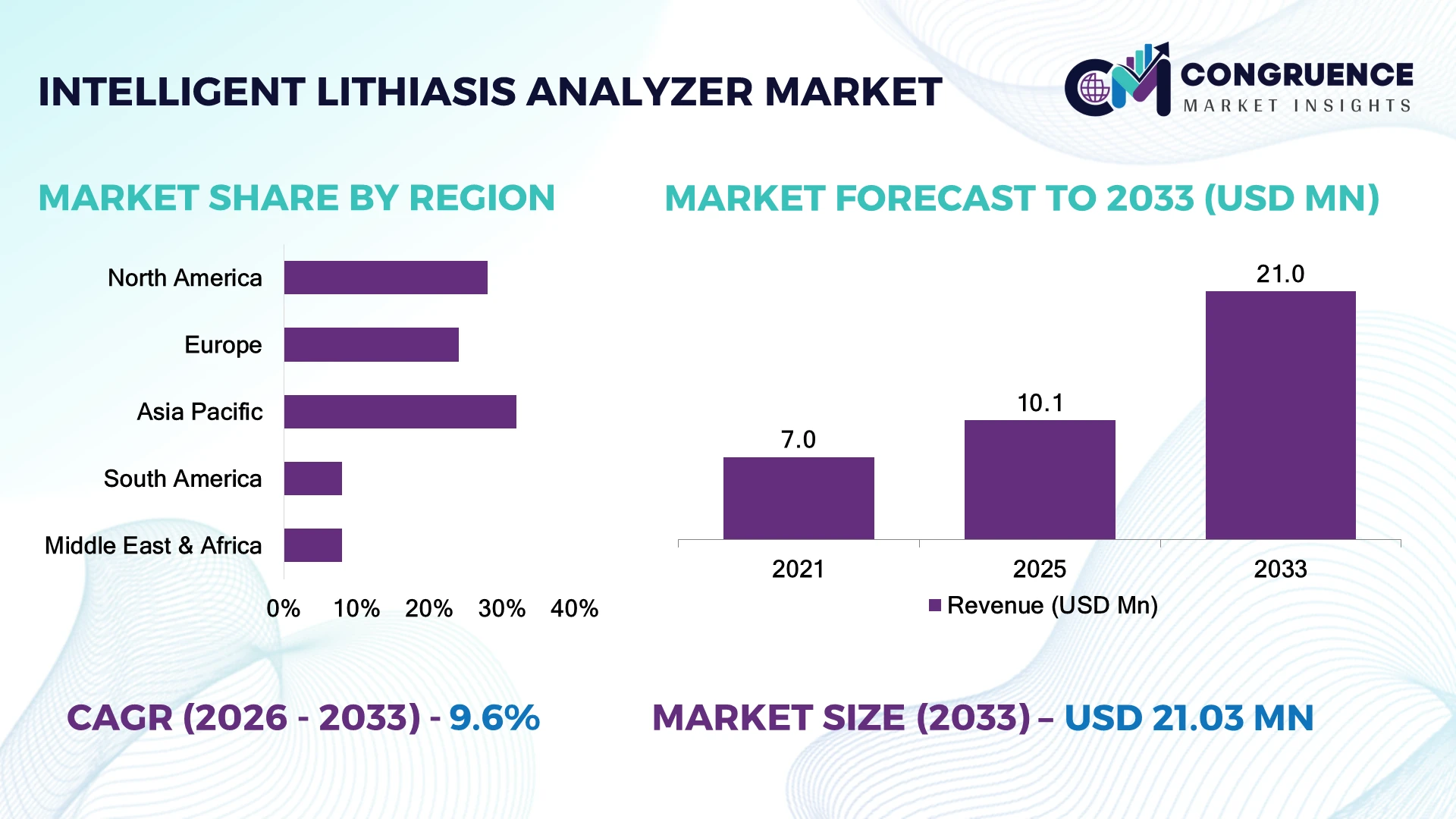
China dominates the market with nearly 32% share, supported by expanding urology infrastructure, domestic medical technology investments, and over 1,500 advanced diagnostic facilities adopting automated analyzers. The United States follows with approximately 28% share, driven by high hospital automation penetration and AI-based healthcare integration. In 2024, China’s medical device localization policies accelerated domestic analyzer development, while U.S. facilities reported over 60% adoption of digital diagnostic workflows.
Strategic investments in intelligent lithiasis analysis are enabling healthcare providers to improve diagnostic accuracy, reduce manual testing dependency, and strengthen precision medicine capabilities.
Market Size & Growth: USD 10.1 Million (2025) to USD 21.0 Million (2033) at 9.6% CAGR, driven by AI-powered diagnostic automation and precision urology adoption.
Top Growth Drivers: AI diagnostics (35%), hospital automation (30%), and rising kidney stone incidence (25%) are accelerating market expansion.
Short-Term Forecast: By 2028, automated analysis adoption increases by 40%, reducing laboratory processing time by 35%.
Emerging Technologies: AI-based recognition, cloud-connected analyzers, and automated spectroscopy systems are transforming stone analysis workflows.
Regional Leaders: Asia-Pacific reaches USD 7.2 Million by 2033 through hospital modernization; North America reaches USD 6.3 Million through AI integration; Europe reaches USD 4.8 Million through advanced clinical diagnostics adoption.
Consumer/End-User Trends: Over 55% of urology centers prioritize faster diagnostic platforms to improve personalized treatment planning.
Pilot/Case Example: A 2024 hospital automation program using intelligent analyzers reduced manual interpretation workload by 45% and improved reporting speed.
Competitive Landscape: China-based manufacturers lead with approximately 30% market share, alongside key players including MINDRAY, Shenzhen Mindray Bio-Medical Electronics, DIRUI, Roche Diagnostics, and Thermo Fisher Scientific.
Regulatory & ESG Impact: Digital healthcare regulations and reduced reagent consumption lower laboratory waste by nearly 20% through automated testing processes.
Investment & Funding: Over USD 150 Million invested in medical AI and diagnostic automation partnerships, with expansion focused on smart laboratory ecosystems.
Innovation & Future Outlook: Next-generation analyzers integrate AI algorithms, predictive diagnostics, and connected healthcare platforms, shifting competition toward intelligent precision medicine solutions.
Intelligent Lithiasis Analyzer Market adoption is expanding across hospitals, diagnostic laboratories, and specialized urology centers due to demand for faster stone composition identification and treatment personalization. Recent product innovations include AI-assisted imaging, automated spectral analysis, and cloud-based diagnostic reporting, with advanced systems improving interpretation accuracy by nearly 30%. Growing regulatory emphasis on digital healthcare infrastructure and laboratory automation is accelerating adoption across emerging markets, creating a transition toward connected diagnostic ecosystems.
The Intelligent Lithiasis Analyzer Market is becoming strategically important as healthcare systems shift toward precision diagnostics, automation, and data-driven treatment decisions. Hospitals are prioritizing intelligent laboratory solutions to improve turnaround times, reduce operator dependency, and support personalized kidney stone management. Digital healthcare modernization programs across Asia-Pacific, North America, and Europe are reshaping investment priorities toward connected diagnostic platforms.
Compared with traditional manual stone analysis methods, AI-enabled analyzers improve interpretation efficiency by approximately 40% and reduce repetitive laboratory handling requirements by nearly 30%. North America maintains stronger AI integration due to advanced hospital networks, while Asia-Pacific demonstrates faster deployment growth through expanding healthcare infrastructure and domestic medical device manufacturing initiatives.
Over the next 2–3 years, adoption is expected to accelerate as hospitals upgrade diagnostic capabilities and establish integrated laboratory systems. For example, urology networks implementing automated analyzers are reducing reporting delays and improving clinical workflow coordination. Companies are responding through strategic partnerships, regional manufacturing expansion, and software-driven innovation. Competitive advantage will increasingly depend on technological accuracy, interoperability, and the ability to deliver scalable intelligent diagnostics across global healthcare markets.
The primary growth driver for intelligent lithiasis analyzers is the transition from manual stone evaluation to AI-enabled automated diagnostics, improving accuracy and laboratory efficiency. Advanced systems reduce interpretation time by nearly 40% and enhance analytical consistency by over 30% across urology laboratories. In China, government-backed healthcare digitization programs are accelerating adoption of smart diagnostic equipment, while U.S. hospitals are integrating AI platforms into precision medicine workflows. Companies are responding through AI algorithm development, strategic hospital partnerships, and investments in cloud-connected analyzers. The key operational advantage is enabling faster treatment decisions with fewer skilled laboratory resources.
High acquisition costs, limited laboratory infrastructure, and interoperability challenges remain significant barriers to widespread intelligent lithiasis analyzer deployment. Advanced analyzer systems can require 20–35% higher upfront investment compared with conventional testing equipment, restricting adoption among smaller hospitals and diagnostic centers. In India and several emerging healthcare markets, uneven digital infrastructure limits seamless integration with hospital information systems. Companies face pressure on margins due to component costs and specialized software requirements. Manufacturers are reducing exposure through localized production strategies, supplier diversification, and modular analyzer designs that lower installation complexity while improving scalability across different healthcare environments.
Growing opportunities are emerging from connected diagnostic platforms, AI-driven stone classification, and decentralized laboratory automation. Cloud-enabled analyzers can improve data accessibility by more than 50% and support centralized monitoring across multi-hospital networks. Japan and South Korea are advancing smart healthcare ecosystems, creating demand for intelligent diagnostic technologies integrated with electronic medical records. Companies are expanding through software upgrades, ecosystem partnerships, and R&D investments focused on predictive analytics. A major untapped opportunity lies in combining lithiasis analysis data with preventive care models, allowing healthcare providers to identify recurrence risks and optimize personalized treatment pathways.
Long-term market expansion faces execution challenges related to cybersecurity, workforce adaptation, and integration complexity within existing healthcare systems. Nearly 40% of hospitals implementing digital diagnostic tools report workflow adjustment requirements, while cybersecurity compliance increases operational costs for connected medical devices. In the United States and European markets, evolving medical device regulations require continuous software validation and data protection measures. Companies must strengthen cybersecurity frameworks, improve interoperability standards, and provide technical training programs to maintain deployment consistency. The strategic challenge is balancing advanced automation with reliable clinical adoption across diverse healthcare environments.
AI-Assisted Diagnostic Evolution: Intelligent lithiasis analyzers are shifting toward AI-powered classification and automated interpretation, with hospitals reporting workflow efficiency improvements of 30–40% after digital diagnostic integration. U.S. healthcare networks are expanding AI-enabled laboratory systems due to rising precision medicine requirements and skilled technician shortages. Companies are responding through software upgrades, cloud connectivity, and algorithm partnerships to improve diagnostic speed and reduce manual analysis dependency.
Cloud Laboratory Connectivity Growth: Connected analyzer platforms are becoming central to multi-site healthcare operations, enabling over 50% faster data sharing between laboratories and clinical departments. Japan and South Korea are accelerating smart hospital deployments through electronic medical record integration and automation programs. Manufacturers are prioritizing secure cloud ecosystems, remote monitoring capabilities, and subscription-based service models to improve operational continuity and customer retention.
Localized Supply Chain Expansion: Medical device manufacturers are restructuring supply networks as component availability and geopolitical trade pressures influence equipment production. China-based suppliers are increasing domestic component sourcing by nearly 35%, reducing dependency on international supply chains. Companies are establishing regional manufacturing partnerships and localized service networks to improve delivery reliability, shorten maintenance cycles, and strengthen competitiveness in emerging healthcare markets.
Workflow Automation Standardization: Hospitals are increasingly adopting automated lithiasis analysis workflows to address laboratory capacity constraints, with automation reducing repetitive handling activities by approximately 40%. European healthcare providers are aligning digital diagnostic adoption with stricter operational efficiency targets. Companies are developing integrated analyzer platforms that combine testing, reporting, and data management, creating scalable solutions for hospitals seeking consistent diagnostic performance.
Automated intelligent lithiasis analyzers represent the leading type segment, accounting for approximately 58% of market adoption due to superior processing speed, reduced operator dependency, and integration with digital laboratory systems. Their ability to standardize stone composition analysis supports higher deployment across hospitals and diagnostic centers. Semi-automated analyzers hold nearly 30% share, remaining relevant in cost-sensitive facilities requiring partial workflow automation, while manual systems continue serving smaller laboratories with limited infrastructure. The fastest-growing segment is advanced AI-integrated analyzers, expanding as healthcare providers prioritize predictive diagnostics and data-driven treatment planning. Adoption is increasing by nearly 35% among digitally advanced hospitals implementing smart laboratory solutions. Companies are shifting investments toward AI software development, modular hardware platforms, and cloud-enabled diagnostic ecosystems. The strategic focus is moving from standalone equipment sales toward intelligent diagnostic networks that improve long-term clinical value.
Clinical diagnosis remains the leading application segment with approximately 65% market share, supported by increasing utilization of intelligent analyzers in urology departments and specialized diagnostic laboratories. Hospitals rely on these systems for accurate stone composition identification, treatment planning, and recurrence management. Research applications account for nearly 20% share, supported by pharmaceutical studies and metabolic disease investigations, while other applications continue developing through specialized healthcare initiatives. The fastest-growing application area is integrated digital diagnostics, expanding as hospitals connect analyzer outputs with electronic health records and clinical decision platforms. Adoption among advanced healthcare facilities has increased by nearly 40% as providers seek faster reporting and improved workflow coordination. Companies are strengthening partnerships with hospitals and laboratory networks to expand deployment. The business shift is toward connected diagnostic solutions that transform analysis results into actionable clinical intelligence.
Hospitals represent the dominant end-user segment with approximately 60% market share due to higher diagnostic volumes, advanced infrastructure, and greater investment capacity. Large healthcare institutions deploy intelligent lithiasis analyzers to improve laboratory throughput and reduce diagnostic delays. Diagnostic laboratories contribute nearly 25% share, supported by centralized testing demand and increasing outsourcing of specialized analysis services, while research institutions maintain niche adoption. The fastest-growing end-user group is specialized urology centers, with adoption rising by approximately 35% as outpatient precision treatment models expand. These facilities are investing in compact, automated systems to improve patient turnaround and clinical efficiency. Companies are responding through customized solutions, service contracts, and partnerships with healthcare providers. Future demand is shifting toward integrated care networks where analyzers support continuous patient monitoring and personalized treatment strategies.
Asia-Pacific accounted for the largest market share at 32% in 2025 however, North America is expected to register the fastest growth, expanding at a CAGR of 10.8% between 2026 and 2033.
North America accounted for approximately 28% market share in 2025, supported by advanced healthcare infrastructure, high adoption of automated laboratory systems, and strong investment in AI-enabled diagnostics. The United States represents the largest contributor within the region, driven by widespread deployment of intelligent laboratory solutions across hospitals and urology centers. More than 60% of large healthcare facilities in the country have integrated digital diagnostic workflows, improving analyzer connectivity and clinical efficiency. Leading companies are expanding through partnerships with healthcare providers, software integration initiatives, and development of advanced analyzer platforms. The region’s market position is strengthened by mature medical technology adoption and strong demand for precision diagnostic solutions.
United States Market Outlook: The United States remains the dominant country in North America due to its extensive hospital network, advanced healthcare infrastructure, and high adoption of digital diagnostics. Over 70% of large hospitals utilize connected healthcare systems, supporting the integration of intelligent lithiasis analyzers. Companies are focusing on AI enhancement, cloud-based reporting, and strategic collaborations to improve diagnostic efficiency.
Europe accounted for approximately 24% market share in 2025, supported by advanced healthcare systems, regulatory emphasis on diagnostic accuracy, and increasing laboratory automation. Germany, France, and the United Kingdom are the primary adoption markets, with Germany contributing significantly due to its strong medical device manufacturing base. Automated diagnostic systems are gaining acceptance across European hospitals as healthcare providers seek improved workflow efficiency and standardized testing procedures. Around 35% of advanced healthcare facilities have increased investment in digital laboratory technologies, encouraging manufacturers to develop connected and compliant analyzer solutions. Companies are strengthening their presence through regional partnerships, regulatory-focused product development, and expansion of technical support capabilities.
Germany Market Outlook: Germany leads European adoption due to its medical technology ecosystem, manufacturing expertise, and advanced healthcare infrastructure. More than 50% of leading diagnostic facilities have adopted digital laboratory solutions, creating demand for intelligent analyzers with improved automation, interoperability, and data management capabilities.
Asia-Pacific accounted for approximately 32% market share in 2025, making it the leading region due to expanding healthcare infrastructure, growing medical device manufacturing capabilities, and increasing adoption of intelligent diagnostic technologies. China represents the largest contributor, supported by healthcare modernization initiatives, domestic production expansion, and rising deployment across hospitals and diagnostic laboratories. More than 1,500 healthcare facilities in China are adopting advanced laboratory automation technologies, strengthening regional demand. Japan, South Korea, and India are also increasing investments in digital healthcare infrastructure and precision diagnostics. Companies are expanding manufacturing capacity, developing cost-effective analyzer solutions, and forming partnerships with healthcare networks to improve accessibility. The region’s competitive advantage comes from manufacturing strength combined with rapid healthcare technology adoption.
China Market Outlook: China is the leading country within Asia-Pacific due to its large healthcare system, expanding medical device industry, and strong focus on domestic technology development. The country has increased local medical device production capacity by nearly 35%, enabling faster deployment of intelligent diagnostic platforms across hospitals and specialized laboratories.
South America accounted for approximately 8% market share in 2025, with Brazil and Argentina representing the major adoption markets. Brazil contributes the largest share within the region due to its extensive healthcare network and increasing investment in diagnostic modernization. Adoption remains concentrated in private hospitals and urban medical centers where automated analyzers improve laboratory efficiency and reduce manual processing requirements. Around 30% improvement in diagnostic workflow efficiency has been observed in facilities adopting automated laboratory technologies. Companies are expanding through distribution partnerships, localized service networks, and affordable analyzer models designed for developing healthcare systems. Infrastructure improvement and increasing access to advanced diagnostics are shaping future deployment opportunities.
Brazil Market Outlook: Brazil is the leading South American market due to its healthcare infrastructure scale and growing private healthcare sector. Major hospitals in urban centers are upgrading laboratory capabilities, with more than 40% of advanced diagnostic facilities adopting digital healthcare solutions to improve testing efficiency and clinical decision-making.
Middle East & Africa accounted for approximately 8% market share in 2025, supported by healthcare modernization programs, hospital infrastructure development, and increasing adoption of advanced diagnostic equipment. Saudi Arabia and the United Arab Emirates represent the key markets, driven by government healthcare transformation initiatives and investment in digital medical technologies. Newly developed healthcare facilities in Gulf countries are increasingly adopting automated diagnostic systems, with automation penetration improving by approximately 25% in advanced hospitals. Companies are targeting the region through government partnerships, healthcare infrastructure projects, and customized deployment strategies. The market remains influenced by infrastructure differences across countries, creating demand for scalable and adaptable analyzer solutions.
Saudi Arabia Market Outlook: Saudi Arabia is the leading country in the region due to healthcare transformation investments and expansion of advanced medical facilities. More than 200 healthcare facilities are undergoing digital modernization initiatives, supporting demand for intelligent diagnostic systems, automated laboratory solutions, and connected healthcare technologies.
The Intelligent Lithiasis Analyzer market is contested by Chinese medical device specialists such as Dingshun Medical Equipment and Lanmode, alongside global diagnostic technology providers including Mindray, Sysmex, and Thermo Fisher Scientific. Regional manufacturers compete through cost efficiency, localized service networks, and rapid customization, while global players compete through advanced automation, AI integration, and laboratory connectivity. The top five companies account for approximately 55% of market presence, creating a moderately consolidated structure. Competition centers on analyzer accuracy, workflow automation, pricing, and integration capabilities, with automated systems improving laboratory efficiency by 30–40%. Players are expanding through healthcare partnerships, software upgrades, and vertical integration of hardware with digital platforms. The competitive landscape is shifting toward AI-driven diagnostics and supply-chain localization, increasing entry barriers for new manufacturers. Winning companies will require superior technology, reliable support networks, and scalable intelligent diagnostic ecosystems.
Lanmode (Tianjin) Science Instrument Co., Ltd.
Mindray
Sysmex Corporation
Thermo Fisher Scientific
Agilent Technologies
Roche Diagnostics
Siemens Healthineers
HORIBA Medical
DIRUI Industrial Co., Ltd.
Maccura Biotechnology Co., Ltd.
Shenzhen Mindray Bio-Medical Electronics Co., Ltd.
Intelligent lithiasis analyzers are advancing through AI-based image recognition, automated spectroscopy, and digital laboratory connectivity. AI classification systems improve stone identification accuracy and reduce interpretation time by nearly 30%, while automated workflows lower manual handling requirements by approximately 40%. Hospitals are increasingly adopting connected diagnostic platforms as healthcare systems prioritize faster and standardized urology analysis.
The transition from conventional manual assessment to intelligent automated analyzers is creating measurable operational advantages. New AI-supported platforms deliver around 35% faster processing compared with traditional laboratory methods and improve data traceability through cloud-enabled reporting. Global diagnostic companies and specialized medical device manufacturers are competing by integrating predictive analytics, electronic health record compatibility, and remote monitoring capabilities.
Between 2026 and 2028, the market will increasingly move toward multimodal diagnostics combining imaging, clinical data, and AI algorithms. Companies investing in explainable AI, cybersecurity, and scalable software ecosystems will gain competitive advantages. The strongest beneficiaries will be hospitals seeking reduced workflow pressure, laboratories requiring automation, and technology providers developing integrated precision diagnostics.
April 2024 Dornier MedTech launched UroGPT™, an AI-based kidney stone patient support tool developed with urologist collaboration. The platform provides digital guidance and improves patient engagement through AI assistance. The launch strengthened Dornier’s digital urology portfolio and expanded AI adoption in stone care. Source: www.dornier.com
April 2025 Agilent Technologies introduced the InfinityLab Pro iQ Series intelligent mass detection platform, enhancing laboratory analytical workflows. The system targets advanced molecular analysis applications and improves laboratory productivity through next-generation detection capabilities. Source: www.agilent.com
October 2025 DIRUI expanded automated laboratory diagnostics with regulatory approval for the HC-300 urine analyzer in Russia. The compact system performs 14 chemical parameter tests, supporting decentralized laboratory deployment and strengthening the company’s international diagnostic equipment presence. Source: www.dirui.com.ru
October 2025 Withings commercialized its U-Scan urine health analyzer in the U.S. and Europe, introducing consumer-focused kidney health monitoring. The device uses interchangeable cartridges providing approximately 22 tests over three months, expanding digital urine analysis accessibility.
The Intelligent Lithiasis Analyzer Market Report covers market segmentation by type, application, and end-user, including fully automated systems, semi-automated systems, hospitals, clinics, diagnostic laboratories, and research facilities. The study evaluates adoption patterns across North America, Europe, Asia-Pacific, South America, and Middle East & Africa, highlighting country-level deployment trends and competitive positioning.
The report analyzes key technologies such as AI-enabled diagnostics, automated spectroscopy, digital connectivity, and laboratory workflow integration. It provides strategic insights into company participation, technology advancement, investment priorities, and emerging opportunities. Coverage includes approximately 10–15 major industry participants, evolving healthcare automation trends, and operational factors influencing market expansion from 2026 to 2033. The report supports business planning, market entry strategies, competitive benchmarking, and long-term technology investment decisions.
| Report Attribute / Metric | Details |
|---|---|
| Market Revenue (2025) | USD 10.1 Million |
| Market Revenue (2033) | USD 21.0 Million |
| CAGR (2026–2033) | 9.6% |
| Base Year | 2025 |
| Forecast Period | 2026–2033 |
| Historic Period | 2021–2025 |
| Segments Covered |
By Type
By Application
By End-User
|
| Key Deliverables | Revenue Forecast; Market Trends; Growth Drivers & Restraints; Technology Insights; Segmentation Analysis; Regional Insights; Competitive Landscape; Regulatory & ESG Overview; Recent Developments |
| Regions Covered | North America; Europe; Asia-Pacific; South America; Middle East & Africa |
| Companies Profiled | Dingshun Medical Equipment Co., Ltd.; Lanmode (Tianjin) Science Instrument Co., Ltd.; Mindray; Sysmex Corporation; Thermo Fisher Scientific; Agilent Technologies; Roche Diagnostics; Siemens Healthineers; HORIBA Medical; DIRUI Industrial Co., Ltd.; Maccura Biotechnology Co., Ltd.; Shenzhen Mindray Bio-Medical Electronics Co., Ltd. |
| Customization & Pricing | Available on Request (10% Customization Free) |




