
Reports
The Global Intelligent Hearing Protection Device Market was valued at USD 1,272.0 Million in 2025 and is anticipated to reach a value of USD 4,028.5 Million by 2033 expanding at a CAGR of 15.5% between 2026 and 2033. Growth is driven by the shift from passive hearing protection toward digitally connected systems combining adaptive noise suppression, speech enhancement, situational awareness, and real-time communications across defense, manufacturing, oil & gas, construction, and aviation.
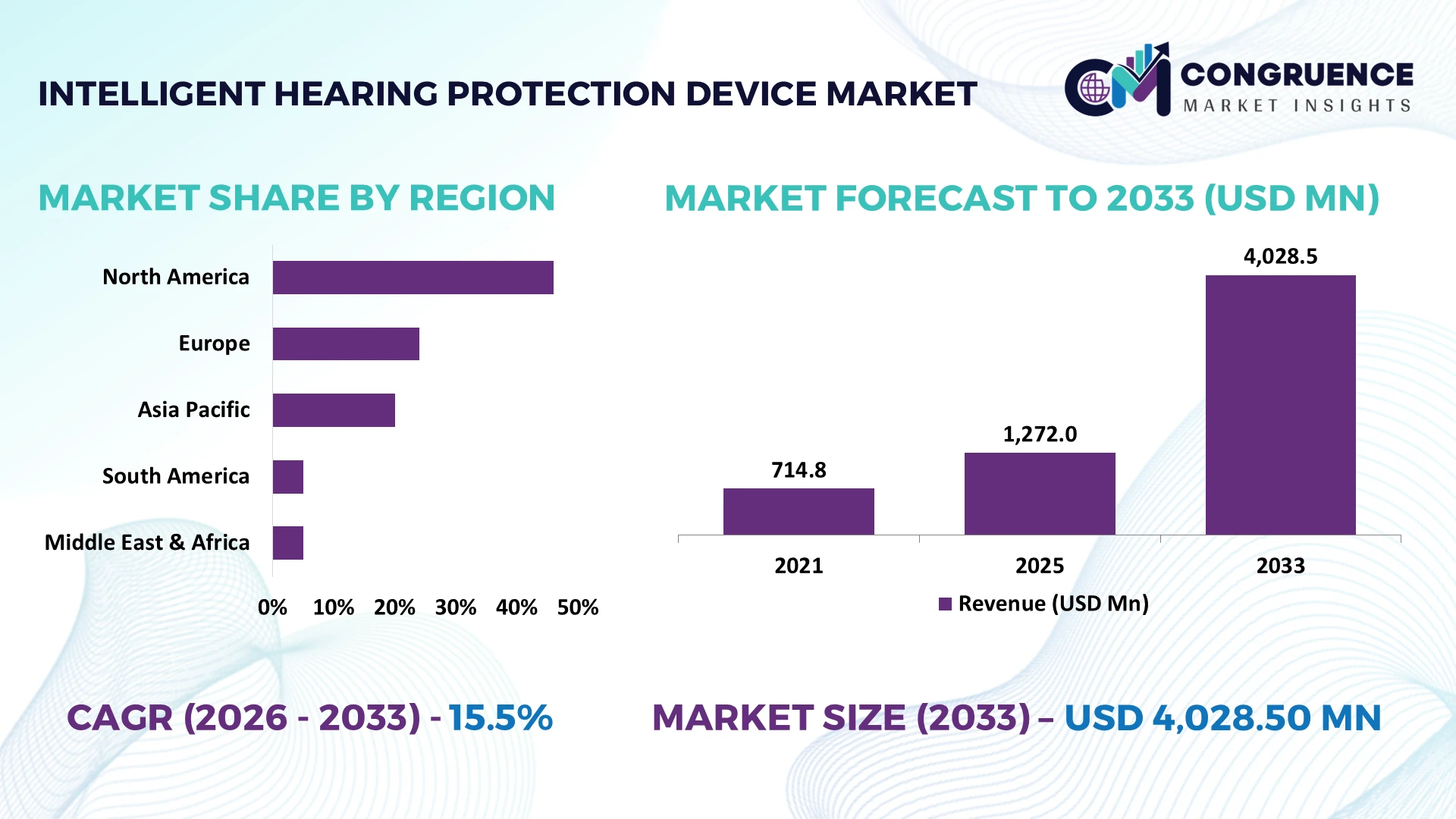
The United States dominates adoption, accounting for more than 50% of the North American market, while North America itself represents over 50% of global intelligent hearing protection demand. U.S. deployment is concentrated across defense, aviation, manufacturing, and construction, where OSHA requires hearing-conservation programs at 85 dBA over an 8-hour TWA. Europe and China together represent about 40%, creating a strong competitive contrast between mature U.S. compliance-led deployment and industrial expansion in China.
Strategically, suppliers should prioritize communication-enabled, connected protection platforms and strengthen industrial partnerships where regulatory compliance directly accelerates technology adoption.
Market Size & Growth: Market value reaches USD 1,272.0 million in 2025 and USD 4,028.5 million by 2033, with 15.5% CAGR, supported by connected hearing protection and industrial safety modernization.
Top Growth Drivers: Regulatory compliance contributes to roughly 48% of growth drivers, while AI-integrated technology contributes about 36%; industrial safety remains the core purchasing trigger.
Short-Term Forecast: By 2028, connected-device deployment is positioned to accelerate as manufacturers target approximately 20% higher operational efficiency through integrated communication, adaptive attenuation, and remote device management.
Emerging Technologies: AI-assisted sound classification, adaptive noise cancellation, Bluetooth connectivity, and real-time speech separation are reshaping advanced IHPDs; Sensear already combines speech enhancement, noise suppression, and 360° awareness.
Regional Leaders: North America remains the largest market at more than 50% share, while Europe and China collectively represent about 40%; adoption is shifting toward connected industrial and defense-grade systems.
Consumer/End-User Trends: Earmuffs represent more than 50% of product demand, while defense and law enforcement lead application adoption as users prioritize protection without losing communication and situational awareness.
Pilot/Case Example: Sensear's smartMuff delivers up to 27 dB NRR, limits in-ear exposure to 82 dB(A), and provides up to 24 hours of battery life, demonstrating the shift toward multi-shift intelligent protection.
Competitive Landscape: Honeywell holds approximately 22% share in one 2025 industry estimate, while Honeywell and 3M together command about 35%; Phonak, Sensear, and Etymotic Research strengthen the competitive field.
Regulatory & ESG Impact: OSHA's 85 dBA action level makes hearing conservation a measurable workplace requirement, pushing employers toward reusable, communication-enabled devices that reduce unnecessary replacement and improve worker protection.
Investment & Funding: Around 48% of market investment is directed toward IoT and AI integration, while 37% of venture inflows target adaptive noise-cancellation technologies, accelerating software-defined safety products.
Innovation & Future Outlook: Next-generation platforms will combine AI sound recognition, wireless connectivity, adaptive attenuation, and safety analytics, shifting competition from standalone PPE toward integrated connected-worker ecosystems.
The Intelligent Hearing Protection Device market is increasingly concentrated in defense, industrial manufacturing, oil & gas, construction, and aviation, where communication continuity is becoming as important as attenuation. Around 42% of devices are reported to incorporate wireless connectivity, reinforcing the transition from conventional PPE toward connected safety equipment. Supply-chain localization and stricter workplace-noise enforcement are also encouraging manufacturers to regionalize production and certification strategies.
Intelligent hearing protection is becoming strategically important because industrial buyers increasingly require one device to deliver hearing conservation, communication, and situational awareness simultaneously. OSHA's 85 dBA action level reinforces this transition in the U.S., while defense, aviation, mining, construction, and heavy manufacturing are moving toward connected-worker technologies.
The technology shift is measurable at the device level. Sensear systems, for example, combine speech enhancement and background-noise suppression while maintaining 360° awareness; its smartMuff limits in-ear exposure to 82 dB(A), provides up to 27 dB NRR, and supports 24-hour battery operation. This contrasts with legacy passive protection that primarily attenuates sound without integrated communication or adaptive processing.
North America retains the largest installed base, exceeding 50% of the market, while Europe and China together account for about 40%, creating different investment priorities: compliance-led replacement in the U.S. versus industrial modernization in China. Over the next 2–3 years, companies are prioritizing Bluetooth, AI-enabled sound processing, software updates, and hazardous-location certifications. Strategic advantage will increasingly depend on interoperable platforms rather than standalone protective hardware.
Regulatory exposure thresholds and industrial communication requirements are accelerating intelligent-device adoption. OSHA requires hearing-conservation programs at 85 dBA over an 8-hour TWA, while advanced systems increasingly combine protection with communication and awareness. Sensear's platforms provide up to 27 dB NRR, 24-hour battery operation, and controlled in-ear exposure of 82 dB(A). In U.S. manufacturing and oil & gas operations, this converts hearing protection from passive PPE into a productivity tool. Companies are responding with Bluetooth-enabled headsets, speech-enhancement algorithms, and hazardous-location-certified products. The non-obvious advantage is reduced need to remove protection for communication, improving compliance consistency and workflow continuity.
Advanced microphones, digital signal processors, batteries, wireless modules, and hazardous-location certification raise acquisition and lifecycle costs versus conventional plugs and earmuffs. Products targeting extreme environments can require certification across ATEX, IECEx, UL, CSA, and other frameworks, increasing engineering and market-entry requirements. Battery-dependent systems also introduce maintenance requirements across multi-shift industrial fleets, while device compatibility can constrain replacement flexibility. The U.S. market benefits from mature procurement infrastructure, whereas smaller industrial operators in emerging manufacturing hubs face tighter equipment budgets. Manufacturers are reducing exposure through modular electronics, longer battery cycles, software upgrades, and standardized communication interfaces. The strategic constraint is not attenuation performance alone but total cost of ownership across large worker fleets.
AI sound classification and adaptive speech processing create an opportunity to transform IHPDs into real-time industrial safety interfaces. Around 42% of devices are reported to incorporate wireless connectivity, while approximately 33% integrate data analytics, supporting greater emphasis on connected safety management. Future systems can distinguish speech, alarms, machinery, vehicles, and impulse noise while dynamically controlling attenuation. India's expanding manufacturing base and China's industrial automation investments create large deployment opportunities beyond mature North American procurement channels. Companies are positioning through software development, sensor integration, and partnerships with communication-platform providers. A non-obvious opportunity is recurring software and fleet-management revenue: manufacturers can move beyond one-time PPE sales toward firmware upgrades, analytics, device monitoring, and compliance-management services.
Scaling intelligent hearing protection across industrial fleets requires reliable interoperability among Bluetooth, two-way radio, short-range communication, mobile devices, and existing safety systems. Sensear already supports multiple communication pathways and software upgrades, illustrating the integration complexity manufacturers must solve. Battery degradation, wireless interference, firmware compatibility, and cybersecurity become more consequential as protection devices become connected endpoints. Hazardous environments add another layer through ATEX and IECEx certification requirements. Companies must therefore invest in ruggedized electronics, secure firmware architecture, compatibility testing, and regional certification. The long-term competitive issue is maintaining consistent protection and communication performance across changing industrial networks rather than simply increasing device intelligence.
AI-Assisted Noise Classification: Intelligent devices are shifting toward real-time sound classification, with advanced systems combining speech enhancement, adaptive attenuation, and wireless connectivity. More than 40% of reported devices now incorporate connected functionality, changing hearing protection from standalone PPE into active communication equipment. Manufacturers are scaling digital signal processing and Bluetooth integration to improve communication continuity without removing protection during high-noise tasks.
Defense Procurement Gets Smarter: Defense and law-enforcement deployment remains the largest application, while connected tactical systems increasingly prioritize situational awareness alongside attenuation. Earmuffs account for more than 50% of product demand in several established market datasets, reflecting their compatibility with radios and helmets. Suppliers are responding with integrated communications, impulse-noise control, and modular configurations as defense procurement shifts toward multifunctional equipment.
Industrial Fleets Move Connected: Manufacturing and construction buyers are increasingly deploying standardized device fleets rather than isolated worker units. Manufacturing represents about 28% of end-user demand and construction about 24%, creating stronger requirements for durability, battery management, and fleet consistency. Companies are responding through enterprise contracts, device standardization, and scalable procurement programs, while connected monitoring reduces the operational burden of managing large distributed workforces.
Compact Devices Gain Traction: Smart earplugs are gaining attention because their compact form factor fits helmets, eyewear, and other PPE more easily than conventional over-ear equipment. One recent market assessment places earplugs at about 54% share, while intelligent earmuffs retain strong adoption in extreme-noise environments. Supply-chain pressure on electronics and batteries is encouraging manufacturers to simplify component architectures and localize selected production stages.
Earplugs represent the leading type, with approximately 54% market share in recent market estimates, supported by lightweight construction, discreet form factors, and compatibility with helmets and face protection. Their compact architecture also supports integration of Bluetooth connectivity, adaptive noise control, and miniature electronics. Earmuffs remain strategically important, particularly in aviation, defense, oil and gas, and heavy manufacturing where higher attenuation and communication integration are priorities. In several established market assessments, earmuffs account for more than 50% of demand, demonstrating the variation between product-focused datasets and application-specific procurement patterns.
The fastest-moving shift is toward smart earplugs that combine communication and hearing protection without obstructing other PPE. Approximately 43% of surveyed users in manufacturing and defense reportedly prefer connected smart earplugs, strengthening investment in miniaturized electronics. Companies are expanding compact-device portfolios while retaining rugged earmuffs for high-noise applications. This creates a two-track strategy: earplugs address mobility and comfort, while earmuffs capture demanding industrial and tactical deployments.
Defense and Law Enforcement remains the leading application because users require hearing protection without losing radio communication, speech recognition, or awareness of surrounding events. It represents the largest application category in established market assessments, followed by Aviation, Oil and Gas, Construction, Manufacturing, Consumer Use, and Others. Defense deployments prioritize impulse-noise management and communication integration, while aviation emphasizes continuous communication around aircraft and ground equipment.
Construction and Manufacturing are strengthening demand as automated machinery, heavy equipment, and increasingly dense production environments raise requirements for continuous protection. The combined industrial applications represent a substantial share of deployment, while consumer use is expanding through compact Bluetooth-enabled products. Companies are therefore separating product architectures by operating environment: tactical systems emphasize communication reliability, whereas industrial systems prioritize durability, battery life, and fleet deployment. The operational implication is a shift from generic hearing protection toward application-specific configurations.
Manufacturing represents the leading end-user group at approximately 28% share, supported by large worker populations, continuous machinery exposure, and structured occupational-safety programs. Construction follows at about 24%, reflecting extensive use around heavy equipment, infrastructure projects, and high-noise worksites. Defense is also a significant buyer because communication reliability and impulse-noise protection are mission-critical. Manufacturing procurement typically favors standardized fleets and repeat purchasing, while construction buyers place greater emphasis on ruggedness, mobility, and compatibility with helmets and face shields.
Music and Entertainment represents a smaller but increasingly specialized segment, where sound fidelity and controlled attenuation matter more than maximum industrial isolation. Others capture additional professional and recreational users with specialized requirements. The fastest strategic shift is toward enterprise-wide connected procurement, enabling companies to manage devices across multiple facilities instead of purchasing conventional PPE independently at each site. Manufacturers are responding with customization, longer battery cycles, communication integration, and direct enterprise partnerships.
North America accounted for the largest market share at 46.0% in 2025 however, Asia-Pacific is expected to register the fastest growth, expanding at a CAGR of 17.2% between 2026 and 2033.
North America held approximately 46.0% of global demand in 2025, supported by established occupational-safety programs, defense procurement, aviation activity, and technologically advanced manufacturing. The U.S. accounts for the overwhelming majority of regional consumption, with intelligent earmuffs and communication-enabled headsets increasingly replacing conventional protection in high-noise environments. OSHA's 85 dBA action level continues to influence enterprise purchasing, while defense and aerospace contractors prioritize speech intelligibility and situational awareness. Connected devices are also becoming easier to integrate with two-way radios and workforce communication platforms. Manufacturers are responding through ruggedized Bluetooth systems, longer battery cycles, and enterprise fleet agreements. The strategic shift is toward multifunctional PPE that combines attenuation, communication, and worker connectivity rather than treating hearing protection as a standalone safety product.
United States Market Outlook: The United States remains the region's principal technology and procurement center, supported by defense, aerospace, construction, mining, and advanced manufacturing. Large industrial employers increasingly standardize hearing-protection equipment across multiple facilities, strengthening demand for interoperable systems. The 85 dBA occupational exposure threshold creates a measurable procurement trigger, while connected headsets increasingly support communication-intensive workflows. U.S. manufacturers and technology suppliers are therefore emphasizing certification, ruggedization, software integration, and direct enterprise partnerships.
Europe represented approximately 24.0% of global demand in 2025, supported by stringent worker-protection requirements, advanced automotive production, aerospace manufacturing, energy infrastructure, and industrial automation. Germany, France, the U.K., and Italy form the principal demand centers, with Germany particularly important because of its dense manufacturing ecosystem. Intelligent protection is increasingly integrated into automated production environments where workers must communicate around machinery without removing PPE. Sustainability requirements are also encouraging longer-life equipment, replaceable components, and lower-frequency replacement cycles. Manufacturers are responding with modular electronics, rechargeable systems, and products compatible with broader industrial communication platforms. The region's distinctive opportunity is the combination of safety compliance and Industry 4.0 modernization, making connected hearing protection increasingly relevant to digitally managed factories.
Germany Market Outlook: Germany is Europe's strongest industrial demand center because automotive manufacturing, machinery production, chemicals, and industrial automation create extensive high-noise workplace exposure. Intelligent devices are increasingly relevant to digitally coordinated factories where workers interact with automated machinery and mobile communication systems. Germany's large manufacturing base supports recurring enterprise procurement and encourages suppliers to develop durable, interoperable products. Manufacturers are prioritizing modular designs and communication compatibility to fit increasingly automated production environments.
Asia-Pacific accounted for approximately 20.0% of global demand in 2025 and represents the fastest-expanding deployment base, supported by manufacturing expansion, infrastructure construction, mining, shipbuilding, and energy projects. China represents the region's largest demand center, while Japan, South Korea, India, and Australia contribute through advanced manufacturing, electronics, mining, and construction activity. China's large industrial workforce creates substantial opportunities for fleet-scale intelligent PPE, while India's infrastructure and manufacturing expansion is increasing demand for digitally enabled worker safety. Suppliers are responding through localized distribution, regional partnerships, lower-cost electronics, and application-specific product configurations. The key operational advantage is scale: manufacturers can deploy connected protection across large workforces, making centralized procurement and fleet management increasingly commercially attractive.
China Market Outlook: China remains the region's largest industrial deployment base, supported by extensive manufacturing, construction, mining, shipbuilding, and energy activity. Large production campuses create demand for standardized hearing protection that can operate across multiple high-noise processes. Intelligent devices with wireless communication and adaptive attenuation are particularly relevant where conventional protection can interfere with worker coordination. Suppliers are strengthening local distribution and manufacturing relationships to reduce delivery times and tailor products to large enterprise procurement programs.
South America represented approximately 5.0% of global demand in 2025, with Brazil accounting for the largest portion through mining, construction, steel, energy, and industrial manufacturing. Chile's copper-mining industry adds specialized demand for rugged communication-enabled protection, particularly where workers operate around heavy machinery and continuous industrial noise. Adoption remains more concentrated than in North America because advanced devices carry higher acquisition and maintenance requirements. However, enterprise mining operators increasingly favor standardized PPE procurement and communication-integrated equipment. Manufacturers are responding through distributor partnerships, rugged product configurations, and localized service capabilities. The non-obvious opportunity lies in mining: a smaller number of large operators can generate substantial fleet orders, making enterprise contracts more commercially important than fragmented consumer sales.
Brazil Market Outlook: Brazil is the region's principal market because of its large mining, construction, steel, manufacturing, and energy sectors. Large industrial worksites create sustained requirements for hearing conservation and worker communication. Mining operations particularly favor rugged equipment capable of operating around heavy machinery and extended shifts. Suppliers are increasingly targeting enterprise procurement rather than individual purchases, using local distributors and service networks to improve maintenance response and product availability across geographically dispersed industrial facilities.
Middle East & Africa accounted for approximately 5.0% of global demand in 2025, with the strongest opportunities concentrated in Saudi Arabia, the UAE, South Africa, and major oil and gas production centers. Energy infrastructure, construction megaprojects, mining, aviation, and defense generate sustained requirements for advanced hearing protection. Saudi Arabia's infrastructure modernization and industrial diversification are creating large worksites where communication-enabled PPE can improve coordination around heavy equipment. South Africa contributes through mining and industrial activity, while the UAE provides a technology-oriented aviation, construction, and logistics base. Suppliers are responding with ruggedized systems, regional partnerships, and project-specific procurement. The region's strategic shift is toward integrated worker-safety systems as large infrastructure projects increasingly standardize connected equipment across contractors.
Saudi Arabia Market Outlook: Saudi Arabia is the region's most strategically significant deployment market because large-scale infrastructure, energy, construction, and industrial diversification programs are expanding the number of high-noise worksites. Intelligent hearing protection supports communication around heavy equipment while maintaining continuous attenuation. Large projects also favor standardized procurement across multiple contractors, creating opportunities for suppliers able to provide fleet-scale deployment, training, maintenance, and replacement services rather than standalone devices.
Leaders 3M, Honeywell, and Phonak compete with specialists Sensear, SensGard, and Etymotic, while OEMs pressure pricing. The top five hold 48.3% combined share. Technology drives differentiation, with roughly 42% connectivity adoption and 27 dB-class attenuation. Competition increasingly centers on customization, interoperability, and supply reliability; connected platforms command premium positioning, while value suppliers compete through lower hardware costs. Players expand through distributors, radio partnerships, and vertical product integration. Certification remains the principal entry barrier. The competitive shift is moving from passive attenuation toward communication-enabled protection, where 3M and Honeywell leverage scale while Sensear targets industrial specialization. Phonak brings advanced signal processing, while smaller innovators target compact smart-earplug niches and tactical deployments. Winning requires validated acoustic performance, reliable communications, broad certification, and scalable channel coverage. Suppliers without ecosystem integration face procurement pressure even with competitive pricing. The decisive advantage is combining protection, communication, ruggedization, and service support into one enterprise-ready platform.
3M
Honeywell
Phonak
SensGard
Etymotic Research
Sensear
Moldex-Metric
Minuendo
ISOtunes Audio
Bose
Radians
David Clark Company
Silenta Group
Starkey Hearing Technologies
Current intelligent protection is moving from passive attenuation to digital speech enhancement, adaptive noise control, Bluetooth, and environmental listening. Connected systems now represent roughly 40% of advanced-device adoption in several industry assessments, while electronic products can deliver 23–30 dB protection. Companies gain communication continuity and reduce the need to remove PPE.
Emerging AI sound processing is becoming the key differentiator. Phonak’s dedicated neural-processing architecture demonstrates a 10 dB signal-to-noise improvement in speech-focused applications, while advanced connected platforms support real-time speech separation. Compared with conventional passive protection, adaptive systems improve communication performance rather than simply reducing sound. This favors technology-led suppliers with software and acoustic engineering.
Between 2026 and 2028, interoperability will matter as much as attenuation. Bluetooth, two-way radio, 4G/5G mission-critical communications, rechargeable power, and intrinsically safe electronics are converging. Sensear systems provide up to 27 dB NRR while supporting radio and Bluetooth communication, illustrating the enterprise direction. Manufacturers that integrate hardware, software, certification, and fleet support will capture premium industrial deployments. The competitive benefit extends beyond worker protection: connected devices can standardize communication workflows across factories, mines, airports, and defense sites. Longer battery life and radio-powered architectures reduce charging dependency, while modular designs simplify maintenance and support faster replacement across fleets.
April 2025 — Sensear signed a distribution agreement with Allcan covering Canada and industrial markets including mining, oil and gas, manufacturing, and data centers. The partnership broadens channel access and accelerates deployment of communication-enabled hearing protection across Canadian industrial worksites. Source: sensear.com
July 2025 — Sensear partnered with Dräger to integrate hearing protection with respiratory equipment for hazardous environments. Sensear’s solutions provide up to 27 dB NRR, strengthening communication continuity where respirators and high noise previously constrained worker coordination and PPE usability. Source: aplusa-online.com
January 2025 — 3M introduced the PELTOR ComTac VIII at SHOT Show, adding a redesigned headband and smaller earcups while providing 23 dB protection and up to 40 dB SNR with earplugs. The launch strengthens tactical interoperability and situational-awareness performance. Source: magnumelectronics.com
January 2026 — Sensear appointed Valérie Lemée as Director of Sales Europe, adding more than 25 years of business-development experience across aerospace, rail, construction, nuclear, petrochemicals, oil and gas, and military markets. The appointment strengthens European expansion and distributor development. Source: linkedin.com
The Intelligent Hearing Protection Device Market Report evaluates smart earplugs, intelligent earmuffs, and other connected protection formats across Defense and Law Enforcement, Aviation, Oil and Gas, Construction, Manufacturing, Consumer Use, and related applications. End-user analysis covers Manufacturing, Construction, Defense, Music and Entertainment, and Others, with emphasis on communication-enabled protection, adaptive attenuation, Bluetooth connectivity, speech enhancement, and situational-awareness technologies.
The report provides regional assessment across North America, Europe, Asia-Pacific, South America, and Middle East & Africa, highlighting country-level deployment patterns and industrial demand centers. With connected functionality appearing in roughly 40% of advanced-device adoption assessments, the study tracks the transition from passive PPE toward integrated worker-communication platforms. Competitive analysis covers major global manufacturers and specialist innovators, supporting investment planning, geographic expansion, product positioning, partnership strategy, and technology prioritization through 2026–2033.
| Report Attribute / Metric | Details |
|---|---|
| Market Revenue (2025) | USD 1,272.0 Million |
| Market Revenue (2033) | USD 4,028.5 Million |
| CAGR (2026–2033) | 15.5% |
| Base Year | 2025 |
| Forecast Period | 2026–2033 |
| Historic Period | 2021–2025 |
| Segments Covered |
By Type
By Application
By End-User
|
| Key Deliverables | Revenue Forecast; Market Trends; Growth Drivers & Restraints; Technology Insights; Segmentation Analysis; Regional Insights; Competitive Landscape; Regulatory & ESG Overview; Recent Developments |
| Regions Covered | North America; Europe; Asia Pacific; South America; Middle East & Africa |
| Companies Profiled | 3M; Honeywell; Phonak; SensGard; Etymotic Research; Sensear; Moldex-Metric; Minuendo; ISOtunes Audio; Bose; Radians; David Clark Company; Silenta Group; Starkey Hearing Technologies |
| Customization & Pricing | Available on Request (10% Customization Free) |




