
Reports
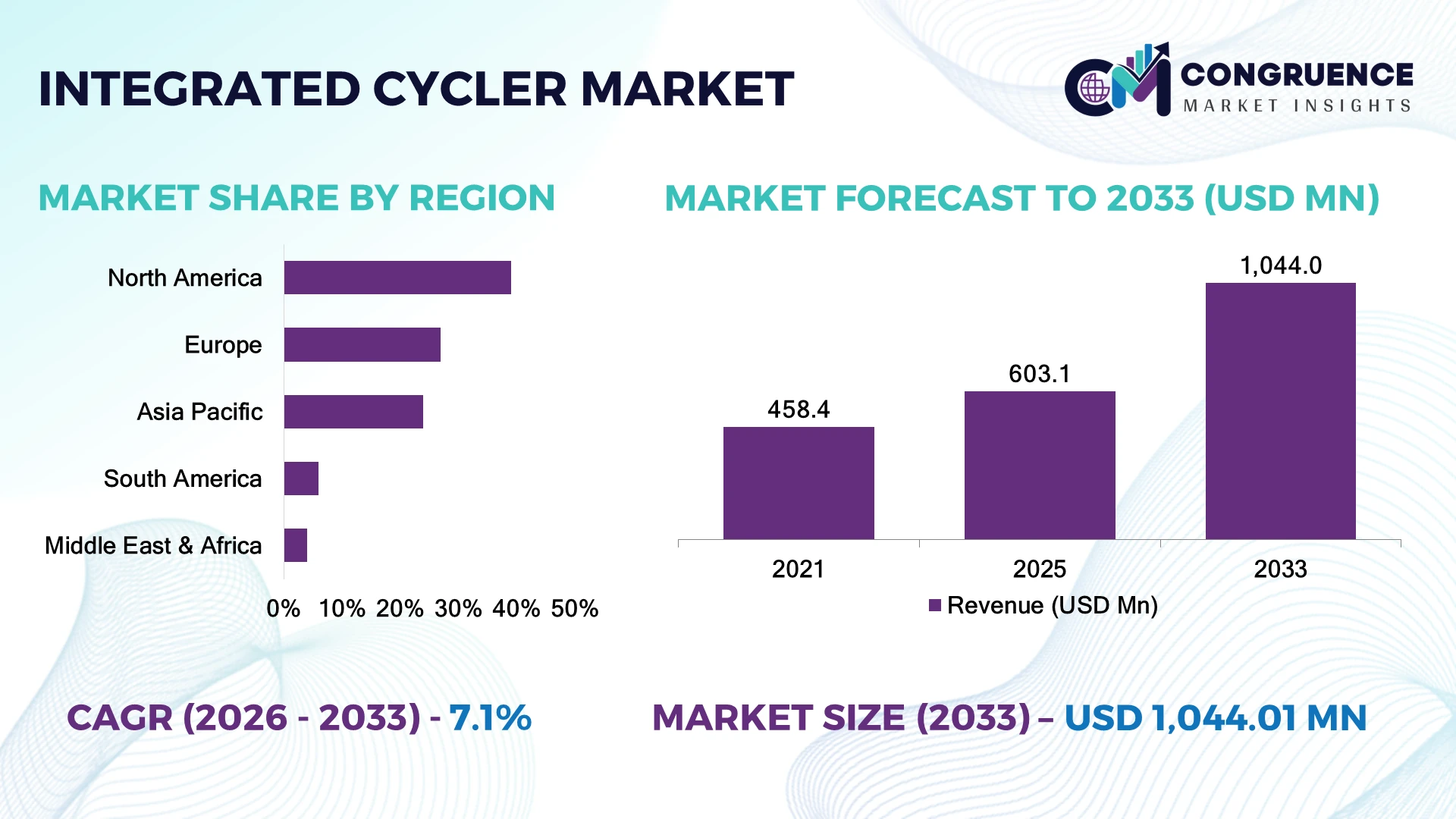
The Global Integrated Cycler Market was valued at USD 603.1 Million in 2025 and is anticipated to reach a value of USD 1,044.0 Million by 2033 expanding at a CAGR of 7.1% between 2026 and 2033. Growth is being driven by rising deployment of integrated PCR cyclers in molecular diagnostics, infectious disease testing, oncology screening, and automated laboratory workflows requiring higher throughput and faster result turnaround.
The United States dominates the market with approximately 38% of global installed integrated cycler capacity, supported by over USD 3 billion in annual molecular diagnostics investments and widespread adoption across clinical laboratories and biotechnology facilities. More than 72% of high-complexity testing centers utilize automated cycler platforms, compared with roughly 55% in Germany. Strong pharmaceutical R&D activity, public health surveillance programs, and post-pandemic laboratory modernization continue to strengthen deployment. Geopolitical emphasis on domestic biotechnology resilience further supports procurement and manufacturing expansion.
Strategic implication Companies that align automation capabilities with regulatory-compliant diagnostic workflows are positioned to secure long-term laboratory modernization contracts and premium market share.
Market Size & Growth: USD 603.1 Million in 2025, reaching USD 1,044.0 Million by 2033 at 7.1% CAGR, driven by automated molecular testing adoption.
Top Growth Drivers: Diagnostic automation (+35%), oncology testing expansion (+28%), laboratory digitalization (+32%) accelerate market momentum.
Short-Term Forecast: By 2028, sample processing efficiency improves by nearly 25% while workflow turnaround times decline by 18%.
Emerging Technologies: AI-enabled diagnostics, cloud-connected laboratory systems, and advanced thermal control technologies improve precision and throughput.
Regional Leaders: North America (~USD 390 Million by 2033), Europe (~USD 275 Million), Asia-Pacific (~USD 240 Million); adoption centers on laboratory modernization and biotech expansion.
Consumer/End-User Trends: More than 68% of advanced clinical laboratories prioritize integrated automation over standalone cycler systems.
Pilot/Case Example: In 2024, automated molecular testing deployments reduced manual intervention by 40% and improved reporting accuracy by 22%.
Competitive Landscape: Leading suppliers control nearly 55% of the market; key players include Thermo Fisher Scientific, Bio-Rad Laboratories, Roche, QIAGEN, and Agilent Technologies.
Regulatory & ESG Impact: Digital traceability systems improve laboratory compliance efficiency by approximately 30% while supporting quality assurance requirements.
Investment & Funding: More than USD 1.2 billion in biotechnology and diagnostic infrastructure investments support global capacity expansion amid supply-chain diversification.
Innovation & Future Outlook: Compact multiplex testing platforms and AI-assisted analytics are reducing processing complexity and strengthening decentralized diagnostics.
Integrated cyclers have become critical tools across clinical diagnostics, pharmaceutical research, infectious disease surveillance, and precision medicine applications. Manufacturers are introducing faster thermal cycling architectures, automated sample handling, and cloud-enabled data management platforms to improve laboratory productivity. Nearly 30% of newly installed systems now support advanced multiplex testing capabilities. Growing emphasis on supply-chain resilience and laboratory standardization is accelerating technology upgrades, creating a strong foundation for the strategic developments discussed below.
Integrated cyclers are becoming strategically important as healthcare systems, biotechnology companies, and research institutions prioritize rapid molecular analysis, workflow automation, and standardized testing environments. Laboratory infrastructure modernization, coupled with stricter quality-control requirements, is accelerating demand for platforms capable of integrating amplification, analysis, and data management within a single workflow. The ongoing restructuring of healthcare diagnostics networks is further elevating the role of automated molecular testing technologies.
Modern integrated cyclers deliver measurable operational advantages compared with legacy standalone systems. Advanced platforms can reduce manual handling requirements by approximately 40% while improving sample throughput by nearly 30%. The United States remains the largest deployment market due to extensive clinical laboratory infrastructure, while China is expanding rapidly through biotechnology manufacturing investments and domestic diagnostic innovation initiatives. Over the next two to three years, automated molecular workflow adoption is expected to exceed 75% among newly upgraded high-complexity laboratories.
A practical example can be seen in hospital laboratory networks deploying integrated cyclers to consolidate multiple testing processes into centralized diagnostic workflows. Companies are responding through strategic partnerships, software integration investments, and localized manufacturing expansion. Organizations that successfully combine automation, regulatory compliance, and scalable molecular testing capabilities will strengthen competitive positioning and secure long-term relevance across the evolving diagnostics ecosystem.
The increasing integration of molecular diagnostics into routine healthcare workflows is a primary driver for integrated cycler adoption. More than 70% of newly established high-complexity laboratories now prioritize automated testing platforms, while molecular testing volumes have increased by approximately 25% over the last five years. Public-health preparedness initiatives and precision medicine programs are accelerating investment in advanced diagnostic infrastructure. The United States and Japan continue expanding laboratory automation capacity to improve testing consistency and turnaround performance. This shift directly enhances productivity, reduces manual error rates by nearly 30%, and improves laboratory utilization. In response, manufacturers are expanding production facilities, strengthening software capabilities, and establishing partnerships with healthcare providers. A key strategic insight is that laboratories increasingly view integrated cyclers as workflow optimization assets rather than standalone analytical instruments.
Integrated cycler manufacturing remains vulnerable to specialized component sourcing, particularly for optical systems, thermal control modules, and precision electronics. Certain critical subsystems account for nearly 35% of total equipment production costs, while component lead times can extend by more than 20% during supply disruptions. Global semiconductor availability and cross-border logistics constraints continue affecting procurement schedules. Laboratories in emerging economies frequently face acquisition costs that are 25–30% higher after import duties and distribution expenses. These factors slow deployment and pressure operating budgets. To mitigate risks, suppliers are diversifying sourcing strategies, increasing local assembly operations, and negotiating long-term supplier agreements. A critical operational insight is that supply-chain localization increasingly influences purchasing decisions alongside technical performance.
The convergence of integrated cyclers with artificial intelligence, cloud analytics, and multiplex diagnostic technologies creates significant opportunities for market participants. Advanced multiplex platforms can increase testing efficiency by nearly 40% while reducing reagent consumption by approximately 20%. Countries such as China and South Korea are investing heavily in digital laboratory ecosystems that support automated data interpretation and workflow optimization. AI-assisted result validation is emerging as a major differentiator, particularly in oncology and infectious disease applications. Companies are accelerating R&D spending, expanding software partnerships, and developing interoperable laboratory platforms. A non-obvious opportunity lies in decentralized testing environments, where compact integrated cyclers can deliver hospital-grade molecular diagnostics without requiring large centralized laboratory infrastructure.
As laboratories adopt increasingly connected diagnostic ecosystems, integration complexity has become a significant long-term challenge. More than 45% of laboratory operators identify interoperability between instruments, software platforms, and data management systems as a major deployment obstacle. Cybersecurity requirements have intensified, with healthcare organizations increasing diagnostic data protection spending by approximately 20% over recent years. In Germany and the United States, compliance expectations for digital laboratory systems continue to evolve, requiring ongoing software validation and system updates. These pressures affect deployment consistency, scalability, and operational efficiency. Companies must invest in standardized connectivity frameworks, cybersecurity enhancements, and workforce training programs. A decisive strategic insight is that future market leadership will depend as much on ecosystem integration capabilities as on instrument performance.
AI-Integrated Workflow Automation Laboratory operators are rapidly embedding AI-assisted analytics into integrated cycler platforms, with automated result interpretation adoption exceeding 35% across newly upgraded molecular testing facilities. Manual review workloads have declined by nearly 25%, while reporting turnaround times improved by approximately 20%. Growing pressure to address laboratory staffing shortages is accelerating deployment. Vendors are expanding software ecosystems, integrating cloud-based diagnostics, and forming data-platform partnerships to improve workflow efficiency and diagnostic consistency.
Shift Toward Multiplex Testing Multiplex assay utilization has increased by more than 30% in advanced clinical laboratories as healthcare providers seek greater testing capacity from existing infrastructure. New integrated cycler deployments now process up to 40% more analytes per run compared with conventional workflows. This transition reduces reagent consumption and lowers operational bottlenecks. Manufacturers are responding through assay portfolio expansion, platform standardization, and co-development agreements with diagnostic developers to strengthen application versatility and laboratory productivity.
Decentralized Testing Expansion Hospital networks and regional diagnostic centers are increasing adoption of compact integrated cyclers, with decentralized molecular testing installations rising by nearly 28% over the past two years. Sample transport requirements have fallen by approximately 18%, improving response speed for time-sensitive testing programs. Regulatory emphasis on faster public-health surveillance capabilities is reinforcing this trend. Companies are prioritizing portable architectures, remote monitoring functionality, and service-network expansion to support distributed testing environments.
Supply-Chain Localization Strategies Diagnostic equipment manufacturers are restructuring production networks as component procurement risks remain elevated. More than 32% of major suppliers have expanded regional assembly operations, while localized sourcing initiatives reduced critical component lead times by approximately 15%. The transition strengthens inventory resilience and improves delivery reliability. Companies are increasing strategic supplier partnerships, expanding domestic manufacturing footprints, and implementing digital supply-chain visibility tools to secure long-term operational continuity and customer responsiveness.
Real-time PCR integrated cyclers represent the leading type segment, accounting for approximately 58% of total market demand due to their superior analytical accuracy, automated quantification capabilities, and broad clinical validation across infectious disease, oncology, and genetic testing applications. Their ability to combine amplification and detection within a single workflow significantly reduces processing complexity while improving laboratory throughput. More than 70% of newly procured molecular diagnostic systems incorporate real-time functionality, reinforcing their position as the primary investment category. Digital PCR integrated cyclers are emerging as the fastest-growing segment, supported by increasing demand for ultra-sensitive molecular analysis and precision medicine applications. Adoption among advanced research laboratories has increased by nearly 27% over the last three years. Conventional PCR systems remain relevant in academic and cost-sensitive environments, while endpoint analysis platforms continue supporting routine testing requirements. Manufacturers are prioritizing digital PCR innovation, software integration, and assay expansion strategies. Investment priorities are shifting toward high-sensitivity platforms capable of supporting advanced biomarker detection and next-generation molecular workflows.
Clinical diagnostics remains the dominant application segment with an estimated 52% market share, supported by extensive utilization in infectious disease testing, oncology screening, and molecular pathology workflows. Growing requirements for rapid diagnostic turnaround and standardized laboratory operations continue strengthening deployment levels. More than 65% of high-complexity testing facilities rely on integrated cyclers as core molecular diagnostic infrastructure. Their operational value is reinforced by reduced manual intervention and improved workflow traceability. Precision medicine and companion diagnostics represent the fastest-growing application category as healthcare providers increasingly adopt biomarker-driven treatment strategies. Utilization rates in personalized medicine programs have expanded by approximately 30% in recent years. Research applications remain strategically important for biotechnology and pharmaceutical development, while public-health surveillance programs continue expanding molecular testing capacity. Companies are scaling assay portfolios, strengthening software interoperability, and expanding deployment support services. Demand is increasingly shifting toward applications requiring high-throughput molecular analysis and data-integrated diagnostic workflows.
Clinical laboratories constitute the largest end-user segment, representing approximately 47% of overall demand due to their extensive testing volumes, automation requirements, and regulatory compliance obligations. Large laboratory networks increasingly deploy integrated cyclers to streamline molecular workflows and improve utilization rates. More than 68% of newly modernized diagnostic laboratories prioritize integrated platforms over standalone instruments, reflecting a strong operational shift toward consolidated testing environments. Biotechnology and pharmaceutical companies are the fastest-growing end-user group, with adoption expanding by nearly 26% as molecular research programs, biomarker discovery initiatives, and advanced therapeutic development activities accelerate. Hospitals continue investing in integrated testing capabilities to improve turnaround times, while academic and research institutions focus on high-precision analytical applications. Public-health agencies remain important purchasers for surveillance and outbreak-monitoring programs. Suppliers are responding through customized workflow solutions, strategic partnerships, and service-based support models. Competitive positioning increasingly depends on delivering application-specific performance and scalable deployment options across diverse customer groups.
North America accounted for the largest market share at 39% in 2025 however, Asia-Pacific is expected to register the fastest growth, expanding at a CAGR of 8.4% between 2026 and 2033.

North America remains the largest regional market, supported by extensive molecular diagnostics infrastructure, advanced biotechnology ecosystems, and high laboratory automation penetration. The region accounts for approximately 39% of global demand, driven by widespread deployment across clinical laboratories, pharmaceutical companies, and research institutions. More than 70% of newly modernized high-complexity laboratories in the region have integrated automated molecular workflows into routine testing operations. Expansion of precision medicine initiatives and increasing adoption of multiplex testing continue strengthening equipment replacement cycles. Enterprise demand is further supported by investments in laboratory digitization and workflow standardization. Strategic collaborations between diagnostic developers and healthcare networks are accelerating integrated platform deployment. The region also benefits from a mature service ecosystem that supports instrument validation, software integration, and operational scalability across large laboratory networks.
United States Market Outlook: The United States represents the largest national market due to its concentration of biotechnology companies, advanced hospital networks, and molecular diagnostics laboratories. More than 72% of high-complexity testing facilities utilize automated molecular testing platforms. Federal support for genomic medicine, strong clinical research activity, and expanding companion diagnostic programs continue driving procurement. Major healthcare providers are increasingly consolidating laboratory operations, creating demand for high-throughput integrated cyclers capable of supporting large-scale testing volumes while maintaining regulatory compliance and workflow efficiency.
Europe maintains a strong market position through advanced healthcare systems, established life sciences industries, and increasing emphasis on diagnostic standardization. The region accounts for approximately 27% of global market activity and continues to prioritize automation, data traceability, and laboratory quality assurance. Regulatory requirements surrounding molecular diagnostics are encouraging laboratories to upgrade aging testing infrastructure and adopt integrated analytical platforms. More than 60% of large diagnostic centers are actively investing in workflow digitization initiatives. Expansion of personalized medicine programs and translational research projects is creating additional demand for advanced cycler technologies. Regional manufacturers are strengthening partnerships with healthcare institutions to improve deployment efficiency and technical support capabilities. Laboratory modernization remains a central theme shaping purchasing decisions across the region.
Germany Market Outlook: Germany serves as the region’s strategic hub for molecular diagnostics and biotechnology innovation. The country benefits from a strong industrial technology base, extensive clinical laboratory infrastructure, and active research collaboration networks. Approximately 55% of advanced diagnostic laboratories have adopted integrated molecular testing environments. Investment in precision medicine initiatives and digital healthcare programs continues accelerating technology deployment. German enterprises are also expanding laboratory automation capabilities to improve operational consistency and support increasing testing complexity across clinical and research applications.
Asia-Pacific is emerging as the fastest-expanding regional market due to growing healthcare infrastructure, biotechnology investment, and molecular diagnostics adoption. The region accounts for approximately 24% of global demand and continues to strengthen its position through large-scale laboratory expansion programs. More than 35% of newly established molecular testing facilities globally are being developed within Asia-Pacific markets. Rising demand for infectious disease surveillance, oncology diagnostics, and genomic testing is increasing procurement activity. Domestic manufacturing capabilities and government-supported healthcare modernization initiatives are further improving technology accessibility. Companies are expanding distribution networks, localized production capabilities, and strategic partnerships to address rising deployment requirements. The region's scale advantage and expanding diagnostic capacity create substantial opportunities for integrated cycler suppliers.
China Market Outlook: China is the leading country within the region due to its rapidly expanding biotechnology sector, strong manufacturing capabilities, and extensive healthcare modernization programs. Molecular diagnostic capacity has expanded significantly, with integrated testing platforms becoming standard equipment in major urban laboratory networks. More than 65% of newly established advanced diagnostic centers incorporate automated molecular workflows. Domestic technology development, expanding genomics programs, and increased investment in precision healthcare continue strengthening demand for high-performance integrated cycler systems across clinical and research environments.
South America is experiencing steady market development as healthcare providers increase investment in molecular testing capabilities and laboratory modernization. The region contributes approximately 6% of global demand, with adoption concentrated in major metropolitan healthcare systems and national diagnostic networks. Public health surveillance programs and growing awareness of precision diagnostics are supporting equipment deployment. Integrated cyclers are increasingly utilized to improve testing efficiency and reduce workflow fragmentation. However, procurement cycles remain influenced by budget constraints and uneven laboratory infrastructure development. Several healthcare organizations have expanded molecular testing capacity by more than 20% through targeted modernization initiatives. Suppliers are responding through localized service support, training programs, and strategic distributor partnerships to improve market accessibility.
Brazil Market Outlook: Brazil represents the largest market in South America due to its extensive healthcare network, strong diagnostic testing volumes, and expanding biotechnology activities. Large urban laboratory groups continue investing in automation technologies to improve throughput and operational consistency. Integrated molecular testing adoption has increased substantially within private diagnostic networks, where efficiency improvements and standardized workflows are becoming key procurement priorities. Ongoing investments in laboratory infrastructure and infectious disease monitoring programs continue supporting long-term market development.
The Middle East & Africa market is gradually strengthening as governments and healthcare providers invest in laboratory modernization and advanced diagnostic capabilities. The region accounts for approximately 4% of global demand and is characterized by increasing deployment within reference laboratories, public health institutions, and specialized diagnostic centers. National healthcare transformation initiatives are encouraging adoption of automated molecular testing platforms. Several healthcare infrastructure projects have expanded diagnostic laboratory capacity by more than 15% in key markets. Demand is supported by rising focus on infectious disease monitoring, genomic medicine, and healthcare quality improvement. Companies are strengthening regional partnerships, expanding technical support networks, and establishing localized training programs to improve deployment success and operational utilization.
Saudi Arabia Market Outlook: Saudi Arabia serves as the region’s leading market due to substantial healthcare investment, laboratory modernization initiatives, and national biotechnology development programs. Large healthcare projects are increasing demand for integrated molecular diagnostics infrastructure across hospitals and specialized testing centers. More than 50% of newly commissioned advanced laboratory facilities incorporate automated molecular testing technologies. Strong government support for healthcare transformation, combined with growing investment in genomics and precision medicine, continues positioning the country as a key deployment hub for integrated cycler technologies.
The Integrated Cycler Market is led by Thermo Fisher Scientific, Bio-Rad Laboratories, QIAGEN, Roche, and Agilent Technologies, which collectively control approximately 62% of global market activity. Competition is primarily between global diagnostics leaders and specialized molecular testing innovators, while regional suppliers compete through lower-cost configurations and localized support models. Thermo Fisher and Roche focus on integrated clinical workflows, whereas Bio-Rad and QIAGEN compete aggressively in digital PCR innovation and analytical precision. Technology performance remains the primary differentiator, with automated workflows reducing manual intervention by nearly 40% and advanced multiplex systems increasing testing efficiency by over 30%. Companies are strengthening market positions through platform expansion, assay portfolio development, strategic partnerships, and software integration capabilities. Recent competitive momentum has shifted toward digital PCR, AI-enabled analytics, and end-to-end laboratory ecosystems. Regulatory validation requirements, installed-base loyalty, and workflow integration complexity remain major entry barriers. Winning requires superior automation, validated applications, scalable software ecosystems, and strong post-deployment laboratory support.
Bio-Rad Laboratories
QIAGEN
Roche
Agilent Technologies
Revvity
Merck KGaA
Takara Bio
Promega Corporation
Standard BioTools
Analytik Jena
Eppendorf SE
Bioneer Corporation
Benchmark Scientific
Integrated cycler technology is transitioning from standalone thermal cycling systems toward intelligent molecular workflow platforms. Real-time PCR remains the dominant technology, utilized in approximately 65% of advanced diagnostic laboratories due to its reliability and standardized testing protocols. Current-generation systems increasingly incorporate automated sample preparation, cloud connectivity, and workflow orchestration tools. Laboratories deploying automated cycler environments report workflow efficiency improvements of nearly 25% and reduced manual processing requirements of approximately 30%, creating measurable operational advantages in high-volume testing environments.
Emerging technologies are centered on digital PCR, multiplex assay processing, and AI-assisted data interpretation. Digital PCR platforms deliver up to 20% greater analytical sensitivity than conventional real-time PCR in low-abundance target detection applications. Multiplex testing capabilities increase sample throughput by approximately 35% while reducing reagent consumption. Adoption of integrated analytics platforms has surpassed 40% among newly modernized molecular laboratories. These technologies benefit diagnostic providers, biotechnology companies, and precision medicine programs seeking greater accuracy and laboratory productivity.
Between 2026 and 2028, AI-driven result interpretation, cloud-enabled laboratory management, and advanced microfluidic architectures will reshape competitive positioning. Organizations adopting integrated molecular ecosystems are expected to achieve approximately 15% faster reporting workflows than facilities operating legacy disconnected systems. Companies investing early in software-centric platforms, digital PCR expansion, and interoperable laboratory infrastructure will secure stronger operational scalability, higher utilization rates, and long-term technology leadership.
July 2025 – Bio-Rad Laboratories launched four new Droplet Digital PCR platforms, including the QX Continuum and QX700 series following its Stilla Technologies integration. The portfolio now supports more than 400,000 assays, significantly expanding multiplexing and quantification capabilities for molecular diagnostics and research. Source: www.investors.bio-rad.com
February 2025 – Bio-Rad Laboratories announced the acquisition of Stilla Technologies to strengthen next-generation digital PCR capabilities. The transaction expands access to Stilla’s Nio all-in-one digital PCR systems, accelerating development of advanced oncology, infectious disease, and cell therapy testing workflows. Source: www.investors.bio-rad.com
September 2024 – QIAGEN expanded its QIAcuity portfolio with more than 100 new validated digital PCR assays covering cancer research, inherited disorders, infectious disease surveillance, and environmental monitoring. The expansion broadens application coverage while strengthening adoption of integrated digital PCR workflows. Source: www.corporate.qiagen.com
May 2024 – QIAGEN entered a cooperative development agreement with the FBI to create a specialized digital PCR assay for QIAcuity systems. The initiative improves DNA quantification performance for forensic applications, enhancing analytical accuracy and expanding digital PCR deployment beyond traditional clinical environments.
The report provides comprehensive analysis of the Integrated Cycler Market across major technology categories, applications, end-users, and regional markets. Coverage includes real-time PCR systems, digital PCR platforms, and related integrated molecular testing technologies. Application assessment spans clinical diagnostics, research activities, precision medicine, public health surveillance, and biotechnology workflows. End-user evaluation includes clinical laboratories, hospitals, pharmaceutical companies, biotechnology firms, academic institutions, and government testing facilities. The study assesses adoption patterns, deployment intensity, technology penetration, and competitive positioning across key markets.
The report further examines North America, Europe, Asia-Pacific, South America, and the Middle East & Africa, highlighting regional deployment dynamics, infrastructure trends, and operational priorities. Analysis incorporates laboratory automation trends, digital PCR adoption, AI-enabled workflow integration, and multiplex testing developments. More than 60% of industry investment activity currently targets workflow automation, digital analytics, and advanced molecular diagnostics capabilities. The report supports expansion planning, partnership evaluation, investment prioritization, competitive benchmarking, and strategic decision-making through 2033 while identifying emerging opportunities across both mature and developing market segments.
| Report Attribute / Metric | Details |
|---|---|
| Market Revenue (2025) | USD 603.1 Million |
| Market Revenue (2033) | USD 1,044.0 Million |
| CAGR (2026–2033) | 7.1% |
| Base Year | 2025 |
| Forecast Period | 2026–2033 |
| Historic Period | 2021–2025 |
| Segments Covered |
By Type
By Application
By End-User
|
| Key Deliverables | Revenue Forecast; Market Trends; Growth Drivers & Restraints; Technology Insights; Segmentation Analysis; Regional Insights; Competitive Landscape; Regulatory & ESG Overview; Recent Developments |
| Regions Covered | North America; Europe; Asia-Pacific; South America; Middle East & Africa |
| Companies Profiled | Thermo Fisher Scientific; Bio-Rad Laboratories; QIAGEN; Roche; Agilent Technologies; Revvity; Merck KGaA; Takara Bio; Promega Corporation; Standard BioTools; Analytik Jena; Eppendorf SE; Bioneer Corporation; Benchmark Scientific |
| Customization & Pricing | Available on Request (10% Customization Free) |




