
Reports
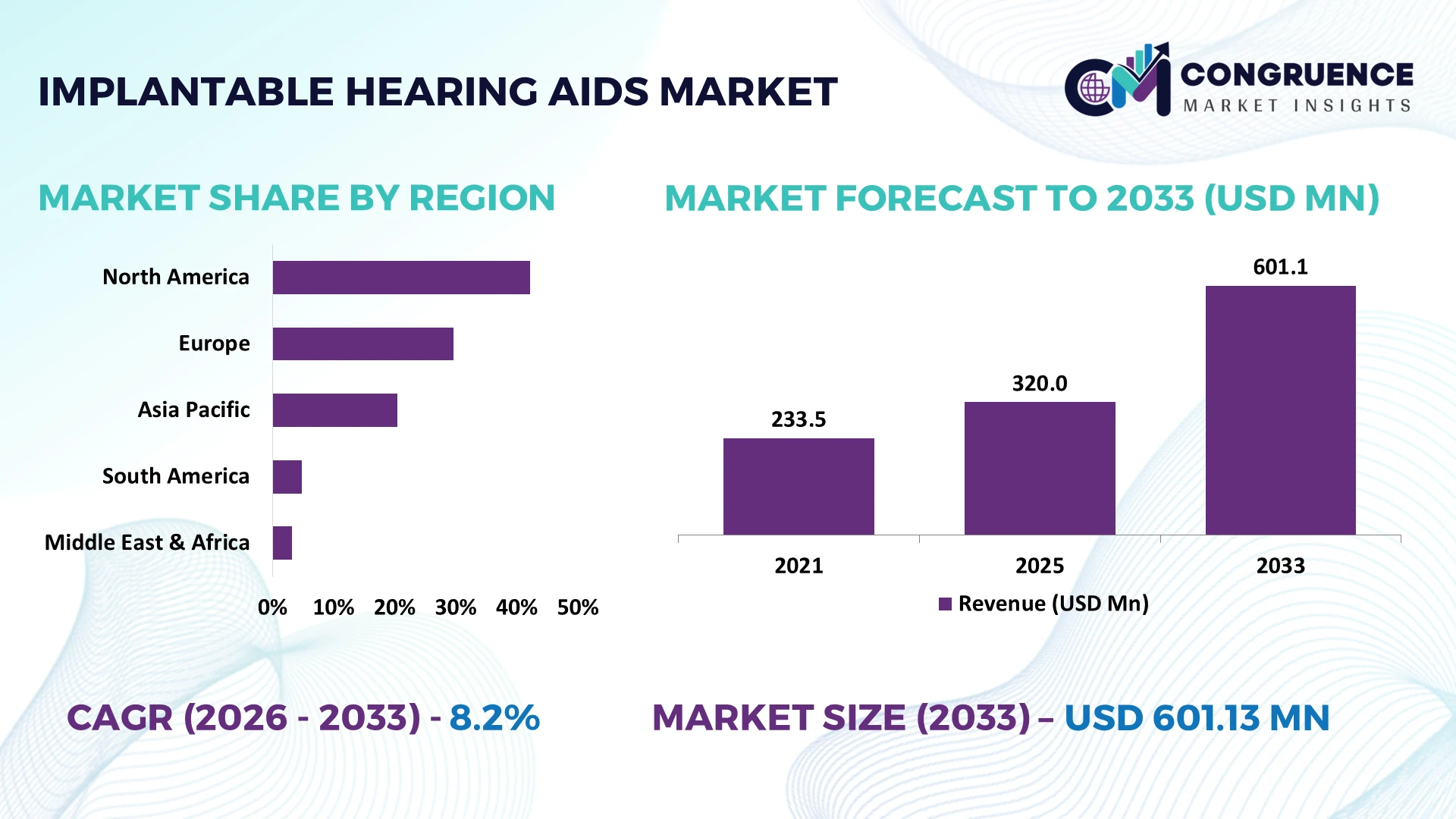
The Global Implantable Hearing Aids Market was valued at USD 320.0 Million in 2025 and is anticipated to reach a value of USD 601.1 Million by 2033 expanding at a CAGR of 8.2% between 2026 and 2033. Growth is driven by smart implant architectures, expanded pediatric implantation, wireless sound processing, and stronger clinical referral pathways for severe-to-profound hearing loss.
The U.S. remains the dominant commercial hub, supported by advanced ENT infrastructure, reimbursement pathways, and high clinical capacity; adults and seniors represent about 75% of developed-market implants, while direct-to-consumer activity contributes roughly 30% of U.S. surgeries. By contrast, India represented 2.7% of the global cochlear implant market in 2025, highlighting substantial whitespace across emerging care networks.
Strategically, suppliers should prioritize upgradeable implants, clinician networks, pediatric pathways, and scalable access models in high-volume developed markets and underpenetrated Asian healthcare systems.
Market Size & Growth: USD 320.0 million in 2025 rising to USD 601.1 million by 2033 at 8.2%, supported by smart implant and processor innovation.
Top Growth Drivers: Pediatric intervention 42.5%, adult demand 57.5%, and cochlear implants 66.1% are reshaping product mix and clinical investment.
Short-Term Forecast: By 2028, remote programming and rechargeable systems are positioned to reduce servicing requirements by approximately 10% while improving patient convenience.
Emerging Technologies: AI sound processing, upgradeable implant firmware, wireless connectivity, and compact rechargeable processors are accelerating next-generation product differentiation.
Regional Leaders: North America is projected near USD 253 million by 2033, Europe near USD 178 million, and Asia Pacific near USD 122 million, with Asia Pacific showing the strongest access expansion.
Consumer/End-User Trends: Adults account for 57.5% of implantable hearing-aid demand, while pediatric pathways remain critical for early auditory development.
Pilot/Case Example: In 2025, upgradeable smart-implant technology introduced firmware-based innovation, reducing dependence on complete implant replacement for future technology upgrades.
Competitive Landscape: Cochlear maintains more than 60% global implantable-hearing market share, competing with MED-EL, Sonova/Advanced Bionics, Demant, and Nurotron.
Regulatory & ESG Impact: FDA approvals and evolving EU medical-device requirements are increasing evidence, lifecycle, and post-market compliance requirements for advanced implants.
Investment & Funding: More than AUD 3 billion has been invested in R&D by a leading implant manufacturer, reinforcing sustained investment in neural interfaces and smart-device architectures.
Innovation & Future Outlook: Upgradeable implants, remote fitting, AI-assisted processing, and smaller rechargeable hardware are shifting competition toward lifecycle value rather than hardware replacement alone.
The Implantable Hearing Aids Market is increasingly shaped by severe-to-profound hearing-loss treatment, pediatric intervention, and sophisticated adult rehabilitation. Global implant uptake remains only about 2.5% among people with profound hearing loss, leaving substantial access headroom. Smart processors, rechargeable platforms, and upgradeable implant firmware are redefining product lifecycles, while evolving medical-device requirements are pushing manufacturers toward stronger clinical evidence and lifecycle management. These shifts create a clear transition toward strategic technology differentiation.
Implantable hearing aids are becoming strategically important because competition is shifting from conventional amplification toward surgically integrated, digitally connected hearing restoration. The addressable population remains substantially underpenetrated: global cochlear-implant uptake among people with profound hearing loss was estimated at only 2.5%, while even high-income countries generally remained at or below 20%. This creates room for manufacturers to compete through clinical access, referral networks, processor upgrades, and lifetime patient support.
Technology is also changing the economics of device ownership. Upgradeable implant firmware can extend the useful technology lifecycle without requiring complete replacement, while rechargeable processors reduce dependence on disposable batteries and routine accessory replacement. The U.S. continues to provide a mature clinical environment, whereas India and China represent expansion priorities where specialist capacity and affordability remain more constrained.
Over the next 2–3 years, companies are positioned to expand remote programming, AI-enabled sound processing, pediatric referral programs, and regional partnerships. Manufacturers are increasingly combining R&D with hospital relationships and localized distribution to improve conversion from diagnosis to implantation. The strongest competitive positioning will come from controlling the full pathway from patient identification and surgery through rehabilitation, upgrades, and long-term digital support.
Upgradeable implant platforms are becoming a core growth catalyst as manufacturers move beyond fixed hardware architectures. Adults and seniors represent roughly 75% of developed-market implants, creating a large installed base for processor and software upgrades, while emerging-market implant volumes have exceeded 20% growth in recent reporting. In 2025, smart implant technology introduced firmware-based upgradeability, allowing future functionality to be delivered through the implant rather than relying solely on external processor replacement. Companies are responding by increasing R&D investment, strengthening software capabilities, and expanding clinical partnerships. The non-obvious advantage is lifecycle monetization: manufacturers can generate recurring upgrade value without repeating the entire surgical pathway.
High treatment costs continue to restrict implantation outside mature reimbursement systems, particularly where specialist ENT infrastructure is concentrated in major cities. Global uptake remains only about 2.5% among people with profound hearing loss, while most high-income countries remain at or below 20%, demonstrating the gap between clinical eligibility and actual access. Surgical requirements, rehabilitation expenses, and device pricing create additional affordability pressure in countries such as India. Companies are reducing exposure through tiered product portfolios, tender participation, localized distribution, and partnerships with hospitals. In Europe, reimbursement expansion can directly improve accessibility; Belgium, for example, added reimbursement provisions for unilateral cochlear implantation in 2025.
Asia Pacific offers a substantial expansion opportunity because implant penetration remains low relative to population need. India represented only 2.7% of the global cochlear implant market in 2025, while China is positioned as the leading Asia Pacific country market, creating significant room for specialist-network expansion. Companies can capture this opportunity through regional surgical centers, pediatric screening partnerships, lower-cost implant configurations, and tele-audiology support. AI-assisted sound processing and remote programming can reduce follow-up intensity while improving access across dispersed populations. The non-obvious opportunity lies in building hub-and-spoke implantation networks around secondary cities rather than concentrating investment exclusively in capital-city hospitals.
Long-term scalability depends on integrating surgery, audiology, rehabilitation, software updates, and patient monitoring into one consistent care pathway. Children implanted early can require extensive auditory rehabilitation, while adult outcomes depend heavily on programming and continued clinical support. Regulatory requirements further increase operational complexity: FDA modifications require additional evidence and review, while European medical-device rules continue to evolve. Companies therefore need stronger interoperability, cybersecurity controls, clinician training, and post-market surveillance. The strategic pressure is shifting from simply manufacturing reliable implants to maintaining an integrated digital-clinical ecosystem throughout the device lifecycle.
Smart Processors Reshape Upgrades: AI-assisted processing, wireless connectivity, and firmware-enabled implants are shifting value toward software-led upgrades. In 2025, cochlear implants represented 66.1% of implantable hearing-aid demand, while smart systems increasingly preserve personalized settings across processor changes. Companies are expanding software capabilities and clinician connectivity to improve lifecycle value.
Pediatric Access Is Expanding: Pediatric implantation is moving toward earlier intervention as screening and reimbursement pathways improve. Children represented 42.5% of demand in 2025, while India’s Uttar Pradesh program supported 214 pediatric cochlear implant procedures during 2024–2025. Manufacturers are responding with smaller processors, age-specific fitting workflows, and hospital partnerships.
Clinical Networks Become Decentralized: Implant delivery is shifting beyond major tertiary hospitals toward specialized clinics and ambulatory pathways. Clinics accounted for 63.2% of cochlear-implant end use in 2025, while outpatient models are gaining relevance through shorter procedural workflows. Companies are strengthening ENT training, referral partnerships, and remote programming to extend specialist coverage.
Integration Is Driving Differentiation: Manufacturers are increasingly connecting implants with external hearing devices and digital ecosystems rather than treating implants as standalone hardware. In 2025, strategic industry partnerships targeted integrated hearing solutions and cross-device compatibility. This reduces fragmentation in patient management and creates a non-obvious advantage: installed-device ecosystems can strengthen retention without requiring additional surgery.
Cochlear implants remain the leading type, accounting for approximately 66.1% of the global implantable hearing-aids market in 2025. Their dominance reflects established clinical pathways for severe-to-profound sensorineural hearing loss, broad surgeon familiarity, and mature processor ecosystems. Bone-anchored hearing systems represented about 23.0%, supported by conductive, mixed, and single-sided hearing-loss indications, while middle ear implants held approximately 11.0% and continue serving patients who require direct mechanical stimulation.
The fastest-moving shift is toward more sophisticated cochlear platforms rather than simple unit expansion. Pediatric adoption represented 42.5% of demand, compared with 57.5% for adults, encouraging manufacturers to prioritize miniaturization, wireless processing, and upgradeable architectures. Bone-conduction systems remain strategically important where conventional amplification is unsuitable, while middle ear systems address specialized clinical profiles. Companies are therefore concentrating investment on processor intelligence, interoperability, and longer device lifecycles rather than competing solely on hardware specifications.
Severe-to-profound hearing loss represents the leading application, accounting for approximately 69.1% of cochlear-implant demand in 2025. The concentration reflects the clinical limitations of conventional amplification for advanced sensorineural loss and the established role of cochlear implants in bypassing damaged hair cells. Pediatric intervention and rehabilitation remain important adjacent applications, while elderly patients increasingly enter implant pathways as diagnosis and referral systems improve.
Pediatric applications are experiencing the strongest operational shift as earlier diagnosis, newborn screening, and lower implantation-age thresholds shorten the interval between detection and treatment. Elderly applications are also strengthening as adult implantation becomes more normalized; at KEM Hospital in Mumbai, adults represented 36% of implant surgeries in January 2024 compared with below 10% several years earlier. Rehabilitation is consequently becoming more integrated with implantation, while military applications remain specialized. Companies are expanding clinical education, patient-selection tools, and post-operative programming to capture these changing workflows.
Hospitals remain the dominant end-user because implantable hearing procedures require surgical infrastructure, multidisciplinary ENT teams, anesthesia support, audiology, and post-operative rehabilitation. Hospitals accounted for approximately 54.3% of hearing-implant procedures in 2025, compared with 28.6% for ambulatory surgical centers and 12.8% for ENT clinics. Their advantage is strongest for complex pediatric and medically complicated cases requiring integrated perioperative services.
Ambulatory surgical centers represent the fastest-shifting end-user group, supported by streamlined workflows and approximately 25–35% lower procedural costs than hospital settings for appropriate routine cases. ENT clinics are also expanding as specialist care becomes more decentralized, while other facilities remain focused on rehabilitation, research, and niche patient populations. Companies are responding with dedicated clinical training, hospital procurement partnerships, ASC-compatible workflows, and specialized programming services. The competitive implication is a gradual move from hospital-centric implantation toward a distributed care ecosystem that improves procedural efficiency without eliminating the need for tertiary expertise.
North America accounted for the largest market share at 42.1% in 2025 however, Asia Pacific is expected to register the fastest growth, expanding at a CAGR of 9.3% between 2026 and 2033.

North America represented approximately 42.1% of the global implantable hearing-aids market in 2025, with demand concentrated in the U.S. and Canada. Established cochlear-implant centers, reimbursement pathways, specialist audiology networks, and strong manufacturer presence support high procedural consistency. The U.S. accounts for roughly 86.7% of North American cochlear-implant activity, reinforcing its role as the region's primary commercial and technology hub. Manufacturers are prioritizing remote programming, processor connectivity, pediatric referral networks, and next-generation implant platforms rather than relying solely on procedure-volume expansion. The region's operational advantage is its integrated clinical ecosystem, which enables faster conversion from diagnosis to implantation and long-term device support.
United States Market Outlook: The United States remains the strategic center of North American implantable hearing-aid activity, supported by extensive hospital-based cochlear-implant programs, specialist surgeons, audiology infrastructure, and established payer pathways. Approximately 183,100 cochlear implants had been performed in U.S. adults and children by July 2022, providing a substantial installed clinical base. Manufacturers are using this infrastructure to introduce smart processors, remote-care capabilities, and upgradeable implant technologies.
Europe held approximately 29.6% of the global implantable hearing-aids market in 2025, supported by national healthcare systems, established audiology infrastructure, and recurring device-support programs. Germany, the U.K., France, and Italy provide substantial clinical capacity, while procurement increasingly emphasizes lifecycle value, clinical evidence, and service coverage. Germany and other European markets are strengthening access through reimbursement mechanisms, while manufacturers are adapting product portfolios to different national funding structures. The region's mature infrastructure creates a different competitive environment from emerging markets: suppliers compete heavily on clinical outcomes, processor functionality, service continuity, and procurement efficiency. Sustainability considerations are also becoming more relevant as rechargeable processors and longer upgrade cycles reduce dependence on disposable accessories and complete hardware replacement.
Germany Market Outlook: Germany represents a strategically important European market because of its extensive statutory health-insurance infrastructure, specialist ENT capacity, and established medical-device procurement system. Reimbursement support for advanced hearing technologies strengthens patient access while encouraging manufacturers to demonstrate clinical and economic value. German providers are increasingly evaluating device performance alongside service continuity, rehabilitation support, and lifecycle economics, creating opportunities for suppliers with strong local clinical partnerships and comprehensive after-sales capabilities.
Asia Pacific represented approximately 20.4% of the global implantable hearing-aids market in 2025 and is positioned as the fastest-expanding major region. China, Japan, India, South Korea, and Australia are driving adoption through expanding specialist hospitals, higher healthcare expenditure, aging populations, and government-supported pediatric implantation programs. China is particularly important because centralized procurement has reduced cochlear-implant system prices to around CNY 50,000, creating a stronger affordability pathway. India is simultaneously expanding access through public-sector pediatric programs and specialist-center development. Manufacturers are responding with localized distribution, lower-cost configurations, clinician training, and partnerships with hospitals. The key strategic shift is from premium-market penetration toward scalable implantation ecosystems capable of serving high-volume patient populations.
China Market Outlook: China is the most strategically significant Asia-Pacific market because of its large patient pool, expanding specialist infrastructure, and centralized procurement mechanisms. National volume-based procurement has brought average cochlear-implant system pricing to approximately CNY 50,000, strengthening affordability and supporting broader access. Domestic-content requirements are also encouraging localization of components and manufacturing, pushing global suppliers toward regional partnerships, localized production strategies, and differentiated pricing structures.
South America accounted for approximately 4.8% of the global implantable hearing-aids market in 2025, with demand concentrated in Brazil and selected urban healthcare networks. Adoption is shaped by public reimbursement, private hospital capacity, specialist availability, and access to cochlear-implant rehabilitation. Brazil remains the principal commercial hub because of its large healthcare system and established tertiary-care infrastructure. However, procurement cycles and uneven specialist coverage create longer pathways between diagnosis, surgery, and rehabilitation than in North America or Europe. Companies are therefore emphasizing distributor partnerships, hospital-based training, and localized clinical support rather than broad physical expansion. The non-obvious opportunity is concentrated deployment through high-capacity metropolitan centers, allowing manufacturers to improve case throughput before extending services into lower-density markets.
Brazil Market Outlook: Brazil is the leading strategic market in South America, supported by its large healthcare system, tertiary hospitals, and established public-private treatment networks. Healthcare expenditure represented approximately 9.47% of GDP in recent national estimates, providing a meaningful infrastructure base for specialized medical technologies. Manufacturers can leverage major urban ENT centers to expand surgical training, rehabilitation partnerships, and distribution while gradually extending access beyond metropolitan hospitals.
The Middle East & Africa region represented approximately 3.1% of the global implantable hearing-aids market in 2025, with demand concentrated in GCC countries, South Africa, and major tertiary-care centers. Saudi Arabia and the UAE are strengthening advanced hospital infrastructure, while South Africa provides an important gateway for specialist services across the wider African market. Adoption remains more concentrated than in Europe because implant procedures require specialized surgeons, audiologists, rehabilitation teams, and reliable device procurement. Private hospitals and government modernization programs are therefore becoming important deployment channels. Manufacturers are responding through hospital partnerships, clinician training, distributor expansion, and regional service hubs. The strategic priority is infrastructure-led market development: expanding clinical capability first creates a more reliable foundation for subsequent device adoption.
Saudi Arabia Market Outlook: Saudi Arabia is the region's most strategically significant market because healthcare modernization is increasing tertiary-care capacity and accelerating adoption of advanced medical technologies. Large hospital systems provide a stronger platform for cochlear implantation, specialist audiology, and rehabilitation than many neighboring markets. The country's focus on healthcare infrastructure development creates opportunities for manufacturers to establish clinical partnerships, training programs, and localized service networks that can also support neighboring GCC markets.
Cochlear, MED-EL, Advanced Bionics, Envoy Medical, and Nurotron compete across global premium, specialist, fully implanted, and cost-focused niches. Cochlear leads established cochlear implants, while MED-EL and Advanced Bionics contest clinical performance, connectivity, and surgeon preference; Envoy targets disruptive fully implanted architecture and Nurotron emphasizes regional affordability. The top five collectively control approximately 87% of the market, confirming a concentrated structure. Competition centers on technology, clinical evidence, service reach, and procurement economics, with roughly 65% share attributed to Cochlear and about 78% combined share held by Cochlear, MED-EL, and Advanced Bionics in available estimates. Manufacturers are expanding clinical networks, partnering on connectivity, localizing production, and integrating software with processors. China’s volume-based procurement intensifies price pressure, while fully implanted platforms increase technology disruption. Regulatory approvals, clinical-trial costs, surgeon relationships, intellectual property, and installed bases remain major entry barriers. Winning requires validated clinical performance, scalable service infrastructure, differentiated technology, and strong referral ecosystems.
Cochlear Limited
MED-EL Medical Electronics
Advanced Bionics
Envoy Medical
Zhejiang Nurotron Biotechnology Co., Ltd.
iotaMotion, Inc.
Ototronix
Neubio
Shanghai Listent Medical Technology Co., Ltd.
TODOC Co., Ltd.
Implantable hearing technology is shifting from fixed hardware toward upgradeable, connected platforms. Cochlear’s Nucleus Nexa introduced implant firmware upgrades and memory, while its Nucleus 8 Nexa processor is 9% smaller and 12% lighter than the preceding configuration. MED-EL’s SONNET 3 adds integrated direct streaming and automated acoustic management, improving workflow simplicity and reducing accessory dependence. These architectures strengthen differentiation for established OEMs with installed bases.
AI-assisted sound processing is becoming more practical across processors. Automated environmental classification, speech enhancement, and adaptive microphone control reduce manual fitting requirements and support more consistent performance. Advanced Bionics combines cochlear implants with Phonak technologies and remote programming, while processor connectivity is expanding across Bluetooth-enabled devices. Remote programming can reduce clinic visits and improve service reach for dispersed patients.
Fully implantable systems represent the disruptive 2026–2028 technology pathway. MED-EL’s feasibility study evaluated its totally implantable cochlear implant in six participants, with hearing performance reported as comparable to conventional implants. Envoy Medical is advancing a fully implanted Acclaim system through pivotal trials. The competitive advantage will shift toward companies that combine implant miniaturization, wireless power, biocompatible sensors, cybersecurity, and software upgradeability. Early investment matters because regulatory validation, surgeon training, and installed-base conversion create long lead times.
July 2025 — Cochlear launched Nucleus Nexa after FDA approval, introducing upgradeable implant firmware and internal memory. Its processor is 9% smaller and 12% lighter than the prior configuration, strengthening lifecycle differentiation and supporting upgrades without replacing the implanted component. Source: cochlear.com
December 2025 — MED-EL received FDA approval for cochlear implants in children aged seven months and older. The expanded indication targets earlier intervention and broadens pediatric eligibility, strengthening adoption opportunities and encouraging hospitals to accelerate screening, referral, and implantation pathways. Source: medel.com
December 2025 — Envoy Medical completed activations in the final stage of its Acclaim trial across two of seven investigational sites. No serious adverse events were reported, advancing validation of fully implanted architecture and strengthening commercialization preparation for external-component-free technology. Source: tradingview.com
May 2025 — Advanced Bionics reported its U.S. Phonak plus AB network served almost 600 individuals in its second year. The referral model links hearing-aid users with implant evaluation, improving candidate identification, clinician engagement, and commercial reach across hearing-care networks. Source: sonova.com
The Implantable Hearing Aids Market Report covers implantable hearing technologies across cochlear implants, bone-anchored hearing systems, and middle ear implants, with analysis spanning severe-to-profound, conductive, mixed, and single-sided hearing-loss applications. End-user coverage evaluates hospitals, specialty clinics, ambulatory surgical centers, and other care settings, capturing differences in procedural scale, infrastructure intensity, and deployment models.
Geographic analysis covers North America, Europe, Asia Pacific, South America, and Middle East & Africa, with country-level emphasis on the United States, Germany, China, India, Brazil, and Saudi Arabia. The report evaluates AI-enabled sound processing, wireless connectivity, remote programming, rechargeable processors, and fully implanted architectures. With cochlear implants representing about 66% of the implantable market in 2025, the analysis helps investors prioritize technology platforms, manufacturers assess expansion pathways, and healthcare organizations plan capacity, partnerships, procurement, and competitive positioning through 2033.
| Report Attribute / Metric | Details |
|---|---|
| Market Revenue (2025) | USD 320.0 Million |
| Market Revenue (2033) | USD 601.1 Million |
| CAGR (2026–2033) | 8.2% |
| Base Year | 2025 |
| Forecast Period | 2026–2033 |
| Historic Period | 2021–2025 |
| Segments Covered |
By Type
By Application
By End-User
|
| Key Deliverables | Revenue Forecast; Market Trends; Growth Drivers & Restraints; Technology Insights; Segmentation Analysis; Regional Insights; Competitive Landscape; Regulatory & ESG Overview; Recent Developments |
| Regions Covered | North America; Europe; Asia Pacific; South America; Middle East & Africa |
| Companies Profiled | Cochlear Limited; MED-EL Medical Electronics; Advanced Bionics; Envoy Medical; Zhejiang Nurotron Biotechnology Co., Ltd.; iotaMotion, Inc.; Ototronix; Neubio; Shanghai Listent Medical Technology Co., Ltd.; TODOC Co., Ltd. |
| Customization & Pricing | Available on Request (10% Customization Free) |




