
Reports
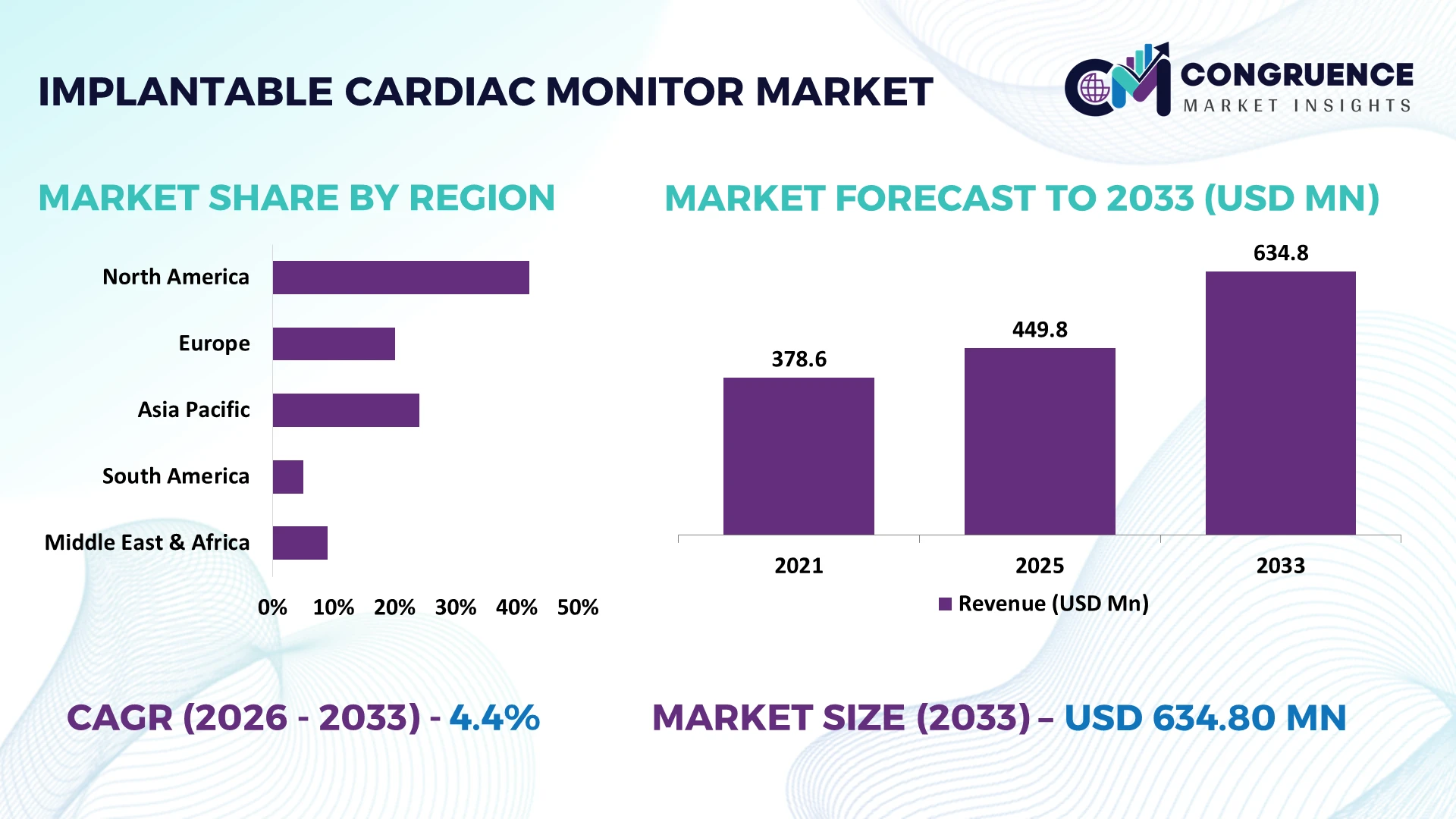
The Global Implantable Cardiac Monitor Market was valued at USD 449.81 Million in 2025 and is anticipated to reach a value of USD 634.8 Million by 2033 expanding at a CAGR of 4.4% between 2026 and 2033. Growth is driven by increasing atrial fibrillation detection, continuous cardiac monitoring after unexplained stroke, extended device longevity and expanding remote cardiac monitoring capabilities.
The United States represents a major implantable cardiac monitor market, supported by established electrophysiology services, advanced medical device manufacturing and remote patient monitoring infrastructure. American manufacturers Medtronic, Abbott and Boston Scientific compete through extended monitoring capabilities and automated arrhythmia detection. Abbott's Assert IQ offers monitoring beyond 6 years, compared with Medtronic's LINQ II at 4.5 years under specified operating conditions. Germany provides a European manufacturing counterpart through BIOTRONIK, strengthening international competition in implantable cardiac monitoring technologies.
Strategically, manufacturers should prioritize extended device longevity, clinically validated detection algorithms and integrated remote monitoring infrastructure to strengthen hospital procurement and international market penetration.
Market Size & Growth: USD 449.81 million in 2025, reaching USD 634.8 million by 2033 at 4.4% CAGR, supported by continuous arrhythmia monitoring.
Top Growth Drivers: Clinical detection reached 8.9% at six months, 12.4% at twelve months and 30% at three years in a landmark monitoring trial.
Short Term Forecast: By 2028, manufacturers will prioritize extended monitoring, remote programming and automated clinical workflows, with device longevity already exceeding 6 years.
Emerging Technologies: Three technologies are advancing the industry: artificial intelligence algorithms, Bluetooth connectivity and automated remote cardiac monitoring.
Regional Leaders: North America maintains established medical device manufacturing capabilities, Europe supports advanced electrophysiology innovation, and Asia Pacific offers opportunities through expanding cardiac healthcare infrastructure.
Consumer Trends: Clinical evidence indicates that 79% of initially detected atrial fibrillation episodes were asymptomatic, reinforcing demand for continuous monitoring.
Pilot and Case Example: The CRYSTAL AF trial enrolled 441 patients and demonstrated substantially higher arrhythmia detection with implantable monitoring than conventional follow up.
Competitive Landscape: Medtronic, Abbott, Boston Scientific and BIOTRONIK compete through device longevity, detection accuracy, connectivity and electrophysiology distribution networks.
Regulatory & ESG Impact: The European Union's Medical Device Regulation requires clinical evidence, device traceability and continued safety monitoring throughout the product lifecycle.
Investment & Funding: Manufacturers are investing in remote monitoring platforms, artificial intelligence algorithms and longer battery performance, supporting product differentiation and clinical workflow integration.
Innovation & Future Outlook: Next generation devices combine continuous electrocardiographic monitoring, automated arrhythmia classification and remote programming to support extended cardiac surveillance.
The global implantable cardiac monitor market serves patients requiring prolonged investigation of unexplained syncope, intermittent palpitations and suspected atrial fibrillation following cryptogenic stroke. Manufacturers are developing miniature implantable devices with extended battery performance, wireless connectivity and intelligent arrhythmia detection algorithms. Clinical evidence demonstrates that implantable monitoring identified atrial fibrillation in 12.4% of patients after twelve months, compared with 2.0% receiving conventional monitoring. Increasing integration with remote cardiac monitoring platforms is changing electrophysiology workflows, creating strategic opportunities for manufacturers offering clinically validated detection, reliable connectivity and efficient diagnostic data management.
Implantable cardiac monitors are becoming strategically important as healthcare systems prioritize earlier arrhythmia detection, prolonged diagnostic surveillance and efficient management of cardiovascular patients. Continuous electrocardiographic monitoring addresses the limitations of intermittent diagnostic testing, particularly among patients experiencing unexplained syncope or suspected atrial fibrillation. The CRYSTAL AF trial demonstrated atrial fibrillation detection in 30% of patients receiving implantable monitoring after three years, compared with 3% receiving conventional follow up. This clinical advantage is encouraging manufacturers to strengthen device connectivity and remote monitoring capabilities.
Technology competition increasingly centers on automated arrhythmia classification, extended battery performance and integration with hospital information systems. Abbott's Assert IQ provides monitoring beyond six years, while Medtronic's LINQ II offers approximately 4.5 years under specified conditions. American manufacturers benefit from established electrophysiology infrastructure, whereas German manufacturers emphasize advanced cardiac device engineering. These differences influence hospital procurement, replacement schedules and international distribution strategies.
Between 2026 and 2028, manufacturers will prioritize artificial intelligence assisted diagnostics, remote programming and integrated cardiac monitoring platforms. Hospitals implementing centralized remote monitoring can consolidate transmitted electrocardiographic data and streamline clinical review. Manufacturers investing in validated detection algorithms, secure connectivity and clinical partnerships will strengthen competitive positioning through improved diagnostic reliability and operational efficiency.
Growing clinical recognition of intermittent atrial fibrillation is strengthening demand for implantable cardiac monitors. The CRYSTAL AF study demonstrated detection rates of 8.9% after six months and 12.4% after twelve months among patients receiving implantable monitoring, compared with 1.4% and 2.0% under conventional follow up. These findings highlight the diagnostic limitations of intermittent electrocardiographic testing. American hospitals increasingly incorporate prolonged monitoring into selected cryptogenic stroke investigations. Manufacturers are responding through miniature implantable devices, automated arrhythmia detection and integrated remote monitoring platforms. Investment in clinical evidence and electrophysiology partnerships strengthens device adoption while helping hospitals identify patients requiring further cardiovascular evaluation.
Implantable cardiac monitor adoption faces limitations involving device procurement, implantation procedures, reimbursement arrangements and specialist availability. The CRYSTAL AF trial reported device related serious adverse events in approximately 2.4% of monitored patients, demonstrating the importance of procedural oversight and patient selection. Implantation requires trained clinical personnel, while prolonged monitoring generates recurring data management responsibilities. Healthcare facilities in India and other developing markets face additional constraints involving electrophysiology infrastructure and reimbursement coverage. Manufacturers are addressing these barriers through smaller implantation systems, physician training and partnerships with healthcare distributors. Simplified clinical workflows and interoperable monitoring platforms help hospitals manage operating costs and expand access to appropriate patients.
Artificial intelligence assisted arrhythmia classification and remote cardiac monitoring create opportunities for manufacturers to improve diagnostic workflows and reduce unnecessary clinical review. The PER DIEM trial demonstrated atrial fibrillation detection in 15.3% of patients receiving implantable monitoring over twelve months, compared with 4.7% receiving prolonged external monitoring. This diagnostic advantage strengthens opportunities for integrated monitoring services following ischemic stroke. Manufacturers are developing automated electrocardiographic classification, wireless transmission and centralized clinical review platforms. Hospitals adopting integrated monitoring infrastructure can coordinate specialist assessment without requiring repeated diagnostic appointments. Companies investing in algorithm validation, secure cloud infrastructure and hospital information system integration can differentiate their products through clinical utility and operational efficiency.
Maintaining diagnostic accuracy across extended monitoring periods presents substantial technical and operational challenges. Automated detection systems must distinguish clinically significant arrhythmias from motion artifacts, sensing irregularities and nonpathological rhythm variations. False positive alerts increase clinical review requirements and create additional workload for electrophysiology teams. Implantable monitoring can continue for more than six years, requiring sustained connectivity, software maintenance and secure data management. European manufacturers must also satisfy Medical Device Regulation requirements concerning clinical evaluation and postmarket surveillance. Companies are investing in algorithm refinement, cybersecurity controls and standardized data integration. Successful deployment requires reliable sensing performance, validated clinical workflows and monitoring infrastructure capable of supporting prolonged patient surveillance.
Extended Battery Life Changes Procurement: Manufacturers are emphasizing device longevity to reduce replacement procedures and improve monitoring continuity. Abbott's Assert IQ supports monitoring beyond 6 years, while Medtronic's LINQ II offers up to 4.5 years under specified conditions. American hospitals increasingly evaluate expected monitoring duration alongside implantation costs. Manufacturers are responding through battery optimization, miniature electronics and differentiated product portfolios.
Remote Programming Simplifies Clinical Operations: Remote device management is changing how electrophysiology departments coordinate follow up appointments and maintain implanted monitors. Medtronic's LINQ II incorporates remote programming capabilities, while Abbott's Assert IQ integrates wireless monitoring infrastructure. These systems support continuous surveillance across multiple years without requiring every device adjustment to occur during an appointment. Manufacturers are expanding compatible monitoring platforms and clinician training.
Miniaturization Improves Implantation Workflows: Smaller device profiles and simplified insertion tools are influencing hospital purchasing decisions. Medtronic's LINQ II measures approximately 4.0 millimeters in thickness, while Abbott's Assert IQ provides monitoring options extending beyond 6 years. These developments combine compact implantation technology with prolonged surveillance. Manufacturers are refining insertion systems and procedural training to support consistent implantation practices.
Clinical Evidence Reshapes Patient Selection: Hospitals are refining monitoring protocols using evidence from comparative clinical studies. The LOOP trial enrolled 6,004 participants, while the PER DIEM trial included 300 patients. Their different populations and clinical outcomes demonstrate why implantation decisions require indication specific evidence. Manufacturers are strengthening clinical research partnerships and developing educational resources to support appropriate patient selection.
Insertable Loop Recorders represent an established product category within implantable cardiac monitoring, supported by extensive clinical evidence and established electrophysiology workflows. Their continuous recording capabilities support prolonged investigation of intermittent cardiac rhythm abnormalities. An independently verified global market share for this specific product category is unavailable because commercial classifications frequently overlap with Implantable ECG Monitors. Manufacturers compete through device longevity, sensing performance, insertion simplicity and compatibility with remote monitoring infrastructure. Established products provide monitoring periods exceeding 4 years, supporting diagnostic investigations that require prolonged observation.
Wireless Cardiac Monitors represent an important technology direction as manufacturers integrate wireless communication and remote device management into implantable monitoring platforms. Their commercial expansion is associated with increasing emphasis on connected cardiac care rather than an entirely separate device architecture. Implantable ECG Monitors remain central to continuous rhythm surveillance and automated event recording. Because these categories overlap technically, identifying a statistically defensible fastest growing type requires a consistently defined product dataset. Manufacturers are prioritizing connectivity, algorithm development and integrated monitoring services rather than treating these capabilities as independent products.
Arrhythmia Detection represents the broadest clinical application for implantable cardiac monitors, encompassing prolonged surveillance for intermittent rhythm abnormalities. Atrial Fibrillation Monitoring represents a major application within this broader category, supported by established evidence demonstrating the limitations of intermittent electrocardiographic assessment. Because these applications overlap clinically, independently verified global revenue shares cannot be assigned without a mutually exclusive segmentation methodology. Manufacturers are strengthening automated rhythm classification and clinical reporting capabilities to support electrophysiology departments managing complex diagnostic investigations.
Cryptogenic Stroke Monitoring represents an important area of clinical development because identifying previously undetected atrial fibrillation can influence subsequent treatment decisions. Syncope Diagnosis remains an established indication, particularly when conventional investigations fail to identify an underlying rhythm disturbance. The STROKE AF trial reported atrial fibrillation detection of 12.1% with implantable monitoring after twelve months, compared with 1.8% under conventional care. These findings strengthen the commercial importance of indication specific clinical evidence. Manufacturers are developing specialist education programs and hospital partnerships to support appropriate deployment across different diagnostic pathways.
Hospitals represent the principal institutional purchasing channel for implantable cardiac monitors because implantation services depend on specialist assessment, procedural facilities and coordinated follow up care. However, a verified global hospital market share is unavailable from consistently defined end user data. Hospital purchasing decisions increasingly consider device longevity, procedural requirements, diagnostic performance and compatibility with existing clinical information systems. Cardiology Clinics represent another important customer group, particularly where specialist practices maintain established implantation and follow up capabilities.
Ambulatory Care Centers represent an emerging deployment setting as manufacturers develop simplified insertion systems and clinical support services. Their expansion depends on local reimbursement arrangements, physician qualifications and procedural infrastructure. Diagnostic Centers contribute rhythm assessment and referral services, although implantation capabilities differ between facilities. Research Institutes support clinical evaluation, algorithm validation and investigation of new diagnostic applications. Manufacturers are adapting commercial strategies through hospital purchasing agreements, specialist training and connected monitoring services. Comparative growth rankings remain dependent on consistently defined end user utilization data rather than clinical deployment assumptions.
North America accounted for the largest market share at 38.5% in 2025 however, Asia Pacific is expected to register the fastest growth between 2026 and 2033.
Advanced Cardiac Diagnostics and Integrated Monitoring Infrastructure
North America maintains a substantial position in implantable cardiac monitoring through established electrophysiology infrastructure, specialist healthcare networks and medical device manufacturing. The region's reported 38.5% share in 2025 reflects a broader implantable cardiac monitoring devices market definition. American hospitals increasingly prioritize prolonged rhythm surveillance for patients with unexplained syncope, intermittent arrhythmias and suspected atrial fibrillation. Manufacturers compete through device longevity, automated diagnostic algorithms and integration with remote patient management platforms. Medtronic's 2024 product performance report documented 308,758 enrolled LINQ II devices in its CareLink population, demonstrating the operational scale of connected monitoring infrastructure. This installed base highlights the commercial importance of dependable data transmission, clinical support and monitoring software. Manufacturers are strengthening hospital relationships and investing in diagnostic automation to improve workflow efficiency.
United States Market Outlook: The United States combines established electrophysiology services with domestic medical technology development. Abbott's Assert IQ incorporates artificial intelligence algorithms and wireless connectivity, supporting automated arrhythmia assessment. Its manufacturer reports potential savings of 486 clinical review hours annually for every 100 monitored patients under specified assumptions. This operational benefit strengthens competition around diagnostic workflow efficiency rather than device specifications alone.
Regulatory Modernization and Advanced Cardiac Device Engineering
Europe combines specialized cardiovascular treatment infrastructure with established medical device engineering capabilities. Germany supports cardiac rhythm management innovation, while France and the United Kingdom maintain extensive clinical research and specialist treatment networks. European manufacturers operate under the Medical Device Regulation, which places substantial emphasis on clinical evaluation, product traceability and continued safety monitoring. These requirements influence development expenditure, clinical documentation and product introduction schedules. Hospitals increasingly assess implantable cardiac monitors according to diagnostic reliability, compatibility with clinical information systems and long term technical support. Manufacturers are responding through investment in regulatory expertise, clinical partnerships and interoperable monitoring platforms. The region's competitive environment increasingly rewards companies that combine validated diagnostic performance with reliable device surveillance and consistent technical support across different national healthcare systems.
Germany Market Outlook: Germany benefits from established cardiovascular engineering expertise and specialist cardiac treatment facilities. BIOTRONIK contributes to the country's medical technology manufacturing capabilities. Implantable cardiac monitoring systems increasingly incorporate automated arrhythmia assessment and wireless transmission. Germany's clinical infrastructure supports evaluation of advanced diagnostic technologies, while European regulatory requirements encourage manufacturers to strengthen clinical evidence and product lifecycle management.
Healthcare Modernization and Specialist Diagnostic Expansion
Asia Pacific presents expanding opportunities through cardiovascular healthcare investment and modernization of specialist diagnostic services. Japan maintains established cardiac treatment infrastructure and advanced medical technology capabilities. China offers extensive hospital networks, while India provides opportunities through developing specialist cardiology services. Adoption depends on reimbursement availability, electrophysiology expertise and access to connected monitoring infrastructure. International manufacturers are strengthening clinical education programs, hospital partnerships and distribution capabilities to address differences between national healthcare systems. Smartphone compatible monitoring platforms are particularly relevant where specialist facilities serve geographically dispersed populations. Manufacturers are adapting their commercial strategies through localized technical support and regulatory partnerships. These investments support deployment beyond established metropolitan cardiac centers and strengthen the operational foundation for prolonged diagnostic surveillance.
China Market Outlook: China provides a substantial potential patient population and an extensive hospital infrastructure base. Manufacturers must satisfy domestic medical device registration requirements and establish reliable distribution arrangements. Partnerships with specialist cardiovascular hospitals support clinical education and appropriate device selection. Connected monitoring technologies create opportunities to extend diagnostic surveillance between specialist consultations, particularly as healthcare institutions modernize their digital infrastructure.
Specialist Cardiology Expansion and Distribution Development
South America's implantable cardiac monitoring industry is shaped by differences in specialist availability, reimbursement coverage and hospital purchasing capacity. Brazil represents an important regional market through its established cardiovascular treatment infrastructure. Argentina and Chile contribute additional demand through specialist cardiac facilities and private healthcare networks. Manufacturers face operational constraints involving imported medical devices, distribution expenses and access to trained electrophysiology personnel. Remote monitoring offers practical advantages for patients who live considerable distances from specialist treatment centers. International suppliers are strengthening relationships with medical device distributors and clinical specialists to improve product accessibility. Investment in physician education and technical support remains essential because successful deployment requires appropriate patient selection, implantation expertise and consistent diagnostic follow up.
Brazil Market Outlook: Brazil combines extensive healthcare infrastructure with an established medical device distribution industry. The country's population exceeds 200 million, creating a substantial underlying need for cardiovascular diagnostic services. Manufacturers must navigate ANVISA registration requirements and differences between public and private healthcare purchasing. Partnerships with specialist hospitals support clinical training, device introduction and integration with existing cardiac monitoring services.
Healthcare Investment and Connected Diagnostic Transformation
The Middle East and Africa presents differentiated opportunities for implantable cardiac monitoring as healthcare systems expand specialist treatment capabilities. Saudi Arabia and the United Arab Emirates are investing in healthcare modernization and digital medical infrastructure. South Africa contributes established specialist cardiovascular services and medical technology distribution networks. Deployment remains concentrated in healthcare facilities possessing trained electrophysiology personnel and suitable monitoring infrastructure. Manufacturers are strengthening hospital partnerships, clinical education and technical support capabilities to improve market access. Connected diagnostic platforms offer particular value where specialist cardiac services are concentrated in major urban centers. Regional commercial strategies must accommodate differences in healthcare funding, reimbursement arrangements and regulatory requirements. Suppliers providing dependable connectivity and comprehensive clinical support can address these operational barriers.
Saudi Arabia Market Outlook: Saudi Arabia's Vision 2030 program supports healthcare infrastructure modernization and development of specialized medical services. Digital healthcare investment creates opportunities for implantable monitoring systems incorporating wireless transmission and automated diagnostic assessment. Manufacturers can establish partnerships with major hospital groups and specialist cardiovascular centers. Regulatory compliance, physician training and integration with existing clinical information systems remain important requirements for sustained commercial deployment.
Medtronic, Abbott, Boston Scientific and BIOTRONIK compete through diagnostic accuracy, device longevity, remote connectivity and established electrophysiology networks. The combined global market share of the five largest manufacturers remains unverified. Medtronic differentiates through AccuRhythm AI, which demonstrated an 88.2% reduction in false atrial fibrillation alerts and a 97.4% reduction in false pause alerts during validation. Abbott competes through Assert IQ technology, extended monitoring duration and integrated diagnostic software. Boston Scientific and BIOTRONIK emphasize connected cardiac care and specialist relationships. Manufacturers are expanding clinical partnerships, refining detection algorithms and integrating device data with hospital monitoring platforms. Competition is shifting from hardware specifications toward diagnostic accuracy, automated clinical workflows and comprehensive patient management. Regulatory approval, clinical validation and established distribution networks create substantial entry barriers. Competitive positioning increasingly depends on reliable arrhythmia detection, secure connectivity, efficient clinical review and sustained investment in electrophysiology partnerships across international healthcare markets.
Medtronic
Abbott Laboratories
Boston Scientific Corporation
BIOTRONIK
Avertix Medical
Vectorious Medical Technologies
GE HealthCare
Philips
Nihon Kohden
MicroPort Scientific
Artificial intelligence is transforming implantable cardiac monitoring through automated arrhythmia classification and improved diagnostic efficiency. Medtronic's AccuRhythm AI demonstrated an 88.2% reduction in false atrial fibrillation alerts and a 97.4% reduction in false pause alerts during validation. Compared with conventional detection workflows, these improvements substantially reduce unnecessary clinical review. Manufacturers are integrating validated algorithms with remote monitoring platforms to improve diagnostic efficiency and electrophysiology department productivity.
Emerging technologies combine miniature implantable sensors, advanced wireless communication and intelligent diagnostic software. Abbott's Assert IQ demonstrates 99.4% episode based atrial fibrillation sensitivity, while its artificial intelligence algorithms reduce false atrial fibrillation episodes by up to 81%. Wireless connectivity supports continuous information transmission and enables specialists to review clinically significant events remotely. Manufacturers are developing integrated hardware and software platforms that improve clinical workflow efficiency and strengthen hospital relationships.
Between 2026 and 2028, technological investment will increasingly emphasize algorithm validation, remote device management and interoperability with hospital information systems. Cloud infrastructure supports centralized cardiac monitoring, while improved battery management extends diagnostic surveillance. Manufacturers are developing integrated platforms combining continuous electrocardiographic recording with automated clinical reporting. Competitive differentiation depends on maintaining diagnostic sensitivity while reducing unnecessary alerts, protecting patient information and supporting efficient specialist workflows.
May 2024: Medtronic expanded AccuRhythm AI across Reveal LINQ monitors in the United States, Australia and New Zealand through cloud updates. The company projected an 85% reduction in combined false alerts, reducing clinical review workloads without requiring device replacement.
July 2025: Boston Scientific introduced its LUX Dx II+ monitoring system in European product materials, highlighting enhanced arrhythmia verification and remote programming. The device supports three years of monitoring, strengthening product differentiation through configurable detection settings and improved clinical workflow management.
November 2025: Researchers published validation results for Boston Scientific's enhanced LUX Dx II+ algorithms. Testing demonstrated 38% fewer false atrial fibrillation detections while preserving sensitivity above 98%, supporting more efficient clinical review and strengthening evidence for advanced diagnostic software.
May 2026: BIOTRONIK received FDA clearance for an updated BIOMONITOR IV implantable cardiac monitor under submission K261074. The regulatory decision confirmed substantial equivalence, supporting continued United States market access and reinforcing the company's ability to maintain its cardiac monitoring portfolio.
The global Implantable Cardiac Monitor Market Report examines industry structure, clinical adoption and technological developments between 2026 and 2033. Product segmentation covers Insertable Loop Recorders, Implantable ECG Monitors and Wireless Cardiac Monitors. Application analysis evaluates Arrhythmia Detection, Atrial Fibrillation Monitoring, Syncope Diagnosis and Cryptogenic Stroke Monitoring. End user coverage includes Hospitals, Cardiology Clinics, Diagnostic Centers, Ambulatory Care Centers and Research Institutes.
Regional analysis encompasses North America, Europe, Asia Pacific, South America, and the Middle East and Africa. Technology coverage examines artificial intelligence algorithms, miniature implantable sensors, wireless connectivity, remote programming and automated electrocardiographic analysis. The report evaluates clinical validation, regulatory requirements, manufacturer competition and healthcare infrastructure development. These insights support investment planning, geographic expansion, product differentiation and strategic positioning across established and emerging cardiac diagnostic markets.
| Report Attribute/Metric | Report Details |
|---|---|
Market Revenue in 2025 | USD 449.81 Million |
Market Revenue in 2033 | USD 634.8 Million |
CAGR (2026 - 2033) | 4.4% |
Base Year | 2025 |
Forecast Period | 2026 - 2033 |
Historic Period | 2021 - 2025 |
Segments Covered | By Type
By Application
By End-User
|
Key Report Deliverable | Revenue Forecast, Growth Trends, Market Dynamics, Segmental Overview, Regional and Country-wise Analysis, Competition Landscape |
Region Covered | North America, Europe, Asia-Pacific, South America, Middle East, Africa |
Key Players Analyzed | Medtronic, Abbott Laboratories, Boston Scientific Corporation, BIOTRONIK, Avertix Medical, Vectorious Medical Technologies, GE HealthCare, Philips, Nihon Kohden, MicroPort Scientific |
Customization & Pricing | Available on Request (10% Customization is Free) |




