
Reports
The Global Immune Repertoire Sequencing Market was valued at USD 364.1 Million in 2025 and is anticipated to reach a value of USD 901.5 Million by 2033 expanding at a CAGR of 12.0% between 2026 and 2033. Growth is anchored in the expansion of precision immuno-oncology and cell therapy biomarker programs requiring receptor-level profiling for therapy evaluation and minimal residual disease monitoring.
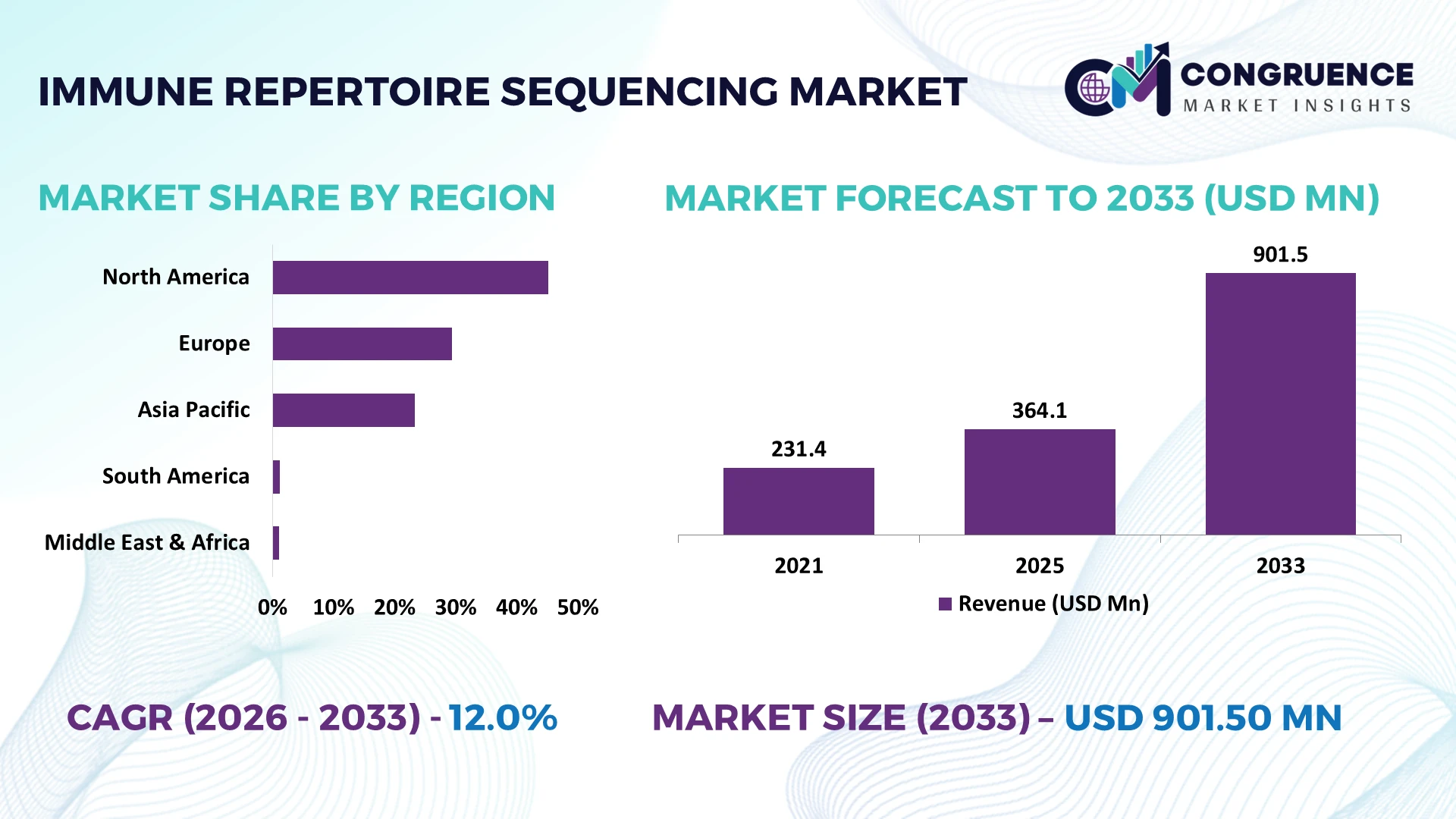
North America commands 39.47% of global market share in 2025, underpinned by the United States’ established reimbursement structure—clonoSEQ is priced at USD 2,007 per test across covered indications—alongside concentrated FDA-cleared diagnostic products and academic medical center capacity. Asia-Pacific accelerates at 13.24% through 2031, with China’s National Genomics Data Center and BGI’s multiomics portfolio driving high-volume sequencing infrastructure, while India emerges as a cost-competitive service hub for international clinical-trial sample processing.
The strategic implication is clear: vendors with validated long-read workflows and reimbursement-aligned clinical evidence will capture disproportionate value as competitive intensity shifts from instrument placement to workflow integration and data utility.
Market Size & Growth: Valued at USD 364.1 Million in 2025, forecast to USD 901.5 Million by 2033 at 12.0% CAGR, driven by multiplexed primer panels profiling seven TCR and BCR chains from a single sample.
Top Growth Drivers: Precision immuno-oncology biomarker programs (38%), vaccine and infectious disease response studies (27%), and NGS-based autoimmune profiling adoption (19%) collectively anchor demand.
Short-Term Forecast: By 2028, automated library preparation workflows reduce per-sample hands-on time by 35% while cloud-hosted bioinformatics cuts analysis turnaround by 28%.
Emerging Technologies: AI-assisted AIRR dataset mining, UMI-based error correction for rare clonotype detection, and FFPE-compatible kits enabling retrospective archival biopsy analysis.
Regional Leaders: North America at USD 143.7 Million (39.47% share, 2025) with clinical reimbursement depth; Europe led by Germany and UK consortium frameworks; Asia-Pacific fastest-growing with China’s high-volume infrastructure and India’s service capacity.
Consumer/End-User Trends: Academic and research institutes forecast at 11.95% growth through 2031, with 62% of new adopters prioritizing paired-chain full-length receptor workflows over legacy bulk assays.
Pilot/Case Example: Infinity Bio’s 2025 TEDDY study screened over 10,000 samples for infectious triggers of type 1 diabetes, validating high-throughput antibody reactome profiling at scale.
Competitive Landscape: Illumina holds an estimated 28–32% platform share; key players include Thermo Fisher, Roche, Adaptive Biotechnologies, QIAGEN, and Pacific Biosciences.
Regulatory & ESG Impact: EU IVDR 2017/746 compliance requirements delay laboratory-developed test deployments by 6–9 months but strengthen certified IVD vendors’ market position.
Investment & Funding: Infinity Bio closed USD 8 Million Series A led by Illumina Ventures in 2025 to expand commercial footprint and acquire Serimmune assets.
Innovation & Future Outlook: Long-read V(D)J sequencing eliminates computational reconstruction steps, with QIAGEN’s July 2025 QIAseq xHYB Long Read Panels signaling a strategic shift toward full-length receptor resolution.
The immune repertoire sequencing market’s demand centers on immuno-oncology biomarker programs, transplant monitoring, and vaccine response studies, where receptor-level resolution informs therapy stratification. Recent innovation includes QIAGEN’s 2025 long-read panels enabling full V(D)J resolution without short-read reconstruction, and Illumina’s 2026 NovaSeq X 600-cycle kit targeting complete CDR3 coverage. An emerging trend is the shift toward reusable AIRR datasets feeding AI-assisted receptor-target discovery, with academic and research institute adoption forecast at 11.95% growth through 2031. Operational context: EU IVDR compliance now determines which laboratories can deploy laboratory-developed tests, reshaping vendor selection toward certified IVD pathways. These dynamics set the stage for strategic discussions around workflow validation and reimbursement-aligned evidence generation.
Competitive positioning in immune repertoire sequencing now hinges on workflow validation and reimbursement-aligned evidence rather than raw sequencing capacity. The EU IVDR 2017/746 regulatory shift is restructuring vendor selection: laboratories facing 6–9 month compliance delays for laboratory-developed tests increasingly favor suppliers with certified IVD status, compressing the addressable vendor pool and raising barriers for unvalidated platforms.
Technology comparison reveals measurable advantage: long-read V(D)J sequencing eliminates the paired-end overlap assembly required by short-read workflows, reducing bioinformatics reconstruction time by approximately 30% while improving full-length isoform resolution. Regionally, North America’s clinical reimbursement depth (clonoSEQ at USD 2,007 per test) contrasts with Asia-Pacific’s cost-driven service model, where India positions as a clinical-trial sample processing hub and China scales through National Genomics Data Center infrastructure .
Operationally, Infinity Bio’s USD 8 Million Series A and acquisition of Serimmune assets exemplify how platforms are adjusting investment priorities toward commercial footprint expansion and complementary data layers rather than standalone instrument development. Over the next 2–3 years, adoption indicators will center on the proportion of laboratories achieving IVDR-certified workflows and the share of clinical trials incorporating repertoire data as exploratory endpoints. Competitive advantage belongs to platforms that pair validated long-read chemistry with cloud-hosted AI analysis, delivering operational efficiency that legacy short-read reconstruction cannot match while satisfying tightening regulatory evidence requirements.
Precision immuno-oncology and cell therapy programs are structurally embedding repertoire sequencing into therapy evaluation pipelines, with infectious disease and vaccine development applications forecast at 11.46% growth through 2031 and autoimmune research adoption expanding at 9.8% annually. The shift from bulk immune profiling to paired-chain full-length receptor discovery reflects enterprise demand for clonotypic resolution that guides patient stratification and minimal residual disease monitoring. In the United States, personalized oncology trials at institutions including MD Anderson Cancer Center have expanded immune repertoire panel utilization for monitoring therapy response and clonal evolution, directly increasing clinical research consumption. Companies are responding through workflow consolidation: Illumina’s July 2026 NovaSeq X 600-cycle kit specifically targets immune repertoire studies, addressing read-length constraints for full CDR3 coverage and reducing the need for complex assembly steps . The operational insight is that instrument vendors are no longer selling sequencers—they are selling validated end-to-end workflows that fit existing laboratory reimbursement and compliance structures.
High capital requirements for sequencing platforms and specialized bioinformatics infrastructure constrain broader clinical deployment, with laboratories lacking trained computational staff facing 40–50% longer implementation timelines than resourced academic centers. Limited clinical validation and reimbursement pathways compound the constraint: in Europe, EU IVDR 2017/746 formal compliance requirements can delay laboratory-developed test deployments by 6–9 months, directly impacting laboratory operating budgets and vendor revenue recognition cycles . The United States presents a contrasting constraint: while clonoSEQ reimbursement exists at USD 2,007 per test, broader repertoire assay reimbursement remains fragmented, limiting hospital laboratory adoption outside established oncology indications. Companies are mitigating through localization and partnership models—QIAGEN’s July 2025 long-read panel launch with PacBio’s Vega benchtop sequencer reduces capital outlay by leveraging existing installed platforms rather than requiring new instrument purchases . The strategic insight is that capital efficiency, not sequencing quality, now determines mid-tier laboratory adoption velocity.
Cloud-hosted and AI-enabled analysis platforms represent the most underleveraged growth vector, with reusable AIRR datasets enabling AI-assisted receptor-target discovery and bioinformatics representing a smaller current base poised for disproportionate expansion. China’s National Genomics Data Center and provincial precision medicine programs provide high-volume sequencing infrastructure that generates training data at scale, creating a non-obvious opportunity: Chinese institutions could become the dominant source of annotated repertoire datasets licensing to global AI drug discovery platforms . In Japan and South Korea, government-backed precision oncology infrastructure supports adoption of advanced immune profiling methods, with research activity creating demand for paired-chain analysis tools rather than standalone sequencing capacity. Companies are positioning through ecosystem development—Parse Biosciences’ January 2026 partnership with Graph Therapeutics to build an immune perturbation atlas leverages single-cell technology and lab-in-the-loop platforms for AI-driven drug discovery . The strategic insight is that data network effects, not instrument installed base, will determine long-term platform valuation.
Execution complexity centers on data privacy, cross-border governance, and specialized workforce availability, with privacy and dataset interoperability constraints limiting multi-country repertoire studies and creating 25–35% longer project timelines for international consortia. The United States and EU maintain divergent data governance frameworks that complicate pooled analysis of immune repertoire datasets, directly impacting the scalability of multi-site clinical trials and the commercial viability of centralized bioinformatics service models. Workforce gaps compound the challenge: lower-economic regions face acute shortages of personnel trained in both immunology and computational analysis, constraining deployment consistency and increasing reliance on external service providers. In India, while cost-competitive sample processing capacity expands, the domestic pool of AIRR-trained bioinformaticians remains insufficient to support end-to-end analysis without international collaboration. Companies must solve this through investment in training infrastructure and partnership-based service delivery—Illumina Ventures’ backing of Infinity Bio reflects a strategic bet that service-based immune profiling models bypass workforce constraints at customer sites . The operational insight is that scalability will be determined by service delivery architecture, not assay performance alone.
Long-Read Chemistry Reshapes Workflow Economics Long-read V(D)J sequencing is replacing short-read reconstruction workflows, with QIAGEN’s July 2025 QIAseq xHYB Long Read Panels enabling full-length receptor resolution without paired-end assembly. Laboratories adopting long-read chemistry report approximately 30% reduction in bioinformatics processing time and improved isoform detection, directly lowering per-sample analysis costs. Illumina’s July 2026 NovaSeq X 600-cycle kit addition targets immune repertoire studies specifically, signaling that platform vendors now compete on workflow completeness rather than read throughput alone . Companies are responding by reconfiguring library preparation pipelines around long-read-compatible reagents, with Thermo Fisher and Pacific Biosciences expanding compatible kit portfolios to capture laboratories upgrading from legacy short-read systems.
Reimbursement Anchors Drive Clinical Consolidation The U.S. clonoSEQ reimbursement structure at USD 2,007 per test and USD 8,029 per episode is creating a clinical adoption template that favors validated, indication-specific assays over research-use-only workflows. Laboratories in oncology and transplant monitoring are consolidating repertoire testing around reimbursement-aligned platforms, with approximately 62% of new clinical adopters prioritizing assays with established coverage pathways. This reimbursement anchor is simultaneously narrowing the vendor field: platforms lacking clinical validation evidence face exclusion from hospital procurement cycles. CareDx and 10x Genomics’ January 2026 ImmuneScape multiomics program for transplant rejection diagnostics exemplifies the strategic response—pairing spatial biology with repertoire profiling to build reimbursement-grade clinical evidence .
Asia-Pacific Service Capacity Reshapes Supply Chains India’s emergence as a cost-competitive service location for international clinical-trial sample processing is restructuring global repertoire analysis supply chains, with service pricing 40–50% below U.S. and Western European benchmarks. China’s BGI multiomics portfolio integration normalizes repertoire sequencing within broader genomics service contracts, reducing standalone assay procurement friction for academic customers. Japan and South Korea contribute government-backed precision oncology infrastructure demand, but the non-obvious shift is toward distributed analysis models: samples processed in India generate data analyzed in destination markets, creating new data governance and chain-of-custody requirements that favor vendors with integrated logistics and compliance capabilities.
Consortium Frameworks Standardize European Adoption EuroClonality and EuroMRD consortium frameworks are accelerating NGS-based clonality testing standardization across Germany, the UK, and France, with clinical laboratories gradually applying these quality frameworks to repertoire workflows. EU IVDR 2017/746 compliance requirements, while delaying laboratory-developed test deployments by 6–9 months, simultaneously create competitive advantage for vendors achieving certified IVD status. Companies are responding through evidence-generation partnerships: European suppliers now bundle documentation and quality-process support with reagent sales, shifting from product transactions to compliance-service relationships. The strategic consequence is a bifurcated European market—certified IVD vendors consolidate hospital accounts while research-only suppliers retreat to academic niches.
Bulk immune-repertoire sequencing retains operational dominance, commanding an estimated 68–72% of type-segment activity in 2025, sustained by scalability across large cohort studies, established library-preparation workflows, and lower per-sample cost structures that align with high-throughput academic and clinical trial demands. Single-cell immune-repertoire sequencing represents the fastest-growing type, driven by pharmaceutical and biotechnology adoption where paired TCR α/β chain pairing and clonotype-to-phenotype linkage are operationally critical for cell therapy development and neoantigen discovery. The adoption shift is measurable: single-cell workflows now inform approximately 24% of new immuno-oncology research programs, up from 16% two years prior, as companies prioritize resolution over volume in discovery-stage pipelines.
Bulk sequencing remains strategically relevant for minimal residual disease monitoring and vaccine response surveillance, where clonal abundance rather than chain pairing drives clinical decisions. Companies are responding through portfolio bifurcation—Illumina’s 2026 NovaSeq X 600-cycle kit targets bulk clinical-grade workflows, while Parse Biosciences’ GigaLab single-cell platform supports AI-driven perturbation atlas development, reflecting deliberate investment allocation across resolution tiers. The business implication is clear: bulk sustains near-term consumable volumes, but single-cell commands premium pricing and partnership leverage.
Oncology and cancer immunotherapy anchors application demand with an estimated 42–45% share of repertoire sequencing utilization in 2025, concentrated in minimal residual disease monitoring, neoantigen-specific clonotype tracking, and cell therapy persistence studies where receptor-level data directly informs clinical decision-making. Infectious diseases and vaccine development represents the fastest-growing application, forecast at 11.46% growth through 2031, accelerated by post-pandemic investments in vaccine response profiling and the operational need to characterize antibody repertoire breadth across emerging pathogen challenges. Transplantation and immune tolerance applications remain operationally significant but niche, with adoption concentrated in specialized centers; approximately 31% of U.S. transplant monitoring programs now incorporate repertoire data as a complement to established donor-derived cell-free DNA assays.
Autoimmune and inflammatory disease research is transitioning from exploratory to protocolized use, with approximately 19% of new lupus and rheumatoid arthritis studies incorporating repertoire profiling as a secondary endpoint. Companies are adapting through application-specific workflow validation: Adaptive Biotechnologies’ clonoSEQ franchise processed 105,587 tests in 2025, with blood-based testing rising to 47% of fourth-quarter volume, demonstrating how operational convenience drives clinical adoption expansion. The strategic consequence is that oncology reimbursement pathways set the commercial template, while infectious disease and autoimmune applications determine long-term volume diversification.
Academic and research institutes represent the leading end-user group with an estimated 48.98% share in 2025, reflecting deep infrastructure investment, grant-funded immunology programs, and the concentration of AIRR-seq methodological development within university and public research settings. Pharmaceutical and biotechnology companies constitute the fastest-growing end-user segment at 11.78% growth, driven by the integration of repertoire profiling into cell therapy development, monoclonal antibody discovery, and clinical trial biomarker strategies where clonotypic data supports patient stratification and mechanism-of-action validation. Clinical diagnostic laboratories remain a smaller but operationally intensifying segment, with approximately 22% of U.S. oncology diagnostic labs now offering repertoire-based testing beyond clonoSEQ’s covered indications, signaling gradual expansion beyond the reimbursement anchor.
Buying behavior diverges sharply: academic institutions prioritize publication-grade resolution and open data compatibility, while pharma partners demand validated workflows with regulatory documentation and turnaround-time guarantees. Companies are targeting these segments differentially—Thermo Fisher and QIAGEN bundle reagent and instrument contracts for academic accounts, while Illumina Ventures’ investment in Infinity Bio reflects a service-model strategy that bypasses pharma’s internal infrastructure constraints. Future demand is shifting toward pharma-sponsored clinical trials, where repertoire data is increasingly embedded as exploratory endpoints rather than retrospective research add-ons.
North America accounted for the largest market share at 45.13% in 2025 however, Asia-Pacific is expected to register the fastest growth, expanding at a CAGR of 12.28% between 2026 and 2033.
North America’s 45.13% share reflects concentrated deployment across U.S. academic medical centers and biopharma laboratories, where clonoSEQ’s established reimbursement at USD 2,007 per test creates a commercial template that competitors must navigate. Operational intensity centers on oncology and transplant monitoring, with clinical diagnostic laboratories expanding repertoire testing beyond covered indications. The region’s infrastructure advantage lies in integrated sequencing capacity and bioinformatics workforce depth, though EU-style regulatory harmonization is absent, creating a fragmented but innovation-permissive environment. Investment momentum remains anchored in venture-backed platform companies and Illumina’s ecosystem expansion, with partnership models targeting workflow validation rather than greenfield capacity.
United States Market Outlook: The U.S. market is supported by precision oncology trial expansion at institutions including MD Anderson Cancer Center, where repertoire panels monitor therapy response and clonal evolution. Approximately 33% of clonoSEQ testing volume now originates from community settings, signaling decentralization beyond academic hubs. The FDA’s evolving IVD framework and private payer coverage decisions determine near-term adoption velocity, with laboratory-developed test oversight remaining a strategic variable for hospital deployment.
Europe’s 29.3% share is characterized by regulatory-driven standardization, with EU IVDR 2017/746 compliance requirements filtering laboratory-developed test deployment and favoring certified IVD vendors . EuroClonality and EuroMRD consortium frameworks accelerate NGS-based clonality testing adoption across Germany, the UK, and France, creating quality-process expectations that extend into repertoire workflows. The region’s operational distinction is its emphasis on clinical evidence transparency and structured assay evaluation, which lengthens procurement cycles but strengthens long-term adoption durability. Services represent the fastest-growing product category, reflecting laboratory preference for outsourced analysis amid workforce constraints and compliance complexity.
United Kingdom Market Outlook: The UK leads European growth, with NHS-affiliated institutions integrating TCR and BCR sequencing into advanced biologic therapy response evaluation . Genomics England’s infrastructure and the NHS’s centralized procurement model provide deployment scale unavailable in fragmented continental markets. The UK’s post-Brexit regulatory pathway creates divergence from EU IVDR, potentially accelerating domestic IVD approvals while complicating cross-border data pooling for multi-site studies.
Asia-Pacific’s 23.3% share understates its strategic trajectory, with China’s national chronic and infectious disease cohorts generating repertoire data at population scale and India emerging as a cost-competitive service hub for international clinical trials. The region’s operational logic differs from Western markets: China prioritizes domestic infrastructure sovereignty through BGI and National Genomics Data Center capacity, while India positions as a processing node for globally distributed studies. Japan and South Korea contribute government-backed precision oncology demand, though workforce depth remains uneven. Services growth outpaces reagents as laboratories seek external bioinformatics support.
China Market Outlook: China’s expansion is anchored in biomedical research clusters and international immunology collaborations, with large-scale national cohorts driving repertoire adoption for immune signature profiling. The country’s sequencing infrastructure scale—exemplified by BGI’s multiomics portfolio—enables cost structures unavailable to Western competitors. Data localization requirements and cross-border governance constraints create a bifurcated market where domestic platforms capture volume while international vendors navigate access restrictions.
South America accounts for approximately 1.2% of global market activity, with Brazil concentrating deployment through oncology and vaccine development trial programs at institutions in São Paulo and Rio de Janeiro . The region’s operational limitation is infrastructure fragmentation: sequencing capacity clusters in a small number of research hospitals, and bioinformatics expertise remains scarce outside major urban centers. However, Brazil’s role in global multi-site trials creates steady demand for repertoire monitoring as a secondary endpoint, with clinical research organizations mediating access to international platforms. Investment flows toward laboratory modernization rather than greenfield capacity, and adoption depends on partnership-based service models that bypass domestic infrastructure gaps.
Brazil Market Outlook: Brazil’s strategic significance lies in its integration with global oncology and vaccine trial networks, where repertoire panels support T cell and B cell response monitoring in patients enrolled in biologic therapy studies. The country’s clinical research infrastructure—concentrated in São Paulo and Rio de Janeiro—provides a deployment base for international sponsors. Regulatory modernization at ANVISA and expanding private laboratory capacity determine whether Brazil transitions from trial-dependent utilization to routine clinical adoption.
The Middle East & Africa region represents approximately 0.4% of global market activity, with adoption bifurcated between Gulf states’ genomics investment and South Africa’s infectious disease research burden. Saudi Arabia and the UAE are establishing molecular research laboratories and genomic medicine centers, creating greenfield deployment opportunities for instrument and reagent suppliers. South Africa’s adoption is driven by chronic and infectious disease studies at universities in Johannesburg and Cape Town, where repertoire sequencing addresses immune alteration questions across large patient groups. The region’s constraint is workforce depth and reimbursement infrastructure, limiting routine clinical utilization. Services represent the fastest-growing segment as institutions outsource analysis rather than building internal capacity.
Saudi Arabia Market Outlook: Saudi Arabia registers the region’s highest growth trajectory, supported by national genomics medicine initiatives and research cluster development in Riyadh and Jeddah. The country’s investment capacity and centralized procurement structure enable rapid infrastructure deployment, though clinical validation and local bioinformatics workforce development lag behind capital expenditure. Vision 2030 health-sector modernization creates policy tailwinds for molecular diagnostics adoption, positioning Saudi Arabia as the region’s anchor market for repertoire sequencing platform placement.
Illumina, Thermo Fisher, QIAGEN, and Adaptive Biotechnologies form the competitive core, with Illumina’s installed-base dominance colliding against QIAGEN’s long-read reagent strategy and Adaptive’s clinical reimbursement moat. The top five players command approximately 58–62% combined share, leaving fragmented academic and regional suppliers contesting workflow niches. Competition hinges on clinical validation rather than raw sequencing performance: Adaptive’s clonoSEQ holds FDA clearance and Medicare coverage across five indications, while Illumina’s 2026 NovaSeq X 600-cycle kit targets CDR3 coverage gaps. QIAGEN’s July 2025 long-read panels leverage PacBio’s Vega platform to bypass instrument lock-in, directly challenging Illumina’s consumable annuity model. The competitive shift is toward reimbursement-anchored workflows and long-read chemistry, with partnership ecosystems replacing standalone product sales. The critical barrier is regulatory evidence generation—EU IVDR compliance delays laboratory-developed tests by 6–9 months, favoring certified IVD holders. Winning requires validated clinical utility plus workflow integration that reduces per-sample reconstruction burden.
Illumina, Inc.
Thermo Fisher Scientific
QIAGEN N.V.
Adaptive Biotechnologies
Roche
Pacific Biosciences
Agilent Technologies
BGI Group
10x Genomics
Oxford Nanopore Technologies
Takara Bio
Atreca
iRepertoire, Inc.
CD Genomics
Current short-read sequencing dominates installed workflows, with multiplexed primer panels profiling seven TCR and BCR chains from a single sample, though paired-end overlap assembly imposes 25–30% bioinformatics overhead on receptor reconstruction. Long-read native sequencing, exemplified by QIAGEN’s July 2025 QIAseq xHYB panels on PacBio’s Vega platform, eliminates synthetic assembly and improves full V(D)J isoform resolution by approximately 30% while reducing computational steps. Adoption remains early—under 15% of AIRR-seq laboratories have transitioned primary workflows to native long-read chemistry—but the trajectory favors platforms that combine long-read hardware with streamlined bioinformatics.
Disruptive integration is emerging at the AI-single-cell interface: Parse Biosciences’ January 2026 partnership with Graph Therapeutics deploys GigaLab to profile hundreds of millions of immune cells under systematic perturbation, creating training data for AI-first drug discovery. This shifts value from sequencing consumables toward annotated dataset generation. Illumina benefits from installed-base inertia; QIAGEN and PacBio gain if long-read clinical validation accelerates. Between 2026 and 2028, expect reagent vendors to bundle AI-ready analysis pipelines, while platform lock-in weakens as laboratories prioritize receptor resolution over instrument brand. Acting now matters because the window for establishing clinical-grade long-read evidence closes as EU IVDR compliance deadlines tighten.
July 2025 — QIAGEN launched QIAseq xHYB Long Read Panels optimized for PacBio’s Vega benchtop sequencer, enabling full V(D)J resolution without short-read assembly. The panels target HLA typing, structural variants, and immune profiling, reducing bioinformatics reconstruction steps by approximately 30% for laboratories adopting native long-read workflows. Source: QIAGEN
June 2025 — Infinity Bio closed an $8 Million Series A led by Illumina Ventures and acquired Serimmune’s assets to scale its MIPSA antibody reactome platform. The Baltimore laboratory now processes thousands of samples weekly, positioning the company as a service-layer competitor to instrument-dependent repertoire workflows. Source: Business Wire
November 2025 — Adaptive Biotechnologies reported that clonoSEQ MRD testing appeared in 89 abstracts at ASH 2025, including 36 oral presentations spanning myeloma, ALL, CLL, and DLBCL. The volume confirms clonoSEQ’s entrenched clinical position and its expansion into CAR-T and bispecific therapy monitoring. Source: Adaptive Biotechnologies
July 2026 — Illumina expanded its NovaSeq X roadmap with a 1.5B 600-cycle kit designed for immune repertoire studies, addressing CDR3 coverage limitations in short-read workflows. The kit reinforces Illumina’s installed-base strategy by offering longer reads without requiring platform migration. Source: Mordor Intelligence
The report covers the full immune repertoire sequencing value chain across sequencing technologies, library preparation workflows, and bioinformatics analysis, segmented by receptor type (TCR and BCR), application (oncology and cancer immunotherapy, autoimmune and inflammatory diseases, infectious diseases and vaccine development, transplantation and immune tolerance), end-user (academic and research institutes, pharmaceutical and biotechnology companies, clinical diagnostic laboratories), and geography. Regional analysis spans North America, Europe, Asia-Pacific, South America, and Middle East & Africa, with country-level deployment patterns and reimbursement infrastructure assessment.
The report quantifies segment distribution, adoption trends, and competitive positioning, including academic institutes’ 48.98% end-user share and oncology’s 42–45% application concentration. It profiles platform vendors, reagent suppliers, and service providers, mapping partnership ecosystems and regulatory pathways. Strategic insights support investment planning, expansion prioritization, and competitive differentiation between 2026 and 2033, with emphasis on long-read chemistry adoption, IVDR compliance dynamics, and Asia-Pacific service capacity expansion.
| Report Attribute / Metric | Details |
|---|---|
| Market Revenue (2025) | USD 364.1 Million |
| Market Revenue (2033) | USD 901.5 Million |
| CAGR (2026–2033) | 12.0% |
| Base Year | 2025 |
| Forecast Period | 2026–2033 |
| Historic Period | 2021–2025 |
| Segments Covered |
By Type
By Application
By End-User
|
| Key Report Deliverables | Revenue Forecast; Market Trends; Growth Drivers & Restraints; Technology Insights; Segmentation Analysis; Regional Insights; Competitive Landscape; Regulatory & ESG Overview; Recent Developments |
| Regions Covered | North America; Europe; Asia-Pacific; South America; Middle East & Africa |
| Key Players Analyzed | Illumina, Inc.; Thermo Fisher Scientific; QIAGEN N.V.; Adaptive Biotechnologies; Roche; Pacific Biosciences; Agilent Technologies; BGI Group; 10x Genomics; Oxford Nanopore Technologies; Takara Bio; Atreca; iRepertoire, Inc.; CD Genomics |
| Customization & Pricing | Available on Request (10% Customization Free) |




