
Reports
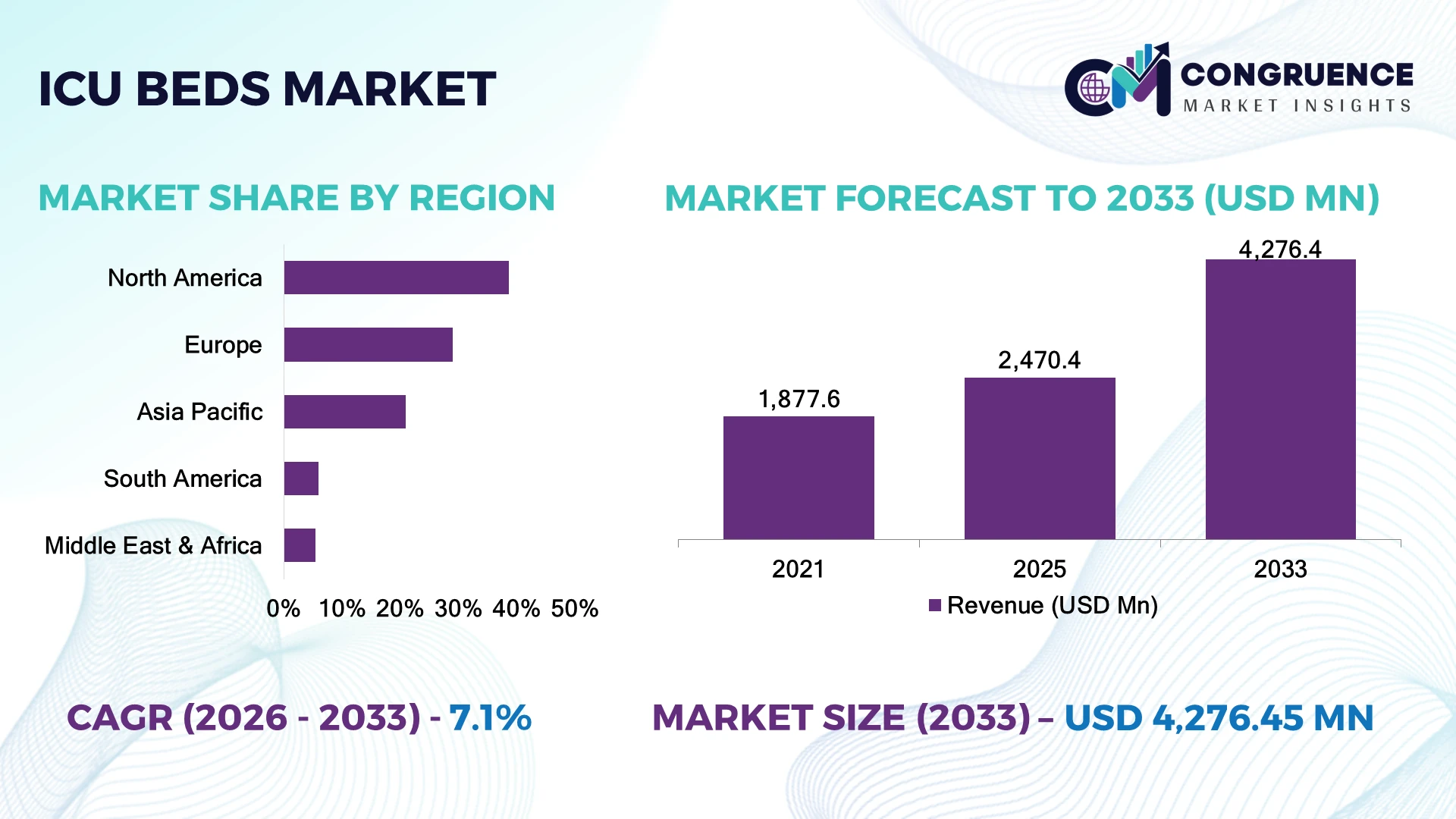
The Global ICU Beds Market was valued at USD 2,470.4 Million in 2025 and is anticipated to reach a value of USD 4,276.4 Million by 2033 expanding at a CAGR of 7.1% between 2026 and 2033. Growth is being driven by ICU capacity expansion, replacement of manual beds with electric positioning systems, and hospital modernization focused on critical-care workflow efficiency.
China represents a dominant capacity hub, with national policy targeting 15 ICU beds per 100,000 people by end-2025 and 18 per 100,000 by 2027, alongside convertible ICU capacity of 10 and 12 beds per 100,000, respectively. This contrasts with India’s more fragmented critical-care infrastructure, while China’s post-pandemic healthcare-capacity restructuring is accelerating procurement of advanced ICU infrastructure.
Strategic procurement is shifting toward connected, high-acuity beds that combine patient positioning, mobility, safety, and workflow integration rather than basic bed replacement.
Market Size & Growth: USD 2.47 billion in 2025 to USD 4.28 billion by 2033 at 7.1% CAGR, driven by critical-care capacity expansion and hospital modernization.
Top Growth Drivers: ICU infrastructure expansion 15%; electric-bed adoption 12%; critical-care replacement demand 9%.
Short-Term Forecast: By 2028, automated positioning is expected to reduce manual adjustment workload by 10–15% in digitally equipped ICUs.
Emerging Technologies: Integrated weighing, motorized positioning, patient-turning systems, and connectivity are advancing smart ICU workflows.
Regional Leaders: Asia-Pacific leads scale; North America leads technology adoption; Europe emphasizes advanced safety and ergonomic systems.
Consumer/End-User Trends: Hospitals increasingly prioritize ICU beds supporting mobility, pressure management, and integration with bedside monitoring systems.
Pilot/Case Example: China’s 2025 critical-care capacity program targets 15 ICU beds per 100,000 people, strengthening infrastructure readiness.
Competitive Landscape: Hillrom, Stryker, LINET, Getinge, and Paramount Bed compete through engineering, safety features, ergonomics, and hospital-system integration.
Regulatory & ESG Impact: China’s target of 15 ICU beds per 100,000 by 2025 is accelerating standardized critical-care infrastructure deployment.
Investment & Funding: Healthcare infrastructure programs are directing capital toward ICU expansion, equipment replacement, and digitally enabled critical-care environments.
Innovation & Future Outlook: AI-enabled monitoring interfaces, connected bed platforms, automated positioning, and predictive maintenance are shifting competition toward intelligent critical-care infrastructure.
ICU Beds are becoming a high-priority procurement category as hospitals upgrade critical-care capacity, particularly in public-sector systems and tertiary facilities. Demand is increasingly concentrated around electric ICU beds with integrated weighing, lateral positioning, pressure-injury prevention, and mobility functions; advanced configurations can command materially stronger purchasing preference than basic manual models. China’s policy-driven ICU expansion is reinforcing this shift, while India is emphasizing capacity visibility and operational readiness across major hospitals.
ICU beds are becoming strategic hospital infrastructure because bed design directly affects nursing workload, patient repositioning, infection-control workflows, mobilization, and compatibility with intensive-care equipment. Procurement is therefore moving from standalone furniture toward integrated clinical platforms. China’s post-pandemic critical-care policy is particularly significant, with national targets moving from 15 ICU beds per 100,000 people in 2025 toward 18 per 100,000 by 2027.
Technology differentiation is becoming measurable. Electrically powered multi-position beds replace manual adjustment with motorized controls, reducing repeated caregiver handling and enabling faster positioning during high-acuity interventions. Integrated weighing, patient-exit alerts, lateral therapy, and connectivity further improve workflow visibility. In China, 2024 hospital bed utilization remained 79.2%, while average hospital length of stay continued to decline, increasing pressure to extract more operational value from each critical-care bed.
Over 2026–2028, hospitals are expected to prioritize modular ICU platforms that support ventilation, monitoring, mobility, and rapid bed reconfiguration. India’s real-time ICU-bed reporting practices illustrate the growing emphasis on capacity visibility, while China is combining capacity expansion with standardized staffing and infrastructure targets. Manufacturers that combine ergonomic engineering, connected functionality, serviceability, and lifecycle support will secure stronger positions in hospital modernization programs.
China’s critical-care expansion policy is directly increasing ICU bed procurement, with national capacity targets rising from 15 to 18 ICU beds per 100,000 people between 2025 and 2027. Convertible ICU capacity is also targeted at 10 and 12 beds per 100,000, respectively. Hospitals are therefore prioritizing electric positioning, integrated weighing, mobility, and emergency-conversion capabilities. Manufacturers are responding with modular platforms, localized production, and hospital partnerships. The strategic shift is significant: procurement is moving from simple bed replacement toward standardized critical-care infrastructure that can support both routine utilization and surge capacity. Suppliers able to combine clinical functionality with rapid deployment and service support are gaining stronger positioning in capacity-expansion programs.
Advanced ICU beds carry higher acquisition and maintenance requirements than conventional hospital beds, while their value depends heavily on adequate staffing and clinical infrastructure. In the United States, 89.6% of surveyed ICUs used a 1:2 nurse-to-patient ratio for mechanically ventilated patients, demonstrating the labor intensity surrounding critical-care deployment. China’s target of a 1:3 nurse-to-bed ratio similarly links infrastructure expansion with workforce availability. Hospitals facing constrained budgets can therefore defer premium bed replacement even when capacity requirements are rising. Manufacturers are reducing purchasing friction through modular configurations, lifecycle-service contracts, localized maintenance, and scalable feature packages. The non-obvious constraint is that adding beds without matching oxygen, monitoring, power, and staffing capacity does not proportionately increase usable ICU capacity.
Connected ICU beds create an underpenetrated opportunity by linking positioning, weighing, patient-exit alerts, pressure management, and nurse-call systems into hospital workflows. China’s 2025 policy requires convertible ICU beds to become operational within 24 hours, increasing the value of modular equipment that can be rapidly configured. Hospitals are also moving toward integrated digital infrastructure, creating opportunities for manufacturers to embed interoperability and remote diagnostics. Companies are investing in sensor-enabled platforms, software integration, and service partnerships rather than selling beds as standalone equipment. The strongest opportunity lies in converting existing hospital rooms into flexible critical-care spaces, where standardized bed platforms can reduce equipment duplication while improving surge readiness. Suppliers with open interfaces and retrofit capability can capture demand beyond newly constructed ICUs.
The long-term challenge is coordinating advanced ICU beds with monitoring systems, medical gases, power infrastructure, nurse-call networks, and clinical workflows without increasing operational complexity. U.S. ICU data show 98.5% respiratory-therapist availability but only 85.1% hospital-level intensivist coverage, illustrating uneven multidisciplinary capacity. China’s requirements for rapid ICU conversion further increase pressure on infrastructure readiness, requiring oxygen, power, infection-control provisions, and life-support equipment. Manufacturers must therefore design beds for interoperability, rapid commissioning, and low-complexity maintenance. Hospitals require stronger staff training and standardized workflows to extract value from connected functions. Competitive advantage will increasingly depend on implementation capability, not hardware specifications alone, because poorly integrated smart beds can create workflow friction instead of reducing it.
Connected Bed Integration Accelerates Smart ICU beds are increasingly integrating weighing, patient-exit alerts, positioning, and nurse-call connectivity, with advanced configurations targeting 1–2% workflow-efficiency gains. Hospitals are consolidating bedside technologies to reduce equipment duplication, while manufacturers are expanding interoperability and software-enabled platforms.
Convertible ICU Capacity Expands China’s critical-care modernization program targets 10 convertible ICU beds per 100,000 people by 2025 and 12 by 2027. Hospitals are redesigning adaptable wards around 24-hour conversion capability, increasing demand for modular beds compatible with oxygen, power, monitoring, and emergency equipment.
Mobility Features Gain Priority Early mobilization is strengthening demand for beds supporting lateral positioning, height adjustment, and assisted patient movement. Hospitals increasingly prioritize systems that reduce manual handling by approximately 5–10%, while suppliers are integrating mobility functions with safety controls and pressure-management technologies.
Procurement Shifts Toward Standardization Hospitals are moving from fragmented bed purchasing toward standardized ICU platforms that simplify maintenance, training, and spare-parts management. Standardized configurations can reduce equipment variability by roughly 10–15%, prompting manufacturers to expand modular product families and service agreements across hospital networks.
Advanced Electric ICU Beds lead as Hospitals Prioritize Integrated Critical-care Functionality
Advanced electric ICU beds account for approximately 58% of the global ICU beds market, supported by motorized height adjustment, electronic backrest and knee positioning, lateral tilting, patient weighing, and compatibility with monitoring equipment. Their higher upfront cost is offset by improved workflow efficiency and reduced manual handling requirements, making them particularly relevant in tertiary and multispecialty hospitals. Semi-electric beds represent about 24%, retaining strong demand where hospitals balance functionality with procurement budgets, while manual ICU beds account for roughly 18% and remain relevant in smaller facilities and cost-sensitive healthcare systems.
The fastest-growing category is advanced electric beds, with adoption expanding as hospitals integrate pressure-redistribution surfaces, electronic controls, fall-prevention features, and connectivity. Demand for electronically adjustable models is estimated to increase by 8–10 percentage points across new critical-care installations through 2030. Manufacturers are responding with modular platforms, antimicrobial surfaces, integrated scales, and centralized control features. The strategic shift is clear: procurement is moving from basic bed capacity toward ICU platforms that directly support nurse productivity, patient safety, and equipment integration.
The OECD’s 2025 Health at a Glance reported an average of 17 ICU beds per 100,000 population across 31 OECD countries in 2023, while capacity exceeded 40 beds per 100,000 in Czechia and Estonia, reinforcing substantial differences in critical-care infrastructure requirements.
Adult Critical Care Remains Dominant while Specialized ICU Configurations Gain Ground
Adult ICU applications represent approximately 72% of global ICU bed demand because adult critical-care units operate at substantially larger scale across tertiary hospitals, trauma centers, cardiac facilities, and surgical departments. Pediatric ICU applications account for about 16%, while neonatal ICU beds represent roughly 12%, supported by specialized maternity and neonatal-care infrastructure. Adult ICU procurement remains concentrated around high-acuity beds with electric positioning, weighing systems, side-rail controls, and compatibility with ventilators and patient-monitoring equipment.
Pediatric and neonatal applications are the fastest-expanding use cases in specialized hospital construction because clinical protocols increasingly require beds designed around smaller patient dimensions, infection control, thermal management, and caregiver access. Their share of new specialized ICU installations is estimated to rise by 4–6 percentage points through the next several years. Companies are responding with pediatric-specific dimensions, integrated safety controls, and modular accessories rather than adapting conventional adult beds. This shift makes customization increasingly operationally critical, particularly for hospitals expanding neonatal and pediatric intensive-care capacity alongside surgical and maternal-care services.
In 2025, the OECD reported that ICU capacity remained a critical health-system resource and that most OECD countries had increased ICU capacity compared with the pre-pandemic period, supporting continued replacement and expansion requirements for specialized critical-care infrastructure.
Hospitals Dominate Procurement while Specialty and Private-care Networks Accelerate Modernization
Hospitals account for approximately 84% of global ICU bed procurement, reflecting their concentration of emergency departments, intensive-care units, operating theaters, and high-acuity patient pathways. Large tertiary and multispecialty hospitals generate the strongest demand because ICU beds must support continuous monitoring, ventilation, infusion therapy, and rapid patient repositioning. Specialty clinics represent nearly 10%, while other healthcare facilities, including rehabilitation and smaller acute-care centers, contribute about 6%.
Private hospital networks and specialty healthcare groups form the fastest-growing buyer segment, with modernization-focused procurement expected to increase their share of new ICU bed installations by roughly 5 percentage points. Unlike public hospitals, which often prioritize lifecycle cost and standardized procurement, private operators increasingly compete through patient throughput, clinical differentiation, and premium infrastructure. Manufacturers are therefore introducing tiered product configurations, leasing arrangements, service contracts, and customization packages. Approximately 30–35% of new private-sector procurement increasingly emphasizes integrated features such as electronic weighing, automated positioning, and pressure-management systems, shifting competition toward total cost of ownership and clinical workflow efficiency.
India’s Ministry of Health and Family Welfare highlighted in May 2025 that hospital readiness for emergency cases included maintaining adequate beds, ICU and HDU capacity, medical equipment, oxygen, blood supplies, and trauma-care resources, underscoring the operational importance of deployable critical-care infrastructure.
North America accounted for the largest market share at 38.6% in 2025 however, Asia-Pacific is expected to register the fastest growth, expanding at a CAGR of 8.3% between 2026 and 2033.

Technology-led ICU modernization is shifting procurement toward connected critical-care platforms
North America represents the largest ICU beds market, supported by extensive tertiary-care infrastructure, high hospital expenditure, and replacement demand for technologically advanced critical-care equipment. The region accounts for approximately 38.6% of global demand, with the United States representing the dominant share through its concentration of academic medical centers, trauma hospitals, cardiac facilities, and large private healthcare networks. More than 70% of newly specified ICU bed projects increasingly emphasize electric positioning, integrated weighing, pressure-management, and patient-safety functions. Hospitals are also prioritizing standardized equipment platforms to reduce maintenance complexity across multi-site networks. Manufacturers are responding with modular configurations, connected accessories, service agreements, and fleet-level procurement programs. The competitive advantage is moving beyond bed durability toward interoperability, nurse workflow support, and lifecycle economics.
United States Market Outlook: The United States remains the principal North American demand center because of its extensive critical-care infrastructure and high concentration of tertiary hospitals. More than 80% of large hospital systems operate specialized intensive-care units, creating recurring replacement and expansion requirements. Procurement increasingly favors electric ICU beds with integrated weighing, positioning, and pressure-relief functionality. Large healthcare networks are consolidating purchasing to standardize equipment, while manufacturers are expanding service coverage and customization capabilities.
Hospital modernization is accelerating replacement of conventional critical-care equipment
Europe maintains a substantial ICU beds installed base, with demand concentrated in Germany, France, the United Kingdom, Italy, and Spain. Approximately 29% of European ICU procurement is linked to replacement and modernization programs rather than entirely new hospital construction, strengthening demand for electrically adjustable and pressure-management-enabled platforms. Germany and France prioritize equipment standardization, infection-control functionality, and lifecycle efficiency, while the United Kingdom is increasingly focused on capacity resilience and flexible critical-care infrastructure. Manufacturers are responding with modular bed architectures, antimicrobial surfaces, remote diagnostics, and service-based contracts. Procurement decisions increasingly weigh maintenance requirements and staff ergonomics alongside acquisition price, creating an advantage for suppliers capable of delivering standardized fleets with localized service support.
Germany Market Outlook: Germany represents one of Europe's strongest ICU bed markets because of its dense hospital network, advanced medical-device manufacturing base, and established critical-care infrastructure. Approximately 20% of hospital equipment procurement is directed toward replacement and modernization activities across mature facilities. Hospitals increasingly favor electrically adjustable platforms and pressure-management systems that improve caregiver ergonomics while supporting standardized clinical workflows. Domestic engineering capabilities also strengthen supplier responsiveness for customized configurations and maintenance-intensive deployments.
Large-scale hospital construction is driving a rapid shift toward advanced ICU infrastructure
Asia-Pacific is the fastest-expanding demand center for ICU beds as China, India, Japan, South Korea, and Southeast Asian economies expand tertiary hospitals and critical-care capacity. The region represents approximately 21% of global market demand, while China and India together account for more than 55% of regional procurement activity. New hospital projects increasingly specify electric ICU beds rather than basic manual models, particularly in metropolitan medical centers. Approximately 35% of new installations in major urban facilities incorporate integrated positioning, electronic weighing, or pressure-management functions. Manufacturers are strengthening local assembly, distributor networks, and component sourcing to address price sensitivity and shorten delivery cycles. The strategic opportunity is strongest where hospital expansion intersects with rising clinical-acuity requirements and modernization of public healthcare infrastructure.
China Market Outlook: China is the region's most strategically significant ICU bed market because of its large hospital network, domestic medical-equipment manufacturing capacity, and continued investment in advanced healthcare infrastructure. More than 60% of major tertiary hospitals operate high-acuity critical-care departments, supporting recurring equipment replacement and expansion. Local manufacturing enables competitive pricing and shorter lead times, while leading hospitals increasingly specify electric positioning, pressure-management, and integrated monitoring-compatible beds for newly developed facilities.
Capacity expansion is increasingly tied to private hospital modernization
South America is characterized by concentrated ICU bed demand in Brazil, Argentina, Chile, and Colombia, with Brazil accounting for approximately 55% of regional procurement. Private hospital networks are leading modernization because they operate larger tertiary facilities and maintain stronger equipment replacement budgets. Around 30% of new ICU bed purchases in major metropolitan hospitals increasingly prioritize electric adjustment and pressure-management functionality, compared with greater reliance on manual platforms in smaller facilities. Currency volatility and imported component costs remain procurement constraints, encouraging distributors and manufacturers to strengthen local inventories and flexible payment structures. Brazil's large private healthcare networks are therefore becoming important launch customers for advanced ICU beds, while suppliers are balancing premium configurations with cost-optimized models for public and secondary-care facilities.
Brazil Market Outlook: Brazil dominates South American ICU bed demand through its extensive hospital network, large private healthcare sector, and concentration of advanced facilities in São Paulo, Rio de Janeiro, and other major metropolitan areas. Private hospitals increasingly prioritize electrically adjustable beds with integrated patient-safety functions, while public facilities remain more price-sensitive. Approximately 25% of new premium ICU installations in major private networks incorporate advanced pressure-management or electronic weighing capabilities, creating a clear premiumization opportunity for manufacturers.
Hospital infrastructure investment is accelerating premium critical-care deployment
Middle East & Africa demand is concentrated in Saudi Arabia, the United Arab Emirates, South Africa, and other markets investing heavily in tertiary hospitals and specialized medical infrastructure. The Middle East contributes the larger share of regional demand, supported by hospital construction, healthcare diversification programs, and expansion of specialist treatment capacity. Approximately 40% of new ICU bed specifications in premium hospitals increasingly include electric positioning, integrated weighing, and pressure-management functions. Saudi Arabia and the UAE are particularly important for suppliers targeting technologically advanced facilities, while African markets remain more sensitive to acquisition and maintenance costs. Manufacturers are responding through distributor partnerships, localized technical support, modular product configurations, and service agreements that reduce maintenance exposure and improve equipment availability.
Saudi Arabia Market Outlook: Saudi Arabia is the leading strategic market in the region because healthcare infrastructure expansion is closely linked with national economic diversification and development of advanced medical centers. Major hospitals increasingly specify technologically equipped ICU beds as part of integrated critical-care projects. More than 35% of premium ICU procurement is estimated to favor electrically adjustable configurations with enhanced patient-positioning and pressure-management capabilities. Suppliers with local service partnerships and rapid replacement support are positioned more effectively than purely equipment-focused vendors.
Baxter, Stryker, and LINET lead advanced ICU bed competition, while Arjo and Paramount Bed challenge them through specialized surfaces, ergonomics, and cost-focused configurations. The top five players collectively represent approximately 62% of organized global sales, with Baxter strongest in North America. Technology accounts for nearly 35% of purchasing differentiation, while price influences about 30% of hospital decisions and service capability another 20%. Baxter and Stryker are expanding connected-bed ecosystems; LINET emphasizes pressure-care engineering, while Asian suppliers compete through localized manufacturing and shorter lead times. The competitive shift is moving from standalone beds toward integrated platforms combining patient positioning, weighing, pressure management, mobility support, and connectivity. Entry barriers remain high because regulatory validation, hospital procurement cycles, clinical evidence, and installed-service networks constrain new entrants. Cost pressure is strongest in emerging markets, where localized sourcing can reduce procurement costs by 10–15%. Winning requires clinically differentiated technology, dependable after-sales infrastructure, customization, and scalable supply.
Baxter International Inc.
Stryker Corporation
LINET Group SE
Arjo AB
Paramount Bed Holdings Co., Ltd.
Getinge AB
Medline Industries, LP
Joerns Healthcare LLC
Malvestio S.p.A.
Famed Żywiec S.A.
Stiegelmeyer GmbH
Favero Health Projects S.p.A.
Connected ICU beds are becoming the core technology platform, combining electronic positioning, patient weighing, pressure redistribution, bed-exit detection, and nurse-call connectivity. Wireless integration can reduce manual documentation and bedside checks by about 10–15%, while automated positioning improves workflow efficiency by approximately 8–12%. Adoption is strongest across large tertiary hospitals, where integrated beds increasingly connect with clinical communication and electronic-record environments.
Powered pressure-management surfaces represent the most clinically significant advancement, using alternating-pressure, lateral-rotation, and microclimate-control technologies to support pressure-injury prevention. Hospitals deploying advanced therapeutic surfaces can achieve roughly 20–30% lower pressure-injury incidence in targeted ICU protocols. Compared with conventional foam or basic manual systems, automated pressure-management platforms deliver approximately 15–20% improvement in repositioning consistency. Baxter and Stryker benefit most from this shift because their bed platforms combine surfaces, mobility functions, monitoring, and service infrastructure.
Between 2026 and 2028, sensor-enabled beds, wireless connectivity, predictive alerts, and interoperability with hospital information systems will move from premium features toward standard specifications in major tertiary facilities. AI-assisted risk detection can reduce response delays by an estimated 5–10%, while modular upgrade architectures lower replacement requirements by roughly 10–15%. Companies that integrate beds into broader clinical ecosystems will gain stronger procurement positioning than suppliers competing solely on mechanical functionality.
June 2025 Stryker launched APAISER X1, an advanced ICU air mattress customized for India, integrating SmartMedic and three pressure-care modes. The launch strengthened its connected critical-care portfolio and localized product strategy for Indian hospitals. Source: stryker.com (Stryker)
September 2025 Stryker expanded its Bangalore R&D footprint with a new facility designed to consolidate specialized talent and technology capabilities. The expansion strengthened regional innovation capacity and reinforced India as an engineering base for medical-device development. Source: stryker.com (Stryker)
January 2026 Baxter reported a Boston Medical Center deployment involving 35 ICU beds equipped with advanced alternating-low-pressure surfaces. The hospital recorded a 30% reduction in hospital-acquired pressure injuries, demonstrating measurable clinical value from upgraded ICU bed technology. Source: hillrom.com (Baxter Pro US)
October 2025 Pristyn Care expanded to 11 owned hospitals with 700+ beds and more than 100 ICU beds across India. The expansion increased demand for critical-care equipment while accelerating deployment of modern ICU infrastructure across multiple metropolitan markets. Source: theprint.in (ThePrint)
The ICU Beds Market Report evaluates demand across manual, semi-electric, and fully electric ICU bed configurations, with application coverage spanning adult, pediatric, and neonatal intensive-care environments. End-user analysis covers public hospitals, private hospitals, specialty healthcare facilities, and other critical-care institutions. Regional assessment includes North America, Europe, Asia-Pacific, South America, and Middle East & Africa, with country-level analysis emphasizing infrastructure intensity and procurement activity.
The report examines smart-bed connectivity, electronic positioning, patient weighing, pressure-management surfaces, fall detection, mobility assistance, and interoperability with hospital information systems. It also evaluates replacement cycles, modernization programs, modular ICU expansion, and localized manufacturing strategies. Quantitative indicators address segment shares, technology adoption, deployment concentration, and procurement patterns. The analysis supports hospital-equipment investment planning, geographic expansion, product positioning, partnership strategy, and competitive benchmarking through 2026–2033.
| Report Attribute/Metric | Report Details |
|---|---|
|
Market Revenue in 2025 |
USD 2,470.4 Million |
|
Market Revenue in 2033 |
USD 4,276.4 Million |
|
CAGR (2026 - 2033) |
7.1% |
|
Base Year |
2025 |
|
Forecast Period |
2026 - 2033 |
|
Historic Period |
2021 - 2025 |
|
Segments Covered |
By Type
By Application
By End-User
|
|
Key Report Deliverable |
Revenue Forecast, Growth Trends, Market Dynamics, Segmental Overview, Regional and Country-wise Analysis, Competition Landscape |
|
Region Covered |
North America, Europe, Asia-Pacific, South America, Middle East, Africa |
|
Key Players Analyzed |
Baxter International Inc., Stryker Corporation, LINET Group SE, Arjo AB, Paramount Bed Holdings Co., Ltd., Getinge AB, Medline Industries, LP, Joerns Healthcare LLC, Malvestio S.p.A., Famed Żywiec S.A., Stiegelmeyer GmbH |
|
Customization & Pricing |
Available on Request (10% Customization is Free) |




