
Reports
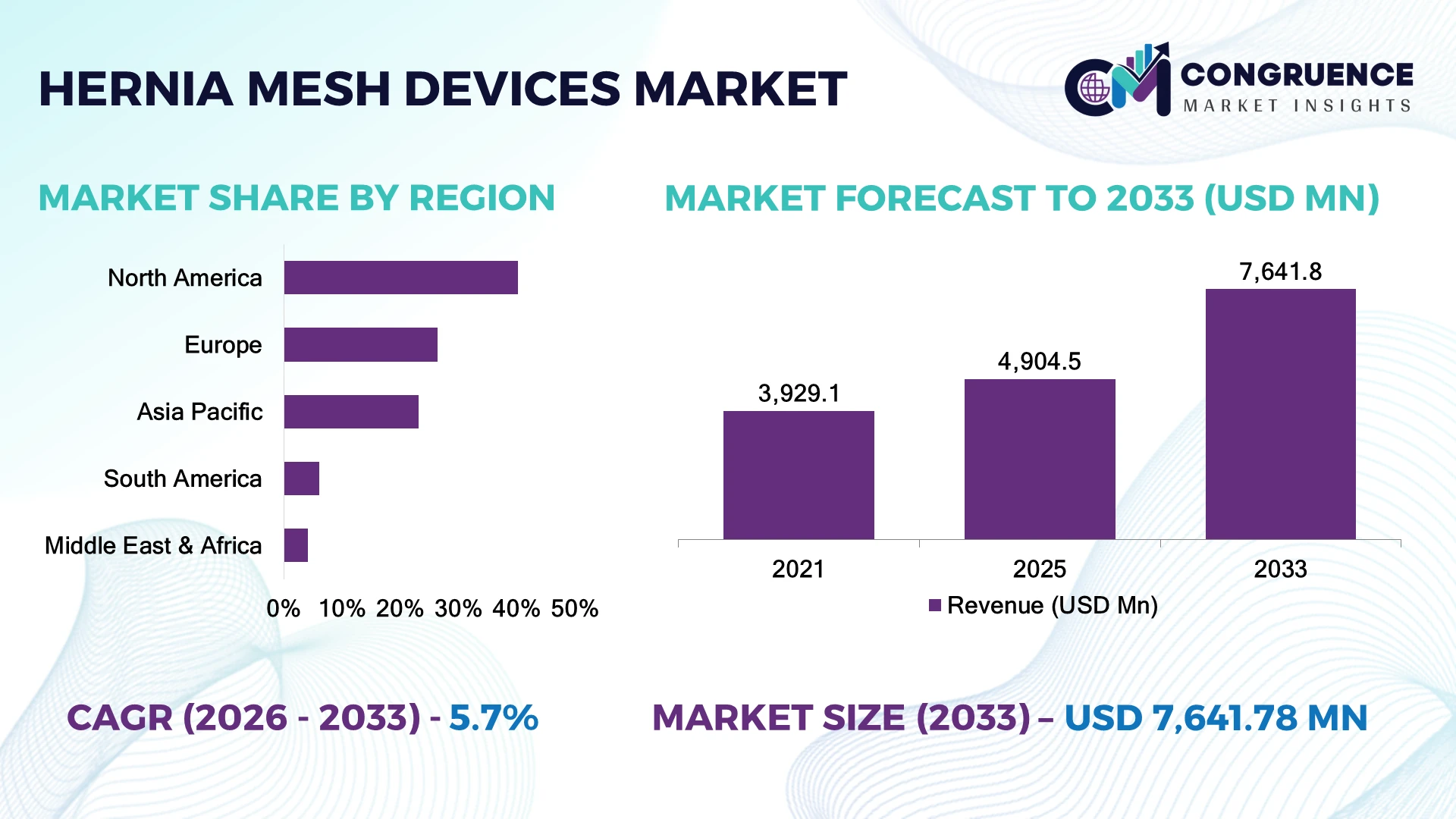
The Global Hernia Mesh Devices Market was valued at USD 4,904.5 Million in 2025 and is anticipated to reach a value of USD 7,641.8 Million by 2033 expanding at a CAGR of 5.7% between 2026 and 2033. Growth is driven by increasing adoption of mesh-based hernia repair, expansion of minimally invasive surgery, and innovation in lightweight, composite, and bioresorbable implants.
The United States remains a strategically important market because of its established surgical-device industry, hospital infrastructure, and advanced laparoscopic procedures. Mesh-based repair is recommended for most inguinal hernias in international clinical guidance, while product selection increasingly considers material weight, tissue integration, and long-term complication risks. Lightweight mesh has demonstrated a 22% reduction in chronic pain and a 36% reduction in foreign-body sensation in open inguinal repair compared with heavyweight mesh. European markets are also expanding the clinical role of absorbable implants in selected procedures.
Manufacturers should prioritize clinically differentiated materials, surgeon education, and robust evidence of safety and performance rather than competing exclusively on implant price.
Market Size & Growth: The market is valued at USD 4.90 billion in 2025 and projected to reach USD 7.64 billion by 2033, supported by mesh-based repair and advanced implant development.
Top Growth Drivers: Lightweight mesh has demonstrated 22% lower chronic pain and 36% lower foreign-body sensation in open inguinal repair, strengthening interest in material optimization and patient-specific selection.
Short-Term Outlook: Through 2028, clinical evidence, product qualification, and reimbursement access will influence adoption more directly than unverified market-wide efficiency targets.
Emerging Technologies: Bioresorbable scaffolds, barrier-coated composite mesh, lightweight macroporous structures, and improved positioning systems are expanding surgical options.
Regional Leaders: North America benefits from established device manufacturers and clinical infrastructure; Europe emphasizes evidence and regulatory compliance; Asia-Pacific offers expanding surgical capacity and manufacturing scale.
End-User Trends: Hospitals and ambulatory surgical centers prioritize implant handling, reliable fixation, procedure compatibility, and evidence supporting long-term outcomes.
Clinical Development: In 2026, BD completed enrollment of 477 patients across 32 sites in its PREVENT trial evaluating bioresorbable mesh for incisional hernia prevention.
Competitive Landscape: BD, Medtronic, B. Braun, TELA Bio, and other surgical-device manufacturers compete through implant materials, product portfolios, clinical evidence, and hospital relationships.
Regulatory Impact: The FDA's June 2025 draft guidance recommends standardized hernia-mesh labeling to improve access to clinically relevant information and support appropriate device selection.
Investment Priorities: Product development is increasingly focused on resorbable materials, barrier technologies, and indications supported by clinical research and reimbursement pathways.
Innovation & Future Outlook: Competition is shifting toward procedure-specific mesh designs, stronger evidence packages, and differentiated options for permanent reinforcement versus temporary scaffolding.
The hernia mesh devices market serves surgical treatment of inguinal, ventral, incisional, umbilical, and other abdominal-wall hernias. Polypropylene-based synthetic mesh remains established, while composite, biologic, and bioresorbable options address selected anatomical and clinical requirements. Product development increasingly focuses on reducing unnecessary foreign-body burden, improving placement, and balancing tissue integration with long-term reinforcement. Regulatory scrutiny and patient awareness are also elevating the importance of transparent labeling and post-market evidence, making clinical differentiation central to future competitive positioning.
Hernia mesh devices are strategically important because implant selection affects surgical technique, recurrence risk, recovery, and the possibility of subsequent complications. Manufacturers compete not only on mechanical strength but also on handling, tissue response, placement characteristics, and the quality of long-term clinical evidence. As hospitals scrutinize device value and regulators emphasize clearer labeling, product differentiation increasingly depends on matching mesh design to the hernia type, operative approach, and patient's clinical profile.
Material engineering is creating distinct options. Permanent synthetic mesh provides lasting reinforcement, whereas fully bioresorbable scaffolds are designed to provide temporary support while tissue remodels. In open inguinal repair, international guideline evidence associates lightweight mesh with a 22% reduction in chronic pain and a 36% reduction in foreign-body sensation compared with heavyweight mesh, without a corresponding increase in recurrence for regular non-absorbable lightweight designs. These findings reinforce the value of procedure-specific selection rather than a universal implant strategy.
During 2026–2028, clinical validation, reimbursement decisions, and standardized labeling will influence commercialization. BD's PREVENT trial enrolled 477 patients across 32 sites, illustrating investment in evidence for prophylactic mesh use. Manufacturers should align research programs with clearly defined indications, surgeon workflows, and measurable outcomes. Long-term competitive advantage will depend on demonstrating appropriate clinical value, maintaining regulatory compliance, and supporting surgeons with reliable product education and evidence-based selection.
Mesh-based repair remains recommended for most inguinal hernias because it reduces recurrence risk compared with non-mesh repair. International guideline evidence also indicates that lightweight mesh in open repair reduces chronic pain by 22% and foreign-body sensation by 36% relative to heavyweight mesh. These outcomes strengthen demand for implants engineered around tissue integration, appropriate pore structure, and reduced material burden. Minimally invasive procedures further increase the importance of mesh flexibility, reliable positioning, and compatibility with laparoscopic deployment. Manufacturers are responding through lightweight structures, composite barriers, and improved positioning systems. The commercial advantage lies in demonstrating meaningful clinical benefits while ensuring that device characteristics match the operative technique and patient requirements.
Postoperative pain, infection, recurrence, adhesions, seroma, and mesh migration remain important concerns affecting product selection and long-term device reputation. The FDA's review of published studies on barrier-coated and hybrid mesh reported recurrence rates ranging from 0% to 11.1%, while reported seroma incidence ranged from 0% to 52.5%; these wide ranges reflect differences in procedures, populations, and study methods rather than a single expected outcome. Such variability complicates comparisons between products and can increase scrutiny from surgeons, hospitals, and regulators. Manufacturers must strengthen evidence generation, improve instructions for use, and monitor post-market performance. Transparent risk communication and procedure-specific selection are essential to preserving clinician confidence.
Bioresorbable mesh creates an opportunity for selected repairs where temporary reinforcement and tissue remodeling are desired. In April 2025, BD launched a fully absorbable umbilical hernia patch following U.S. regulatory clearance, expanding material options for surgeons. In 2026, the company's PREVENT clinical trial completed enrollment of 477 patients across 32 sites to evaluate mesh reinforcement for incisional hernia prevention. These developments show how manufacturers are moving beyond treatment of existing defects toward evidence-led preventive applications. Companies can strengthen their position through biomaterial research, controlled clinical studies, surgeon partnerships, and indication-specific product design. Commercial success will depend on proving that the benefits justify clinical and procurement costs.
Hernia mesh manufacturers must demonstrate performance across different anatomical sites, surgical approaches, and patient-risk profiles. A device suited to inguinal repair cannot automatically be assumed to perform equally in complex ventral or incisional procedures. The FDA's review of mesh-related adverse-event reports identified more than 55,000 reports involving mesh or similar terms, although these reports alone cannot establish causation or incidence. Long-term follow-up, standardized outcome definitions, and comparable clinical evidence remain essential to responsible product differentiation. Manufacturers must invest in multicenter studies, post-market surveillance, surgeon training, and clearer labeling. The principal execution challenge is translating promising material science into reliable outcomes across routine and complex clinical settings.
Absorbable Implants Expand Clinical Choice: In April 2025, BD launched a fully bioresorbable umbilical hernia patch after U.S. regulatory clearance. The device combines a resorbable scaffold with a hydrogel barrier and is designed for a specific anatomical indication. This development expands options beyond permanent implants. Manufacturers are investing in material platforms that preserve handling familiarity while offering alternative resorption characteristics, with adoption dependent on evidence, patient selection, and clinical judgment.
Labeling Moves Toward Greater Standardization: The FDA issued draft hernia-mesh labeling recommendations in June 2025. The proposal seeks to make clinically relevant information easier to locate and compare, addressing device-selection challenges. Manufacturers must review instructions, evidence summaries, and product claims for consistency. Clearer labeling can support informed clinical decisions while increasing the importance of precise indication statements and robust documentation in commercial evaluation.
Clinical Research Targets Prevention: In August 2026, BD completed enrollment of 477 patients across 32 U.S. and European sites in its PREVENT trial evaluating bioresorbable mesh for incisional hernia prevention. The study illustrates a shift toward investigating prophylactic reinforcement in high-risk abdominal surgery. Manufacturers are allocating resources to multicenter trials and indication expansion, although clinical outcomes and regulatory decisions remain necessary before wider use can be established.
Placement Systems Improve Surgical Handling: Manufacturers are developing mesh-and-positioning-system combinations intended to simplify deployment and reduce handling complexity. BD reports that its Phasix ST Mesh with Open Positioning System is designed to support accurate placement and claims up to 43% faster overall procedure time than conventional mesh, based on cited product evidence. Such performance claims require interpretation in their specific testing context. Competitors are responding with designs that emphasize positioning, fixation, and compatibility with established surgical workflows.
Synthetic mesh is estimated to account for approximately 85% of the global hernia mesh devices market, supported by established clinical use, broad availability, mechanical durability, and cost advantages in routine repairs. Polypropylene and other permanent polymer meshes remain widely used across inguinal, ventral, and incisional procedures. Lightweight and large-pore variants offer material-reduced options, while composite mesh incorporates barrier layers for selected placements where tissue adhesion must be considered. Biologic mesh serves a more specialized role in complex reconstructions, particularly where surgeons assess tissue integration and contamination risks. These categories are not interchangeable; clinical suitability depends on the procedure, anatomical site, and patient profile.
Bioresorbable and biologic meshes are gaining strategic attention as manufacturers pursue alternatives to permanent reinforcement for selected indications. Biologic mesh is estimated to represent a smaller market share, approximately 5–10%, while resorbable technologies are attracting investment through new product launches and clinical studies. A potential 2–3 percentage-point increase in the combined share of advanced absorbable and biologic options is an analytical scenario, not a verified forecast. Manufacturers are investing in polymer science, scaffold design, barrier technologies, and clinical validation. Commercial priorities are shifting toward indication-specific evidence and differentiated outcomes, while established synthetic products retain advantages in routine high-volume procedures.
In June 2025, the U.S. Food and Drug Administration issued draft package-labeling recommendations for hernia mesh devices, emphasizing consistent presentation of clinically relevant information to help healthcare professionals select devices appropriately.
Inguinal hernia repair is estimated to account for approximately 55% of hernia mesh device demand, reflecting its high procedure volume and established use of mesh-based tension-free repair. Synthetic flat mesh remains important in routine open procedures, while laparoscopic and robotic approaches require products compatible with minimally invasive placement and fixation. Ventral and incisional hernia repairs represent a substantial secondary application, often requiring larger implants, composite barriers, or specialized reinforcement strategies. Umbilical and femoral hernias contribute additional demand, with product choice shaped by defect size, anatomy, recurrence risk, and surgical approach. These clinical differences influence mesh dimensions, handling requirements, and purchasing decisions across hospitals and surgical centers.
Ventral and incisional repairs are positioned for faster strategic expansion as healthcare providers address abdominal-wall defects following prior operations and investigate preventive reinforcement in selected high-risk patients. Their combined share is estimated at approximately 30–35%, although published market definitions vary. A potential 2–3 percentage-point increase in this application group's share is a directional scenario rather than a confirmed forecast. Manufacturers are responding with larger composite meshes, resorbable scaffolds, and products designed for specific operative techniques. Inguinal repair remains the volume anchor, while complex abdominal-wall procedures offer opportunities for evidence-led differentiation. Investment priorities increasingly include clinical trials, surgeon training, and procedure-specific product portfolios.
In August 2026, BD announced completed enrollment of 477 patients across 32 sites in its PREVENT trial, evaluating resorbable mesh for incisional hernia prevention and demonstrating growing clinical research attention to preventive abdominal-wall reinforcement.
Hospitals are estimated to account for approximately 49% of hernia mesh device demand, reflecting their high surgical volumes, access to specialist teams, and capacity to manage complex, recurrent, and comorbidity-associated cases. Tertiary hospitals also support advanced laparoscopic and robotic procedures that require broader implant portfolios and coordinated surgical supply chains. Ambulatory surgical centers represent an important alternative for clinically suitable repairs, particularly when patients can be discharged on the same day. Specialty clinics and other surgical facilities contribute through focused treatment pathways and referral networks. These end-users differ in purchasing priorities: hospitals emphasize portfolio breadth, clinical evidence, and procurement contracts, whereas outpatient centers place greater weight on predictable procedural costs and workflow efficiency.
Ambulatory surgical centers are positioned as a faster-expanding end-user group as minimally invasive techniques and outpatient care pathways develop. Their share is estimated at approximately 20–25%, with variation across countries and market definitions. A potential 2–3 percentage-point increase in their share is an analytical scenario, not a verified forecast. Hospitals will retain an important role in complex ventral and incisional repairs, while suitable routine cases can increasingly be managed in outpatient settings where clinical protocols and reimbursement support the model. Manufacturers are tailoring pack sizes, mesh configurations, training, and supply agreements to each care setting. Future competition will depend on demonstrating appropriate clinical performance while meeting the operational and purchasing requirements of both hospital networks and ambulatory providers.
The U.S. Centers for Medicare & Medicaid Services continued updating its ambulatory surgical center payment framework in 2025 and 2026, reinforcing the importance of procedure eligibility, reimbursement, and facility economics when providers evaluate outpatient surgical pathways.
North America accounted for the largest market share at 40.2% in 2025 however, Asia-Pacific is expected to register the fastest growth, expanding at a CAGR of 7.2% between 2026 and 2033.

Clinical Evidence and Advanced Surgical Care Shape Product Selection
North America is estimated to account for 40.2% of the global hernia mesh devices market in 2025, supported by established surgical infrastructure, high procedure volumes, advanced laparoscopic capabilities, and strong medical-device manufacturing. The United States anchors regional demand, while Canada contributes through publicly funded surgical services and established hospital networks. The U.S. Food and Drug Administration issued draft hernia-mesh package-labeling recommendations in June 2025, emphasizing consistent clinical information to support appropriate device selection. This regulatory development increases the importance of evidence quality, clear indications, and transparent product documentation. Manufacturers compete through lightweight synthetic meshes, composite implants, resorbable materials, and surgeon education. Hospitals increasingly assess clinical suitability, procurement economics, and complication management together, favoring suppliers with differentiated portfolios and credible long-term evidence.
United States Market Outlook: The United States is the region's principal commercial market, supported by advanced surgical facilities, specialist training, and an established medical-device ecosystem. The FDA notes that approximately one million hernia repairs take place annually in the country, providing a substantial clinical base for mesh-based procedures. Manufacturers are investing in indication-specific products, clinical research, and improved labeling. Competition increasingly depends on demonstrating appropriate clinical performance, supporting surgeons with evidence-based product selection, and maintaining regulatory compliance across established and emerging implant technologies.
Regulatory Scrutiny Elevates Evidence and Implant Differentiation
Europe is estimated to represent approximately 26.4% of the global hernia mesh devices market in 2025. Germany, France, Italy, and the United Kingdom contribute through established surgical services, specialist hospitals, and medical-device distribution networks. Procurement decisions reflect clinical evidence, product traceability, device quality, and compliance with applicable medical-device requirements. Lightweight synthetic meshes remain important for routine repairs, while composite and resorbable products address selected clinical needs. Manufacturers face pressure to demonstrate meaningful advantages rather than rely on material novelty alone. Investment is increasingly directed toward clinical validation, surgeon training, and differentiated implant portfolios. Differences in reimbursement, purchasing structures, and healthcare capacity continue to influence adoption across individual European markets.
Germany Market Outlook: Germany offers a strategically important market through its extensive hospital network, specialist surgical services, and established medical-technology industry. Hospitals and surgical centers evaluate mesh devices based on handling characteristics, procedural compatibility, safety documentation, and purchasing economics. The country's technical capabilities support clinical evaluation of advanced synthetic and composite implants. Suppliers that combine regulatory readiness with dependable distribution, surgeon education, and robust evidence packages are positioned to compete effectively. Commercial expansion depends on demonstrating clinical relevance within Germany's established procurement and healthcare delivery systems.
Expanding Surgical Access Strengthens Regional Market Potential
Asia-Pacific is estimated to account for approximately 23.1% of the global hernia mesh devices market in 2025. China and India offer substantial demand potential because of their large populations and expanding hospital infrastructure, while Japan, South Korea, and Australia contribute through advanced surgical practice and established medical-device markets. Adoption varies with affordability, specialist availability, reimbursement, and access to minimally invasive procedures. Standard synthetic mesh remains commercially important because purchasing budgets and clinical requirements differ considerably across healthcare systems. Manufacturers are strengthening local distribution, surgeon training, and product availability while introducing differentiated implants for more complex repairs. Regional growth will depend on converting procedure demand into consistent access to appropriately selected mesh devices.
China Market Outlook: China benefits from a large healthcare system, domestic medical-device manufacturing capabilities, and expanding access to specialist surgical services. Local suppliers can compete on cost, distribution reach, and responsiveness to hospital procurement requirements, while international manufacturers retain opportunities in differentiated materials and advanced surgical applications. Commercial expansion depends on regulatory registration, clinical acceptance, and reliable hospital access. Companies that combine competitively priced synthetic meshes with evidence-backed composite and resorbable options can address different hospital tiers while building stronger relationships with surgeons and procurement teams.
Healthcare Access and Cost-Conscious Procurement Shape Demand
South America is estimated to represent approximately 6.1% of the global hernia mesh devices market in 2025, with Brazil serving as the principal demand center. Public hospitals, private hospital groups, and specialist surgical facilities purchase mesh devices according to clinical requirements, availability, and budget constraints. Conventional synthetic meshes retain an important position because of their established use and comparatively accessible pricing. Advanced composite and resorbable products face more selective adoption, particularly where procurement budgets and reimbursement arrangements limit premium-device access. Distributors play an important role in maintaining product availability across geographically dispersed healthcare networks. Manufacturers can strengthen their position through local partnerships, dependable inventory, surgeon education, and product portfolios that balance clinical performance with affordability.
Brazil Market Outlook: Brazil is the region's most strategically significant market because of its large population, extensive public healthcare system, and established private hospital sector. The Unified Health System provides a broad platform for surgical care, although access and waiting times vary by location and facility. Cost-effective synthetic meshes remain commercially important, while advanced products target private hospitals and more complex procedures. Suppliers need reliable distribution, appropriate regulatory registration, and competitive procurement strategies. Companies that balance affordability with consistent product quality can expand access while building credibility among surgeons and hospital purchasing teams.
Healthcare Modernization Creates Selective Opportunities for Advanced Implants
The Middle East & Africa region is estimated to account for approximately 4.1% of the global hernia mesh devices market in 2025. Saudi Arabia and the United Arab Emirates are important markets for advanced hospital services and specialist surgical care, while South Africa serves as a key healthcare and distribution hub for parts of sub-Saharan Africa. Demand reflects hospital modernization, access to elective surgery, and availability of specialist surgeons. Imported synthetic meshes remain important, while premium composite and resorbable products are more dependent on hospital budgets and clinical indications. Suppliers are strengthening distributor networks, surgeon education, and product registration. Market development requires balancing advanced implant adoption with affordability, procurement reliability, and uneven healthcare access.
Saudi Arabia Market Outlook: Saudi Arabia offers a strategic opportunity through healthcare modernization, investment in hospital capacity, and development of specialist clinical services under Vision 2030. Hospitals increasingly require dependable surgical supplies and products compatible with modern operative techniques. Mesh suppliers can target public and private providers through distributor partnerships, clinical education, and product portfolios tailored to different procedure requirements. Adoption of advanced implants will depend on clinical justification, procurement approval, and local registration. Manufacturers that establish reliable supply and strong relationships with surgical teams can improve access to differentiated products as healthcare capabilities expand.
Johnson & Johnson MedTech, BD, Medtronic, B. Braun, and TELA Bio compete through permanent synthetic meshes, absorbable implants, composite designs, and reinforced tissue matrices. Global portfolios challenge specialist innovators, while regional manufacturers compete on price and hospital access. The market is fragmented; the top five manufacturers are estimated to hold approximately 12–16% combined share, although published estimates vary by market definition. Competition centers on clinical evidence, material performance, surgeon familiarity, regulatory readiness, and distribution. Lightweight mesh has demonstrated 22% lower chronic pain and 36% lower foreign-body sensation than heavyweight mesh in open inguinal repair, sharpening differentiation around implant design. BD expands resorbable indications; TELA Bio targets minimally invasive procedures with reinforced tissue matrices; established manufacturers leverage broad portfolios and hospital relationships. FDA labeling recommendations intensify pressure for clearer evidence and product information. Clinical validation and regulatory compliance remain entry barriers. Winning requires proven outcomes, reliable supply, surgeon trust, and differentiated products aligned with specific procedures.
Hernia mesh technology is moving beyond conventional permanent polypropylene structures toward lightweight macroporous designs, composite barriers, and resorbable scaffolds. Lightweight mesh has demonstrated 22% lower chronic pain and 36% lower foreign-body sensation than heavyweight mesh in open inguinal repair, supporting material optimization without assuming identical outcomes across procedures. Product selection remains indication-specific, with pore structure, tensile strength, tissue integration, and placement influencing performance. Manufacturers benefit when design improvements are supported by procedure-specific clinical evidence.
Bioresorbable implants provide temporary reinforcement while the material degrades, contrasting with permanent synthetic mesh. In April 2025, BD launched its fully absorbable Phasix ST Umbilical Hernia Patch after U.S. FDA clearance. TELA Bio’s OviTex Inguinal, launched in Europe in June 2025, combines biologic tissue matrix with polymer reinforcement and is designed for laparoscopic and robotic repair. These launches demonstrate commercial activity, but do not establish market-wide adoption rates or a universal percentage improvement in outcomes. Hospitals and surgeons assess evidence, handling, reimbursement, and indication fit.
Between 2026 and 2028, competition will increasingly depend on resorbable materials, procedure-specific implant geometry, and evidence for preventive reinforcement. BD’s PREVENT trial enrolled 477 patients across 32 sites, illustrating investment in clinical validation for incisional hernia prevention. Advanced biomaterial developers may gain differentiation, while established manufacturers retain advantages in distribution and surgeon relationships. Manufacturers should prioritize robust follow-up, transparent labeling, and training that supports appropriate device selection. Digital tools can improve evidence collection and traceability, but clinical outcomes and regulatory authorization remain decisive commercial gates.
April 2025 — BD launched Phasix ST Umbilical Hernia Patch after U.S. FDA 510(k) clearance. The fully absorbable device combines P4HB mesh with a hydrogel barrier, expanding options for umbilical repair without permanent implant material. Source: BD
June 2025 — TELA Bio launched OviTex Inguinal in Europe for laparoscopic and robotic-assisted repair. The product offers two configurations, extending its U.S. launch into European markets and expanding surgeon access to reinforced tissue-matrix alternatives for inguinal procedures. Source: TELA Bio
June 2025 — The U.S. FDA issued draft hernia-mesh package-labeling recommendations to improve access to clinically relevant device information. The proposal targets more consistent labeling, helping clinicians compare indications and safety information and strengthening manufacturers’ documentation and regulatory preparation requirements. Source: FDA
August 2026 — BD completed enrollment in its PREVENT trial evaluating Phasix Mesh for incisional hernia prevention. The randomized study enrolled 477 patients across 32 U.S. and European sites, advancing evidence generation for a potential preventive indication. Source: bd.com
The report evaluates hernia mesh devices by material type, including permanent synthetic, composite, biologic, and bioresorbable meshes; application, including inguinal, ventral, incisional, umbilical, femoral, and other hernia repairs; and end-user, including hospitals, ambulatory surgical centers, specialty clinics, and other surgical facilities. Geographic coverage spans North America, Europe, Asia-Pacific, South America, and the Middle East & Africa, with country-level analysis of surgical infrastructure, device access, regulatory requirements, and procurement conditions.
Technology coverage includes lightweight macroporous structures, barrier-coated composites, resorbable scaffolds, reinforced tissue matrices, and mesh fixation systems. Competitive analysis compares multinational manufacturers, biomaterial specialists, and regional suppliers on clinical evidence, product portfolios, regulatory readiness, distribution, and surgeon engagement. The report supports investment planning, market entry, product development, and expansion strategy through 2026–2033. It also assesses opportunities in preventive reinforcement and minimally invasive repair, distinguishing established synthetic-mesh demand from emerging technologies whose adoption depends on clinical outcomes, reimbursement, and regulatory authorization.
| Report Attribute/Metric | Report Details |
|---|---|
|
Market Revenue in 2025 |
USD 4,904.5 Million |
|
Market Revenue in 2033 |
USD 7,641.8 Million |
|
CAGR (2026 - 2033) |
5.7% |
|
Base Year |
2025 |
|
Forecast Period |
2026 - 2033 |
|
Historic Period |
2021 - 2025 |
|
Segments Covered |
By Type
By Application
By End-User
|
|
Key Report Deliverable |
Revenue Forecast, Growth Trends, Market Dynamics, Segmental Overview, Regional and Country-wise Analysis, Competition Landscape |
|
Region Covered |
North America, Europe, Asia-Pacific, South America, Middle East, Africa |
|
Key Players Analyzed |
Johnson & Johnson MedTech, Becton, Dickinson and Company (BD), Medtronic, B. Braun, W. L. Gore & Associates, TELA Bio, Integra LifeSciences, Cook Medical, Healthium Medtech, Meril Life Sciences, Mölnlycke Health Care, Medline Industries, Groupe Lepine |
|
Customization & Pricing |
Available on Request (10% Customization is Free) |




