
Reports
The Global Hepatitis C Virus Testing Market was valued at USD 1,410.3 Million in 2025 and is anticipated to reach a value of USD 2,282.0 Million by 2033 expanding at a CAGR of 6.2% between 2026 and 2033. Growth is driven by expanded hepatitis elimination programs, reflex RNA confirmation, decentralized molecular testing, and wider screening of high-risk and previously undiagnosed populations.
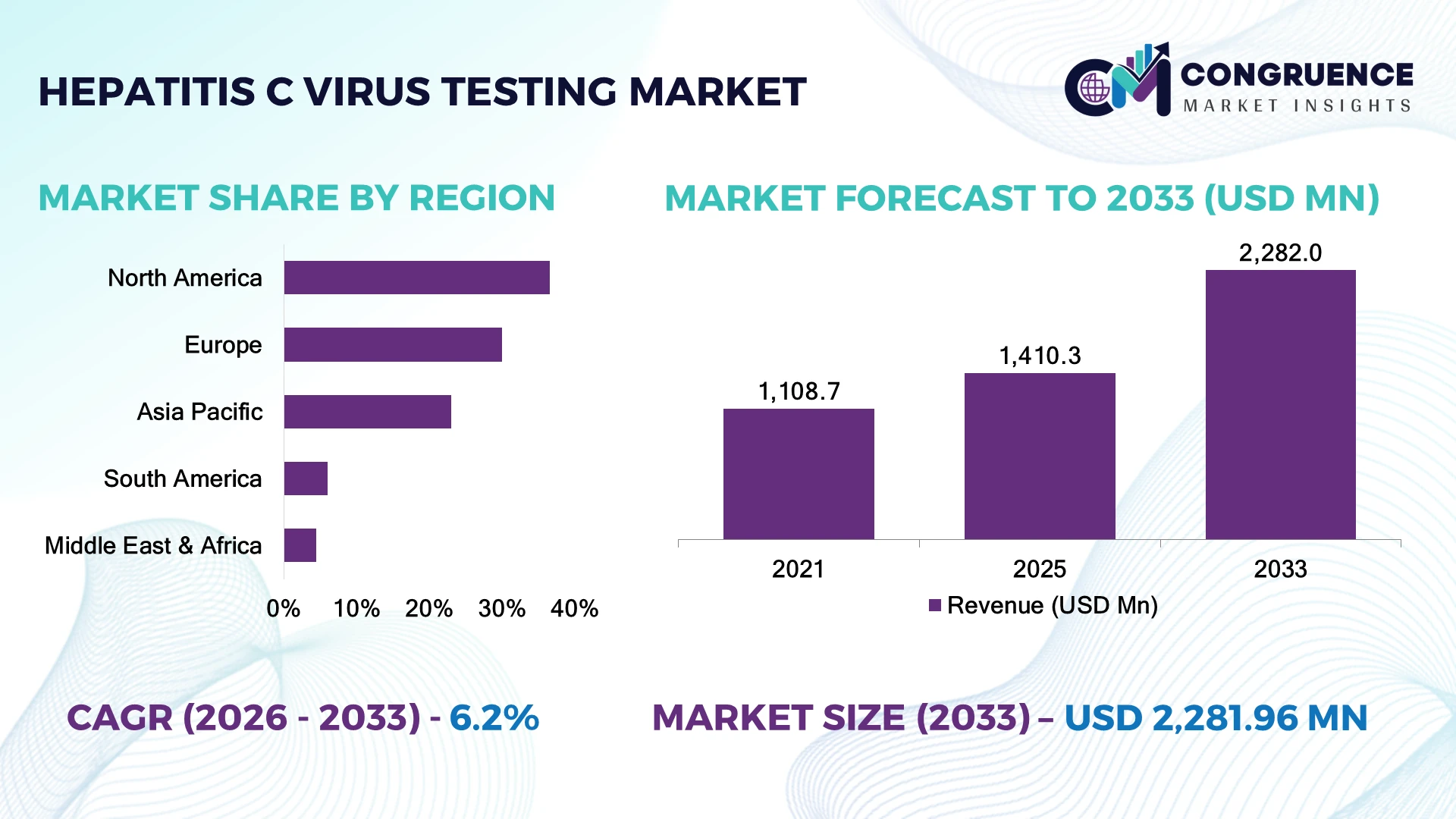
The United States represents the dominant country market, contributing approximately 30% of global hepatitis C testing demand, supported by established molecular diagnostics, hospital laboratories, public-health screening, and commercial testing networks. The country has strengthened one-time and risk-based screening alongside reflex confirmatory testing, while India combines a substantially larger infection burden with lower per-capita testing intensity. Molecular and automated laboratory platforms account for more than 55% of testing activity in developed diagnostic systems. The 2026 global elimination agenda is increasing emphasis on diagnosis-to-treatment linkage and decentralized testing.
Strategically, diagnostic companies that integrate antibody screening, reflex HCV RNA confirmation, and decentralized molecular workflows are best positioned to capture elimination-driven testing demand.
Market Size & Growth: USD 1.41 billion in 2025 to USD 2.28 billion by 2033 at 6.2% CAGR, driven by elimination programs and expanded reflex molecular testing.
Top Growth Drivers: Screening expansion 34%; molecular confirmation 29%; decentralized testing 22%.
Short-Term Forecast: By 2028, automated reflex-testing workflows can reduce manual laboratory intervention by approximately 20–30%, improving turnaround consistency.
Emerging Technologies: Reflex HCV RNA testing, point-of-care molecular diagnostics, dried-blood-spot testing, and multiplex platforms are strengthening decentralized hepatitis testing.
Regional Leaders: North America approaches USD 780 million, Europe USD 650 million, and Asia-Pacific USD 550 million by 2033, with Asia-Pacific showing increasing decentralized-testing adoption.
Consumer/End-User Trends: Hospitals and diagnostic laboratories account for approximately 70% of testing activity, while community and point-of-care programs are expanding access among underserved populations.
Pilot/Case Example: 2026 elimination-focused testing programs combining screening with immediate confirmatory pathways target 15–25% reductions in diagnostic-to-treatment delays.
Competitive Landscape: Abbott, Roche, Danaher, bioMérieux, and Hologic compete across immunoassays, molecular diagnostics, laboratory automation, and decentralized testing platforms.
Regulatory & ESG Impact: Reflex testing and integrated workflows can reduce repeat blood collection by approximately 15–25%, lowering consumable use and improving patient retention.
Investment & Funding: More than USD 500 million is being directed across molecular diagnostics, point-of-care testing, laboratory automation, and infectious-disease screening infrastructure.
Innovation & Future Outlook: Self-testing, dried-blood-spot sampling, portable molecular platforms, and automated diagnosis-to-treatment pathways are shifting hepatitis C testing toward decentralized elimination models.
The Hepatitis C Virus Testing Market is increasingly centered on integrated antibody-to-RNA workflows, molecular confirmation, point-of-care diagnostics, and screening among populations with historically limited laboratory access. Reflex molecular testing can eliminate a second patient visit in appropriately configured workflows, while decentralized approaches are expanding testing reach. In 2026, national elimination programs and healthcare systems are placing greater emphasis on closing the gap between diagnosis and treatment, creating opportunities for integrated diagnostic platforms.
Hepatitis C testing is becoming strategically important because elimination depends not only on identifying infected individuals but also on rapidly confirming active infection and connecting patients with curative treatment. This is shifting competition from standalone antibody assays toward integrated diagnostic pathways combining screening, HCV RNA confirmation, reporting, and treatment referral. Diagnostic companies with broad laboratory footprints and decentralized molecular capabilities are therefore gaining strategic relevance.
Automation is improving testing economics. Reflex HCV RNA workflows can reduce repeat patient visits and manual laboratory handling by approximately 20–30% compared with sequential testing models requiring separate testing encounters. North America and Western Europe emphasize automated laboratory platforms and high-throughput molecular confirmation, whereas India, Southeast Asia, and other emerging markets place greater value on portable systems, dried-blood-spot sampling, and decentralized access.
During 2026–2028, manufacturers are prioritizing compact molecular analyzers, integrated reflex workflows, and testing models that operate closer to primary-care and community settings. A practical deployment priority is linking antibody-positive results directly to confirmatory RNA testing, reducing diagnostic attrition. Companies are also partnering with public-health programs and laboratory networks to expand screening coverage. Competitive advantage will increasingly depend on shortening the pathway from screening to confirmed infection while maintaining assay accuracy, workflow efficiency, and affordable access.
National hepatitis-elimination programs are shifting testing from isolated screening toward integrated antibody and HCV RNA confirmation pathways. Reflex molecular testing can reduce diagnostic attrition by approximately 20–30%, while automated laboratory workflows reduce manual intervention by 15–25%. The United States is expanding risk-based and one-time screening, whereas India is strengthening decentralized testing and treatment linkage. This structural shift increases demand for automated immunoassay platforms, molecular analyzers, and integrated laboratory information systems. Diagnostic companies are responding through expanded molecular menus, public-health partnerships, and compact testing platforms. The non-obvious advantage is that reflex workflows increase confirmed diagnoses without proportionally increasing patient encounters, improving laboratory utilization while shortening the path from positive screening to treatment.
Testing capacity remains uneven because sophisticated molecular infrastructure is concentrated in major laboratories while rural and underserved populations frequently depend on centralized referral pathways. Molecular confirmation can account for approximately 30–40% of total testing workflow costs in resource-constrained settings, while specimen transport can add 15–25% to turnaround time. India and parts of Southeast Asia face greater decentralized-access constraints than the United States or Western Europe. Manufacturers are reducing exposure through portable molecular systems, dried-blood-spot workflows, reagent localization, and partnerships with community laboratories. The critical operational issue is not antibody screening capacity but conversion of positive screens into confirmed active infections. Companies that reduce specimen movement and repeat visits can capture greater testing volume while improving public-health program efficiency.
Portable molecular diagnostics and dried-blood-spot sampling are creating new testing opportunities outside centralized laboratories. Decentralized workflows can reduce specimen logistics requirements by approximately 20–30%, while integrated point-of-care molecular systems can shorten confirmation turnaround by 30–50% compared with conventional referral workflows. India, Africa, and Southeast Asia offer particularly strong deployment potential where laboratory access remains uneven. The emergence of simplified HCV RNA platforms also enables community-based screening programs to connect diagnosis with treatment referral. Companies are investing in compact analyzers, cartridge-based assays, and public-health partnerships rather than relying exclusively on high-throughput laboratory systems. The strategic opportunity is to monetize the diagnostic gap between screening and confirmation, where infrastructure-light platforms can generate both operational savings and higher case conversion.
Hepatitis C testing increasingly depends on coordinated antibody screening, RNA confirmation, laboratory reporting, and treatment referral, creating integration pressure across fragmented healthcare systems. Approximately 15–25% of diagnostic workflow inefficiency can arise from manual result handling, duplicate registration, or referral delays in poorly integrated settings. Data interoperability is particularly challenging when community testing platforms connect with centralized laboratories and national surveillance systems. Cybersecurity and patient-data requirements further complicate cloud-connected molecular diagnostics. Companies must invest in interoperable middleware, laboratory information systems, secure connectivity, and automated result reporting. The non-obvious competitive challenge is maintaining continuity after decentralization: expanding testing sites without integrating their data pathways can increase positive-test leakage rather than improve treatment conversion.
Reflex Testing Gains Traction: Laboratories are increasingly connecting positive antibody assays directly to HCV RNA confirmation, reducing repeat blood collection and patient-return requirements. Integrated workflows can cut manual handling by approximately 20–30% and shorten diagnostic turnaround by 15–25%. Manufacturers are therefore prioritizing analyzer compatibility, automated reflex rules, and laboratory-information-system integration rather than standalone assay placement.
Dried-Blood Sampling Expands Reach: Dried-blood-spot approaches are gaining attention in community and hard-to-reach screening programs, reducing dependence on conventional venous sampling and centralized collection infrastructure. Sample logistics requirements can fall by approximately 20–30%, while transport flexibility improves outreach deployment. Diagnostic companies are adapting assay workflows and validation strategies for decentralized specimen collection.
Portable RNA Testing Advances: Compact molecular platforms are increasingly being deployed where centralized PCR infrastructure is limited. Point-of-care confirmation can reduce diagnostic turnaround by roughly 30–50% compared with referral-based molecular testing. Manufacturers are responding with cartridge-based systems requiring less laboratory infrastructure, enabling public-health programs to place confirmation closer to screening locations.
Screening Moves Into Primary Care: Hepatitis C testing is increasingly integrated into primary-care, emergency-care, harm-reduction, and community-health workflows rather than remaining concentrated in specialist laboratories. Screening programs targeting high-risk populations can increase testing coverage by 15–25% when testing is embedded into existing encounters. The operational shift is pushing companies toward simpler workflows, automated reporting, and partnerships connecting diagnostics with treatment pathways.
Antibody tests remain the leading type, representing approximately 55–60% of global hepatitis C virus testing activity because they are inexpensive, scalable, and widely embedded in hospital and public-health screening workflows. HCV RNA tests account for roughly 25–30% and represent the fastest-growing type as healthcare systems increasingly prioritize confirmation of active infection after a reactive antibody result. HCV core-antigen testing and other specialized formats represent approximately 10–15%, offering lower-complexity alternatives where molecular infrastructure is limited.
The competitive shift is toward reflex antibody-to-RNA workflows, particularly in the United States and Western Europe, while India and emerging markets increasingly require lower-infrastructure molecular and antigen solutions. RNA platforms command higher value per test but require greater instrumentation and technical capability. Manufacturers are therefore expanding cartridge-based systems, multiplex molecular menus, and analyzer compatibility. The investment priority is moving from standalone screening assays toward integrated diagnostic pathways that reduce patient loss between screening and confirmation.
The World Health Organization's 2025 global hepatitis report estimated that only about 36% of people living with hepatitis C were diagnosed, highlighting the substantial testing gap and the commercial importance of simpler confirmation pathways.
Hepatitis C screening represents the leading application, accounting for approximately 50–55% of testing activity because antibody assays remain the principal entry point into diagnostic pathways. Diagnosis and active-infection confirmation represent roughly 30–35% and are the fastest-growing application as healthcare systems increasingly adopt reflex HCV RNA testing. Treatment monitoring contributes approximately 10–15%, while surveillance and specialized epidemiological testing retain strategic importance for elimination programs.
Screening remains mature in the United States and Western Europe, where automated laboratory platforms support high-throughput testing, whereas confirmation is expanding more rapidly in decentralized programs across India, Southeast Asia, and Africa. Reflex testing can reduce repeat patient encounters by approximately 20–30%, improving diagnostic conversion and laboratory utilization. Companies are responding by integrating antibody and molecular workflows, developing portable RNA platforms, and partnering with public-health programs. The strongest commercial opportunity is shifting toward complete screening-to-confirmation pathways rather than isolated test-volume expansion.
WHO's 2025 hepatitis estimates indicated that 60% of people living with hepatitis C remained undiagnosed globally, demonstrating that screening coverage and subsequent confirmation remain the principal operational gaps in elimination programs.
Diagnostic laboratories represent the leading end-user, accounting for approximately 45–50% of global hepatitis C testing activity because centralized laboratories provide high-throughput immunoassay, molecular testing, automation, and quality-control infrastructure. Hospitals contribute approximately 30–35%, supported by emergency, inpatient, infectious-disease, and specialty-care testing. Public-health agencies, community testing programs, and other decentralized providers account for roughly 15–20% and represent the fastest-shifting end-user group.
Centralized laboratories prioritize analyzer utilization, reagent economics, and automated workflows, whereas community programs prioritize portability, rapid turnaround, and simplified sample collection. Decentralized testing can reduce specimen-transport requirements by approximately 20–30%, creating new deployment opportunities in underserved populations. Companies are therefore adapting product portfolios toward compact molecular systems, dried-blood-spot workflows, and integrated reporting platforms. Partnerships with hospitals, public-health agencies, harm-reduction services, and community organizations are becoming increasingly important for reaching populations that conventional laboratory networks underserve.
The World Health Organization reported in 2025 that hepatitis C testing and diagnosis remain substantially below elimination targets, reinforcing the need to extend diagnostic capacity beyond conventional laboratory and hospital settings.
North America accounted for the largest market share at 36.5% in 2025 however, Asia-Pacific is expected to register the fastest growth, expanding at a CAGR of 7.4% between 2026 and 2033.

Integrated molecular confirmation is strengthening North America's elimination-focused testing infrastructure
North America represents approximately 36.5% of the global hepatitis C virus testing market, supported by sophisticated laboratory networks, high molecular-diagnostic penetration, and established public-health screening programs. The United States accounts for the majority of regional testing activity, with hospitals, commercial laboratories, and community programs increasingly integrating antibody screening with reflex HCV RNA confirmation. Molecular testing represents approximately 30–35% of regional testing workflows, supported by automated analyzers and high-throughput laboratory infrastructure. Diagnostic companies are expanding assay menus, analyzer compatibility, and decentralized molecular platforms to improve testing access. Public-health programs are also increasing screening among populations with elevated exposure risk. The operational priority is shifting toward reducing diagnostic attrition after a reactive antibody result, making integrated screening-to-confirmation workflows increasingly valuable for laboratories and healthcare systems.
United States Market Outlook: The United States remains the region's largest testing market, supported by extensive commercial laboratory capacity, hospital networks, and established molecular-diagnostics infrastructure. HCV testing is increasingly embedded into primary-care, emergency-care, and high-risk population screening workflows. Reflex RNA confirmation can reduce repeat patient encounters by approximately 20–30%, strengthening laboratory efficiency while improving the probability that antibody-positive individuals receive definitive diagnosis.
Elimination programs are pushing Europe toward automated confirmation and decentralized access
Europe contributes approximately 30% of global hepatitis C virus testing activity, with Germany, France, Italy, Spain, and the United Kingdom representing major diagnostic markets. Established laboratory infrastructure supports high-throughput antibody testing and molecular confirmation, while national elimination strategies are increasing emphasis on reaching undiagnosed populations. Molecular confirmation represents approximately 25–30% of testing workflows, with reflex testing becoming more important in integrated laboratory pathways. European healthcare systems are also expanding dried-blood-spot and community testing approaches to reach underserved groups. Diagnostic manufacturers are responding with automated reflex capabilities, compact molecular analyzers, and interoperable reporting systems. Regulatory emphasis on diagnostic quality and data governance is reinforcing demand for validated, traceable testing workflows.
Germany Market Outlook: Germany represents one of Europe's most advanced laboratory markets, combining extensive hospital infrastructure with sophisticated molecular diagnostics and centralized laboratory networks. Approximately 25–30% of HCV testing activity is associated with molecular confirmation and related diagnostic workflows. Laboratories are increasingly adopting automation and electronic result integration to reduce manual processing and improve turnaround consistency across high-volume testing environments.
Decentralized diagnostics are expanding hepatitis C testing beyond major laboratories
Asia-Pacific accounts for approximately 23% of the global hepatitis C virus testing market, with China, Japan, India, and Australia representing important testing and healthcare markets. India and China combine substantial patient populations with significant unmet diagnostic needs, creating strong demand for affordable screening and confirmation technologies. Decentralized and point-of-care testing is gaining importance where centralized molecular infrastructure remains uneven. Portable molecular systems and dried-blood-spot workflows can reduce specimen logistics requirements by approximately 20–30%. Companies are responding through lower-infrastructure analyzers, local distribution partnerships, and public-health collaborations. The strategic shift is toward diagnostic models that deliver reliable confirmation closer to patients rather than expanding centralized laboratory capacity alone.
India Market Outlook: India represents the region's most significant scale opportunity because of its large population, substantial hepatitis C burden, and expanding public-health diagnostic infrastructure. Screening remains heavily dependent on antibody testing, while molecular confirmation is increasingly important for treatment eligibility. Compact molecular systems and dried-blood-spot collection can improve access in districts where conventional laboratory referral adds substantial turnaround time.
Brazil is strengthening integrated screening through public-health diagnostic networks
South America represents approximately 6% of global hepatitis C virus testing activity, with Brazil accounting for the largest share of regional testing demand. Public healthcare infrastructure, centralized laboratories, and national hepatitis programs support widespread antibody screening, while molecular confirmation remains strategically important for treatment pathways. Approximately 50–55% of regional testing activity is concentrated in conventional laboratory screening, leaving substantial opportunity for reflex molecular and decentralized approaches. Brazil is expanding diagnostic access through public-health networks and targeted testing programs. Companies are positioning compact analyzers, molecular assays, and automated workflows for public laboratories and specialist centers. Infrastructure differences between major cities and remote areas make portability and simplified sample logistics important competitive factors.
Brazil Market Outlook: Brazil is the principal South American testing market, supported by its extensive public healthcare network and national infectious-disease infrastructure. Public laboratories handle substantial screening volumes, while molecular confirmation supports treatment decisions. Decentralized testing can reduce specimen-transport requirements by approximately 20–30%, creating opportunities for companies offering portable molecular systems and simplified sample-collection technologies.
Public-health modernization is shifting HCV diagnostics toward decentralized access
Middle East & Africa accounts for approximately 4.5% of global hepatitis C virus testing activity, with Egypt, Saudi Arabia, South Africa, and the United Arab Emirates representing important testing markets. Egypt has established one of the world's most extensive hepatitis C screening and treatment programs, creating significant laboratory and molecular-testing infrastructure. Antibody screening remains dominant, while RNA confirmation is increasingly integrated into treatment pathways. Decentralized testing is gaining relevance in African markets where centralized laboratory access remains limited. Companies are expanding portable molecular platforms, simplified specimen workflows, and public-health partnerships. The region's strategic opportunity lies in connecting screening infrastructure with rapid confirmation and treatment referral rather than simply increasing standalone test volumes.
Egypt Market Outlook: Egypt is the region's most strategically significant HCV testing market because of its large-scale national screening experience and established hepatitis treatment infrastructure. Mass screening programs have tested tens of millions of people, creating substantial laboratory workflow expertise. The country provides a strong deployment environment for automated confirmation, decentralized molecular testing, and integrated diagnosis-to-treatment pathways.
Roche, Abbott, Hologic, bioMérieux, and Cepheid compete across distinct HCV testing layers, with Roche and Abbott strongest in high-throughput serology and molecular laboratories, Hologic in automated molecular workflows, bioMérieux in integrated immunoassay, and Cepheid challenging centralized models through point-of-care RNA testing. The top five are estimated to control about 55–60% of HCV testing value, reflecting platform concentration. Competition centers on assay performance, installed-base integration, turnaround time, and workflow economics: automated platforms can cut hands-on processing by 15–25%, while point-of-care molecular testing can compress result delivery from days to about one hour. Roche and Abbott are deepening integrated analyzer menus; Hologic is leveraging Panther automation; Cepheid is expanding decentralized molecular deployment; bioMérieux is strengthening automated hepatitis panels. The competitive shift is from standalone antibody screening toward integrated antibody, antigen, and RNA pathways. Entry barriers include regulatory validation, installed instruments, reimbursement, and trust. Winning requires broad assay menus, rapid confirmation, and deployment flexibility.
Roche Diagnostics
Abbott Laboratories
Hologic, Inc.
bioMérieux SA
Cepheid
QIAGEN N.V.
Bio-Rad Laboratories, Inc.
DiaSorin S.p.A.
Siemens Healthineers AG
Thermo Fisher Scientific Inc.
OraSure Technologies, Inc.
Fujirebio Holdings, Inc.
Reflex molecular testing is becoming the core technology shift, linking antibody screening directly to HCV RNA confirmation. Automated extraction, amplification, and reporting can reduce hands-on laboratory work by 15–25%, while adoption is concentrated in high-volume laboratories using integrated analyzers. HCV RNA platforms increasingly support simplified specimen workflows, improving utilization where conventional sampling is difficult.
Point-of-care molecular testing is the main disruptive technology. Cepheid’s Xpert HCV delivers RNA results in about one hour from fingerstick blood, versus conventional centralized workflows requiring longer transport and reporting cycles. Moving confirmation to the care site can improve operational turnaround by roughly 50–80% and reduce referral leakage. Self-testing and oral-fluid antibody assays add another access layer, with results typically available within 20–40 minutes, but positive tests still require confirmatory diagnostics.
From 2026–2028, competitive advantage will increasingly depend on interoperability between serology, molecular analyzers, laboratory information systems, and decentralized devices. Compared with multi-step laboratory pathways, single-visit molecular testing can reduce diagnostic steps by roughly 50%. Roche and Abbott benefit from installed laboratory ecosystems, while Cepheid gains from decentralized deployment. Companies acting now can capture demand created by elimination programs through compact analyzers, reflex algorithms, connectivity, and integrated test-to-treat workflows.
June 2024 Cepheid received FDA authorization and CLIA waiver for Xpert HCV, the first U.S. point-of-care HCV RNA test, delivering results in about one hour from fingerstick blood. The approval enables same-visit diagnosis and treatment linkage directly. Source: cepheid.mediaroom.com
November 2025 Roche’s cobas HCV received FDA 510(k) clearance, supporting HCV RNA detection and quantification on established molecular platforms. The regulatory decision strengthens Roche’s U.S. molecular portfolio and expands options for laboratories seeking standardized, high-throughput confirmation workflows. Source: fda.gov
December 2025 OraSure’s OraQuick HCV Self-Test received a WHO report amendment confirming prequalified product specifications, including a 15-month finished-goods shelf life. The update supports procurement and distribution planning for decentralized HCV screening programs serving underserved populations globally. Source: who.int
March 2026 Roche launched cobas MPX-E, a four-in-one donor screening assay detecting HIV, HCV, HBV and HEV on cobas x800 systems, with up to eight hours of walk-away time. Integration improves laboratory efficiency and reduces instrumentation requirements for blood screening. Source: Roche
The report covers hepatitis C virus testing across antibody, antigen, RNA molecular, genotyping, and emerging point-of-care and self-testing formats. Application analysis includes screening, active-infection confirmation, treatment monitoring, and surveillance, while end-user coverage spans diagnostic laboratories, hospitals, public-health agencies, community programs, and decentralized testing sites. Regional analysis encompasses North America, Europe, Asia-Pacific, South America, and Middle East & Africa, with country-level assessment of major testing markets.
Technology coverage examines reflex testing, automated molecular workflows, cartridge-based diagnostics, dried-blood-spot sampling, oral-fluid self-testing, connectivity, and integrated test-to-treat pathways. The competitive assessment profiles 12 major companies and evaluates platform integration, assay breadth, regulatory positioning, deployment models, and innovation priorities. The report supports investment planning, geographic expansion, partnership decisions, technology selection, competitive positioning, and assessment of market direction through 2026–2033.
| Report Attribute/Metric | Report Details |
|---|---|
|
Market Revenue in 2025 |
USD 1,410.3 Million |
|
Market Revenue in 2033 |
USD 2,282.0 Million |
|
CAGR (2026 - 2033) |
6.2% |
|
Base Year |
2025 |
|
Forecast Period |
2026 - 2033 |
|
Historic Period |
2021 - 2025 |
|
Segments Covered |
By Type
By Application
By End-User
|
|
Key Report Deliverable |
Revenue Forecast, Growth Trends, Market Dynamics, Segmental Overview, Regional and Country-wise Analysis, Competition Landscape |
|
Region Covered |
North America, Europe, Asia-Pacific, South America, Middle East, Africa |
|
Key Players Analyzed |
Roche Diagnostics, Abbott Laboratories, Hologic, Inc., bioMérieux SA, Cepheid, QIAGEN N.V., Bio-Rad Laboratories, Inc., DiaSorin S.p.A., Siemens Healthineers AG, Thermo Fisher Scientific Inc., OraSure Technologies, Inc., Fujirebio Holdings, Inc. |
|
Customization & Pricing |
Available on Request (10% Customization is Free) |




