
Reports
The Global Hemostatic Powder Market was valued at USD 490.3 Million in 2025 and is anticipated to reach a value of USD 781.5 Million by 2033 expanding at a CAGR of 6.0% between 2026 and 2033. Growth is driven by increasing use of non-contact bleeding control in gastrointestinal, cardiovascular, orthopedic, trauma, and complex surgical procedures, alongside advances in absorbable starch, chitosan, and mineral-based formulations.
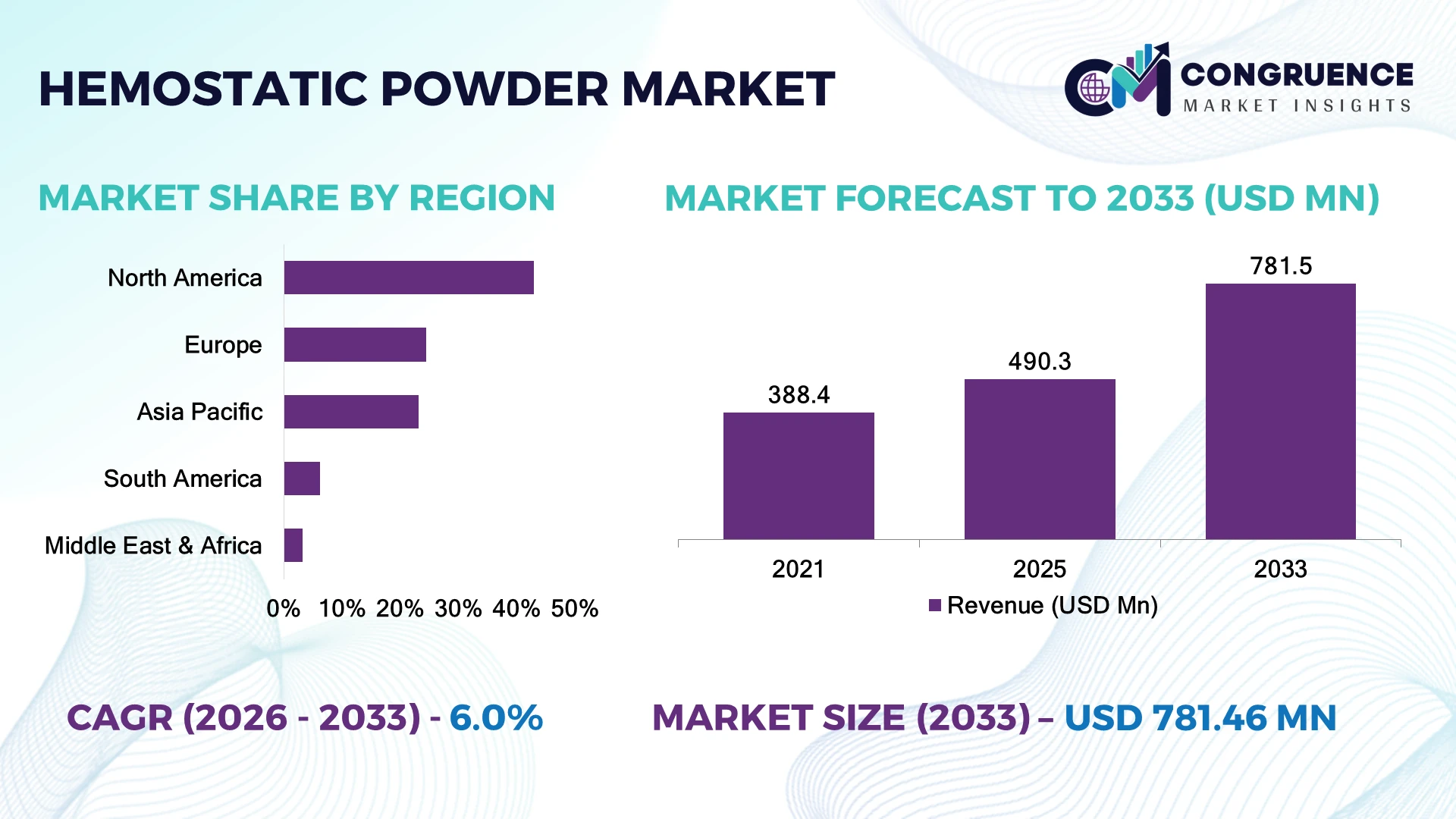
The United States remains the dominant national market, driving North America’s 42.9% share in 2025 through high surgical volumes, advanced hospital infrastructure, and established topical-hemostat procurement. Europe represented about 24.5%, compared with 23.1% for Asia-Pacific, where China and India are expanding surgical capacity. In 2026, automated filling, weighing, labeling, and cleanroom upgrades are strengthening production efficiency and quality consistency.
Strategically, manufacturers combining validated hemostatic performance, automated production, regulatory readiness, and reliable hospital distribution will gain stronger competitive positioning.
Market Size & Growth: The market reaches USD 781.5 million by 2033 from USD 490.3 million in 2025 at a 6.0% CAGR, supported by advanced non-contact bleeding-control technologies and broader surgical adoption.
Top Growth Drivers: Approximately 42.9% regional concentration in North America, 34.6% gelatin-powder product share, and 29.5% trauma-application share highlight the strongest demand drivers.
Short-Term Forecast: By 2028, automated manufacturing, standardized dispensing, and improved formulation consistency are positioned to reduce production handling requirements by approximately 10% while increasing throughput.
Emerging Technologies: Chitosan-based powders demonstrate 94.5× water absorption, while self-gelling formulations achieve burst pressures up to 452.6 mmHg, accelerating advanced-material development.
Regional Leaders: North America is projected at approximately USD 335 million by 2033, Europe at USD 191 million, and Asia-Pacific at USD 181 million, with Asia-Pacific showing the strongest hospital-capacity expansion.
Consumer/End-User Trends: Hospitals account for approximately 75.4% of endoscopic hemostatic-powder demand, reflecting preference for rapid, broad-area bleeding control in minimally invasive procedures.
Pilot/Case Example: A 2025 dual-crosslinked chitosan powder achieved a 77.92% clot index and 5.9 kPa adhesion, demonstrating measurable performance advantages for next-generation surgical applications.
Competitive Landscape: North America leads adoption, while BD, Johnson & Johnson MedTech, Medtronic, Teleflex, Cook Medical, and specialized powder developers compete through formulation performance, clinical evidence, and distribution reach.
Regulatory & ESG Impact: In 2026, manufacturing modernization included automated filling and labeling and upgraded water systems, strengthening process control while reducing manual handling across production operations.
Investment & Funding: The USD 490.3 million 2025 market base is attracting manufacturing expansion, formulation development, and strategic partnerships, with investment increasingly directed toward automation, advanced biomaterials, and quality-system modernization.
Innovation & Future Outlook: Over the next 2–3 years, self-gelling powders, antimicrobial formulations, automated dispensing, and digitally controlled manufacturing will shift competition toward measurable hemostatic performance, production consistency, and lifecycle efficiency.
The Hemostatic Powder Market is gaining traction across gastrointestinal intervention, trauma surgery, cardiovascular procedures, and minimally invasive operations. Advanced chitosan formulations achieving 94.5× water absorption are expanding material-performance benchmarks. Approximately 75.4% hospital concentration in endoscopic applications reinforces institutional procurement strength, while 2026 manufacturing upgrades emphasize automated quality control and resilient supply chains, setting the foundation for strategic competition.
The Hemostatic Powder Market is becoming strategically important because bleeding-control performance increasingly influences procedure efficiency, inventory planning, and hospital procurement decisions. The shift from conventional compression and mechanical devices toward non-contact topical systems is strengthening demand for products that provide rapid coverage across irregular or difficult-to-access bleeding sites.
Technology differentiation is becoming measurable. Advanced chitosan powders demonstrate water absorption of 94.5× their own weight, while self-gelling systems have achieved burst pressures of 452.6 mmHg. These capabilities contrast with legacy approaches that require direct compression or mechanical placement. North America remains the largest deployment base at 42.9%, whereas Asia-Pacific is expanding hospital capacity and advanced surgical adoption more rapidly.
Over the next 2–3 years, automated dispensing, formulation optimization, antimicrobial functionality, and tighter manufacturing controls will reshape competitive positioning. A practical deployment example is endoscopic bleeding management, where powder delivery enables broad-area application without precise device placement. Companies are responding through manufacturing automation, formulation partnerships, regulatory upgrades, and regional distribution expansion. Long-term advantage will favor suppliers that convert clinical performance into reliable production, compliant supply, and measurable operating value.
The shift toward rapid, non-contact bleeding control is strengthening demand across gastrointestinal, trauma, cardiovascular, and complex surgical procedures. North America accounted for 42.9% of the market in 2025, while trauma represented 29.5% of hemostatic powder applications and gelatin-based products held 34.6%. In the United States, hospitals are prioritizing broad-area delivery where clips or compression are difficult to deploy. Companies are responding by expanding absorbable powder portfolios, investing in advanced dispensing systems, and developing chitosan-based formulations. The strategic advantage lies in reducing procedural dependence on precise device placement while improving coverage of diffuse bleeding sites, creating stronger procurement value for high-volume surgical centers.
Manufacturing economics remain constrained by raw-material volatility and dependence on specialized biomaterial inputs. Since early 2022, gelatin prices increased approximately 18%, oxidized cellulose costs rose 21%, and regulatory certification fees increased 11%, creating pressure on formulation margins. Manufacturers using imported pharmaceutical-grade starch, gelatin, or polysaccharide inputs face additional exposure to transportation disruptions and supplier concentration. The United States and European producers are therefore increasing dual-sourcing, negotiating longer-term procurement contracts, and qualifying alternative raw materials. The non-obvious constraint is that material substitution can require renewed validation and regulatory review, limiting the speed at which companies can offset input inflation without affecting product consistency or commercialization timelines.
Next-generation biomaterials are opening higher-value opportunities beyond conventional powder formulations. Research-stage chitosan systems have demonstrated 94.5× water absorption and antibacterial reductions exceeding 4 log units against key pathogens, while self-gelling formulations have reached 452.6 mmHg burst pressure. India and China offer additional opportunities as surgical infrastructure expands and domestic medical-device manufacturing receives greater policy attention. Companies are directing R&D toward antimicrobial, adhesive, and on-demand removable powders while investing in automated filling and dispensing technologies. The strongest opportunity is the convergence of material science and workflow automation: products that combine rapid hemostasis with controlled application can command stronger institutional adoption while reducing procedural complexity.
Commercial scaling requires manufacturers to maintain uniform particle characteristics, absorption profiles, sterility, packaging integrity, and delivery performance across larger production volumes. Advanced formulations often introduce additional process-control requirements, while approximately 75.4% of endoscopic hemostatic powder demand is concentrated in hospitals with stringent procurement and quality expectations. In 2026, manufacturing upgrades involving automated filling, weighing, labeling, cleanroom infrastructure, and water systems demonstrate the operational pressure to standardize production. Companies must therefore invest in validated automation, quality-management systems, workforce training, and supplier qualification. The critical challenge is translating laboratory performance into reproducible manufacturing economics without increasing batch variability, compliance burden, or hospital switching costs.
Automation Reshapes Production Controls: Manufacturing operations are shifting toward automated filling, weighing, and labeling, with 2026 facility upgrades targeting tighter process consistency and reduced manual intervention. Cleanroom and water-system modernization is becoming increasingly important as producers scale absorbable powders. Companies are integrating automation into quality systems rather than treating it solely as a labor-saving measure, strengthening batch traceability and production reliability.
Chitosan Raises Performance Benchmarks: Advanced chitosan formulations are moving beyond basic absorption, with research systems recording 94.5× water absorption, 5.9 kPa adhesion, and reductions of more than 4 log units in bacterial counts. This shift is increasing competitive emphasis on multifunctionality. Manufacturers are pursuing adhesive, antimicrobial, and self-gelling properties to differentiate products in specialized surgical applications.
Endoscopic Use Drives Workflow Change: Endoscopic procedures represent a major deployment pathway, with hospitals accounting for approximately 75.4% of endoscopic hemostatic powder demand. Powder delivery is increasingly positioned around broad-area treatment and difficult-to-access bleeding rather than simple replacement of mechanical devices. Companies are refining applicators and delivery mechanisms to improve targeting, handling speed, and compatibility with minimally invasive workflows.
Procurement Prioritizes Supply Resilience: Hospitals are placing greater emphasis on reliable availability as specialized biomaterials face cost and sourcing pressures. Gelatin costs have risen approximately 18% since early 2022, encouraging manufacturers to diversify suppliers and strengthen inventory planning. The resulting trend is a move toward localized sourcing, longer procurement agreements, and alternative-material qualification, making supply continuity an increasingly important competitive differentiator.
Gelatin hemostatic powder remains the leading type, accounting for approximately 34.6% of demand, supported by established clinical familiarity, absorbability, and broad surgical compatibility. Oxidized cellulose follows as a mature alternative, particularly where localized intraoperative bleeding requires rapid topical coverage. Starch-based powders are gaining strategic importance as manufacturers improve fluid absorption and clot-concentration characteristics. Companies are increasingly prioritizing formulations that reduce application complexity while maintaining predictable resorption, strengthening their position in hospital formularies.
Advanced starch and chitosan formulations represent the strongest innovation shift, with next-generation chitosan powder demonstrating 94.5× water absorption and antibacterial reductions exceeding 4 log units in laboratory testing. Approximately 42.9% of global demand is concentrated in North America, reinforcing the importance of clinical validation and regulatory readiness for commercialization. Manufacturers are therefore directing investment toward biomaterial engineering, applicator optimization, and differentiated absorbable formulations rather than competing solely on powder composition.
Industry insight: A 2025 multicenter randomized study across four Korean referral institutions reported 96.3% initial hemostasis with a novel sprayed powder versus 91.8% for conventional endoscopic treatment, reinforcing the commercial value of rapid, broad-area delivery.
Trauma represents the leading application, accounting for approximately 29.5% of hemostatic powder demand, reflecting the need for rapid bleeding control when conventional compression is difficult. Surgical procedures remain a major established use case because powders can cover irregular tissue surfaces without extensive device manipulation. Endoscopic applications are expanding faster as gastrointestinal interventions increasingly require non-contact treatment for diffuse or inaccessible bleeding. Companies are strengthening applicator systems and procedure-specific formulations to capture this shift.
Endoscopic hemostatic powder demand is particularly concentrated in hospitals, which account for approximately 75.4% of this application segment. North America represents about 41.5% of endoscopic powder demand, compared with 30.6% for Europe and 19.9% for Asia-Pacific. The competitive implication is clear: manufacturers are expanding beyond general surgical products toward specialized gastrointestinal platforms, while clinical evidence increasingly supports use as an adjunct or rescue intervention.
Industry insight: A 2025 randomized trial involving 341 patients found 72-hour rebleeding of 2.9% with post-hemostasis powder versus 11.3% without powder, demonstrating measurable value for selected gastrointestinal bleeding workflows.
Hospitals represent the dominant end-user group, particularly because complex surgery, trauma management, and endoscopic intervention require continuous access to topical hemostatic inventories. Within endoscopic hemostatic powder applications, hospitals account for approximately 75.4% of demand, demonstrating the concentration created by procedure volume, specialist availability, and centralized procurement. Ambulatory surgical centers are becoming an increasingly important secondary buyer as minimally invasive procedures migrate outside major hospitals. Companies are responding with compact applicators, standardized product configurations, and procedure-specific training.
Hospital procurement is also becoming more economically disciplined. A 2025 academic medical-center implementation study recorded a nearly 25% reduction in annual hemostatic-product expenditure following supplier consolidation, while 87% of surveyed stakeholders reported satisfactory product availability during conversion. This indicates that purchasing decisions increasingly combine clinical performance with inventory rationalization. Manufacturers are therefore pursuing sole-supplier agreements, value-based procurement programs, and integrated education to protect formulary access and expand utilization across surgical departments.
Industry insight: A 2025 study at a large U.S. academic medical center found 75% stakeholder satisfaction with supplier conversion and nearly 25% lower hemostatic-product expenditure, highlighting the commercial importance of procurement optimization alongside clinical performance.
North America accounted for the largest market share at 42.9% in 2025 however, Asia-Pacific is expected to register the fastest growth, expanding at a CAGR of 6.8% between 2026 and 2033.
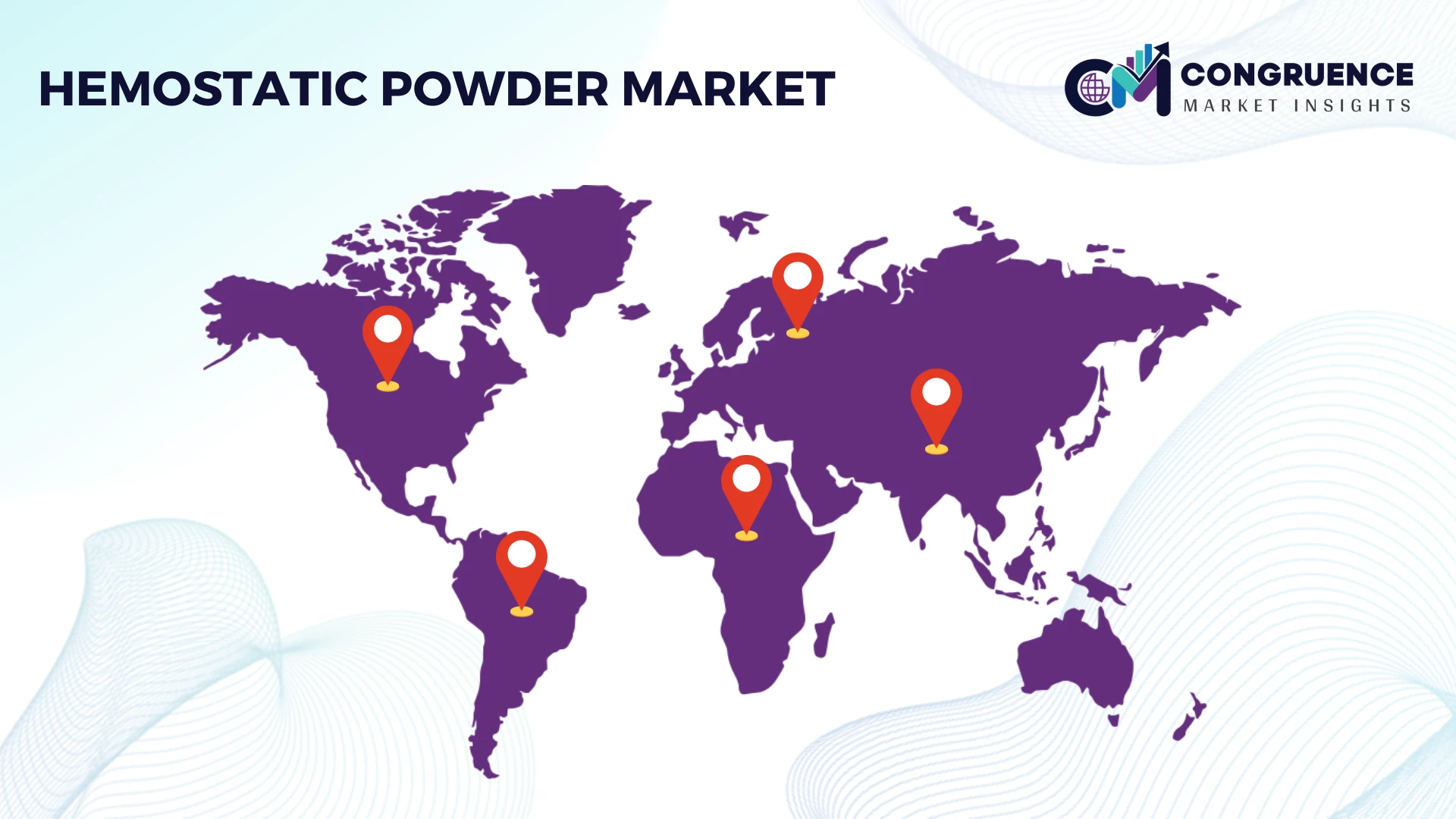
North America held 42.9% of the global hemostatic powder market in 2025, supported by high surgical volumes, sophisticated hospital infrastructure, and established adoption of topical bleeding-control products. The United States represents the region’s principal demand center, with hospitals increasingly integrating absorbable powders into gastrointestinal, trauma, cardiovascular, and complex surgical protocols. Endoscopic applications account for approximately 41.5% of global endoscopic hemostatic powder demand from North America, reinforcing the region’s technology leadership. In 2026, manufacturing modernization has focused on automated filling, weighing, labeling, cleanroom controls, and water-system upgrades. Companies are responding by expanding advanced powder portfolios, strengthening hospital contracts, and investing in applicator technologies that improve delivery precision and procedural efficiency.
United States Market Outlook: The United States benefits from concentrated tertiary-care infrastructure, high procedural intensity, and mature medical-device procurement systems. Hospitals and ambulatory surgical centers increasingly evaluate hemostatic powders according to rapid application, absorbability, inventory efficiency, and clinical evidence. The country's strong regulatory infrastructure also supports controlled commercialization of advanced starch and chitosan formulations, encouraging manufacturers to prioritize U.S. clinical validation, manufacturing automation, and specialized distribution partnerships.
Europe represented approximately 24.5% of the global hemostatic powder market in 2025, supported by advanced surgical infrastructure and strong demand for absorbable bleeding-control technologies. Germany, France, the United Kingdom, and Italy form important procurement centers, while stringent medical-device compliance increasingly influences product qualification. Hospitals are emphasizing predictable absorption, sterility, traceability, and evidence-backed performance alongside acquisition cost. Approximately 30.6% of global endoscopic hemostatic powder demand is associated with Europe, highlighting strong penetration in minimally invasive gastrointestinal procedures. Manufacturers are responding through localized regulatory capabilities, distributor partnerships, and formulation improvements designed to meet tighter quality and documentation requirements.
Germany Market Outlook: Germany provides a strategically important market because of its dense network of university hospitals, surgical centers, and advanced medical-technology manufacturers. Hospital procurement increasingly favors products that combine procedural efficiency with standardized quality documentation. Germany’s established medical-device ecosystem supports adoption of advanced absorbable powders and automated delivery systems, while manufacturers are strengthening distributor relationships and clinical collaborations to accelerate institutional formulary penetration.
Asia-Pacific accounted for approximately 23.1% of global demand in 2025 and represents the strongest expansion opportunity as China, India, Japan, South Korea, and Southeast Asian economies modernize surgical infrastructure. China combines large hospital networks with expanding domestic medical-device manufacturing, while India is increasing access to advanced surgical technologies beyond metropolitan centers. The region's approximately 19.9% share of global endoscopic hemostatic powder demand indicates substantial room for procedural adoption. Companies are responding through localized manufacturing, distributor networks, clinical partnerships, and lower-complexity applicator designs, creating a strategic pathway to improve affordability without sacrificing product performance.
China Market Outlook: China offers the strongest combination of hospital scale, manufacturing capability, and medical-device localization. Its extensive tertiary-hospital network supports demand for topical hemostatic technologies across gastrointestinal, trauma, and surgical applications. Domestic manufacturers are increasingly developing advanced biomaterial products, while international suppliers are strengthening local partnerships and regulatory capabilities. The strategic priority is localization of production and clinical evidence to improve procurement competitiveness and supply resilience.
South America represented approximately 6.3% of the global hemostatic powder market in 2025, with Brazil serving as the principal commercial and healthcare infrastructure center. Demand is concentrated in major metropolitan hospitals where complex surgery, trauma care, and gastrointestinal intervention support adoption of advanced topical hemostats. Import dependence and uneven access to specialized medical technologies remain important execution constraints outside leading urban centers. Companies are addressing these conditions through distributor partnerships, localized inventory management, and selective hospital targeting. The strategic opportunity is concentrated rather than broad-based: suppliers that establish dependable availability in Brazil and other high-volume surgical hubs can build institutional demand before expanding into less-developed healthcare networks.
Brazil Market Outlook: Brazil combines the region’s largest healthcare system with substantial private-hospital capacity and established specialist surgical networks. São Paulo and other major medical hubs provide the strongest environment for advanced hemostatic powder adoption because hospitals maintain greater access to minimally invasive procedures and specialized clinicians. Manufacturers are prioritizing distributor coverage, clinical education, and inventory availability to reduce import-related delays and strengthen hospital procurement relationships.
Middle East & Africa accounted for approximately 3.2% of global hemostatic powder demand in 2025, with adoption concentrated in Gulf healthcare systems and major African urban hospitals. Saudi Arabia and the United Arab Emirates are strengthening tertiary-care infrastructure, advanced surgical capacity, and medical-technology procurement under healthcare modernization programs. Demand increasingly favors absorbable and rapidly deployable products for trauma, cardiovascular, and complex procedures. Companies are responding through distributor expansion, hospital partnerships, clinician training, and premium-product positioning. The region's relatively small installed base creates a different commercial model from North America: supplier success depends more heavily on securing reference hospitals and establishing dependable import, registration, and inventory channels.
Saudi Arabia Market Outlook: Saudi Arabia is the region’s most strategically significant market because healthcare infrastructure investment is increasingly concentrated around advanced hospitals and specialized surgical services. Large tertiary-care facilities create favorable conditions for premium hemostatic technologies requiring specialized training and reliable clinical support. Manufacturers are strengthening local distribution and institutional partnerships while aligning product portfolios with national healthcare modernization priorities, creating a platform for wider adoption across high-acuity surgical settings.
| Report Attribute/Metric | Report Details |
|---|---|
|
Market Revenue in 2025 |
USD 490.3 Million |
|
Market Revenue in 2033 |
USD 781.5 Million |
|
CAGR (2026 - 2033) |
6% |
|
Base Year |
2025 |
|
Forecast Period |
2026 - 2033 |
|
Historic Period |
2021 - 2025 |
|
Segments Covered |
By Type
By Application
By End-User
|
|
Key Report Deliverable |
Revenue Forecast, Growth Trends, Market Dynamics, Segmental Overview, Regional and Country-wise Analysis, Competition Landscape |
|
Region Covered |
North America, Europe, Asia-Pacific, South America, Middle East, Africa |
|
Key Players Analyzed |
Becton, Dickinson and Company, Johnson & Johnson MedTech, Baxter International Inc., Teleflex Incorporated, Medtronic plc, Cook Medical, Stryker Corporation, EndoClot Plus, Inc., Next Biomedical Co., Ltd., Medcura, Inc., Aegis Lifesciences, BioCer Entwicklungs-GmbH, Chitotech, Chongqing Lianbaibochao Medical Device Co., Ltd. |
|
Customization & Pricing |
Available on Request (10% Customization is Free) |




