
Reports
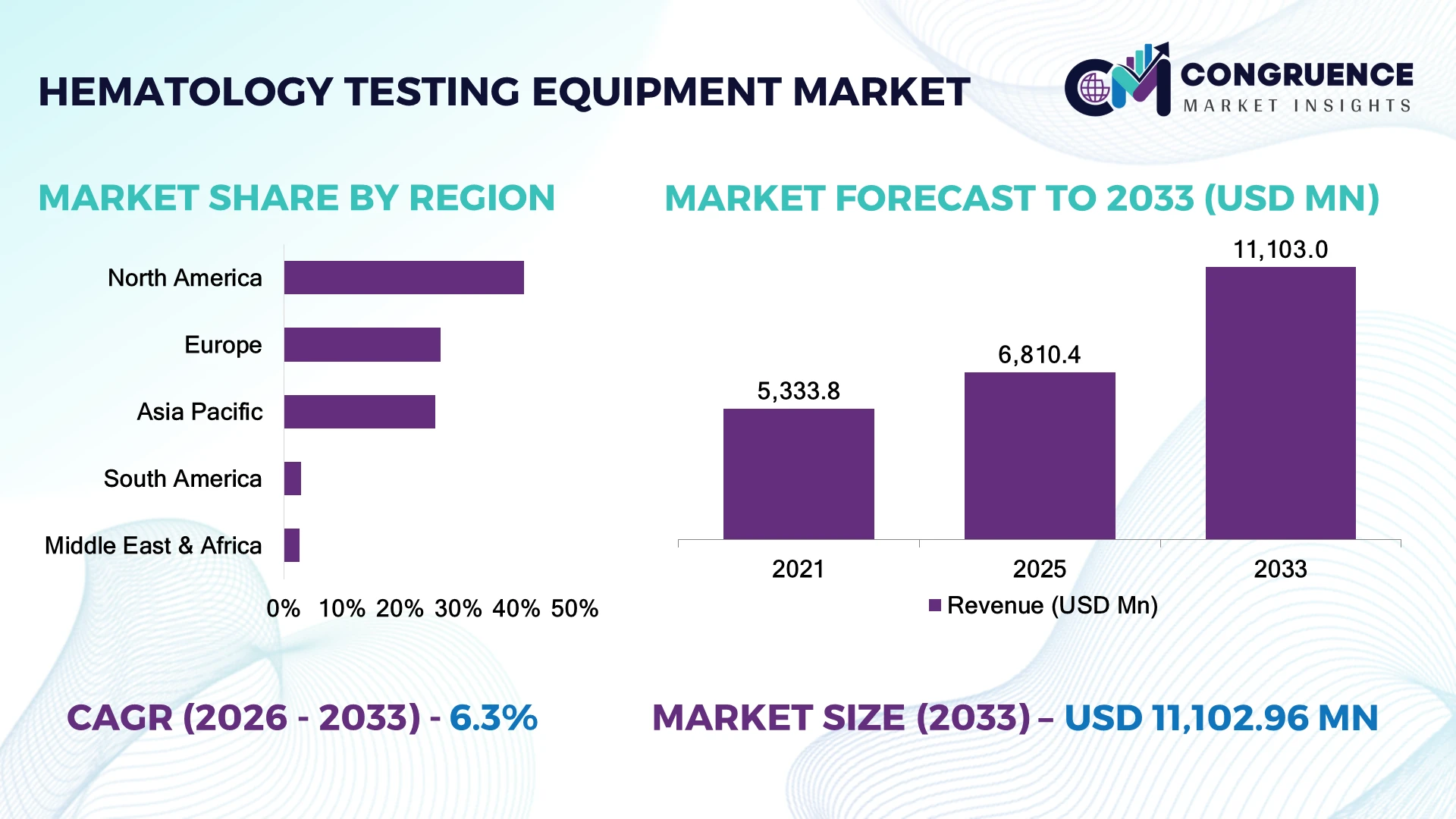
The Global Hematology Testing Equipment Market was valued at USD 6,810.4 Million in 2025 and is anticipated to reach a value of USD 11,103.0 Million by 2033 expanding at a CAGR of 6.3% between 2026 and 2033. Growth is being driven by laboratory automation, rising CBC testing volumes, workforce shortages, and replacement of manual microscopy with integrated digital hematology workflows.
The U.S. dominates the global hematology testing equipment landscape, accounting for approximately 32% of North American analyzer demand, supported by high-volume hospital laboratories, reference networks, and automated 5-part differential systems. China and India are expanding laboratory capacity through localized manufacturing and public-health programs. India’s Sysmex manufacturing facility spans 10,600 square meters and received approximately JPY 3 billion investment, while reagent production capacity increased fourfold. Compared with India, U.S. laboratories show substantially higher automation penetration, with high-throughput workcells processing up to 300 samples hourly.
Strategic implication: prioritize automated, connected analyzers and localized production to capture high-volume laboratories while controlling supply-chain exposure.
Market Size & Growth: USD 6.81 billion in 2025 to USD 11.10 billion by 2033 at 6.3% CAGR, driven by automation and laboratory workforce constraints.
Top Growth Drivers: Automation 60%+; hospital laboratories 52.6%; CBC testing 4+ billion annually.
Short-Term Forecast: By 2028, automated workflows target 10–20% higher throughput and 15–25% lower manual handling.
Emerging Technologies: AI morphology, digital cell imaging, flow cytometry, and connected workcells are moving hematology beyond standalone analyzers.
Regional Leaders: North America approaches USD 4.0 billion; Europe USD 2.8 billion; Asia-Pacific USD 2.7 billion, with Asia-Pacific accelerating local manufacturing.
Consumer/End-User Trends: Hospitals represent about 40–53% of demand, while commercial reference laboratories are expanding high-throughput automation.
Pilot/Case Example: 2025 Adventist Health processed 120,000 annual CBC differentials within a 4.4-million-test laboratory, supporting automated hematology deployment.
Competitive Landscape: Sysmex leads with approximately 54.6% hematology share; Abbott, Beckman Coulter, Siemens Healthineers, and Mindray remain major challengers.
Regulatory & ESG Impact: Automated platforms reduce manual handling and reagent waste, while localized production can reduce logistics exposure by approximately 15–20%.
Investment & Funding: Sysmex committed JPY 3 billion to Indian manufacturing, combining instrument and reagent localization with a fourfold increase in reagent capacity.
Innovation & Future Outlook: 2026–2028 competition shifts toward AI-assisted morphology, predictive diagnostics, digital connectivity, and modular automation rather than analyzer hardware alone.
The Hematology Testing Equipment Market is concentrating investment around automated 5-part differential analyzers, digital morphology, flow cytometry, and integrated laboratory workcells. High-volume systems increasingly process 100–300 samples per hour, while AI-assisted cell classification reduces manual review pressure. India’s localized manufacturing expansion under the Make in India policy is also reshaping procurement and supply resilience.
Hematology testing equipment is becoming strategically important because laboratories are balancing rising test volumes against shortages of skilled technologists, tighter turnaround-time requirements, and pressure to standardize multi-site diagnostic workflows. Hospital networks increasingly favor platforms that combine analyzer automation, digital morphology, LIS connectivity, and remote diagnostics rather than isolated instruments.
Technology is materially changing laboratory economics. Modern automated workcells can process up to 300 samples per hour, while older manual workflows require substantially greater technologist intervention. Digital morphology and AI-assisted classification can reduce manual smear-review workload, while connected systems improve traceability and exception handling. North America remains the technology-intensive benchmark, whereas India and China emphasize scalable, cost-efficient deployment and localized production.
Over the next 2–3 years, laboratories are expected to prioritize automation that delivers measurable throughput gains without proportional staffing increases. Sysmex’s Indian facility demonstrates the shift toward regional manufacturing, with JPY 3 billion invested and reagent capacity increased fourfold. Manufacturers are responding through local production, strategic partnerships, modular platforms, and AI-enabled workflows. Competitive advantage will increasingly depend on combining analytical accuracy with workflow integration, supply resilience, and measurable laboratory productivity.
Laboratory automation is accelerating hematology equipment adoption as high-volume diagnostic networks consolidate testing and target shorter turnaround times. Automated 5-part differential analyzers can process 100–300 samples per hour, while integrated workflows reduce manual handling by approximately 20–30%. In the U.S., workforce shortages are strengthening investment in automated sample preparation, digital morphology, and autoverification. India is simultaneously expanding domestic manufacturing to reduce dependence on imported analyzers and reagents. Manufacturers are responding with modular workcells, AI-assisted flagging, and connected laboratory systems. The non-obvious advantage is scalability: automation allows laboratories to absorb additional test volumes without increasing staffing proportionally, improving utilization of expensive analytical platforms.
Capital-intensive analyzers, proprietary reagents, maintenance contracts, and calibration requirements constrain adoption among smaller laboratories. Automated hematology systems can require reagent and consumable commitments representing roughly 15–25% of operating costs, while service agreements can add another 8–12% to annual equipment expenditure. In India and Southeast Asia, imported components and foreign-exchange exposure further complicate procurement economics. Smaller facilities therefore favor compact 3-part systems or refurbished equipment over premium automated workcells. Manufacturers are reducing this barrier through reagent-rental contracts, financing models, localized assembly, and modular analyzers. The strategic pressure is clear: vendors that lower the entry cost without sacrificing connectivity can penetrate fragmented laboratories more effectively than suppliers relying solely on premium instrument sales.
AI-assisted morphology and digital cell imaging are creating a new automation layer beyond automated blood counts. Advanced image-analysis systems can reduce manual smear-review workloads by approximately 20–40%, while digital workflows enable remote verification and standardized interpretation across multi-site laboratory networks. China and India offer particularly strong opportunities as diagnostic infrastructure expands beyond major metropolitan hospitals. Manufacturers are integrating machine-learning algorithms, digital microscopy, LIS connectivity, and cloud-based review into hematology platforms. The non-obvious opportunity lies in secondary laboratories: distributed digital review can extend specialist expertise without requiring a hematologist at every facility. Vendors that combine analyzers with software, image libraries, and remote-service partnerships can capture higher-value workflow spending.
Connected hematology laboratories face integration challenges across analyzers, LIS platforms, middleware, digital pathology systems, and hospital information systems. Approximately 20–30% of laboratory workflow delays in complex environments can stem from manual exception handling and information-transfer bottlenecks rather than analytical processing itself. U.S. multi-hospital networks increasingly require standardized data exchange, while cybersecurity controls add complexity to remotely connected instruments. Manufacturers must invest in interoperable middleware, API-ready platforms, cybersecurity architecture, and technician training. The long-term differentiator is workflow continuity: an analyzer operating at 300 samples per hour delivers limited value if downstream verification or reporting remains manual. Vendors therefore need ecosystem-level integration rather than isolated instrument optimization.
AI Flags Reshape Morphology Review: AI-assisted image analysis is moving from pilot laboratories into routine hematology workflows, with automated classification targeting 20–40% reductions in manual smear-review workload. U.S. reference laboratories are integrating digital morphology with analyzers and LIS platforms, allowing specialists to focus on abnormal cases while standardizing review across distributed facilities.
Middleware Becomes Workflow Infrastructure: Laboratories are increasingly deploying middleware between analyzers, LIS systems, and hospital information platforms. Integrated rules engines can automate approximately 60–80% of routine result-routing decisions, reducing repetitive technologist intervention. Vendors are strengthening API connectivity and cybersecurity controls as multi-site hospital networks consolidate instruments and standardize diagnostic workflows.
Compact Systems Gain Peripheral Reach: Smaller laboratories in India, Southeast Asia, and Latin America are adopting compact hematology analyzers requiring less space and lower infrastructure investment. Three-part systems can reduce equipment footprint by roughly 30–50% compared with larger workcells, enabling deployment in satellite laboratories and community diagnostic centers. Manufacturers are pairing compact hardware with remote support.
Reagent Localization Gains Importance: Geopolitical logistics disruptions are encouraging manufacturers to localize reagent production and critical consumables closer to major testing markets. Regional sourcing can shorten replenishment cycles by approximately 15–25% and reduce inventory buffers. India is emerging as a strategic manufacturing base as suppliers expand domestic reagent and analyzer production to improve supply resilience.
5-part differential hematology analyzers lead the market with approximately 51% share in 2025, reflecting the strongest balance between CBC capability, five-cell differential classification, throughput, and total cost of ownership. They serve mainstream hospital and diagnostic workflows without the premium complexity of high-end 6-part platforms. 6-part and above analyzers account for roughly 25%, concentrating in tertiary hospitals, oncology laboratories, and high-volume reference centers where expanded parameters justify higher capital intensity. 3-part systems retain about 15% share, particularly across smaller laboratories prioritizing affordability and straightforward testing.
Point-of-care analyzers, at approximately 9%, represent the fastest-shifting segment as decentralized testing expands. Their compact footprint and rapid turnaround support clinics and satellite facilities where centralized laboratory infrastructure is limited. Companies are investing in portable connectivity, simplified reagent systems, and higher automation. The strategic shift is from maximizing analyzer complexity to matching analytical capability with workflow economics, making 5-part platforms the volume anchor while POC systems capture decentralized opportunities.
A 2025 Association for Diagnostics & Laboratory Medicine event in Chicago attracted more than 20,000 laboratory professionals from over 110 countries, underscoring the accelerating industry focus on automated 5-part systems, digital morphology, and integrated laboratory workflows.
Anemia testing represents approximately 37% of hematology testing equipment application demand, supported by routine CBC requirements across primary care, hospitals, maternal-health programs, and chronic-disease monitoring. Blood-cancer diagnostics follows as a higher-complexity application, accounting for roughly 32% of broader hematology testing demand and requiring advanced differential analysis, morphology, and flow-cytometry integration. Infection and inflammatory-disease testing remains a substantial routine workload, reinforcing demand for high-throughput automated platforms.
Blood-cancer diagnostics is the fastest-shifting application as laboratories increasingly combine automated CBC results with digital morphology and specialized cellular analysis. In contrast, anemia testing remains volume-intensive but more standardized, favoring cost-efficient automation. Companies are therefore differentiating product portfolios: mainstream analyzers target high-frequency CBC workflows, while premium systems integrate morphology and advanced parameters for oncology centers. The business implication is clear—application-specific configuration increasingly determines equipment value, particularly where laboratories seek to reduce manual review and consolidate testing onto fewer platforms.
The World Health Organization’s updated essential-IVD framework identifies automated CBC analyzers as appropriate for district and regional hospitals and specifically recognizes anemia, infections, leukemia, and chemotherapy monitoring among their principal clinical uses.
Hospitals account for approximately 40% of hematology analyzer demand, reflecting continuous CBC requirements across emergency departments, inpatient wards, oncology units, surgery, and intensive care. Their procurement favors integrated platforms capable of supporting high sample volumes, standardized quality control, and laboratory-information-system connectivity. Commercial and diagnostic laboratories represent an increasingly important buyer group, with commercial service providers alone accounting for approximately 46% of hematology analyzers and reagents demand in 2025. Their centralized operating model supports higher analyzer utilization and standardized purchasing.
Commercial diagnostic laboratories are the fastest-shifting end-user group as testing consolidation moves routine CBC workloads toward centralized facilities. Hospitals prioritize turnaround time and clinical availability, while commercial laboratories emphasize throughput, reagent economics, and multi-site standardization. Research and academic institutes remain smaller but strategically relevant for advanced hematology methods and validation. Manufacturers are responding with scalable workcells, reagent-service models, remote diagnostics, and middleware integration. The competitive opportunity increasingly lies in winning network-wide standardization contracts rather than individual instrument placements.
A 2025 study of a 550-bed tertiary hospital in Mumbai documented 2.3 million laboratory results annually after implementing total laboratory automation, demonstrating how integrated workflows are becoming operational infrastructure for high-volume hospital testing.
North America accounted for the largest market share at 41.3% in 2025 however, Asia-Pacific is expected to register the fastest growth, expanding at a CAGR of 8.1% between 2026 and 2033.
North America represents approximately 41% of the global hematology analyzers and reagents market, supported by dense hospital networks, reference laboratories, oncology centers, and established laboratory automation. The U.S. contributes the overwhelming majority of regional demand, with automated analyzers increasingly integrated into LIS-connected workcells and autoverification workflows. Large laboratories prioritize throughput, uptime, and standardized reagent supply rather than standalone analyzer capability. The region also has a mature replacement cycle, supporting premium 5-part and advanced hematology platforms. Manufacturers are expanding service infrastructure and software integration while strengthening reagent contracts. This creates a defensible installed-base advantage: vendors that control instruments, consumables, middleware, and service can retain customers across multi-site laboratory networks rather than compete for individual analyzer placements.
United States Market Outlook: The U.S. accounts for approximately 82% of North American hematology analyzer demand, making it the primary commercial and technology center. Large hospital systems and national reference laboratories increasingly consolidate testing onto high-throughput platforms, favoring automated differential analysis, digital morphology, and remote diagnostics. The country's established reimbursement structure and laboratory infrastructure support premium systems, while workforce constraints strengthen the business case for automation and reduced manual review.
Europe contributes approximately 27% of global hematology analyzers and reagents demand, with Germany, the U.K., France, and Italy forming the principal purchasing centers. Germany alone represented 26.4% of European hematology analyzers and reagents demand in 2025, reflecting high testing volumes, advanced laboratory infrastructure, and strong automation adoption. The EU IVDR is increasing requirements for clinical evidence, traceability, quality management, and post-market surveillance, favoring established manufacturers with mature regulatory systems. Laboratories are increasingly standardizing analyzer platforms across networks to simplify validation, training, and consumable procurement.
Germany Market Outlook: Germany is Europe's leading country market, accounting for approximately 26.4% of regional demand. Its large hospital network, oncology diagnostics capacity, and advanced laboratory infrastructure support high-throughput hematology systems. Berlin, Frankfurt, and Munich host major laboratory networks integrating analyzers with LIS and digital platforms. Manufacturers are positioning through standardized multi-site deployments, service contracts, and automation-compatible instruments that reduce workflow fragmentation.
Asia-Pacific accounts for approximately 26% of global hematology analyzers and reagents demand and is the fastest-expanding major market, led by China and India. Healthcare infrastructure expansion, private diagnostic networks, and increasing automation are shifting laboratories from basic analyzers toward 5-part differential and connected systems. Local manufacturing is becoming strategically important as suppliers seek shorter replenishment cycles and lower procurement barriers. Japan and South Korea remain technology-intensive markets, while Southeast Asia is adding mid-range platforms. Manufacturers are therefore combining localized production, distributor partnerships, reagent supply, and service networks rather than relying on imported instruments alone.
India Market Outlook: India is emerging as a strategic manufacturing and deployment base for hematology equipment. Sysmex invested approximately JPY 3 billion in its Gujarat manufacturing facility, covering 10,600 square meters of floor space, while local diagnostic reagent production capacity increased approximately fourfold. The facility produces instruments and reagents, strengthening supply resilience and supporting more competitive domestic deployment. This localization model positions India as both a high-volume diagnostic market and an export-oriented manufacturing platform.
South America represents approximately 7% of global hematology analyzers and reagents demand, with Brazil serving as the dominant country market. Diagnostic-network expansion, hospital modernization, and rising use of automated testing are shifting procurement toward fully automated and mid-to-high-throughput systems. Brazil accounted for approximately 1.7% of the global hematology diagnostics market in 2024, demonstrating its outsized regional position. However, geographic dispersion and uneven laboratory infrastructure create different equipment requirements between major cities and smaller facilities. Manufacturers are responding with distributor-led service models, compact analyzers, and localized consumable availability.
Brazil Market Outlook: Brazil is the region's principal hematology equipment market, supported by extensive public and private laboratory networks. Modernization is increasing adoption of automated analyzers in urban and regional diagnostic centers, while point-of-care systems address facilities where centralized laboratory infrastructure is less accessible. The market's consumables-intensive structure, with consumables representing 69.45% of hematology diagnostics revenue in 2024, also makes dependable reagent supply and service support critical to vendor retention.
Middle East & Africa contributes approximately 4% of global hematology analyzers and reagents demand, but purchasing is concentrated in Saudi Arabia, the UAE, South Africa, and other markets investing in hospital modernization. Gulf healthcare systems increasingly favor automated laboratory platforms capable of supporting centralized testing, oncology services, and high-volume hospitals. Public-sector procurement and private hospital expansion are creating opportunities for established diagnostic equipment suppliers with local technical support. Manufacturers are strengthening distributor relationships, reagent availability, and application training to address operational requirements. The strategic opportunity is concentrated rather than broad: suppliers that secure major hospital-network contracts can establish installed-base positions across national healthcare modernization programs.
Saudi Arabia Market Outlook: Saudi Arabia is the region's most strategically significant market, supported by healthcare infrastructure investment, hospital expansion, and laboratory modernization under national transformation programs. Procurement increasingly favors automated analyzers, integrated information systems, and standardized laboratory workflows. Suppliers with local service capabilities and dependable reagent logistics have an advantage because large hospital networks require consistent uptime and rapid technical response. The market is therefore shifting from equipment-only procurement toward integrated diagnostic infrastructure partnerships.
Sysmex, Beckman Coulter, Abbott, Mindray, and HORIBA form the principal global competitive tier, while Erba Mannheim and Dymind compete aggressively on price and localization. The top five players command approximately 61% combined share, creating a concentrated OEM-led structure.
Competition centers on technology depth, reagent economics, throughput, service coverage, and workflow integration. Premium vendors differentiate through AI morphology, automation, and connected workcells, while cost-focused Asian manufacturers compete with 10–20% lower equipment pricing and localized consumables. High-throughput platforms can deliver 100–300 samples per hour, making productivity decisive.
Sysmex is strengthening supply control through Indian manufacturing; Mindray is integrating CBC and ESR; Beckman Coulter is pairing analyzers with digital morphology. The shift is toward bundled ecosystems, increasing switching costs. Regulatory validation, installed bases, reagent availability, and service networks remain major entry barriers. Winning requires reliable analytics, scalable automation, localized supply, and lifecycle economics that outperform established platforms across diverse laboratory operating environments worldwide.
Sysmex Corporation
Abbott Laboratories
Beckman Coulter
Siemens Healthineers
Mindray Medical International
HORIBA
Nihon Kohden Corporation
Boule Diagnostics AB
Bio-Rad Laboratories
Roche Diagnostics
Erba Mannheim
A. Menarini Diagnostics
Dymind Biotechnology Co., Ltd.
Current hematology platforms are shifting from standalone cell counters toward automated, connected workcells combining 5-part differential analysis, autoloading, digital morphology, and LIS integration. High-throughput systems can process 100–300 samples per hour, while automation can reduce manual handling by roughly 20–30% in suitable workflows. Sysmex and Beckman Coulter benefit most where installed-base connectivity and reagent ecosystems influence replacement decisions.
Emerging digital morphology and AI-based decision support are changing smear review. Full-field imaging can reduce repetitive microscopy workload by approximately 20–40% in selected laboratory workflows, while automated flagging improves prioritization of abnormal samples. Integrated CBC-plus-ESR systems also compress turnaround time: Mindray’s BC-700 delivers both results in 1.5 minutes versus up to 60 minutes traditionally. These platforms favor vendors combining analyzer hardware, software, reagents, and service.
By 2026–2028, AI-assisted morphology, remote review, predictive maintenance, and middleware orchestration should become increasingly important differentiators. Digital workflows can improve review efficiency by 15–25%, while connected monitoring can reduce avoidable service interventions by roughly 10–15%. The competitive shift favors manufacturers able to integrate instruments with informatics rather than merely improve counting performance. Laboratories should act now because platform standardization, data interoperability, and workflow redesign and scalable reagent management increasingly determine the value captured from new analyzer investments.
April 2025 Sysmex began full-scale operations at its Indian manufacturing base, producing the XQ-320 and reagents. Reagent capacity rose approximately fourfold versus the previous local factory, strengthening supply resilience, supporting public procurement eligibility, and expanding localized hematology equipment availability. Source: sysmex.co.jp
April 2024 Mindray launched the BC-700 Series, combining 5-part CBC and ESR testing. Results arrive in 1.5 minutes versus up to 60 minutes traditionally, reducing workflow steps and supporting compact laboratory deployment where integrated testing can replace separate equipment. Source: mindray.com
October 2025 Beckman Coulter reported Adventist Health’s deployment of DxH 900 analyzers with Scopio digital morphology. The 221-bed hospital performs over 4.4 million annual billable tests, while automated workflows maintained turnaround targets despite manual differential requests nearly doubling. Source: beckmancoulter.com
February 2025 Abbott’s Alinity h-series System received FDA 510(k) clearance for automated differential cell counting. The decision confirmed substantial equivalence for hematology use, strengthening regulatory access and enabling laboratories to integrate CBC testing within Abbott’s broader diagnostic workflow. Source: fda.gov (FDA Access Data)
The Hematology Testing Equipment Market Report evaluates analyzer demand across 3-part, 5-part, 6-part and above, and point-of-care systems, with application coverage spanning anemia testing, blood-cancer diagnostics, infection and inflammatory-disease testing, and related clinical workflows. End-user analysis includes hospitals, commercial diagnostic laboratories, research and academic institutes.
Geographic coverage spans North America, Europe, Asia-Pacific, South America, and Middle East & Africa, with country-level assessment of major procurement and manufacturing centers. The report examines automation, AI-assisted morphology, digital cell imaging, connected workcells, middleware, and integrated CBC-plus-ESR platforms. With hospitals representing roughly 40% of analyzer demand and commercial laboratories driving centralized testing, the analysis helps investors evaluate capacity priorities, manufacturers refine product and reagent strategies, and suppliers identify expansion opportunities. Coverage through 2033 clarifies technology adoption, competitive positioning, localization requirements, and emerging deployment models shaping future equipment investment.
| Report Attribute/Metric | Report Details |
|---|---|
|
Market Revenue in 2025 |
USD 6,810.4 Million |
|
Market Revenue in 2033 |
USD 11,103.0 Million |
|
CAGR (2026 - 2033) |
6.3% |
|
Base Year |
2025 |
|
Forecast Period |
2026 - 2033 |
|
Historic Period |
2021 - 2025 |
|
Segments Covered |
By Type
By Application
By End-User
|
|
Key Report Deliverable |
Revenue Forecast, Growth Trends, Market Dynamics, Segmental Overview, Regional and Country-wise Analysis, Competition Landscape |
|
Region Covered |
North America, Europe, Asia-Pacific, South America, Middle East, Africa |
|
Key Players Analyzed |
Sysmex Corporation, Abbott Laboratories, Beckman Coulter, Siemens Healthineers, Mindray Medical International, HORIBA, Nihon Kohden Corporation, Boule Diagnostics AB, Bio-Rad Laboratories, Roche Diagnostics, Erba Mannheim, A. Menarini Diagnostics, Dymind Biotechnology Co., Ltd. |
|
Customization & Pricing |
Available on Request (10% Customization is Free) |




