
Reports
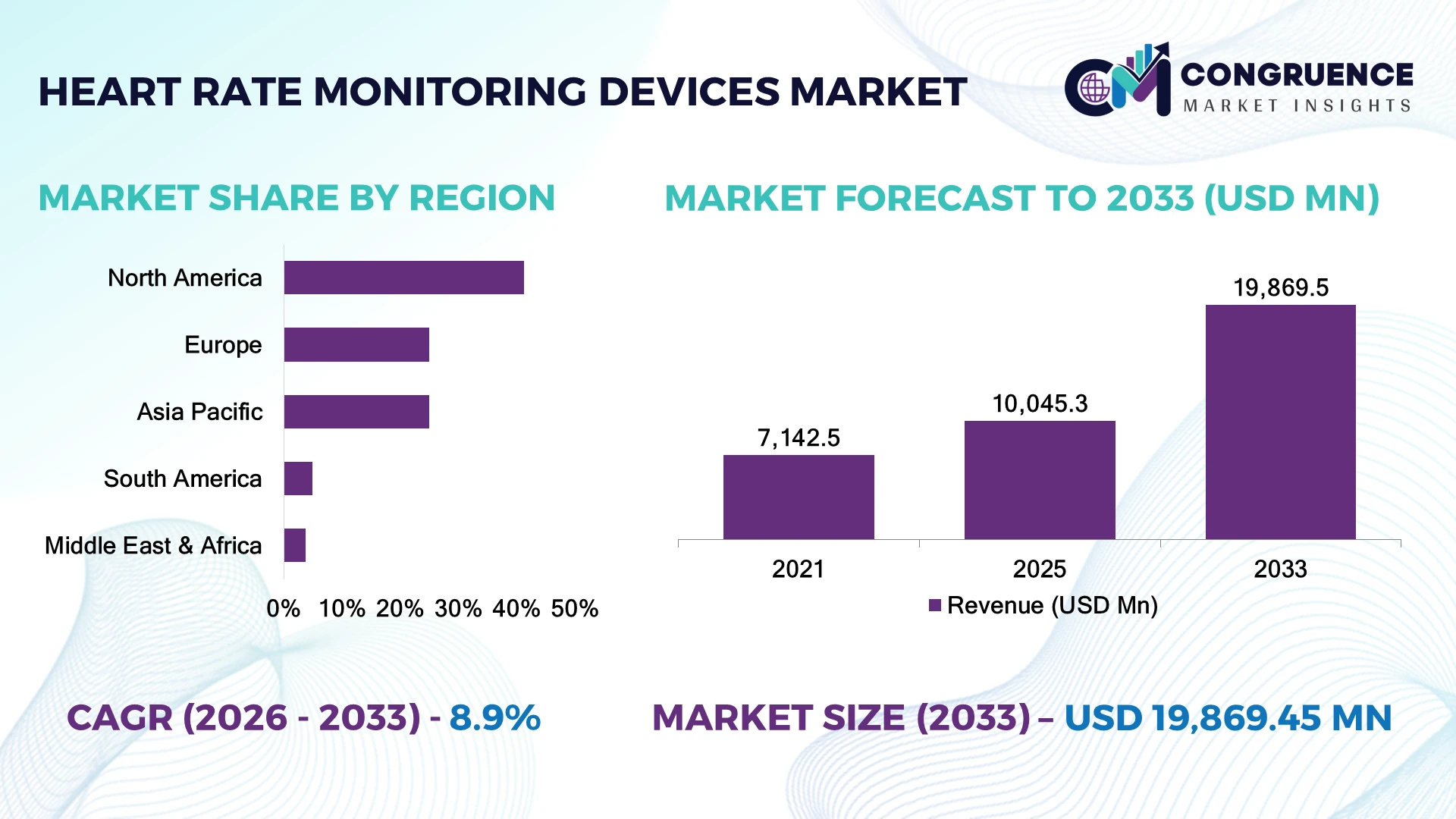
The Global Heart Rate Monitoring Devices Market was valued at USD 10,045.3 Million in 2025 and is anticipated to reach a value of USD 19,869.5 Million by 2033 expanding at a CAGR of 8.9% between 2026 and 2033. Growth is driven by continuous photoplethysmography (PPG) sensing, ECG-enabled wearables, and integration of heart-rate data into preventive-care and remote-monitoring workflows.
The United States remains a strategically important adoption market: 37% of adults reported owning a smartwatch in 2026, while health-monitoring wearables are increasingly used beyond fitness. In India, the rollout of smartwatch-based hypertension notifications in 2025 illustrates how consumer devices are moving toward opportunistic health screening. However, wearable alerts remain complementary to clinical assessment, creating opportunities for validated sensors, dependable algorithms, and clinician-connected platforms.
Strategic implication: prioritize validated monitoring, interoperable data platforms, and region-specific pricing rather than competing on sensor availability alone.
Market Size & Growth: The market is valued at USD 10,045.3 million in 2025 and is projected to reach USD 19,869.5 million by 2033, supported by continuous monitoring and connected-care integration.
Top Growth Drivers: Cardiovascular disease accounted for approximately 32% of global deaths in 2022; 37% of U.S. adults owned a smartwatch in 2026; and remote monitoring is widening access to longitudinal health data.
Short-Term Forecast: Through 2028, competitive gains will depend on improving wear-time, signal reliability, battery performance, and integration into clinical workflows—not simply adding more tracking features.
Emerging Technologies: PPG sensors, single-lead ECG, heart-rate variability analysis, and AI-assisted anomaly detection are expanding monitoring from exercise tracking to broader health insights.
Regional Leaders: North America benefits from established wearable ecosystems and digital-health infrastructure; Europe emphasizes regulated health technology; and Asia-Pacific combines large consumer-electronics supply chains with expanding wearable adoption.
Consumer/End-User Trends: In a 2025 U.S. survey, 83% of wearable owners reported wearing devices at least five days per week, reinforcing the value of comfortable designs and consistent data capture.
Pilot/Case Example: In 2025, Apple received U.S. regulatory clearance for its smartwatch hypertension-notification feature, demonstrating how optical heart-sensor data can support screening-oriented alerts when used within defined limitations.
Competitive Landscape: Apple, Samsung, Garmin, Fitbit, and specialized monitoring providers compete through sensor performance, software ecosystems, battery life, and health-feature availability; comparable global market shares are not consistently disclosed.
Regulatory & ESG Impact: Medical claims require stronger validation and regulatory discipline than general wellness tracking. Clear labeling and secure data handling reduce compliance exposure and protect user trust.
Investment & Funding: Investment is shifting toward sensor algorithms, connected-care software, and clinical validation. A single comparable global investment total is not publicly established across hardware, software, and medical monitoring.
Innovation & Future Outlook: The next competitive step is translating continuous heart-rate data into useful, explainable alerts while maintaining accuracy, privacy, and clear boundaries between wellness insights and diagnosis.
Heart rate monitoring devices are evolving from fitness accessories into connected tools for longitudinal health tracking, exercise management, and selected screening workflows. PPG-based wearables provide continuous measurement, while ECG-capable devices add rhythm-recording functionality. With 37% of U.S. adults reporting smartwatch ownership in 2026, differentiation increasingly depends on useful interpretation, comfortable daily wear, and responsible handling of health data. The market is moving toward validated, connected monitoring rather than feature counts alone.
Heart rate monitoring devices are becoming strategically important because they connect consumer electronics, preventive health, and clinical data workflows. Cardiovascular diseases caused an estimated 19.8 million deaths in 2022, representing 32% of global deaths. This burden reinforces the value of accessible monitoring, but it also raises expectations for reliable readings, clear alerts, and evidence-based product claims. Manufacturers must differentiate between wellness information and functions intended for medical use.
Technology is moving beyond basic optical pulse tracking toward combinations of PPG, ECG, heart-rate variability, and algorithmic pattern analysis. Optical sensors support continuous collection with minimal user effort, whereas ECG functions can provide more specific rhythm recordings but generally require deliberate measurement. Adoption also varies by market: U.S. smartwatch ownership reached 37% in 2026, while markets with lower purchasing power and uneven digital-health infrastructure require affordable devices, localized software, and dependable connectivity.
Over the next two to three years, providers are likely to prioritize improved signal quality during movement, longer battery life, interoperability, and clinical validation. A practical deployment pathway combines wearable monitoring with clinician review and confirmatory testing rather than treating alerts as diagnoses. Companies that invest in algorithm validation, secure data exchange, and healthcare partnerships will be better positioned to convert device engagement into sustained commercial and clinical value.
Cardiovascular diseases accounted for approximately 32% of global deaths in 2022, strengthening the case for earlier risk awareness and longitudinal monitoring. In the United States, 37% of adults reported smartwatch ownership in 2026, creating a sizable installed base for heart-rate tracking outside clinical settings. Continuous PPG collection can reveal resting-rate patterns and changes associated with activity, while ECG-enabled devices add a way to record selected rhythm events. The commercial opportunity lies in turning repeated measurements into actionable, understandable information. Manufacturers are responding through improved sensor placement, algorithm refinement, and integrations with health applications. Providers that demonstrate reliable performance and communicate limitations clearly can build trust without positioning consumer wearables as replacements for medical evaluation.
Heart-rate accuracy varies with movement, device fit, skin contact, and exercise intensity; performance is not interchangeable across wearable models. A 2026 comparison of four PPG-based devices found meaningful differences in measurement error across activity levels, highlighting the risk of treating all readings as equivalent. In addition, consumers may interpret an irregular-rate notification as a diagnosis, increasing support burdens and potential liability. These limitations are especially important when products enter clinical or insurance-linked workflows. Companies must fund device-specific validation, transparent labeling, and post-market performance monitoring. Maintaining separate claims for wellness tracking and medical functions helps contain regulatory exposure while allowing products to serve fitness, wellness, and appropriately validated healthcare use cases.
Wearable ownership creates an opportunity to offer more than step counts and exercise summaries. In 2025, Apple received U.S. regulatory clearance for a smartwatch hypertension-notification feature that analyzes optical heart-sensor data over time, illustrating the shift toward screening-oriented functions. Such capabilities can increase engagement when paired with clear follow-up guidance, compatible health records, and clinician communication. The opportunity is not to replace a blood-pressure cuff or clinical assessment; it is to help users recognize patterns that merit confirmation. Manufacturers can invest in validated algorithms, regional clinical partnerships, and software that helps users share trend data securely. Products that connect monitoring to an appropriate next step can differentiate on utility rather than adding alerts without a care pathway.
Scaling heart-rate monitoring across consumer and clinical settings requires consistent data formats, secure transmission, usable dashboards, and clear responsibility for responding to alerts. Wearable use does not guarantee sustained engagement: in a 2024 U.S. survey cycle, 41.1% of adults reported using a wearable to monitor health in the preceding year, while daily use among wearable users was 45.6%. This gap between access and routine use makes comfort, charging frequency, and understandable feedback operational priorities. Companies must also adapt to changing privacy and medical-device requirements across markets. Partnerships with healthcare providers, secure-by-design software, and explicit escalation protocols are essential to prevent fragmented data, alert fatigue, and uneven performance from undermining long-term adoption.
Wearables Move Toward Health Screening — Product development is extending from continuous heart-rate display to selected screening-oriented alerts. In 2025, Apple received U.S. regulatory clearance for a hypertension-notification feature using optical heart-sensor data. The feature evaluates patterns over 30-day periods and directs users toward confirmatory blood-pressure measurement, showing how vendors are connecting passive monitoring with defined follow-up actions.
Daily Wear Drives Design Priorities — A 2025 U.S. survey found that 83% of wearable owners wore their devices at least five days a week. That usage pattern makes comfort, battery life, skin contact, and charging convenience commercial differentiators. Manufacturers are refining lightweight designs and power management to preserve continuous data capture without increasing user effort.
Validation Separates Devices — A 2026 comparison of four PPG-based wearables found that measurement error differed by device and exercise intensity. This makes accuracy validation a competitive issue, especially for products marketed around training zones or health alerts. Suppliers are emphasizing sensor algorithms, fit guidance, and performance evidence rather than assuming optical tracking delivers uniform results.
Regulatory Boundaries Shape Product Claims — In September 2025, U.S. regulators warned consumers against using unauthorized wearable features that claim to measure or estimate blood pressure. The warning sharpens the distinction between wellness metrics and medical functions. Companies are responding by narrowing claims, validating intended uses, and designing clearer instructions for confirmation and clinical follow-up.
Wrist-worn heart rate monitors, including smartwatches and fitness bands, represent the leading type, accounting for an estimated 49.6% of the market in 2025. Their advantage comes from combining heart-rate tracking with notifications, activity analysis, and smartphone connectivity in a device consumers already wear daily. Chest-strap monitors remain relevant for athletes and training professionals who prioritize responsive readings during intensive exercise. ECG patches and ambulatory monitors address a different requirement: extended cardiac observation and clinical assessment. Handheld, arm-worn, finger-based, and ear-worn monitors serve more specialized measurement needs, including spot checks and activity-specific tracking.
Chest straps are projected to expand faster than wrist-worn devices in some market estimates, reflecting demand for accurate exercise data and heart-rate variability analysis. Hybrid products combining optical PPG with electrical ECG sensing are also gaining strategic importance, although their adoption depends on price, validation, and intended use. Manufacturers are therefore balancing mass-market integration with differentiated accuracy, longer battery life, and more comfortable designs. Investment priorities are shifting toward sensor fusion and validated algorithms rather than hardware additions alone.
Fitness and sports tracking is the leading application, representing an estimated 40.3% of market demand in 2025. Adoption is supported by workout-zone monitoring, recovery tracking, and integration with training applications. This mature use case benefits from high-frequency consumer engagement and relatively straightforward device setup. Medical and clinical monitoring serves patients who require heart-rate observation, rhythm assessment, or follow-up after care. Remote patient monitoring and home healthcare are gaining importance as connected devices support longitudinal data collection outside hospitals. Exercise and rehabilitation applications also use heart-rate feedback to guide training intensity and recovery, while occupational and other specialized applications address narrower needs.
Remote patient monitoring is among the faster-growing applications, with market estimates pointing to stronger expansion than conventional fitness tracking. The shift is driven by connected-care workflows and the need to observe patients between appointments, although consumer-grade readings cannot automatically substitute for validated medical monitoring. Providers are investing in ECG-enabled wearables, secure data transfer, and clinician-facing dashboards; fitness brands continue to improve personalization and workout analytics. Companies that tailor accuracy, alert logic, and integration to each application can avoid competing solely on device price and capture demand where reliable data supports a defined user or clinical decision.
Individual consumers represent the leading end-user group, accounting for an estimated 45.6% of the market in 2025. Their demand is concentrated in smartwatches, fitness bands, and connected devices used for daily activity, exercise, and general wellness. Consumer products benefit from retail availability and integration with mobile ecosystems, whereas hospitals and clinics prioritize measurement reliability, clinical workflow compatibility, and appropriate regulatory status. Home healthcare providers and patients represent an increasingly important buying group because connected monitoring can extend observation beyond in-person visits. Fitness centers, sports teams, and professional athletes purchase devices for training, performance assessment, and recovery management; employers and other organizations use them in more targeted wellness programs.
Home healthcare is among the faster-growing end-user categories in current market estimates, reflecting wider use of connected monitoring and remote-care services. However, deployment depends on clinician workflows, reimbursement arrangements, connectivity, and clear escalation procedures. Consumer brands compete through design, affordability, and ecosystem integration, while clinical suppliers differentiate through validated measurements, data security, and service support. Companies are adapting with tiered product portfolios, provider partnerships, and software that supports data sharing without overstating diagnostic capability. The strongest positioning comes from matching device specifications and support models to each buyer’s needs rather than treating consumer and clinical procurement as interchangeable.
North America accounted for the largest market share at an estimated 41.2% in 2025; however, Asia-Pacific is expected to register the fastest growth, expanding at an estimated CAGR of 13.0% between 2026 and 2033.
Connected Health Ecosystems Shift Competition Toward Clinical Utility
North America leads the heart rate monitoring devices market through established wearable brands, advanced healthcare infrastructure, and integration of consumer-generated health data into remote-care services. Its estimated 41.2% share in 2025 reflects strong adoption of smartwatches, chest-strap monitors, ECG-enabled wearables, and clinical monitoring systems. The United States is the principal demand center, supported by consumer purchasing power and a mature digital-health ecosystem. Pew Research Center reported in 2026 that 37% of U.S. adults owned a smartwatch, reinforcing the scale of the addressable consumer base. Competition is shifting toward validated health functions, software integration, and secure data exchange. Manufacturers are strengthening clinical partnerships and developing distinct wellness and medical-device portfolios to address regulatory requirements and avoid overreliance on hardware upgrades.
United States Market Outlook: The United States combines technology leadership with a large consumer electronics market and an established medical-device sector. Its 37% smartwatch ownership rate creates a substantial foundation for heart-rate tracking, activity monitoring, and selected health alerts. Companies are competing through sensor accuracy, software subscriptions, interoperability, and regulatory clearance for specific features. Suppliers seeking healthcare-channel growth must demonstrate performance in intended use cases, protect health information, and ensure that consumer alerts direct users toward appropriate clinical confirmation rather than unsupported self-diagnosis.
Regulatory Discipline and Preventive Care Shape Product Positioning
Europe's market is shaped by public healthcare systems, an aging population, sports and wellness adoption, and stringent expectations for health-data protection. Germany, the United Kingdom, and France provide important demand centers, while Nordic countries support digitally enabled healthcare adoption. Buyers increasingly distinguish between wellness wearables and products intended for medical monitoring, making validation and transparent product claims commercially important. The European Health Data Space framework is also increasing attention to secure, interoperable health-data exchange. Manufacturers are responding with privacy-focused software, clearer intended-use labeling, and partnerships that connect wearable measurements with healthcare workflows. Suppliers that localize language, support regional compliance, and establish reliable distribution can compete more effectively across Europe's varied reimbursement and purchasing environments.
Germany Market Outlook: Germany is a strategically important market because of its healthcare infrastructure, engineering capabilities, sports technology demand, and established medical-device industry. Digital health applications can enter statutory reimbursement pathways through the DiGA framework when they meet applicable requirements, although ordinary heart-rate wearables do not qualify automatically. Manufacturers must therefore distinguish consumer monitoring from reimbursable medical applications. Partnerships with healthcare providers, clinical research organizations, and device distributors can help suppliers establish evidence, navigate procurement requirements, and build trust among patients and clinicians.
Manufacturing Scale and Affordable Wearables Accelerate Adoption
Asia-Pacific is positioned for the fastest regional expansion as domestic electronics brands, large consumer populations, and lower-priced wearable products broaden access to heart-rate monitoring. China anchors both manufacturing and demand, while India offers opportunities through affordable devices, digital health services, and a growing fitness-oriented consumer base. International Data Corporation reported that China's wrist-worn device shipments reached 73.9 million units in 2025, up 20.8% year over year; this category includes smartwatches and bands rather than heart-rate monitors alone. That scale supports supplier ecosystems and frequent product refreshes. Competition increasingly centers on price-performance, battery life, sensor integration, and compatibility with local mobile platforms. Companies are expanding product tiers and regional partnerships to serve both mass-market consumers and specialized monitoring users.
China Market Outlook: China combines extensive electronics manufacturing, domestic wearable brands, component suppliers, and a large online retail ecosystem. Its 2025 wrist-worn device shipments included 50.61 million smartwatches and 23.29 million bands, creating a broad platform for optical heart-rate sensing. Government-supported consumer trade-in and promotional programs also influenced purchasing during the year. Suppliers can compete through localized software, cost-efficient production, rapid product development, and stronger health features. However, medical claims require appropriate validation and regulatory compliance, particularly when devices move beyond general wellness tracking.
Digital Access Expands, but Affordability Remains Decisive
South America's heart rate monitoring devices market is concentrated in Brazil and supported by demand from fitness consumers, private healthcare providers, sports organizations, and connected-care services. Adoption is constrained by income disparities, device-import costs, and uneven access to digital health infrastructure outside major cities. Brazil's established telehealth framework supports remote consultations, creating a potential route for wearable data to complement follow-up care when clinicians consider the readings appropriate. Manufacturers and distributors are responding with entry-level smart bands, locally relevant applications, and retail partnerships. The key commercial challenge is not simply introducing advanced sensors; it is maintaining affordability while ensuring dependable performance, after-sales support, and clear distinctions between wellness readings and medically validated measurements.
Brazil Market Outlook: Brazil is the region's most strategically significant market because of its population scale, large private healthcare sector, and established digital-health activity. Federal rules governing telehealth provide a framework for remote consultations, although they do not automatically validate consumer wearable measurements for clinical decisions. Suppliers can build demand through partnerships with healthcare networks, sports organizations, pharmacies, and e-commerce channels. Devices that balance accessible pricing with reliable connectivity and Portuguese-language interfaces are better positioned to reach consumers beyond premium urban segments.
Healthcare Modernization Creates Openings for Connected Monitoring
The Middle East and Africa market is shaped by investment in digital healthcare, private hospital expansion, chronic-disease management, and mobile-first services. Adoption remains uneven: Gulf markets benefit from stronger healthcare investment and connected infrastructure, while affordability and access constraints influence purchasing across parts of Africa. Saudi Arabia's Health Sector Transformation Program is advancing virtual care and digital integration. In 2025, the Saudi Ministry of Health reported that strategic healthcare investments and partnerships announced at the Global Health Exhibition exceeded USD 33 billion, spanning hospitals, digital health, and related infrastructure. Such investment creates an enabling environment for remote monitoring, but wearable suppliers still need local clinical partnerships, secure data handling, and service models suited to each country's healthcare system.
Saudi Arabia Market Outlook: Saudi Arabia is a leading regional opportunity because Vision 2030 links healthcare modernization with digital services and preventive care. The Seha Virtual Hospital network connected 241 healthcare facilities and served more than 365,000 beneficiaries, according to the country's 2025 transformation reporting. This infrastructure provides a pathway for appropriate remote-monitoring services, although consumer heart-rate devices require suitable validation before being used for clinical decisions. Suppliers can pursue partnerships with hospitals, telehealth providers, and digital-health platforms, emphasizing interoperability, Arabic-language support, cybersecurity, and clear escalation pathways for concerning readings.
The market pits ecosystem leaders Apple and Samsung against sports-performance specialists Garmin and Polar, while WHOOP competes through subscription-led coaching. Medical-monitoring suppliers iRhythm and AliveCor differentiate through ECG and ambulatory systems rather than smartwatch features. A reliable public top-five share for the overall market is not consistently disclosed; assigning a precise combined percentage would create false precision. Competition centers on sensor reliability, battery life, price, software integration, and regulatory clearance. WHOOP 5.0 and MG offer 14-plus-day battery life, while Garmin’s HRM 600 adds standalone recording and rechargeable operation. These shifts raise expectations for continuous use and data continuity. Technology companies strengthen AI interpretation, while specialists target training accuracy and clinical credibility. Entry barriers include algorithm validation, medical-device compliance, established mobile ecosystems, and user trust. Winning requires reliable measurements, actionable insights, and an advantage for a defined user group. Market structure is fragmented; top-five combined share is not reliably disclosed globally.
Optical photoplethysmography (PPG) remains the volume technology because it supports continuous, low-effort measurement in watches and bands. ECG-enabled wearables add electrical recordings for rhythm assessment, while chest straps remain useful during intensive exercise. A 2025 systematic review found resting Apple Watch heart-rate error ranging from 1.69% to 7.2%; during exercise, 91% of reviewed studies reported error below 10%. This variation makes validation by activity and user group commercially important.
Sensor fusion combines heart rate, heart-rate variability, motion, skin temperature, and sleep signals, giving algorithms more context than pulse readings alone. WHOOP 5.0 and MG introduced 14-plus-day battery life, reducing charging interruptions. Garmin’s HRM 600 supports standalone activity recording and transmits heart-rate and variability data across compatible devices. These approaches favor companies with strong software ecosystems and cross-device integration.
From 2026 to 2028, AI-assisted trend interpretation, secure data exchange, and validated ECG features will increasingly separate premium devices from basic trackers. Algorithm gains must be tested against defined performance targets rather than assumed universally applicable. Manufacturers should test motion artifacts, skin contact, and subgroup performance, then communicate limitations clearly. The priority is converting trustworthy measurements into useful guidance while maintaining battery life, privacy, and regulatory compliance, without sacrificing usability or trust.
September 2025 — Apple introduced hypertension notifications for Apple Watch models, using optical heart-sensor data across 30-day periods and validation involving 2,000 participants. The feature expands preventive-health utility while directing users toward confirmatory blood-pressure checks at scale. Source: apple.com
May 2025 — Garmin launched the HRM 600, adding standalone activity recording, heart-rate variability tracking, and rechargeable operation with up to two months of battery life. The upgrade targets athletes seeking continuous training data across compatible devices. Source: garmin.com
July 2025 — The FDA issued WHOOP a warning letter over Blood Pressure Insights, stating the feature was marketed without required authorization. The action highlights regulatory pressure on wearable makers whose claims cross into medical-device territory globally. Source: fda.gov
June 2026 — Samsung announced a Galaxy Watch health update comparing five overnight signals, including heart rate and heart-rate variability, against a user’s baseline. The change shifts competition toward personalized interpretation, not just raw biometric collection for consumers. Source: samsung.com
The report assesses the heart rate monitoring devices market across smartwatches and bands, chest straps, ECG patches, handheld monitors, and specialized formats. Applications include fitness and sports, clinical monitoring, remote patient monitoring, home healthcare, rehabilitation, and occupational use. End-users include consumers, hospitals, home healthcare providers, fitness organizations, and sports teams. Regional coverage spans North America, Europe, Asia-Pacific, South America, and the Middle East and Africa, with country-level analysis of adoption, infrastructure, and regulation.
Technology coverage includes optical PPG, ECG sensing, heart-rate variability, sensor fusion, AI interpretation, battery optimization, and data integration. The report distinguishes wellness devices from clinical systems by validation, intended use, pricing, and procurement. Segment and competitor assessments support market entry, product prioritization, partner selection, and investment. Analysis through 2033 identifies opportunities in connected monitoring, sports performance, and remote-care workflows, alongside accuracy, privacy, interoperability, and regulatory barriers.
| Report Attribute/Metric | Report Details |
|---|---|
|
Market Revenue in 2025 |
USD 10,045.3 Million |
|
Market Revenue in 2033 |
USD 19,869.5 Million |
|
CAGR (2026 - 2033) |
8.9% |
|
Base Year |
2025 |
|
Forecast Period |
2026 - 2033 |
|
Historic Period |
2021 - 2025 |
|
Segments Covered |
By Type
By Application
By End-User
|
|
Key Report Deliverable |
Revenue Forecast, Growth Trends, Market Dynamics, Segmental Overview, Regional and Country-wise Analysis, Competition Landscape |
|
Region Covered |
North America, Europe, Asia-Pacific, South America, Middle East, Africa |
|
Key Players Analyzed |
Apple Inc., Samsung Electronics Co., Ltd., Garmin Ltd., Google LLC (Fitbit), WHOOP, Inc., Polar Electro Oy, Huawei Technologies Co., Ltd., Suunto Oy, Withings, Masimo Corporation, iRhythm Technologies, Inc., AliveCor, Inc., CONTEC Medical Systems Co., Ltd., Beurer GmbH |
|
Customization & Pricing |
Available on Request (10% Customization is Free) |




