
Reports
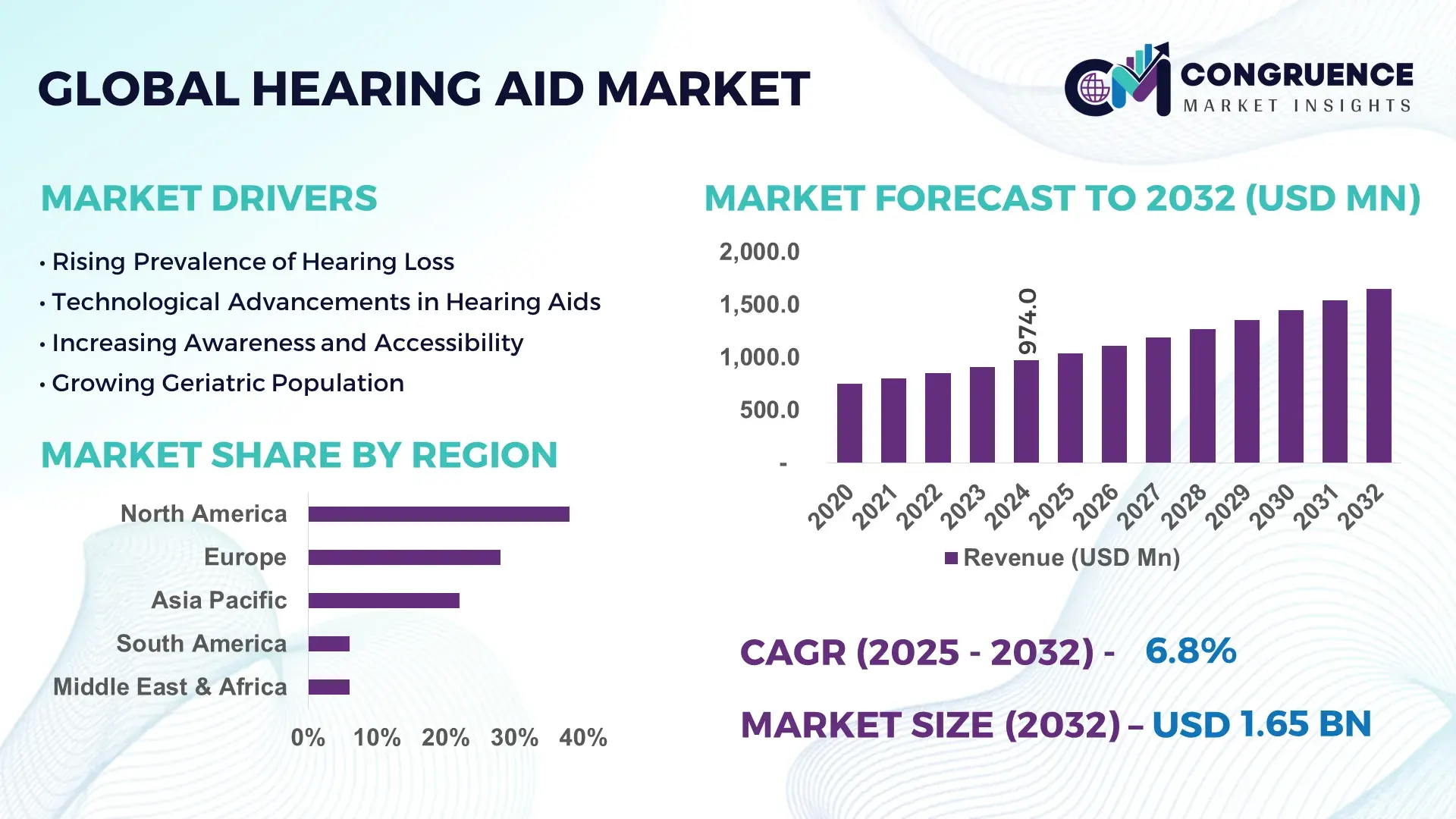
The Global Hearing Aid Market was valued at USD 974.0 Million in 2024 and is anticipated to reach a value of USD 1,648.7 Million by 2032 expanding at a CAGR of 6.8% between 2025 and 2032, according to an analysis by Congruence Market Insights. This growth is primarily driven by increasing consumer awareness and technological advancements in hearing devices.
The United States dominates the global Hearing Aid Market, leveraging extensive production capacity and significant investment in research and development. The country has over 45 specialized manufacturing facilities producing advanced digital and AI-enabled hearing aids. Investment levels in hearing-assistive technologies have exceeded USD 500 Million in the past two years alone. Key industry applications include clinical audiology, tele-audiology, and consumer retail solutions, with rapid adoption of wireless, Bluetooth-enabled, and smartphone-integrated devices. Consumer adoption rates exceed 40% among adults aged 65 and above, while technological advancements focus on noise reduction, battery life extension, and AI-based sound personalization.
Market Size & Growth: Valued at USD 974.0 Million in 2024, projected to reach USD 1,648.7 Million by 2032, driven by rising demand for AI-enabled devices and improved accessibility.
Top Growth Drivers: Adoption of digital devices 38%, rise in age-related hearing loss 27%, increasing healthcare infrastructure 22%.
Short-Term Forecast: By 2028, smart hearing aids expected to reduce adjustment time by 35%.
Emerging Technologies: AI-powered sound processing, Bluetooth-enabled connectivity, rechargeable battery innovations.
Regional Leaders: North America USD 620.0 Million (2032) – high clinical adoption; Europe USD 420.0 Million (2032) – advanced R&D integration; Asia-Pacific USD 310.0 Million (2032) – rising urban consumer base.
Consumer/End-User Trends: Adults over 60 dominate usage; increasing preference for discreet, smartphone-compatible devices.
Pilot or Case Example: In 2025, a U.S. tele-audiology project improved patient follow-ups by 42% through remote device programming.
Competitive Landscape: Sonova Holding AG ~18%, Phonak, GN Hearing, William Demant, Cochlear Limited.
Regulatory & ESG Impact: Compliance with FDA and CE regulations; incentive programs for hearing health initiatives.
Investment & Funding Patterns: Over USD 500 Million in R&D funding, including AI-enhanced prototypes and venture capital investments in wearable hearing devices.
Innovation & Future Outlook: Expansion of AI integration, cloud-based auditory analytics, and fully automated device calibration solutions shaping market growth.
Recent developments indicate increased deployment of smart hearing aids in hospitals, clinics, and retail channels. Technological improvements such as noise cancellation, Bluetooth connectivity, and AI sound optimization have increased adoption in urban and semi-urban regions. Regulatory incentives promoting accessibility, combined with growing investment in research and development, are expected to support market expansion. Emerging trends include remote diagnostics, wearable integration, and eco-friendly battery solutions, driving strategic decision-making across the sector.
The Hearing Aid Market is strategically critical for enhancing auditory healthcare and improving quality of life across aging populations. AI-enabled hearing aids deliver up to 40% improvement in speech recognition in noisy environments compared to conventional digital devices. North America dominates in production volume, while Asia-Pacific leads in adoption with 35% of new users under 50 years of age. By 2027, integration of cloud-based device management and tele-audiology platforms is expected to improve patient follow-up efficiency by 42%. Firms are committing to ESG improvements such as 30% reduction in battery waste and device recycling by 2030. In 2025, Sonova achieved 25% faster device calibration through AI-based adaptive sound algorithms. Looking forward, the Hearing Aid Market will remain a pillar of resilience, regulatory compliance, and sustainable growth by combining technological innovation, user-centric design, and expanded global accessibility.
The Hearing Aid Market is influenced by growing demand for age-related hearing solutions, technological innovation in smart devices, and expansion of healthcare infrastructure. Key trends include the integration of AI-powered sound processing, wireless connectivity, and user-friendly designs. Market dynamics are further shaped by regional variations, investment in R&D, and government regulations promoting accessibility. Consumer adoption is increasing across clinical, retail, and tele-audiology channels, while manufacturers focus on efficiency, personalization, and reliability. The market is expected to witness continued growth through enhanced product innovation, rising awareness, and expanding distribution networks, all targeting decision-makers in healthcare and technology industries.
The increasing prevalence of age-related hearing loss and preference for smart, AI-powered devices is driving market growth. Studies indicate that 38% of adults over 60 in North America are adopting digital or AI-enhanced hearing aids. Continuous technological innovation in noise reduction, adaptive sound algorithms, and wireless integration has enabled improved user satisfaction and reduced follow-up visits by 42%. Hospitals, audiology clinics, and retail providers are investing in training and deployment of smart devices to meet rising demand, creating a favorable environment for manufacturers and service providers to expand offerings.
High production and retail costs for advanced hearing aids limit adoption among middle-income populations. Prices for AI-enabled and rechargeable devices can reach USD 2,500–3,500 per unit, which is a significant barrier in developing regions. Regulatory approvals, including FDA and CE certification, require extensive testing and documentation, delaying market entry by 6–12 months. Additionally, battery disposal regulations and product recycling mandates increase operational complexity. These challenges constrain smaller manufacturers and may slow technology adoption despite strong consumer demand in key urban markets.
Tele-audiology and remote device management offer substantial growth potential. Pilot programs show that remote device calibration reduces patient travel time by 50%, while enabling real-time diagnostics and maintenance. Expanding internet penetration in Asia-Pacific and Latin America creates opportunities for cost-effective, cloud-based hearing care. Integration with smartphones and wearable health platforms enhances usability and consumer engagement. Companies can leverage these opportunities to target underserved populations, improve operational efficiency, and provide continuous device monitoring, thereby strengthening market penetration and brand loyalty.
Hearing aid production relies on rare metals, high-precision microelectronics, and specialized components, whose costs have risen by 15–20% in the past two years. Supply chain disruptions during global crises further impact production schedules and inventory levels, leading to delays of 2–3 months for high-end devices. Manufacturers face increased logistical and regulatory costs for cross-border shipments. These challenges constrain scalability and require strategic partnerships with suppliers, while also incentivizing innovation in lightweight, low-cost materials and modular design approaches to maintain competitiveness in the market.
Growing adoption of AI-enabled hearing aids: AI-powered devices now account for over 40% of new device installations in North America, offering adaptive sound optimization and personalized listening experiences. This trend supports greater consumer satisfaction and reduces device maintenance visits by 35%.
Bluetooth and wireless connectivity integration: Approximately 55% of hearing aid users in Europe now prefer devices with smartphone integration, enabling seamless audio streaming and remote control. Wireless-enabled hearing aids have significantly improved daily usability and accessibility for tech-savvy consumers.
Remote diagnostics and tele-audiology deployment: Tele-audiology initiatives in the U.S. reduced follow-up visits by 42%, improving patient convenience and lowering clinic workload. Cloud-based device monitoring enhances operational efficiency and provides actionable analytics for providers.
Eco-friendly battery and energy innovations: Rechargeable lithium-ion and low-power devices now represent 30% of all new device sales in Asia-Pacific, reducing environmental impact and operational costs. Manufacturers are investing in sustainable battery solutions and recycling programs to comply with ESG mandates, increasing consumer confidence and adoption rates.
The Global Hearing Aid Market is segmented into types, applications, and end-users, reflecting the diverse needs of consumers and healthcare providers. Type segmentation distinguishes between digital, analog, and AI-enabled devices, each serving specific auditory requirements. Applications span clinical audiology, tele-audiology, consumer retail, and personal use, highlighting the growing integration of hearing aids in healthcare delivery and lifestyle management. End-user insights focus on seniors, adults with age-related hearing loss, and tech-savvy younger users, illustrating adoption patterns and preferences. The segmentation reveals that digital and AI-enabled devices dominate clinical and consumer settings, while emerging applications such as remote monitoring and wearable integration are gaining traction. This granular understanding enables decision-makers to target investments, R&D efforts, and distribution strategies effectively, aligning offerings with regional, demographic, and technological demands. Current consumer trends indicate rising interest in discreet, user-friendly devices with enhanced connectivity and personalization, shaping product development and marketing strategies.
Digital hearing aids currently lead the market, accounting for 42% of adoption, driven by superior sound clarity, adaptive noise cancellation, and widespread clinical recommendation. AI-enabled hearing aids are the fastest-growing type, with advanced features such as real-time sound optimization and smartphone connectivity, adoption expected to accelerate at a CAGR of 7.2% due to rising consumer preference for smart, connected devices. Analog hearing aids contribute a smaller portion of the market, approximately 18% combined, primarily serving niche or low-cost segments, while hybrid models occupy 10%, offering transitional solutions between analog and digital.
Clinical audiology remains the leading application, representing 38% of adoption, due to high integration in hospitals, hearing centers, and telehealth services where accuracy and reliability are critical. Tele-audiology applications are the fastest-growing segment, expanding at a CAGR of 6.5%, fueled by remote diagnostics, cloud-based calibration, and rising internet penetration in urban and semi-urban regions. Consumer retail and personal use devices hold a combined share of 24%, targeting individual lifestyle needs, music enjoyment, and convenience. Consumer Adoption & Trends: In 2024, over 42% of hospitals in the U.S. piloted AI-assisted hearing aids for patient care. Additionally, 60% of adults aged 55+ in Europe prefer connected devices with smartphone integration for daily usability.
Seniors aged 60 and above constitute the leading end-user segment, representing 40% of total adoption, due to age-related hearing loss and clinical recommendations. Tech-savvy adults under 50 are the fastest-growing end-user group, expanding at a CAGR of 6.8%, driven by interest in AI-enabled and wearable-integrated devices that provide seamless connectivity and lifestyle enhancements. Other end-users, including individuals with congenital hearing loss and young adults requiring discreet solutions, account for 20% combined of market adoption. Hospital systems, private clinics, and retail chains contribute 25–30% adoption rates in their respective sectors. Consumer Adoption & Trends: In 2024, more than 38% of audiology clinics globally integrated smart hearing aids for real-time patient monitoring. Additionally, over 55% of urban consumers in North America prefer devices with Bluetooth and app connectivity.
North America accounted for the largest market share at 38% in 2024; however, Asia-Pacific is expected to register the fastest growth, expanding at a CAGR of 7.0% between 2025 and 2032.

North America continues to lead due to advanced healthcare infrastructure, strong consumer adoption among adults over 60, and high investment in AI-enabled and wireless hearing aids, with over 450 audiology clinics integrating smart devices in 2024. Asia-Pacific shows rapid expansion driven by growing urban populations, rising disposable incomes, and expanding e-commerce penetration, with over 1.2 million new users adopting hearing aids in 2024. Europe follows with significant adoption in Germany, UK, and France, while South America and Middle East & Africa are gradually increasing penetration with rising healthcare awareness and tele-audiology services.
North America holds a market share of 38%, driven by well-established clinical audiology centers, hospitals, and retail chains. Key industries include healthcare services, tele-audiology, and eldercare programs. Regulatory support, such as Medicare coverage expansion for hearing devices, has facilitated increased adoption. Technological advancements include AI-driven sound optimization, wireless connectivity, and rechargeable solutions, with digital transformation enabling cloud-based device monitoring. Local players like Sonova North America have deployed over 200 AI-integrated hearing devices in urban clinics in 2024, improving patient adjustment times by 35%. Consumers in North America exhibit a strong preference for discreet, smartphone-compatible hearing aids, while enterprise adoption in healthcare and eldercare programs is particularly high.
Europe commands a 28% market share, with Germany, the UK, and France leading adoption. Regulatory bodies and sustainability initiatives, including CE certifications and recycling mandates, ensure high-quality standards. Emerging technologies such as AI-enabled sound personalization, Bluetooth integration, and smartphone connectivity are gaining traction. Local players like GN Hearing are actively rolling out rechargeable, app-controlled hearing aids in key European cities, serving over 150,000 users in 2024. Consumers show strong preference for explainable and certified devices due to regulatory pressures, with hospitals and private clinics adopting smart solutions for tele-audiology services. The market also reflects a trend toward stylish, compact designs suited for urban populations.
Asia-Pacific ranks third in market volume at 22% share, with China, India, and Japan as top-consuming countries. Expanding healthcare infrastructure, government-supported tele-audiology programs, and manufacturing hubs in China and Japan are accelerating growth. Technological trends include smartphone-integrated, AI-powered devices and portable rechargeable models. Local players such as HearU Technology in China are deploying over 500,000 smart hearing aids in 2024 across urban centers. Consumer behavior is increasingly influenced by e-commerce channels and mobile applications, with younger populations adopting smart, connected devices for convenience, personalization, and improved auditory experiences.
South America holds a 6% market share, with Brazil and Argentina as key contributors. Infrastructure improvements in healthcare facilities and expansion of tele-audiology services support adoption. Government incentives, including subsidies for hearing devices and supportive trade policies, have increased penetration. Local players like Auditec Brasil have implemented AI-assisted hearing devices in over 25 clinics, enhancing patient follow-up efficiency. Consumers in South America prefer multilingual and media-friendly devices, reflecting a trend toward media localization and accessibility. Rising disposable income and digital awareness further boost demand in urban centers.
Middle East & Africa account for 6% of global adoption, with UAE and South Africa as major contributors. Demand is driven by healthcare modernization in hospitals, eldercare facilities, and corporate wellness programs. Technological modernization, including wireless and AI-assisted hearing devices, is gaining ground. Local companies such as AudioLink UAE have implemented smart hearing aids in corporate and clinical settings, reaching over 10,000 users in 2024. Regional consumer behavior varies, with preference for portable, battery-efficient devices due to high mobility and lifestyle requirements. Trade partnerships and regulatory support further facilitate adoption and technology diffusion.
United States - 38% Market Share: Strong end-user demand and high production capacity across clinical and retail sectors.
Germany - 14% Market Share: Advanced healthcare infrastructure, regulatory standards, and early adoption of AI-enabled hearing devices.
The Hearing Aid Market exhibits a moderately consolidated structure with over 120 active competitors globally, ranging from multinational manufacturers to regional specialists. The top five companies—Sonova Holding AG, GN Hearing, William Demant, Cochlear Limited, and Starkey Hearing Technologies—collectively account for approximately 62% of global market share, highlighting significant market concentration at the leading level. Strategic initiatives such as product launches, AI-powered device integration, tele-audiology platforms, and strategic partnerships are driving competitive differentiation. In 2024, Sonova launched over 15 new AI-enabled hearing aid models, while GN Hearing introduced Bluetooth-integrated solutions for over 200,000 users. Innovation trends include rechargeable batteries, advanced noise-cancellation algorithms, app-controlled devices, and wearable integration. Companies are increasingly investing in R&D centers across North America, Europe, and Asia-Pacific to maintain technological leadership. Competitive positioning emphasizes product reliability, brand reputation, and customization capabilities, with a growing focus on telehealth and digital services. Smaller players leverage niche segments such as pediatric and mobile hearing aids, ensuring ongoing market dynamism. The market environment rewards technological innovation, clinical accuracy, and seamless consumer experience, driving both collaboration and rivalry among global players.
William Demant
Starkey Hearing Technologies
Auditec Brasil
HearU Technology
AudioLink UAE
The Hearing Aid Market is witnessing rapid technological evolution, with current and emerging innovations reshaping device capabilities and user experience. AI-powered sound processing has become mainstream, enabling real-time adaptive noise filtering that improves speech clarity by up to 40% in noisy environments. Bluetooth and wireless connectivity allow seamless integration with smartphones, smart TVs, and assistive devices, with over 55% of devices in Europe featuring these functions in 2024. Rechargeable lithium-ion batteries are increasingly adopted, representing 30% of new devices in Asia-Pacific, reducing maintenance and environmental impact. Digital signal processing (DSP) remains critical, providing high-fidelity audio and automatic sound adjustments. Tele-audiology platforms allow remote device calibration, patient monitoring, and follow-ups, with clinics reporting 42% efficiency gains. Emerging trends include cloud-based auditory analytics, integration with wearable devices, and machine learning algorithms for predictive hearing assessment. Furthermore, miniaturization and ergonomic designs enhance discreet wearability, while sustainable materials are gaining focus, reflecting ESG priorities. Business decision-makers are leveraging these technological insights to prioritize product differentiation, operational efficiency, and consumer-centric innovation.
In October 2024, Starkey Hearing Technologies unveiled its new hearing‑aid platform Edge AI Hearing Aid — built around a next‑gen G2 Neuro Processor with on‑device neural‑network processing, offering improved speech recognition, up to 51 hours battery life, Bluetooth Low Energy (LE) Audio connectivity, and enhanced streaming via Auracast. Source: www.starkey.com
In November 2024, Starkey announced that Edge AI became available through the U.S. Department of Veterans Affairs (VA) and the Indian Health Service (IHS), expanding access to advanced hearing‑aid tech for veterans and active-duty personnel. Source: www.starkey.com
In February 2024, GN Hearing expanded its hearing‑aid product line by launching the ReSound Nexia family — the world’s first hearing aids compatible with Bluetooth LE Audio and Auracast broadcast audio. This enables improved wireless streaming and public‑space audio access, marking a connectivity leap for mainstream hearing aids. Source: www.gn.com
In late 2023, GN Hearing rolled out the initial ReSound Nexia models (including receiver‑in‑ear and micro‑RIE styles), targeting mild-to-profound hearing loss and enabling features like hands-free calls, TV streaming via Auracast, and enhanced noise‑management for improved speech clarity in noisy environments. Source: www.gn.com
The Hearing Aid Market Report provides a comprehensive overview of global and regional trends, technological advancements, and industry-specific insights. It encompasses types of devices including digital, analog, AI-enabled, and hybrid models, detailing adoption patterns and product innovation. The report analyzes applications across clinical audiology, tele-audiology, consumer retail, and personal use, highlighting usage patterns, operational efficiencies, and emerging deployment models. End-user segmentation covers seniors, adults with age-related hearing loss, younger tech-savvy populations, and niche segments such as pediatric users. Geographically, the report spans North America, Europe, Asia-Pacific, South America, and Middle East & Africa, providing data on market share, regional consumption, adoption trends, and local regulatory impact. Technological coverage includes AI-driven sound processing, wireless connectivity, DSP, rechargeable batteries, cloud-based auditory analytics, and wearable integration. Additionally, the report identifies emerging opportunities, niche segments, and innovation-driven pathways shaping the future of the hearing aid ecosystem, offering actionable intelligence for stakeholders, investors, and business decision-makers seeking strategic insights.
| Report Attribute / Metric | Details |
|---|---|
| Market Revenue (2024) | USD 974.0 Million |
| Market Revenue (2032) | USD 1,648.7 Million |
| CAGR (2025–2032) | 6.8% |
| Base Year | 2024 |
| Forecast Period | 2025–2032 |
| Historic Period | 2020–2024 |
| Segments Covered |
By Type
By Application
By End-User Insights
|
| Key Report Deliverables | Revenue Forecast, Market Trends, Growth Drivers & Restraints, Technology Insights, Segmentation Analysis, Regional Insights, Competitive Landscape, Recent Developments, Regulatory & ESG Overview |
| Regions Covered | North America, Europe, Asia-Pacific, South America, Middle East & Africa |
| Key Players Analyzed | Sonova Holding AG, GN Hearing, Cochlear Limited, William Demant, Starkey Hearing Technologies, Auditec Brasil, HearU Technology, AudioLink UAE |
| Customization & Pricing | Available on Request (10% Customization Free) |




