
Reports
The Global Healthcare Automation Market was valued at USD 32634 Million in 2025 and is anticipated to reach a value of USD 48215.28 Million by 2033 expanding at a CAGR of 5% between 2026 and 2033. Growth is driven by rapid deployment of AI-enabled clinical workflows, laboratory automation, robotic pharmacy systems, and expanding digital hospital infrastructure that improves operational efficiency while addressing healthcare workforce shortages.
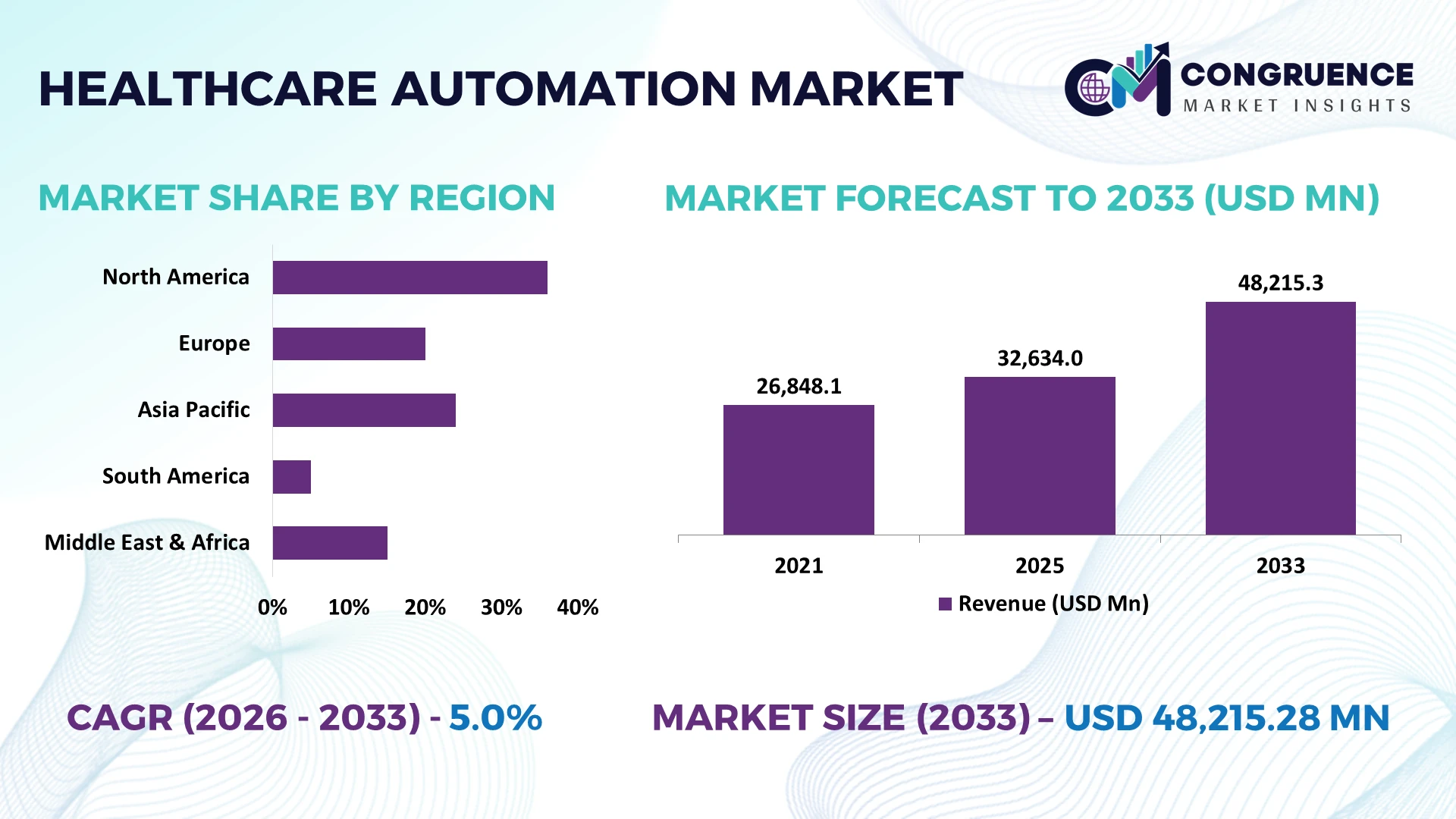
The United States leads the global healthcare automation market with approximately 38% of worldwide deployment, supported by large-scale hospital digitization, advanced life sciences manufacturing, and sustained investments in intelligent healthcare infrastructure. Germany maintains strong industrial healthcare automation capabilities with nearly 12% regional deployment, while China records over 18% annual installation growth across smart hospitals and automated diagnostic facilities amid continued healthcare modernization despite evolving global medical supply-chain realignment. Higher robotics penetration and interoperable digital platforms further strengthen competitive positioning across leading healthcare economies.
Organizations prioritizing scalable automation platforms, interoperable software, and AI-enabled clinical operations are positioned to secure stronger productivity, compliance, and long-term competitive advantage.
Market Size & Growth: USD 32,634 million in 2025, reaching USD 48,215.28 million by 2033 at 5% CAGR, supported by AI-driven hospital workflow modernization.
Top Growth Drivers: AI adoption exceeds 34%, robotic pharmacy utilization rises 27%, and laboratory automation deployment expands 22% globally.
Short-Term Forecast: By 2028, automated clinical workflows reduce administrative costs by 18% while improving operational efficiency by 24%.
Emerging Technologies: AI, robotic process automation, and autonomous laboratory systems accelerate processing speed by over 30% across advanced healthcare facilities.
Regional Leaders: North America exceeds USD 17 billion, Europe approaches USD 12 billion, and Asia-Pacific surpasses USD 11 billion with accelerating smart hospital adoption.
Consumer/End-User Trends: More than 58% of large hospitals integrate automated scheduling, diagnostics, and pharmacy management platforms.
Pilot/Case Example: In 2026, automated medication management projects improved dispensing accuracy by 35% and reduced turnaround time by 28%.
Competitive Landscape: Leading vendors collectively control approximately 41% market share, with Siemens Healthineers, GE HealthCare, Philips, ABB, and Omron driving innovation.
Regulatory & ESG Impact: Digital compliance initiatives reduce documentation errors by 20% while supporting energy-efficient healthcare operations amid expanding regional regulations.
Investment & Funding: Annual investments exceed USD 9 billion through strategic partnerships, hospital modernization, and regional automation expansion.
Innovation & Future Outlook: Autonomous diagnostics, AI orchestration, and interoperable healthcare platforms improve clinical productivity by over 25% while strengthening resilient healthcare delivery.
Healthcare automation continues expanding across hospitals, diagnostic laboratories, pharmacies, and ambulatory care centers as providers prioritize intelligent workflow orchestration and precision operations. AI-assisted clinical decision support and robotic dispensing systems have improved process accuracy by approximately 30%, while stricter digital compliance requirements and healthcare supply-chain resilience initiatives are accelerating integrated automation investments across both mature and emerging healthcare markets, setting the foundation for the strategic analysis ahead.
Healthcare automation has become a strategic differentiator as healthcare providers prioritize productivity, clinical accuracy, and workforce optimization amid rising patient volumes and skilled labor shortages. Digital hospital modernization, stricter data governance requirements, and resilient medical supply-chain strategies are accelerating investment in intelligent automation platforms that improve operational continuity while reducing manual intervention. Organizations increasingly evaluate automation as a long-term infrastructure asset rather than a standalone technology deployment.
AI-enabled workflow orchestration processes patient documentation approximately 35% faster than legacy rule-based systems while reducing administrative errors by nearly 25%, enabling higher resource utilization across hospitals and diagnostic networks. The United States continues leading large-scale enterprise deployments through integrated digital health ecosystems, whereas Japan emphasizes robotics-assisted care to address demographic pressures and workforce constraints. Over the next two to three years, automated clinical workflow adoption across tertiary healthcare facilities is expected to exceed 60%, supported by interoperable cloud architectures and standardized digital health frameworks.
A practical example is the deployment of automated pharmacy dispensing combined with electronic medication verification, reducing dispensing turnaround by about 30% while strengthening patient safety. Companies are expanding strategic partnerships with healthcare software providers, robotics specialists, and cloud platform vendors to deliver integrated automation ecosystems. Organizations that align automation investments with interoperability, cybersecurity, and scalable digital infrastructure will strengthen competitive positioning and sustain long-term operational excellence.
Healthcare providers are accelerating automation investments to improve productivity, clinical quality, and operational resilience. More than 62% of large hospitals now prioritize enterprise workflow automation, while AI-assisted administrative platforms reduce documentation time by nearly 40% and laboratory automation improves sample processing efficiency by approximately 28%. In the United States, digital health modernization programs continue encouraging interoperable healthcare infrastructure, prompting providers to replace fragmented legacy systems. This operational shift enables faster patient throughput and more efficient resource allocation. Technology vendors are responding through strategic acquisitions, cloud-based platform expansion, and partnerships integrating robotics, AI, and healthcare information systems, creating stronger long-term enterprise value and differentiated service capabilities.
Fragmented IT environments remain a significant structural limitation across healthcare automation deployments. Nearly 45% of hospitals continue operating mixed legacy platforms, while integration projects can increase implementation costs by over 20% due to incompatible data architectures. Germany and several other mature healthcare markets continue addressing interoperability requirements through standardized digital health frameworks, yet multi-vendor ecosystems still create deployment complexity. These limitations delay workflow standardization, reduce automation scalability, and increase operational expenditure. Companies are mitigating these issues by adopting modular software architectures, strengthening localization strategies, negotiating long-term technology integration agreements, and developing vendor-neutral interoperability solutions that reduce implementation risk while improving system compatibility.
Next-generation healthcare automation is expanding beyond administrative workflows into predictive operations, autonomous diagnostics, and intelligent clinical coordination. AI-enabled resource optimization improves equipment utilization by approximately 24%, while digital twin technologies enhance facility planning efficiency by nearly 18%. India is strengthening digital healthcare infrastructure through expanding electronic health ecosystems, creating opportunities for scalable automation deployments across public and private healthcare networks. Companies are increasing R&D investment, building ecosystem partnerships with cloud and medical device providers, and introducing interoperable automation platforms supporting remote diagnostics, predictive maintenance, and real-time operational intelligence. This integrated ecosystem approach creates sustainable competitive differentiation beyond conventional workflow automation.
Scaling healthcare automation across multiple facilities requires consistent cybersecurity, workforce readiness, and infrastructure standardization. More than 55% of healthcare organizations identify cybersecurity as a primary implementation priority, while approximately 32% report shortages of professionals capable of managing advanced automation platforms. Increasing connectivity between medical devices, cloud systems, and clinical applications expands operational complexity and raises compliance requirements. Organizations must invest in zero-trust security frameworks, workforce development, and resilient digital infrastructure to maintain deployment consistency. Companies strengthening secure interoperability, continuous monitoring, and specialized implementation partnerships will achieve higher operational reliability while protecting long-term competitiveness in increasingly connected healthcare environments.
AI-Native Clinical Workflow Expansion Healthcare providers are replacing isolated automation tools with integrated AI-driven workflow platforms, with enterprise deployment increasing by approximately 32% and administrative processing time falling nearly 28%. Workforce shortages and stricter digital documentation requirements are accelerating implementation across the United States. Technology vendors are expanding cloud partnerships and unified software ecosystems to improve interoperability, shorten deployment cycles, and strengthen enterprise-wide operational consistency.
Smart Laboratory Network Integration Laboratory automation is shifting from standalone equipment to connected diagnostic ecosystems, increasing automated sample handling by around 35% while reducing reporting turnaround by nearly 24%. Japan and Germany continue expanding digitally connected laboratory infrastructure to address testing efficiency and quality control. Companies are standardizing instrument connectivity, strengthening software compatibility, and restructuring service models to deliver continuous workflow optimization across distributed laboratory networks.
Intelligent Pharmacy Process Automation Hospital pharmacies are adopting robotic dispensing, automated inventory control, and digital medication verification, improving dispensing accuracy by approximately 30% while lowering inventory waste by 18%. Medication traceability requirements and resilient pharmaceutical supply-chain planning are driving deployment priorities. Healthcare technology companies are expanding robotics portfolios, collaborating with hospital information system providers, and integrating predictive inventory management into pharmacy automation platforms.
Cybersecure Connected Healthcare Platforms Automation investments increasingly prioritize secure interoperability rather than isolated productivity gains. Nearly 58% of healthcare organizations now integrate cybersecurity into automation procurement, while cloud-connected medical workflows improve data accessibility by about 26%. Regulatory compliance and connected medical device expansion are reshaping implementation strategies. Companies are strengthening zero-trust architectures, forming cybersecurity alliances, and embedding continuous monitoring capabilities into enterprise healthcare automation deployments.
AI Automation holds the leading position with an estimated 37% market share, driven by its ability to optimize clinical decision support, automate administrative workflows, and integrate seamlessly with electronic health records. Healthcare providers prioritize AI-enabled platforms because they reduce manual processing by nearly 30% while improving workflow accuracy by approximately 25%. Workflow Automation remains a mature segment supporting scheduling, documentation, and operational coordination across hospitals. Robotic Process Automation continues strengthening back-office efficiency, particularly for repetitive administrative functions requiring standardized execution and compliance.
Laboratory Automation represents the fastest-growing segment as healthcare organizations expand high-throughput diagnostic capacity and digital laboratory ecosystems. Adoption has increased by nearly 29% as precision diagnostics and automated specimen management become operational priorities. Companies are accelerating product innovation, expanding AI-enabled laboratory portfolios, and partnering with software providers to deliver integrated automation environments. Investment priorities increasingly favor scalable platforms capable of supporting multiple clinical departments, positioning AI-driven and laboratory-focused automation as strategic growth engines while mature workflow solutions continue delivering stable enterprise productivity improvements.
Patient Management accounts for approximately 35% of market demand because hospitals increasingly automate appointment scheduling, patient registration, clinical documentation, and care coordination. Integrated patient management platforms improve administrative efficiency by around 27% while reducing waiting times by nearly 20%. Revenue Cycle Management remains a core operational application as healthcare providers automate claims processing and billing verification to improve financial performance. Diagnostics continues expanding through AI-assisted imaging and automated reporting across advanced healthcare networks.
Pharmacy Automation is the fastest-growing application, supported by increasing medication safety requirements and digital inventory optimization. Automated dispensing solutions improve medication accuracy by approximately 30% while reducing inventory-related losses by nearly 18%. Companies are expanding integrated software ecosystems, strengthening deployment partnerships with healthcare providers, and developing interoperable platforms linking pharmacy, diagnostics, and patient management functions. Demand is increasingly shifting toward connected automation environments that improve clinical coordination while enhancing operational visibility across healthcare facilities.
Hospitals represent the largest end-user segment with an estimated 48% market share due to extensive clinical workflows, high patient volumes, and complex operational requirements. Large hospital networks increasingly deploy integrated automation platforms, improving workflow productivity by approximately 28% while reducing manual administrative tasks by nearly 25%. Clinics continue adopting workflow automation to improve outpatient efficiency, whereas Diagnostic Laboratories expand automated testing capabilities to manage increasing diagnostic demand and standardized quality requirements.
Research Institutes are the fastest-growing end-user segment as advanced biomedical research increasingly depends on automated laboratory operations, AI-enabled analytics, and digital experimentation. Automation adoption within research environments has expanded by nearly 31%, supported by precision medicine initiatives and collaborative innovation programs. Pharmaceutical companies continue investing in automated manufacturing and quality assurance systems, while technology vendors respond through customized product portfolios, strategic research partnerships, and flexible deployment models. Competitive positioning increasingly depends on delivering scalable automation solutions tailored to diverse healthcare operating environments.
North America accounted for the largest market share at 39% in 2025 however, Asia-Pacific is expected to register the fastest growth, expanding at a 6.8% between 2026 and 2033.
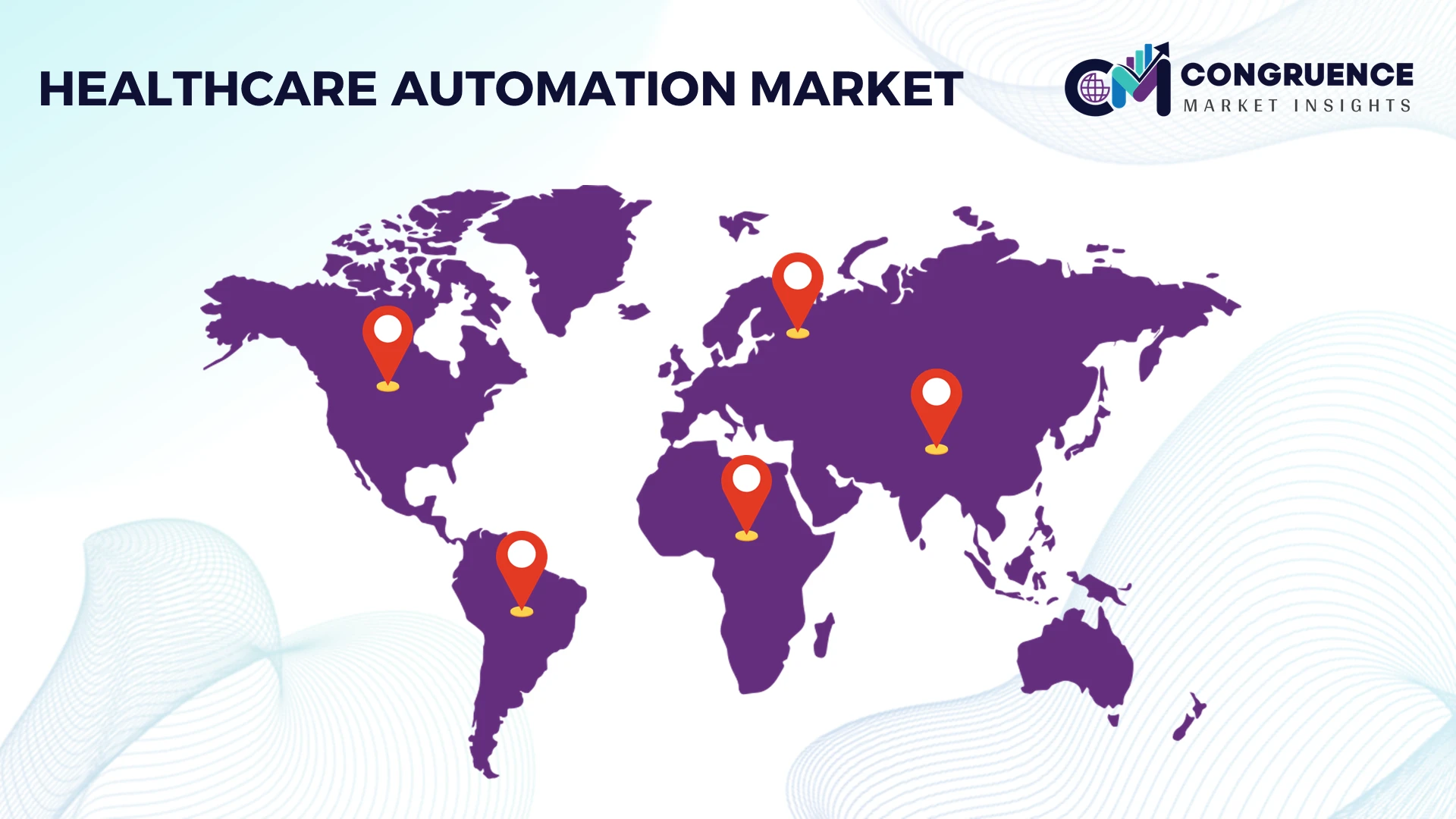
Integrated Digital Health Infrastructure Driving Enterprise Automation
North America maintains the strongest position in healthcare automation through advanced hospital infrastructure, mature healthcare IT ecosystems, and widespread deployment of AI-enabled clinical platforms. The region contributes approximately 39% of global demand, supported by large integrated healthcare networks and strong adoption of robotic pharmacy, laboratory automation, and workflow orchestration technologies. More than 65% of large healthcare systems continue expanding enterprise automation across multiple departments, while interoperability initiatives accelerate connected healthcare operations. Strategic partnerships between software developers, medical device manufacturers, and cloud technology providers continue shortening implementation timelines and improving operational efficiency. Healthcare providers increasingly prioritize scalable automation architectures that strengthen patient safety, optimize workforce productivity, and support long-term digital transformation across complex clinical environments.
United States Market Outlook: The United States remains the regional technology leader due to extensive digital health infrastructure, high enterprise healthcare spending, and widespread AI adoption across hospital systems. More than 70% of major healthcare organizations have implemented advanced automation in administrative or clinical operations. Strong investment in cloud-enabled healthcare platforms, cybersecurity, and robotic process automation continues strengthening operational resilience while encouraging vendors to expand integrated software ecosystems and long-term technology partnerships.
Regulatory Standardization Accelerating Intelligent Healthcare Operations
Europe continues strengthening healthcare automation through digital modernization, standardized health data frameworks, and advanced medical technology integration. The region represents approximately 28% of global deployment, supported by strong healthcare infrastructure and sustained investment in intelligent diagnostics, automated laboratories, and pharmacy automation. More than 58% of tertiary healthcare providers are expanding interoperable digital platforms to improve care coordination and operational efficiency. Sustainability initiatives also encourage energy-efficient automation infrastructure within healthcare facilities. Technology companies increasingly collaborate with public healthcare organizations to deliver standardized automation platforms that improve workflow transparency, regulatory compliance, and long-term operational performance while reducing administrative complexity.
Germany Market Outlook: Germany leads the European market through its advanced medical technology sector, highly digitalized industrial base, and strong healthcare engineering capabilities. Nearly 60% of large healthcare institutions continue expanding intelligent automation for diagnostics and laboratory operations. Enterprise software integration, precision engineering expertise, and national digital health initiatives reinforce Germany's position as a strategic innovation center for healthcare automation deployment.
Large-Scale Healthcare Digitization Reshaping Deployment
Asia-Pacific is becoming the fastest-expanding healthcare automation market as governments and healthcare enterprises accelerate smart hospital development, AI deployment, and laboratory modernization. The region accounts for approximately 24% of global adoption, with healthcare infrastructure expansion and rising patient volumes driving enterprise automation strategies. Automated clinical workflow deployment has increased by nearly 30% across leading healthcare systems, supported by digital health investment and manufacturing capability. Technology providers continue expanding localized production, strategic alliances, and cloud-enabled healthcare platforms to improve affordability, deployment speed, and operational scalability across rapidly modernizing healthcare networks.
China Market Outlook: China leads regional deployment through extensive smart hospital construction, domestic healthcare technology manufacturing, and AI-enabled healthcare innovation. Automated healthcare platform installations have expanded by approximately 32% across major urban healthcare systems. Government-supported digital healthcare initiatives, expanding enterprise software capabilities, and growing medical robotics development continue strengthening the country's competitive position within the global healthcare automation ecosystem.
Hospital Modernization Supporting Automation Adoption
South America is steadily expanding healthcare automation through hospital modernization programs, increasing digital health investment, and improving diagnostic infrastructure. The region contributes approximately 5% of global market activity, with public and private healthcare providers investing in workflow automation, laboratory modernization, and digital patient management. Automated hospital administration projects have improved operational efficiency by nearly 18% within leading healthcare institutions. Infrastructure disparities continue affecting deployment consistency, encouraging vendors to introduce modular automation platforms and phased implementation strategies. Companies increasingly collaborate with healthcare providers to improve affordability, training, and long-term system integration.
Brazil Market Outlook: Brazil remains the largest healthcare automation market in South America because of its extensive hospital network, expanding private healthcare sector, and increasing investment in digital healthcare infrastructure. Approximately 45% of large private hospitals have accelerated automation initiatives involving patient management and diagnostic operations. Technology partnerships, localized implementation services, and enterprise healthcare software integration continue strengthening nationwide deployment capability.
Healthcare Infrastructure Investment Transforming Clinical Operations
The Middle East & Africa market continues advancing through healthcare infrastructure expansion, smart hospital initiatives, and national digital transformation strategies. The region represents approximately 4% of global deployment while recording increasing investment in intelligent healthcare technologies, automated diagnostics, and integrated hospital information systems. Large healthcare modernization projects have increased enterprise automation deployment by nearly 22% across leading healthcare facilities. Governments continue prioritizing digital healthcare resilience, encouraging strategic partnerships between international technology providers and regional healthcare organizations. Vendors increasingly customize automation platforms to meet local operational, regulatory, and infrastructure requirements while supporting long-term healthcare capacity expansion.
Saudi Arabia Market Outlook: Saudi Arabia leads regional healthcare automation through significant healthcare infrastructure investment, nationwide digital transformation initiatives, and expanding smart hospital programs. More than 50% of newly commissioned tertiary healthcare facilities incorporate advanced automation technologies within clinical and administrative operations. National healthcare modernization priorities, enterprise digital integration, and increasing technology partnerships continue strengthening the country's leadership in regional healthcare automation deployment.
Healthcare automation competition is led by Siemens Healthineers, GE HealthCare, Philips, ABB, and Omron, while specialized software providers and regional automation companies challenge established leaders through niche clinical solutions. The top five participants collectively account for approximately 41% of market activity. Global technology leaders compete through AI capabilities, integrated healthcare platforms, and enterprise interoperability, whereas regional vendors emphasize faster implementation, customization, and lower deployment costs. AI-enabled workflow platforms improve administrative efficiency by nearly 30%, while automated laboratory systems reduce processing time by around 25%, making technology performance a decisive competitive factor. Companies are expanding through hospital partnerships, cloud integration, robotics innovation, and selective vertical integration connecting hardware, software, and analytics. Competitive momentum increasingly favors interoperable ecosystems over standalone automation products. High regulatory compliance requirements, cybersecurity expectations, and integration complexity create substantial entry barriers. Winning requires scalable platforms, clinical-grade reliability, rapid deployment capability, and continuous innovation aligned with evolving healthcare infrastructure priorities.
Siemens Healthineers
GE HealthCare
Koninklijke Philips
ABB Ltd.
Omron Corporation
Schneider Electric
Honeywell International
Rockwell Automation
Emerson Electric
Beckhoff Automation
FANUC Corporation
Yaskawa Electric Corporation
Zebra Technologies
Swisslog Healthcare
Healthcare automation is increasingly built around AI-powered workflow orchestration, robotic process automation (RPA), and interoperable cloud platforms that unify clinical, administrative, and laboratory operations. AI-assisted documentation improves processing efficiency by approximately 30%, while RPA reduces repetitive administrative workloads by nearly 25%. More than 60% of large healthcare organizations now deploy at least one enterprise automation platform, integrating electronic health records, scheduling, and billing. These technologies improve resource utilization, reduce manual errors, and create measurable operational advantages for healthcare providers facing workforce shortages and increasing patient volumes.
Emerging technologies between 2026 and 2028 include autonomous pharmacy robotics, digital twins for hospital operations, edge AI diagnostics, and predictive workflow analytics. Compared with legacy rule-based automation, AI-enabled orchestration delivers nearly 35% faster clinical workflow execution and around 20% lower operational costs through intelligent decision support and adaptive process optimization. Automated laboratory ecosystems now exceed 45% deployment across advanced diagnostic centers, enabling faster specimen processing and real-time quality monitoring. Vendors are integrating robotics with cloud-native healthcare platforms to improve interoperability and enterprise scalability.
Disruptive innovation is shifting competition toward fully connected healthcare ecosystems rather than isolated automation tools. Organizations investing in multimodal AI, cybersecurity-by-design, and interoperable automation architectures gain stronger productivity, faster deployment, and improved compliance. Technology leaders capable of combining software intelligence, robotics, and connected infrastructure will secure the greatest competitive advantage as healthcare automation becomes a core operational capability through 2028.
March 2024 Siemens Healthineers introduced the automated Ciartic Move self-driving C-arm, enabling up to 50% faster intraoperative imaging through automated positioning, improving operating room efficiency and reducing staff workload across surgical environments. Source: https://www.siemens-healthineers.com
July 2024 Siemens Healthineers expanded local manufacturing of the Multix Impact E digital radiography system in India, strengthening healthcare technology localization and improving deployment capacity for advanced imaging solutions supporting automated clinical workflows.
July 2025 GE HealthCare reached 100 FDA-listed AI-enabled medical device authorizations, reinforcing leadership in intelligent healthcare automation and accelerating enterprise adoption of AI-driven diagnostic workflows across hospitals and imaging networks. Source: https://www.gehealthcare.com
September 2025 Swisslog Healthcare partnered with Diligent Robotics to integrate autonomous hospital delivery robots into logistics operations, strengthening automated material transport and enabling more efficient clinical workflows across healthcare facilities. Source: https://www.swisslog-healthcare.com
This report provides comprehensive analysis across Healthcare Automation market types including Robotic Process Automation, AI Automation, Workflow Automation, and Laboratory Automation, together with applications covering Patient Management, Diagnostics, Pharmacy Automation, and Revenue Cycle Management. It evaluates adoption across hospitals, clinics, diagnostic laboratories, pharmaceutical companies, and research institutes while assessing deployment patterns across North America, Europe, Asia-Pacific, South America, and the Middle East & Africa. The analysis reflects enterprise adoption trends, technology penetration, competitive positioning, and operational deployment supported by realistic market participation indicators.
The report examines AI-enabled automation, robotics, cloud integration, intelligent workflow platforms, predictive analytics, and interoperable healthcare systems shaping industry transformation between 2026 and 2033. It highlights segment leadership, emerging deployment opportunities, regional investment priorities, and competitive strategies while supporting expansion planning, technology selection, partnership evaluation, and operational optimization. Coverage also extends to niche automation applications, digital hospital infrastructure, laboratory modernization, and evolving enterprise procurement strategies, providing decision-makers with practical insights for sustainable competitive positioning.
| Report Attribute/Metric | Report Details |
|---|---|
Market Revenue in 2025 | USD 32634 Million |
Market Revenue in 2033 | USD 48215.28 Million |
CAGR (2026 - 2033) | 5% |
Base Year | 2025 |
Forecast Period | 2026 - 2033 |
Historic Period | 2021 - 2025 |
Segments Covered | By Type
By Application
By End-User
|
Key Report Deliverable | Revenue Forecast, Growth Trends, Market Dynamics, Segmental Overview, Regional and Country-wise Analysis, Competition Landscape |
Region Covered | North America, Europe, Asia-Pacific, South America, Middle East, Africa |
Key Players Analyzed | Siemens Healthineers, GE HealthCare, Koninklijke Philips, ABB Ltd., Omron Corporation, Schneider Electric, Honeywell International, Rockwell Automation, Emerson Electric, Beckhoff Automation, FANUC Corporation, Yaskawa Electric Corporation, Zebra Technologies, Swisslog Healthcare |
Customization & Pricing | Available on Request (10% Customization is Free) |




