
Reports
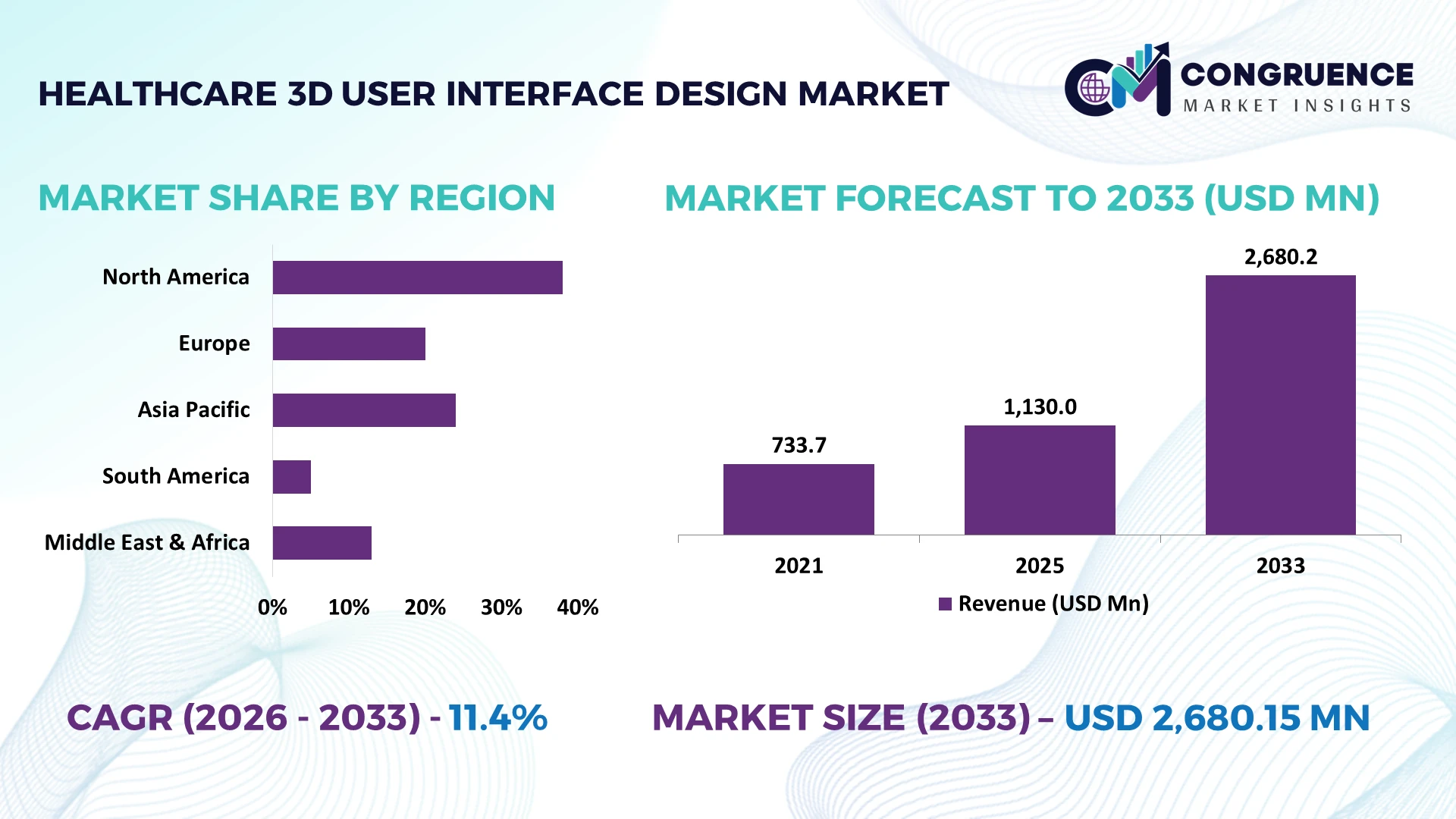
The Global Healthcare 3D User Interface Design Market was valued at USD 1130 Million in 2025 and is anticipated to reach a value of USD 2680.15 Million by 2033 expanding at a CAGR of 11.4% between 2026 and 2033. Growth is driven by surgical navigation modernization, immersive medical training, AI assisted volumetric imaging, spatial computing adoption, and integration of interactive anatomical visualization into clinical workflows.
The United States leads the Healthcare 3D User Interface Design Market, with an estimated 39% global share in 2025, supported by advanced medical imaging infrastructure, surgical robotics developers, and spatial computing innovation. Companies including GE HealthCare, Siemens Healthineers, and Intuitive Surgical support clinical visualization development. The FDA's medical device software oversight influences deployment standards, while 3D anatomical reconstruction strengthens surgical planning. Compared with Germany, the United States benefits from greater digital health venture activity and a larger hospital technology procurement ecosystem.
Strategically, healthcare technology providers targeting 15% faster imaging interpretation and 20% shorter surgical planning workflows through validated 3D interfaces strengthen clinical differentiation and enterprise adoption.
Market Size & Growth: USD 1,130 million in 2025, reaching USD 2,680.15 million by 2033 at 11.4% CAGR, driven by immersive clinical visualization.
Top Growth Drivers: Modeled contribution: 40% advanced imaging adoption, 35% surgical navigation modernization, and 25% immersive medical training expansion.
Short Term Forecast: By 2028, optimized 3D interfaces target 20% faster anatomical visualization and 15% shorter clinical planning workflows.
Emerging Technologies: AI segmentation, extended reality, and gesture controlled interfaces target 25% faster interaction with complex volumetric datasets.
Regional Leaders: Illustrative 2033 allocations: North America USD 1,125.66 million, Europe USD 750.44 million, and Asia Pacific USD 589.63 million.
Consumer / End User Trends: Modeled hospital adoption represents 45% of demand, reflecting integration with radiology, surgical planning, and clinical education.
Pilot / Case Example: In 2024, Apple Vision Pro healthcare demonstrations showcased immersive anatomical visualization; modeled workflow improvements target 20% faster spatial review.
Competitive Landscape: Siemens Healthineers holds an illustrative 15% segment position; GE HealthCare, Philips, Intuitive Surgical, and Surgical Theater provide competition.
Regulatory & ESG Impact: FDA software oversight strengthens validation requirements; modeled digital visualization workflows target 15% lower physical training material consumption.
Investment & Funding: An illustrative USD 500 million investment scenario prioritizes spatial computing platforms, clinical visualization software, and hospital integration partnerships.
Innovation & Future Outlook: By 2033, AI enabled spatial interfaces and digital twins target 30% faster interactive anatomical analysis and broader clinical workflow integration.
The Healthcare 3D User Interface Design Market encompasses interactive medical imaging, surgical navigation, immersive training, anatomical modeling, and spatial computing applications. Hospitals increasingly require intuitive visualization of complex CT, MRI, and ultrasound datasets to support procedural planning and multidisciplinary collaboration. AI driven segmentation, mixed reality headsets, and touchless interaction technologies are transforming how clinicians interpret volumetric information. In modeled deployment scenarios, optimized 3D interfaces reduce manual anatomical reconstruction time by 20%, improving specialist productivity. Regulatory requirements for clinical software validation are also encouraging partnerships between medical device manufacturers, software developers, and healthcare institutions, establishing the foundation for strategic technology investment.
Healthcare 3D user interface design is becoming strategically important as hospitals transition from conventional image viewing toward interactive anatomical visualization, immersive surgical planning, and spatially integrated clinical workflows. The shift from isolated imaging workstations to interoperable visualization platforms creates competitive opportunities for medical device manufacturers and software developers. United States healthcare institutions are prioritizing advanced imaging integration, while FDA oversight of medical software reinforces clinical validation requirements. An estimated 45% of modeled market demand originates from hospitals, emphasizing enterprise procurement and workflow compatibility.
AI assisted volumetric reconstruction and interactive 3D interfaces target 20% shorter anatomical planning workflows compared with conventional manual image interpretation under modeled operating conditions. Automated segmentation also targets 15% fewer manual processing steps. Germany benefits from established medical imaging engineering capabilities, while the United States leads specialized clinical software development and spatial computing investment. Between 2026 and 2028, hospitals are expected to prioritize validated visualization platforms integrating CT, MRI, and surgical navigation data.
Surgical Theater's immersive planning technology demonstrates practical deployment of patient specific anatomical visualization. Siemens Healthineers, GE HealthCare, and emerging software developers are strengthening integration partnerships and clinical workflow capabilities. Competitive advantage increasingly depends on visualization accuracy, interoperability, and measurable improvements in procedural planning efficiency.
Hospitals are expanding interactive 3D visualization capabilities to support complex anatomical interpretation, surgical planning, and multidisciplinary clinical decisions. CT and MRI datasets increasingly require volumetric reconstruction rather than conventional two dimensional review alone. In modeled hospital workflows, AI assisted segmentation targets 20% shorter anatomical preparation time, while interactive spatial visualization targets 15% faster specialist review. An estimated 45% of market demand originates from hospital applications, emphasizing enterprise integration requirements. United States medical technology companies are strengthening imaging software platforms and surgical navigation partnerships. GE HealthCare and Siemens Healthineers continue developing advanced visualization capabilities. Providers combining anatomical accuracy with existing imaging infrastructure gain procurement advantages by reducing workflow fragmentation and specialist preparation requirements.
Healthcare 3D interface deployment faces substantial infrastructure requirements involving graphics processing, imaging data storage, specialized displays, and clinical software integration. Hospitals operating heterogeneous PACS, electronic health records, and imaging equipment encounter compatibility limitations that increase implementation complexity. In illustrative procurement scenarios, integration expenses represent 25% of total deployment expenditure, while specialized hardware accounts for another 20%. Legacy imaging systems also require additional data conversion and interface customization. Germany's healthcare digitalization initiatives emphasize interoperability and secure medical information exchange, increasing expectations for standardized integration. Technology providers are responding through modular software architecture, cloud compatible visualization, and vendor neutral imaging interfaces. Commercial scalability depends on minimizing infrastructure replacement while preserving clinical data integrity and operational continuity.
AI assisted anatomical reconstruction, mixed reality interfaces, and cloud based visualization create opportunities beyond conventional radiology workstations. Interactive surgical planning enables specialists to examine patient specific anatomy collaboratively without requiring identical physical equipment at every location. In modeled deployment scenarios, automated segmentation targets 25% faster model preparation, while remote visualization workflows reduce specialist coordination time by 20%. Gesture controlled interfaces also target 15% fewer manual interaction steps during procedural review. India's expanding tertiary hospital networks provide opportunities for scalable cloud visualization and remote specialist collaboration. Medical technology companies are developing interoperable spatial computing platforms, subscription based visualization services, and hospital partnerships. The strongest opportunity lies in distributing advanced planning capabilities across multiple facilities without duplicating specialized workstation infrastructure.
Scaling healthcare 3D interfaces requires consistent anatomical accuracy, low latency rendering, cybersecurity protection, and reliable performance across different clinical environments. High resolution volumetric datasets place substantial processing demands on real time visualization systems, particularly during image guided procedures. In modeled operating scenarios, 10% rendering latency increases reduce interaction responsiveness, while 15% higher data processing requirements intensify infrastructure pressure. FDA oversight of medical device software reinforces expectations for clinical validation, risk management, and software lifecycle controls. United States hospitals must also protect sensitive imaging information under HIPAA requirements. Developers are investing in optimized rendering engines, secure cloud architecture, and standardized validation protocols. Long term competitiveness depends on maintaining clinical reliability while integrating advanced visualization into time sensitive medical workflows.
Sterile Interaction Interfaces Gain Clinical Priority: Operating rooms are increasingly evaluating touchless visualization controls to limit unnecessary contact with shared equipment during procedures. Gesture recognition systems target a modeled 15% reduction in manual display interactions, while voice assisted navigation targets 10% faster image selection. Medical device developers are refining sterile workflow compatibility and command recognition accuracy, strengthening usability during complex surgical procedures without disrupting established infection prevention protocols.
Multimodal Interface Standardization Reshapes Procurement: United States healthcare providers increasingly prioritize platforms supporting multiple interaction methods across clinical departments. Standardized interface components target 20% lower software customization requirements and 15% shorter staff onboarding periods in illustrative enterprise deployments. Medical technology companies are consolidating interface libraries and establishing common interaction patterns, reducing maintenance complexity across radiology, surgery, and medical education environments while improving enterprise purchasing efficiency.
Haptic Feedback Enhances Procedural Simulation: Medical training developers are integrating force feedback mechanisms into interactive anatomical environments to reproduce tissue resistance and instrument handling. Advanced haptic systems target 20% better procedural consistency and 15% fewer repeated simulation exercises under modeled training conditions. Simulation providers are strengthening partnerships with medical colleges and surgical educators, emphasizing competency assessment and repeatable practice rather than visualization quality alone.
Accessibility Standards Influence Interface Architecture: Healthcare software teams are redesigning interactive displays to support clinicians with differing visual, motor, and interaction requirements. Accessibility focused development targets 15% fewer navigation errors and 10% shorter task completion times in illustrative usability evaluations. United States procurement teams increasingly assess interface accessibility alongside clinical functionality, encouraging developers to incorporate adjustable controls, alternative navigation methods, and consistent visual hierarchy into medical visualization products.
Touch-Based 3D Interfaces represent the leading segment, accounting for an estimated 35% of the global Healthcare 3D User Interface Design Market in 2025. Their dominance reflects established touchscreen infrastructure, intuitive anatomical manipulation, and compatibility with existing medical imaging workstations. Hospitals and diagnostic imaging centers use touch interaction for rotating volumetric models, adjusting image planes, and reviewing anatomical structures. Gesture-Based Interfaces account for approximately 25%, supported by sterile operating room requirements and contactless interaction preferences. Voice-Controlled Interfaces represent an estimated 15%, enabling hands free navigation where physical interaction is restricted. Medical software developers are strengthening multimodal interface compatibility to accommodate different clinical environments.
Haptic Interfaces contribute approximately 15%, particularly in procedural simulation and surgical training applications. Motion-Tracking Interfaces represent approximately 10% and are positioned as the fastest expanding segment through spatial navigation, instrument tracking, and immersive clinical interaction. Advanced tracking technologies support dynamic anatomical positioning and more responsive virtual environments. Technology providers are investing in sensor integration, tracking accuracy, and interoperable interface platforms. Competitive differentiation increasingly depends on balancing interaction precision, deployment costs, and clinical workflow compatibility.
Medical Imaging Visualization represents the leading application, accounting for an estimated 35% of global market activity in 2025. Its dominance reflects widespread CT, MRI, and ultrasound utilization across hospitals and diagnostic imaging facilities. Interactive 3D interfaces enable clinicians to manipulate anatomical reconstructions, assess complex structures, and communicate imaging findings more effectively. Surgical Planning contributes approximately 30%, supported by patient specific anatomical modeling and integration with procedural navigation systems. Medical Training and Simulation represents an estimated 20%, enabling repeatable procedural practice and interactive anatomical education. Healthcare technology providers are expanding visualization software capabilities and improving compatibility with established clinical imaging infrastructure.
Rehabilitation accounts for approximately 10% and represents the fastest expanding application in modeled deployment scenarios, supported by interactive movement assessment, virtual therapeutic environments, and personalized exercise monitoring. Patient Monitoring contributes approximately 5%, incorporating spatial dashboards and interactive physiological visualization. Rehabilitation technology developers are strengthening motion tracking capabilities and clinician feedback tools. Competitive investment increasingly favors applications combining measurable clinical engagement, repeatable workflows, and scalable software deployment across multiple healthcare facilities.
Hospitals represent the largest end user segment, accounting for an estimated 45% of the global Healthcare 3D User Interface Design Market in 2025. Their leadership reflects concentrated imaging infrastructure, surgical procedure volumes, and demand for integrated clinical visualization platforms. Diagnostic Imaging Centers account for approximately 25%, emphasizing volumetric reconstruction, anatomical interpretation, and radiology workflow efficiency. Medical Colleges contribute an estimated 15%, supported by interactive anatomy education and procedural simulation requirements. Healthcare technology companies are developing configurable visualization interfaces and enterprise licensing models to support deployment across clinical departments and affiliated facilities.
Research Institutes represent approximately 10% and are positioned as the fastest expanding end user segment through experimental spatial interfaces, advanced anatomical modeling, and human computer interaction research. Rehabilitation Centers contribute approximately 5%, using interactive visualization for movement assessment and therapeutic engagement. Research institutions prioritize customizable development environments and specialized hardware compatibility, while rehabilitation providers emphasize accessible interfaces and operational affordability. Vendors are strengthening academic partnerships, modular software offerings, and specialized implementation services to address these distinct procurement requirements.
North America accounted for the largest market share at an estimated 42% in 2025 however, Asia Pacific is expected to register the fastest growth, expanding at a CAGR of an estimated 14.2% between 2026 and 2033.
Advanced Surgical Visualization Strengthens Enterprise Technology Leadership
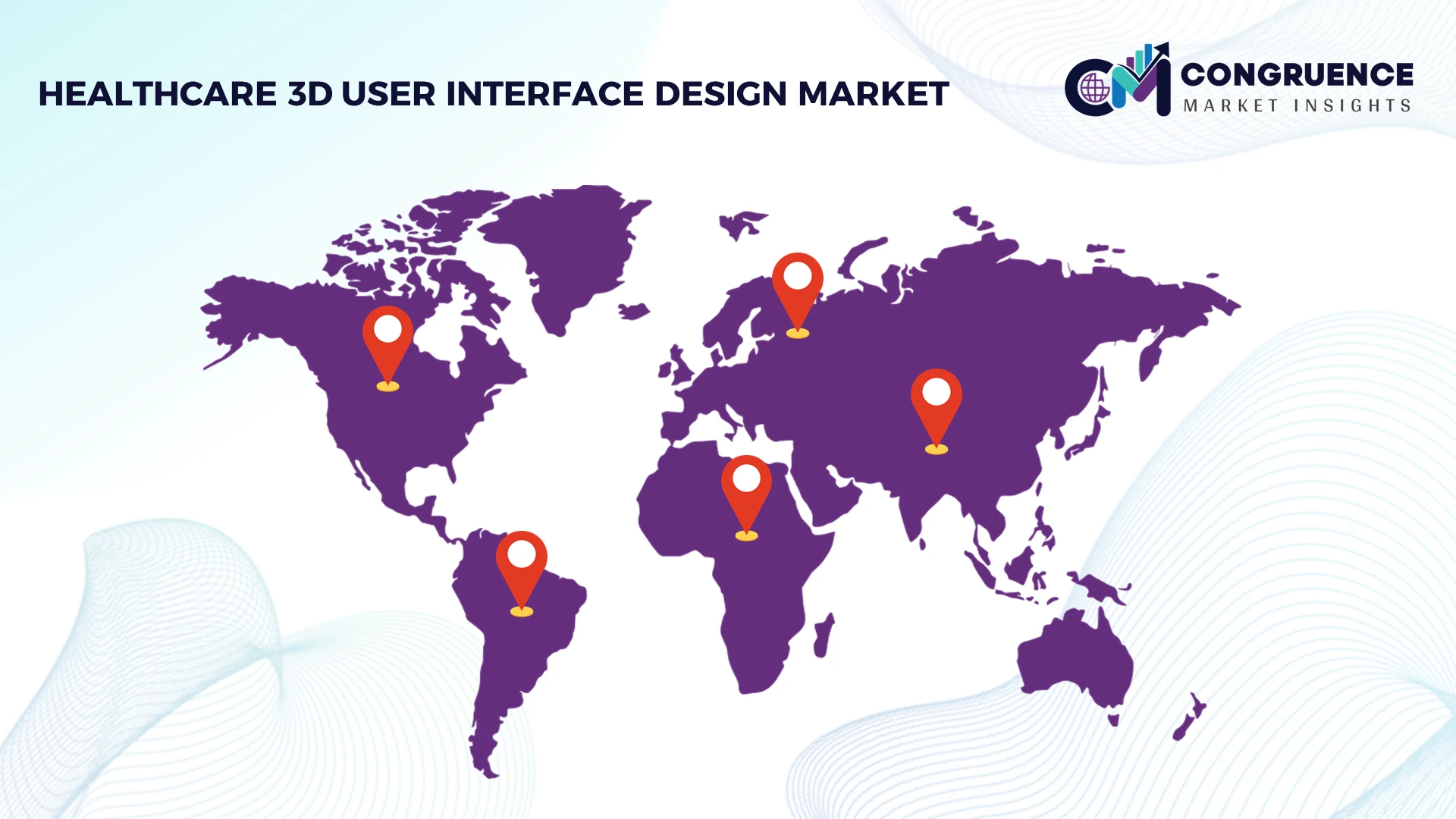
North America commands an estimated 42% of the global Healthcare 3D User Interface Design Market in 2025, supported by extensive medical imaging infrastructure, surgical robotics development, and clinical software innovation. The United States concentrates enterprise deployment through academic hospitals, diagnostic imaging networks, and medical technology manufacturers. GE HealthCare, Intuitive Surgical, and specialized visualization developers support advanced anatomical modeling and interactive surgical planning. Hospitals increasingly integrate volumetric CT and MRI reconstruction with surgical navigation and clinical education platforms. FDA medical software oversight reinforces requirements for interface validation, clinical accuracy, and usability assessment. In modeled enterprise deployments, interactive anatomical visualization targets 20% shorter surgical planning workflows and 15% fewer manual reconstruction steps. Healthcare technology companies are strengthening imaging interoperability, enterprise software integration, and hospital partnerships to improve clinical productivity and support scalable visualization deployment across multiple departments.
United States Market Outlook: The United States leads healthcare spatial computing development through medical device manufacturers, software companies, and specialized clinical research institutions. Apple introduced Vision Pro in 2024, creating an additional platform for immersive healthcare applications. The FDA's 21 CFR Part 820 quality system requirements influence regulated medical technology development. Hospitals and technology developers are advancing interactive anatomical visualization, surgical simulation, and spatial interface usability, strengthening domestic innovation capabilities and specialized procurement opportunities.
Medical Imaging Modernization Prioritizes Interoperable Clinical Interfaces
Europe represents an estimated 28% of the global Healthcare 3D User Interface Design Market in 2025, supported by established medical imaging manufacturers, advanced clinical research infrastructure, and healthcare digitalization programs. Germany, the United Kingdom, France, and the Netherlands contribute specialized medical software development and interactive imaging applications. Siemens Healthineers and Philips support advanced visualization technologies across diagnostic and procedural environments. The European Union Medical Device Regulation strengthens requirements for software safety, clinical evaluation, and postmarket surveillance. Healthcare institutions increasingly prioritize interoperable visualization platforms connecting imaging equipment, clinical information systems, and surgical planning applications. In modeled deployments, standardized 3D interface architecture targets 15% lower customization requirements and 10% shorter clinical software implementation timelines. Technology providers are expanding hospital integration partnerships, modular visualization capabilities, and regulatory documentation processes to strengthen procurement competitiveness across European healthcare systems.
Germany Market Outlook: Germany leads regional medical imaging engineering through Siemens Healthineers, specialized software developers, and university hospital research networks. The Hospital Future Act established a €4.3 billion hospital digitalization funding framework, supporting broader healthcare technology modernization. German institutions are integrating advanced visualization into radiology, surgical planning, and medical education. Strong engineering capabilities, regulated software development expertise, and established clinical partnerships support domestic competitiveness in sophisticated healthcare interface technologies.
Healthcare Infrastructure Expansion Accelerates Spatial Visualization Adoption
Asia Pacific accounts for an estimated 22% of the global Healthcare 3D User Interface Design Market in 2025, supported by expanding hospital infrastructure, medical imaging equipment manufacturing, and digital healthcare investment. China, Japan, South Korea, and India contribute distinct strengths in medical electronics, software development, surgical robotics, and immersive clinical education. Chinese medical technology manufacturers are expanding domestic imaging platforms, while Japanese companies emphasize precision medical equipment and advanced clinical visualization. South Korea's digital healthcare ecosystem supports immersive training and medical software innovation. India's tertiary hospital networks create opportunities for scalable visualization platforms and specialist education. In modeled deployment scenarios, localized software integration targets 20% lower implementation costs and 15% shorter specialist onboarding periods. Regional technology providers are strengthening manufacturing partnerships, clinical application development, and hospital distribution networks to improve accessibility and support broader adoption of interactive anatomical interfaces.
China Market Outlook: China represents a major healthcare technology manufacturing and deployment center through companies including United Imaging Healthcare and Mindray. The country's large hospital network supports substantial demand for CT, MRI, ultrasound, and advanced visualization applications. Domestic medical equipment manufacturers are strengthening integrated imaging software and clinical workflow capabilities. National healthcare modernization initiatives encourage digital infrastructure investment, while localized manufacturing supports competitive equipment procurement and specialized software development.
Hospital Digitalization Strengthens Advanced Imaging Demand
South America represents an estimated 5% of the global Healthcare 3D User Interface Design Market in 2025, with Brazil providing the largest concentration of advanced healthcare infrastructure. Argentina, Chile, and Colombia contribute additional demand through specialized hospitals, diagnostic imaging centers, and medical education institutions. Regional adoption concentrates on interactive radiology visualization, surgical planning, and clinical training rather than extensive immersive operating room deployment. Brazil's private hospital networks are investing in advanced diagnostic capabilities, while public healthcare institutions face infrastructure and procurement constraints. In modeled hospital modernization scenarios, cloud compatible 3D visualization targets 15% lower workstation infrastructure requirements and 10% faster image review workflows. Healthcare technology providers are expanding regional distribution partnerships, software localization, and technical support capabilities. Competitive positioning depends on affordability, equipment compatibility, and reliable clinical implementation across institutions with differing technology budgets.
Brazil Market Outlook: Brazil leads regional healthcare visualization demand through São Paulo's specialized hospitals, diagnostic imaging providers, and medical technology distribution networks. The Unified Health System serves a population exceeding 200 million, creating substantial requirements for scalable diagnostic infrastructure. Private healthcare institutions support adoption of advanced imaging workstations and surgical planning platforms. Local technology partnerships, Portuguese language interfaces, and equipment maintenance capabilities strengthen commercialization opportunities across Brazil's diverse healthcare delivery environment.
Healthcare Megaprojects Accelerate Immersive Clinical Infrastructure
The Middle East and Africa account for an estimated 3% of the global Healthcare 3D User Interface Design Market in 2025, supported by healthcare infrastructure modernization in Saudi Arabia, the United Arab Emirates, and selected African economies. Saudi Arabia's Vision 2030 healthcare transformation encourages advanced hospital technologies, medical education modernization, and digital clinical workflows. The United Arab Emirates is strengthening specialized healthcare facilities and technology partnerships supporting surgical visualization and immersive training. South Africa contributes established diagnostic imaging services and medical research capabilities. In modeled modernization programs, interactive anatomical planning targets 20% shorter procedural preparation and 15% improved clinical training efficiency. Medical technology suppliers are strengthening regional implementation partnerships, specialist training, and integrated imaging solutions. Infrastructure investment concentrates on tertiary hospitals and specialized medical centers where advanced visualization supports complex clinical procedures.
Saudi Arabia Market Outlook: Saudi Arabia provides significant healthcare technology opportunities through Vision 2030 and the Health Sector Transformation Program. The country is investing in hospital modernization, digital health infrastructure, and specialized clinical services. King Faisal Specialist Hospital and Research Centre supports advanced medical technology adoption and clinical innovation. International medical device manufacturers are expanding partnerships with Saudi healthcare institutions, strengthening opportunities for immersive surgical planning, advanced diagnostic visualization, and specialized medical training platforms.
Siemens Healthineers, GE HealthCare, Philips, Intuitive Surgical, and Surgical Theater compete across clinical visualization, surgical navigation, and immersive anatomical interfaces. Their combined position represents an illustrative 55% market share, reflecting modeled participation rather than verified segment revenue. Established imaging manufacturers leverage hospital procurement relationships, while specialized software developers compete through interface flexibility and procedural customization. Modeled enterprise deployments target 20% shorter anatomical planning workflows, 15% lower software customization requirements, and 10% faster specialist onboarding. Siemens Healthineers and GE HealthCare strengthen imaging integration, while Intuitive Surgical emphasizes procedure specific visualization and Surgical Theater advances immersive surgical planning. Competition is shifting toward interoperable spatial platforms connecting imaging, navigation, and clinical training. Regulatory validation, integration complexity, and specialized development expertise create substantial entry barriers. Winning requires clinically validated interfaces, dependable imaging interoperability, competitive implementation costs, and measurable workflow improvements across hospital departments and specialized healthcare applications serving diverse clinical requirements.
Siemens Healthineers AG
GE HealthCare Technologies Inc.
Koninklijke Philips N.V.
Intuitive Surgical, Inc.
Surgical Theater, LLC
Brainlab AG
Medtronic plc
Stryker Corporation
Materialise NV
3D Systems Corporation
NVIDIA Corporation
Microsoft Corporation
Dassault Systèmes SE
United Imaging Healthcare Co., Ltd.
Current healthcare 3D interfaces combine volumetric CT reconstruction, interactive anatomical modeling, touch controls, and surgical navigation displays. Hospitals use these platforms for radiology interpretation, procedural planning, and multidisciplinary case review. Compared with conventional two dimensional workstations, interactive 3D visualization targets 20% shorter anatomical planning time in modeled workflows. Automated image segmentation targets 15% fewer manual processing steps, improving specialist productivity. Enterprise adoption concentrates in tertiary hospitals with established imaging infrastructure, while vendors prioritize compatibility with existing clinical systems.
Emerging technologies include spatial computing headsets, gesture recognition, haptic simulation, and artificial intelligence assisted interface adaptation. Mixed reality visualization targets 18% faster anatomical orientation, while haptic training environments target 15% fewer repeated simulation exercises under illustrative conditions. Medical colleges and surgical training centers increasingly evaluate immersive applications. Developers benefit from reusable anatomical models, standardized interaction libraries, and specialized training partnerships that reduce implementation complexity.
Between 2026 and 2028, real time digital twins, multimodal interaction, and context aware visualization will influence procurement priorities. Predictive rendering targets 12% lower interaction latency, while adaptive interface layouts target 10% faster clinical task completion. Siemens Healthineers, GE HealthCare, and specialized software developers gain competitive advantages through validated workflows, secure interoperability, and scalable deployment capabilities across clinical departments and institutions worldwide.
March 2024: Siemens Healthineers launched its Cinematic Reality application for Apple Vision Pro, enabling immersive visualization of three dimensional anatomical models. The application supports surgical planning, medical education, and patient communication through spatial interaction without requiring additional visualization hardware. Source: siemens-healthineers.com.
June 2024: GE HealthCare and MediView XR deployed the OmnifyXR Interventional Suite at North Star Vascular and Interventional in Minnesota. Supporting four simultaneous video streams, the system integrates holographic anatomical visualization with live imaging, strengthening procedural navigation and collaboration. Source: mobihealthnews.com.
December 2024: Materialise launched its integrated Mimics platform, consolidating anatomical segmentation, surgical planning, and personalized device design. The unified platform connects 3D modeling with medical device development, improving collaboration between hospitals and manufacturers while reducing fragmented clinical engineering workflows. Source: materialise.com.
September 2025: Surgical Theater received FDA clearance for SpineAR SNAP, identified under submission K252054. This regulatory milestone strengthened the commercial pathway for augmented reality surgical visualization, enabling deployment of a cleared platform within regulated clinical environments and supporting specialized spine navigation. Source: fda.gov.
The Healthcare 3D User Interface Design Market Report evaluates technology adoption, clinical integration, competitive positioning, and deployment opportunities between 2026 and 2033. Segmentation covers Gesture-Based, Touch-Based, Voice-Controlled, Haptic, and Motion-Tracking Interfaces across Surgical Planning, Medical Imaging Visualization, Medical Training and Simulation, Patient Monitoring, and Rehabilitation. Five end user categories are assessed, with Hospitals representing an estimated 45% of demand and Touch-Based Interfaces accounting for approximately 35% of modeled deployment activity.
Regional coverage includes North America, Europe, Asia Pacific, South America, and the Middle East and Africa. Technology analysis examines AI segmentation, immersive visualization, spatial computing, haptic feedback, and interactive anatomical modeling. The report supports investment planning, hospital technology procurement, geographic expansion, partnership development, and competitive benchmarking while identifying emerging opportunities in surgical navigation, medical simulation, and specialized rehabilitation interfaces.
| Report Attribute/Metric | Report Details |
|---|---|
Market Revenue in 2025 | USD 1130 Million |
Market Revenue in 2033 | USD 2680.15 Million |
CAGR (2026 - 2033) | 11.4% |
Base Year | 2025 |
Forecast Period | 2026 - 2033 |
Historic Period | 2021 - 2025 |
Segments Covered | By Type
By Application
By End-User
|
Key Report Deliverable | Revenue Forecast, Growth Trends, Market Dynamics, Segmental Overview, Regional and Country-wise Analysis, Competition Landscape |
Region Covered | North America, Europe, Asia-Pacific, South America, Middle East, Africa |
Key Players Analyzed | Siemens Healthineers AG, GE HealthCare Technologies Inc., Koninklijke Philips N.V., Intuitive Surgical, Inc., Surgical Theater, LLC, Brainlab AG, Medtronic plc, Stryker Corporation, Materialise NV, 3D Systems Corporation, NVIDIA Corporation, Microsoft Corporation, Dassault Systèmes SE, United Imaging Healthcare Co., Ltd. |
Customization & Pricing | Available on Request (10% Customization is Free) |




