
Reports
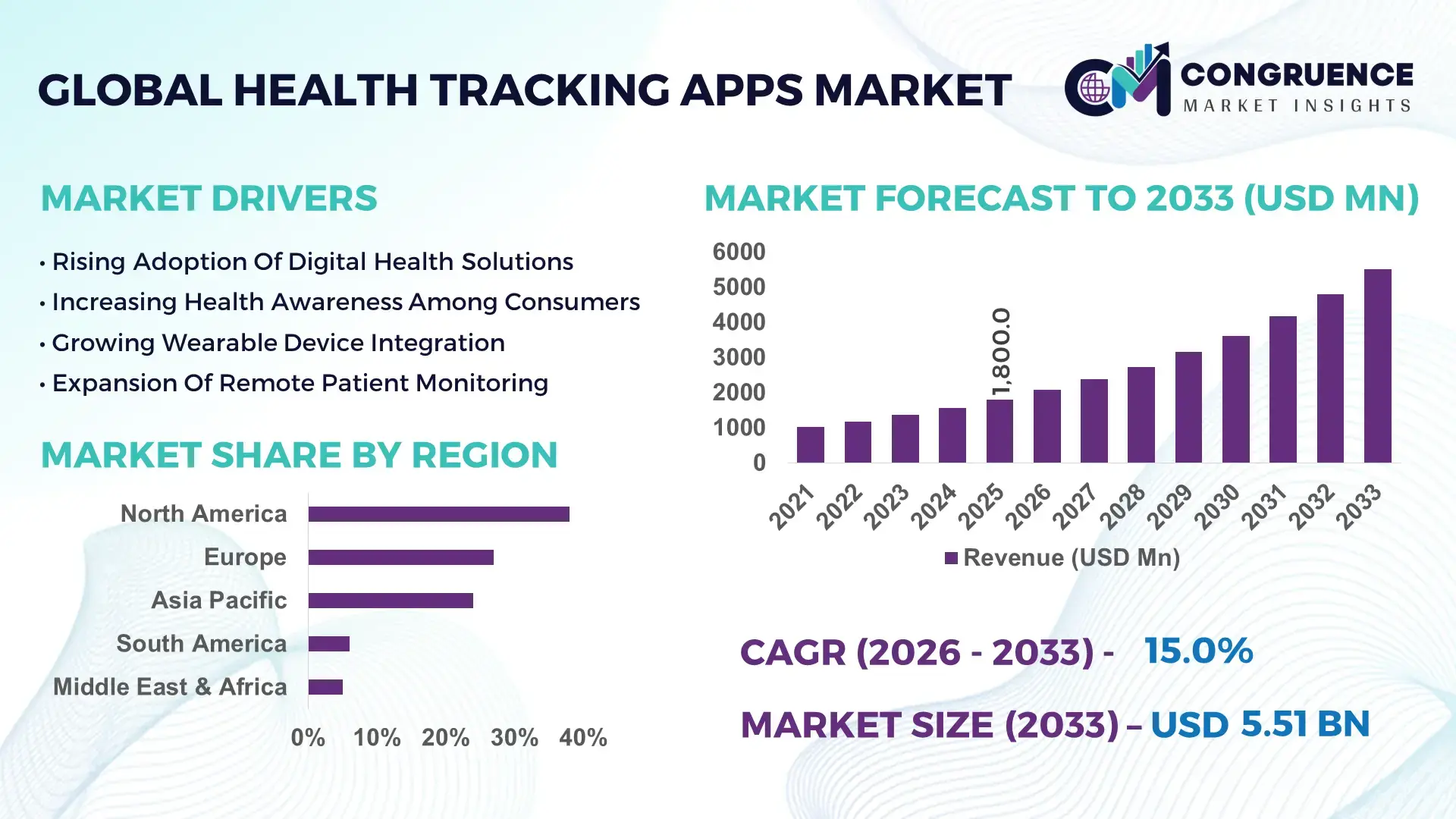
The Global Health Tracking Apps Market was valued at USD 1,800.0 Million in 2025 and is anticipated to reach a value of USD 5,506.2 Million by 2033 expanding at a CAGR of 15.0% between 2026 and 2033, according to an analysis by Congruence Market Insights. Increasing integration of wearable devices and AI-powered health monitoring solutions is a key factor accelerating market growth.
The United States remains the dominant country in the Health Tracking Apps Market, supported by strong digital health infrastructure, high smartphone penetration exceeding 85%, and widespread wearable adoption reaching over 40% of adults. The country hosts more than 60% of global digital health startups, with annual investments in digital health exceeding USD 25 billion. Health tracking applications are extensively used across fitness monitoring, chronic disease management, and telehealth integration, with over 70 million users actively engaging in app-based health tracking monthly. Advanced AI-based diagnostics and integration with electronic health records (EHRs) have improved clinical decision-making efficiency by nearly 30%. Additionally, major healthcare providers and insurers increasingly incorporate app-based monitoring systems, with approximately 50% of hospitals utilizing patient-generated health data through apps for preventive care and remote monitoring programs.
Market Size & Growth: USD 1,800.0 Million in 2025, projected to reach USD 5,506.2 Million by 2033 at 15.0% CAGR, driven by rising preventive healthcare adoption.
Top Growth Drivers: Wearable adoption (42%), AI-based health analytics usage (38%), chronic disease monitoring demand (35%).
Short-Term Forecast: By 2028, healthcare cost reduction through app-based monitoring is expected to improve by 22%.
Emerging Technologies: AI-driven predictive analytics, IoT-enabled wearables, and cloud-based health data platforms.
Regional Leaders: North America (~USD 2,100 Million by 2033), Europe (~USD 1,450 Million), Asia-Pacific (~USD 1,200 Million) with strong mobile-first adoption trends.
Consumer/End-User Trends: Over 65% of users track fitness and wellness metrics daily through mobile apps.
Pilot or Case Example: In 2024, a remote monitoring pilot reduced hospital readmissions by 28% through real-time app tracking.
Competitive Landscape: Market leader holds ~18% share, followed by key players such as Fitbit, MyFitnessPal, Samsung Health, Apple Health, and Garmin.
Regulatory & ESG Impact: Digital health compliance frameworks and data privacy regulations increased adoption by 30%.
Investment & Funding Patterns: Over USD 20 billion invested in digital health startups globally in recent years.
Innovation & Future Outlook: Integration of AI diagnostics and personalized healthcare ecosystems continues to shape market evolution.
Health tracking apps are widely utilized across fitness (45%), chronic disease management (30%), and mental wellness (15%) sectors, with remaining 10% spanning niche applications. Rapid AI integration and regulatory emphasis on digital health compliance are accelerating adoption, particularly in North America and Asia-Pacific. Emerging trends such as personalized health insights, real-time biometric monitoring, and interoperability with healthcare systems are expected to enhance long-term market scalability and decision-making efficiency.
The Health Tracking Apps Market holds significant strategic relevance as healthcare systems transition toward preventive and data-driven models. Enterprises and healthcare providers increasingly rely on app-based monitoring solutions to reduce operational burdens and enhance patient outcomes. AI-enabled health tracking applications deliver approximately 35% improvement in early disease detection compared to traditional periodic health checkups, enabling proactive intervention and reducing long-term healthcare costs.
From a regional perspective, North America dominates in volume due to advanced digital infrastructure and high consumer adoption, while Asia-Pacific leads in adoption growth with over 60% of smartphone users actively engaging with health apps. The increasing penetration of wearable devices, which has surpassed 30% globally, is further amplifying real-time health data collection and analytics capabilities.
In the short term, by 2028, AI-powered predictive health analytics is expected to improve patient monitoring efficiency by 25%, significantly reducing hospital visits and enabling remote care delivery. Companies are focusing on integrating cloud computing, IoT, and machine learning to enhance personalization and predictive accuracy in health tracking applications.
Compliance and ESG considerations are also shaping the market. Firms are committing to improving data security and reducing healthcare-related emissions through digital monitoring solutions, targeting up to 20% reduction in unnecessary hospital visits by 2030. In 2024, a leading US healthcare provider achieved a 27% reduction in patient readmissions through AI-enabled remote monitoring apps, highlighting measurable operational benefits.
Looking ahead, the Health Tracking Apps Market is positioned as a critical pillar supporting healthcare resilience, regulatory compliance, and sustainable growth through continuous innovation and digital transformation.
The Health Tracking Apps Market is experiencing rapid transformation driven by increasing digitalization in healthcare, rising consumer awareness regarding preventive health, and expanding adoption of connected devices. The proliferation of smartphones, with global penetration exceeding 70%, has created a strong foundation for app-based health monitoring solutions. Additionally, the growing burden of chronic diseases such as diabetes and cardiovascular conditions, affecting over 500 million individuals worldwide, is driving demand for continuous health tracking tools. Integration of wearable devices and IoT ecosystems is enhancing real-time data collection, enabling personalized insights and improving patient engagement.
Healthcare providers are increasingly adopting digital health platforms to optimize resource utilization, reduce hospital admissions, and enhance patient outcomes. Moreover, regulatory frameworks focusing on data security and interoperability are influencing product development and deployment strategies. The market is also benefiting from technological advancements such as AI-driven analytics and cloud-based infrastructure, which improve accuracy and scalability. However, challenges such as data privacy concerns and lack of standardization persist, shaping the competitive landscape and innovation priorities across the Health Tracking Apps Market.
The widespread adoption of wearable devices such as smartwatches and fitness bands is a major driver for the Health Tracking Apps Market. Over 40% of global consumers now use at least one wearable device, generating continuous streams of health-related data including heart rate, sleep patterns, and physical activity levels. This real-time data integration enhances the functionality and value of health tracking apps, enabling users to monitor their health proactively. Healthcare providers are increasingly leveraging wearable-integrated applications for remote patient monitoring, particularly for chronic disease management. For instance, over 35% of hospitals in developed economies have adopted wearable-based monitoring systems to track patient vitals outside clinical settings. Additionally, fitness-focused consumers are driving demand, with nearly 65% of users relying on apps to achieve health and wellness goals. The seamless integration of wearable ecosystems with mobile applications is improving user engagement by approximately 30%, reinforcing sustained market growth.
Data privacy and security concerns remain a significant restraint in the Health Tracking Apps Market, as these applications handle sensitive personal health information. Over 60% of users express concerns regarding the misuse or unauthorized access to their health data, impacting adoption rates. Regulatory frameworks such as data protection laws require strict compliance, increasing operational complexity for developers. Additionally, cybersecurity threats targeting healthcare data have increased by nearly 25% in recent years, highlighting vulnerabilities in digital health ecosystems. Many small and mid-sized app developers lack advanced encryption and security infrastructure, leading to potential data breaches. Furthermore, inconsistencies in global regulatory standards create challenges in cross-border app deployment and scalability. These concerns limit user trust and hinder widespread adoption, especially in emerging markets where awareness of data protection practices is still evolving.
AI-driven personalization presents significant growth opportunities in the Health Tracking Apps Market by enabling tailored health insights and predictive analytics. Approximately 55% of users prefer applications that provide personalized recommendations based on their health data, driving demand for advanced AI integration. These solutions can analyze large datasets to identify patterns and predict potential health risks, improving preventive care outcomes. Healthcare providers are increasingly adopting AI-powered apps to enhance patient engagement and treatment adherence. For example, personalized fitness and nutrition recommendations have improved user retention rates by nearly 25%. Additionally, integration with telehealth platforms enables real-time consultations and continuous monitoring, expanding the scope of application. Emerging technologies such as machine learning and natural language processing further enhance user experience by delivering actionable insights, positioning AI-driven personalization as a key opportunity for market expansion.
Interoperability challenges pose a significant obstacle in the Health Tracking Apps Market, as diverse devices and healthcare systems often lack standardized communication protocols. Over 45% of healthcare organizations report difficulties in integrating app-generated data with existing electronic health record systems, limiting the utility of these applications. The absence of universal data standards leads to fragmentation, making it difficult for users to consolidate health information from multiple sources. This issue is particularly critical in multi-device ecosystems, where compatibility across platforms is essential for seamless user experience. Additionally, integration complexities increase development costs and time-to-market for app providers. As healthcare systems increasingly rely on digital data exchange, addressing interoperability challenges remains crucial to unlocking the full potential of health tracking applications.
AI-powered predictive analytics improving early detection rates: AI-enabled health tracking apps are enhancing early disease detection, with predictive models improving accuracy by over 35%. Around 48% of advanced health apps now incorporate machine learning algorithms to analyze user data patterns, enabling timely alerts and personalized recommendations for users managing chronic conditions.
Rapid growth in wearable-integrated ecosystems: Over 52% of health tracking applications are now integrated with wearable devices, supporting real-time biometric monitoring. Adoption of wearable-linked apps has increased by nearly 40% in the past three years, particularly in North America and Asia-Pacific, where consumers actively track fitness, sleep, and cardiovascular health metrics.
Expansion of mental health and wellness tracking features: Mental wellness tracking has seen significant growth, with nearly 30% of users utilizing apps for stress management and mindfulness. Features such as guided meditation, mood tracking, and behavioral analytics have improved user engagement rates by approximately 25%, especially among younger demographics.
Increased adoption of cloud-based health data platforms: Cloud-enabled health tracking solutions account for over 60% of app deployments, facilitating secure data storage and seamless access across devices. These platforms have improved data processing efficiency by nearly 28%, enabling healthcare providers to deliver more accurate and timely insights for patient care.
The Health Tracking Apps Market is segmented based on type, application, and end-user categories, each playing a critical role in shaping market dynamics. Type-based segmentation highlights the dominance of fitness and activity tracking apps, followed by nutrition and sleep monitoring solutions. Application-wise, fitness and wellness management remains the largest segment, while chronic disease management is gaining traction due to rising global health concerns. End-user segmentation shows strong adoption among individual consumers, with increasing usage by healthcare providers and corporate wellness programs.
The integration of advanced technologies such as AI, IoT, and cloud computing is influencing segmentation trends, enabling more personalized and scalable solutions. Additionally, the rise of preventive healthcare and remote monitoring is driving demand across all segments. Regional variations also play a role, with developed markets focusing on advanced analytics, while emerging regions prioritize accessibility and affordability. These segmentation insights provide a comprehensive understanding of the market’s structure and growth opportunities.
The Health Tracking Apps Market by type includes fitness tracking apps, diet and nutrition tracking apps, sleep monitoring apps, chronic disease management apps, and mental wellness apps. Fitness tracking apps dominate the segment, accounting for approximately 42% of total adoption, driven by increasing consumer focus on physical activity and lifestyle management. These apps provide features such as step tracking, calorie monitoring, and workout planning, making them widely used among general consumers. Diet and nutrition tracking apps hold around 20% share, supported by growing awareness of healthy eating habits. Sleep monitoring apps contribute approximately 15%, focusing on improving sleep quality through analytics and behavioral insights. Chronic disease management apps, though currently accounting for around 13%, are the fastest-growing segment with an expected growth rate of 18%, driven by rising prevalence of conditions such as diabetes and hypertension. Mental wellness apps represent the remaining 10%, gaining traction among younger users.
• In 2025, a global healthcare research initiative reported that fitness tracking applications were used by over 120 million users worldwide to monitor daily activity levels, significantly improving lifestyle management outcomes.
Applications in the Health Tracking Apps Market include fitness and wellness management, chronic disease monitoring, mental health tracking, and remote patient monitoring. Fitness and wellness management leads with approximately 45% adoption, as consumers increasingly focus on preventive healthcare and lifestyle improvement. Chronic disease monitoring accounts for around 28%, reflecting growing demand for continuous health tracking among patients with long-term conditions. Mental health tracking applications contribute about 15%, with increasing awareness of stress management and emotional well-being. Remote patient monitoring, although currently at 12%, is the fastest-growing application segment with an estimated growth rate of 20%, driven by telehealth expansion and healthcare digitization. In 2025, more than 62% of smartphone users reported using at least one health tracking application regularly. Additionally, over 40% of healthcare providers have integrated app-based monitoring into patient care programs.
• In 2024, a global health organization reported deployment of digital health tracking solutions across more than 150 hospitals, improving patient monitoring efficiency and early diagnosis outcomes.
End-users in the Health Tracking Apps Market include individual consumers, healthcare providers, corporate wellness programs, and insurance companies. Individual consumers dominate the segment with approximately 58% share, driven by increasing health awareness and widespread smartphone usage. These users primarily utilize apps for fitness tracking, diet management, and general wellness monitoring. Healthcare providers account for around 22% of the market, leveraging apps for remote patient monitoring and chronic disease management. Corporate wellness programs represent approximately 12%, with organizations adopting health tracking solutions to improve employee productivity and reduce healthcare costs. Insurance companies contribute the remaining 8%, using app-based data to assess risk and offer personalized plans. Healthcare providers are the fastest-growing end-user segment, with an expected growth rate of 19%, supported by increasing telehealth adoption. In 2025, over 48% of hospitals globally reported using digital health apps for patient monitoring. Additionally, more than 55% of employees participating in corporate wellness programs actively engage with health tracking applications.
• In 2025, a healthcare technology study indicated that over 500 hospitals implemented app-based monitoring systems, improving patient engagement and reducing readmission rates significantly.
North America accounted for the largest market share at 38% in 2025 however, Asia-Pacific is expected to register the fastest growth, expanding at a CAGR of 17.5% between 2026 and 2033.
North America leads due to high digital health adoption, with over 70% of adults using at least one health tracking application. Europe follows with approximately 27% share, supported by strong regulatory frameworks and increasing demand for preventive healthcare solutions. Asia-Pacific holds around 24% share, driven by rapid smartphone penetration exceeding 75% in key countries such as China and India. South America and the Middle East & Africa collectively account for nearly 11%, with growing investments in healthcare infrastructure and digital transformation initiatives. Increasing adoption of wearable devices, which has surpassed 35% in developed regions, continues to influence regional growth patterns.
North America holds approximately 38% of the global Health Tracking Apps Market, driven by strong healthcare infrastructure and high consumer awareness. The region benefits from widespread adoption across healthcare providers, fitness industries, and insurance companies. Government initiatives promoting digital health integration and data interoperability have significantly boosted adoption. Technological advancements such as AI-powered analytics and wearable integration are widely implemented, improving patient monitoring efficiency by nearly 30%. A leading regional player, Apple Health, continues to enhance its ecosystem by integrating health tracking features with wearable devices, supporting millions of users. Consumer behavior shows higher adoption in healthcare and fitness sectors, with over 65% of users actively tracking daily health metrics.
Europe accounts for approximately 27% of the Health Tracking Apps Market, with key markets including Germany, the UK, and France driving demand. Strict regulatory frameworks focusing on data protection and interoperability encourage development of secure and compliant applications. The region is witnessing increased adoption of AI-driven health analytics and cloud-based platforms. Sustainability initiatives and digital health policies are promoting widespread use of health tracking solutions. A regional player, Withings, is advancing smart health devices integrated with tracking apps, enhancing user experience. Consumer behavior reflects strong preference for secure and transparent health data management solutions.
Asia-Pacific ranks as the fastest-growing region, holding around 24% market share. Key countries such as China, India, and Japan are driving growth through increasing smartphone usage and digital health awareness. Mobile-first solutions dominate the market, with over 60% of users relying on apps for health monitoring. The region is witnessing rapid innovation in AI-based health analytics and wearable integration. Companies such as Samsung Health are expanding their ecosystem to cater to diverse consumer needs. Consumer behavior is heavily influenced by affordability and accessibility, with strong growth in fitness and wellness applications.
South America accounts for approximately 6% of the Health Tracking Apps Market, with Brazil and Argentina as key contributors. Growing investments in healthcare infrastructure and digital transformation are supporting adoption. Government initiatives promoting telehealth and digital health solutions are encouraging market growth. Local players are focusing on developing affordable applications tailored to regional needs. Consumer behavior shows increasing adoption among younger populations, particularly for fitness and wellness tracking applications.
The Middle East & Africa region holds around 5% of the Health Tracking Apps Market, driven by increasing investments in healthcare modernization. Countries such as the UAE and South Africa are leading adoption through digital health initiatives. Technological advancements and partnerships with global companies are enhancing market development. Local players are focusing on mobile-based solutions to improve accessibility. Consumer behavior reflects growing awareness of preventive healthcare, with increasing adoption of fitness and wellness tracking applications.
United States – 38% Market share: Strong digital health infrastructure and high consumer adoption
China – 18% Market share: Rapid smartphone penetration and expanding digital healthcare ecosystem
The Health Tracking Apps Market is characterized by a moderately fragmented competitive landscape with over 150 active players globally. The top five companies collectively account for approximately 45% of the market, indicating a balanced mix of established players and emerging startups. Major companies are focusing on product innovation, strategic partnerships, and ecosystem expansion to strengthen their market position.
Key strategies include integration of AI and machine learning capabilities, development of personalized health insights, and expansion into telehealth services. Companies are also investing heavily in research and development to enhance data accuracy and user experience. Partnerships between app developers, healthcare providers, and wearable manufacturers are becoming increasingly common, enabling seamless data integration and improved service offerings.
Additionally, mergers and acquisitions are shaping the competitive landscape, with companies seeking to expand their technological capabilities and geographic presence. Innovation trends such as real-time health monitoring, predictive analytics, and interoperability with healthcare systems are driving competition. The market continues to evolve with increasing focus on user engagement, data security, and regulatory compliance.
Samsung Electronics
Fitbit Inc.
Garmin Ltd.
MyFitnessPal Inc.
Google LLC
Huawei Technologies
Nike Inc.
Adidas AG
Withings SA
Under Armour Inc.
Polar Electro Oy
Azumio Inc.
Noom Inc.
The Health Tracking Apps Market is being significantly influenced by rapid technological advancements, particularly in artificial intelligence, Internet of Things (IoT), and cloud computing. AI-based analytics are now integrated into over 45% of health tracking applications, enabling predictive health insights and early detection of potential health issues. These systems analyze large datasets to provide personalized recommendations, improving user engagement and retention rates by nearly 30%.
IoT-enabled wearable devices play a crucial role, with more than 50% of apps connected to smartwatches, fitness bands, and other sensors. These devices generate real-time data such as heart rate, sleep patterns, and physical activity, which is processed through advanced algorithms to deliver actionable insights. Additionally, cloud-based platforms support over 60% of app deployments, ensuring secure data storage and seamless accessibility across devices.
Emerging technologies such as blockchain are being explored to enhance data security and privacy, addressing concerns related to unauthorized access. Natural language processing (NLP) is also gaining traction, enabling voice-based health tracking and interaction features. Furthermore, integration with electronic health records (EHRs) is improving interoperability, allowing healthcare providers to utilize app-generated data effectively. These technological innovations are driving efficiency, scalability, and improved healthcare outcomes across the market.
• In November 2025, Garmin expanded its “Health Status” feature across multiple smartwatch models via the Garmin Connect app, enabling users to track metrics such as heart rate variability, respiration, Pulse Ox, and skin temperature. The feature establishes personal baselines using multi-week data to detect anomalies and improve early health insights. Source: www.garmin.com
• In 2025, Fitbit (under Google) introduced an AI-powered Personal Health Coach integrated into its app ecosystem, enabling users to generate customized fitness and wellness plans through conversational AI. The system adapts to user goals such as muscle gain or endurance, improving personalization and engagement through real-time health insights.
• In 2025, Samsung advanced its Samsung Health platform by expanding AI-driven features such as Energy Score and predictive health insights, integrating these capabilities across Galaxy wearable devices. These enhancements focus on continuous health monitoring and personalized recommendations, strengthening its digital health ecosystem across mobile and wearable platforms.
• In 2024, Google strengthened its health tracking ecosystem by deepening Fitbit integration within Android and Wear OS platforms, enabling unified health data analytics and improved cross-device tracking. This integration supports advanced AI-based health insights and enhances interoperability across smartphones and wearable devices.
The Health Tracking Apps Market Report provides a comprehensive analysis of the global landscape, covering key segments such as type, application, end-user, and regional markets. The report evaluates a wide range of application categories including fitness tracking, chronic disease management, mental wellness, and remote patient monitoring, highlighting their relative contributions and evolving usage patterns.
Geographically, the report spans major regions including North America, Europe, Asia-Pacific, South America, and the Middle East & Africa, offering insights into regional adoption trends, technological advancements, and infrastructure development. It also examines variations in consumer behavior, smartphone penetration rates, and wearable device adoption, which influence market dynamics across different regions.
From a technological perspective, the report covers advancements in AI, IoT, cloud computing, and data analytics, detailing their impact on product innovation and service delivery. It further explores integration with healthcare systems such as electronic health records and telehealth platforms, which are reshaping the market landscape.
The report also includes analysis of competitive dynamics, highlighting key players, strategic initiatives, and innovation trends. Additionally, it addresses regulatory frameworks, data security requirements, and ESG considerations that influence market development. Overall, the scope provides a holistic view of the Health Tracking Apps Market, enabling stakeholders to make informed strategic decisions.
| Report Attribute / Metric | Details |
|---|---|
| Market Revenue (2025) | USD 1,800.0 Million |
| Market Revenue (2033) | USD 5,506.2 Million |
| CAGR (2026–2033) | 15.0% |
| Base Year | 2025 |
| Forecast Period | 2026–2033 |
| Historic Period | 2021–2025 |
| Segments Covered |
By Type
By Application
By End-User Insights
|
| Key Report Deliverables | Revenue Forecast; Market Trends; Growth Drivers & Restraints; Technology Insights; Segmentation Analysis; Regional Insights; Competitive Landscape; Regulatory & ESG Overview; Recent Developments |
| Regions Covered | North America; Europe; Asia-Pacific; South America; Middle East & Africa |
| Key Players Analyzed | Apple Inc.; Samsung Electronics; Fitbit Inc.; Garmin Ltd.; MyFitnessPal Inc.; Google LLC; Huawei Technologies; Nike Inc.; Adidas AG; Withings SA; Under Armour Inc.; Polar Electro Oy; Azumio Inc.; Noom Inc. |
| Customization & Pricing | Available on Request (10% Customization Free) |




