
Reports
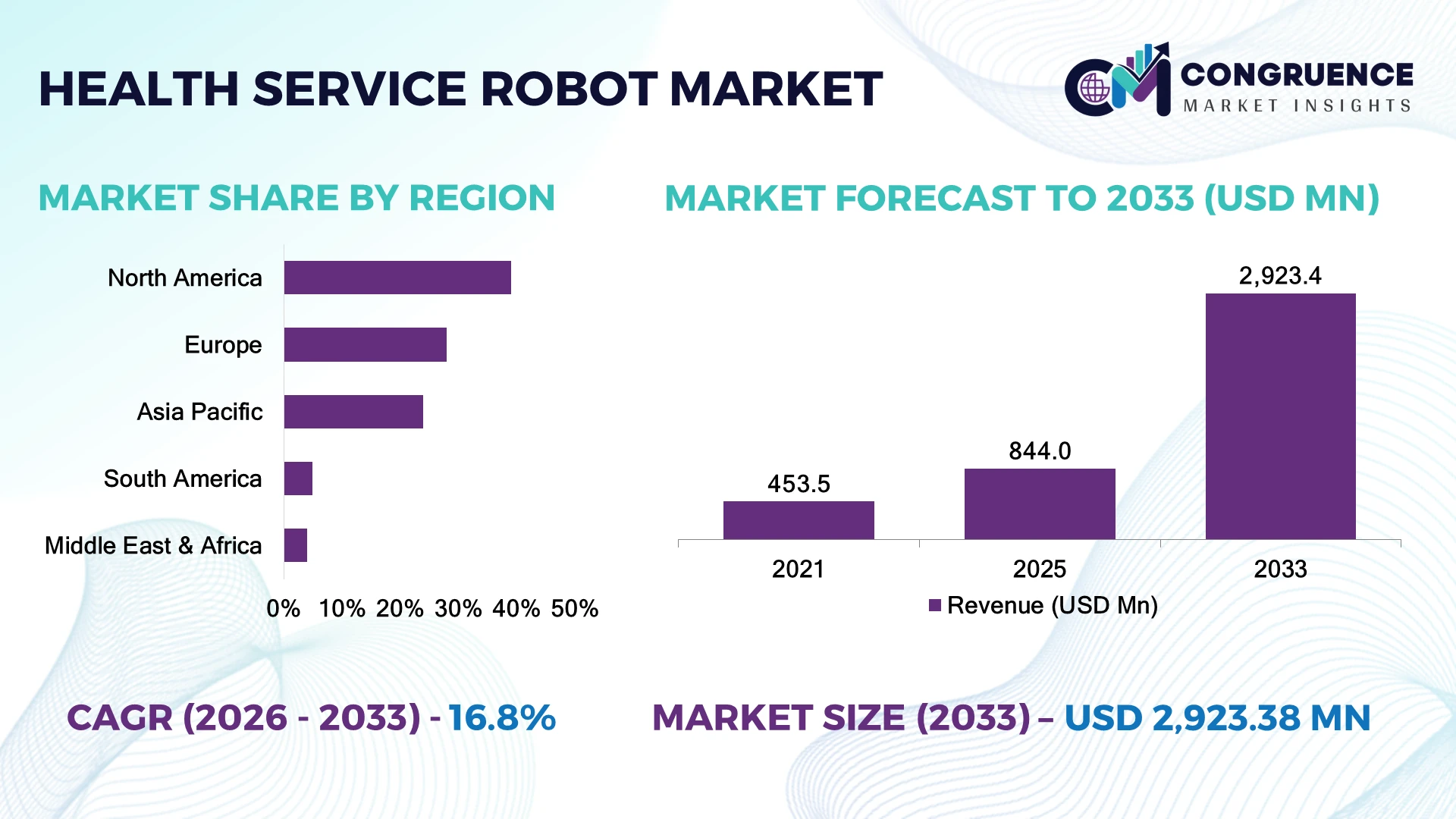
The Global Health Service Robot Market was valued at USD 844.0 Million in 2025 and is anticipated to reach a value of USD 2,923.4 Million by 2033 expanding at a CAGR of 16.8% between 2026 and 2033. Growth is primarily driven by expanding robotic-assisted surgery programs, aging populations, AI-enabled rehabilitation systems, and increasing automation across hospitals facing healthcare workforce shortages.
The United States dominates the global market with approximately 36% share, supported by over 6,500 hospitals, strong robotics investments exceeding USD 2 billion annually, and rapid deployment across surgical, rehabilitation, and hospital logistics applications. Japan follows with one of the world's highest elderly populations, where more than 29% of citizens are aged above 65, accelerating service robot adoption for eldercare compared with the U.S., where healthcare automation is primarily hospital-focused. Ongoing healthcare digitalization initiatives and post-pandemic modernization continue strengthening deployment across major healthcare systems.
The concentration of innovation in technologically advanced healthcare ecosystems makes strategic partnerships, regulatory readiness, and AI integration essential competitive priorities.
Market Size & Growth: USD 844.0 Million in 2025, projected to reach USD 2,923.4 Million by 2033 at 16.8% CAGR, supported by AI-enabled clinical automation and expanding robotic surgery programs.
Top Growth Drivers: Robotic-assisted surgeries (+24%), elderly care automation (+31%), hospital logistics optimization (+27%).
Short-Term Forecast: By 2028, hospital workflow efficiency is expected to improve by nearly 30% while patient handling time declines by approximately 22%.
Emerging Technologies: AI vision, collaborative robotics, digital twins, and autonomous navigation are transforming advanced healthcare robotics platforms.
Regional Leaders: North America (~USD 1.04 Billion), Europe (~USD 760 Million), Asia-Pacific (~USD 690 Million), each supported by accelerating hospital automation and healthcare infrastructure expansion.
Consumer/End-User Trends: More than 48% of large hospitals are increasing investments in robotic rehabilitation and patient-assistance technologies.
Pilot/Case Example: In 2024, autonomous hospital logistics robots reduced internal medicine transport time by nearly 35% in large healthcare facilities.
Competitive Landscape: Intuitive Surgical leads with approximately 23% share alongside ABB, Stryker, Omron Healthcare, and Panasonic Healthcare.
Regulatory & ESG Impact: Digital healthcare regulations have accelerated robotic deployment approvals by nearly 20% while reducing operational waste through automation.
Investment & Funding: Global investments exceeded USD 5 billion, driven by strategic partnerships, hospital modernization, and healthcare robotics startups.
Innovation & Future Outlook: AI-powered autonomous care robots, cloud robotics, and remote clinical support systems are reshaping long-term competitive strategies.
Health Service Robot Market demand is accelerating across robotic surgery, rehabilitation, pharmacy automation, and hospital logistics as healthcare providers prioritize precision, workforce efficiency, and patient safety. AI-enabled navigation, collaborative robotic platforms, and predictive maintenance continue improving operational performance, with intelligent robotic deployments increasing by over 28% in advanced hospitals. Supply-chain localization and evolving medical device regulations are encouraging manufacturers to strengthen regional production capabilities, setting the foundation for broader strategic market expansion.
Health service robots have become strategically important as healthcare providers pursue higher operational efficiency, standardized clinical outcomes, and workforce resilience. Hospital modernization, digital healthcare infrastructure, and AI-driven automation are reshaping procurement priorities while governments continue supporting intelligent healthcare ecosystems. Increasing localization of critical medical technologies is also strengthening supply-chain resilience and reducing dependence on overseas component sourcing.
Modern AI-powered service robots complete repetitive logistics and patient-support tasks approximately 35% faster than conventional manual workflows while reducing operational errors by nearly 30%. North America continues leading high-value surgical deployments, whereas East Asian countries emphasize eldercare and rehabilitation robotics due to demographic pressures. Over the next two to three years, intelligent fleet management, remote monitoring, and interoperable hospital platforms are expected to become standard deployment requirements.
Leading healthcare providers are deploying autonomous logistics robots to automate medicine delivery, laboratory transport, and inventory movement while manufacturers expand software partnerships, AI capabilities, and regional production networks. Organizations that combine intelligent robotics, healthcare interoperability, and scalable deployment models will secure stronger competitive positioning, higher operational resilience, and long-term strategic differentiation.
Hospitals are rapidly integrating intelligent robotics to improve clinical productivity, reduce repetitive workloads, and address healthcare staffing shortages. Robotic-assisted procedures have increased by approximately 22% globally, while AI-enabled rehabilitation systems have improved therapy consistency by nearly 30%. Japan continues expanding eldercare robotics under national healthcare modernization initiatives, while the United States increases investments in hospital automation and robotic surgery centers. This operational shift enables faster patient handling, improved resource utilization, and enhanced care quality. Manufacturers are responding through AI software upgrades, strategic partnerships with healthcare providers, expanded production capacity, and integrated robotics platforms capable of supporting surgery, rehabilitation, logistics, and patient assistance within unified healthcare ecosystems.
Capital-intensive procurement, specialized infrastructure requirements, and interoperability challenges continue limiting broader adoption across medium-sized healthcare facilities. Initial implementation expenses frequently exceed conventional medical equipment budgets by more than 40%, while integration projects can extend deployment timelines by approximately 25%. Dependence on advanced sensors, semiconductor components, and precision actuators also exposes manufacturers to periodic supply-chain disruptions, particularly across East Asian production hubs. Healthcare organizations increasingly mitigate these constraints through phased deployment strategies, long-term procurement contracts, localized sourcing initiatives, and modular robotic architectures that simplify integration while reducing operational complexity and lifecycle costs.
Emerging opportunities are expanding beyond surgical robotics into intelligent hospital automation, remote patient support, and predictive healthcare operations. AI-driven service robots improve logistics efficiency by nearly 32%, while cloud-connected robotic platforms reduce maintenance downtime by approximately 26%. South Korea and Singapore continue investing in smart hospital infrastructure that encourages deployment of interoperable robotics and digital healthcare platforms. Companies are strengthening research collaborations, expanding AI software capabilities, and developing modular robotic ecosystems supporting pharmacy automation, rehabilitation, infection control, and patient engagement. These integrated solutions create differentiated value through improved operational intelligence rather than hardware performance alone.
Long-term market expansion depends on achieving secure interoperability across hospitals, electronic health records, AI platforms, and connected medical devices. More than 45% of healthcare organizations identify cybersecurity and system integration as major deployment priorities, while software validation requirements extend implementation schedules by approximately 20%. The growing complexity of multi-vendor robotic ecosystems increases demands for standardized communication protocols, workforce training, and continuous software updates. Companies are addressing these execution barriers through cybersecurity investments, open-platform architectures, cloud-based monitoring systems, and strategic collaborations with healthcare IT providers to ensure scalable, secure, and operationally consistent robotic deployments.
AI-Driven Clinical Workflow Integration Hospitals are embedding artificial intelligence into service robots to coordinate patient transport, medicine distribution, and clinical scheduling. More than 42% of tertiary hospitals have expanded AI-assisted robotic workflows, while task completion time has improved by nearly 30% and manual handling errors have declined by approximately 24%. Workforce shortages and healthcare digitalization policies are accelerating adoption across the United States and Germany. Manufacturers are responding through cloud-connected platforms, hospital software integration, and long-term technology partnerships that enable continuous workflow optimization and predictive fleet management.
Expansion of Autonomous Logistics Robots Internal hospital logistics is becoming increasingly autonomous as healthcare providers automate pharmacy delivery, laboratory sample transport, and inventory movement. Autonomous transport robots now handle nearly 35% of repetitive logistics tasks in advanced hospitals, reducing internal delivery time by about 28% and lowering operational costs by close to 18%. Rising labor costs and stricter infection-control procedures continue driving deployment. Companies are scaling modular robotic fleets, expanding service contracts, and integrating intelligent navigation systems to improve operational continuity across multi-building healthcare campuses.
Localized Manufacturing and Component Supply Healthcare robotics manufacturers are restructuring production strategies to reduce supply-chain exposure and improve procurement stability. Approximately 33% of robotic component sourcing has shifted toward regional suppliers, while inventory lead times have fallen by nearly 21% and production flexibility has improved by about 17%. Japan and South Korea continue strengthening domestic precision manufacturing capabilities following global semiconductor supply disruptions. Companies are expanding localized assembly facilities, qualifying alternative component suppliers, and increasing vertical integration to improve delivery reliability and product availability.
Collaborative Robotics Beyond Surgery Healthcare providers are deploying collaborative robots across rehabilitation, eldercare, and patient assistance rather than limiting robotics to operating rooms. Rehabilitation robot utilization has increased by approximately 29%, patient mobility support deployments have expanded by nearly 25%, and clinician workload has declined by around 16% in digitally enabled care facilities. Aging populations and long-term care reforms are reshaping procurement priorities. Companies are introducing adaptable robotic platforms, expanding rehabilitation partnerships, and developing interoperable software ecosystems that support multiple clinical environments through a single robotic infrastructure.
The Health Service Robot Market is commonly segmented into Surgical Robots, Rehabilitation Robots, Hospital Logistics Robots, Telepresence Robots, and Companion & Elderly Care Robots. Surgical Robots account for approximately 41% of total deployments, supported by precision-assisted procedures, high clinical accuracy, and seamless integration with advanced imaging systems. Their proven operational performance and growing utilization in minimally invasive procedures continue to strengthen adoption across major healthcare institutions. Rehabilitation Robots represent the fastest-growing category as demand increases for post-stroke recovery, orthopedic rehabilitation, and elderly mobility assistance. Clinical studies indicate rehabilitation efficiency improvements of nearly 30%, while therapy consistency has increased by approximately 22%. Hospital Logistics Robots continue gaining strategic importance by automating medicine transport, linen movement, and laboratory delivery, reducing repetitive manual activities by nearly 28%. Telepresence Robots remain valuable for remote consultation and specialist access, particularly across distributed healthcare networks. Companion and Elderly Care Robots are expanding steadily in Japan and South Korea as demographic aging reshapes long-term care delivery. Manufacturers continue investing in AI-enabled navigation, modular software platforms, and specialized robotic portfolios to address diverse healthcare requirements while strengthening enterprise partnerships.
The market is segmented into Hospital Care, Rehabilitation & Therapy, Elderly Care, Pharmacy Automation, and Remote Healthcare & Telemedicine. Hospital Care remains the leading application with approximately 46% share due to extensive deployment across surgery support, patient transport, infection control, and material handling. Large healthcare systems continue expanding robotic operations to improve productivity, reduce staff workload, and standardize clinical workflows. Rehabilitation & Therapy is the fastest-growing application as healthcare providers invest in intelligent recovery solutions that improve therapy outcomes by nearly 30% while supporting individualized treatment pathways. Elderly Care continues expanding rapidly in countries experiencing aging populations, while Pharmacy Automation is strengthening medication accuracy and inventory efficiency through autonomous dispensing technologies. Remote Healthcare & Telemedicine applications continue evolving with integrated telepresence robots supporting specialist consultations and remote patient monitoring. Companies are increasing investment in application-specific robotic software, cloud connectivity, and healthcare interoperability to strengthen deployment flexibility and expand operational value across multiple clinical environments.
The market is segmented into Hospitals, Rehabilitation Centers, Elderly Care Facilities, Ambulatory Surgical Centers, and Home Healthcare Providers. Hospitals represent the dominant end-user with approximately 58% of total installations due to extensive infrastructure, high patient volumes, and broad clinical deployment requirements. Large hospital networks continue integrating robotics into surgery, logistics, rehabilitation, and patient assistance to improve operational consistency. Home Healthcare Providers represent the fastest-growing buyer group as aging populations, remote monitoring, and independent living solutions accelerate demand. Adoption of home-based robotic assistance has increased by nearly 27%, while connected care utilization has expanded by approximately 23%. Rehabilitation Centers continue investing in robotic therapy platforms that improve treatment consistency and patient engagement. Elderly Care Facilities are strengthening deployment of mobility assistance and monitoring robots to support long-term care operations. Ambulatory Surgical Centers increasingly adopt compact robotic systems to improve procedural efficiency without major infrastructure expansion. Manufacturers are introducing customized robotic platforms, subscription-based service models, and strategic healthcare partnerships to address the operational priorities of each end-user category.
North America accounted for the largest market share at 39% in 2025 however, Asia-Pacific is expected to register the fastest growth, expanding at a CAGR of 18.4% between 2026 and 2033.

North America maintains its leadership through advanced healthcare infrastructure, high robotic surgery penetration, and widespread adoption of AI-enabled hospital automation. The region contributes approximately 39% of global demand, supported by strong deployment across hospitals, rehabilitation centers, and outpatient facilities. More than 70% of large healthcare systems have integrated robotic solutions into at least one core clinical workflow, while autonomous logistics platforms continue reducing internal transport times by nearly 30%. Healthcare providers are prioritizing digital interoperability, predictive maintenance, and enterprise-wide robotics management platforms to improve operational efficiency. Strategic collaborations between medical device manufacturers and healthcare networks continue accelerating deployment of next-generation service robots across both public and private healthcare institutions.
United States Market Outlook: The United States remains the largest national market due to its extensive healthcare infrastructure, strong medical technology ecosystem, and continuous investment in intelligent hospital modernization. More than 6,500 hospitals create significant deployment opportunities across surgery, rehabilitation, logistics, and patient support applications. Increasing collaboration between robotics developers, healthcare providers, and AI software companies continues strengthening innovation while enterprise healthcare systems expand robotic fleets to improve workforce productivity and clinical efficiency.
Europe continues strengthening its position through hospital digitalization, aging population management, and advanced regulatory frameworks supporting healthcare innovation. The region represents approximately 28% of global market activity, with robotic rehabilitation, pharmacy automation, and patient assistance recording consistent deployment growth. More than 45% of newly commissioned smart hospital projects include robotic automation as part of digital transformation strategies. Healthcare organizations continue integrating robotics with electronic health records and AI-enabled decision-support systems to improve operational performance while addressing workforce shortages. Strategic public-private partnerships and research collaborations continue supporting commercialization of advanced healthcare robotics throughout the region.
Germany Market Outlook: Germany leads the European market through its advanced manufacturing capabilities, strong medical technology sector, and extensive hospital modernization initiatives. Precision engineering expertise supports development of high-performance healthcare robotics, while university hospitals continue expanding robotic-assisted clinical services. More than 60% of large academic medical centers have adopted advanced robotic platforms for surgery, logistics, or rehabilitation, reinforcing Germany's position as the region's technology and deployment leader.
Asia-Pacific is rapidly expanding through healthcare infrastructure development, domestic robotics manufacturing, and increasing demand for elderly care technologies. The region accounts for approximately 24% of global market activity while maintaining the fastest deployment momentum. More than 35% of newly installed healthcare service robots are deployed across Japan, China, and South Korea, supported by expanding smart hospital programs and demographic shifts. Manufacturers continue strengthening regional production capacity, reducing component dependence, and improving supply-chain resilience. Government-supported healthcare digitalization programs and enterprise investments in AI-driven robotics continue accelerating adoption across hospitals, rehabilitation facilities, and long-term care institutions.
Japan Market Outlook: Japan remains the region's most strategically significant market because of its aging population, advanced robotics ecosystem, and strong healthcare automation initiatives. More than 29% of the country's population is aged above 65, driving sustained demand for rehabilitation, mobility assistance, and elderly care robots. Domestic manufacturers continue investing in AI-enabled service robotics while healthcare providers expand robotic deployment to address long-term workforce shortages and improve patient support capabilities.
South America is gradually increasing adoption of healthcare service robots through hospital modernization, private healthcare investment, and expanding digital healthcare initiatives. The region contributes approximately 5% of global market demand, with deployment concentrated in major metropolitan healthcare networks. Robotic-assisted procedures have increased by nearly 18% across leading private hospitals, while investments in digital healthcare infrastructure continue improving readiness for automation technologies. Limited specialist availability and uneven infrastructure remain operational constraints, encouraging phased deployment strategies. Technology providers are expanding local distribution partnerships, clinical training programs, and after-sales service capabilities to strengthen long-term market penetration.
Brazil Market Outlook: Brazil represents the region's largest healthcare robotics market due to its extensive hospital network, growing private healthcare sector, and increasing investment in advanced medical technologies. Major urban hospitals continue expanding robotic-assisted surgery and rehabilitation capabilities while partnerships with international medical technology companies improve technology accessibility. Continuous healthcare infrastructure upgrades and increasing clinical training initiatives are supporting broader operational deployment across leading healthcare institutions.
The Middle East & Africa market is advancing through healthcare infrastructure modernization, smart hospital development, and government-supported digital transformation initiatives. The region contributes approximately 4% of global market activity, with adoption concentrated in technologically advanced healthcare systems. Smart hospital projects have increased by nearly 25%, while healthcare providers continue integrating robotics into logistics, patient assistance, and rehabilitation services. Strategic investments in healthcare infrastructure and technology partnerships are improving deployment readiness despite varying adoption levels across developing markets. Enterprise healthcare organizations increasingly prioritize intelligent automation to strengthen operational efficiency and service quality.
Saudi Arabia Market Outlook: Saudi Arabia leads the regional market through substantial healthcare modernization investments, Vision 2030 initiatives, and expansion of digitally connected hospitals. National healthcare transformation programs continue accelerating deployment of AI-enabled medical technologies across major healthcare facilities. Large hospital groups are increasing investments in robotic-assisted clinical operations, rehabilitation technologies, and autonomous logistics systems while international partnerships strengthen technology transfer, workforce development, and long-term healthcare innovation.
The Health Service Robot Market is led by Intuitive Surgical, ABB Ltd., Omron Corporation, Panasonic Holdings, and Stryker, with emerging competition from CMR Surgical, SS Innovations, and specialized rehabilitation robotics developers. The top five players collectively account for approximately 58% of the global market, creating a moderately consolidated competitive environment. Global technology leaders compete through AI integration, clinical validation, and digital healthcare ecosystems, while regional manufacturers focus on cost-efficient deployment and localized service capabilities. Product performance, software intelligence, and lifecycle support have become stronger differentiators than equipment pricing alone. AI-enabled workflow automation improves clinical efficiency by nearly 30%, while predictive maintenance reduces equipment downtime by approximately 20%. Companies are strengthening competitive positions through hospital partnerships, manufacturing expansion, software upgrades, and vertical integration of robotics platforms with digital healthcare infrastructure. Regulatory compliance, surgeon training ecosystems, and long product validation cycles remain significant entry barriers. Winning requires continuous innovation, integrated healthcare platforms, scalable service networks, and strong clinical adoption.
ABB Ltd.
Omron Corporation
Panasonic Holdings Corporation
Stryker Corporation
CMR Surgical Ltd.
Medtronic plc
Siemens Healthineers AG
Cyberdyne Inc.
SoftBank Robotics Group
SS Innovations International Inc.
F&P Robotics AG
Artificial intelligence, computer vision, force-feedback systems, and autonomous navigation are defining current healthcare robotics innovation. AI-assisted workflow optimization improves operational efficiency by nearly 30%, while advanced computer vision reduces navigation errors by approximately 25%. More than 45% of newly deployed healthcare service robots now incorporate cloud-based monitoring and predictive analytics. Healthcare providers benefit from improved workflow visibility, lower equipment downtime, and more consistent patient support, giving technology leaders a clear operational advantage over conventional equipment suppliers.
Next-generation robotic platforms increasingly combine collaborative robotics, digital twins, edge computing, and interoperable hospital software. Compared with traditional rule-based robotic systems, AI-enabled adaptive robots improve task accuracy by nearly 35% while reducing manual intervention by approximately 28%. Hospitals adopting integrated robotic ecosystems report faster deployment, simplified fleet management, and improved resource allocation. Companies investing in scalable software platforms and cybersecurity capabilities are strengthening long-term competitive differentiation.
Between 2026 and 2028, intelligent autonomy, remote robotic operations, and multimodal AI will reshape healthcare robotics deployment. Autonomous logistics robots, rehabilitation systems, and remote clinical assistance platforms are expected to become standard components of digitally connected hospitals. Early adopters will strengthen operational resilience, improve workforce productivity, and accelerate enterprise-wide automation strategies, while manufacturers expanding cloud integration, AI software, and interoperable robotics ecosystems will secure stronger competitive positioning.
March 2025 – SS Innovations International announced that its SSi Mantra surgical robotic platform surpassed 3,500 robotic procedures across more than 100 surgical indications, strengthening clinical validation and supporting wider hospital adoption across international markets. Source: www.ssinnovations.com
March 2025 – Intuitive Surgical published peer-reviewed findings showing that the da Vinci 5 Force Feedback technology reduced tissue force by up to 43%, reinforcing surgeon performance improvements and supporting broader adoption of advanced robotic-assisted surgery. Source: www.isrg.intuitive.com
July 2025 – Intuitive demonstrated a transatlantic telesurgery capability using the da Vinci 5 dual-console system, enabling surgeons on different continents to collaborate remotely, advancing global surgical connectivity and future remote care models. Source: www.isrg.intuitive.com
January 2025 – SS Innovations completed the world's first robotic cardiac telesurgeries using the SSi Mantra 3 system with 40-millisecond communication latency, demonstrating commercial readiness for remote robotic cardiac procedures and expanding advanced telehealth capabilities.
The report provides comprehensive analysis of the Health Service Robot Market across major robot types, applications, end-user industries, and key geographical markets. It evaluates adoption trends spanning surgical robotics, rehabilitation systems, hospital logistics, telepresence platforms, and elderly care solutions while assessing deployment across hospitals, rehabilitation centers, ambulatory surgical centers, home healthcare providers, and long-term care facilities. The study also examines AI integration, autonomous navigation, collaborative robotics, cloud connectivity, and healthcare interoperability as critical technology enablers.
The report delivers strategic intelligence covering competitive positioning, technology innovation, deployment patterns, regional market dynamics, and evolving healthcare automation strategies between 2026 and 2033. It incorporates operational benchmarks, enterprise adoption indicators, industry participation, and deployment trends supporting investment evaluation, expansion planning, product development, partnership strategies, and competitive decision-making. Detailed segmentation, regional assessment, and technology analysis enable stakeholders to identify high-opportunity applications, emerging healthcare ecosystems, and long-term business priorities across the global Health Service Robot Market.
| Report Attribute / Metric | Details |
|---|---|
| Market Revenue (2025) | USD 844.0 Million |
| Market Revenue (2033) | USD 2,923.4 Million |
| CAGR (2026–2033) | 16.8% |
| Base Year | 2025 |
| Forecast Period | 2026–2033 |
| Historic Period | 2021–2025 |
| Segments Covered |
By Type
By Application
By End-User
|
| Key Deliverables | Revenue Forecast; Market Trends; Growth Drivers & Restraints; Technology Insights; Segmentation Analysis; Regional Insights; Competitive Landscape; Regulatory & ESG Overview; Recent Developments |
| Regions Covered | North America; Europe; Asia-Pacific; South America; Middle East & Africa |
| Companies Profiled | Intuitive Surgical, Inc.; ABB Ltd.; Omron Corporation; Panasonic Holdings Corporation; Stryker Corporation; CMR Surgical Ltd.; Medtronic plc; Siemens Healthineers AG; Cyberdyne Inc.; SoftBank Robotics Group; SS Innovations International Inc.; F&P Robotics AG |
| Customization & Pricing | Available on Request (10% Customization Free) |




