
Reports
The Global Hair Transplant Market was valued at USD 910.0 Million in 2025 and is anticipated to reach a value of USD 4,495.4 Million by 2033 expanding at a CAGR of 22.1% between 2026 and 2033. Growth is driven by the shift from FUT toward minimally invasive FUE, AI-assisted follicular mapping, robotic extraction, and expanding medical-tourism infrastructure that reduces procedure time and improves graft-planning precision.
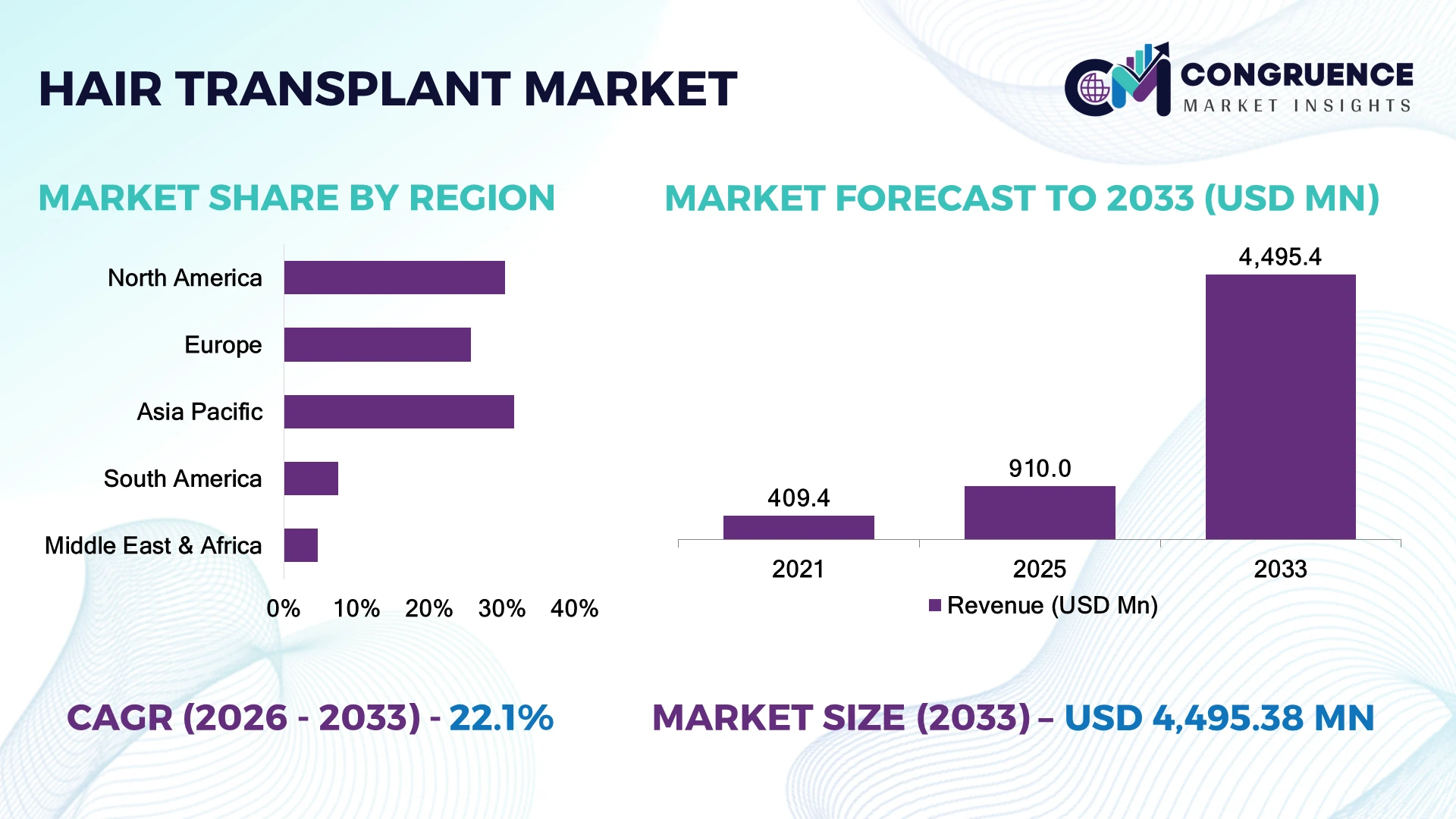
Turkey remains a dominant country-level medical-tourism hub, with high-volume Istanbul clinics handling 50–80 patients daily in some facilities and adopting AI-assisted scalp mapping using nearly 400 images and 6-axis robotic scanning. Asia Pacific represented 31.7% of the global market, while US and Canadian clinics performed 149,254 procedures, about 21.2% of global procedures in 2021. Turkey’s cost-led model contrasts with the United States’ technology-intensive premium positioning.
Strategic implication companies should prioritize AI-enabled FUE platforms, surgeon-led quality controls, and scalable medical-tourism networks to secure high-growth opportunities.
Market Size & Growth: Market value rises from USD 910.0 million in 2025 to USD 4,495.4 million by 2033 at 22.1% CAGR, driven by FUE adoption and robotic-assisted procedures.
Top Growth Drivers: FUE adoption 63.7%, male patients 77.6%, and clinic-based procedures 58.8% strengthen high-growth demand.
Short-Term Forecast: By 2028, AI-assisted planning targets 20–30% faster assessment and improved graft-selection consistency.
Emerging Technologies: AI scalp mapping, robotic FUE, and image-guided implantation are shifting clinics toward precision-based workflows.
Regional Leaders: Asia Pacific reaches about USD 1.42 billion, North America USD 1.51 billion, and Europe USD 1.16 billion by 2033 under current regional-share assumptions.
Consumer/End-User Trends: Male patients represent approximately 77.6%, while earlier intervention and minimally invasive FUE increasingly shape clinic utilization.
Pilot/Case Example: A robotic FUE project reduced procedure time from 8 hours to 1–1.5 hours, representing an efficiency improvement of roughly 81–88%.
Competitive Landscape: North America holds about 33.6% in one market assessment, with Bosley, Bernstein Medical, DHI Global, Vinci Hair Clinic, and EsteWorld competing through technology and clinic expansion.
Regulatory & ESG Impact: Unlicensed-provider concerns have driven stronger physician-supervision requirements, while 5.4% of patients sought corrective treatment after procedures lacking direct physician involvement.
Investment & Funding: A European robotic FUE project received €50,000 in public funding, reinforcing investment toward automation, image guidance, and surgical precision.
Innovation & Future Outlook: AI planning, robotic extraction, digital follow-up, and integrated implantation systems are moving competition from procedure volume toward measurable clinical consistency.
Hair Transplant Market adoption is concentrating around FUE, robotic assistance, AI-based scalp assessment, and specialized medical-tourism clinics. Male patients remain the principal user group at approximately 77.6%, while earlier intervention and minimally invasive procedures reshape clinic workflows. Turkey, India, South Korea, and the United States are strengthening specialized capacity as digital consultation and image-guided planning become increasingly operational.
The hair transplant market is becoming strategically important because competition is shifting from basic surgical availability toward precision, throughput, physician oversight, and patient experience. FUE has displaced much of the legacy FUT workflow, while AI-based follicular mapping and robotic extraction are creating differentiated clinic models. The industry is also restructuring around medical-tourism corridors, particularly Turkey, India, and Southeast Asia, where treatment capacity and international patient flows increasingly influence investment decisions.
Technology is producing measurable operational differences. A European robotic FUE development targeted procedure duration of 1–1.5 hours versus approximately 8 hours for conventional workflows, representing an efficiency improvement of roughly 81–88%. However, clinical evidence remains mixed: one 2024 comparison recorded an 82.05% robotic yield versus 90.03% for conventional FUE, reinforcing the importance of surgeon supervision rather than automation alone.
Over the next 2–3 years, clinics will prioritize digital consultation, AI-assisted donor assessment, robotic extraction, and remote postoperative monitoring. Turkey will emphasize high-volume medical tourism, while the United States will continue prioritizing premium technology and specialist-led care. Companies are responding through equipment partnerships, clinic expansion, localized training, and integrated digital platforms. Competitive advantage will increasingly depend on combining automation with clinical expertise, quality governance, and scalable patient-management infrastructure.
The transition toward minimally invasive FUE is the strongest structural growth driver, with FUE accounting for approximately 63.7% of the market and male patients representing about 77.6%. AI-enabled donor mapping and robotic extraction are increasing procedural standardization while reducing dependence on repetitive manual tasks. Turkey has accelerated this shift through high-volume medical-tourism clinics, while India is expanding lower-cost specialist capacity. Robotic development projects have targeted procedure-time reductions of more than 80% versus legacy workflows. Companies are responding by investing in robotic platforms, AI imaging, and surgeon-training partnerships. The strategic opportunity lies not simply in automation but in combining automated extraction with physician-led hairline design and graft placement.
High procedure costs and uneven clinical infrastructure constrain broader adoption, particularly where elective cosmetic procedures remain predominantly self-funded. North America accounts for approximately 33.6% in one market assessment, reflecting premium pricing and specialist infrastructure, while lower-cost markets compete aggressively through medical tourism. Quality fragmentation is another structural constraint: corrective procedures represented 5.4% of hair-restoration cases in one reported assessment involving inadequate physician participation. Turkey has faced particular scrutiny over high-volume clinics and unlicensed technicians. Companies are reducing exposure through physician-supervision protocols, accreditation, standardized contracts, centralized training, and diversified clinic networks. The key operational issue is maintaining clinical consistency while scaling patient throughput without compromising surgical governance.
AI-assisted planning creates an opportunity to convert hair transplantation into a more standardized, data-driven clinical workflow. Modern robotic systems can analyze nearly 400 scalp images and generate three-dimensional follicular maps, enabling more precise donor assessment and procedural planning. Advanced FUE already represents approximately 63.7% of the market, creating a substantial installed base for digital upgrades. India, South Korea, and Turkey offer particularly attractive expansion environments because of specialist capacity and medical-tourism activity. Companies are positioning through AI software, robotic equipment partnerships, remote consultations, and integrated postoperative monitoring. The non-obvious opportunity is recurring digital revenue: clinics can use imaging, treatment planning, and follow-up platforms across multiple procedures rather than relying solely on surgical fees.
Scaling advanced hair-transplant systems remains difficult because automation does not eliminate the need for highly trained surgeons and technicians. A 2024 robotic-versus-FUE comparison recorded an 82.05% robotic yield against 90.03% for conventional FUE, demonstrating that technology alone does not guarantee superior graft performance. At the same time, corrective cases linked to inadequate physician involvement reached 5.4% in one assessment, creating reputational and regulatory pressure. Turkey’s high-volume model and North America’s premium specialist model therefore face different execution pressures. Companies must invest in surgeon training, standardized operating protocols, quality monitoring, cybersecurity for patient imaging, and integrated clinical infrastructure. Long-term competitiveness will depend on achieving automation-assisted consistency without weakening physician accountability.
FUE Workflow Becomes More Standardized: Clinics are shifting toward FUE-led workflows, with the technique used in more than 68% of female and 85% of male surgical procedures. Automated graft counting, motorized punches, and digital donor mapping are reducing handling variability and improving session planning. Turkish and Indian providers are scaling standardized protocols to shorten operating cycles, while clinics increasingly pair FUE with imaging and preservation controls to improve graft utilization.
Younger Patients Reshape Clinic Operations: First-time surgical patients aged 20–35 represented about 95% of new cases in recent industry data, pushing clinics toward earlier diagnosis, conservative hairline planning, and long-term donor management. Female surgical demand has also risen 16.5% since 2021, encouraging providers to develop diffuse-thinning protocols and customized consultation pathways. Clinics are responding with digital assessments and staged treatment plans rather than high-graft procedures.
AI Enters Graft Planning Workflows: Computer-assisted scalp mapping is moving from demonstration to operational deployment, using 3D imaging, follicle recognition, and algorithmic density analysis. Advanced systems can process hundreds of scalp images during planning, improving follicle identification and reducing manual assessment time. Providers are investing in AI-supported planning and robotic assistance to increase consistency, while technician shortages are strengthening the case for workflow automation.
Medical Tourism Faces Quality Pressure: High-volume centers are restructuring around physician oversight, standardized technician roles, and tighter patient screening as international demand expands. Some Turkish clinics historically handled 50–80 patients daily, exposing capacity and quality-control pressures. Regulatory scrutiny and concerns over unlicensed practice are encouraging operators to formalize clinical governance, while premium providers increasingly compete through physician-led care, specialized tools, and documented procedural protocols.
FUE remains the leading type, accounting for approximately 80% of surgical hair-restoration procedures when male and female utilization patterns are combined, supported by minimal linear scarring, flexible graft harvesting, and suitability for outpatient workflows. FUT retains strategic relevance for selected patients requiring larger graft yields, but its utilization remains below 20% in many contemporary clinical settings. DHI is the fastest-growing type, benefiting from direct implantation workflows and growing demand for controlled placement.
DHI is gaining particular traction among premium clinics, where approximately 15–20% of procedure portfolios can increasingly involve implanter-assisted placement. Companies are investing in specialized punches, implanter pens, and technician training to improve graft handling and placement consistency. FUE providers are also expanding digital planning capabilities, while FUT remains important for patients with limited donor availability. The investment priority is shifting toward precision tools and standardized workflows rather than simply increasing procedure volume.
Male Pattern Baldness remains the leading application, representing approximately 70% of hair-transplant procedures, supported by high prevalence, predictable donor patterns, and established surgical protocols. Female Pattern Baldness is the fastest-growing application, with demand increasingly concentrated around diffuse thinning and density restoration rather than conventional hairline reconstruction. Alopecia Areata and Traumatic Hair Loss remain smaller applications, generally requiring more selective patient assessment and individualized graft planning.
Female-focused procedures are expanding as clinics improve diagnostic screening and customized implantation strategies, with female surgical patient volumes rising approximately 16.5% from 2021 levels. Male procedures remain operationally mature, often involving standardized FUE sessions and repeatable graft-density protocols. Providers are responding by developing gender-specific consultation pathways, while specialized centers are increasing trichoscopy and scalp-imaging use to distinguish suitable candidates. This is shifting investment toward diagnostic precision and personalized treatment planning.
Specialty Hair Restoration Clinics remain the leading end-user, accounting for approximately 65% of procedure activity because of dedicated surgical teams, higher procedure throughput, and established medical-tourism infrastructure. Dermatology Centers represent the fastest-growing end-user group as hair-loss diagnosis increasingly precedes surgical referral. Hospitals retain strategic importance for complex cases, medically supervised procedures, and patients requiring broader surgical infrastructure, although routine transplantation remains concentrated in specialized facilities.
Specialty clinics are strengthening capacity through dedicated FUE rooms, technician training, digital consultation systems, and packaged aftercare. Dermatology Centers are increasingly integrating trichoscopy, scalp imaging, and treatment screening before referral, creating a more structured pathway into transplantation. Hospitals are emphasizing multidisciplinary oversight and complex-case capability. Providers are also tailoring pricing and partnerships by buyer group, with approximately 20–25% of emerging clinic investments increasingly directed toward digital assessment, workflow automation, and patient-management infrastructure.
Asia-Pacific accounted for the largest market share at 31.7% in 2025 however, Asia-Pacific is expected to register the fastest growth, expanding at a CAGR of 12.41% between 2026 and 2033.
North America accounted for 30.4% of the global hair transplant market in 2025, supported by established dermatology networks, specialized restoration centers, advanced FUE infrastructure, and strong private-pay demand. The United States represents the dominant country market, with clinics increasingly integrating robotic assistance, trichoscopy, digital donor mapping, and automated graft planning into outpatient workflows. FUE remains the principal procedural approach, while corrective transplantation is becoming more operationally important as patients seek revision of previous procedures. Providers are responding through physician-led protocols, specialized revision services, and higher investment in imaging-assisted planning. Competition is increasingly based on clinical precision, technology integration, patient experience, and long-term donor management rather than low-cost procedure packages.
United States Market Outlook: The United States remains the principal North American market because of its specialist density, sophisticated private healthcare infrastructure, and early adoption of advanced transplantation technologies. Clinics increasingly combine FUE with digital scalp assessment, automated graft counting, and structured postoperative monitoring. Premium providers are strengthening physician involvement and personalized treatment planning, while established cosmetic-care networks provide an efficient platform for scaling minimally invasive restoration services.
Europe accounted for 25.7% of the global hair transplant market in 2025, with Turkey representing the region's most influential operational hub. Istanbul has developed a highly concentrated hair-restoration ecosystem supported by specialized clinics, international patient coordination, experienced surgical teams, and established FUE and DHI workflows. Turkey's high procedure volumes have encouraged greater specialization in graft extraction, implantation, patient logistics, and postoperative management. European providers outside Turkey are increasingly emphasizing physician-led procedures, clinical governance, individualized treatment plans, and premium aftercare. This creates a differentiated competitive structure in which Turkish providers benefit from scale and medical-tourism infrastructure, while Western European clinics increasingly compete through clinical oversight, customization, and technology-enabled treatment planning.
Turkey Market Outlook: Turkey remains the strategically significant European country and one of the world's most prominent hair-transplant destinations. Istanbul's concentrated clinic ecosystem supports high procedural throughput and specialized FUE and DHI capabilities. The country's medical-tourism infrastructure also enables coordinated consultation, transportation, accommodation, treatment, and follow-up services. Leading providers are increasingly investing in physician oversight, standardized graft handling, digital planning, and quality-control systems as competition moves beyond price-led positioning.
Asia-Pacific accounted for 31.7% of the global hair transplant market in 2025, making it the leading regional market. The region's position is supported by a large patient population, high prevalence of hair-loss conditions, expanding specialist facilities, and increasing investment in transplantation technologies. India, China, Japan, and South Korea are strengthening dedicated restoration infrastructure, with FUE and DHI increasingly integrated into outpatient clinic workflows. India is particularly important because its specialist availability and comparatively accessible treatment economics support expanding procedure volumes. South Korea contributes advanced aesthetic-care capabilities and technology-oriented clinical practices, while Japan emphasizes precision and structured clinical management. Providers are expanding dedicated treatment rooms, digital consultations, trichoscopy, graft-density planning, and postoperative monitoring to accommodate rising demand while maintaining procedural consistency.
India Market Outlook: India is the most strategically significant Asia-Pacific country because of its large patient pool, expanding private healthcare infrastructure, and established base of dermatologists and hair-restoration specialists. Major metropolitan clinics are increasingly deploying FUE, DHI, trichoscopy, digital consultations, and structured aftercare. Providers are also expanding capacity as demand broadens beyond conventional male-pattern restoration toward female thinning and younger patients, creating opportunities for specialized clinics and technology-enabled treatment pathways.
South America accounted for 7.5% of the global hair transplant market in 2025, with Brazil representing the region's principal specialist market. The country's established aesthetic-medicine ecosystem supports dedicated transplantation clinics, plastic-surgery practices, and dermatology-led restoration services. FUE is increasingly incorporated into clinical workflows because of its minimally invasive profile and reduced visible scarring. Demand remains concentrated in major metropolitan areas where specialist access, private healthcare spending, and advanced equipment availability are strongest. Providers are investing in improved donor-area assessment, graft extraction, implantation precision, and postoperative monitoring. However, differences in healthcare infrastructure and purchasing power across neighboring countries continue to limit uniform deployment. Competitive positioning is therefore centered on specialist expertise, clinical reputation, treatment customization, and procedural consistency.
Brazil Market Outlook: Brazil remains the leading South American country because of its mature aesthetic-surgery ecosystem and established specialist infrastructure. Major urban centers provide concentrated access to dermatologists, plastic surgeons, and dedicated hair-restoration clinics. Providers are expanding FUE and DHI capabilities while strengthening graft-handling protocols and postoperative care. Professional education and specialist networks are also supporting greater adoption of refined transplantation techniques, enabling Brazil to maintain its regional leadership in clinical expertise and procedure availability.
Middle East & Africa accounted for 4.7% of the global hair transplant market in 2025, with the United Arab Emirates and Saudi Arabia emerging as important premium-care markets. Dubai has developed sophisticated private healthcare and aesthetic-medicine infrastructure, allowing specialized clinics to combine FUE, DHI, digital consultation, and international-patient services. Saudi Arabia is also expanding private healthcare capacity and specialist cosmetic services. Demand remains concentrated in affluent urban populations, where premium treatment infrastructure and international connectivity support specialized procedures. Providers are responding by establishing dedicated transplantation units, recruiting specialist physicians, and developing integrated treatment and aftercare packages. Investment is increasingly directed toward digital scalp assessment, precision implantation, and patient-management systems, creating a premium service model distinct from Turkey's high-volume medical-tourism structure.
United Arab Emirates Market Outlook: The UAE is the strategically significant Middle Eastern market because Dubai combines advanced private healthcare infrastructure, international connectivity, and a strong aesthetic-medicine ecosystem. Specialized clinics increasingly offer FUE and DHI alongside digital consultations and structured postoperative care. International patient flows support premium positioning, while concentrated private medical infrastructure enables providers to invest in specialist recruitment, advanced equipment, dedicated transplantation facilities, and integrated patient-management systems.
The market pits robotic and device-led specialists such as Meta Healthcare Group’s ARTAS platform against clinic networks including Bosley, DHI Global, Smile Hair Clinic, and Turkish operators competing on throughput, physician expertise, and medical-tourism pricing. The top five players collectively command an estimated 22% share, leaving a fragmented field of independent clinics. Price influences roughly 30% of international patient decisions, while technology and customization increasingly determine premium positioning. FUE-focused providers compete through faster extraction, digital planning, and graft-preservation workflows; robotic platforms compete through repeatability and labor reduction. Players are expanding clinics, partnering with travel and healthcare networks, and integrating consultation, surgery, and aftercare. The competitive shift is moving from low-cost procedure volume toward documented outcomes, accreditation, automation, and physician oversight. Entry barriers remain high because surgical credentials, donor-management expertise, patient trust, and specialized equipment require investment. Winning requires combining clinical credibility with scalable technology, efficient patient operations, and personalized outcomes.
DHI Global Medical Group
Bosley
HairClub
Smile Hair Clinic
Dr. Serkan Aygin Clinic
Cosmedica
ASMED Surgical Medical Center
The Esthetic Clinics
Bernstein Medical
Ziering Medical
Clinicana
AI-assisted scalp mapping, robotic FUE, and digital graft planning are becoming core technologies across specialist clinics, particularly high-volume centers. Robotic systems target repeatability, while imaging supports donor-density measurement and recipient-site design. In 2025, 10.5% of surveyed specialists identified AI as a likely next technological leap, while 8.7% cited improved FUE devices. These tools can reduce planning variability by roughly 10–15% and improve workflow consistency.
DHI implanters and automated extraction are replacing more manual handling. Compared with conventional manual FUE workflows, robotic assistance can improve extraction consistency by about 15% in controlled operating environments, while digital graft tracking can reduce documentation and coordination time by 10%. Premium clinics benefit most because higher procedure volumes justify equipment and training costs. Integration with trichoscopy and teleconsultation is also tightening the pathway from diagnosis to surgery.
Between 2026 and 2028, AI-based donor mapping, semi-automated implantation, and regenerative technologies will increasingly differentiate providers. Tissue-engineered follicles and stem-cell approaches remain emerging rather than routine, but 27.9% and 26.7% of specialists respectively identified them as potential next leaps. Providers acting now can build data-rich workflows, train technicians earlier, and protect premium positioning before automation becomes mainstream and technology-led differentiation becomes harder to sustain commercially across major markets.
June 2025 Venus Concept agreed to sell its Venus Hair business to Meta Healthcare Group for $20 million, transferring ARTAS and NeoGraft technologies. Meta Healthcare also assumed the San Jose manufacturing and R&D facility, strengthening its hair-restoration technology and production capabilities. Source: ir.venusconcept.com
March 2025 DHI Global announced collaboration between the London Hair Restoration Training Academy and Claude Bernard Lyon 1 University to advance practitioner education. The partnership strengthens formal clinical training and supports standardized DHI expertise across its international network of clinics and practitioners. Source: dhiglobal.com
December 2025 Dr. Serkan Aygin Clinic documented a 4,400-graft FUE procedure for an Italian patient, with results assessed after nine months. The case demonstrates continued deployment of high-graft transplantation and supports the clinic’s international medical-tourism positioning and personalized treatment model. Source: drserkanaygin.com
December 2025 Cosmedica published its assessment of PP405, an investigational topical regenerative treatment designed to reactivate dormant hair follicles. The development highlights how the clinic is incorporating emerging regenerative medicine into patient education and broadening its technology focus beyond transplantation toward future non-surgical hair-restoration options. Source: cosmedica.com
The Hair Transplant Market Report covers FUE, FUT, and DHI across Male Pattern Baldness, Female Pattern Baldness, Alopecia Areata, and Traumatic Hair Loss, with analysis of Specialty Hair Restoration Clinics, Hospitals, and Dermatology Centers. Regional coverage spans Asia-Pacific, North America, Europe, South America, and Middle East & Africa, highlighting leading country markets, procedure concentration, medical-tourism activity, and clinic infrastructure.
The report evaluates robotic FUE, AI-assisted scalp mapping, digital graft planning, trichoscopy, DHI implantation, automated extraction, and emerging regenerative approaches. It assesses competitive positioning across technology-led platforms, specialist clinic networks, premium providers, and cost-focused operators, while tracking adoption shifts such as younger patients and rising female demand. The 2026–2033 outlook supports investment planning, geographic expansion, technology prioritization, capacity decisions, partnership development, and competitive strategy across established and emerging market segments.
| Report Attribute / Metric | Details |
|---|---|
| Market Revenue (2025) | USD 910.0 Million |
| Market Revenue (2033) | USD 4,495.4 Million |
| CAGR (2026–2033) | 22.1% |
| Base Year | 2025 |
| Forecast Period | 2026–2033 |
| Historic Period | 2021–2025 |
| Segments Covered |
By Type
By Application
By End-User
|
| Key Deliverables | Revenue Forecast; Market Trends; Growth Drivers & Restraints; Technology Insights; Segmentation Analysis; Regional Insights; Competitive Landscape; Regulatory & ESG Overview; Recent Developments |
| Regions Covered | North America; Europe; Asia-Pacific; South America; Middle East & Africa |
| Companies Profiled | Meta Healthcare Group; DHI Global Medical Group; Bosley; HairClub; Smile Hair Clinic; Dr. Serkan Aygin Clinic; Cosmedica; ASMED Surgical Medical Center; The Esthetic Clinics; Bernstein Medical; Ziering Medical; Clinicana |
| Customization & Pricing | Available on Request (10% Customization Free) |




