
Reports
The Global Genomic Data Analysis Service Market was valued at USD 2010.0 Million in 2025 and is anticipated to reach a value of USD 6063.6 Million by 2033 expanding at a CAGR of 14.8% between 2026 and 2033. Growth is driven by AI-powered genomic interpretation platforms, rising precision medicine programs, and increasing demand for scalable next-generation sequencing data processing infrastructure.
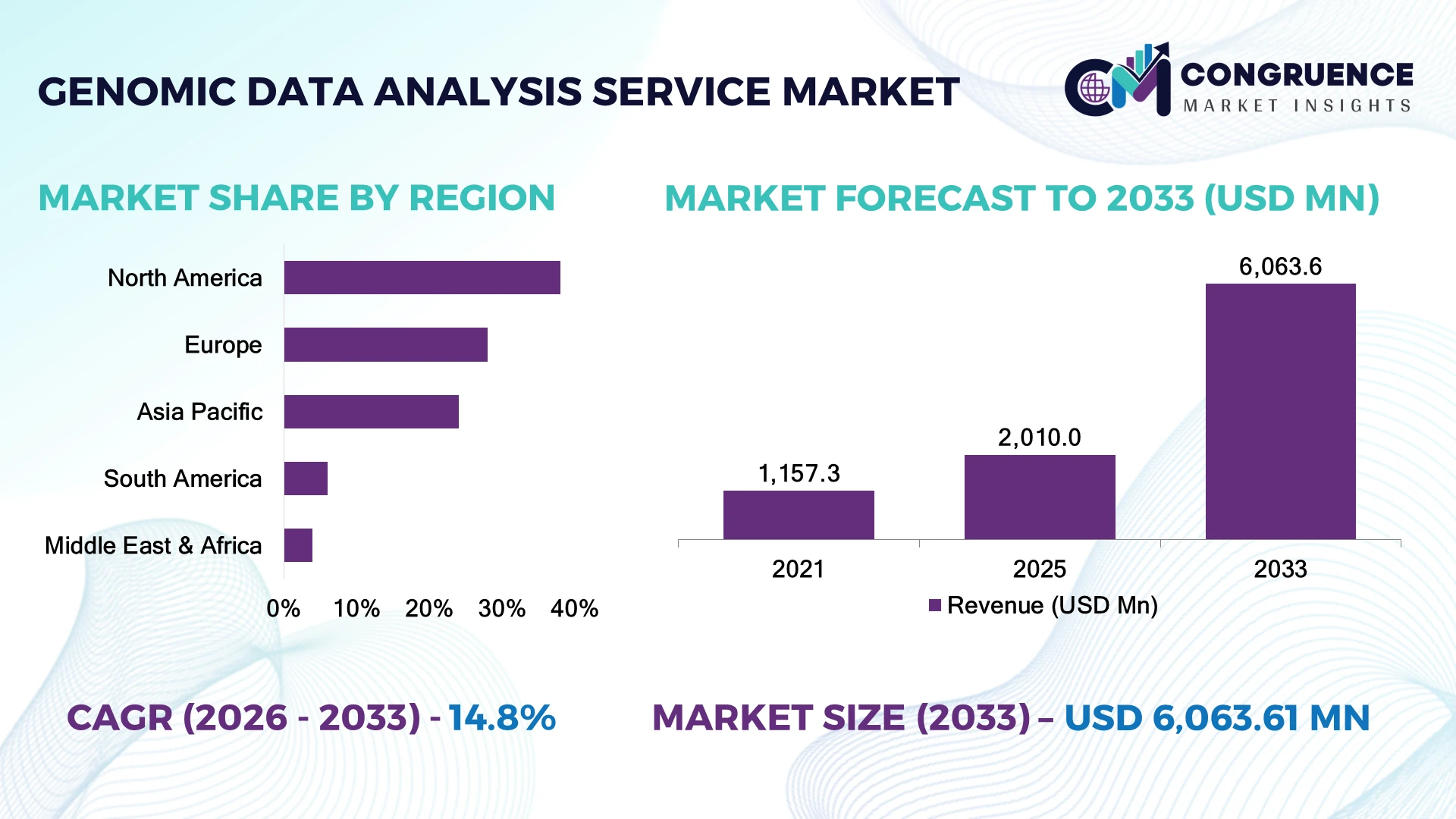
The United States dominates the global genomic data analysis service landscape with approximately 38% market share, supported by over USD 10 billion annual federal genomics investments, including initiatives linked to the National Institutes of Health. The country’s pharmaceutical, biotechnology, and research sectors have accelerated adoption of cloud-based genomic analytics, with more than 60% of major biopharma companies integrating computational genomics workflows. China follows with strong sequencing capacity expansion, operating more than 20 large-scale genomic research centers and prioritizing precision healthcare under national biotechnology programs.
This competitive gap highlights the importance of localized analytics platforms, strategic partnerships, and advanced computational infrastructure for future market positioning.
Market Size & Growth: USD 2.01 billion in 2025 expanding to USD 6.06 billion by 2033 at 14.8% CAGR, driven by AI-based genomic interpretation and precision medicine adoption.
Top Growth Drivers: AI analytics adoption (35%), cloud genomic computing demand (30%), and personalized medicine expansion (25%) are the leading growth factors.
Short-Term Forecast: By 2028, automated genomic workflows are expected to reduce analysis processing time by 40% and improve laboratory efficiency by 35%.
Emerging Technologies: AI-driven variant interpretation, automated sequencing pipelines, and cloud-native genomic platforms are reshaping advanced data analysis capabilities.
Regional Leaders: North America is projected at USD 2.3 billion, Europe at USD 1.5 billion, and Asia-Pacific at USD 1.8 billion by 2033, supported by digital healthcare adoption.
Consumer/End-User Trends: More than 45% of research institutions are adopting integrated genomic analytics platforms for faster clinical and discovery workflows.
Pilot/Case Example: In 2024, AI-enabled genomic analysis projects demonstrated approximately 30% faster variant identification compared with traditional computational workflows.
Competitive Landscape: Illumina leads with approximately 25% ecosystem influence, followed by Thermo Fisher Scientific, QIAGEN, BGI, and DNAnexus across genomic analytics services.
Regulatory & ESG Impact: Data governance frameworks and healthcare digitization policies are improving genomic data compliance efficiency by nearly 20%.
Investment & Funding: Over USD 5 billion has been directed toward genomics and biotechnology innovation, with increasing VC funding and strategic partnerships.
Innovation & Future Outlook: Next-generation platforms integrating AI, multi-omics analysis, and real-time genomic interpretation are driving competitive differentiation.
The Genomic Data Analysis Service Market is advancing as healthcare organizations prioritize faster biological insights, precision diagnostics, and scalable computational solutions. Recent innovations in AI-assisted sequencing interpretation and cloud-based analytics have improved workflow efficiency, with approximately 40% of genomic laboratories increasing digital adoption. Growing regulatory emphasis on secure genomic data handling and cross-border research collaboration is creating new opportunities for advanced service providers, setting the foundation for strategic market transformation.
The Genomic Data Analysis Service Market is becoming strategically important as biotechnology companies, healthcare providers, and research institutions compete through faster data interpretation and precision-driven innovation. The shift toward decentralized clinical research, cloud infrastructure modernization, and AI-enabled analytics is transforming genomic workflows, allowing organizations to process increasingly complex biological datasets with improved operational efficiency.
Advanced AI-based genomic analysis platforms are reducing interpretation cycles by nearly 50% compared with traditional manual bioinformatics approaches, while cloud-based systems provide greater scalability and lower infrastructure dependency. The United States continues to lead in commercialization and research integration, whereas China and India are accelerating deployment through expanding biotechnology ecosystems and population-scale genomic initiatives.
Healthcare organizations are increasingly adopting integrated genomic platforms for applications such as cancer profiling, rare disease identification, and drug discovery. Companies are responding through strategic collaborations, software investments, and expansion of secure data environments. Over the next 2–3 years, competitive advantage will depend on analytical accuracy, regulatory compliance, and the ability to deliver cost-efficient genomic insights at enterprise scale.
AI-driven genomic interpretation is becoming the primary catalyst for service adoption as healthcare systems require faster and more accurate biological insights. Machine learning-based platforms improve variant classification accuracy by nearly 30%, while automated workflows reduce manual bioinformatics workloads by over 40%. The growing use of precision oncology programs in the United States, Germany, and Japan is accelerating demand for advanced genomic analytics. Companies are responding by expanding AI capabilities, forming partnerships with sequencing providers, and investing in cloud-based genomic platforms. A key strategic shift is the transition from standalone sequencing services toward integrated analytics ecosystems that combine data processing, interpretation, and clinical decision support.
Genomic data management remains challenging due to high computational requirements, regulatory restrictions, and fragmented data environments. Large genomic datasets can require storage capacities exceeding terabytes per patient cohort, increasing infrastructure costs by nearly 25% for smaller research organizations. Countries such as India face challenges related to computational infrastructure availability and standardized genomic data frameworks. Companies are reducing operational pressure through hybrid cloud deployment, regional data centers, and strategic technology partnerships. The major constraint is not data generation but efficient interpretation and secure management of increasingly complex genomic information across different healthcare systems.
Integration of genomics with proteomics, transcriptomics, and AI-based diagnostics creates significant opportunities for advanced analytics providers. Multi-omics platforms are improving research efficiency by approximately 35% through combined biological data interpretation. Emerging markets including India, South Korea, and Singapore are increasing investments in population genomics and precision healthcare infrastructure. Companies are positioning themselves through R&D expansion, partnerships with pharmaceutical firms, and development of automated analytics solutions. A notable opportunity lies in offering specialized genomic interpretation services for rare diseases and personalized therapies, where demand for high-accuracy computational analysis continues to expand.
The rapid expansion of genomic datasets creates execution challenges related to cybersecurity, skilled bioinformatics availability, and regulatory compliance. Healthcare organizations report that more than 50% of genomic initiatives require additional computational expertise for effective deployment. Data protection requirements under frameworks such as GDPR in Europe increase compliance complexity for international genomic service providers. Companies must strengthen cybersecurity infrastructure, automate analytical workflows, and develop specialized workforce capabilities. The long-term competitive advantage will depend on maintaining secure genomic ecosystems while ensuring consistent service performance across diverse healthcare and research environments.
AI Workflow Automation Surge: Genomic service providers are rapidly integrating artificial intelligence into variant interpretation and annotation workflows, with adoption increasing by approximately 35% among advanced research organizations. Automated pipelines are reducing analysis turnaround times by 40–50% and lowering manual bioinformatics workload requirements. Companies are responding by expanding AI partnerships, upgrading computational infrastructure, and developing enterprise-grade analytics platforms. A key operational shift is the movement from researcher-operated analysis toward automated decision-support ecosystems.
Cloud Genomics Expansion: Cloud-based genomic analysis deployment is accelerating as laboratories seek scalable computing capacity without maintaining expensive infrastructure. Enterprise adoption of cloud genomic platforms has increased by nearly 30%, while hybrid computing models are improving data accessibility by approximately 25%. Regulatory requirements for secure health data management in Europe and North America are driving investment in compliant cloud environments. Companies are building regional data centers, strengthening cybersecurity frameworks, and forming collaborations with cloud technology providers.
Real-Time Data Integration Growth: Pharmaceutical companies and research institutions are shifting toward integrated genomic data environments combining sequencing, clinical, and population datasets. Adoption of connected analytics platforms has increased by around 28%, improving research coordination and reducing data processing delays by nearly 35%. Companies are restructuring workflows around centralized genomic repositories and investing in interoperability solutions to support large-scale clinical research programs.
Precision Medicine Deployment Shift: Healthcare systems are expanding genomic analysis applications beyond research into routine diagnostics, especially in oncology and rare disease management. Clinical genomic testing adoption has increased by approximately 32% in advanced healthcare markets, supported by precision medicine initiatives and reimbursement improvements. Companies are responding through specialized diagnostic partnerships, workflow customization, and expansion into hospital-based genomic services, creating stronger links between genomic insights and patient treatment decisions.
AI-powered genomic analysis platforms represent the leading type segment, accounting for approximately 42% market share due to superior scalability, automated interpretation capabilities, and compatibility with large sequencing datasets. These platforms reduce analytical complexity by integrating machine learning algorithms, cloud computing, and automated annotation tools. Traditional bioinformatics processing services remain important, particularly for research institutions requiring customized analysis, but their adoption growth is slower due to higher manual dependency and longer processing cycles.
Cloud-based genomic analysis services are the fastest-growing type, supported by increasing enterprise adoption and demand for flexible computational infrastructure. Adoption among biotechnology companies has increased by nearly 35%, while automated genomic workflows improve processing efficiency by approximately 40%. Companies are prioritizing platform expansion, strategic cloud partnerships, and AI investments to strengthen competitive positioning. Emerging integrated solutions combining multi-omics analysis and predictive analytics are shifting investment toward comprehensive genomic intelligence ecosystems.
Precision medicine is the leading application segment, capturing approximately 45% market share due to rising genomic testing adoption in oncology, rare disease diagnosis, and personalized therapies. Hospitals and pharmaceutical companies are increasingly using genomic analysis services to identify biomarkers and improve treatment decisions. Drug discovery and clinical research applications remain significant, supported by biotechnology innovation, while population genomics is gaining strategic importance through national healthcare initiatives.
Clinical research is the fastest-growing application area, with adoption expanding by nearly 38% as pharmaceutical companies integrate genomic insights into clinical trial design. Genomic analysis reduces patient stratification challenges by approximately 30% and improves biomarker identification efficiency. Companies are scaling partnerships with healthcare providers, expanding analytical capabilities, and developing specialized platforms for therapeutic development. The increasing use of genomic data in decentralized clinical trials is creating new operational models for pharmaceutical research organizations.
Pharmaceutical and biotechnology companies represent the leading end-user segment with approximately 48% market share, driven by extensive genomic data requirements for drug discovery, biomarker identification, and precision therapeutics development. These organizations depend on high-performance genomic analytics infrastructure to accelerate research pipelines and improve clinical success rates. Academic and research institutions remain critical users, particularly for population studies and fundamental genomic research.
Healthcare providers are the fastest-growing end-user group, with adoption increasing by nearly 36% as hospitals integrate genomic testing into diagnostics and personalized treatment programs. Healthcare deployment is expanding through partnerships between hospitals, sequencing companies, and analytics providers. Companies are responding with customized clinical platforms, subscription-based service models, and integrated solutions designed for healthcare workflows. Emerging demand from diagnostic laboratories is also reshaping purchasing patterns by increasing demand for secure, scalable, and clinically validated genomic analysis services.
North America accounted for the largest market share at 38% in 2025 however, Asia-Pacific is expected to register the fastest growth, expanding at a CAGR of 16.2% between 2026 and 2033.
North America holds the leading position in the genomic data analysis service market, supported by advanced healthcare infrastructure, strong biotechnology investment, and widespread adoption of precision medicine platforms. The region contributes approximately 38% of global demand, with the United States accounting for the majority share through pharmaceutical research, clinical genomics, and academic sequencing programs. More than 60% of large biopharma companies in the region utilize advanced genomic analytics workflows. Partnerships between technology providers and healthcare organizations are increasing deployment of cloud-based genomic platforms, improving scalability and reducing analysis turnaround time.
United States Market Outlook: The United States remains the primary growth engine due to its strong biotechnology ecosystem, federal genomics initiatives, and advanced computational infrastructure. Over 70 million genomic records are integrated into large-scale research databases, supporting drug discovery and personalized medicine. Leading pharmaceutical companies are expanding AI-enabled analytics capabilities to improve biomarker discovery and clinical research efficiency.
Europe is emerging as a strategically important genomic analytics market due to healthcare digitalization, regulatory frameworks, and national genome programs. The region represents nearly 28% of global adoption, supported by investments in secure health data infrastructure and cross-border research collaboration. Countries including the United Kingdom, Germany, and France are strengthening genomic data platforms to support precision diagnostics. Approximately 40% of European healthcare institutions are increasing investment in digital genomic workflows. Companies are focusing on GDPR-compliant platforms, interoperability solutions, and partnerships with research networks to improve deployment efficiency.
United Kingdom Market Outlook: The United Kingdom leads European genomic adoption through national sequencing initiatives and advanced healthcare research infrastructure. More than 100,000 whole-genome sequences have been incorporated into healthcare-focused programs, strengthening clinical applications. Biotechnology companies are expanding collaborations with hospitals and research institutions to accelerate genomic diagnostics and therapeutic development.
Asia-Pacific is the fastest-expanding genomic analytics market, supported by large patient populations, biotechnology investments, and government-backed precision healthcare initiatives. The region contributes approximately 24% of current market demand, with China, Japan, South Korea, and India driving adoption. China has developed large-scale sequencing infrastructure, while India is expanding population genomics programs through public-private partnerships. Adoption of cloud-based genomic services has increased by nearly 35% across major biotechnology hubs. Companies are investing in regional data centers, AI analytics platforms, and localized genomic solutions to address diverse healthcare requirements.
China Market Outlook: China maintains strong market influence through large sequencing capacity, biotechnology investment, and government-supported genomic research programs. The country operates more than 20 major genomic research centers and continues expanding precision healthcare applications. Domestic companies are strengthening AI-based analysis platforms to support pharmaceutical research, diagnostics, and population-scale genomic studies.
South America is gradually expanding genomic data analysis adoption through healthcare modernization, research collaboration, and biotechnology development. The region accounts for approximately 6% of global market activity, with Brazil and Argentina representing major deployment centers. Limited computational infrastructure remains a challenge, but investments in digital healthcare platforms are improving accessibility. Brazil has increased genomic research partnerships by nearly 25% through academic and healthcare collaborations. Companies are focusing on scalable cloud solutions and regional partnerships to overcome infrastructure limitations and improve genomic service availability.
Brazil Market Outlook: Brazil represents the largest genomic analytics market in South America due to its healthcare scale, research institutions, and biodiversity-focused genomic studies. The country supports more than 200 genomic research initiatives across universities and medical organizations. Companies are expanding collaborations with laboratories to improve diagnostic applications and strengthen local analytical capabilities.
The Middle East & Africa market is developing through healthcare modernization programs, biotechnology investments, and expansion of advanced diagnostic infrastructure. The region contributes approximately 4% of global demand, with adoption concentrated in countries such as Saudi Arabia, Israel, and the United Arab Emirates. National genomics initiatives are increasing investment in sequencing and data management capabilities. Healthcare digital transformation programs have improved genomic platform deployment by nearly 20% in leading markets. Companies are establishing partnerships with hospitals, research centers, and technology providers to build regional analytics ecosystems.
Saudi Arabia Market Outlook: Saudi Arabia is emerging as a key genomic analytics hub through national biotechnology programs and healthcare modernization initiatives. The country has expanded large-scale genomic research efforts involving more than 100,000 participants in population studies. Investments in advanced healthcare infrastructure and AI-enabled diagnostics are supporting increased adoption of genomic analysis services across clinical and research applications.
The Genomic Data Analysis Service Market features competition between global genomics leaders, cloud-based analytics providers, and specialized bioinformatics innovators. Illumina, Thermo Fisher Scientific, QIAGEN, DNAnexus, BGI, and Oxford Nanopore compete across sequencing analytics, clinical interpretation, and enterprise platforms. The top five players collectively account for approximately 55% market influence, driven by technology ecosystems and installed infrastructure. Competition centers on analytical accuracy, processing speed, platform integration, customization, and data security, with AI-based workflows improving efficiency by 30–50%. Companies are expanding through cloud partnerships, AI investments, software integration, and clinical collaborations. The competitive landscape is shifting toward integrated genomic intelligence platforms rather than standalone analysis services. High regulatory requirements, computational infrastructure needs, and specialized expertise create strong entry barriers. Winning players must combine scalable AI analytics, secure data management, rapid interpretation, and strategic healthcare partnerships to outperform established genomic technology ecosystems.
Thermo Fisher Scientific Inc.
QIAGEN N.V.
DNAnexus, Inc.
BGI Genomics Co., Ltd.
Oxford Nanopore Technologies plc
F. Hoffmann-La Roche Ltd.
PerkinElmer, Inc.
Agilent Technologies, Inc.
NeoGenomics, Inc.
Sophia Genetics SA
Seven Bridges Genomics
Fabric Genomics
Personalis, Inc.
Artificial intelligence and machine learning are transforming genomic interpretation by automating variant classification, predictive modeling, and clinical reporting. AI-enabled platforms improve analysis accuracy by approximately 30% and reduce manual review requirements by nearly 40%. Compared with traditional bioinformatics workflows, AI-driven systems deliver faster interpretation cycles and allow pharmaceutical companies to scale genomic research programs with fewer computational bottlenecks.
Cloud-native genomic platforms are becoming essential for handling large sequencing datasets, with enterprise adoption increasing across research institutions and healthcare providers. Hybrid cloud environments improve data accessibility by 35% while reducing infrastructure management costs by nearly 25%. Leading technology providers benefit through secure analytics ecosystems, enabling partnerships between sequencing companies, hospitals, and pharmaceutical organizations.
From 2026 to 2028, multi-omics integration, generative AI models, and automated genomic decision-support systems will define competitive advantage. Companies investing in AI-powered platforms, interoperability frameworks, and real-time analytics capabilities will strengthen market positioning. The shift from basic data processing toward predictive genomic intelligence is creating opportunities for faster diagnostics, personalized therapies, and more efficient drug discovery operations.
May 2025 Illumina launched PromoterAI, an AI algorithm for rare disease genomic interpretation. The platform identifies regulatory variants across noncoding genome regions and improves combined AI diagnostic yield by nearly 2x. The development strengthens clinical analytics capabilities for researchers and precision medicine providers. Source: Illumina.com
March 2024 DNAnexus integrated NVIDIA NIM and CUDA-X microservices into its Precision Health Data Cloud. The collaboration introduced workflows delivering more than 50x acceleration compared with CPU-based processing, improving genomic analysis speed for drug discovery and healthcare applications. Source: DNAnexus.com
July 2025 QIAGEN expanded its QIAseq portfolio with xHYB Long Read Panels for complex genomic analysis. The solution supports structural variant detection and strengthens integrated sequencing-to-bioinformatics workflows, improving research capabilities across advanced genomics applications. Source: QIAGEN.com
May 2025 Oxford Nanopore introduced technology updates supporting multiomics discovery and scalable sequencing workflows. The company enhanced platform flexibility through higher-throughput solutions and real-time analysis capabilities, supporting decentralized genomics applications and improving operational efficiency for research users. Source: Oxford Nanopore Technologies.com
The Genomic Data Analysis Service Market Report covers comprehensive segmentation across service types, including AI-based platforms, cloud genomic analytics, and bioinformatics solutions. The study evaluates applications such as precision medicine, drug discovery, clinical research, and population genomics, along with end-users including pharmaceutical companies, healthcare providers, research institutions, and diagnostic laboratories. Regional coverage includes North America, Europe, Asia-Pacific, South America, and Middle East & Africa.
The report analyzes emerging technologies such as artificial intelligence, multi-omics integration, automation, and secure genomic data platforms. It evaluates adoption patterns, deployment strategies, competitive positioning, and innovation trends shaping market direction from 2026 to 2033. The insights support investment decisions, expansion planning, partnership strategies, and technology prioritization by identifying growth opportunities, operational challenges, and evolving competitive dynamics across the genomic analytics ecosystem.
| Report Attribute / Metric | Details |
|---|---|
| Market Revenue (2025) | USD 2010.0 Million |
| Market Revenue (2033) | USD 6063.6 Million |
| CAGR (2026–2033) | 14.8% |
| Base Year | 2025 |
| Forecast Period | 2026–2033 |
| Historic Period | 2021–2025 |
| Segments Covered |
By Type
By Application
By End-User
|
| Key Deliverables | Revenue Forecast; Market Trends; Growth Drivers & Restraints; Technology Insights; Segmentation Analysis; Regional Insights; Competitive Landscape; Regulatory & ESG Overview; Recent Developments |
| Regions Covered | North America; Europe; Asia-Pacific; South America; Middle East & Africa |
| Companies Profiled | Illumina, Inc.; Thermo Fisher Scientific Inc.; QIAGEN N.V.; DNAnexus, Inc.; BGI Genomics Co., Ltd.; Oxford Nanopore Technologies plc; F. Hoffmann-La Roche Ltd.; PerkinElmer, Inc.; Agilent Technologies, Inc.; NeoGenomics, Inc.; Sophia Genetics SA; Seven Bridges Genomics; Fabric Genomics; Personalis, Inc. |
| Customization & Pricing | Available on Request (10% Customization Free) |




