
Reports
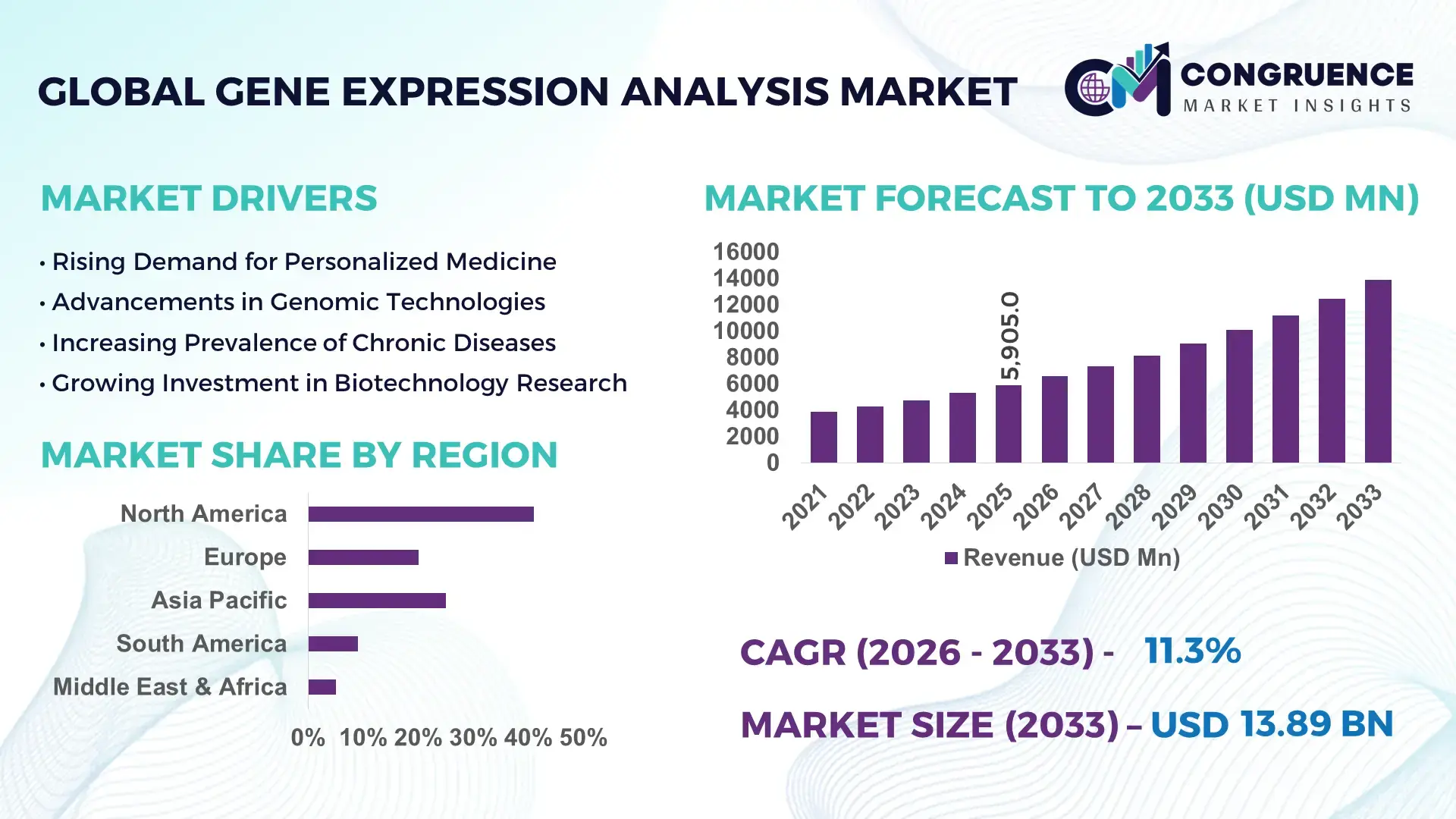
The Global Gene Expression Analysis Market was valued at USD 5904.95 Million in 2025 and is anticipated to reach a value of USD 13885.23 Million by 2033 expanding at a CAGR of 11.28% between 2026 and 2033. The growth trajectory is strongly supported by the expanding adoption of advanced genomic technologies and increasing clinical reliance on transcriptomic profiling for disease diagnosis and treatment optimization.
The United States remains a focal hub for Gene Expression Analysis activities, characterized by large-scale genomic infrastructure and continuous investment in biotechnology innovation. The country hosts over 2,500 molecular diagnostic laboratories and contributes significantly to global sequencing output, with more than 65% of high-throughput sequencing capacity concentrated in North America. Annual funding in genomics research exceeds USD 10 billion, enabling widespread integration of gene expression tools in oncology, immunology, and rare disease studies. Nearly 70% of pharmaceutical companies in the U.S. actively incorporate gene expression analysis in clinical trials, while advancements in RNA sequencing have improved workflow efficiency by approximately 40%, enhancing both research productivity and clinical application outcomes.
Market Size & Growth: USD 5904.95 Million in 2025 to USD 13885.23 Million by 2033 at 11.28% CAGR, driven by increasing adoption of precision medicine and molecular diagnostics.
Top Growth Drivers: 62% rise in precision medicine adoption, 48% improvement in sequencing efficiency, 55% increase in biomarker-based diagnostic usage.
Short-Term Forecast: By 2028, automation technologies are projected to reduce gene expression analysis processing time by 35%.
Emerging Technologies: RNA sequencing advancements, single-cell transcriptomics, and AI-powered bioinformatics platforms enhancing analytical precision.
Regional Leaders: North America projected at USD 5200 Million by 2033 with strong research infrastructure; Europe at USD 3900 Million driven by regulatory genomics programs; Asia-Pacific at USD 3200 Million with rapid clinical adoption.
Consumer/End-User Trends: Pharmaceutical and biotechnology companies account for over 60% usage, with growing hospital-based diagnostic integration.
Pilot or Case Example: In 2024, a genomic research project improved diagnostic accuracy by 42% using AI-integrated gene expression analysis tools.
Competitive Landscape: Leading player holds approximately 22% share, followed by Thermo Fisher Scientific, Illumina, Agilent Technologies, and Bio-Rad Laboratories.
Regulatory & ESG Impact: Adoption of genomic data protection standards and sustainable lab practices reducing waste by up to 25%.
Investment & Funding Patterns: Over USD 15 billion invested globally in genomics and transcriptomics research initiatives in recent years.
Innovation & Future Outlook: Integration of AI with sequencing platforms and expansion of cloud-based genomic analytics driving next-generation solutions.
The Gene Expression Analysis market reflects strong sectoral contributions, with pharmaceutical and biotechnology companies representing nearly 50% of total demand, followed by academic and research institutes at around 30%. Technological innovations such as single-cell RNA sequencing and multiplex gene assays have enhanced analytical accuracy by over 45% compared to traditional methods. Regulatory developments focusing on genomic data privacy and harmonization are shaping adoption, while sustainable laboratory practices are reducing reagent waste by approximately 20%. Asia-Pacific continues to experience accelerated consumption due to expanding clinical diagnostics infrastructure, while Europe emphasizes structured genomic research initiatives. Future market expansion is expected to be driven by AI-integrated analytics, real-time gene expression monitoring, and scalable cloud-based genomic platforms.
The Gene Expression Analysis market holds strategic importance in advancing precision medicine, enabling targeted therapies, and enhancing disease diagnostics across oncology, infectious diseases, and genetic disorders. The adoption of next-generation sequencing combined with artificial intelligence analytics delivers nearly 50% improvement in data interpretation speed compared to traditional microarray-based methods, enabling faster clinical decision-making. North America dominates in volume due to extensive research infrastructure, while Asia-Pacific leads in adoption growth with over 58% of emerging biotech enterprises integrating gene expression platforms into clinical workflows.
From a strategic standpoint, companies are investing in automation, cloud integration, and high-throughput sequencing platforms to optimize operational efficiency and reduce costs. By 2028, AI-driven bioinformatics tools are expected to improve data processing efficiency by 40%, significantly reducing turnaround time for complex genomic analyses. Firms are also committing to ESG initiatives, including reducing laboratory plastic waste by 30% and implementing energy-efficient sequencing systems by 2030.
In 2024, a biotechnology firm in Germany achieved a 38% increase in diagnostic accuracy through AI-powered transcriptomic profiling, demonstrating measurable gains in clinical outcomes. Additionally, strategic collaborations between pharmaceutical companies and research institutes are accelerating biomarker discovery, improving drug development success rates by approximately 25%. The Gene Expression Analysis market is evolving into a foundational pillar for healthcare innovation, supporting resilient healthcare systems, regulatory compliance, and sustainable growth through advanced genomic insights and scalable analytical technologies.
The increasing emphasis on precision medicine is a primary driver for the Gene Expression Analysis market, as healthcare systems shift toward individualized treatment approaches. Approximately 65% of ongoing clinical trials incorporate gene expression profiling to identify disease-specific biomarkers and optimize therapeutic outcomes. Advanced RNA sequencing technologies have improved detection sensitivity by over 50%, enabling early diagnosis and targeted interventions. Pharmaceutical companies are leveraging gene expression data to enhance drug efficacy, reducing trial failure rates by nearly 30%. Additionally, government-backed genomic initiatives and funding programs are expanding access to molecular diagnostics, further accelerating market growth. The integration of AI-driven analytics is also enhancing data interpretation accuracy, making gene expression analysis an essential tool in modern healthcare and biomedical research.
Despite its advancements, the Gene Expression Analysis market faces challenges due to high operational costs and technical complexities associated with advanced sequencing technologies. The cost of next-generation sequencing platforms and associated reagents remains significant, limiting accessibility for smaller research institutions and developing regions. Additionally, the requirement for highly skilled personnel to interpret complex genomic data creates a barrier to widespread adoption. Data storage and management issues also pose challenges, as large-scale gene expression studies generate terabytes of data requiring secure and scalable infrastructure. Furthermore, variations in standardization and reproducibility across laboratories can affect data reliability, impacting clinical decision-making and slowing adoption in regulated healthcare environments.
The emergence of single-cell gene expression analysis presents significant growth opportunities by enabling high-resolution insights into cellular heterogeneity. This technology allows researchers to analyze gene activity at the individual cell level, improving understanding of complex diseases such as cancer and neurological disorders. Adoption of single-cell sequencing has increased by over 60% in advanced research laboratories, driven by its ability to identify rare cell populations and novel biomarkers. The integration of cloud-based platforms is further enhancing accessibility, enabling remote data analysis and collaboration. Additionally, the expansion of genomics research in emerging markets and increasing funding for biotechnology startups are creating new avenues for innovation and market expansion.
Data privacy and regulatory compliance remain critical challenges in the Gene Expression Analysis market, particularly as genomic data becomes more integral to clinical and research applications. Stringent data protection regulations require secure handling of sensitive genetic information, increasing operational costs and complexity for organizations. Compliance with international standards and varying regional regulations can delay product approvals and market entry. Furthermore, concerns regarding ethical use of genetic data and patient consent are influencing adoption, especially in clinical settings. The need for robust cybersecurity measures to prevent data breaches adds another layer of complexity, while ensuring interoperability between different genomic platforms remains an ongoing technical challenge for industry stakeholders.
Expansion of Single-Cell Sequencing Driving High-Resolution Insights: Single-cell gene expression analysis adoption has increased by over 60% in advanced research laboratories, enabling precise cellular-level profiling. More than 45% of oncology-focused studies now rely on single-cell RNA sequencing to identify tumor heterogeneity and rare cell populations. This shift has improved biomarker discovery efficiency by nearly 50%, allowing researchers to generate more targeted therapeutic strategies and significantly enhancing translational research outcomes.
Integration of Artificial Intelligence in Bioinformatics Pipelines: AI-driven gene expression analysis platforms are improving data processing speed by approximately 40% while reducing analytical errors by nearly 30%. Around 58% of large-scale genomics projects now incorporate machine learning algorithms for pattern recognition and predictive modeling. Automated data interpretation tools are also reducing manual workload by up to 35%, enabling faster turnaround times in both clinical diagnostics and drug discovery workflows.
Growing Adoption of Cloud-Based Genomic Data Platforms: Cloud integration in gene expression analysis has surged, with nearly 52% of research organizations utilizing cloud infrastructure for data storage and processing. This shift has reduced infrastructure costs by approximately 25% and enhanced collaborative research capabilities across geographically distributed teams. Additionally, cloud-based platforms enable real-time data sharing, accelerating multi-center clinical studies and improving overall project efficiency by nearly 30%.
Rising Demand for Multiplex and High-Throughput Assays: Multiplex gene expression assays are gaining traction, with adoption rates increasing by over 48% due to their ability to analyze multiple genes simultaneously. High-throughput sequencing platforms now process up to 10,000 samples per run, improving laboratory productivity by nearly 55%. These advancements are particularly significant in large-scale population studies and pharmaceutical research, where speed and accuracy are critical for decision-making.
The Gene Expression Analysis market segmentation reflects a diverse structure based on type, application, and end-user categories, each contributing uniquely to overall market expansion. By type, technologies such as RNA sequencing, microarrays, and PCR-based methods dominate usage patterns, with RNA sequencing emerging as the most advanced and widely adopted solution. In terms of applications, drug discovery and development accounts for a significant portion of demand, followed by clinical diagnostics and academic research. End-user segmentation highlights pharmaceutical and biotechnology companies as primary consumers, supported by growing adoption in hospitals and diagnostic laboratories. Approximately 60% of total usage is concentrated within research-intensive industries, while clinical applications are expanding rapidly due to increasing demand for precision diagnostics and personalized treatment approaches.
The Gene Expression Analysis market by type is led by RNA sequencing technologies, which currently account for approximately 46% of total adoption due to their superior accuracy, scalability, and ability to analyze entire transcriptomes. In comparison, PCR-based methods hold around 28% share, primarily driven by their cost-effectiveness and rapid turnaround in clinical diagnostics. However, microarray technologies, with an estimated 18% share, are witnessing slower growth due to limitations in detecting novel transcripts. Adoption in RNA sequencing is expanding at the fastest pace, with an estimated growth rate of 14.5% annually, fueled by advancements in sequencing depth, reduced error rates by nearly 35%, and increasing affordability of sequencing platforms.
Other niche technologies, including northern blotting and in situ hybridization, collectively contribute around 8% of the market, mainly in specialized research applications. These methods continue to serve specific use cases where targeted gene expression validation is required.
By application, drug discovery and development leads the Gene Expression Analysis market with approximately 42% share, as pharmaceutical companies increasingly rely on gene expression profiling to identify drug targets and optimize therapeutic efficacy. Clinical diagnostics follows with around 33% share, driven by the growing adoption of molecular diagnostic tools for early disease detection and treatment monitoring. Academic and research applications account for nearly 25%, supporting fundamental studies in genomics and molecular biology. Clinical diagnostics is emerging as the fastest-growing application segment, expanding at an estimated rate of 13.8% annually due to rising demand for personalized medicine and increasing integration of gene expression analysis in hospital workflows. Enhanced diagnostic accuracy, improving by nearly 45% with advanced sequencing techniques, is a key factor driving this growth.
Other applications, including agricultural genomics and environmental research, collectively contribute a smaller but steadily increasing share, reflecting expanding use cases beyond healthcare.
Pharmaceutical and biotechnology companies represent the leading end-user segment in the Gene Expression Analysis market, accounting for approximately 50% of total demand due to their extensive use in drug development, biomarker discovery, and clinical trials. Academic and research institutes follow with around 30% share, driven by ongoing genomics research and government-funded projects. Hospitals and diagnostic laboratories contribute nearly 20%, reflecting increasing adoption in clinical diagnostics and patient care. Hospitals and diagnostic laboratories are the fastest-growing end-user segment, with an estimated growth rate of 15.2% annually, supported by rising demand for precision diagnostics and integration of advanced molecular testing in routine healthcare. Adoption rates in hospitals have increased by over 35% in the past few years, indicating a shift toward genomics-based clinical decision-making.
Other end-users, including contract research organizations and agricultural research entities, collectively contribute a smaller share but play a crucial role in expanding application diversity and market reach.
Region North America accounted for the largest market share at 41% in 2025 however, Asia-Pacific is expected to register the fastest growth, expanding at a CAGR of 13.9% between 2026 and 2033.
North America’s leadership is supported by over 65% of global high-throughput sequencing infrastructure and more than 2,500 molecular diagnostic laboratories. Europe holds approximately 28% share, driven by strong regulatory-backed genomics programs and widespread research funding across Germany, the UK, and France. Asia-Pacific currently represents around 22% of the market, with China, Japan, and India collectively contributing over 70% of regional demand due to expanding healthcare infrastructure and rising adoption of molecular diagnostics. South America accounts for nearly 5% share, with Brazil leading regional consumption, while the Middle East & Africa contributes close to 4%, supported by increasing healthcare investments and genomic research initiatives. Across all regions, the number of genomic research projects has increased by over 35% since 2022, reflecting strong global demand for advanced gene expression technologies.
How are advanced genomics ecosystems shaping competitive innovation landscapes?
North America holds approximately 41% of the Gene Expression Analysis market, supported by strong demand from pharmaceutical, biotechnology, and clinical diagnostics sectors. Over 70% of pharmaceutical companies in this region utilize gene expression profiling in drug development pipelines, while healthcare institutions are increasingly adopting molecular diagnostics, with hospital-based usage growing by nearly 38% in recent years. Regulatory support through genomic research funding programs and data standardization frameworks has accelerated adoption across clinical settings. Technological advancements, including AI-integrated sequencing platforms, have improved data analysis efficiency by around 40%. A key player in the region is Illumina, which continues to expand sequencing capabilities through high-throughput platforms, processing thousands of samples daily. Consumer behavior reflects high enterprise adoption, particularly in healthcare and life sciences, where precision medicine initiatives are prioritized.
What regulatory-driven innovation trends are accelerating adoption of advanced genomic tools?
Europe accounts for nearly 28% of the Gene Expression Analysis market, with Germany, the UK, and France serving as primary contributors. More than 55% of research institutions in these countries actively utilize gene expression technologies for biomedical research. Strong regulatory frameworks focused on genomic data privacy and ethical standards have influenced adoption, with compliance-driven investments increasing by approximately 30%. Sustainability initiatives have also led to a 20% reduction in laboratory waste through eco-friendly practices. The region is witnessing growing adoption of single-cell sequencing and AI-based bioinformatics tools, improving analytical precision by over 45%. A notable regional player, Qiagen, is advancing molecular testing solutions and expanding its diagnostic portfolio. Consumer behavior in Europe is shaped by regulatory pressure, leading to increased demand for standardized and explainable gene expression analysis solutions.
How is rapid digital transformation enabling scalable genomic research ecosystems?
Asia-Pacific represents approximately 22% of the Gene Expression Analysis market and ranks as the fastest-growing regional segment. China, Japan, and India together account for over 70% of regional demand, supported by expanding healthcare infrastructure and increasing investments in biotechnology. The number of genomic sequencing facilities in the region has grown by nearly 50% over the past five years, reflecting rapid infrastructure development. Government-backed initiatives and funding programs have increased research output by over 40%, particularly in precision medicine and disease genomics. A leading regional company, BGI Genomics, has expanded sequencing capabilities, processing millions of samples annually. Consumer behavior is characterized by rapid adoption of digital health platforms and mobile-based diagnostic tools, driving accessibility and scalability in gene expression analysis.
What emerging healthcare investments are strengthening molecular diagnostics adoption?
South America holds around 5% of the Gene Expression Analysis market, with Brazil and Argentina serving as key contributors. Brazil alone accounts for nearly 60% of regional demand, supported by expanding healthcare infrastructure and increasing investment in genomic research. Government initiatives promoting biotechnology innovation have resulted in a 25% increase in research funding over recent years. Infrastructure improvements in diagnostic laboratories have enhanced testing capacity by approximately 30%, enabling broader access to gene expression technologies. Regional trade policies supporting import of advanced sequencing equipment have further accelerated market growth. A notable regional development includes expanding clinical research programs focused on genomics. Consumer behavior indicates demand tied to healthcare accessibility and localized diagnostic services, particularly in urban centers.
How are healthcare modernization efforts influencing genomic technology adoption?
The Middle East & Africa region accounts for nearly 4% of the Gene Expression Analysis market, with the UAE and South Africa emerging as key growth hubs. Healthcare modernization initiatives have increased investment in molecular diagnostics by over 35%, while the number of genomic research projects has risen by approximately 28% in the past three years. Technological advancements, including adoption of automated sequencing systems, have improved laboratory efficiency by nearly 32%. Trade partnerships and government-backed healthcare programs are facilitating access to advanced genomic tools. A regional development includes expansion of diagnostic centers integrating gene expression technologies for disease detection. Consumer behavior reflects growing demand for advanced healthcare solutions, particularly in urban populations, along with increasing awareness of precision medicine applications.
United States Gene Expression Analysis Market – 38% share: Strong biotechnology ecosystem, high R&D investment, and widespread adoption across pharmaceutical and clinical sectors.
China Gene Expression Analysis Market – 18% share: Rapid expansion of genomic infrastructure, increasing government funding, and rising demand for precision diagnostics.
The Gene Expression Analysis market is moderately consolidated, with the top five companies accounting for approximately 58% of the global market share. More than 120 active competitors operate across various segments, including sequencing technologies, bioinformatics platforms, and molecular diagnostic solutions. Leading players are focusing on strategic partnerships, product innovation, and geographic expansion to strengthen their market position. Over 45% of companies have introduced new gene expression analysis solutions in the past three years, emphasizing automation, AI integration, and high-throughput capabilities.
Mergers and acquisitions have increased by nearly 30%, enabling companies to expand their technological portfolios and enhance competitive advantage. Partnerships between biotechnology firms and research institutions have also grown by approximately 35%, accelerating innovation in biomarker discovery and precision medicine. Continuous investment in research and development, accounting for over 20% of operational budgets among leading firms, highlights the importance of innovation in maintaining competitiveness. The market is characterized by rapid technological advancements, with companies focusing on improving sequencing accuracy, reducing turnaround times, and enhancing data analytics capabilities.
Thermo Fisher Scientific
Illumina
Agilent Technologies
Bio-Rad Laboratories
Qiagen
BGI Genomics
PerkinElmer
F. Hoffmann-La Roche
Danaher Corporation
Pacific Biosciences
Oxford Nanopore Technologies
Merck KGaA
Technological advancements are significantly transforming the Gene Expression Analysis market, with next-generation sequencing (NGS) platforms leading innovation. Modern NGS systems are capable of processing over 10,000 samples per run while achieving read accuracies exceeding 99%, enabling large-scale transcriptomic profiling. RNA sequencing technologies have reduced sequencing costs per genome by nearly 60% over the past decade, increasing accessibility for research institutions and clinical laboratories. Additionally, improvements in sequencing depth now allow detection of low-abundance transcripts, enhancing sensitivity by approximately 45% compared to earlier platforms.
Single-cell gene expression technologies are emerging as a critical innovation, enabling analysis of gene activity at the individual cell level. These systems can process over 1 million cells per experiment, providing high-resolution insights into cellular heterogeneity. Adoption of single-cell analysis has increased by more than 50% in advanced research environments, particularly in oncology and immunology studies, where understanding cellular diversity is essential for targeted therapies.
Artificial intelligence and machine learning are playing a pivotal role in optimizing data analysis workflows. AI-driven bioinformatics tools can reduce data processing time by up to 40% while improving pattern recognition accuracy by nearly 30%. Automated pipelines are also enabling real-time data interpretation, significantly enhancing decision-making speed in clinical diagnostics and drug development. Cloud-based platforms further support these advancements by enabling storage and analysis of large genomic datasets exceeding several petabytes, improving collaboration across global research teams.
Multiplex assays and digital PCR technologies are also contributing to technological progress by enabling simultaneous analysis of multiple gene targets with high precision. Digital PCR platforms offer sensitivity levels capable of detecting single-copy gene variations, improving diagnostic accuracy by approximately 35%. Integration of automation and robotics in laboratory workflows has reduced manual intervention by nearly 50%, enhancing operational efficiency and reproducibility. Collectively, these technologies are shaping a highly advanced and scalable ecosystem for gene expression analysis, supporting both research innovation and clinical application expansion.
In January 2025, Illumina announced enhancements to its NovaSeq X Series, enabling up to 20,000 whole genomes per year per system while reducing sequencing turnaround time by nearly 30%. The upgrade improves throughput efficiency and supports large-scale gene expression studies in clinical and research settings. Source: www.illumina.com
In March 2025, Thermo Fisher Scientific expanded its Ion Torrent Genexus System capabilities by integrating automated RNA sequencing workflows, reducing sample-to-result time to under 24 hours and increasing laboratory productivity by approximately 40%. This advancement supports rapid gene expression profiling in clinical diagnostics. Source: www.thermofisher.com
In September 2024, QIAGEN launched an advanced digital PCR solution designed to improve gene expression quantification accuracy by up to 35%, enabling precise detection of low-abundance transcripts in oncology and infectious disease research applications. Source: www.qiagen.com
In November 2024, Oxford Nanopore Technologies introduced updates to its nanopore sequencing platform, enhancing real-time RNA sequencing capabilities and improving read accuracy by approximately 20%, supporting faster and more detailed transcriptomic analysis across research and clinical use cases. Source: www.nanoporetech.com
The Gene Expression Analysis Market Report provides a comprehensive evaluation of industry dynamics across multiple dimensions, including technology platforms, application areas, end-user industries, and regional distribution. The report covers a wide range of technologies such as RNA sequencing, polymerase chain reaction (PCR), microarrays, and emerging single-cell analysis tools, each contributing to diverse analytical capabilities. RNA sequencing alone accounts for over 45% of technology adoption, reflecting its importance in high-throughput genomic research and clinical diagnostics.
From an application perspective, the report examines key sectors including drug discovery, clinical diagnostics, and academic research, which together represent more than 70% of total market utilization. It also highlights emerging applications in agricultural genomics and environmental studies, where gene expression analysis is increasingly used for crop improvement and ecological monitoring.
Geographically, the report provides insights into major regions including North America, Europe, Asia-Pacific, South America, and the Middle East & Africa, collectively accounting for 100% of global market activity. North America leads with over 40% share, followed by Europe and Asia-Pacific with significant contributions driven by research infrastructure and healthcare investments.
The report further analyzes end-user segments such as pharmaceutical and biotechnology companies, academic institutes, and healthcare providers, which together account for over 80% of demand. It also explores niche segments including contract research organizations and diagnostic startups. Additionally, the report evaluates key trends such as AI integration, cloud-based genomic platforms, and automation, all of which are improving efficiency by up to 40% and shaping the future of gene expression analysis.
| Report Attribute/Metric | Report Details |
|---|---|
|
Market Revenue in 2025 |
USD V2025 Million |
|
Market Revenue in 2033 |
USD V2033 Million |
|
CAGR (2026 - 2033) |
11.28% |
|
Base Year |
2025 |
|
Forecast Period |
2026 - 2033 |
|
Historic Period |
2021 - 2025 |
|
Segments Covered |
By Type
By Application
By End-User
|
|
Key Report Deliverable |
Revenue Forecast, Growth Trends, Market Dynamics, Segmental Overview, Regional and Country-wise Analysis, Competition Landscape |
|
Region Covered |
North America, Europe, Asia-Pacific, South America, Middle East, Africa |
|
Key Players Analyzed |
Thermo Fisher Scientific, Illumina, Agilent Technologies, Bio-Rad Laboratories, Qiagen, BGI Genomics, PerkinElmer, F. Hoffmann-La Roche, Danaher Corporation, Pacific Biosciences, Oxford Nanopore Technologies, Merck KGaA |
|
Customization & Pricing |
Available on Request (10% Customization is Free) |




