
Reports
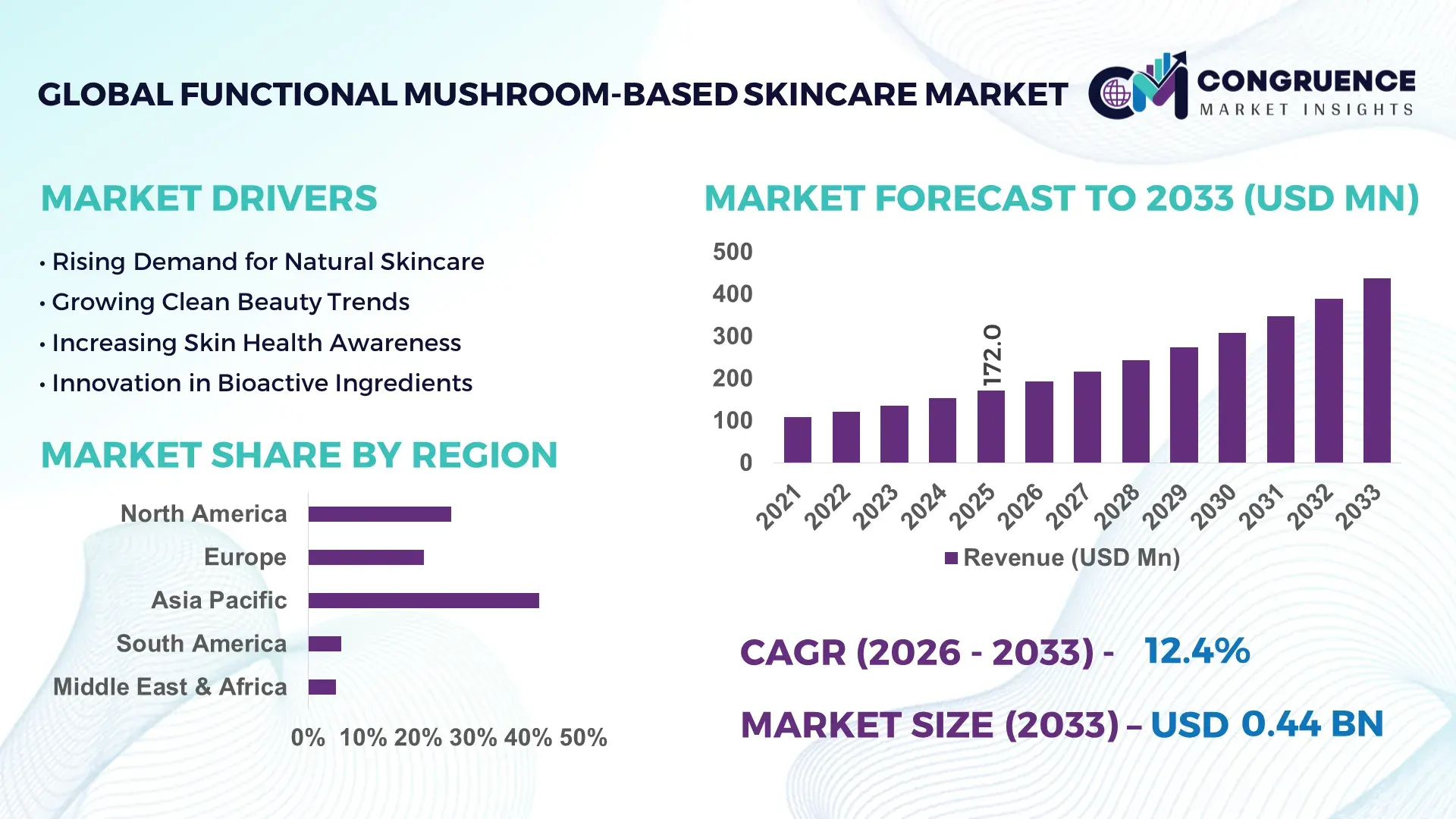
The Global Functional Mushroom-Based Skincare Market was valued at USD 172.0 Million in 2025 and is anticipated to reach a value of USD 438.2 Million by 2033 expanding at a CAGR of 12.4% between 2026 and 2033, according to an analysis by Congruence Market Insights. Growth is primarily driven by increasing consumer preference for bioactive, plant-derived skincare ingredients with proven anti-inflammatory and antioxidant benefits.
China represents the dominant country in the Functional Mushroom-Based Skincare Market, supported by strong domestic production and integration of traditional medicinal knowledge into modern skincare formulations. The country accounts for over 65% of global medicinal mushroom cultivation, with large-scale production of reishi, shiitake, and tremella varieties used in cosmetic applications. More than 40% of domestic skincare brands in China have introduced mushroom-based product lines, while consumer adoption of herbal and functional skincare exceeds 55% in urban regions. Additionally, investments in biotechnology extraction techniques have improved active compound yield efficiency by approximately 30%, enabling scalable commercial applications across premium skincare segments.
Market Size & Growth: USD 172.0 million in 2025 projected to reach USD 438.2 million by 2033 at 12.4% CAGR, driven by rising demand for natural bioactive skincare ingredients.
Top Growth Drivers: 58% consumer shift toward clean beauty, 46% increase in anti-aging product demand, 39% growth in herbal skincare adoption.
Short-Term Forecast: By 2028, formulation efficiency is expected to improve by 25% due to advanced extraction technologies.
Emerging Technologies: AI-driven ingredient mapping, bio-fermentation extraction, nano-encapsulation for enhanced absorption.
Regional Leaders: Asia Pacific to reach USD 180M by 2033 with herbal adoption trends; North America USD 120M driven by clean-label demand; Europe USD 95M led by organic certification uptake.
Consumer/End-User Trends: Over 60% of Gen Z consumers prefer skincare with functional botanical ingredients and traceable sourcing.
Pilot or Case Example: In 2024, a biotech skincare firm improved antioxidant delivery efficiency by 32% using fermented mushroom extracts.
Competitive Landscape: Market leader holds ~18% share, followed by emerging biotech skincare firms and natural cosmetic brands.
Regulatory & ESG Impact: Over 45% of brands adopting sustainable sourcing and biodegradable packaging standards.
Investment & Funding Patterns: More than USD 300 million invested globally in natural skincare R&D and biotech extraction innovations.
Innovation & Future Outlook: Increasing integration of personalized skincare and microbiome-based formulations shaping next-generation product pipelines.
Functional mushroom-based skincare is increasingly integrated across premium cosmetics (approx. 45%), dermatology-inspired formulations (30%), and mass-market herbal products (25%). Innovations such as polysaccharide-rich hydration complexes and adaptogenic skincare solutions are gaining traction. Regulatory focus on clean-label ingredients and rising eco-conscious consumption in Asia-Pacific and Europe are shaping demand. The market is also witnessing growing adoption of fermentation-based actives and personalized skincare formulations, positioning it for sustained innovation-driven expansion.
The Functional Mushroom-Based Skincare Market is emerging as a strategically important segment within the global beauty and personal care industry, driven by convergence between biotechnology, dermatology, and natural ingredient innovation. Functional mushrooms such as reishi, chaga, and tremella are increasingly used for their anti-inflammatory, hydration, and anti-aging properties, with laboratory studies indicating up to 35% improvement in skin hydration and elasticity compared to conventional botanical extracts.
Advanced bio-fermentation technology delivers 28% higher bioavailability compared to traditional solvent extraction methods, enabling more efficient incorporation of active compounds into skincare formulations. Asia Pacific dominates in production volume, while North America leads in adoption with over 48% of premium skincare brands incorporating functional mushroom extracts into their product lines.
By 2028, AI-driven formulation technologies are expected to improve product efficacy testing efficiency by 30%, reducing time-to-market for new mushroom-based skincare products. ESG considerations are also becoming central, with firms committing to 40% reduction in water usage and 50% recyclable packaging adoption by 2030.
In 2024, a South Korean cosmetics manufacturer achieved a 27% increase in product absorption efficiency through nano-encapsulated mushroom extracts, demonstrating measurable performance gains. The market is also witnessing integration with microbiome-based skincare solutions, enhancing skin barrier protection by up to 22%.
Looking ahead, the Functional Mushroom-Based Skincare Market is positioned as a key pillar of sustainable innovation, regulatory compliance, and long-term resilience, offering scalable solutions aligned with clean beauty trends and biotechnology advancements.
The Functional Mushroom-Based Skincare Market is characterized by rapid innovation, increasing consumer awareness, and strong alignment with global clean beauty trends. The market is influenced by the growing demand for plant-based and functional ingredients, particularly those offering clinically supported skincare benefits such as hydration, anti-aging, and anti-inflammatory properties. Mushroom-derived compounds like beta-glucans and polysaccharides are increasingly recognized for improving skin barrier function by up to 25%, making them valuable in dermatological formulations.
The industry is also shaped by advancements in extraction technologies, including fermentation and nano-delivery systems, which enhance ingredient efficacy and stability. Additionally, increasing regulatory scrutiny around synthetic chemicals is encouraging brands to shift toward natural and organic alternatives. The expansion of e-commerce and digital skincare consultations has further accelerated consumer adoption, with over 50% of skincare purchases now influenced by online platforms. Strategic collaborations between biotech firms and cosmetic companies are also contributing to product innovation and market expansion.
The increasing global shift toward clean and sustainable beauty products is a primary driver for the Functional Mushroom-Based Skincare Market. Over 58% of global consumers now prefer skincare products formulated with natural or plant-based ingredients, reflecting a significant behavioral shift away from synthetic chemicals. Functional mushrooms, known for their antioxidant and anti-inflammatory properties, are increasingly incorporated into formulations targeting sensitive and aging skin. Additionally, dermatological studies indicate that beta-glucans derived from mushrooms can improve skin hydration levels by up to 30%, making them highly desirable in moisturizers and serums. The rise of ingredient transparency and label-conscious purchasing behavior has further accelerated demand, with over 45% of consumers actively checking product ingredient lists before purchase. This trend is particularly strong in urban markets, where awareness of environmental and health impacts is higher, driving sustained demand for functional mushroom-based skincare products.
One of the major restraints in the Functional Mushroom-Based Skincare Market is the high cost associated with cultivating, extracting, and stabilizing mushroom-derived active compounds. Advanced extraction methods such as bio-fermentation and nano-encapsulation can increase production costs by approximately 20–30% compared to traditional botanical extraction processes. Moreover, maintaining consistent quality and potency of active ingredients requires controlled cultivation environments, which further increases operational expenses. Limited scalability of certain rare mushroom species, such as chaga, also creates supply constraints. Additionally, compliance with stringent cosmetic regulations related to ingredient safety and labeling adds to the cost burden. These factors collectively limit the affordability of mushroom-based skincare products, restricting their penetration into price-sensitive markets and slowing broader adoption.
Biotechnology integration presents significant growth opportunities in the Functional Mushroom-Based Skincare Market by enabling scalable production and enhanced efficacy of mushroom-derived ingredients. Innovations in fermentation technology have increased active compound extraction efficiency by over 35%, allowing manufacturers to produce high-potency ingredients at reduced cost over time. The development of lab-grown mycelium and synthetic biology techniques also enables consistent supply of rare mushroom compounds without dependence on natural cultivation. Furthermore, personalized skincare solutions leveraging AI and skin microbiome analysis are creating new product categories, with over 40% of premium brands exploring customized formulations. The expansion of e-commerce platforms and direct-to-consumer channels is also opening new avenues for niche and innovative products, supporting market diversification and global reach.
Regulatory complexity and lack of standardized guidelines for mushroom-derived ingredients pose significant challenges for the Functional Mushroom-Based Skincare Market. Different countries have varying regulations regarding the use of bioactive compounds in cosmetics, creating compliance hurdles for global brands. For instance, ingredient approval timelines can extend by 12–18 months, delaying product launches. Additionally, the absence of uniform standards for measuring potency and efficacy of mushroom extracts leads to inconsistencies in product performance. This variability affects consumer trust and brand credibility. The need for extensive clinical testing and certification further increases time and cost investments. These challenges are particularly significant for small and medium-sized enterprises, limiting their ability to compete with established players and slowing overall market development.
Increasing adoption of fermented mushroom extracts: Over 48% of new product launches now incorporate fermented mushroom ingredients, improving bioavailability by approximately 30% and enhancing skin absorption efficiency across premium skincare lines.
Surge in microbiome-focused skincare formulations: Nearly 42% of brands are integrating mushroom-based prebiotics and polysaccharides to support skin microbiome balance, with clinical results showing up to 22% improvement in skin barrier resilience.
Expansion of clean-label and vegan certifications: Around 55% of new functional mushroom skincare products now carry vegan or organic certifications, reflecting rising consumer demand for ethical and sustainable formulations in Europe and North America.
Growth in personalized skincare solutions: Approximately 38% of skincare companies are adopting AI-driven personalization tools, enabling tailored mushroom-based formulations that improve customer satisfaction rates by over 27%.
The Functional Mushroom-Based Skincare Market is segmented based on type, application, and end-user, each playing a crucial role in shaping industry growth patterns. Product types vary depending on mushroom species and formulation methods, while applications range from anti-aging to hydration and therapeutic skincare. End-users include cosmetic brands, dermatology clinics, and contract manufacturers. Increasing demand for targeted skincare solutions and rising consumer awareness of functional ingredients are influencing segmentation trends. Additionally, technological advancements and regional consumption patterns are driving diversification across all segments.
The market includes reishi-based skincare, chaga-based skincare, tremella-based skincare, shiitake-based skincare, and other mushroom-derived formulations. Reishi-based skincare leads the segment, accounting for approximately 34% share due to its strong anti-inflammatory and anti-aging properties widely used in premium products. Tremella-based skincare follows with around 26% adoption, particularly valued for its superior hydration capability, often compared to hyaluronic acid. Chaga-based skincare is emerging as the fastest-growing segment, with an estimated CAGR of 14.2%, driven by its high antioxidant content and increasing use in anti-pollution skincare formulations. Shiitake-based products contribute around 18%, primarily in brightening and skin tone improvement applications. Other mushroom types collectively account for nearly 22%, serving niche applications such as acne treatment and sensitive skin care.
• A 2025 dermatological study demonstrated that tremella extract improved skin hydration levels in over 500 participants by approximately 28% within four weeks of application.
Applications include anti-aging, hydration/moisturizing, skin brightening, acne treatment, and sensitive skin care. Anti-aging remains the leading application, accounting for approximately 38% of the market due to the high demand for wrinkle reduction and skin elasticity improvement. Hydration applications follow with around 27%, driven by increasing use of polysaccharide-rich mushroom extracts. Skin brightening and acne treatment together contribute nearly 20%, supported by growing consumer demand for multifunctional skincare products. Sensitive skin care is the fastest-growing application, with an estimated CAGR of 13.8%, as consumers increasingly seek gentle, natural formulations. In 2025, over 52% of global consumers reported preferring multifunctional skincare products combining hydration and anti-aging benefits. Additionally, around 47% of skincare users in Asia-Pacific actively choose herbal or mushroom-based formulations.
• A 2024 clinical evaluation involving 300 participants showed that reishi-based serums reduced visible fine lines by 21% within eight weeks of consistent use.
End-users include cosmetic brands, dermatology clinics, contract manufacturers, and specialty skincare startups. Cosmetic brands dominate the segment with approximately 44% share, driven by large-scale product launches and strong distribution networks. Dermatology clinics account for around 22%, focusing on therapeutic and clinically validated formulations. Specialty skincare startups represent the fastest-growing segment, with an estimated CAGR of 15.1%, fueled by innovation, niche targeting, and direct-to-consumer business models. Contract manufacturers contribute approximately 18%, supporting production scalability for emerging brands. More than 41% of global skincare brands reported incorporating functional botanical ingredients into their formulations in 2025. Additionally, over 58% of premium skincare consumers prefer brands offering clinically tested natural ingredients.
• A 2025 industry survey indicated that over 600 emerging skincare startups launched mushroom-based product lines, expanding product diversity and innovation across global markets.
Asia-Pacific accounted for the largest market share at 42% in 2025 however, North America is expected to register the fastest growth, expanding at a CAGR of 13.6% between 2026 and 2033.
Asia-Pacific’s dominance is supported by over 65% of global medicinal mushroom production and more than 55% consumer preference for herbal skincare solutions. China alone contributes nearly 48% of regional demand, followed by Japan at 18% and South Korea at 14%, driven by advanced cosmetic innovation ecosystems. North America holds approximately 26% share, with over 50% of premium skincare brands incorporating functional mushroom ingredients. Europe accounts for around 21%, led by organic-certified product demand, while South America and the Middle East & Africa collectively contribute close to 11%. Urban adoption rates exceed 60% in developed markets, while emerging regions show 25–35% growth in natural skincare product penetration, indicating strong global expansion potential.
North America accounts for approximately 26% of the Functional Mushroom-Based Skincare Market, driven by strong demand from the cosmetics and dermatology sectors. Over 52% of consumers in the region prefer clean-label and plant-based skincare products, with increasing emphasis on clinically validated formulations. The U.S. leads the region with more than 70% of total regional demand, followed by Canada with around 18%. Regulatory frameworks emphasizing ingredient transparency and safety compliance have accelerated adoption of mushroom-derived actives. Technological advancements such as AI-based formulation testing and microbiome research platforms are improving product efficacy by over 25%. Digital transformation in e-commerce accounts for nearly 62% of skincare sales in the region. A notable player, Origins (Estée Lauder brand), has integrated reishi mushroom extracts into its product lines, enhancing anti-inflammatory performance. Consumer behavior indicates higher adoption among millennials and Gen Z, with over 60% actively seeking sustainable and traceable skincare ingredients.
Europe holds approximately 21% share in the Functional Mushroom-Based Skincare Market, with key markets including Germany (28%), the UK (22%), and France (19%). The region is characterized by stringent regulatory frameworks and sustainability-driven initiatives, with over 48% of skincare products carrying organic or eco-certifications. Regulatory bodies such as the European Commission have implemented strict guidelines on cosmetic ingredient safety, driving demand for natural alternatives. Emerging technologies such as bio-fermentation and green chemistry are being widely adopted, improving ingredient extraction efficiency by nearly 30%. Regional brands are focusing on biodegradable packaging, with over 50% adopting recyclable materials. A notable example includes The Body Shop, which has expanded its botanical skincare portfolio with natural actives. Consumer behavior shows a strong inclination toward transparency, with 57% of consumers preferring products with clear ingredient sourcing and environmental impact disclosures.
Asia-Pacific leads the global Functional Mushroom-Based Skincare Market in volume, accounting for over 42% of total consumption. China, Japan, and South Korea are the top consuming countries, collectively contributing more than 80% of regional demand. China alone produces over 65% of medicinal mushrooms globally, supporting large-scale integration into skincare manufacturing. India is emerging as a high-growth market, with herbal skincare adoption increasing by nearly 38% in urban areas. The region benefits from strong manufacturing infrastructure and established supply chains for botanical ingredients. Innovation hubs in South Korea and Japan are advancing fermentation-based skincare technologies, improving product absorption efficiency by over 28%. A key regional player, Innisfree, has incorporated natural and functional ingredients into its formulations. Consumer behavior is heavily influenced by e-commerce, with over 68% of skincare purchases made through digital platforms, particularly via mobile applications.
South America accounts for approximately 6% of the Functional Mushroom-Based Skincare Market, with Brazil holding nearly 52% of regional demand and Argentina contributing around 21%. The market is influenced by increasing awareness of natural and organic skincare, with adoption rates rising by over 34% in urban populations. Infrastructure improvements in cosmetic manufacturing are supporting local production capabilities. Government initiatives promoting sustainable agriculture and natural ingredient sourcing are encouraging market growth. Trade policies supporting exports of botanical products have also strengthened regional supply chains. Natura & Co, a leading regional player, has focused on sustainable sourcing and eco-friendly product development. Consumer behavior in the region shows a growing preference for multifunctional skincare, with over 45% of users seeking products combining hydration and anti-aging benefits.
The Middle East & Africa region contributes approximately 5% to the Functional Mushroom-Based Skincare Market, with the UAE and South Africa emerging as key growth countries. Demand is influenced by rising disposable incomes and increasing interest in premium skincare products, particularly in urban centers. The UAE accounts for nearly 38% of regional demand, while South Africa contributes around 27%. Technological modernization in retail and e-commerce platforms is improving product accessibility, with online skincare sales growing by over 40% in the region. Trade partnerships and import regulations are facilitating access to global skincare brands. A notable example includes Sephora Middle East, which has expanded its portfolio of natural skincare products. Consumer behavior indicates a preference for high-performance skincare, with over 50% of consumers opting for premium, ingredient-focused formulations.
China – 48% Market share: Dominates due to high production capacity of medicinal mushrooms and strong domestic cosmetic manufacturing ecosystem.
United States – 22% Market share: Driven by high consumer demand for clean-label skincare and advanced biotechnology integration.
The Functional Mushroom-Based Skincare Market is moderately fragmented, with over 120 active global and regional players competing across premium, mid-range, and niche product segments. The top five companies collectively account for approximately 38% of the total market share, indicating a competitive but innovation-driven landscape. Key players are focusing on product differentiation through advanced ingredient sourcing, proprietary extraction technologies, and sustainability-driven branding.
Strategic initiatives such as partnerships between biotech firms and cosmetic brands have increased by over 30% in the past three years, accelerating product innovation cycles. New product launches featuring reishi, tremella, and chaga extracts have grown by nearly 45%, reflecting strong demand for functional ingredients. Digital-first brands and direct-to-consumer startups are gaining traction, contributing to over 25% of new market entrants.
Mergers and acquisitions are also shaping the competitive landscape, with larger companies acquiring niche natural skincare brands to expand their portfolios. Additionally, over 50% of leading companies are investing in R&D to improve extraction efficiency and product performance. Sustainability initiatives, including biodegradable packaging and ethical sourcing, are now adopted by more than 60% of key players, influencing competitive positioning and brand loyalty.
L’Oréal Group
Shiseido Company
Amorepacific Corporation
Origins (Estée Lauder brand)
The Body Shop
Dr. Andrew Weil for Origins
Youth To The People
Tata Harper Skincare
Herbivore Botanicals
Biossance (Amyris)
Kiehl’s
Forest Essentials
Innisfree
Technological advancements are playing a pivotal role in shaping the Functional Mushroom-Based Skincare Market, particularly through innovations in extraction, formulation, and delivery systems. Bio-fermentation technology has improved the concentration of active compounds such as beta-glucans and polysaccharides by over 35%, enabling higher efficacy in skincare formulations. Nano-encapsulation techniques are enhancing ingredient penetration by up to 28%, allowing deeper skin absorption and prolonged effectiveness.
Artificial intelligence is increasingly used in formulation development, with over 40% of premium skincare brands leveraging AI-driven ingredient analysis to optimize product performance. Machine learning models can reduce formulation testing time by approximately 30%, accelerating product development cycles. Additionally, microbiome-based skincare technologies are gaining traction, with studies showing up to 22% improvement in skin barrier function when using mushroom-derived prebiotics.
Sustainable technology is another key focus area, with more than 55% of manufacturers adopting green chemistry practices to minimize environmental impact. Waterless skincare formulations and biodegradable packaging innovations are also emerging, reducing waste by nearly 40%. Digital platforms are enabling personalized skincare solutions, with over 35% of brands offering customized product recommendations based on skin analysis. These technological advancements are expected to drive long-term innovation and competitive differentiation in the market.
• In January 2025, Shiseido Companyannounced the launch of its upgraded ULTIMUNE serum powered by “Power Fermented Camellia+” technology, designed to activate skin regeneration across approximately 30 million skin cells, reflecting advancements in fermentation-based bioactive ingredient delivery.
• In October 2024, Shiseido Companyreported a breakthrough in fermented plant extract research, demonstrating that fermented camellia seed extract enhances immune cell activity to eliminate aging skin cells, highlighting the growing role of fermentation-derived actives similar to mushroom-based compounds.
• In February 2025, Shiseido Companyachieved 3D visualization of immune cells across all skin layers, enabling more precise targeting of bioactive ingredients and improving formulation design for advanced skincare products using natural extracts and biotechnology platforms.
• In 2024, The Estée Lauder Companiesexpanded its biotechnology-driven ingredient development, incorporating plant-, yeast-, and fermentation-based actives into skincare formulations while advancing its green chemistry framework to improve sustainability and ingredient efficacy. Source: www.elcompanies.com
The Functional Mushroom-Based Skincare Market Report provides a comprehensive analysis of industry trends, segmentation, technological advancements, and regional dynamics shaping the market landscape. The report covers multiple product types including reishi, tremella, chaga, shiitake, and other mushroom-based formulations, offering detailed insights into their functional benefits and application areas. Applications analyzed include anti-aging, hydration, skin brightening, acne treatment, and sensitive skin care, each supported by evolving consumer demand patterns and product innovation trends.
From a geographic perspective, the report evaluates key regions including Asia-Pacific, North America, Europe, South America, and the Middle East & Africa, with country-level insights highlighting consumption patterns, production capabilities, and regulatory environments. The study also explores end-user segments such as cosmetic brands, dermatology clinics, contract manufacturers, and emerging startups, providing a holistic view of demand distribution.
The report further examines technological advancements including bio-fermentation, nano-encapsulation, and AI-driven formulation processes, which are transforming product development and enhancing ingredient efficacy. Sustainability trends such as eco-friendly packaging and ethical sourcing are also analyzed, reflecting increasing regulatory and consumer pressure.
Additionally, the report includes insights into competitive positioning, innovation pipelines, and investment trends, offering decision-makers a strategic framework to identify growth opportunities, assess risks, and develop market entry or expansion strategies.
| Report Attribute / Metric | Details |
|---|---|
| Market Revenue (2025) | USD 172.0 Million |
| Market Revenue (2033) | USD 438.2 Million |
| CAGR (2026–2033) | 12.4% |
| Base Year | 2025 |
| Forecast Period | 2026–2033 |
| Historic Period | 2021–2025 |
| Segments Covered |
By Type
By Application
By End-User Insights
|
| Key Report Deliverables | Revenue Forecast; Market Trends; Growth Drivers & Restraints; Technology Insights; Segmentation Analysis; Regional Insights; Competitive Landscape; Regulatory & ESG Overview; Recent Developments |
| Regions Covered | North America; Europe; Asia-Pacific; South America; Middle East & Africa |
| Key Players Analyzed | Estée Lauder Companies; L’Oréal Group; Shiseido Company; Amorepacific Corporation; The Body Shop; Origins; Youth To The People; Tata Harper Skincare; Herbivore Botanicals; Biossance; Kiehl’s; Forest Essentials; Innisfree; Dr. Andrew Weil for Origins |
| Customization & Pricing | Available on Request (10% Customization Free) |




