
Reports
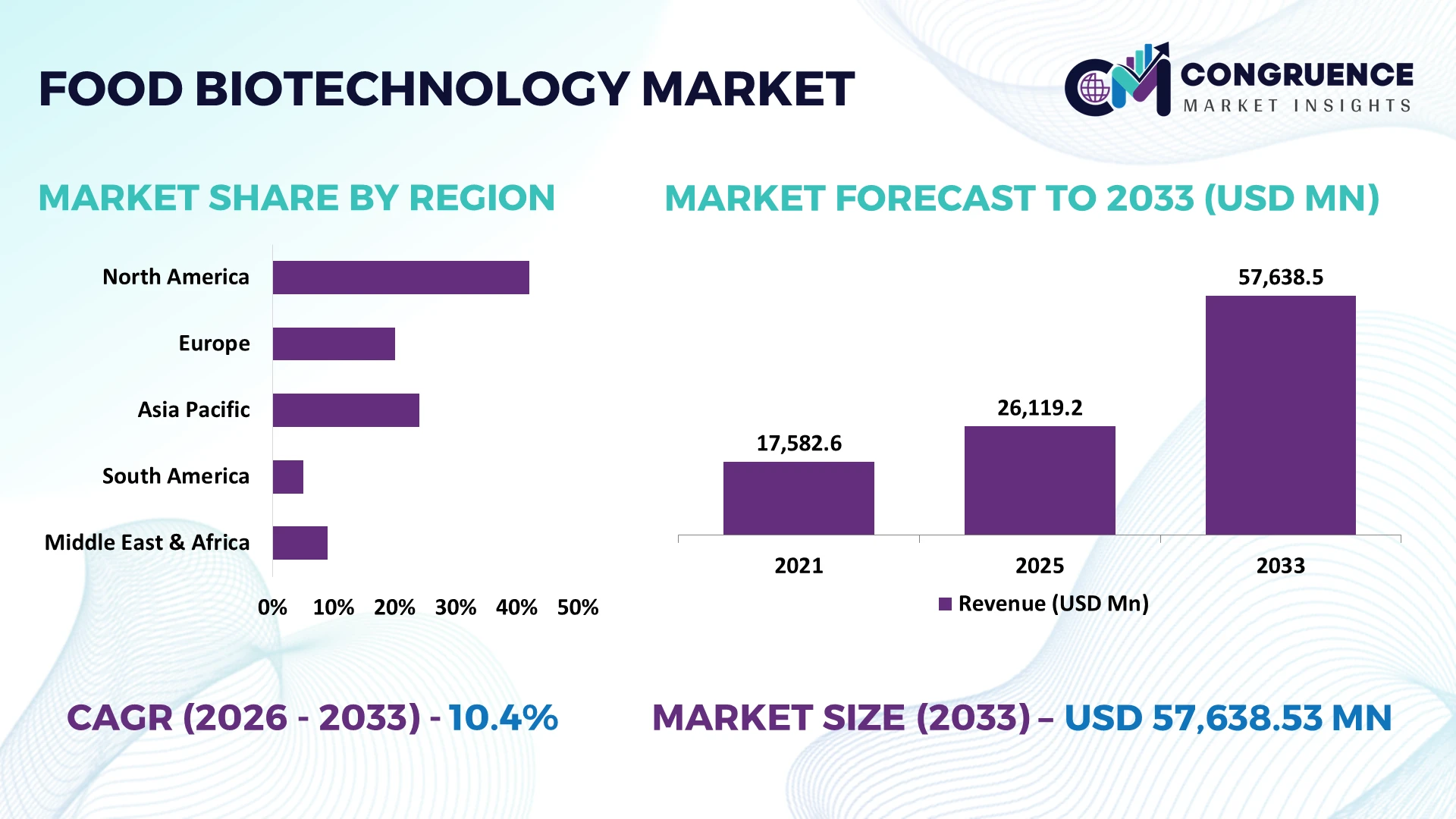
The Global Food Biotechnology Market was valued at USD 26119.22 Million in 2025 and is anticipated to reach a value of USD 57638.53 Million by 2033 expanding at a CAGR of 10.4% between 2026 and 2033. Growth is driven by precision fermentation, advances in genetically engineered crops, industrial enzyme applications, and increasing investment in alternative protein production.
The United States occupies a central position in the global food biotechnology industry, supported by advanced agricultural biotechnology, established fermentation infrastructure, and substantial research investment. Genetically engineered varieties account for more than 90% of domestic corn and soybean acreage, supporting extensive commercial adoption of agricultural biotechnology. In comparison, Brazil maintains substantial biotechnology adoption across soybean production, strengthening its position in agricultural exports. The United States also benefits from established biotechnology companies, university research networks, and regulatory frameworks supporting commercial innovation in food processing.
The strategic priority is integrating advanced biotechnology with scalable manufacturing infrastructure to strengthen production efficiency, ingredient innovation, and international competitiveness.
Market Size & Growth: USD 26119.22 Million in 2025, reaching USD 57638.53 Million by 2033 at a 10.4% CAGR, supported by precision fermentation and advanced food ingredient manufacturing.
Top Growth Drivers: Biotechnology adoption in major United States corn, soybean, and cotton crops exceeds 90%, demonstrating established commercial acceptance of genetic engineering.
Short Term Forecast: By 2028, industrial enzyme optimization and automated fermentation are expected to improve production efficiency, although a verified industrywide percentage target is unavailable.
Emerging Technologies: Three important technologies are precision fermentation, CRISPR gene editing, and artificial intelligence for microbial strain optimization and ingredient development.
Regional Leaders: North America, Europe, and Asia Pacific represent three important commercial regions, supported respectively by biotechnology infrastructure, alternative protein innovation, and expanding fermentation capacity. Verified regional revenue projections are unavailable.
Consumer and End User Trends: Food manufacturers increasingly utilize biotechnology across three applications: ingredient functionality, nutritional enhancement, and alternative protein development.
Pilot and Case Example: In 2024, Singapore approved cultivated meat products from additional producers, demonstrating continued regulatory development for commercial cellular agriculture.
Competitive Landscape: Five prominent participants include Novonesis, DSM Firmenich, IFF, ADM, and Cargill. Their competitive activities span enzymes, microbial cultures, fermentation ingredients, and agricultural biotechnology.
Regulatory & ESG Impact: The European Union maintains strict biotechnology authorization requirements, making regulatory compliance and traceability essential for commercialization across its 27 member states.
Investment & Funding: Capital allocation increasingly targets three investment areas: fermentation infrastructure, microbial engineering, and alternative protein manufacturing. A verified consolidated global investment total is unavailable.
Innovation & Future Outlook: Advanced biotechnology investment is shifting toward three commercial priorities: scalable precision fermentation, improved microbial productivity, and specialized functional ingredients.
Food biotechnology is transforming commercial food production through microbial fermentation, enzyme engineering, genetically improved crops, and cellular agriculture. Demand is concentrated in food processing, functional ingredients, agricultural productivity, and alternative protein manufacturing. Precision fermentation enables targeted production of proteins and other specialized ingredients, while artificial intelligence accelerates microbial strain development. In the United States, biotechnology adoption exceeds 90% across major corn and soybean acreage, demonstrating the commercial maturity of agricultural applications. Meanwhile, regulatory developments in Singapore and expanding Asian fermentation infrastructure highlight emerging commercialization opportunities, establishing the foundation for evaluating strategic investment priorities and competitive positioning.
Food biotechnology is becoming strategically important as manufacturers seek greater control over ingredient production, agricultural productivity, and supply chain resilience. Precision fermentation, microbial engineering, and advanced bioprocessing are reducing dependence on conventional agricultural inputs while enabling specialized ingredient manufacturing. Singapore's regulatory framework for novel foods demonstrates how government policy influences commercialization. Meanwhile, industrial biotechnology companies are investing in domestic fermentation infrastructure and establishing partnerships with food manufacturers to accelerate product development and improve production flexibility.
Technological advancement is reshaping manufacturing economics. Precision fermentation enables controlled production of specialized proteins, while conventional agricultural extraction remains dependent on seasonal harvests and variable raw material quality. Production efficiency depends on microbial yield, fermentation conditions, and downstream recovery. The United States emphasizes commercial biotechnology infrastructure, while Singapore prioritizes regulatory innovation and alternative protein commercialization. China is expanding industrial biotechnology capabilities through fermentation technology development and domestic manufacturing investment.
During 2026 to 2028, competitive differentiation will increasingly depend on fermentation productivity, regulatory readiness, and manufacturing integration. Companies are deploying automated bioreactors, advanced microbial strain engineering, and digital process monitoring to improve consistency. Commercial partnerships between biotechnology developers and established ingredient manufacturers provide access to production facilities and distribution networks. The strategic advantage lies in converting laboratory innovations into commercially viable ingredients through efficient industrial production.
Industrial demand for specialized proteins, functional ingredients, and biotechnology derived food additives is accelerating investment in precision fermentation. In the United States, genetically engineered crops represent more than 90% of corn, soybean, and cotton acreage, demonstrating established commercial biotechnology adoption. Precision fermentation extends biotechnology applications beyond agriculture into controlled ingredient manufacturing. Advances in microbial engineering enable manufacturers to produce enzymes, proteins, and nutritional compounds with precisely defined characteristics. Singapore's authorization framework for novel foods further supports commercial diversification. Companies are investing in microbial strain development, fermentation capacity, and partnerships with established ingredient suppliers. Integrating biotechnology expertise with existing food manufacturing infrastructure strengthens production flexibility and reduces dependence on conventional agricultural sourcing.
Commercial food biotechnology faces structural constraints involving fermentation infrastructure, processing costs, and inconsistent regulatory requirements. Industrial fermentation requires substantial investment in sterile production facilities, specialized equipment, and downstream purification systems. Feedstock procurement, energy consumption, and purification expenses directly influence manufacturing profitability. The European Union maintains extensive authorization procedures for genetically modified food products, while the United States operates through multiple regulatory agencies. These differences complicate international commercialization and increase compliance expenditure. Additionally, limited access to suitable fermentation facilities restricts smaller biotechnology companies from achieving commercial production volumes. Manufacturers are responding through contract fermentation partnerships, diversified feedstock procurement, and selective localization of manufacturing operations. Securing reliable production capacity before commercial expansion is becoming an important competitive consideration.
Precision fermentation creates commercial opportunities in specialized proteins, nutritional compounds, enzymes, and ingredients that conventional agricultural systems cannot consistently supply. Advanced microbial engineering enables manufacturers to optimize ingredient functionality and develop products with targeted nutritional characteristics. India's expanding biotechnology infrastructure and established pharmaceutical fermentation capabilities provide opportunities for technology transfer into food ingredient manufacturing. Artificial intelligence and automated strain screening are improving microbial development processes and enabling more targeted fermentation optimization. Companies are exploring partnerships with contract manufacturers to reduce infrastructure investment and accelerate commercialization. Specialized ingredients for medical nutrition, functional beverages, and alternative proteins offer opportunities beyond conventional food processing. Competitive differentiation increasingly depends on proprietary microbial strains, efficient purification technologies, and application specific ingredient development.
Scaling food biotechnology from laboratory development to industrial manufacturing presents substantial engineering and operational challenges. Microbial strains demonstrating strong laboratory performance do not necessarily maintain equivalent productivity in commercial bioreactors. Differences in oxygen transfer, mixing efficiency, temperature control, and contamination exposure complicate production consistency. Large fermentation facilities require integrated process monitoring, specialized engineering expertise, and reliable downstream recovery systems. In the United States, biotechnology manufacturers are addressing these challenges through automated process control and advanced bioreactor engineering. Digital monitoring improves operational visibility, but integrating biological production data with industrial manufacturing systems requires specialized capabilities. Companies must strengthen process validation, workforce development, and technology partnerships. Sustained competitiveness depends on achieving reproducible manufacturing performance while maintaining ingredient quality and regulatory compliance.
Continuous Fermentation Reshapes Manufacturing Economics: Industrial biotechnology companies are transitioning toward continuous fermentation to improve productivity and reduce manufacturing expenditure. In 2025, a commercial technology demonstration achieved more than threefold productivity improvement and 50% lower production costs at a 3,000 liter scale. Manufacturers are integrating automated bioprocess controls to improve equipment utilization and accelerate production.
Biochemical Processing Gains Investment Priority: Food manufacturers are increasing investment in biochemical technologies for food safety, quality improvement, and waste reduction. Industry survey findings identified 21% planned investment in biochemical technologies and 14% in bioactive compound technologies. Companies are incorporating specialized biological processing solutions into existing production facilities to improve product functionality and manufacturing consistency.
Fermentation Investment Becomes More Selective: Investment priorities are shifting toward commercial validation and established manufacturing partnerships. In 2025, more than 163 specialized fermentation companies remained active despite tighter funding conditions. Biotechnology developers are increasingly collaborating with established dairy, grain, and ingredient manufacturers to access production expertise, strengthen commercialization pathways, and reduce infrastructure duplication.
Digital Integration Accelerates Process Optimization: Biotechnology manufacturers are introducing artificial intelligence and advanced monitoring systems into fermentation workflows. Industry survey findings identified cost as an adoption barrier for 63% of respondents, while 34% reported limited scalability and accessibility. Companies are prioritizing digital process integration, standardized production data, and automated monitoring to improve manufacturing reliability.
Fermentation represents an established technology within the global food biotechnology market because of its extensive application in food manufacturing, microbial production, and industrial ingredient processing. Its infrastructure supports established food production alongside emerging precision fermentation applications. However, a verified percentage of total market revenue attributable to fermentation is unavailable. Enzyme Technology represents another commercially established category, supporting food processing efficiency, product functionality, and specialized ingredient manufacturing.
Genetic Engineering enables targeted modification of biological production systems, while Microbial Technology supports specialized cultures, functional ingredients, and biological processing applications. Cell Culture serves emerging cellular agriculture applications, whereas Tissue Culture supports agricultural propagation and crop improvement. Precision fermentation investment indicates accelerating technological development within the Fermentation segment, although available industry evidence does not establish a definitive segment growth ranking. Manufacturers are concentrating investment on microbial productivity, specialized enzyme formulations, and scalable production systems. Partnerships between biotechnology developers and established ingredient producers are improving access to commercial manufacturing infrastructure and accelerating product validation.
Food Processing represents an established application of biotechnology through fermentation, enzymatic modification, microbial cultures, and ingredient stabilization. Its extensive industrial deployment supports consistent demand for biological processing technologies. However, publicly available evidence does not establish its precise share of the defined global market. Enzyme Production supports commercial applications requiring specialized biological catalysts, while Ingredient Development is attracting attention through precision fermentation and targeted nutritional formulations.
Functional Foods and Nutraceuticals benefit from biotechnology applications involving probiotics, bioactive compounds, and specialized nutritional ingredients. Food Safety incorporates biological detection technologies and microbial control systems, while Animal Feed utilizes biotechnology to improve nutritional characteristics and ingredient functionality. Ingredient Development demonstrates emerging investment momentum, although available evidence does not establish its definitive growth ranking against the remaining applications. Companies are expanding application development capabilities, integrating automated processing systems, and establishing manufacturing partnerships. Commercial opportunities increasingly depend on delivering consistent ingredient performance while controlling processing expenditure and maintaining regulatory compliance.
Food Manufacturers represent a broad commercial customer group for biotechnology applications, integrating microbial cultures, fermentation systems, specialized enzymes, and biological ingredients into established production processes. Their diverse manufacturing requirements support extensive biotechnology deployment, although a verified market share for this end user category is unavailable. Ingredient Producers represent another strategically important customer group because of their direct involvement in developing and commercializing specialized biological ingredients.
Beverage Manufacturers utilize fermentation and microbial technologies to improve product functionality and processing consistency. Dairy Companies employ specialized cultures and enzymes, while Meat Processors incorporate biotechnology into processing and product development. Nutraceutical Companies are expanding applications involving bioactive compounds and specialized nutritional formulations. Feed Manufacturers utilize microbial processing and biological ingredients to improve feed characteristics. Investment in advanced ingredient production indicates increasing opportunities for Ingredient Producers, although comparative segment growth rankings remain unverified. Biotechnology suppliers are developing customized formulations, establishing manufacturing partnerships, and expanding application support services to address different production requirements.
North America accounted for the largest reported market share at 38.5% in 2025; however, Asia Pacific is expected to register the fastest regional growth between 2026 and 2033.

Advanced Biotechnology Infrastructure Supports Commercial Leadership
North America maintains a leading position in the global food biotechnology industry, supported by established agricultural biotechnology, advanced fermentation facilities, and specialized ingredient manufacturing. The region's reported 38.5% market share in 2025 reflects extensive commercial biotechnology infrastructure and research capabilities. The United States leads regional innovation through genetic engineering, industrial enzyme manufacturing, and microbial technology development. Canada contributes agricultural biotechnology research and specialized protein processing capabilities. Commercial manufacturers are integrating automated fermentation equipment, biological processing technologies, and advanced quality monitoring systems to improve production consistency. Established agricultural processing infrastructure facilitates biotechnology integration across multiple food manufacturing applications. Strategic partnerships between biotechnology developers and established ingredient manufacturers support commercialization. Regional investment priorities increasingly emphasize industrial process optimization, specialized ingredient development, and scalable manufacturing infrastructure.
United States Market Outlook: The United States maintains substantial commercial biotechnology infrastructure supported by agricultural research, industrial fermentation capabilities, and established food manufacturing networks. In 2025, biotechnology varieties accounted for 94% of planted corn acreage. Commercial enterprises are expanding specialized ingredient development and investing in microbial engineering, automated fermentation, and advanced biological processing technologies.
Industrial Fermentation Drives Manufacturing Modernization
Europe maintains an established food biotechnology ecosystem supported by industrial fermentation, specialized enzyme manufacturing, and advanced food ingredient development. Denmark, Germany, and the Netherlands contribute significant technological expertise through established biotechnology enterprises and research institutions. European manufacturers are integrating advanced microbial engineering and automated bioprocessing into existing production facilities. Regulatory requirements governing genetically modified microorganisms and novel food ingredients influence commercialization strategies and investment decisions. The European Union's 27 member states provide an extensive commercial market for authorized biotechnology products. Industrial partnerships are increasingly focused on precision fermentation, specialized nutritional ingredients, and biological manufacturing optimization. Established fermentation infrastructure offers opportunities to accelerate industrial deployment without developing entirely new production networks. Companies are prioritizing regulatory documentation, microbial strain development, and specialized processing capabilities to strengthen commercial competitiveness.
Denmark Market Outlook: Denmark possesses established industrial biotechnology capabilities supported by specialized enzyme manufacturers and advanced fermentation research. Novonesis maintains a substantial presence in the country's biotechnology ecosystem, supporting commercial applications involving food enzymes, microbial cultures, and biological processing technologies. Denmark's research infrastructure facilitates industrial collaboration and the development of specialized biological ingredients for international food manufacturers.
Manufacturing Expansion Accelerates Biotechnology Commercialization
Asia Pacific is developing advanced food biotechnology capabilities through industrial fermentation expansion, specialized ingredient manufacturing, and agricultural biotechnology investment. China, India, Japan, and Singapore maintain distinct technological and commercial advantages. China possesses extensive industrial fermentation infrastructure, while India benefits from established biotechnology research and biological manufacturing expertise. Japan contributes advanced microbial engineering and specialized functional ingredient development. Singapore provides regulatory infrastructure supporting novel food commercialization. A separate market forecast places Asia Pacific's share at 26% in 2025 and projects 32% by 2034, indicating increasing regional commercial importance. Manufacturers are investing in microbial strain optimization, industrial bioreactors, and specialized ingredient processing facilities. Regional commercialization strategies increasingly emphasize domestic manufacturing capabilities, technology partnerships, and improved access to advanced biological production equipment.
China Market Outlook: China possesses extensive industrial fermentation capabilities supported by established food processing infrastructure and biotechnology research institutions. Its published country growth outlook reaches 13.5% annually for 2025 to 2035. Domestic biotechnology enterprises are investing in microbial engineering, specialized biological ingredients, and industrial fermentation technologies to improve manufacturing productivity and strengthen domestic ingredient supply chains.
Agricultural Biotechnology Strengthens Industrial Integration
South America's food biotechnology industry benefits from established agricultural biotechnology adoption, extensive agricultural production, and substantial food processing capabilities. Brazil and Argentina maintain important positions in genetically engineered crop cultivation and agricultural biotechnology commercialization. Agricultural processing infrastructure provides opportunities to integrate microbial technologies, industrial enzymes, and specialized biological ingredient production. Brazil's extensive soybean and corn industries support biological feedstock availability and industrial processing applications. Biotechnology developers are exploring partnerships with agricultural processors to expand specialized ingredient manufacturing capabilities. Limited access to advanced fermentation infrastructure and specialized equipment influences commercial deployment across smaller markets. Manufacturers are prioritizing technology transfer, domestic processing integration, and international research partnerships. Industrial diversification through biological ingredient manufacturing offers opportunities to increase agricultural value addition and reduce dependence on conventional commodity processing.
Brazil Market Outlook: Brazil maintains extensive agricultural biotechnology infrastructure supported by established soybean and corn production. Its published food biotechnology country forecast indicates 7.5% annual growth for 2025 to 2035. Domestic research institutions and agricultural processing enterprises support biological technology development. Manufacturers are exploring industrial enzyme applications, microbial processing, and specialized ingredient manufacturing to expand commercial biotechnology applications.
Food Security Investment Supports Biotechnology Infrastructure
The Middle East and Africa food biotechnology industry is developing through food security initiatives, agricultural modernization, and investment in specialized biological manufacturing. Saudi Arabia and the United Arab Emirates are prioritizing advanced food production technologies to strengthen domestic manufacturing capabilities. South Africa contributes established food processing infrastructure and agricultural biotechnology research. Regional investment increasingly targets alternative protein development, industrial fermentation, and specialized ingredient production. International technology partnerships provide access to microbial engineering expertise and advanced biological manufacturing equipment. However, specialized fermentation infrastructure, technical workforce availability, and production economics influence commercialization. Biotechnology developers are establishing partnerships with industrial investors and food manufacturers to accelerate technology transfer. Localized biological ingredient production supports food supply diversification and creates opportunities to develop specialized manufacturing capabilities.
Saudi Arabia Market Outlook: Saudi Arabia is investing in advanced biotechnology manufacturing through industrial diversification and food security initiatives. NEOM's investment partnership with Liberation Labs supports precision fermentation infrastructure development and specialized food ingredient production. Collaboration with Topian connects advanced biological manufacturing capabilities with domestic food production objectives, supporting industrial technology transfer and specialized workforce development.
The global food biotechnology market features competition between established ingredient manufacturers, specialized biotechnology developers, and emerging fermentation innovators. Novonesis, IFF, DSM Firmenich, ADM, and Kerry Group compete through enzyme portfolios, microbial engineering, manufacturing capacity, and ingredient customization. Their combined market share remains unverified across the complete food biotechnology industry. However, these companies collectively represented an estimated 33% of the narrower food enzymes market in 2024. Competitive differentiation increasingly depends on biological performance, manufacturing economics, and regulatory expertise. Novonesis achieved 8% organic growth in food and beverages during 2025 and introduced 33 products across its broader portfolio. Established manufacturers are acquiring specialized capabilities, expanding production networks, and developing strategic partnerships with biotechnology innovators. Emerging companies compete through proprietary microbial strains and precision fermentation technologies. Industrial scalability, intellectual property protection, and regulatory authorization remain substantial entry barriers. Sustained competitiveness requires validated biological performance, efficient manufacturing, and dependable commercial distribution across international food supply chains.
Industrial fermentation, enzyme engineering, and microbial biotechnology remain central to commercial food biotechnology. Automated bioreactors improve process monitoring, while advanced microbial strains support specialized ingredient manufacturing. Novonesis demonstrated the commercial importance of biological innovation through 33 product launches during 2025. Its food and beverage business achieved 8% organic growth, indicating established commercial demand for biological processing solutions. Manufacturers are integrating automated fermentation controls with downstream purification technologies to improve production consistency and equipment utilization.
Artificial intelligence, precision fermentation, and advanced genetic engineering are transforming biological development. Novonesis reported that artificial intelligence reduced protein structure prediction from as long as one year to under one minute, demonstrating a substantial improvement over its previous development process. Unlike conventional experimental screening, computational approaches accelerate biological discovery and prioritize promising molecular candidates. Established manufacturers benefit from extensive biological datasets, while emerging developers compete through specialized microbial platforms and proprietary fermentation technologies.
Between 2026 and 2028, industrial deployment will increasingly emphasize automated strain screening, digital fermentation monitoring, and integrated biological manufacturing. Novonesis reported that 25% of its 2025 sales originated from solutions introduced during the preceding five years. Manufacturers are prioritizing proprietary strain development, production partnerships, and process validation to strengthen commercialization.
July 2026: ADM announced a partnership with The EVERY Company to manufacture OvoPro egg white protein at its Clinton, Iowa, facility. The precision fermentation ingredient has a protein digestibility score of 1.0, supporting commercial protein diversification and supply chain resilience.
November 2025: Novonesis introduced Quara Supreme, a thermostable enzymatic solution for vegetable oil processing. The innovation reduces yield losses during water degumming by up to 2%, enabling processors to recover additional oil without introducing operational complexity or increasing free fatty acid generation.
July 2024: ADM participated in the Illinois Fermentation and Agriculture Biomanufacturing consortium, which secured approximately $51 million in federal funding. The initiative strengthens precision fermentation infrastructure, supports agricultural feedstock conversion, and accelerates commercial biotechnology development through collaboration between industry and research institutions.
April 2026: The Good Food Institute documented Pow.Bio's collaboration with Bühler and ATV Technologies, demonstrating continuous fermentation at 3,000 liters. The technology achieved threefold productivity improvements and 50% lower production costs, establishing measurable advantages for commercial precision fermentation manufacturing.
The Food Biotechnology Market Report examines industrial developments, technological innovation, competitive positioning, and commercialization opportunities between 2026 and 2033. Technology segmentation covers Fermentation, Enzyme Technology, Genetic Engineering, Cell Culture, Microbial Technology, and Tissue Culture. Application analysis evaluates Functional Foods, Food Processing, Food Safety, Nutraceuticals, Enzyme Production, Ingredient Development, and Animal Feed. End user coverage includes Food Manufacturers, Beverage Manufacturers, Dairy Companies, Meat Processors, Nutraceutical Companies, Ingredient Producers, and Feed Manufacturers.
Regional analysis encompasses North America, Europe, Asia Pacific, South America, and the Middle East and Africa. The report evaluates precision fermentation, artificial intelligence, microbial engineering, and automated bioprocessing alongside regulatory developments and manufacturing infrastructure. Competitive assessment examines commercialization strategies, industrial partnerships, production scalability, and emerging investment opportunities, supporting capacity planning, geographical expansion, technology selection, and strategic positioning across the global food biotechnology industry.
| Report Attribute/Metric | Report Details |
|---|---|
Market Revenue in 2025 | USD 26119.22 Million |
Market Revenue in 2033 | USD 57638.53 Million |
CAGR (2026 - 2033) | 10.4% |
Base Year | 2025 |
Forecast Period | 2026 - 2033 |
Historic Period | 2021 - 2025 |
Segments Covered | By Type
By Application
By End-User
|
Key Report Deliverable | Revenue Forecast, Growth Trends, Market Dynamics, Segmental Overview, Regional and Country-wise Analysis, Competition Landscape |
Region Covered | North America, Europe, Asia-Pacific, South America, Middle East, Africa |
Key Players Analyzed | Novonesis, DSM Firmenich, International Flavors & Fragrances, Archer Daniels Midland Company, Cargill, Kerry Group, BASF SE, Lallemand, Kemin Industries, Ajinomoto, Ginkgo Bioworks, Perfect Day, Evolva |
Customization & Pricing | Available on Request (10% Customization is Free) |




