
Reports
The Global Folic Acid Market was valued at USD 770.4 Million in 2025 and is anticipated to reach a value of USD 1,236.3 Million by 2033 expanding at a CAGR of 6.09% between 2026 and 2033. Growth is driven by mandatory and voluntary food-fortification programs, rising prenatal nutrition requirements, and expanding pharmaceutical-grade Vitamin B9 applications.
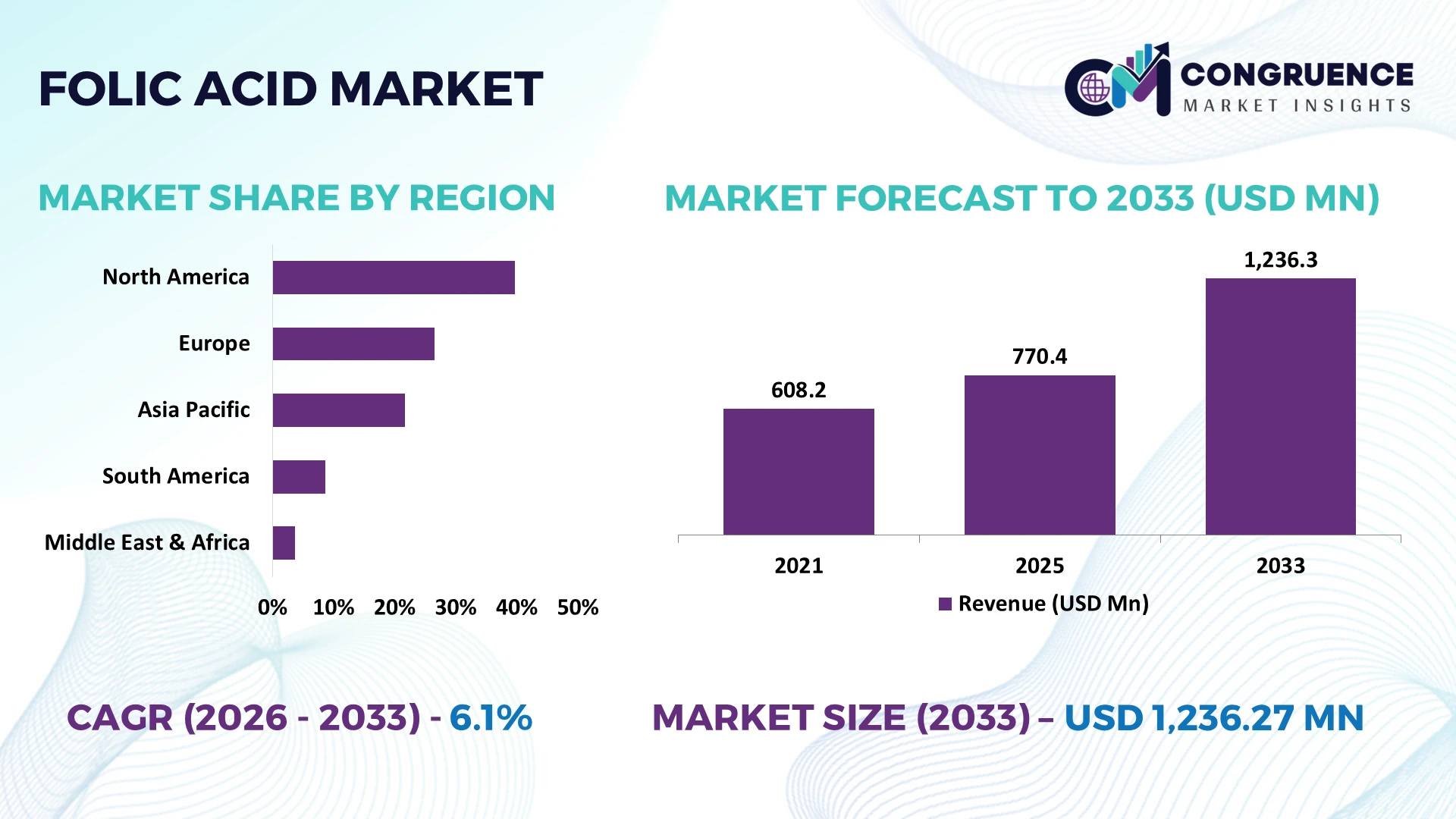
The U.S. dominated the market with North America accounting for 39.65% in 2025, supported by established grain-fortification systems, prenatal supplementation, and pharmaceutical manufacturing. The U.S. market reached about USD 0.20 billion in 2026, while Japan was approximately USD 35.75 million. India is expanding fortified wheat-flour and rice programs through public nutrition systems, creating additional industrial demand. The U.K.’s planned enrichment of non-wholemeal wheat flour by December 2026 further strengthens regulatory-driven demand across developed markets.
Strategically, suppliers should prioritize high-purity production, fortified-food partnerships, and geographically diversified sourcing to capture regulated and emerging demand.
Market Size & Growth: Market value reaches USD 770.4 million in 2025 and USD 1,236.3 million by 2033 at 6.09% CAGR, supported by expanding food fortification and pharmaceutical applications.
Top Growth Drivers: Food fortification contributes to demand growth by over 6%, prenatal supplementation by about 5%, and nutraceutical adoption by more than 6%.
Short-Term Forecast: By 2028, automated quality-control systems are expected to reduce batch-release costs by about 8% and improve production consistency by approximately 10%.
Emerging Technologies: Fermentation-derived folate, advanced micronutrient delivery, and automated formulation systems are reshaping production, with fermentation-derived applications projected to expand at about 8%.
Regional Leaders: North America is positioned around USD 490 million by 2033, Europe near USD 330 million, and Asia Pacific around USD 270 million, with fortified staples, prenatal products, and pharmaceutical formulations driving adoption.
Consumer/End-User Trends: Dietary supplements represented about 46.54% of market demand in 2025, reflecting continued use of targeted prenatal and deficiency-prevention formulations.
Pilot/Case Example: In 2024, fortification workshops across Maharashtra and Rajasthan involved more than 70 officials, millers, and development partners, strengthening quality-control systems for scaled wheat-flour fortification.
Competitive Landscape: North America held approximately 39.65% of the global market in 2025, while BASF, DSM-Firmenich, Jiangxi Tianxin Pharmaceutical, Medicamen Biotech, and Parchem compete through manufacturing scale, quality, and formulation capabilities.
Regulatory & ESG Impact: India permits folic-acid fortification of wheat flour and rice, while current permitted levels are 90% below WHO-referenced levels, increasing the importance of regulatory alignment and precision dosing.
Investment & Funding: Capacity expansion and manufacturing partnerships are directing more than USD 100 million across vitamin and nutrition ingredient supply chains, with producers emphasizing regional sourcing and integrated production.
Innovation & Future Outlook: Next-generation folate formats, clean-label formulations, fermentation technology, and high-bioavailability ingredients are shifting competition toward differentiated formulations and higher-value nutrition applications.
The Folic Acid Market is increasingly centered on fortified staple foods, prenatal nutrition, pharmaceutical formulations, and clean-label nutraceuticals. Synthetic folic acid remains dominant, while fermentation-derived and bioavailable folate products are gaining attention, with fermentation-derived applications showing growth potential of about 8%. Supply-chain adjustments and evolving fortification standards are encouraging manufacturers to strengthen quality control, regional production, and formulation partnerships.
Folic acid is becoming strategically important because food fortification, prenatal nutrition, pharmaceuticals, and nutraceuticals are converging around a single high-volume micronutrient platform. Dietary supplements represented about 46.54% of market demand in 2025, while pharmaceutical-grade material accounted for roughly 63.16%, reinforcing the importance of quality-controlled manufacturing and regulatory compliance.
Supply-chain restructuring is becoming more consequential as raw-material availability and trade policies affect Vitamin B9 pricing. During 2025, folic-acid prices remained firm after earlier increases, while logistics and tariff pressures influenced procurement decisions. Producers with diversified sourcing and secured contracts are therefore gaining greater operational resilience.
Regional strategies differ substantially. North America combines mature fortification with strong supplement penetration, while China and India provide manufacturing scale and expanding fortified-food applications. Over the next 2–3 years, companies are expected to increase automated dosing, analytical quality control, and fermentation-based R&D. Practical deployment in Indian public nutrition programs demonstrates how miller partnerships and standardized monitoring can expand fortified staple production. Competitive advantage will increasingly depend on supply security, formulation precision, and regulatory-ready product portfolios.
Food fortification is the strongest structural demand catalyst as wheat flour and rice programs integrate folic acid with iron and vitamin B12. India has established fortification standards across five staple-food categories, while North America maintains mature enriched-grain systems. Dietary supplements represented 46.54% of demand in 2025, reinforcing the dual pull from public nutrition and consumer health. The U.K.’s planned December 2026 wheat-flour enrichment adds another regulatory demand channel. Manufacturers are responding by expanding pharmaceutical-grade capacity, strengthening premix partnerships, and improving micronutrient dosing precision. The non-obvious advantage is procurement stability: standardized fortification programs create recurring institutional orders that are less sensitive to short-term consumer spending cycles.
Folic acid production remains exposed to raw-material availability, concentrated manufacturing capacity, and international logistics. During 2025, Vitamin B9 prices remained elevated after earlier increases, while tariff and freight pressures complicated procurement. Chemical synthesis represented approximately 90.77% of market supply, creating substantial dependence on established production chains. India’s permitted fortification range of 75–125 mcg/kg for wheat flour and rice also creates formulation constraints when manufacturers serve markets with different standards. These conditions directly affect inventory costs, contract pricing, and production planning. Companies are reducing exposure through multi-source procurement, longer supply agreements, regional inventory buffers, and selective localization. The operational priority is not simply lower input cost but maintaining uninterrupted pharmaceutical-grade supply.
Fermentation-derived folate provides a differentiated opportunity as manufacturers pursue clean-label and higher-bioavailability nutrition products. The fermentation-derived segment is projected to expand at about 8.02%, exceeding the broader market trajectory, while functional-food applications are positioned for roughly 6.2% growth. India, China, and Brazil offer attractive expansion opportunities because fortified staples and maternal-nutrition programs create scalable ingredient demand. Advanced delivery systems and active folate forms can also command higher formulation value than commodity synthetic products. Companies are increasing R&D collaboration with nutrition brands, pharmaceutical formulators, and biotechnology developers. The non-obvious opportunity lies in combining fermentation technology with automated dosing and traceability, allowing suppliers to differentiate through consistency rather than competing solely on price.
Long-term competitiveness depends on maintaining consistent potency, impurity control, and regulatory compliance across diverse markets. India’s existing folic-acid fortification levels for wheat flour and rice are reported at around 90% below WHO-referenced levels, illustrating how national standards can diverge significantly from international nutritional recommendations. Manufacturers serving multiple jurisdictions therefore face formulation, labeling, and quality-assurance complexity. At the production level, pharmaceutical-grade folic acid requires tighter analytical controls than standard food applications, increasing validation and batch-release requirements. Companies must invest in automated quality monitoring, digital batch traceability, regulatory teams, and flexible formulation platforms. The strategic challenge is building one production system capable of meeting multiple national specifications without creating excessive complexity or slowing market launches.
Fermentation Is Gaining Traction: Fermentation-derived folate is gaining attention alongside chemically synthesized material, which represented 90.77% of 2025 supply. Manufacturers are scaling fermentation pilots, improving downstream purification, and partnering with specialty nutrition developers to address demand for bioavailable ingredients. The operational shift is significant because producers can target premium formulations rather than competing only on bulk-input pricing.
Fortification Logistics Are Expanding: India distributed or lifted 323.57 lakh metric tons of fortified rice through TPDS during FY2024–25, followed by 84.80 lakh metric tons in Q1 FY2025–26. This expansion is pushing millers toward standardized premixing, quality testing, and traceability workflows. Companies are strengthening local blending partnerships and quality-control infrastructure as institutional procurement becomes a larger operational channel.
Supplement Formulation Is Diversifying: Dietary supplements captured 46.54% of 2025 demand, while functional-food formulations are increasingly incorporating folate into cereals, beverages, and everyday nutrition products. Brands are shifting from standalone tablets toward targeted formulations and differentiated delivery formats, supported by pharmacy, supermarket, and online availability. The non-obvious change is that folic acid is increasingly becoming a formulation component rather than a standalone nutritional product.
Regulation Is Reshaping Procurement: The U.K. requirement to fortify non-wholemeal wheat flour from December 2026 is creating a new institutional purchasing channel, while India permits 75–125 mcg/kg folic acid in fortified wheat flour and rice. Producers are responding with tighter specification management, advance supply contracts, and jurisdiction-specific premix formulations. This regulatory divergence is increasing the value of flexible manufacturing and documentation systems.
Synthetic Folic Acid (Pteroylmonoglutamic Acid) remains the dominant type, with chemical synthesis accounting for approximately 90.77% of 2025 supply. Its scale, stability, established pharmacopoeial specifications, and suitability for high-volume fortification keep it ahead of Bioactive Folate (L-Methylfolate/5-MTHF) and Fermentation-Derived Folate. Manufacturers continue prioritizing synthetic capacity for standardized pharmaceutical and food-grade contracts, where consistency and procurement economics remain decisive.
Fermentation-Derived Folate is the fastest-growing type as supplement formulators pursue differentiated bioavailability and clean-label positioning. Bioactive Folate is also gaining relevance in specialized formulations, although its addressable volume remains smaller than synthetic material. The remaining 9.23% of supply outside chemical synthesis represents the broader opportunity for differentiated folate formats. Companies are directing R&D and partnerships toward fermentation scale-up and specialized folate formulations rather than displacing established synthetic supply immediately.
Dietary Supplements held approximately 46.54% of the global application market in 2025, making prenatal nutrition, general wellness, and targeted supplementation the largest demand concentration. Food & Beverage Fortification remains strategically important because flour, cereals, and beverages enable population-level micronutrient delivery. Pharmaceuticals retain a high-value role in deficiency management and prenatal therapies, where dosing accuracy and regulatory compliance outweigh commodity pricing.
Food & Beverage Fortification represents the fastest-changing application as governments expand mandatory or structured enrichment programs. More than 85 countries now have mandatory fortification of wheat flour, maize flour, or rice, increasing the operational importance of standardized premixes and quality testing. Pharmaceuticals remain comparatively mature but continue requiring high-purity inputs, while Dietary Supplements are shifting toward targeted formulations. Companies are responding through contract manufacturing, formulation partnerships, automated dosing, and application-specific ingredient grades.
Nutraceutical & Supplement Brands represent the leading end-user group, supported by the 46.54% share held by Dietary Supplements at the application level. These buyers prioritize consistent potency, formulation flexibility, documentation, and reliable replenishment because products span prenatal nutrition, multivitamins, and targeted wellness formulations. Food & Beverage Manufacturers follow with large-volume procurement for fortified flour, cereals, and beverages, while Pharmaceutical Manufacturers emphasize tighter purity and compliance specifications.
Food & Beverage Manufacturers are experiencing the strongest operational expansion as mandatory fortification programs increase recurring industrial orders. Pharmaceutical Manufacturers remain strategically important because pharmaceutical-grade material represented 63.16% of the market by grade in 2025. Supplement brands are responding through premium formulations and specialized folate combinations, while food producers are expanding premix integration and quality-control systems. Companies are increasingly segmenting production by purity, application, and regulatory specification rather than using one uniform product strategy.
North America accounted for the largest market share at 39.7% in 2025 however, Asia Pacific is expected to register the fastest growth, expanding at a CAGR of 8.1% between 2026 and 2033.

North America represented 39.7% of the global Folic Acid Market in 2025, supported by established enriched-grain infrastructure, prenatal supplementation, and pharmaceutical-grade manufacturing. The U.S. remains the principal demand center, supported by established food-fortification standards covering enriched breads, flour, pasta, cereals, and corn masa products. Mature distribution networks allow suppliers to serve food, pharmaceutical, and nutraceutical manufacturers through established ingredient channels. Companies are strengthening quality-control systems, application-specific formulations, and contract supply arrangements to maintain consistent potency and traceability. The region’s operational advantage increasingly rests on specification management and reliable replenishment rather than basic production scale.
U.S. Market Outlook: The U.S. remains the principal national market, supported by its mature enriched-food system, advanced pharmaceutical manufacturing base, and broad prenatal-supplement ecosystem. Established fortification practices create recurring demand from food processors, while pharmaceutical and nutraceutical manufacturers require high-purity material with stringent quality documentation. Companies are increasingly prioritizing application-specific formulations, quality assurance, and long-term procurement agreements to secure supply.
Europe accounted for approximately 26.5% of the global market in 2025, supported by pharmaceutical manufacturing, nutritional supplementation, and structured food-fortification policies. The U.K. is creating a major procurement shift as mandatory folic-acid fortification of non-wholemeal wheat flour takes effect in December 2026 at 0.250 mg per 100 g of flour. The policy is expected to prevent around 200 neural-tube-defect cases annually, increasing the need for standardized premix supply and accurate mill-level dosing. Germany and France remain important pharmaceutical and nutrition-ingredient markets. Companies are preparing through specification alignment, miller partnerships, labeling adjustments, and supply contracts.
Germany Market Outlook: Germany combines a strong pharmaceutical manufacturing base with established demand for micronutrient ingredients and regulated nutrition products. The country’s pharmaceutical and food-processing infrastructure supports consistent procurement of high-purity folic acid. Manufacturers serving German customers are emphasizing documented quality, regulatory compliance, and application-specific specifications. Partnerships with formulation companies and specialized ingredient distributors are also strengthening access to pharmaceutical and nutraceutical demand.
Asia Pacific accounted for 21.6% of the global market in 2025 and is positioned as the fastest-growing major region, supported by expanding supplementation, fortified-food programs, pharmaceutical manufacturing, and digital distribution. China provides substantial manufacturing capacity, while India is expanding institutional nutrition applications. India distributed or lifted 323.57 lakh metric tons of fortified rice through the Targeted Public Distribution System during FY2024–25, demonstrating the scale of government-backed food fortification. Companies are expanding local blending, analytical testing, contract manufacturing, and distribution partnerships. The region’s key advantage is the combination of manufacturing scale and rapidly expanding domestic nutrition programs.
China Market Outlook: China remains a major Asian manufacturing and consumption center, supported by pharmaceutical production, ingredient-processing infrastructure, and an expanding nutrition-product industry. Its established chemical manufacturing ecosystem enables large-scale folic-acid production and competitive procurement. Manufacturers are emphasizing production efficiency, upstream supply security, and export-oriented quality systems, while multinational buyers are increasingly diversifying qualified suppliers to strengthen procurement resilience.
South America accounted for approximately 8.6% of the global market in 2025, with demand concentrated around nutritional supplements, pharmaceutical formulations, fortified foods, and food-processing applications. Brazil represents the principal commercial hub because of its large food-processing industry, pharmaceutical ecosystem, and established supplement distribution network. Argentina provides another important demand center through fortified-food and pharmaceutical applications. Import dependence for specialized vitamin ingredients increases the importance of inventory planning and distributor relationships. Companies are strengthening local distribution partnerships, targeting large food manufacturers, and maintaining regional inventory buffers. The primary operational opportunity is improving supply reliability while controlling exposure to international freight and procurement volatility.
Brazil Market Outlook: Brazil is the most significant South American market because of its large consumer base, extensive food-processing industry, pharmaceutical manufacturing capacity, and established nutrition-product distribution. Suppliers can use Brazil as a commercial entry point for wider South American expansion. Companies are prioritizing distributor partnerships, fortified-food manufacturers, pharmaceutical formulators, and application-specific product portfolios to strengthen market penetration.
Middle East & Africa accounted for approximately 3.6% of the global market in 2025, with demand concentrated in nutritional supplements, pharmaceutical products, and imported vitamin ingredients. Gulf markets benefit from advanced logistics infrastructure and higher purchasing power, while African markets are developing through public-health nutrition initiatives and expanding pharmaceutical distribution. The UAE functions as an important regional distribution and re-export hub, with its market estimated at approximately USD 7.57 million in 2025. Import dependence makes inventory availability and distributor capability important purchasing considerations. Companies are responding through regional distributors, localized inventory, and partnerships with pharmaceutical and nutrition-product manufacturers.
UAE Market Outlook: The UAE serves as a strategic commercial gateway for vitamin and nutrition ingredients across the Gulf because of its logistics infrastructure, pharmaceutical distribution networks, and re-export capabilities. Its position supports regional stocking and faster fulfillment across neighboring markets. Suppliers are increasingly using UAE-based distributors and inventory hubs to improve delivery reliability while supporting premium pharmaceutical and nutraceutical formulations.
Global vitamin producers such as dsm-firmenich and BASF compete with China-based API manufacturers including Zhejiang Shengda, Hebei Jiheng, and Jiangxi Tianxin, while Balchem and Gnosis by Lesaffre target premium bioactive folate. The top five players are estimated to control 57.8% of value, indicating moderate concentration. Price competition remains strongest in synthetic folic acid, where standardized grades can differ by roughly 8–12% across supply contracts. Technology competition is shifting toward active folate, with bioavailability advantages exceeding 2.6× in validated product comparisons. Supply-chain reliability increasingly separates suppliers from regional cost leaders as buyers diversify sourcing and secure inventory positions. Players are expanding formulation portfolios, partnering with supplement brands, and integrating quality-control capabilities to shorten qualification cycles. The competitive shift is moving from commodity volume toward differentiated bioavailability, traceability, and regulatory support. Entry barriers include validated manufacturing, pharmacopoeial compliance, and customer qualification. Winning requires reliable supply, differentiated folate technology, and rapid regulatory execution.
dsm-firmenich
Balchem Corporation
Gnosis by Lesaffre
BASF SE
Merck KGaA
Zhejiang Shengda Bio-Pharm Co., Ltd.
Hebei Jiheng Group Pharmaceutical Co., Ltd.
Jiangxi Tianxin Pharmaceutical Co., Ltd.
Jiangsu Jiangshan Pharmaceutical Co., Ltd.
Shandong Xinhua Pharmaceutical Co., Ltd.
Changzhou Pharmaceutical Factory Co., Ltd.
Jubilant Ingrevia Limited
Sri Krishna Pharmaceuticals Limited
Probi AB
Folic acid production remains dominated by high-purity chemical synthesis, while advanced active-folate platforms increasingly use controlled crystallization, salt engineering, and tighter impurity analytics. Modern active L-5-MTHF formulations can deliver more than 2.6× bioavailability and 3.5× faster absorption than standard folic acid in clinical comparison, shifting competition toward functional performance rather than commodity concentration. Automated in-process testing can reduce batch-release variability by roughly 10–15%, improving pharmaceutical and nutraceutical consistency.
Digital quality systems are critical as manufacturers integrate spectroscopy, electronic batch records, and real-time deviation tracking. Tools can reduce manual quality-review workload by approximately 15% and support traceability across multi-site supply chains. Adoption is strongest among regulated API and premium supplement suppliers, where documentation speed directly affects customer qualification and launch timing.
The disruptive pathway through 2026–2028 is bioactive folate combined with formulation intelligence, including choline-enriched systems and personalized prenatal products. Balchem’s Optifolin+ demonstrates 98% methyl capacity and a sevenfold methyl-agent advantage versus other folates. Technology leaders can command premium positioning, while commodity producers face margin pressure. Acting now means qualifying differentiated forms, upgrading analytics, and securing flexible manufacturing before bioavailability becomes a standard purchasing criterion.
November 2025 Balchem reported a clinical study showing Optifolin+ was 2.6 times more bioavailable and 3.5 times faster absorbed than standard folic acid, strengthening premium active-folate positioning for supplement formulators. supporting faster absorption claims in premium prenatal formulations. Source: balchem.com
March 2025 dsm-firmenich reported folic-acid prices rising after record lows as raw-material tightness constrained availability, prompting cautious inventory management and reinforcing the value of diversified vitamin sourcing for customers. across international vitamin ingredient purchasing and inventory planning decisions. Source: dsm-firmenich.com
May 2025 Probi Female received the NutraIngredients Award for women’s-health innovation; its formula combines LP299V, iron, folic acid, and vitamin C, expanding commercial positioning around integrated maternal iron and folate support. in the premium branded women’s-health supplement segment. Source: probi.com
January 2025 Gnosis by Lesaffre partner PT Simex Pharmaceutical Indonesia reported HY-FOLIC using Quatrefolic showed two-fold greater bioavailability than folic acid, supporting active-folate differentiation in pregnancy-focused formulations and strengthening clinical validation. for formulators seeking differentiated bioactive folate solutions. Source: nutritionaloutlook.com
The Folic Acid Market Report covers the commercial landscape across synthetic folic acid, bioactive folate, and fermentation-derived solutions, with applications spanning dietary supplements, food and beverage fortification, and pharmaceutical formulations. End-user coverage evaluates nutraceutical brands, food manufacturers, pharmaceutical manufacturers, and related institutional demand. The report examines North America, Europe, Asia Pacific, South America, and Middle East & Africa, while identifying niche opportunities in prenatal nutrition, healthy aging, active folate, and fortified staple foods.
The study also evaluates formulation technologies, purity and quality-control systems, bioavailability enhancement, supply-chain localization, and regulatory-driven product development. Segment-level analysis highlights adoption patterns, premium-formulation penetration, and supplier participation to support investment screening and market-entry decisions. Strategic analysis helps companies assess expansion priorities, partnership opportunities, sourcing resilience, competitive positioning, and technology upgrades across 2026–2033, with particular attention to shifts from commodity folic acid toward differentiated bioactive solutions.
| Report Attribute / Metric | Details |
|---|---|
| Market Revenue (2025) | USD 770.4 Million |
| Market Revenue (2033) | USD 1,236.3 Million |
| CAGR (2026–2033) | 6.09% |
| Base Year | 2025 |
| Forecast Period | 2026–2033 |
| Historic Period | 2021–2025 |
| Segments Covered |
By Type
By Application
By End-User
|
| Key Deliverables | Revenue Forecast; Market Trends; Growth Drivers & Restraints; Technology Insights; Segmentation Analysis; Regional Insights; Competitive Landscape; Regulatory & ESG Overview; Recent Developments |
| Regions Covered | North America; Europe; Asia Pacific; South America; Middle East & Africa |
| Companies Profiled | dsm-firmenich; Balchem Corporation; Gnosis by Lesaffre; BASF SE; Merck KGaA; Zhejiang Shengda Bio-Pharm Co., Ltd.; Hebei Jiheng Group Pharmaceutical Co., Ltd.; Jiangxi Tianxin Pharmaceutical Co., Ltd.; Jiangsu Jiangshan Pharmaceutical Co., Ltd.; Shandong Xinhua Pharmaceutical Co., Ltd.; Changzhou Pharmaceutical Factory Co., Ltd.; Jubilant Ingrevia Limited; Sri Krishna Pharmaceuticals Limited; Probi AB |
| Customization & Pricing | Available on Request (10% Customization Free) |




