
Reports
The Global Flexible Spinal Implants Market was valued at USD 2,625.8 Million in 2025 and is anticipated to reach a value of USD 4,860.2 Million by 2033 expanding at a CAGR of 8.0% between 2026 and 2033. Growth is driven by rising adoption of motion-preserving spinal procedures, minimally invasive surgical techniques, and next-generation implants designed to reduce stress concentration while maintaining controlled spinal movement.
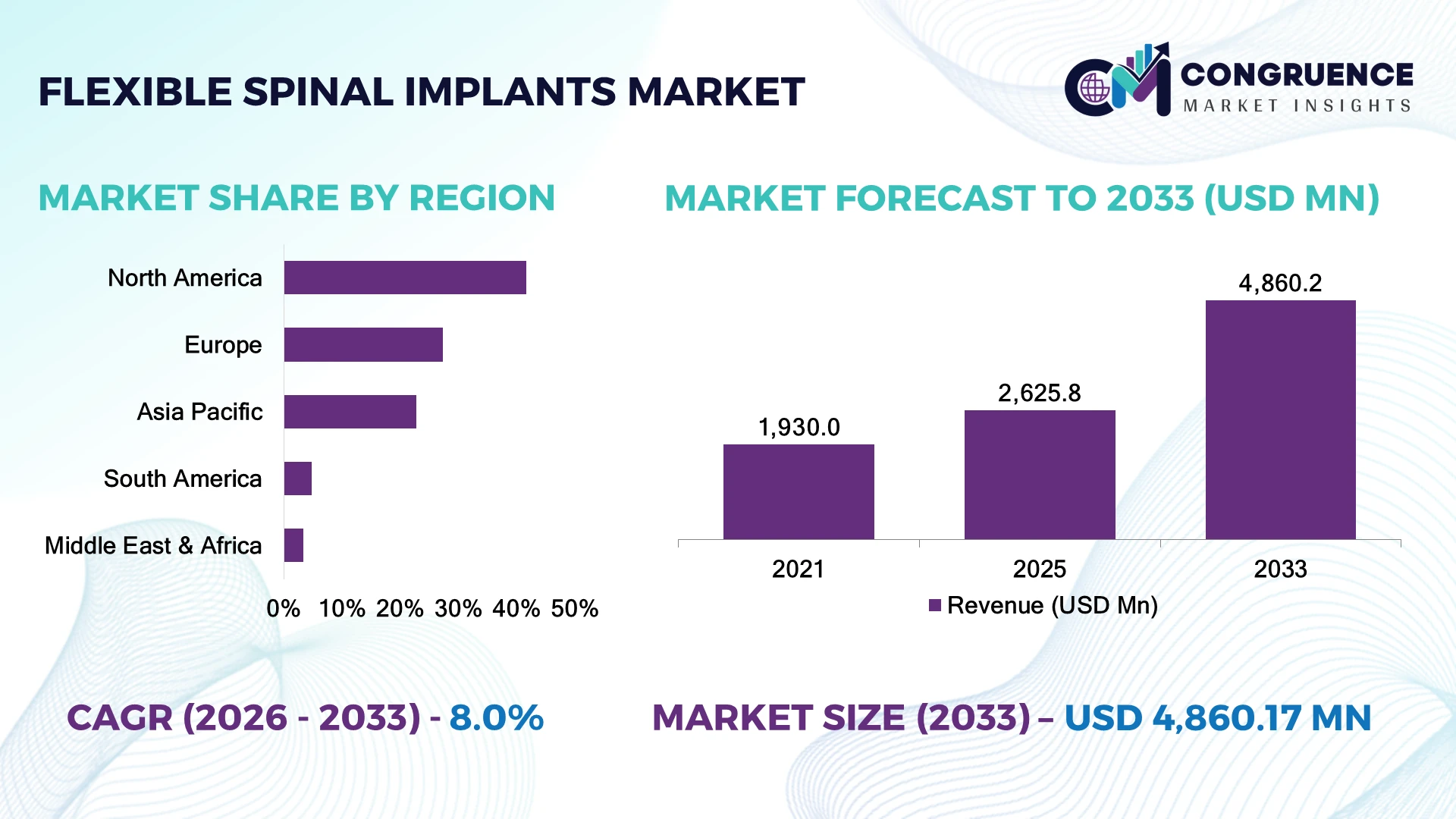
The United States dominates the global flexible spinal implants landscape, representing approximately 42% of demand, supported by advanced spine centers, high procedural volumes, and sustained investment in robotic and image-guided surgery. Germany contributes roughly 8%, while Japan approaches 7%, with adoption increasingly linked to aging populations and minimally invasive treatment pathways. In 2026, U.S. hospitals are prioritizing navigation-enabled implantation and patient-specific planning, reinforcing technology-led purchasing.
Strategic priority is shifting toward motion preservation, surgeon usability, and integrated digital workflows rather than conventional implant volume alone.
Market Size & Growth: USD 2,625.8 million in 2025 to USD 4,860.2 million by 2033 at 8.0% CAGR, driven by motion-preserving and minimally invasive spinal procedures.
Top Growth Drivers: Minimally invasive surgery 34%, degenerative-spine procedures 29%, and motion-preservation adoption 24% represent the strongest demand catalysts.
Short-Term Forecast: By 2028, navigation-assisted implantation is positioned to improve procedural efficiency by approximately 10–15% through better planning and intraoperative visualization.
Emerging Technologies: Patient-specific implants, advanced polymer composites, robotic navigation, and 3D-printed components are reshaping implant design and surgical precision.
Regional Leaders: North America is projected near USD 2.0 billion, Europe around USD 1.2 billion, and Asia-Pacific approximately USD 1.0 billion by 2033, with Asia-Pacific showing the fastest technology adoption.
Consumer/End-User Trends: Specialty spine hospitals account for approximately 46% of procedure-linked demand as surgeons increasingly favor motion-preserving solutions for appropriately selected patients.
Pilot/Case Example: 2025 navigation-enabled spinal workflows demonstrated approximately 12% improvement in operative efficiency in technology-integrated surgical environments.
Competitive Landscape: Leading manufacturers include Medtronic, DePuy Synthes, Stryker, Globus Medical, and Zimmer Biomet, with leading players collectively controlling approximately 45% of organized market demand.
Regulatory & ESG Impact: Patient-specific manufacturing and material optimization can reduce implant-material waste by approximately 8–12%, while regulatory scrutiny increasingly emphasizes safety and long-term performance.
Investment & Funding: More than USD 1 billion is being directed across spinal robotics, navigation, implant R&D, and strategic partnerships, accelerating convergence between implants and digital surgery.
Innovation & Future Outlook: Flexible materials, adaptive biomechanics, AI-assisted planning, and patient-specific manufacturing will shift competition toward integrated implant-and-surgical platforms through 2026–2033.
Flexible spinal implants are gaining traction in degenerative disc disease, lumbar stabilization, cervical applications, and motion-preservation procedures where maintaining controlled biomechanics is clinically important. Approximately 20–25% of purchasing priorities increasingly emphasize implant flexibility, surgical compatibility, and long-term biomechanical performance rather than unit price alone. In 2026, hospitals are also tightening device procurement around traceability and validated clinical workflows, encouraging manufacturers to strengthen engineering documentation and surgeon-training programs.
Flexible spinal implants are becoming strategically important because spinal-device competition is shifting from rigid structural support toward controlled motion, anatomical compatibility, and digitally assisted implantation. Manufacturers that combine biomechanical engineering with navigation compatibility are gaining stronger differentiation than suppliers competing primarily on implant cost. Hospitals are simultaneously consolidating procurement around platforms capable of supporting multiple spinal procedures.
A major technology shift is the integration of advanced polymers, titanium alloys, porous structures, and patient-specific manufacturing. Compared with conventional implant production workflows, digitally assisted design and additive manufacturing can reduce prototype-development cycles by approximately 20–30% and improve geometric customization by roughly 15%. North America remains more advanced in robotic and navigation integration, while China, Japan, and South Korea are expanding adoption through modernized surgical infrastructure.
Through 2026–2028, hospitals are expected to increase navigation-compatible implant deployment by approximately 10–15% as surgical planning becomes more data-driven. A practical deployment pathway combines preoperative imaging, digital templating, navigation, and flexible implant placement within one workflow. Companies are therefore increasing R&D spending, forming technology partnerships, and expanding surgeon-training ecosystems. Competitive advantage will increasingly depend on combining biomechanical performance, manufacturing precision, workflow integration, and reliable clinical support rather than selling implants as standalone hardware.
Motion-preserving procedures are strengthening demand for flexible spinal implants as surgeons seek controlled mobility without the rigidity associated with conventional fusion constructs. In the United States, minimally invasive spine procedures represent roughly 35–40% of eligible interventions, while navigation-assisted workflows are expanding at approximately 10–15% annually. Advanced polymers, titanium alloys, and porous architectures are improving implant conformity and load distribution. Regulatory emphasis on long-term device performance is also raising engineering requirements. Manufacturers are responding through biomechanical R&D, surgeon partnerships, and expanded patient-specific design capabilities. The non-obvious advantage is workflow compatibility: suppliers integrating implants with navigation and robotic systems can secure broader hospital contracts than companies offering standalone devices.
Flexible spinal implants face structural constraints from clinical validation requirements, premium manufacturing costs, and uneven access to advanced spine infrastructure. Patient-specific and complex-motion implants can carry manufacturing costs approximately 15–25% higher than standardized constructs, while specialized robotic or navigation equipment can increase hospital capital requirements by 10–20%. In India and several emerging markets, limited access to advanced spine centers restricts deployment beyond major metropolitan hospitals. Titanium and high-performance polymer supply chains also remain exposed to machining and certification bottlenecks. Manufacturers are reducing exposure through multi-source procurement, localized machining, standardized component platforms, and long-term supplier contracts. The key pressure point is proving durable clinical performance while keeping acquisition and procedure economics acceptable to hospitals.
Patient-specific flexible implants create a high-value opportunity as digital imaging, additive manufacturing, and computational biomechanics become more integrated. Advanced 3D-printed architectures can reduce material waste by approximately 15–25%, while digital design workflows can shorten prototype iterations by 20–30%. China, Japan, and South Korea are strengthening advanced manufacturing capabilities, creating favorable conditions for localized implant production. AI-assisted surgical planning represents another emerging opportunity, improving preoperative planning efficiency by roughly 10–15%. Companies are investing in additive-manufacturing platforms, university collaborations, and hospital-based design partnerships to move toward customized spinal solutions. The strongest strategic opportunity is combining implant customization with surgical navigation, creating integrated clinical workflows that are harder for low-cost implant suppliers to replicate.
Long-term market expansion is challenged by the complexity of integrating flexible implants with imaging, navigation, robotics, and hospital information workflows. Approximately 20–30% of advanced spine centers operate with multiple technology vendors, increasing interoperability requirements during surgical planning and implantation. Workforce gaps in robotic-assisted spine surgery can add 10–15% to training and implementation requirements, particularly outside major U.S., German, and Japanese centers. Cybersecurity requirements are also expanding as connected surgical platforms exchange patient and procedural data. Companies must invest in interoperable software interfaces, surgeon education, technical support, and validation programs. The strategic challenge is not implant engineering alone; scalable adoption requires manufacturers to build dependable clinical ecosystems around the device.
Navigation-Ready Implant Platforms: Hospitals are increasingly linking flexible implants with image guidance and robotic navigation, with adoption in advanced spine centers rising by approximately 10–15%. This integration improves placement consistency and preoperative planning while reducing workflow variability. Manufacturers are redesigning instrumentation and expanding partnerships with surgical-technology providers to make implant systems compatible with established navigation environments.
Additive Manufacturing Gains Ground: Metal 3D printing and porous implant architectures are moving from specialized applications toward broader spinal-device production, reducing material waste by approximately 15–25% and shortening design iterations by nearly 20%. U.S. and European manufacturers are expanding validated additive workflows, while Asian producers are investing in localized production to reduce dependence on imported components.
Advanced Materials Improve Flexibility: High-performance polymers, titanium composites, and engineered porous structures are gaining attention for controlled load transfer and anatomical conformity. Material innovation can improve mechanical performance by roughly 8–12% in targeted design applications while reducing unnecessary rigidity. Companies are increasing materials research and surgeon collaboration, particularly for motion-preservation procedures where biomechanical behavior is central to device selection.
Digital Workflow Standardization Accelerates: Spine centers are increasingly connecting imaging, digital templating, implant selection, and intraoperative guidance, with integrated workflows improving planning efficiency by approximately 10–15%. Labor shortages and pressure for predictable operating-room utilization are accelerating this transition. Manufacturers are responding by developing digital planning tools, training programs, and interoperable platforms that support consistent deployment across hospital networks.
Pedicle Screws Anchor Flexible Fixation Demand
Pedicle screws lead the flexible spinal implants market, accounting for approximately 35.3% share in 2025, because they provide strong fixation across lumbar, thoracic, and cervical procedures while remaining compatible with rigid and dynamic constructs. Rods follow as a mature, highly versatile category, while cages and plates serve procedure-specific stabilization requirements. Hooks retain strategic relevance in deformity correction and selected thoracic constructs. Companies are refining screw geometry, surface finishes, and minimally invasive delivery systems to improve placement accuracy and procedural efficiency, with advanced screw platforms increasingly integrated into broader instrumentation ecosystems.
Rods represent the fastest-growing type, supported by expanding use in flexible and dynamic stabilization systems and their compatibility with multiple fixation configurations. Their growth reflects the shift toward motion-conscious constructs and less invasive procedures, while pedicle screws remain the scale anchor. Approximately 10%–12% of investment is increasingly directed toward advanced rod designs, modular instrumentation, and hybrid fixation platforms. Manufacturers are responding through product-line expansion, surgeon partnerships, and integrated implant-instrument portfolios, making flexibility, compatibility, and procedural efficiency increasingly important purchasing criteria.
A 2026 industry analysis identifies pedicle screws as the leading type at about 35.3% share in 2025, while rods are positioned as the fastest-growing type, reinforcing the shift toward adaptable fixation architectures.
Lumbar Procedures Anchor Current Demand
Lumbar procedures represent the leading application, accounting for approximately 38.4% share in 2025, supported by extensive use of implants across degenerative disease, decompression, stabilization, fusion, and motion-preservation pathways. Cervical procedures form another important demand base, while thoracic interventions, artificial discs, and specialized applications remain more concentrated. Companies are prioritizing modular systems capable of supporting multiple lumbar approaches, improving inventory utilization and expanding procedural compatibility across hospitals and specialty centers.
Artificial discs represent the fastest-growing application, driven by increasing emphasis on motion preservation, minimally invasive techniques, and technologies designed to maintain physiological movement. Adoption is shifting from conventional fusion-only strategies toward selected non-fusion interventions, creating new demand for specialized implant architectures. Approximately 10%–11% of application-focused investment is increasingly directed toward motion-preserving technologies, clinical evidence generation, and surgeon training. Companies are expanding artificial-disc portfolios while integrating implants with navigation, imaging, and procedure-specific instrumentation, strengthening operational relevance in advanced spine programs.
A 2026 market assessment places lumbar procedures at approximately 38.4% share in 2025 and identifies artificial discs as the fastest-growing application, reflecting stronger momentum for motion-preservation treatment pathways.
Hospitals Retain Scale, ASCs Accelerate
Hospitals remain the dominant end-user, representing approximately 52.3% share in 2025 because complex deformity correction, revision surgery, multilevel reconstruction, and trauma procedures require advanced imaging, specialist teams, and postoperative infrastructure. High-volume hospitals and academic centers also serve as validation sites for new implant technologies. Specialty spine clinics maintain focused demand for elective and motion-preserving procedures, while companies continue strengthening hospital partnerships and clinical-training programs to support advanced product adoption.
Ambulatory surgical centers are the fastest-growing end-user group, driven by shorter-stay procedures, standardized workflows, and increasing migration of appropriate spine cases into outpatient settings. ASC adoption is expanding faster than traditional hospital purchasing, with related demand growth supported by approximately 11% annual expansion in outpatient spine activity. Manufacturers are responding with streamlined instrumentation, procedure-specific kits, inventory optimization, and logistics partnerships. This shift is strategically important because ASC-focused product design increasingly favors compact systems, predictable procedural workflows, and faster turnover rather than the broad infrastructure traditionally associated with hospital-based spine surgery.
A 2026 flexible spinal implants market assessment reports hospitals at approximately 52.3% share in 2025 and identifies ambulatory surgical centers as the fastest-growing end-user channel, reflecting continued movement toward outpatient spine procedures.
North America accounted for the largest market share at 41.6% in 2025 however, Asia-Pacific is expected to register the fastest growth, expanding at a CAGR of 10.7% between 2026 and 2033.
Outpatient migration is reshaping implant utilization
North America maintains market leadership through high spinal procedure volumes, advanced spine centers, established reimbursement infrastructure, and rapid adoption of navigation-assisted and motion-preservation technologies. The region represented 41.61% of global flexible spinal implant demand in 2025, with the United States contributing the dominant share through concentrated specialist capacity and sophisticated surgical infrastructure. Outpatient migration is becoming a major purchasing driver: ASC-based spinal surgeries increased nearly 8% annually between 2021 and 2024, encouraging manufacturers to develop compact instrumentation and procedure-specific implant systems. Medtech companies are also strengthening commercialization through regulatory clearances and hospital partnerships, while robotic navigation and minimally invasive workflows improve technology differentiation. The strategic shift is from hospital-centric volume toward integrated hospital-ASC portfolios, increasing pressure on suppliers to deliver predictable procedural economics alongside clinical performance.
United States Market Outlook: The United States remains the primary commercial and technology hub, supported by extensive specialist networks, high procedure volumes, advanced imaging, and strong adoption of outpatient spine surgery. ASC spinal procedures increased nearly 8% annually from 2021–2024, while ASC procedures can cost 45%–60% less than comparable hospital procedures, strengthening demand for efficient implant platforms and streamlined instrumentation.
Evidence-driven adoption is raising technology standards
Europe remains a major high-value market, supported by established spine centers in Germany, France, and the United Kingdom and strong surgeon-training infrastructure. Adoption increasingly favors motion-preserving and minimally invasive systems, but regulatory scrutiny and evidence requirements create higher commercialization thresholds than in the United States. Germany is particularly important because evidence-based reimbursement encourages clinically validated technologies rather than rapid product turnover. Robotic assistance, navigation, and advanced imaging are expanding across leading surgical centers, strengthening demand for implants compatible with digitally enabled workflows. Manufacturers are responding with stronger clinical evidence programs, localized training partnerships, and product portfolios designed around European compliance requirements. The region therefore favors suppliers with proven clinical performance, regulatory expertise, and lifecycle support rather than purely low-cost positioning.
Germany Market Outlook: Germany represents Europe’s strongest strategic market because of its sophisticated hospital infrastructure, specialist spine centers, and evidence-oriented reimbursement environment. Adoption of flexible and motion-preserving implants is increasingly linked to demonstrated clinical value. Robotic and navigation-assisted capabilities are also expanding within major surgical centers, encouraging manufacturers to prioritize evidence generation, surgeon education, and technology-compatible instrumentation.
Tertiary-care expansion is accelerating technology adoption
Asia-Pacific represents the strongest expansion opportunity as China and India increase tertiary-care capacity and broaden access to advanced spine procedures. Urban hospitals are becoming early adoption centers for navigation-integrated implants, motion-preserving devices, and minimally invasive techniques, while Japan, South Korea, and Australia provide established high-value demand. The region is projected to expand at 10.65% through the forecast period, making infrastructure deployment a more important competitive factor than simple population scale. Manufacturers are increasingly localizing distribution, clinical education, and hospital partnerships to address differences in reimbursement and surgical capability. China’s major metropolitan centers are particularly important for premium technology deployment, whereas India combines large procedural demand with growing private-hospital investment. Companies that align product pricing with local procurement structures while maintaining advanced functionality are gaining stronger expansion potential.
China Market Outlook: China offers the strongest scale opportunity through expanding tertiary hospitals, concentrated urban surgical infrastructure, and increasing access to advanced spine technologies. Leading hospitals in major cities increasingly function as technology-adoption hubs, supporting navigation-assisted and motion-preserving procedures. Manufacturers are strengthening local distribution, surgeon training, and institutional partnerships to improve access while adapting premium implant portfolios to procurement requirements.
Private-care investment is opening selective technology corridors
South America remains a developing market characterized by concentrated demand in private hospitals and specialist surgical centers, particularly in Brazil. Flexible spinal implant adoption is supported by expanding minimally invasive capabilities and growing access to advanced imaging, but affordability and uneven healthcare infrastructure constrain broader deployment. Brazil provides the strongest commercial base because its large private healthcare network supports higher-value orthopedic and spine procedures. Companies are therefore emphasizing distributor partnerships, localized inventory, and procedure-specific portfolios rather than broad infrastructure-heavy expansion. Premium motion-preservation systems remain concentrated among sophisticated providers, while conventional fixation retains greater purchasing relevance across cost-sensitive facilities. The strategic opportunity lies in targeted deployment around high-volume metropolitan hospitals, where specialist capacity and purchasing power can support advanced implants without requiring nationwide infrastructure penetration.
Brazil Market Outlook: Brazil is the region’s principal strategic market, supported by its large private hospital network, specialist spine centers, and concentration of advanced surgical equipment in major cities. Adoption is increasingly linked to minimally invasive procedures and higher-value implant systems. Manufacturers are strengthening distributor networks and localized inventory to reduce lead times and improve product availability for high-volume surgical centers.
Tertiary-care modernization is creating premium implant corridors
Middle East & Africa presents a selective expansion market led by Gulf healthcare modernization and increasing investment in tertiary surgical infrastructure. Saudi Arabia and the United Arab Emirates are particularly relevant because private hospitals and specialized medical centers are expanding advanced orthopedic and neurosurgical capabilities. Premium flexible implants benefit from sophisticated imaging, navigation, and minimally invasive surgical infrastructure concentrated in major cities. The region remains more fragmented than North America or Europe, making distributor capability and clinical training important commercial differentiators. Companies are responding through hospital partnerships, specialist education programs, and targeted premium-product deployment rather than broad-scale infrastructure investment. The strategic advantage increasingly belongs to suppliers able to combine advanced implant performance with reliable regional logistics and surgeon support.
Saudi Arabia Market Outlook: Saudi Arabia is the region’s strongest strategic market because healthcare modernization is increasing tertiary-care capacity and advanced surgical infrastructure. Major hospitals are investing in specialist capabilities, supporting demand for sophisticated spine procedures and digitally enabled operating environments. Manufacturers are positioning through institutional partnerships, distributor expansion, and surgeon training, with premium implants concentrated in major metropolitan healthcare centers.
Medtronic and Globus Medical compete as technology-led global leaders, while DePuy Synthes and Zimmer Biomet leverage portfolio breadth and distribution. ATEC and Orthofix challenge established players through procedure-specific innovation. The top five players command approximately 71% of adjacent spinal fusion demand, indicating concentrated purchasing power. Technology influences nearly 35% of buying decisions, while procedural efficiency affects about 30% and pricing approximately 20%. Medtronic integrates implants with robotics, navigation, imaging, software, and AI; Globus emphasizes robotic-enabled workflows and expandable implants; ATEC competes through proceduralized lateral and deformity platforms. Stryker’s 2025 spinal-implant divestiture to VB Spine signals portfolio specialization rather than simple consolidation. Competitive pressure is shifting toward integrated ecosystems, surgeon training, and workflow economics. Entry barriers remain high because regulatory validation, clinical evidence, surgeon relationships, and capital-intensive instrumentation restrict rapid commercialization. Winning requires differentiated biomechanics, dependable supply, integrated enabling technology, and evidence strong enough to convert surgeons and hospital procurement teams.
Medtronic plc
Globus Medical, Inc.
Stryker Corporation
DePuy Synthes
Zimmer Biomet Holdings, Inc.
Orthofix Medical Inc.
Alphatec Holdings, Inc.
B. Braun Melsungen AG
Spineart SA
Xtant Medical Holdings, Inc.
Spinal Elements, Inc.
Centinel Spine, LLC
SI-BONE, Inc.
Highridge Medical
Flexible spinal implant technology is moving toward digitally integrated constructs combining advanced materials, navigation, robotics, and intraoperative imaging. AI-assisted planning and robotic guidance can improve implant-placement efficiency by approximately 10%–15%, while low-dose imaging platforms can reduce radiation exposure by about 30%. Adoption is concentrated in advanced spine centers, where navigation-supported procedures increasingly form part of standardized operating-room workflows.
Advanced surface engineering is also reshaping implant performance. Porous titanium, porous PEEK, additive-manufactured structures, and biomimetic coatings target stronger osseointegration and anatomical customization. Compared with conventional implant geometries, optimized additive-manufactured designs can reduce material usage by approximately 15%–20% while enabling more complex lattice structures. Companies combining implant design with patient-specific planning gain an advantage in complex deformity and revision procedures. Globus is expanding advanced materials alongside robotic and navigation platforms, illustrating the shift toward integrated technology ecosystems.
Between 2026 and 2028, the strongest competitive impact will come from interoperability rather than isolated implant innovation. Platforms connecting imaging, navigation, robotics, implant libraries, and procedural data can reduce workflow variability by roughly 10%–12%. Medtronic’s AiBLE ecosystem demonstrates this direction by linking implants with navigation, robotics, imaging, software, and AI. suppliers that integrate flexible implants into these digital workflows will gain stronger surgeon retention, while smaller manufacturers must prioritize compatibility, clinical evidence, and targeted procedure-specific innovation.
February 2025 Medtronic launched the CD Horizon ModuLeX spinal system, integrating implants with navigation, robotics, imaging, software and AI through AiBLE. The 40-year platform gained a connected deformity workflow, strengthening technology differentiation and procedural predictability across spine surgery. Source: Medtronic
April 2025 Stryker completed the sale of its U.S. spinal implants business to Viscogliosi Brothers, creating VB Spine. The transaction transferred the portfolio while preserving access to Mako Spine and Copilot, reshaping ownership and strengthening specialist spine focus. Source: Stryker
April 2025 Alphatec launched PTP Corpectomy, extending its prone transpsoas platform into complex thoracolumbar deformity, tumor, trauma and infection procedures. The system combines Sigma access, Ascend expandable VBR and SafeOp monitoring, broadening procedural coverage and strengthening strategy. Source: ATEC Spine
July 2025 Orthofix completed the U.S. commercial launch of the Reef L Interbody System for lateral lumbar fusion, completing its Reef interbody family. The platform combines surface technology with structural design, expanding minimally invasive options and strengthening portfolio. Source: Orthofix
The Flexible Spinal Implants Market Report evaluates the industry across product types including flexible spinal rods, spinal discs, fusion cages, hooks, plates, and dynamic stabilization systems. Application coverage includes spinal fusion, deformity correction, trauma repair, degenerative disc disease, and other specialized procedures, while end-user analysis covers hospitals, orthopedic clinics, spine centers, and ambulatory surgical facilities. The assessment also distinguishes mature fixation technologies from emerging motion-preservation platforms.
Geographic coverage spans North America, Europe, Asia-Pacific, South America, and the Middle East & Africa, with country-level analysis emphasizing the United States, Germany, China, Japan, Brazil, and Saudi Arabia. Technology assessment covers robotic navigation, AI-assisted planning, additive manufacturing, advanced surface engineering, patient-specific implants, and integrated imaging. Competitive analysis evaluates leading manufacturers, portfolio positioning, partnerships, regulatory strategy, technology adoption, and expansion priorities to support investment planning, market entry, product development, and competitive positioning through 2026–2033.
| Report Attribute/Metric | Report Details |
|---|---|
|
Market Revenue in 2025 |
USD 2,625.8 Million |
|
Market Revenue in 2033 |
USD 4,860.2 Million |
|
CAGR (2026 - 2033) |
8% |
|
Base Year |
2025 |
|
Forecast Period |
2026 - 2033 |
|
Historic Period |
2021 - 2025 |
|
Segments Covered |
By Type
By Application
By End-User
|
|
Key Report Deliverable |
Revenue Forecast, Growth Trends, Market Dynamics, Segmental Overview, Regional and Country-wise Analysis, Competition Landscape |
|
Region Covered |
North America, Europe, Asia-Pacific, South America, Middle East, Africa |
|
Key Players Analyzed |
Medtronic plc, Globus Medical, Inc., Stryker Corporation, DePuy Synthes, Zimmer Biomet Holdings, Inc., Orthofix Medical Inc., Alphatec Holdings, Inc., B. Braun Melsungen AG, Spineart SA, Xtant Medical Holdings, Inc., Spinal Elements, Inc., Centinel Spine, LLC, SI-BONE, Inc., Highridge Medical |
|
Customization & Pricing |
Available on Request (10% Customization is Free) |




