
Reports
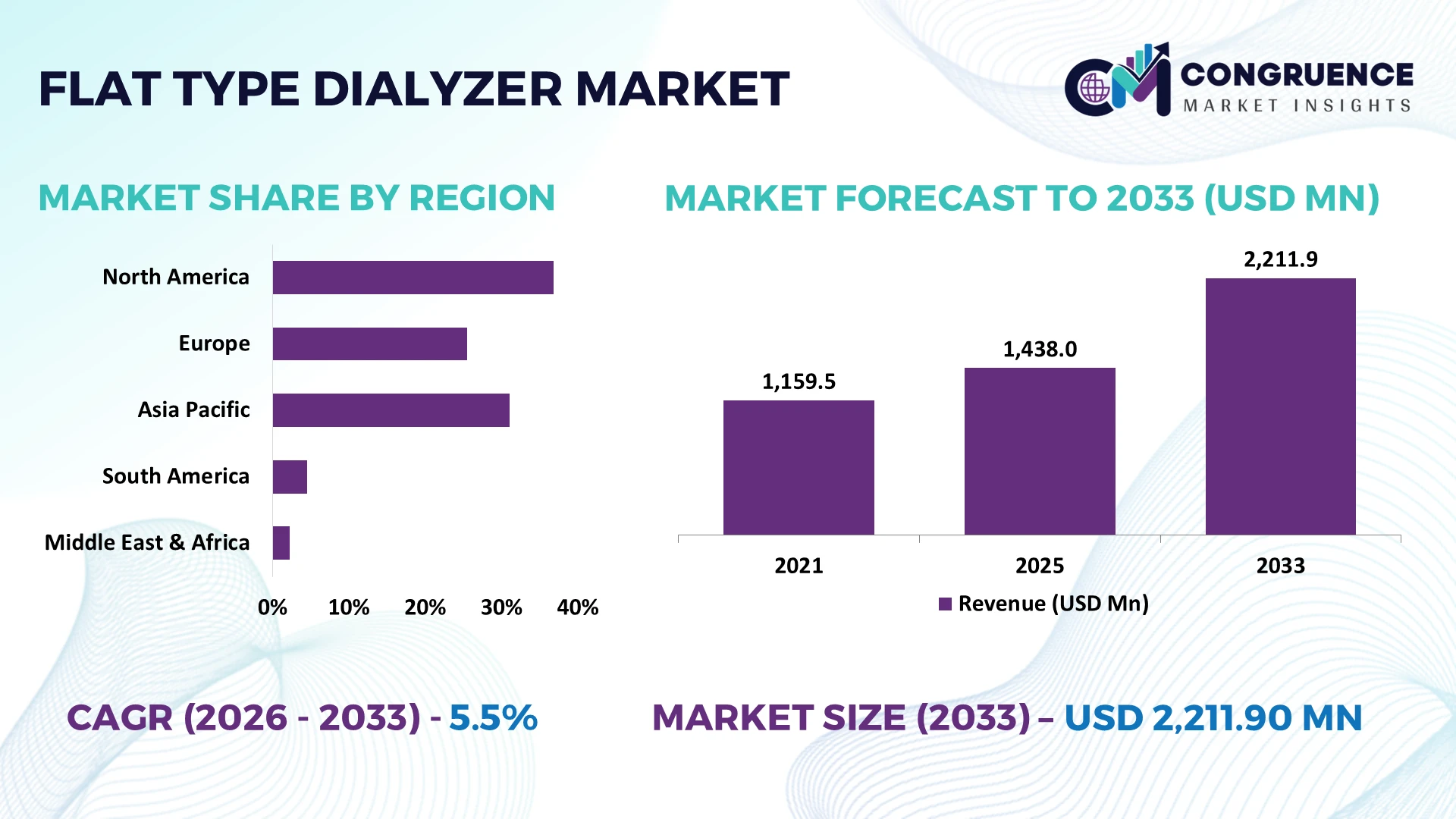
The Global Flat Type Dialyzer Market was valued at USD 1,438.0 Million in 2025 and is anticipated to reach a value of USD 2,211.9 Million by 2033 expanding at a CAGR of 5.53% between 2026 and 2033. Growth is driven by specialized renal replacement therapy requirements, advances in biocompatible membrane materials, demand for reliable extracorporeal blood purification, and the modernization of critical-care dialysis systems.
The United States holds a strategically important position through its 516,837 dialysis patients and 7,556 dialysis centers as of March 2025. Its established medical-device industry, Medicare-supported treatment infrastructure, and advanced membrane technology ecosystem provide significant procurement advantages. Compared with emerging markets such as India, where public dialysis access is expanding through district hospitals, the United States offers greater institutional purchasing maturity and technology integration.
Strategically, manufacturers should prioritize membrane performance, specialized clinical applications, manufacturing consistency, and targeted institutional partnerships rather than competing solely on consumable pricing.
Market Size & Growth: USD 1,438.0 million in 2025, reaching USD 2,211.9 million by 2033 at 5.53% CAGR, supported by expanding renal replacement therapy and specialized blood purification applications.
Top Growth Drivers: Global dialysis patient growth of 4–5%, in-center hemodialysis utilization of 89%, and dialysis-center expansion of approximately 1.9% annually.
Short-Term Forecast: By 2028, manufacturers targeting at least 95% digital batch traceability and improved membrane-production consistency will strengthen institutional procurement competitiveness.
Emerging Technologies: Advanced polymer membranes, automated membrane fabrication, and AI-assisted manufacturing inspection are strengthening product-quality management and process control.
Regional Leaders: North America leads institutional procurement, Asia-Pacific benefits from manufacturing expansion, and Europe maintains strong medical-device engineering capabilities. Flat-type-specific regional USD values are not independently established.
Consumer/End-User Trends: Approximately 89% of global dialysis patients receive in-center hemodialysis, reinforcing hospital and dialysis-center procurement as the primary demand channel.
Pilot/Case Example: A 1995 clinical comparison involving 7 patients found no significant difference in urea clearance between flat-plate and hollow-fiber dialyzers, highlighting the importance of application-specific clinical validation.
Competitive Landscape: Fresenius Medical Care leads the broader dialysis-products industry with approximately 35% market share. Key competitors include Baxter International, Nipro Corporation, B. Braun, and Asahi Kasei Medical.
Regulatory & ESG Impact: Fresenius Medical Care reported a 19% reduction in Scope 1 and market-based Scope 2 emissions against its 2020 baseline, strengthening sustainability expectations across renal-care supply chains.
Investment & Funding: Fresenius Medical Care recorded EUR 915 million in 2025 capital expenditure and development spending, reflecting continued investment in manufacturing capacity, equipment, and product innovation.
Innovation & Future Outlook: Next-generation membrane engineering, precision filtration, and specialized extracorporeal applications will favor companies combining clinical validation, production consistency, and differentiated filtration performance.
The flat type dialyzer market holds strategic relevance through its role in specialized extracorporeal blood purification, where membrane configuration, filtration consistency, and circuit compatibility influence clinical performance. The broader dialysis industry treated approximately 4.5 million patients in 2025, while global dialysis-center infrastructure reached approximately 53,000 facilities. These conditions sustain investment in membrane technologies, although flat type products compete against the more commercially established hollow-fiber architecture.
A significant technology distinction concerns filtration geometry and circuit operation. Flat-plate configurations provide a different membrane arrangement from hollow-fiber systems, but comparative clinical evidence does not establish a universal clearance advantage. A clinical review involving 38 participants reported an estimated 1.4-hour shorter circuit lifespan for flat-plate filters, with very low evidence certainty. Manufacturers therefore need application-specific validation rather than relying on configuration-based claims.
Over the next 2–3 years, opportunities will center on specialized critical-care applications, membrane-material development, manufacturing automation, and reliable product qualification. North America offers established clinical procurement networks, whereas India and China provide expanding treatment infrastructure and manufacturing opportunities. Companies are strengthening production resilience through dual sourcing, regional manufacturing, and clinical partnerships. Competitive positioning will depend on demonstrating measurable treatment suitability, dependable supply, and differentiated membrane performance rather than attempting to displace hollow-fiber products across routine dialysis applications.
The worldwide dialysis population increased approximately 4–5% in 2025, while around 89% of dialysis patients received in-center hemodialysis. The number of dialysis centers also increased from approximately 52,000 to 53,000, strengthening institutional demand for blood purification consumables. Increasing critical-care requirements and specialized extracorporeal treatment applications create opportunities for alternative membrane configurations, including flat-plate systems. In the United States, more than 516,000 patients received dialysis as of March 2025. Manufacturers are responding through membrane engineering, clinical validation, and specialized product development. The non-obvious opportunity lies in serving application-specific treatment requirements rather than competing directly with high-volume hollow-fiber products on price alone.
Hollow-fiber dialyzers dominate routine hemodialysis procurement because of their established manufacturing scale, clinical familiarity, and integration with existing treatment systems. Flat-plate configurations face a narrower commercial application base and require stronger justification during institutional purchasing. A comparative evidence review involving 38 participants estimated a 1.4-hour shorter circuit lifespan for flat-plate filters, although the evidence was rated very low certainty. Global in-center hemodialysis costs also average approximately USD 19,380 annually per patient in the available international assessment. These economics intensify procurement scrutiny. Manufacturers are addressing the restraint through targeted clinical studies, application-specific product positioning, material optimization, and long-term supply agreements rather than broad-based production expansion.
Advanced polymer membranes, surface modification, and precision manufacturing create opportunities to improve filtration consistency and biocompatibility in specialized dialysis applications. India offers a particularly relevant deployment opportunity: its National Dialysis Programme operates across 36 States and Union Territories, with approximately 1,925 centers and 13,824 hemodialysis machines reported in August 2026. China provides additional potential through its medical-device manufacturing ecosystem and large renal-care population. Manufacturers can capture specialized demand by investing in membrane R&D, local production partnerships, and application-specific clinical validation. An important opportunity lies in developing differentiated flat-plate products for critical-care filtration instead of pursuing direct substitution in conventional dialysis procurement.
Commercial scalability depends on clinical acceptance, equipment compatibility, manufacturing reproducibility, and access to trained dialysis personnel. International research covering 167 countries found that in-center hemodialysis availability varied from 12.2 treatments per million population in Africa to 1,575 per million in North and East Asia. Furthermore, 19% of surveyed countries reported that children could not access hemodialysis services. Such disparities restrict standardized product deployment and complicate clinical validation across different healthcare environments. Manufacturers must also maintain stringent membrane integrity, sterilization, and quality-control procedures. Investment in regional clinical partnerships, technician training, validated production processes, and equipment interoperability is essential. The long-term competitive challenge is not simply developing a functional membrane but ensuring consistent clinical performance across diverse treatment environments.
High-Flux Membrane Dominance Accelerates: High-flux flat membrane configurations now account for 64% of new installations across Asia-Pacific and Middle East dialysis center upgrades, driven by superior middle-molecule clearance requirements in chronic hemodialysis protocols. Suppliers including Nipro and Asahi Kasei are restructuring production lines toward high-flux variants, with Fresenius embedding hemodiafiltration-capable systems into U.S. clinic infrastructure upgrades to capture replacement-filter demand.
Localized Procurement Reshapes Supply Chains: China's NMPA accelerated domestic Class III dialyzer approvals, enabling local manufacturers including Bain Medical and WEGO to secure regulatory clearances across Southeast Asia, with Vietnam's Ministry of Health granting new registrations to Chinese flat and hollow-fiber dialyzer producers in 2025. This regulatory-institutional shift is compressing import dependence in ASEAN markets, prompting multinational suppliers to evaluate joint-venture production rather than finished-goods export models.
AI-Enabled Dialysis Center Operations: B. Braun's new Třinec facility in the Czech Republic, opened in March 2025, integrates AI-driven building management with 22 dialysis chairs, doubling prior capacity while eliminating evening shift requirements through optimized scheduling. The deployment signals a broader operational trend where center-level automation reduces labor intensity per treatment session, influencing dialyzer consumption predictability and procurement batching strategies.
Home Therapy-Compatible Designs Gain Traction: Home hemodialysis adoption is expanding at 9.5% annually, creating demand for compact flat dialyzers optimized for lower blood flow rates and simplified patient-operated connectivity. Manufacturers are responding by aligning product roadmaps with telehealth integration, positioning flat dialyzers as components of remote-monitored care ecosystems rather than standalone consumables.
The flat type dialyzer market segments by membrane flux into low-flux and high-flux variants, with high-flux configurations commanding approximately 58% of new clinical installations in advanced markets and sustaining a 22% average selling price premium over low-flux alternatives. Dominance is anchored in superior β2-microglobulin clearance performance, which clinical protocols in Germany and Japan increasingly mandate for end-stage renal disease patients with elevated middle-molecule burden. Low-flux membranes retain relevance in cost-constrained procurement environments across India and Southeast Asia, where per-treatment reimbursement ceilings limit high-flux penetration to below 35% of public hospital volumes. Companies are responding by rationalizing low-flux SKUs while concentrating R&D investment on asymmetric high-flux architectures that reduce albumin loss below 4% while maintaining clearance efficiency.
Dialysis centers represent the leading application segment for flat type dialyzers, capturing an estimated 52% of consumption volume as standalone and hospital-affiliated outpatient facilities expand treatment capacity across China and Germany. Demand concentration reflects the operational intensity of chronic hemodialysis programs, where dialyzer replacement cycles average every 8 months per patient and procurement contracts favor standardized flat membrane configurations compatible with existing machine fleets. Hospitals represent the second-largest application segment, though purchasing behavior differs markedly: hospital-based nephrology departments prioritize brand consistency and clinical outcome documentation over unit price, sustaining premium positioning for Fresenius and Nipro products. Home healthcare is the fastest-growing application, expanding at approximately 9.5% annually as portable and simplified dialysis systems gain regulatory clearance in Japan and select European markets. Companies are adapting through dedicated home-therapy product lines with simplified connectors and patient-friendly packaging, while dialysis center-focused suppliers emphasize volume contracts and automated reorder systems.
Hospitals and specialized dialysis chains collectively represent the dominant end-user group, accounting for approximately 78% of flat type dialyzer consumption value, with Fresenius Medical Care alone operating roughly 3,600 dialysis centers serving approximately 292,000 patients globally. Demand concentration stems from infrastructure dependency: hospital nephrology departments and chain-operated centers require dialyzers compatible with installed machine fleets, creating switching costs that favor incumbent suppliers. Dialysis centers operated by integrated providers—where the same entity supplies machines, dialyzers, and treatment services—exhibit the highest adoption rates of proprietary flat membrane designs, as Fresenius demonstrates through its 5008X CAREsystem rollout across U.S. clinics where nearly 90% of in-center machines are Fresenius devices. Home healthcare end-users represent the fastest-growing buyer group, with adoption expanding as patient training programs and reimbursement frameworks mature in Japan and Germany. Companies are targeting this segment through customized small-batch packaging, remote monitoring integration, and patient education partnerships with home care agencies.
North America accounted for the largest market share at 36.8% in 2025 however, Asia-Pacific is expected to register the fastest growth, expanding at a CAGR of 6.8% between 2026 and 2033.
North America represented an estimated 36.8% of the global flat type dialyzer market in 2025, supported by advanced renal-care infrastructure, established reimbursement systems, and substantial institutional procurement. The United States dominates regional consumption through hospital dialysis departments and specialized treatment networks. Although hollow-fiber dialyzers have become the preferred architecture for routine hemodialysis, flat type products retain selective relevance in specialized applications and established treatment settings. Canada contributes through publicly funded renal-care programs and hospital-based dialysis services. Procurement decisions increasingly emphasize membrane performance, biocompatibility, sterilization reliability, and compatibility with existing dialysis equipment. Suppliers face pressure to maintain consistent product quality while managing manufacturing costs and regulatory compliance. Established medical-device distribution networks provide an advantage for companies serving specialized institutional requirements.
United States Market Outlook: The United States represents the region's most significant market through its extensive dialysis infrastructure, advanced medical-device manufacturing ecosystem, and established renal-care providers. Medicare reimbursement and large dialysis networks support structured procurement of dialysis consumables. The country's medical-device sector also provides technological capabilities in membrane engineering, sterilization, and quality assurance. Specialized hospitals and research institutions create opportunities for flat type dialyzers in selected clinical applications where established treatment protocols and equipment compatibility influence purchasing decisions.
Europe accounted for an estimated 25.5% of the global flat type dialyzer market in 2025. Germany, France, the United Kingdom, and Italy represent important consumption centers, supported by established nephrology departments, public healthcare systems, and specialized dialysis providers. The region benefits from medical-device engineering expertise and established manufacturing capabilities, particularly in Germany and Italy. European procurement emphasizes clinical performance, product traceability, sterilization standards, and compliance with Medical Device Regulation requirements. An aging population and sustained demand for renal replacement therapy support institutional purchasing. Manufacturers are also evaluating material efficiency, packaging reduction, and manufacturing-process optimization. Competition increasingly depends on demonstrating reliable membrane performance and maintaining consistent supply under hospital tender arrangements rather than relying exclusively on price-based differentiation.
Germany Market Outlook: Germany holds a strategically important position through its established medical-device manufacturing industry and strong renal-care infrastructure. The presence of major healthcare technology companies, including Fresenius Medical Care, supports expertise in dialysis systems, consumables, and membrane technologies. German hospitals and specialized treatment providers maintain demanding procurement standards involving product quality, sterilization, and clinical reliability. The country's established engineering ecosystem and export-oriented manufacturing capabilities create opportunities for specialized dialyzer suppliers seeking access to European institutional and international markets.
Asia-Pacific accounted for an estimated 31.0% of the global flat type dialyzer market in 2025 and represents the strongest emerging regional opportunity. China, Japan, and India are important markets, supported by large dialysis patient populations, expanding healthcare infrastructure, and domestic medical-device manufacturing. Japan contributes through advanced membrane engineering and established dialysis treatment practices, while China benefits from extensive medical-device production capabilities. India's Pradhan Mantri National Dialysis Programme added approximately 1,200 dialysis centers between 2024 and 2025, strengthening treatment accessibility. However, flat type dialyzers face competition from widely adopted hollow-fiber alternatives. Manufacturers therefore have opportunities in specialized clinical applications, cost-sensitive procurement, and customized product configurations. Regional suppliers can also benefit from shorter supply chains and growing domestic healthcare procurement.
China Market Outlook: China represents a strategically significant market because of its large renal-care population, domestic medical-device manufacturing capabilities, and expanding hospital infrastructure. Local manufacturers benefit from established polymer processing, membrane production, and medical consumables supply chains. Government-supported healthcare modernization and domestic procurement priorities encourage local sourcing of dialysis products. China's manufacturing ecosystem also supports production scalability and competitive pricing, creating opportunities for suppliers targeting specialized dialyzer applications and regional export markets. Japan provides an additional technology-oriented market through advanced dialysis research and established clinical expertise.
South America accounted for an estimated 4.5% of the global flat type dialyzer market in 2025. Brazil represents the primary regional demand center, supported by its extensive public healthcare network, private dialysis providers, and growing requirements for renal replacement therapy. Argentina, Chile, and Colombia contribute through hospital-based treatment facilities and specialized nephrology services. Procurement remains heavily influenced by affordability, reimbursement arrangements, and the availability of imported medical consumables. Flat type dialyzers occupy a more specialized position as healthcare providers increasingly procure established hollow-fiber alternatives for routine treatment. Nevertheless, opportunities remain in facilities using compatible legacy equipment and specialized treatment configurations. Currency volatility, import dependency, and uneven healthcare infrastructure continue to constrain broader deployment, making distributor partnerships and dependable product availability important competitive factors.
Brazil Market Outlook: Brazil is the most strategically significant country in the region because of its large population, established dialysis provider network, and substantial public healthcare infrastructure. The Unified Health System (SUS) supports access to renal replacement therapy, creating institutional demand for reliable dialysis consumables. Domestic medical-device distributors and healthcare suppliers play an important role in procurement and product availability. Opportunities exist for manufacturers offering competitively priced flat type dialyzers, consistent sterilization quality, and technical compatibility with existing dialysis equipment.
Middle East & Africa represented an estimated 2.2% of the global flat type dialyzer market in 2025. Saudi Arabia, the UAE, and South Africa are important demand centers, supported by hospital modernization, private healthcare investment, and expanding specialist treatment infrastructure. Gulf countries are strengthening renal-care capabilities through investments in advanced hospitals and specialized treatment facilities. South Africa contributes through established private hospital networks and dialysis service providers. However, the regional market remains dependent on imported dialysis equipment and consumables, limiting domestic production capabilities and increasing exposure to procurement costs. Flat type dialyzers primarily serve selected applications rather than mainstream treatment demand. Suppliers can strengthen their regional position through hospital distribution agreements, reliable import channels, product registration, and technical support partnerships.
Saudi Arabia Market Outlook: Saudi Arabia represents an important national market through healthcare transformation under Vision 2030, expanding hospital infrastructure, and investment in specialized treatment services. The National Transformation Program supports healthcare accessibility, operational efficiency, and modernization of medical facilities. These priorities create opportunities for dialysis consumable suppliers capable of meeting institutional quality requirements and maintaining dependable distribution. Growing private healthcare participation and investments in specialist hospitals further strengthen the potential for specialized dialyzer products, including flat type configurations used in compatible clinical settings.
Fresenius Medical Care, Nipro, Asahi Kasei, Toray, and B.Braun form the global leadership tier, competing directly against China's WEGO, Bain Medical, and Shanghai Peony on public tender pricing. The top five players hold approximately 69% combined share, with Fresenius alone commanding roughly 19% . Competition pivots on three axes: membrane technology differentiation (high-flux clearance performance commands a 22% price premium), supply chain localization (Chinese producers hold 42% public hospital procurement share), and vertical integration into clinic networks. Fresenius and B.Braun are accelerating local joint-venture production in China to defend access, while Nipro expands capacity across Japanese and overseas plants . The decisive competitive shift is regulatory-driven localization: NMPA's accelerated approval pathway has commoditized mid-tier flat dialyzers, forcing global leaders to compete on proprietary membrane IP and validated clinical outcome data rather than manufacturing scale. The entry barrier is now clinical evidence generation, not production capability.
Fresenius Medical Care
Nipro
Asahi Kasei Medical
Toray Medical
B. Braun
Nikkiso
Baxter / Vantive
Kawasumi Laboratories
Medica Group
WEGO Group
Shanghai Peony Medical
Bain Medical Equipment
Chengdu OCI Medical
Lengthen
Current flat dialyzer technology is converging on asymmetric high-flux membrane architectures that reduce albumin loss below 4% while maintaining middle-molecule clearance. Polysulfone and polyethersulfone membranes dominate, though Toray's PMMA adsorptive platform differentiates through cytokine removal rather than pure filtration . Adoption signals are clear: high-flux configurations now represent 64% of new installations in advanced markets, with suppliers embedding performance traceability into procurement contracts.
Baxter's 2025 HDx launch illustrates the new-versus-old gap: MCO membranes demonstrated up to 50% greater removal of large middle molecules (45 kDa λ-free light chain) compared with conventional high-flux HD, while maintaining albumin retention . This performance differential favors integrated providers like Fresenius that control both membrane formulation and clinic protocols, disadvantaging third-party dialyzer suppliers reliant on generic specifications.
Between 2026 and 2028, expect AI-driven pore-size analytics and cloud-connected validation to shift competition from membrane chemistry toward documented outcome data. Suppliers that cannot deliver validated clearance traceability will lose formulary access in Germany and China, where procurement increasingly ties reimbursement to performance verification. The strategic imperative is clear: invest in validation infrastructure now, because membrane commoditization is accelerating and clinical evidence is the only durable differentiator.
March 2025: Baxter publicly introduced its HDx (Expanded Hemodialysis) therapy in Korea, utilizing MCO membranes that remove large middle-molecule uremic toxins up to 50% more effectively than conventional HD and HDF while preserving albumin . The therapy runs on standard dialysis machines without specialized equipment, lowering adoption barriers for Korean clinics seeking advanced clearance without infrastructure investment. Source: medipharmhealth.co.kr
July 2025: Toray Medical presented its PMMA membrane dialyzer at the 62nd ERA Congress in Vienna, leveraging the congress's 10,114 attendees to position adsorptive membrane technology for European nephrology formulary consideration . The nearly 50-year PMMA platform differentiates on protein adsorption rather than flux-based clearance, creating a distinct clinical positioning against polysulfone competitors. Source: toray-medical.com
August 2025: Asahi Kasei Medical launched the APS-SA NX and APS-EA NX dialyzer series with revised housing materials designed to reduce raw material procurement risk and stabilize supply chains . The redesign also improves label visibility for clinical workflow efficiency, responding directly to global material sourcing disruptions affecting dialyzer production. Source: asahi-kasei.co.jp
October 2025: Fresenius Medical Care presented ASN Kidney Week 2025 data demonstrating that hemodiafiltration reduces cardiovascular and fluid-related hospitalization risk, supporting its 5008X CAREsystem rollout across U.S. clinics . The evidence base strengthens Fresenius's vertical integration advantage, linking proprietary high-flux flat dialyzers to documented clinical outcome improvements that third-party suppliers cannot easily replicate. Source: freseniusmedicalcare.com
This report delivers comprehensive coverage of the global flat type dialyzer market across membrane flux types, applications, and end-user segments. The analysis spans dialysis centers, hospitals, and home healthcare settings, with regional breakdowns covering North America, Europe, Asia-Pacific, South America, and Middle East & Africa. Segment-level adoption patterns are quantified, including high-flux configurations representing 64% of new installations in advanced markets and home therapy expanding at 9.5% annually.
The report profiles 14 major manufacturers and maps competitive positioning across technology differentiation, supply chain localization, and clinical evidence generation. Coverage extends to emerging membrane architectures, regulatory shifts including NMPA accelerated approvals and EU MDR compliance, and procurement dynamics reshaping supplier selection. Strategic insights support investment prioritization, capacity localization decisions, and formulary positioning between 2026 and 2033, with actionable intelligence on where demand concentration will intensify and which competitive capabilities will determine market access.
| Report Attribute / Metric | Details |
|---|---|
| Market Revenue (2025) | USD 1,438.0 Million |
| Market Revenue (2033) | USD 2,211.9 Million |
| CAGR (2026–2033) | 5.53% |
| Base Year | 2025 |
| Forecast Period | 2026–2033 |
| Historic Period | 2021–2025 |
| Segments Covered |
By Type
By Application
By End-User
|
| Key Deliverables | Revenue Forecast; Market Trends; Growth Drivers & Restraints; Technology Insights; Segmentation Analysis; Regional Insights; Competitive Landscape; Regulatory & ESG Overview; Recent Developments |
| Regions Covered | North America; Europe; Asia-Pacific; South America; Middle East & Africa |
| Companies Profiled | Fresenius Medical Care; Nipro; Asahi Kasei Medical; Toray Medical; B. Braun; Nikkiso; Baxter / Vantive; Kawasumi Laboratories; Medica Group; WEGO Group; Shanghai Peony Medical; Bain Medical Equipment; Chengdu OCI Medical; Lengthen |
| Customization & Pricing | Available on Request (10% Customization Free) |




