
Reports
The Global First Aid Kits Market was valued at USD 625.6 Million in 2025 and is anticipated to reach a value of USD 945.6 Million by 2033 expanding at a CAGR of 5.3% between 2026 and 2033. Growth is driven by workplace safety compliance, specialized trauma kits, outdoor recreation, and the shift toward standardized, replenishable emergency-care systems.
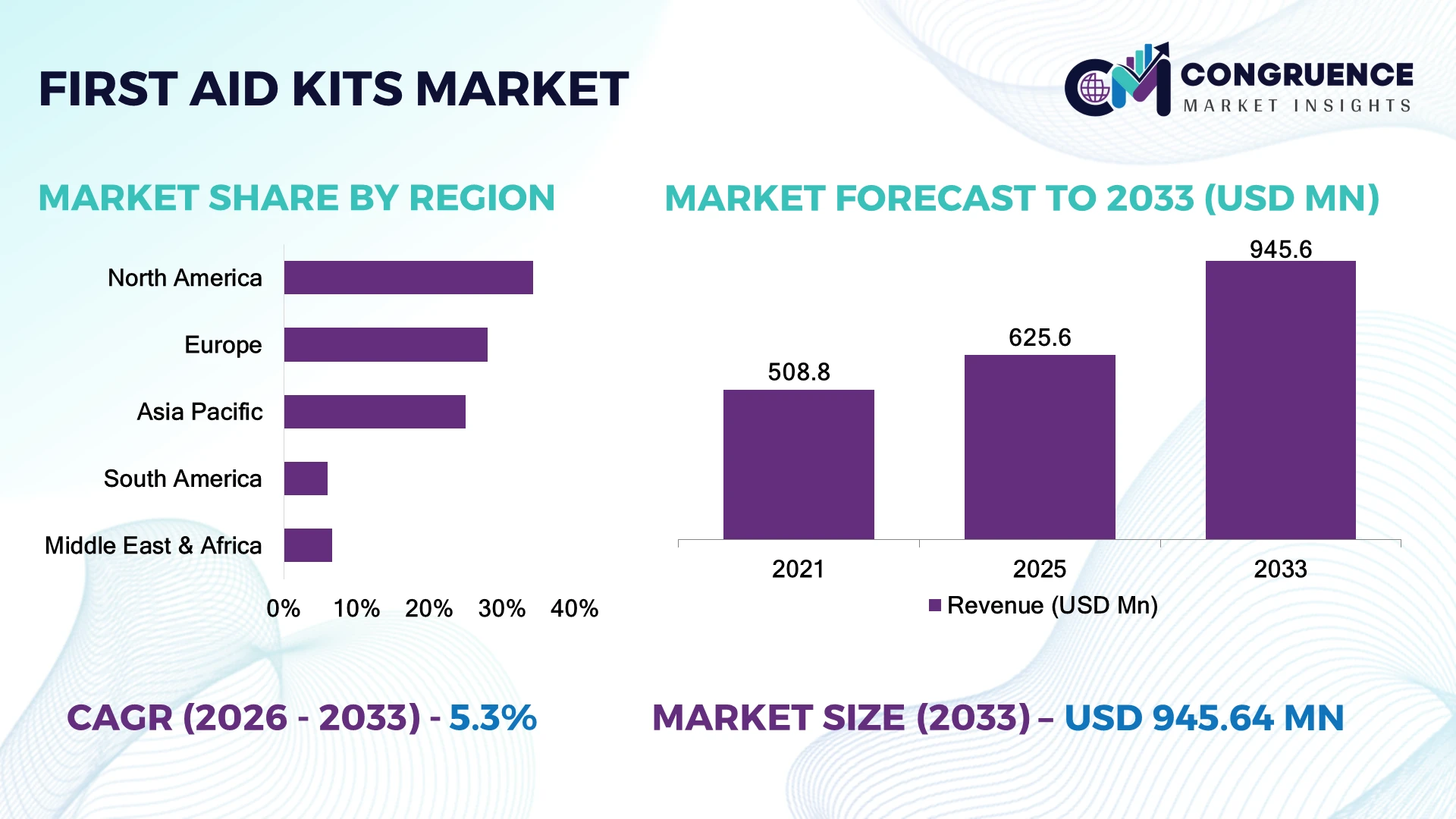
North America holds the dominant regional position with 34.3% of global market value, while the United States represents approximately 37% of North America's first aid kit market. Manufacturing, construction, healthcare, logistics, and sporting-goods channels sustain high adoption. California's workplace naloxone requirement is broadening kit specifications, while U.S. workplace rules emphasize readily accessible supplies.
Strategically, suppliers should prioritize workplace-specific configurations, regulatory-ready contents, rapid replenishment, and modular kits that accommodate changing occupational and emergency-preparedness requirements.
Market Size & Growth: USD 625.6M in 2025 to USD 945.6M by 2033 at 5.3% CAGR, driven by workplace compliance and specialized kits.
Top Growth Drivers: Workplace safety 35%, household preparedness 25%, outdoor and travel use 18%.
Short-Term Forecast: By 2028, modular replenishment programs should reduce inventory gaps 10–15%.
Emerging Technologies: QR-enabled inventories, automated replenishment, antimicrobial materials, and connected emergency cabinets.
Regional Leaders: North America ~USD 324M, Asia-Pacific ~USD 255M, Europe ~USD 227M by 2033.
Consumer/End-User Trends: Workplace and industrial users account for approximately 45% of structured-kit demand.
Pilot/Case Example: 2026 workplace deployments increasingly combine first-aid cabinets with AED and emergency-response systems.
Competitive Landscape: Leading suppliers include 3M, Acme United, Honeywell, Johnson & Johnson, and Medline.
Regulatory & ESG Impact: California's naloxone requirement is expanding workplace kit contents and compliance procurement.
Investment & Funding: Healthcare procurement platforms are integrating digital ordering and inventory management across thousands of providers.
Innovation & Future Outlook: Advanced kits are shifting toward modular trauma contents, digital stock monitoring, sustainable packaging, and application-specific configurations.
The First Aid Kits Market is increasingly concentrated in workplace safety, industrial operations, travel, sports, household preparedness, and emergency-response applications. Modular kits, trauma-focused configurations, antimicrobial dressings, and compact waterproof designs are gaining traction. Approximately 45% of structured-kit demand is linked to workplace and industrial users, while regulatory changes are encouraging faster content standardization and replenishment.
First aid kits are becoming a strategic workplace-safety procurement category rather than a basic consumable because employers increasingly align emergency preparedness with site-specific hazards, regulatory requirements, and business-continuity planning. U.S. workplace rules require adequate first-aid supplies to remain readily accessible, while construction sites require supplies to be checked at least weekly and replenished when depleted.
Technology is changing the economics of kit management. QR-coded inventory systems and automated replenishment reduce manual inspection requirements and can lower stockout exposure by approximately 10–15% versus static cabinet programs. North America remains the most compliance-intensive market, while Asia-Pacific is moving faster through industrial expansion, healthcare infrastructure development, and organized workplace-safety programs. India, for example, is seeing broader institutional adoption across manufacturing, hospitals, schools, and corporate facilities.
Over the next 2–3 years, suppliers will increasingly combine modular kits, digital inventory tracking, workplace-specific contents, and recurring replenishment contracts. Companies are shifting investment toward specialized trauma configurations, sustainable packaging, and enterprise procurement platforms. Competitive advantage will increasingly depend on rapid replenishment, regulatory adaptability, customization, and reliable availability across distributed worksites.
Workplace safety requirements are shifting procurement from generic first aid boxes toward hazard-specific configurations, supporting approximately 35% growth in institutional demand and increasing replenishment frequency by 10–15%. Construction, manufacturing, logistics, and healthcare facilities increasingly specify trauma dressings, burn treatment, eye irrigation, and emergency-response accessories according to site exposure. In the United States, occupational requirements for readily accessible supplies are reinforcing standardized workplace procurement. Companies are responding with modular kits, subscription replenishment, and industry-specific configurations. The non-obvious advantage is higher recurring value: standardized modular contents allow suppliers to replace individual components rather than entire kits, improving inventory efficiency and strengthening customer retention.
First aid kit profitability remains exposed to volatility in medical consumables, packaging materials, and imported components. Imported products can represent 30–40% of inventory for distributors serving price-sensitive markets, while medical consumables can account for more than 60% of kit bill-of-materials value. Currency movements and freight disruptions therefore pressure landed costs and working capital. India-based distributors remain particularly sensitive to imported specialty dressings and emergency accessories. Companies are reducing exposure through dual sourcing, localized packaging, longer-term supplier contracts, and regional inventory buffers. A key operational constraint is that low-cost substitution is limited by material specifications and shelf-life requirements, making procurement resilience more important than headline unit-price reductions.
Connected cabinets, QR-coded inventory, and automated replenishment create an emerging service layer around first aid kits. Digital inventory programs can reduce manual inspection workload by approximately 20–30% and lower stockout exposure by 10–15%, particularly across distributed warehouses, campuses, and manufacturing sites. In the United States, enterprise buyers are increasingly integrating emergency supplies with broader workplace-safety management systems. Suppliers are responding through software-enabled replenishment, barcode tracking, and partnerships with occupational-health providers. An important untapped opportunity is multi-site inventory orchestration: centralized visibility can identify consumption differences between facilities and redirect stock before emergency supplies expire, improving utilization while reducing unnecessary replacement and disposal.
First aid kit suppliers face increasing complexity as workplaces combine conventional injuries with chemical exposure, thermal incidents, severe bleeding, and opioid emergencies. Specialized configurations can increase SKU complexity by 20–30%, while decentralized facilities often operate with 10–15% variation in inspection and replenishment practices. U.S. workplace requirements are also evolving around emergency preparedness and naloxone availability. Companies must therefore build configurable product architectures, digital audit trails, and training partnerships rather than simply expanding SKU counts. The strategic challenge is maintaining consistent contents and expiration control across thousands of locations without creating excessive inventory. Suppliers that integrate kit configuration with workforce training and compliance documentation can protect deployment consistency while reducing operational overhead.
Modular Kits Replace Fixed Configurations: Hazard-specific modular systems are gaining adoption as buyers increasingly tailor contents to construction, manufacturing, healthcare, and outdoor environments. Customized configurations can reduce unnecessary components by 10–20% while improving relevance. Suppliers are expanding refill packs and component-level replacement programs, creating recurring purchasing cycles rather than one-time kit sales.
Digital Inventory Tracking Expands: QR codes, barcodes, and cloud-based cabinet monitoring are moving into enterprise first aid programs, reducing manual inspection workload by 20–30% and improving replenishment visibility. Multi-site operators are consolidating inventory data across warehouses and facilities. Suppliers are integrating digital audits with automated ordering, reducing expired-stock exposure and strengthening contract retention.
Trauma Contents Gain Greater Weight: Severe-bleeding control products, tourniquets, pressure dressings, and emergency blankets are receiving greater procurement attention, with trauma-focused components increasingly representing 15–25% of specialized workplace-kit value. This reflects heightened emergency preparedness requirements rather than routine minor-injury treatment. Manufacturers are redesigning kits around faster access, clearer compartmentalization, and simplified responder workflows.
Sustainable Packaging Enters Procurement: Buyers are increasingly evaluating packaging alongside medical contents, particularly in large institutional tenders where plastic reduction and waste management influence purchasing. Recyclable packaging can reduce packaging material consumption by approximately 15–25%, while longer-shelf-life components reduce disposal frequency. Suppliers are responding with lighter cases, refill-oriented designs, and packaging consolidation, lowering logistics volume while improving ESG performance.
Common type kits lead the First Aid Kits Market with approximately 60% share, supported by standardized contents, lower unit costs, broad availability, and suitability across homes, offices, schools, vehicles, and general workplaces. Their mature procurement model enables high-volume manufacturing and straightforward replenishment, while special type kits account for roughly 40% and serve higher-risk environments requiring burn care, bleeding control, CPR, sports, or industry-specific contents. Common kits remain the volume anchor, but their relatively standardized design limits differentiation and pricing power.
Special type kits represent the faster-growing product shift as employers and institutions increasingly align contents with specific workplace hazards. Demand for specialized configurations is strengthening by approximately 8–12% in high-risk applications, compared with roughly 4–6% for conventional kits. Manufacturers are responding with modular trauma packs, refill systems, waterproof cases, and application-specific configurations. This shift is moving investment toward higher-value contents and customization rather than larger generic kits, creating stronger recurring revenue opportunities through component replenishment.
OSHA guidance requires workplace first-aid supplies to reflect site-specific hazards, workforce size, location, and access to emergency care, reinforcing demand for customized rather than purely standardized configurations.
Home and office applications represent the leading application cluster at approximately 44% of demand, supported by widespread household preparedness and standardized workplace safety programs. Industrial and commercial applications follow closely, with demand concentrated in manufacturing, construction, logistics, warehouses, and field operations where injury exposure requires immediate access to supplies. Sports and outdoor applications account for a smaller but faster-moving segment, expanding as portable trauma, waterproof, and activity-specific kits gain adoption. The application mix increasingly favors kits designed around specific exposure profiles rather than universal contents.
Industrial deployment is strengthening particularly rapidly, with specialized workplace configurations recording approximately 8–12% higher replenishment activity than general-purpose kits. Companies are integrating first-aid procurement with occupational safety programs, digital inventory controls, and recurring inspection schedules. Construction operators in the United States must check kit contents at least weekly and replace depleted items, creating predictable replenishment demand. Manufacturers are therefore expanding industrial configurations, automated refill services, and multi-site procurement programs, making first aid kits an operational safety asset rather than an occasional purchase.
U.S. construction requirements specify that first-aid kit contents be checked before deployment and at least weekly on each job, directly supporting recurring inspection and replenishment activity.
Home and offices represent the leading end-user segment at approximately 44% share, reflecting the large installed base across households, workplaces, schools, and commercial facilities. Hospitals and clinics contribute a smaller but more specification-intensive share, requiring specialized contents and higher-quality packaging. Fire departments represent roughly 15% of demand and are among the fastest-growing specialized buyers because emergency-response organizations require trauma-oriented, ruggedized, and field-deployable configurations. Commercial procurement typically prioritizes cost, standardization, and replenishment efficiency, while emergency organizations prioritize durability, rapid access, and specialized treatment capability.
High-risk institutional buyers are shifting toward premium configurations, with specialized kits achieving approximately 10–15% higher average replenishment intensity than conventional workplace kits. Manufacturers are responding through application-specific product portfolios, institutional contracts, private-label partnerships, and refill programs. Fire and emergency-service procurement increasingly favors waterproof, heat-resistant cases and dedicated bleeding-control contents. The strategic opportunity is therefore moving from selling a fixed kit to managing a lifecycle supply relationship, particularly across distributed workplaces and emergency-response networks where predictable replenishment and compliance documentation strengthen supplier retention.
OSHA guidance for shipyard workplaces requires adequate first-aid supplies to remain accessible, with kit placement and contents determined by workforce size, hazards, location, and distance from medical facilities.
North America accounted for the largest market share at 34.3% in 2025 however, Asia-Pacific is expected to register the fastest growth, expanding at a CAGR of 6.2% between 2026 and 2033.
Workplace compliance is shifting demand toward specialized, replenishable safety kits
North America represents approximately 34% of the global First Aid Kits Market, supported by strong workplace-safety enforcement, established retail distribution, healthcare procurement, and high penetration across manufacturing, logistics, construction, and outdoor recreation. The United States remains the principal demand center, with standardized workplace kits increasingly incorporating trauma supplies and opioid-response products. California's workplace naloxone requirement is changing kit specifications, while Canadian workplace standards have also updated required contents. Manufacturers are responding with modular configurations, refill programs, and application-specific kits. The market's operational advantage lies in recurring replenishment: enterprise buyers increasingly manage first-aid inventories across multiple facilities rather than purchasing isolated kits.
United States Market Outlook: The United States provides the strongest combination of regulatory enforcement, institutional procurement, and product innovation. The country accounted for the largest North American market share in 2024, while workplace, healthcare, logistics, and household channels sustain diversified demand. The addition of naloxone to workplace kits in California is also expanding the addressable contents of compliant emergency-care products, encouraging suppliers to redesign kits around evolving workplace hazards.
Risk-based workplace standards are strengthening specification-driven procurement
Europe holds approximately 28% of the global market, supported by stringent occupational-health frameworks, industrial safety programs, and established first-aid standards. Germany, France, and the United Kingdom represent major procurement centers, with manufacturing, construction, transport, and healthcare creating sustained institutional demand. Germany's workplace framework links first-aid material quantities to workforce size and workplace hazards, while larger facilities face additional first-aid infrastructure requirements. Suppliers are responding with standardized DIN-compliant kits, ergonomic cabinets, refill packs, and sector-specific configurations. Sustainability is also becoming more relevant as institutional buyers seek reduced packaging and longer component shelf lives without compromising medical specifications.
Germany Market Outlook: Germany offers a particularly specification-driven environment because workplace first-aid requirements are tied to company size, occupational hazards, and emergency organization. Facilities with more than 1,000 insured employees generally require dedicated first-aid rooms, while construction sites with more than 50 insured workers can also require dedicated facilities. This structure supports demand for standardized kits, cabinets, replenishment services, and compliant workplace inventories.
Industrial expansion is accelerating localized production and workplace deployment
Asia-Pacific accounts for approximately 19–25% of global First Aid Kits Market demand and represents the strongest expansion opportunity, supported by manufacturing growth, infrastructure construction, rising workplace-safety formalization, and household emergency preparedness. China and India provide the largest industrial demand pools, while Japan, South Korea, and Australia contribute mature safety procurement and specialized applications. The regional market reached approximately USD 39.4 million in 2024 in one established market assessment, with special-type kits identified as the fastest-growing product category. Manufacturers are expanding local sourcing, private-label production, and compact specialized configurations to serve factories, logistics operators, schools, vehicles, and outdoor users.
India Market Outlook: India is strategically positioned through its expanding manufacturing, construction, logistics, healthcare, and institutional sectors. Demand is shifting from low-cost generic kits toward workplace-specific configurations as organized employers formalize occupational safety programs. Local production and packaging provide cost advantages and reduce dependence on imported components, while growing e-commerce penetration improves access to household and travel kits. Suppliers that combine localized manufacturing with standardized refill systems can address both price-sensitive buyers and increasingly specification-driven industrial customers.
Industrial safety formalization is broadening institutional procurement
South America represents approximately 6% of global First Aid Kits Market demand, with Brazil accounting for the largest national opportunity. Mining, construction, agriculture, logistics, healthcare, and automotive manufacturing are strengthening institutional procurement as employers formalize workplace emergency procedures. Brazil's large industrial workforce supports demand for both conventional workplace kits and specialized trauma configurations, while dispersed operations create requirements for portable and durable products. Suppliers are responding through regional distribution partnerships, private-label arrangements, and localized packaging. However, fragmented procurement and uneven enforcement outside major industrial centers continue to favor companies with established distribution networks and broad product portfolios.
Brazil Market Outlook: Brazil provides the region's strongest combination of industrial scale, healthcare infrastructure, manufacturing activity, and organized retail distribution. Mining and construction operators require ruggedized kits suited to remote worksites, while corporate facilities increasingly favor standardized workplace inventories. Localized packaging and distribution can shorten replenishment cycles and reduce imported-component exposure. Suppliers with nationwide logistics coverage and differentiated industrial configurations are therefore better positioned than purely retail-focused competitors.
Infrastructure investment is expanding workplace emergency preparedness
The Middle East & Africa market represents approximately 5% of global First Aid Kits demand, with Saudi Arabia, the UAE, South Africa, and major construction and energy hubs generating concentrated procurement. Large infrastructure projects, oil and gas operations, logistics facilities, hospitality, and healthcare networks require accessible emergency supplies across dispersed worksites. Saudi Arabia's 2026 approval of a national policy for enhancing emergency medical safety in public places and workplaces strengthens the institutional focus on preparedness and first-aid training. Suppliers are responding through project-based contracts, ruggedized industrial kits, multilingual labeling, and partnerships with occupational-health providers.
Saudi Arabia Market Outlook: Saudi Arabia offers the region's strongest policy-driven opportunity as workplace preparedness becomes integrated with broader national emergency-safety priorities. Existing labor requirements already obligate employers to provide first-aid kits and appropriate medical supplies. The 2026 national emergency medical safety policy further strengthens institutional demand across workplaces and public locations, supporting procurement of standardized kits, emergency cabinets, training-linked products, and replenishment services.
Acme United, Cintas, Johnson & Johnson, 3M, and Honeywell compete across consumer kits, workplace safety, medical supplies, and managed replenishment, while specialized brands globally target trauma and outdoor niches. The top five players hold an estimated 50% combined share, creating a moderately concentrated market. Competition centers on price, compliance, customization, distribution, and replenishment: specialized kits command 10–15% higher replenishment intensity, while digital inventory systems can reduce manual inspection workload 20–30%. Acme United differentiates through SmartCompliance and modular refills; Cintas competes through route-based servicing and integrated safety programs; 3M and Johnson & Johnson leverage medical-product portfolios and distribution scale; Honeywell emphasizes industrial safety channels. The competitive shift is moving from standalone boxes toward managed safety ecosystems combining kits, cabinets, training, and recurring replenishment. Regulatory qualification, established distribution, product certification, and institutional contracts create significant entry barriers. Winners will combine compliant product breadth, rapid replenishment, customization, and digital inventory capabilities with defensible enterprise relationships.
Acme United Corporation
Cintas Corporation
3M Company
Johnson & Johnson
Honeywell International Inc.
Certified Safety Manufacturing, Inc.
Performance Health
HARTMANN USA, Inc.
Medline Industries, Inc.
UniFirst Corporation
Protective Industrial Products
AdvaCare Pharma
Adventure Ready Brands
Dynamic Safety Pte. Ltd.
First aid kit technology is moving from static containers toward modular, digitally managed systems. QR-coded inventories, barcode tracking, and automated replenishment can reduce manual inspection workload by 20–30% and stockout exposure by 10–15%. Antimicrobial dressings, advanced wound barriers, and compact trauma components improve protection while reducing kit volume 5–10%. Adoption is strongest across enterprise workplace programs.
Connected cabinets are becoming the main disruptive layer. Smart replenishment systems replace periodic manual checks with item-level visibility, while refill modules reduce unnecessary full-kit replacement by approximately 15–20%. Acme United’s SmartCompliance ecosystem integrates reorder indicators and mobile requisitions, giving employers better compliance control and enterprise reporting. Cintas is also combining kits, cabinets, replenishment, training, and emergency products into managed safety programs, favoring service-led suppliers over low-cost box sellers.
During 2026–2028, digital inventory integration, sustainable packaging, RFID-enabled cabinets, and application-specific trauma modules will gain traction across distributed enterprise facilities and operations globally. Compared with conventional fixed kits, modular systems can improve replenishment efficiency 10–15% and reduce obsolete inventory 8–12%. The strongest competitive benefit will accrue to suppliers combining medical-product quality with software, logistics, and compliance capabilities. Companies that build these ecosystems now can secure recurring institutional contracts, faster replenishment cycles, and stronger customer retention.
March 2026 Cintas agreed to acquire UniFirst for $5.5 billion, combining first aid and safety programs across more than 300,000 customer locations. The transaction strengthens managed replenishment, workplace compliance coverage, and cross-selling of emergency supplies across North America. Source: cintas.com
September 2024 Rhino Rescue launched five specialized outdoor first aid kits spanning ultralight and organized configurations. The portfolio targeted hiking, running, cycling, and camping, expanding beyond responder trauma products and strengthening demand for portable, application-specific emergency-care solutions globally. Source: prnewswire.com
August 2024 Indian Railways directed Northern and North Central Railway zones to equip train ticket examiners with first aid kits. The pilot supplied multiple medical items and underwent one-year evaluation, expanding onboard emergency-response coverage across passenger services nationwide. Source: timesofindia.indiatimes.com
December 2025 Acme United reported first aid and medical products represented nearly 60% of company sales during 2023 and 2024. The shift supports deeper product investment, North American production, and compliance-focused portfolio expansion across workplace and consumer channels. Source: acmeunited.com (Acme United Corporation)
The First Aid Kits Market Report evaluates common and special type kits across home and office, industrial and commercial, sports and outdoor, healthcare, transportation, and emergency-response applications. End-user coverage includes households, workplaces, hospitals and clinics, fire departments, public institutions, and specialized field operations. Regional analysis spans North America, Europe, Asia-Pacific, South America, and the Middle East & Africa, with country-level assessments of regulatory environments, procurement structures, manufacturing capacity, and distribution networks.
The report examines approximately 60% common-kit and 40% specialized-kit demand, alongside modular trauma systems, digital inventory tracking, sustainable packaging, advanced wound-care components, and connected replenishment platforms. Competitive coverage evaluates major suppliers, service-led distributors, private-label manufacturers, and specialized emergency-care brands. Findings support investment planning, product portfolio expansion, channel strategy, localization, partnership development, competitive positioning, and technology priorities through 2033.
| Report Attribute/Metric | Report Details |
|---|---|
|
Market Revenue in 2025 |
USD 625.6 Million |
|
Market Revenue in 2033 |
USD 945.6 Million |
|
CAGR (2026 - 2033) |
5.3% |
|
Base Year |
2025 |
|
Forecast Period |
2026 - 2033 |
|
Historic Period |
2021 - 2025 |
|
Segments Covered |
By Type
By Application
By End-User
|
|
Key Report Deliverable |
Revenue Forecast, Growth Trends, Market Dynamics, Segmental Overview, Regional and Country-wise Analysis, Competition Landscape |
|
Region Covered |
North America, Europe, Asia-Pacific, South America, Middle East, Africa |
|
Key Players Analyzed |
Acme United Corporation, Cintas Corporation, 3M Company, Johnson & Johnson, Honeywell International Inc., Certified Safety Manufacturing, Inc., Performance Health, HARTMANN USA, Inc., Medline Industries, Inc., UniFirst Corporation, Protective Industrial Products, AdvaCare Pharma, Adventure Ready Brands, Dynamic Safety Pte. Ltd. |
|
Customization & Pricing |
Available on Request (10% Customization is Free) |




