
Reports
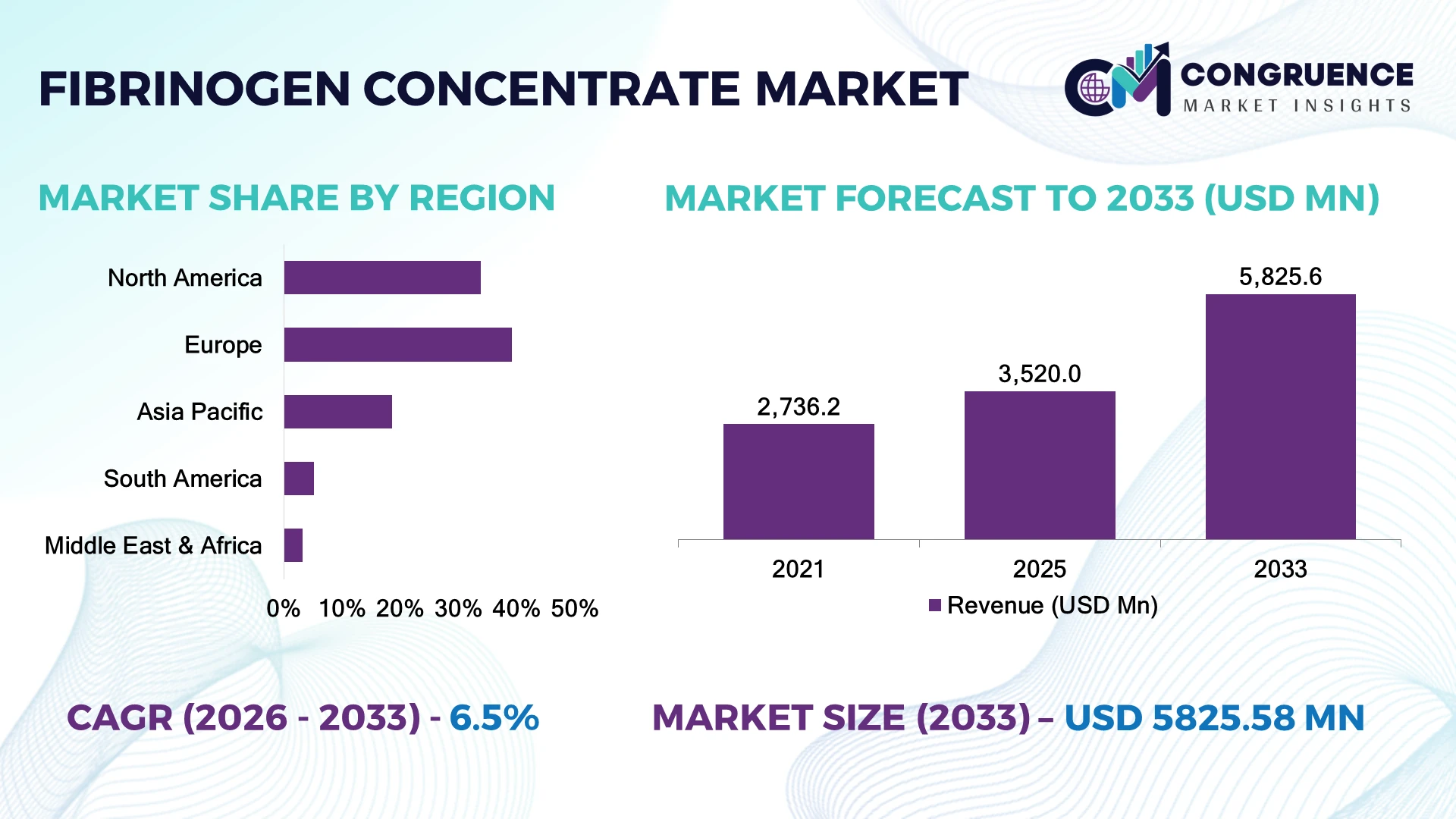
The Global Fibrinogen Concentrate Market was valued at USD 3,520.0 Million in 2025 and is anticipated to reach a value of USD 5,825.6 Million by 2033 expanding at a CAGR of 6.5% between 2026 and 2033. Growth is driven by expanding trauma care protocols, increasing complex surgical procedures, and wider adoption of targeted coagulation therapies across advanced healthcare systems.
Germany accounts for approximately 24% of the European fibrinogen concentrate market, supported by a strong plasma-derived therapeutics manufacturing base, advanced transfusion medicine infrastructure, and continuous investment in hospital modernization. Compared with France, Germany performs over 18% more high-complexity surgical procedures requiring coagulation management, while more than 80% of tertiary hospitals integrate fibrinogen concentrate into patient blood management protocols. The European Union's focus on healthcare resilience has further accelerated strategic plasma product availability across member states.
This positions manufacturers to prioritize regional production capacity, hospital partnerships, and regulatory-aligned product expansion strategies.
Market Size & Growth: USD 3,520.0 Million in 2025, projected to reach USD 5,825.6 Million by 2033 at a CAGR of 6.5%, supported by expanding patient blood management programs.
Top Growth Drivers: Rising trauma admissions (+15%), cardiac surgery volumes (+12%), and plasma fractionation capacity expansion (+10%).
Short-Term Forecast: By 2028, hospital treatment efficiency is expected to improve by nearly 18% through faster bleeding control protocols.
Emerging Technologies: Advanced plasma purification, recombinant coagulation research, and AI-enabled plasma manufacturing optimization accelerate product quality.
Regional Leaders: North America (~USD 2.05 Billion), Europe (~USD 1.78 Billion), and Asia-Pacific (~USD 1.21 Billion) strengthen adoption through healthcare modernization and domestic manufacturing.
Consumer/End-User Trends: More than 70% of leading tertiary hospitals increasingly prefer targeted coagulation concentrates over conventional plasma therapies.
Pilot/Case Example: In 2024, enhanced patient blood management implementation reduced perioperative transfusion requirements by approximately 20% in participating hospitals.
Competitive Landscape: CSL Behring leads with an estimated 30% market share alongside Takeda, Octapharma, LFB Biomedicaments, and Biotest.
Regulatory & ESG Impact: Plasma collection optimization has improved manufacturing utilization by approximately 15% while strengthening supply resilience across major healthcare markets.
Investment & Funding: More than USD 600 Million has been invested globally in plasma processing expansion, strategic partnerships, and manufacturing facilities.
Innovation & Future Outlook: Next-generation recombinant therapies, digital manufacturing, and regional production expansion are strengthening long-term competitive positioning.
The Fibrinogen Concentrate Market is expanding through increasing utilization in trauma management, cardiovascular surgery, liver transplantation, and inherited bleeding disorder treatment. Manufacturers are introducing higher-purity plasma-derived formulations alongside advanced fractionation technologies to improve production consistency. Around 65% of newly commissioned plasma processing investments target capacity enhancement, while healthcare systems continue strengthening domestic plasma supply chains and regulatory preparedness, creating a solid foundation for the market's evolving strategic landscape.
The Fibrinogen Concentrate Market has become strategically important as healthcare systems increasingly prioritize rapid bleeding management, resilient plasma supply chains, and advanced patient blood management programs. Hospitals and manufacturers are strengthening regional production networks while governments encourage greater plasma self-sufficiency to reduce dependence on imported biologics. This shift is reshaping competitive dynamics and investment priorities across the global plasma therapeutics industry.
Modern fibrinogen concentrate therapies provide significantly faster preparation and administration than conventional fresh frozen plasma, reducing treatment preparation time by nearly 40% while supporting more standardized dosing. North America continues to lead in advanced clinical deployment and manufacturing infrastructure, whereas Asia-Pacific is rapidly expanding production capacity through new plasma fractionation facilities and healthcare infrastructure investments. Over the next two to three years, digital manufacturing systems and automated quality control are expected to increase production efficiency by approximately 15%.
Companies are expanding plasma collection networks, entering strategic manufacturing partnerships, and investing in facility modernization to strengthen operational resilience. A growing number of tertiary hospitals are integrating fibrinogen concentrate into standardized perioperative bleeding protocols, improving treatment consistency and inventory management. Organizations that strengthen regional manufacturing capabilities, regulatory readiness, and clinical collaboration will secure stronger competitive positioning and long-term operational advantage.
The widespread adoption of patient blood management (PBM) programs is strengthening fibrinogen concentrate utilization across trauma, cardiac surgery, and obstetric hemorrhage treatment. More than 80% of leading tertiary hospitals in Germany have integrated standardized coagulation management pathways, while targeted fibrinogen therapy has reduced allogeneic plasma use by nearly 30% in selected surgical settings. The European Union's continued emphasis on healthcare preparedness has also accelerated investments in plasma-derived therapeutics manufacturing and strategic stockpiling. This combination of clinical standardization and regulatory alignment improves treatment efficiency and inventory control. Companies are responding by expanding plasma fractionation capacity, strengthening hospital partnerships, and introducing optimized formulations, enabling broader adoption while improving supply reliability across high-acuity healthcare networks.
The market remains constrained by limited plasma collection infrastructure and highly specialized manufacturing requirements. Approximately 70% of plasma used for fractionation originates from a small number of collection markets, creating concentration risk across global supply chains. Processing losses during fractionation can exceed 45%, increasing production complexity and extending manufacturing lead times. Tight donor eligibility regulations in countries such as Germany and Japan further restrict raw material availability, while stringent biological quality standards increase operational costs. Manufacturers are reducing these constraints through long-term plasma procurement agreements, localized collection center expansion, and diversified production footprints. Strengthening upstream supply resilience has become a critical competitive strategy for maintaining uninterrupted therapeutic availability.
Emerging recombinant fibrinogen development and digitally optimized plasma manufacturing create significant opportunities beyond conventional plasma-derived products. AI-enabled production monitoring has demonstrated process efficiency improvements of approximately 15%, while automated quality inspection systems reduce batch deviations by nearly 20%. Japan and Switzerland continue expanding research collaborations focused on recombinant coagulation proteins and advanced bioprocess technologies that reduce dependence on donor-derived plasma. Companies are increasing investment in next-generation biologics, strategic biotechnology partnerships, and digital manufacturing platforms to improve production consistency and regulatory compliance. An emerging strategic advantage lies in combining recombinant innovation with decentralized manufacturing capabilities to strengthen long-term supply security and product differentiation.
Long-term competitiveness depends on maintaining consistent biological quality while expanding production capacity under increasingly stringent regulatory expectations. Validation and qualification activities account for approximately 25% of manufacturing timelines, while advanced biologics facilities require highly specialized technical personnel, with workforce shortages exceeding 18% in several established pharmaceutical hubs. Continuous updates to viral safety requirements and traceability standards increase operational complexity across manufacturing networks. Companies must invest in automated quality control, workforce development, digital batch documentation, and advanced analytical technologies to sustain compliance and operational efficiency. Organizations that successfully integrate manufacturing scalability with regulatory excellence will strengthen supply continuity and secure lasting competitive differentiation.
Hospital Blood Management Expansion: Healthcare providers are integrating fibrinogen concentrate into standardized patient blood management pathways, with adoption increasing by approximately 22% across high-volume surgical centers and treatment protocol compliance exceeding 80% in major European hospitals. Digital transfusion monitoring and multidisciplinary bleeding teams are improving treatment speed while reducing unnecessary plasma utilization by nearly 25%. Manufacturers are expanding clinical training programs and strengthening hospital collaborations to support broader protocol implementation and improve therapeutic consistency.
Plasma Supply Network Optimization: Plasma collection organizations are restructuring procurement and logistics networks after recent supply-chain disruptions, increasing regional plasma collection capacity by nearly 18% while reducing transportation delays by approximately 15%. Germany and the United States continue expanding donor collection infrastructure to improve manufacturing continuity. Companies are investing in localized fractionation facilities, automated inventory management, and long-term plasma sourcing agreements to enhance operational resilience and stabilize production planning.
Advanced Manufacturing Digitalization: Biopharmaceutical manufacturers are accelerating deployment of automated process monitoring, digital batch documentation, and predictive quality analytics. Smart manufacturing platforms have reduced quality deviations by approximately 20% and shortened batch release timelines by nearly 12%. Enterprise-wide digital validation systems are streamlining regulatory compliance while improving production consistency. Companies are expanding automation partnerships and integrating artificial intelligence into manufacturing workflows to strengthen operational efficiency.
Precision Hemostasis Adoption: Clinicians increasingly favor targeted coagulation replacement over generalized plasma transfusion, with fibrinogen-first treatment algorithms improving early intervention rates by approximately 28% and reducing perioperative transfusion requirements by nearly 18%. Healthcare institutions are aligning procurement with evidence-based bleeding management strategies, while manufacturers prioritize higher-purity formulations, clinical evidence generation, and strategic distribution partnerships to strengthen competitive positioning.
The market is segmented into Plasma-Derived Fibrinogen Concentrate and Recombinant Fibrinogen Concentrate. Plasma-derived fibrinogen concentrate remains the dominant segment, accounting for approximately 88% of overall demand due to established clinical acceptance, extensive regulatory approvals, and broad availability across trauma centers, cardiac surgery programs, and hemophilia treatment facilities. Its proven efficacy, mature manufacturing ecosystem, and integration into patient blood management protocols continue to reinforce widespread adoption. Manufacturers are expanding plasma fractionation capacity and strengthening donor collection infrastructure to maintain stable product availability. Recombinant fibrinogen concentrate represents the fastest-growing segment as biotechnology companies advance synthetic coagulation protein platforms that reduce dependence on human plasma. Clinical development programs and manufacturing innovations have accelerated adoption, with recombinant technologies contributing nearly 12% of new pipeline investments. Companies are increasing research partnerships and expanding biologics capabilities to support future commercialization. Investment priorities are gradually shifting toward next-generation recombinant therapies while plasma-derived products continue to dominate current clinical practice.
The market is segmented into Congenital Fibrinogen Deficiency, Acquired Fibrinogen Deficiency, Cardiac Surgery, Trauma, Obstetric Hemorrhage, Liver Surgery, and Others. Cardiac surgery remains the leading application, representing approximately 34% of overall utilization due to high intraoperative bleeding risk and standardized coagulation management pathways. Hospitals increasingly administer targeted fibrinogen replacement to reduce transfusion burden and improve perioperative outcomes. Companies continue expanding clinical education programs and hospital engagement initiatives focused on advanced surgical care. Trauma is the fastest-growing application as emergency care systems adopt earlier coagulation assessment and rapid fibrinogen replacement protocols. Obstetric hemorrhage is also expanding steadily with increasing implementation of patient blood management guidelines, while congenital and acquired fibrinogen deficiency continue generating stable demand through specialized treatment centers. Liver surgery and other complex procedures remain strategically important as precision hemostasis becomes standard clinical practice. Companies are strengthening product availability across emergency medicine, surgical departments, and specialty hospitals to capture expanding procedural demand.
The market is segmented into Hospitals, Specialty Clinics, Ambulatory Surgical Centers, Blood Banks, and Others. Hospitals remain the dominant end-user, accounting for approximately 72% of total consumption because they perform the majority of trauma care, cardiovascular procedures, organ transplantation, and emergency surgeries requiring rapid coagulation management. Their advanced laboratory capabilities, intensive care infrastructure, and established transfusion protocols reinforce purchasing concentration. Manufacturers continue prioritizing hospital contracts, clinical support services, and integrated supply agreements. Ambulatory Surgical Centers represent the fastest-growing end-user segment as minimally invasive procedures continue expanding and outpatient surgical capacity increases. Specialty clinics maintain stable demand for inherited bleeding disorder management, while blood banks play an essential supporting role through plasma processing and inventory coordination. Other healthcare facilities continue adopting fibrinogen concentrate where advanced bleeding management capabilities are developing. Companies are tailoring distribution models, pricing strategies, and clinical training programs to strengthen penetration across emerging healthcare delivery settings while maintaining leadership within hospital networks.
Europe accounted for the largest market share at 39.2% in 2025 however, Asia-Pacific is expected to register the fastest growth, expanding at a CAGR of 7.6% between 2026 and 2033.
North America represented approximately 33.8% of the global market in 2025, supported by extensive trauma center networks, advanced patient blood management programs, and a mature plasma collection ecosystem. The United States continues to dominate regional utilization through high surgical procedure volumes, integrated coagulation management protocols, and strong biopharmaceutical manufacturing capabilities. More than 75% of Level I trauma centers routinely incorporate targeted fibrinogen replacement into severe bleeding management pathways. Expansion of plasma collection facilities and modernization of biologics manufacturing have strengthened supply continuity, while healthcare providers continue standardizing evidence-based transfusion protocols. Companies are investing in production automation, long-term plasma procurement agreements, and strategic distribution partnerships to improve operational resilience and clinical availability across major healthcare systems.
United States Market Outlook: The United States remains the largest national market in North America due to its extensive plasma collection infrastructure, strong biologics manufacturing base, and widespread adoption of patient blood management programs. The country contributes more than 65% of regional plasma collection capacity, while major healthcare systems continue expanding standardized coagulation management protocols. Manufacturers are increasing investment in automated fractionation facilities and strengthening domestic production capabilities to improve long-term supply security and operational efficiency.
Europe led the global market with a 39.2% share in 2025, supported by advanced plasma fractionation infrastructure, well-established patient blood management programs, and broad clinical acceptance of fibrinogen concentrate across tertiary hospitals. The region benefits from strong pharmaceutical manufacturing capabilities, integrated healthcare systems, and harmonized quality standards for plasma-derived therapeutics. More than 80% of leading university hospitals have implemented standardized perioperative coagulation protocols, strengthening consistent product utilization. Continued modernization of plasma processing facilities and expansion of strategic manufacturing capacity are improving production resilience. Companies are focusing on facility upgrades, process optimization, and long-term healthcare partnerships to reinforce regional leadership while ensuring stable product availability across surgical and emergency care settings.
Germany Market Outlook: Germany represents the largest national market in Europe, supported by advanced plasma processing infrastructure, a strong hospital network, and one of the region's highest concentrations of complex surgical procedures. The country accounts for approximately 24% of the European fibrinogen concentrate market, while widespread implementation of patient blood management programs continues to increase clinical utilization. Manufacturers are expanding production capabilities and collaborating with healthcare providers to strengthen domestic supply and innovation.
Asia-Pacific accounted for approximately 18.6% of the global market in 2025 and represents the fastest-expanding regional market due to increasing healthcare infrastructure investments, rising surgical volumes, and expanding access to advanced coagulation therapies. Governments are strengthening plasma collection systems and encouraging domestic biologics manufacturing to reduce import dependency. Hospital capacity expansion and improved emergency care services are driving broader utilization of fibrinogen concentrate. Several pharmaceutical manufacturers are increasing production capabilities through facility expansion and technology upgrades, while healthcare providers continue integrating standardized bleeding management pathways. These developments are strengthening regional supply resilience and accelerating adoption across advanced healthcare institutions.
China Market Outlook: China is emerging as the region's most strategically significant market through continuous expansion of biologics manufacturing, hospital modernization, and government support for plasma-derived therapeutics. More than 40% of newly commissioned plasma processing capacity within Asia-Pacific has been added in China, strengthening domestic production capabilities. Companies continue investing in manufacturing technology, clinical education, and strategic partnerships to improve product accessibility and reduce dependence on imported plasma products.
South America accounted for approximately 5.2% of the global market in 2025, with demand supported by expanding tertiary healthcare infrastructure and gradual implementation of modern patient blood management practices. Large referral hospitals are increasing access to advanced coagulation therapies for trauma, cardiac surgery, and obstetric hemorrhage. Hospital modernization initiatives and procurement improvements are strengthening product availability despite ongoing supply-chain constraints and limited domestic plasma fractionation capacity. Companies are expanding regional distribution partnerships and improving logistics networks to enhance treatment accessibility while supporting healthcare system modernization.
Brazil Market Outlook: Brazil leads the South American market through its extensive hospital network, growing biotechnology sector, and increasing investment in specialized healthcare services. The country performs the highest volume of complex surgical procedures within the region, supporting consistent demand for fibrinogen concentrate. Manufacturers continue expanding partnerships with healthcare institutions and distributors to improve nationwide product availability and strengthen long-term clinical adoption.
Middle East & Africa represented approximately 3.2% of the global market in 2025, supported by increasing investment in tertiary hospitals, trauma centers, and specialized surgical services. Countries across the Gulf region are strengthening healthcare infrastructure while expanding access to advanced biologic therapies through centralized procurement and modernization initiatives. Growth remains concentrated in high-income healthcare systems where advanced coagulation management protocols are increasingly adopted. Companies are strengthening regional distribution networks, expanding clinical education, and improving supply chain coordination to enhance availability across specialized treatment centers.
Saudi Arabia Market Outlook: Saudi Arabia is the leading market within the Middle East & Africa due to significant healthcare infrastructure investments, expanding tertiary hospital capacity, and strong government support for advanced medical technologies. More than 70% of high-complexity surgical procedures are performed within major metropolitan healthcare networks, supporting concentrated demand for fibrinogen concentrate. Manufacturers continue strengthening strategic partnerships with healthcare providers while expanding distribution capabilities to support long-term market development.
The market is led by CSL Behring, Octapharma, Takeda, LFB Biomedicaments, and Biotest, with global plasma therapeutics leaders competing against regional plasma fractionators and specialized biologics manufacturers. The top five companies collectively control approximately 78% of the global market, reflecting high concentration driven by plasma sourcing capabilities and regulatory expertise. Competition centers on manufacturing capacity, product purity, clinical evidence, and plasma collection efficiency rather than price alone. Leading manufacturers achieve 15–20% higher production efficiency through vertically integrated plasma collection networks, while automated fractionation technologies reduce processing variability by nearly 18%. Companies continue expanding plasma donation centers, upgrading manufacturing facilities, pursuing regulatory approvals, and strengthening hospital partnerships to reinforce market access. The competitive landscape is shifting toward supply-chain control and biologics manufacturing integration as plasma availability becomes a strategic differentiator. Strict regulatory requirements, capital-intensive production infrastructure, and limited plasma collection capacity remain major entry barriers. Success depends on securing plasma supply, expanding manufacturing resilience, accelerating clinical innovation, and maintaining regulatory excellence.
Octapharma AG
Takeda Pharmaceutical Company Limited
LFB Biomedicaments
Biotest AG
Kedrion Biopharma
Shanghai RAAS Blood Products Co., Ltd.
Hualan Biological Engineering Inc.
CNBG (China National Biotec Group)
Green Cross Corporation
SK Plasma Co., Ltd.
Japan Blood Products Organization (JBPO)
Digital bioprocessing, advanced plasma fractionation, and real-time quality analytics are transforming fibrinogen concentrate manufacturing. Automated purification systems improve batch consistency by approximately 18%, while digital process monitoring reduces production deviations by nearly 20%. More than 60% of newly upgraded plasma facilities are integrating automated manufacturing execution systems to improve traceability, regulatory compliance, and production planning. These technologies strengthen manufacturing reliability while reducing operational variability across plasma-derived therapeutics.
Emerging technologies focus on recombinant fibrinogen development, artificial intelligence-enabled process optimization, and predictive quality control. Compared with conventional batch monitoring, AI-assisted manufacturing reduces quality review time by approximately 25% and improves production efficiency by nearly 15%. Global plasma leaders with integrated manufacturing capabilities gain the greatest competitive advantage through faster batch release, lower waste generation, and optimized capacity utilization. Digital validation tools are also accelerating regulatory readiness across advanced production facilities.
Between 2026 and 2028, smart manufacturing, continuous analytics, and recombinant biologics development will reshape competitive positioning. Adoption of digital manufacturing platforms is expected to exceed 70% among major plasma processors, improving supply resilience and manufacturing flexibility. Companies investing in automation, recombinant technologies, and integrated plasma collection infrastructure will strengthen operational control, accelerate product availability, and secure long-term differentiation as regulatory expectations and clinical demand continue to evolve.
August 2024 – Octapharma received U.S. FDA approval to expand Fibryga® for acquired fibrinogen deficiency, supported by a 735-patient clinical study, enabling broader hospital adoption and strengthening its critical care portfolio. Source: www.octapharma.com
October 2025 – CSL Behring initiated Phase III patient treatment for RiaSTAP® in acquired fibrinogen deficiency, advancing clinical development while expanding evidence for plasma-derived fibrinogen concentrate across severe bleeding indications. Source: www.investors.csl.com
July 2024 – The U.S. FDA published the approval documentation supporting Fibryga® for acquired fibrinogen deficiency, establishing the product as an approved targeted fibrinogen replacement option and strengthening regulatory confidence for hospital deployment. Source: www.fda.gov
June 2024 – Octapharma presented expanded clinical data on surgical bleeding and coagulation management at ESAIC 2024, reinforcing physician education initiatives and supporting wider adoption of targeted fibrinogen replacement across perioperative care pathways.
This report provides comprehensive analysis of the global fibrinogen concentrate market across product types, clinical applications, end-users, and key geographical markets. It evaluates plasma-derived and recombinant products, covering utilization across congenital and acquired fibrinogen deficiency, trauma, cardiac surgery, obstetric hemorrhage, liver surgery, and additional specialized indications. The study assesses demand across hospitals, specialty clinics, ambulatory surgical centers, blood banks, and other healthcare settings while examining deployment trends, procurement strategies, and evolving clinical practices.
The report delivers detailed regional assessment across Europe, North America, Asia-Pacific, South America, and the Middle East & Africa, supported by country-level operational insights. It analyzes manufacturing technologies, plasma fractionation advancements, digital production systems, recombinant innovation, and competitive positioning across leading market participants. More than 70% of demand remains concentrated within hospital-based care, while advanced manufacturing adoption continues expanding among major producers. The analysis supports strategic investment decisions, product development planning, geographic expansion, competitive benchmarking, partnership evaluation, and long-term business positioning throughout the 2026–2033 forecast period.
| Report Attribute / Metric | Details |
|---|---|
| Market Revenue (2025) | USD 3,520.0 Million |
| Market Revenue (2033) | USD 5,825.6 Million |
| CAGR (2026–2033) | 6.5% |
| Base Year | 2025 |
| Forecast Period | 2026–2033 |
| Historic Period | 2021–2025 |
| Segments Covered |
By Type
By Application
By End-User
|
| Key Deliverables | Revenue Forecast; Market Trends; Growth Drivers & Restraints; Technology Insights; Segmentation Analysis; Regional Insights; Competitive Landscape; Regulatory & ESG Overview; Recent Developments |
| Regions Covered | North America; Europe; Asia-Pacific; South America; Middle East & Africa |
| Companies Profiled | CSL Behring; Octapharma AG; Takeda Pharmaceutical Company Limited; LFB Biomedicaments; Biotest AG; Kedrion Biopharma; Shanghai RAAS Blood Products Co., Ltd.; Hualan Biological Engineering Inc.; China National Biotec Group (CNBG); Green Cross Corporation; SK Plasma Co., Ltd.; Japan Blood Products Organization (JBPO) |
| Customization & Pricing | Available on Request (10% Customization Free) |




