
Reports
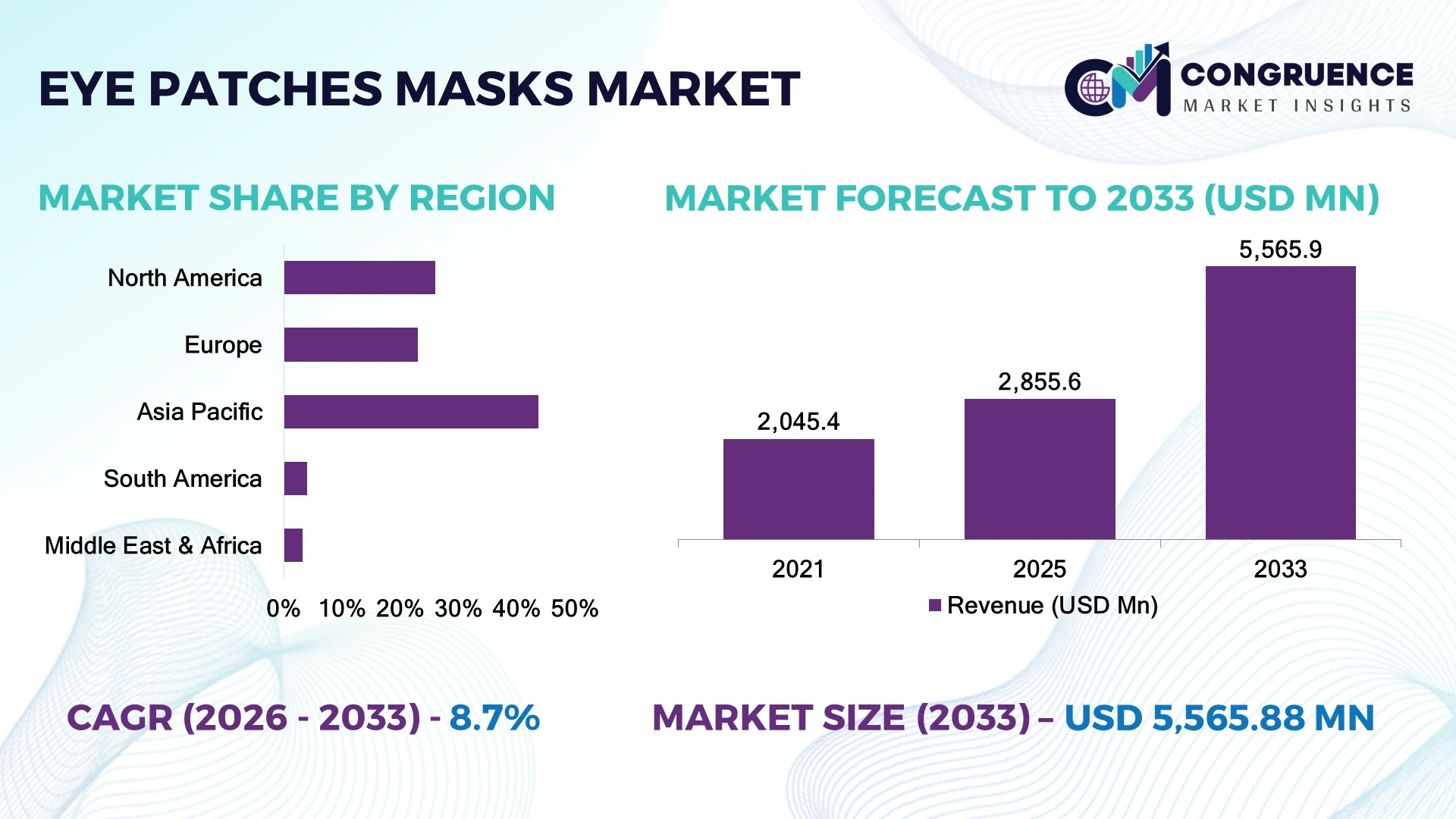
The Global Eye Patches Masks Market was valued at USD 2,855.6 Million in 2025 and is anticipated to reach a value of USD 5,565.9 Million by 2033 expanding at a CAGR of 8.7% between 2026 and 2033. Growth is driven by rising premium skincare adoption, increasing demand for hydrogel-based formulations, expanding anti-fatigue solutions, and continuous innovation in bioactive cosmetic ingredients.
South Korea dominates premium eye patches masks manufacturing with approximately 34% of global production capacity, supported by over USD 2.8 billion in annual skincare innovation investments and strong K-beauty exports. Compared with Japan, South Korea commercializes new hydrogel formulations nearly 25% faster, while advanced peptide-based products account for more than 62% of premium launches. Supply-chain diversification following post-pandemic manufacturing shifts has reinforced regional production resilience.
Manufacturers investing in clinical-grade formulations, sustainable materials, and premium product differentiation are strengthening long-term competitive positioning.
Market Size & Growth: USD 2,855.6 million (2025) to USD 5,565.9 million (2033) at 8.7% CAGR, driven by premium skincare innovation and hydrogel technology.
Top Growth Drivers: Premium skincare (+34%), hydrogel adoption (+28%), e-commerce beauty sales (+25%).
Short-Term Forecast: By 2028, production efficiency improves by 18% while formulation waste declines by 15%.
Emerging Technologies: Bio-cellulose materials, peptide delivery systems, and AI-assisted formulation accelerate product innovation.
Regional Leaders: Asia-Pacific (~USD 2.6 billion), North America (~USD 1.3 billion), Europe (~USD 950 million), supported by premium beauty consumption.
Consumer/End-User Trends: More than 67% of premium skincare buyers prefer multifunctional eye patches with active ingredients.
Pilot/Case Example: A 2026 premium skincare launch improved product hydration performance by nearly 30% through advanced hydrogel technology.
Competitive Landscape: Top five brands account for approximately 42% market share, led by L'Oréal, Shiseido, Estée Lauder, Amorepacific, and Beiersdorf.
Regulatory & ESG Impact: Sustainable packaging adoption reduces plastic usage by approximately 20% across premium product lines.
Investment & Funding: More than USD 3 billion supports premium skincare manufacturing, ingredient innovation, and production expansion.
Innovation & Future Outlook: Personalized skincare formulations and biotechnology-derived ingredients are reshaping premium eye care solutions.
Eye patches masks are experiencing sustained demand across anti-aging, hydration, dark-circle reduction, and post-treatment skincare applications. Hydrogel matrices, encapsulated peptides, and microbiome-friendly formulations are improving ingredient absorption by nearly 22%. Growing sustainability requirements and premium ingredient sourcing are reshaping product development strategies, creating a strong foundation for the strategic market discussion below.
The eye patches masks market has become strategically important as premium skincare brands compete through clinically supported formulations, ingredient innovation, and product differentiation rather than conventional cosmetic positioning. Digital commerce expansion, premium beauty consumption, and localized manufacturing have intensified investment in advanced skincare technologies while encouraging supply-chain diversification for specialty cosmetic ingredients.
Modern hydrogel eye patches improve active ingredient absorption by approximately 25% compared with conventional non-woven sheet masks while reducing application dehydration by nearly 18%. Asia-Pacific leads manufacturing scale through advanced cosmetic production and ingredient innovation, whereas North America emphasizes dermatologist-supported formulations and premium retail positioning. Over the next two to three years, peptide-based and bio-cellulose eye patches are expected to represent more than 55% of premium product launches across major skincare brands.
Manufacturers are integrating biotechnology-derived ingredients, sustainable packaging, and AI-assisted formulation development to strengthen competitive differentiation. Companies continue expanding regional manufacturing, collaborating with dermatology research organizations, and investing in premium ingredient platforms supporting multifunctional skincare products. Businesses combining clinically validated performance, sustainable sourcing, and rapid product innovation will strengthen competitive positioning as premium eye care increasingly shifts toward science-backed and personalized skincare solutions.
Premium skincare brands are expanding clinically inspired eye patches masks featuring peptides, hyaluronic acid, niacinamide, and collagen complexes to address hydration, dark circles, and anti-aging concerns. More than 64% of new premium eye care launches now incorporate multifunctional active ingredients, while hydrogel-based formats improve ingredient absorption by approximately 25% and increase repeat purchase rates by nearly 18%. South Korea continues leading cosmetic formulation innovation through rapid commercialization of advanced skincare technologies. This shift is encouraging manufacturers to expand premium product portfolios, invest in biotechnology-derived ingredients, and collaborate with dermatology research specialists. Companies delivering clinically differentiated formulations are strengthening brand loyalty while capturing higher-margin premium skincare segments.
Dependence on premium cosmetic ingredients such as marine collagen, bioactive peptides, and pharmaceutical-grade hyaluronic acid continues creating procurement uncertainty for manufacturers. Raw material costs for selected active ingredients fluctuate by approximately 20%, while imported specialty ingredients account for nearly 38% of premium eye patch formulations. Japan and South Korea remain important sourcing hubs, making manufacturers vulnerable to logistics disruptions and ingredient availability fluctuations. Rising formulation costs directly pressure product margins and limit pricing flexibility within competitive retail channels. Companies are responding through diversified ingredient sourcing, localized contract manufacturing, long-term procurement agreements, and increased investment in plant-derived alternatives to improve supply resilience and cost stability.
AI-assisted skin analysis, customized formulations, and biotechnology-based cosmetic ingredients are creating new opportunities beyond conventional beauty products. Personalized skincare recommendations improve product conversion rates by approximately 24%, while encapsulated active ingredient technologies increase formulation stability by nearly 19%. South Korea is expanding digital beauty platforms that integrate diagnostic technologies with personalized skincare purchasing, encouraging wider adoption of customized eye care products. Manufacturers are investing in AI-enabled product development, microbiome-friendly ingredients, and strategic partnerships with beauty technology companies. An emerging opportunity lies in subscription-based premium skincare ecosystems that combine personalized recommendations with recurring product delivery and customer retention.
Maintaining consumer confidence increasingly depends on scientifically validated product performance and regulatory compliance across multiple international markets. Nearly 32% of premium skincare buyers actively evaluate efficacy claims before purchasing, while inconsistent testing methodologies delay international product launches by approximately 17%. The European Union continues strengthening cosmetic ingredient transparency and product claim requirements, increasing documentation complexity for manufacturers. These challenges affect commercialization speed, international expansion, and premium brand positioning rather than production capacity. Companies must invest in dermatological testing, standardized efficacy protocols, regulatory expertise, and transparent ingredient communication to strengthen long-term market credibility and sustain premium consumer confidence.
Bio-Cellulose Material Expansion: Premium skincare brands are replacing conventional sheet materials with bio-cellulose and advanced hydrogel substrates, improving moisture retention by approximately 28% while increasing skin adherence by nearly 20%. Sustainability initiatives are accelerating material innovation. Manufacturers are scaling production and strengthening biotechnology partnerships to improve premium product performance.
Functional Ingredient Concentration: Eye patches increasingly incorporate peptides, ceramides, caffeine, and fermented botanical extracts to deliver multiple skincare benefits within a single application. Multifunctional formulations now represent nearly 60% of premium product launches and improve consumer repurchase rates by approximately 18%. Companies are expanding clinical formulation capabilities and premium ingredient sourcing to strengthen product differentiation.
Sustainable Packaging Transition: Cosmetic manufacturers are reducing single-use plastic through recyclable packaging, biodegradable trays, and refill-oriented product concepts. Packaging material consumption has declined by approximately 16%, while consumer preference for environmentally responsible skincare exceeds 55% in premium retail channels. Companies are restructuring packaging supply chains and increasing investment in sustainable material innovation.
Digital Beauty Commerce Growth: AI-powered skincare recommendations, virtual consultations, and direct-to-consumer platforms are transforming premium eye care purchasing. Digital channels now contribute more than 45% of premium skincare sales in several developed markets while personalized recommendations improve customer conversion by approximately 21%. Brands are expanding digital engagement, integrating consumer analytics, and strengthening omnichannel retail strategies to accelerate premium market penetration.
Hydrogel eye patches represent the leading product type, accounting for approximately 48% of the global market due to superior skin adherence, enhanced hydration, and efficient delivery of active ingredients such as peptides, hyaluronic acid, and collagen. Their cooling effect and premium positioning have strengthened adoption across anti-aging and intensive skincare routines. Non-woven eye patches continue serving mass-market consumers because of lower manufacturing costs and broad retail availability, while bio-cellulose eye patches are gaining strategic relevance through higher biocompatibility and sustainable material innovation.
Bio-cellulose eye patches are the fastest-growing segment as premium skincare brands prioritize natural materials and clinically supported performance. Adoption of bio-based cosmetic substrates has increased by nearly 24%, while hydrogel formulations improve active ingredient absorption by approximately 25%. Manufacturers are investing in biotechnology-derived materials, expanding premium product portfolios, and forming ingredient partnerships to develop multifunctional skincare solutions. Investment is steadily shifting toward advanced substrate technologies that combine efficacy, sustainability, and premium consumer appeal while strengthening product differentiation.
Industry observations released during 2026 by Cosmetic Europe indicate that premium skincare manufacturers continue expanding hydrogel and bio-based facial care formats as clinically supported formulations become increasingly important across high-value cosmetic product launches.
Anti-aging applications account for approximately 46% of global demand as consumers increasingly seek products that reduce fine lines, puffiness, and dark circles while improving skin hydration. Premium eye patches featuring peptides, collagen, and antioxidant complexes dominate this segment because of their multifunctional skincare benefits. Hydration and skin recovery applications continue representing mature demand across daily skincare routines, while post-procedure cosmetic care is emerging as an important niche supported by dermatologist-recommended formulations and soothing hydrogel technologies.
Dark-circle reduction and recovery treatments are the fastest-growing application as digital lifestyles and sleep-related skin concerns increase demand for targeted under-eye care. Premium treatment formulations have expanded by nearly 27%, while multifunctional products improve consumer retention by approximately 19%. Manufacturers are responding by integrating encapsulated active ingredients, AI-supported formulation development, and clinically tested botanical extracts into premium product lines. Demand continues shifting toward scientifically differentiated skincare products delivering multiple cosmetic benefits through a single application.
A 2025 enterprise skincare assessment published by Cosmetic Europe highlighted continued expansion of multifunctional facial skincare products incorporating clinically supported hydration, anti-aging, and skin recovery technologies across premium cosmetic categories.
Women remain the dominant end-user segment, accounting for approximately 71% of global demand due to higher premium skincare spending, broader product adoption, and greater participation in preventive anti-aging routines. Frequent product usage, growing awareness of active skincare ingredients, and increasing preference for multifunctional cosmetic solutions continue supporting sustained demand. Men represent an expanding consumer segment as premium grooming awareness improves, while professional beauty clinics and spas continue strengthening institutional purchases through premium treatment protocols and post-procedure skincare applications.
Male consumers are emerging as the fastest-growing end-user group, with premium skincare adoption increasing by nearly 23% and online purchases of eye care products expanding by approximately 21%. Cosmetic brands are responding through gender-neutral packaging, customized formulations, digital marketing strategies, and dermatologist-inspired product positioning. Companies are also strengthening partnerships with beauty retailers, online marketplaces, and aesthetic clinics to expand customer reach while reinforcing premium brand positioning across evolving consumer demographics.
A 2026 industry review published by Cosmetic Europe noted that premium skincare purchasing continues expanding across both female and male consumer segments, supported by stronger demand for multifunctional products and clinically validated cosmetic formulations.
Asia-Pacific accounted for the largest market share at 43.7% in 2025 however, Middle East & Africa is expected to register the fastest growth, expanding at a CAGR of 9.4% between 2026 and 2033.
Premium Skincare Innovation Drives Product Differentiation
North America accounts for approximately 26% of the global eye patches masks market, supported by high consumer spending on premium skincare, dermatologist-endorsed products, and expanding omnichannel beauty retail. Clinical formulations, biotechnology-derived ingredients, and personalized skincare solutions are strengthening demand across premium cosmetic brands. More than 58% of premium eye care product launches now incorporate multifunctional active ingredients designed for hydration, anti-aging, and skin recovery. Manufacturers continue expanding local formulation capabilities, strengthening retail partnerships, and integrating AI-driven consumer analytics to accelerate product innovation while improving inventory planning and direct-to-consumer engagement.
United States Market Outlook: The United States leads the regional market through its mature premium beauty industry, advanced cosmetic research ecosystem, and strong digital retail infrastructure. Premium skincare brands continue investing in clinically validated formulations, sustainable packaging, and biotechnology-based ingredients to strengthen competitive positioning. More than 45% of premium skincare purchases now occur through digital commerce platforms, encouraging companies to expand direct-to-consumer strategies, personalized product recommendations, and subscription-based skincare programs.
Clean Beauty Standards Shape Product Development
Europe represents approximately 23% of the global market, supported by increasing demand for clean-label cosmetics, sustainable packaging, and scientifically validated skincare formulations. Premium beauty companies are emphasizing naturally derived ingredients, biodegradable substrates, and transparent formulation practices to comply with evolving consumer expectations. More than 50% of newly introduced premium eye patches in the region incorporate vegan or naturally sourced active ingredients. Manufacturers continue strengthening formulation research, ingredient traceability, and environmentally responsible production while expanding premium skincare portfolios.
France Market Outlook: France remains the leading European market through its established cosmetics industry, luxury skincare expertise, and advanced product development capabilities. Cosmetic manufacturers continue investing in premium active ingredients, dermatological testing, and environmentally responsible packaging technologies. The country's strong innovation ecosystem supports rapid commercialization of multifunctional skincare products while reinforcing premium positioning across domestic and international beauty markets.
Manufacturing Scale Supports Global Leadership
Asia-Pacific leads the global market with approximately 43.7% share, driven by strong cosmetic manufacturing capabilities, premium skincare innovation, and expanding regional beauty consumption. South Korea, China, and Japan remain central to hydrogel technology development, advanced formulation research, and large-scale contract manufacturing. More than 65% of premium hydrogel eye patch production originates from manufacturers across the region. Companies continue expanding automated production facilities, strengthening ingredient research, and increasing export-oriented manufacturing to support growing global demand for premium skincare products.
South Korea Market Outlook: South Korea dominates the regional market through its globally recognized K-beauty ecosystem, rapid cosmetic innovation, and advanced hydrogel manufacturing capabilities. Premium skincare companies continuously introduce peptide-rich, collagen-based, and biotechnology-derived eye patches supported by high-speed product development. Automated cosmetic manufacturing, strong research investment, and global export networks continue strengthening the country's leadership in premium eye care innovation and international product commercialization.
Premium Beauty Consumption Expands Regionally
South America continues strengthening its market position through rising premium skincare awareness, expanding organized beauty retail, and increasing demand for multifunctional cosmetic products. Brazil and Colombia remain important consumption centers where consumers increasingly prefer hydration-focused and anti-aging eye care products. Premium skincare penetration has increased by approximately 18% across urban retail channels, encouraging manufacturers to expand localized distribution and product portfolios. Companies are strengthening partnerships with beauty retailers, regional distributors, and e-commerce platforms while balancing import dependency and price-sensitive consumer demand.
Brazil Market Outlook: Brazil represents the largest market in the region due to its extensive cosmetics industry, large beauty consumer base, and expanding premium skincare adoption. Domestic manufacturers continue introducing localized formulations designed for tropical climates while strengthening digital retail strategies and premium product positioning. Beauty companies are investing in advanced formulations and sustainable packaging to improve competitiveness within both domestic and regional markets.
Luxury Beauty Investments Accelerate Market Expansion
The Middle East & Africa is emerging as the fastest-growing regional market as premium beauty retail, luxury skincare consumption, and international cosmetic brand expansion continue accelerating. Consumers increasingly prefer dermatologist-inspired formulations and multifunctional eye care products featuring premium active ingredients. More than 30% of newly introduced premium skincare products across Gulf retail channels include advanced hydrogel or bio-cellulose technologies. Cosmetic companies are strengthening regional partnerships, expanding localized distribution, and investing in premium retail experiences to improve market penetration and consumer engagement.
United Arab Emirates Market Outlook: The United Arab Emirates leads the regional market through its premium beauty retail ecosystem, luxury consumer base, and strong international cosmetic brand presence. High purchasing power and advanced retail infrastructure continue supporting rapid adoption of premium eye patches masks featuring clinically supported formulations. Companies are expanding flagship retail stores, omnichannel distribution, and exclusive product launches while using the country as a strategic hub for broader Middle East market expansion.
The market is moderately consolidated, with the top five brands controlling approximately 42% of global sales. L'Oréal, Shiseido, Estée Lauder, Amorepacific, and Beiersdorf compete through premium formulations and dermatological innovation, while regional K-beauty manufacturers compete with cost-efficient launches and rapid product cycles. Competition increasingly focuses on ingredient efficacy, formulation science, and brand differentiation rather than price alone. Hydrogel technologies improve ingredient absorption by approximately 25%, AI-assisted formulation shortens development cycles by nearly 18%, and localized manufacturing reduces supply lead times by around 15%. Leading companies are expanding production capacity, acquiring biotechnology expertise, strengthening retail partnerships, and vertically integrating premium ingredient sourcing. The competitive landscape is shifting toward clinically validated skincare supported by sustainable packaging and personalized beauty technologies. Regulatory compliance, ingredient validation, and premium brand credibility remain major entry barriers. Winning requires continuous formulation innovation, scientific validation, agile supply chains, premium consumer engagement, and differentiated skincare performance.
L'Oréal S.A.
Shiseido Company, Limited
The Estée Lauder Companies Inc.
Amorepacific Corporation
Beiersdorf AG
Kao Corporation
KOSÉ Corporation
LG Household & Health Care Ltd.
Peter Thomas Roth Labs LLC
Pixi Beauty
Patchology
Peace Out Skincare
Eye patches masks are advancing through hydrogel engineering, bio-cellulose substrates, encapsulated active ingredients, and precision ingredient delivery technologies. Modern hydrogel formulations improve active ingredient absorption by approximately 25% while increasing moisture retention by nearly 22% compared with conventional non-woven patches. More than 60% of newly launched premium eye patches now incorporate peptide complexes, hyaluronic acid, or ceramide-based formulations supported by clinically inspired product development. Companies integrating advanced biomaterials with formulation science achieve stronger premium positioning and higher consumer retention.
Emerging technologies include microencapsulation, fermented biotechnology ingredients, AI-assisted formulation development, and microbiome-compatible skincare systems. Encapsulated delivery platforms improve ingredient stability by approximately 20%, while bio-cellulose substrates enhance skin adhesion by nearly 18%. Compared with traditional fabric eye patches, advanced hydrogel technologies deliver approximately 24% higher hydration efficiency through prolonged ingredient release. Premium skincare brands with biotechnology capabilities benefit from stronger product differentiation, faster innovation cycles, and improved consumer confidence supported by clinically validated cosmetic performance.
Between 2026 and 2028, personalized skincare platforms, smart ingredient screening, and biotechnology-derived cosmetic actives will reshape premium eye care innovation. More than 55% of premium eye patch launches are expected to feature multifunctional formulations combining hydration, anti-aging, and skin barrier support. Manufacturers investing in sustainable biomaterials, digital consumer diagnostics, and advanced formulation research will strengthen premium market leadership, improve product performance, and capture growing demand for science-backed skincare solutions.
April 2025 – Dior Beauty introduced Les Patchs Yeux, a dual-layer hydrogel eye patch featuring high- and low-molecular-weight hyaluronic acid, niacinamide, and caffeine. The product delivers an immediate 4.5°C cooling effect after a 10-minute application, strengthening premium eye care innovation.
December 2025 – Shiseido developed an advanced Second Skin base technology that reduced under-eye bag volume after two weeks of continuous use by combining contractile film technology with collagen-stimulating mechanisms. The innovation reinforces clinically supported premium skincare development. Source: Shiseido (Shiseido Corporation)
January 2025 – Beiersdorf expanded its hydrocolloid-based Second Skin Protection platform across multiple international markets, strengthening advanced skin technology expertise and consumer education around next-generation skin barrier solutions. The launch supports broader biomaterial innovation applicable across premium skincare categories. Source: Beiersdorf (Beiersdorf)
January 2026 – TOPICALS introduced its limited-edition Faded Eye Masks through a strategic consumer collaboration, expanding premium hydrogel eye mask visibility while reinforcing multifunctional brightening and depuffing positioning. The launch strengthened direct-to-consumer engagement and premium skincare brand differentiation.
This report provides a comprehensive assessment of the global eye patches masks market across product types, applications, end-user segments, and major regional markets. It evaluates hydrogel, bio-cellulose, non-woven, and other eye patch technologies used for anti-aging, hydration, dark-circle reduction, post-procedure care, and multifunctional skincare applications. The analysis covers North America, Europe, Asia-Pacific, South America, and the Middle East & Africa while examining adoption trends, premium product positioning, ingredient innovation, and competitive developments across more than 12 leading skincare companies.
The report analyzes advanced hydrogel technologies, biotechnology-derived ingredients, encapsulated active delivery systems, sustainable packaging innovations, and digital beauty integration shaping market evolution between 2026 and 2033. It delivers segmentation analysis, regional performance assessment, technology benchmarking, and competitive intelligence while highlighting premium skincare adoption, manufacturing expansion, personalized beauty solutions, and emerging niche opportunities. The findings support investment planning, product portfolio optimization, geographic expansion strategies, partnership evaluation, competitive positioning, and long-term business decision-making across the global premium skincare industry.
| Report Attribute/Metric | Report Details |
|---|---|
|
Market Revenue in 2025 |
USD 2,855.6 Million |
|
Market Revenue in 2033 |
USD 5,565.9 Million |
|
CAGR (2026 - 2033) |
8.7% |
|
Base Year |
2025 |
|
Forecast Period |
2026 - 2033 |
|
Historic Period |
2021 - 2025 |
|
Segments Covered |
By Type
By Application
By End-User
|
|
Key Report Deliverable |
Revenue Forecast, Growth Trends, Market Dynamics, Segmental Overview, Regional and Country-wise Analysis, Competition Landscape |
|
Region Covered |
North America, Europe, Asia-Pacific, South America, Middle East, Africa |
|
Key Players Analyzed |
L'Oréal S.A., Shiseido Company, Limited, The Estée Lauder Companies Inc., Amorepacific Corporation, Beiersdorf AG, Kao Corporation, KOSÉ Corporation, LG Household & Health Care Ltd., Peter Thomas Roth Labs LLC, Pixi Beauty, Patchology, Peace Out Skincare |
|
Customization & Pricing |
Available on Request (10% Customization is Free) |




