
Reports
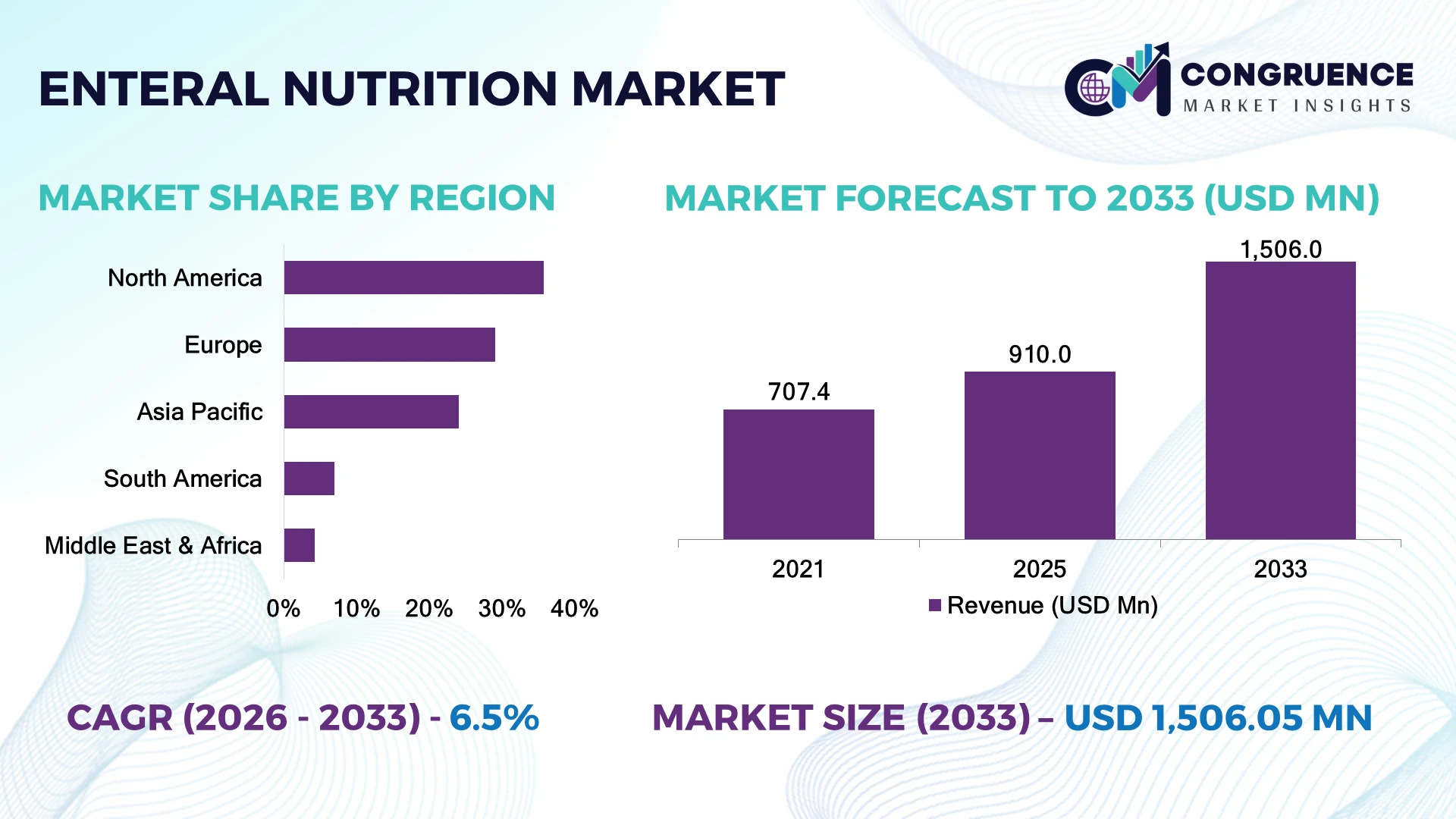
The Global Enteral Nutrition Market was valued at USD 910.0 Million in 2025 and is anticipated to reach a value of USD 1,506.0 Million by 2033 expanding at a CAGR of 6.5% between 2026 and 2033. Growth is driven by the shift toward disease-specific formulas, home-based tube feeding, and digitally supported nutrition delivery for patients with cancer, neurological disorders, gastrointestinal conditions, and age-related dysphagia.
The United States remains the dominant country market, accounting for 79.9% of North American enteral feeding-formula revenue in 2024, while tube-feeding products represented 64.57% of U.S. enteral-nutrition demand in 2025. China held 27.2% of Asia-Pacific enteral-feeding-device share in 2025, supported by expanding domestic manufacturing and healthcare infrastructure. The shift toward home care is strengthening adoption beyond hospitals.
The strategic priority is to combine localized supply, specialized formulations, and connected feeding technologies to strengthen clinical positioning and reduce delivery friction.
Market Size & Growth: USD 910.0 Million in 2025 to USD 1,506.0 Million by 2033 at 6.5% CAGR, supported by specialized nutrition and home-care adoption.
Top Growth Drivers: Chronic disease management 30%+, home-care adoption 20%+, and disease-specific nutrition 15%+ are key demand accelerators.
Short-Term Forecast: By 2028, home-care utilization is positioned for measurable expansion as post-discharge nutrition pathways and remote support become more integrated.
Emerging Technologies: AI-guided nutrition planning, smart feeding pumps, and high-protein peptide formulas are moving enteral care toward personalized and data-supported delivery.
Regional Leaders: North America leads at 37.7%, Europe holds 27.6%, and Asia Pacific reaches 24.6%; Asia Pacific is strengthening home-care and local manufacturing adoption.
Consumer/End-User Trends: Hospitals accounted for 56.12% of U.S. demand in 2025, while home-care settings are projected to expand at 5.77% through 2031.
Pilot/Case Example: In 2025, DeepEN analyzed more than 11,000 ICU patients and reduced estimated mortality by 3.7 percentage points versus its comparator.
Competitive Landscape: North America leads the global market at approximately 37.7%, with Abbott, Nestlé Health Science, Fresenius Kabi, Danone, and B. Braun among major competitive participants.
Regulatory & ESG Impact: ISO 80369-3 connector adoption remains uneven, with only 38.9% of pediatric and 29.7% of adult survey participants using the newer connector standard, increasing interoperability pressure.
Investment & Funding: Nestlé Health Science expanded university partnerships across 3 institutions in 2025 to accelerate nutrition science, startup development, and product innovation.
Innovation & Future Outlook: Advanced pediatric, disease-specific, peptide-based, and personalized nutrition solutions are shifting competition toward clinical outcomes, formulation precision, and ecosystem partnerships.
Enteral Nutrition is increasingly moving toward specialized formulations for oncology, gastrointestinal disorders, diabetes, pediatric care, and healthy aging. Disease-specific products are gaining traction as clinical nutrition becomes more personalized, while home-based delivery is expanding beyond traditional hospital settings. Abbott's 2025 reformulation of Ensure Diabetes Care, featuring 4X higher myo-inositol, illustrates the shift toward condition-specific nutritional solutions.
Enteral nutrition is becoming strategically important as healthcare systems shift nutritional support from hospital-centered treatment toward specialized, continuous, and home-based care. In the United States, hospitals represented 56.12% of demand in 2025, while home-care settings are positioned for faster expansion, creating opportunities for manufacturers that integrate formulas, devices, training, and monitoring into broader care pathways.
Technology is accelerating this transition. AI-supported nutrition planning can individualize caloric, protein, and fluid recommendations, while smart feeding pumps improve controlled administration compared with conventional manual protocols. DeepEN's analysis of more than 11,000 ICU cases produced a 3.7-percentage-point reduction in estimated mortality, illustrating the potential operational value of data-driven nutrition management.
Regional strategies differ sharply: North America benefits from mature reimbursement and hospital infrastructure, whereas China and India are emphasizing domestic manufacturing and broader healthcare access. Companies are responding through university partnerships, localized supply chains, specialized formulas, and digital tools. Fresenius Kabi's 2025 RNI tool enables clinicians to compare up to four enteral regimens simultaneously, while Nestlé expanded partnerships with three universities. Competitive advantage will increasingly depend on clinical precision, deployment efficiency, and resilient care ecosystems.
Disease-specific nutrition is strengthening enteral-product utilization as hospitals manage more complex oncology, neurological, gastrointestinal, and geriatric cases. Tube feeding products represented 64.57% of U.S. enteral-nutrition demand in 2025, while adults accounted for 52.71%, reinforcing the importance of high-acuity and chronic-care pathways. Abbott's 2025 Ensure Diabetes Care reformulation, featuring 4X higher myo-inositol and a low-glycemic carbohydrate blend, demonstrates the shift toward condition-specific formulations. Companies are responding through formulation R&D and disease-focused portfolios, while healthcare providers increasingly favor products that combine nutritional density with targeted metabolic support. The non-obvious advantage is that specialized formulas can improve product differentiation without relying solely on volume expansion.
Enteral nutrition remains constrained by supply complexity, specialized-formula costs, and inconsistent device standards. A 2024 home-enteral survey found legacy connectors were still used by 46.7% of children and 52.6% of adults, despite the availability of ISO 80369-3 connectors. This interoperability gap increases training requirements, connector-management complexity, and the risk of procurement fragmentation across hospitals and home-care providers. In the United States, hospitals represented 56.12% of demand in 2025, intensifying pressure for dependable institutional supply and standardized products. Companies are mitigating exposure through broader supplier networks, standardized device platforms, and longer procurement agreements. The key operational constraint is not formula availability alone but maintaining compatibility across the entire feeding pathway.
Personalized enteral nutrition creates a high-value opportunity as clinical teams seek more precise feeding decisions. DeepEN processed more than 11,000 ICU patient records and generated 4-hourly recommendations for caloric, protein, and fluid intake, achieving a 3.7-percentage-point reduction in estimated mortality versus its comparator. Asia Pacific also presents significant deployment potential, with China holding 27.2% of the region's enteral-feeding-device market in 2025 and local manufacturing improving accessibility. Companies can capitalize through AI-enabled clinical decision support, smart pumps, remote monitoring, and partnerships with hospitals or digital-health providers. The strongest opportunity lies in linking formula selection with patient monitoring rather than selling nutrition products as standalone consumables.
Expanding enteral nutrition into home settings creates execution challenges involving caregiver training, monitoring, device compatibility, and clinical escalation. A 2024 survey of 884 home-enteral participants found tube-related complications remained prevalent, while only 38.9% of children and 29.7% of adults used ISO 80369-3 connectors. This creates a long-term requirement for standardized equipment, digital education, and responsive clinical support. Asia Pacific adds another layer of complexity because procurement and infrastructure maturity differ substantially between China, India, Japan, and Australia. Companies are therefore investing in connected devices, clinician-support platforms, localized manufacturing, and provider partnerships. The strategic challenge is to scale home nutrition without transferring operational complexity from hospitals to caregivers; standardized workflows and interoperable devices are becoming essential competitive assets.
Home-Care Feeding Expansion: Home enteral nutrition is moving beyond discharge support into structured long-term care, with home-based use exceeding 30% of category volume in 2025 compared with under 20% in 2015. U.S. home-care utilization is also expanding faster than hospital demand, prompting suppliers to strengthen caregiver education, refill logistics, and remote monitoring rather than relying only on institutional procurement.
Disease-Specific Formula Shift: Standard/polymeric formulas still represented 56.81% of U.S. formula demand in 2025, but disease-specific products are gaining strategic importance as oncology, diabetes, renal, and gastrointestinal patients require targeted nutritional profiles. Specialty formulations command roughly 40%–60% price premiums over standard formulas, encouraging manufacturers to redirect R&D toward higher-value clinical nutrition portfolios.
Interoperability Becomes Operational: Enteral feeding workflows are increasingly shaped by connector standardization and device-safety requirements. A home-enteral survey found legacy connectors remained in use among 46.7% of children and 52.6% of adults, versus ISO 80369-3 adoption of only 38.9% and 29.7%, respectively. Companies are responding with standardized components and compatibility-focused device portfolios.
AI Enters Clinical Workflows: AI-supported nutrition planning is moving from research into intensive-care decision support, with emerging systems processing thousands of patient records to optimize caloric, protein, and fluid delivery. One 2025 analysis covered more than 11,000 ICU patients and reported a 3.7-percentage-point improvement in estimated mortality. Suppliers are increasingly pairing digital decision tools with smart pumps and connected monitoring.
Standard/polymeric formulas remain the leading type, accounting for approximately 50%–57% of the market, because they provide complete nutrition, broad clinical applicability, established hospital-formulary acceptance, and comparatively efficient procurement. In the United States, standard/polymeric formulas represented 56.81% of formula demand in 2025. Their established use across acute care, long-term care, and home feeding gives manufacturers predictable volume and strong distribution economics.
Disease-specific formulas represent the fastest-moving strategic category as diabetes, oncology, renal, and gastrointestinal care increasingly require targeted nutritional profiles. Elemental and peptide-based formulas retain specialized relevance where digestion or absorption is compromised, but their narrower clinical use limits volume compared with standard products. Disease-specific formulations can command 40%–60% premiums, shifting investment toward clinical differentiation rather than basic formulation scale. Companies are expanding condition-specific portfolios and strengthening hospital and home-care partnerships to capture premium demand.
Gastrointestinal disorders represent the leading application, accounting for approximately 40% of global application demand, supported by short-bowel syndrome, inflammatory bowel disease, malabsorption, and pancreatic insufficiency. The concentration reflects the direct relationship between impaired gastrointestinal function and the need for controlled nutritional delivery. Oncology is another major application, while neurological disorders continue gaining importance as stroke, neurodegenerative disease, and swallowing impairment increase long-term tube-feeding requirements.
Oncology is positioned among the fastest-strengthening applications, supported by nutritional complications during cancer treatment and the movement of feeding support into ambulatory and home settings. Neurology also benefits from extended post-discharge nutritional requirements, while hypermetabolism remains concentrated in high-acuity clinical environments. Companies are adapting through disease-specific formulas, higher-protein products, and application-focused clinical support. The business implication is a shift from broad nutritional coverage toward indication-specific portfolios that improve clinical differentiation and pricing power.
Hospitals remain the dominant end-user, representing approximately 56.12% of U.S. enteral-nutrition demand in 2025. Their leadership reflects high-acuity patients, intensive-care procurement, surgery, oncology treatment, and established nutrition-support protocols. Long-term care facilities form a stable secondary channel because older and chronically ill residents require sustained nutritional support. Hospital purchasing also gives established suppliers an advantage through formulary placement, standardized protocols, and recurring procurement.
Home care is the fastest-growing end-user category as patients increasingly continue enteral feeding after discharge. U.S. home-care demand is projected to expand at 5.77%, supported by post-surgical, oncology, neurological, and chronic-care requirements. This shift changes the buying model: companies must address caregiver usability, supply continuity, reimbursement documentation, and remote support rather than only institutional purchasing. Companies are therefore expanding home-delivery networks, education programs, connected feeding equipment, and provider partnerships, while long-term care suppliers emphasize standardized formulations and dependable recurring supply.
North America accounted for the largest market share at 35.7% in 2025 however, Asia-Pacific is expected to register the fastest growth, expanding at a CAGR of 6.43% between 2026 and 2033.
North America accounted for 35.7% of the global Enteral Nutrition Market in 2025, maintaining its leading position through mature hospital infrastructure, established reimbursement systems, and extensive home-enteral care networks. The United States represents the principal demand center, with hospitals accounting for approximately 56.1% of national enteral nutrition utilization and tube-feeding products representing about 64.6% of demand. High adoption of specialized formulas, portable feeding pumps, and digital monitoring is shifting procurement toward integrated nutrition-care solutions. Companies are expanding home-delivery networks, strengthening hospital partnerships, and investing in disease-specific formulations. The region's operational advantage lies in its ability to move patients from inpatient feeding to structured home nutrition without disrupting product supply or clinical monitoring.
United States Market Outlook: The United States represents the dominant country within North America, supported by advanced clinical nutrition infrastructure, large hospital networks, strong reimbursement coverage, and high home-care adoption. Hospitals accounted for approximately 56.1% of national demand in 2025, while specialized nutrition programs continue expanding across oncology, neurological, gastrointestinal, and post-acute care pathways. Manufacturers are prioritizing connected pumps, ready-to-use formulas, and home-care distribution.
Europe accounted for 29.0% of the global Enteral Nutrition Market in 2025, supported by mature healthcare systems, established clinical nutrition protocols, aging populations, and broad access to hospital and home-care services. Germany, the United Kingdom, France, Italy, and Spain represent the principal demand centers, with Germany contributing approximately 32.2% of European medical clinical nutrition demand. Standardized enteral formulas continue to dominate routine applications, while disease-specific and peptide-based formulations are gaining importance in complex cases. Regulatory harmonization and medical-device standardization are improving cross-border procurement, while healthcare systems are increasingly shifting nutritional support toward lower-cost home settings. Companies are responding through interoperable feeding systems, specialized formulations, local partnerships, and expanded home-delivery capabilities.
Germany Market Outlook: Germany is Europe's leading strategic market, supported by sophisticated hospital infrastructure, structured reimbursement through sickness funds, and strong clinical nutrition capabilities. The country represented approximately 32.2% of European medical clinical nutrition demand in 2025. Its established procurement environment provides manufacturers with a strong platform for introducing advanced enteral formulas, feeding pumps, and standardized home-care solutions.
Asia-Pacific accounted for 24.0% of the global Enteral Nutrition Market in 2025 and represents the fastest-growing major regional market. China and India are the principal expansion engines, supported by healthcare infrastructure development, rising chronic-disease prevalence, expanding hospital capacity, and increasing awareness of clinical nutrition. China accounted for approximately 40.9% of Asia-Pacific enteral feeding-device demand in 2025, while India is strengthening its position through localized medical-device manufacturing and cost-efficient procurement. Feeding pumps represented approximately 40.3% of Asia-Pacific device demand, highlighting increasing preference for controlled nutritional delivery. Companies are responding through domestic manufacturing, technology partnerships, localized distribution, and connected feeding platforms. The key strategic advantage is the region's combination of large patient pools and increasingly sophisticated healthcare infrastructure.
China Market Outlook: China represents the most strategically significant country in Asia-Pacific because of its large hospital network, aging population, domestic medical-device manufacturing base, and healthcare modernization programs. The country accounted for approximately 40.9% of Asia-Pacific enteral feeding-device demand in 2025. Manufacturers are strengthening local production, regulatory capabilities, and hospital partnerships while expanding advanced feeding pumps and specialized nutritional formulations.
South America accounted for 7.0% of the global Enteral Nutrition Market in 2025, with Brazil representing the principal commercial and healthcare infrastructure hub. Demand is concentrated in large hospitals, oncology centers, intensive-care facilities, and long-term care programs, where enteral nutrition is increasingly incorporated into structured nutritional-support protocols. Disease-specific formulas accounted for approximately 54.2% of Latin American enteral formula demand, reflecting increasing clinical specialization. Brazil's healthcare expenditure of approximately 9.9% of GDP provides a substantial infrastructure base, although imported equipment costs and uneven distribution networks continue influencing procurement decisions. Companies are therefore emphasizing distributor partnerships, localized inventory, competitively priced feeding systems, and hospital tenders. The strongest opportunity lies in major urban healthcare centers where specialist nutrition teams can support broader adoption.
Brazil Market Outlook: Brazil is the most strategically important South American market because of its healthcare scale, large patient population, hospital concentration, and expanding clinical nutrition infrastructure. Healthcare expenditure represents approximately 9.9% of GDP, supporting investment in specialized care capacity. Companies are focusing on local distribution partnerships and cost-efficient feeding equipment to improve penetration beyond major metropolitan hospitals.
Middle East & Africa accounted for 4.3% of the global Enteral Nutrition Market in 2025, with demand concentrated in Saudi Arabia, the UAE, South Africa, and major metropolitan healthcare systems. Saudi Arabia and the UAE are driving regional modernization through hospital expansion, digital-health infrastructure, specialist-care development, and public-private healthcare investment. Demand is particularly concentrated in intensive care, oncology, neurological care, and tertiary hospitals requiring controlled nutritional delivery. Imported formulas and feeding devices remain important, making distributor reliability and regional inventory strategically significant. Companies are responding through local distribution agreements, hospital partnerships, regional warehousing, and participation in public healthcare tenders. The UAE's high concentration of technologically advanced private hospitals is also supporting adoption of automated pumps and connected clinical nutrition systems. The strategic opportunity is concentrated rather than uniform, favoring suppliers with strong local service infrastructure.
Saudi Arabia Market Outlook: Saudi Arabia is the leading strategic market in the Middle East & Africa because of healthcare modernization, expanding hospital capacity, and sustained public investment under Vision 2030. Digital-health infrastructure and specialist-care development are increasing demand for advanced nutritional-support equipment. Companies are strengthening local partnerships, tender capabilities, technical support, and hospital-focused distribution to capture institutional demand.
Abbott, Nestlé Health Science, Fresenius Kabi, Danone, and Kate Farms compete as global nutrition leaders, while Avanos competes strongly in enteral-access devices. The top five nutrition players collectively hold an estimated 45%–50% share, creating a moderately concentrated structure. Competition centers on formulation performance, clinical evidence, supply reliability, customization, and home-care accessibility. Disease-specific products command roughly 40%–60% premiums, intensifying investment in specialized formulations, while direct distribution and localized production increasingly reduce supply-chain exposure. Danone strengthened its U.S. position through the Functional Formularies acquisition, while Fresenius Kabi expanded enteral-nutrition R&D infrastructure in India. Kate Farms is challenging incumbents through plant-based, allergen-free formulas and broader retail access. Avanos is shifting toward direct distribution, reducing dependence on intermediaries. The competitive landscape is moving from volume-led formula sales toward integrated nutrition ecosystems combining formulas, feeding devices, clinical support, and home delivery. High regulatory requirements, clinical validation, reimbursement access, and hospital relationships remain major entry barriers. Winning requires differentiated clinical outcomes, reliable supply, and scalable patient-centered distribution.
Abbott Laboratories
Nestlé Health Science
Fresenius Kabi
Danone
Kate Farms
Avanos Medical
B. Braun
Cardinal Health
Medtrition
Victus
Nutricia
Meiji Holdings
Hormel Health Labs
Global Health Products
Smart feeding pumps, connected monitoring, and digital nutrition-management platforms are becoming the most relevant technology layer in enteral care. Compared with gravity-fed or manually controlled systems, programmable pumps improve delivery precision by roughly 10%–20% in controlled clinical workflows. Connected monitoring also reduces manual documentation and strengthens adherence tracking. Adoption remains concentrated in advanced hospitals and home-care programs, where companies benefit from differentiated device ecosystems and recurring service relationships.
Formula technology is advancing through peptide-based proteins, medium-chain triglycerides, high-protein formulations, disease-specific blends, and plant-based ingredients. High-density formulas delivering 1.5–2.0 kcal/mL can reduce feeding volume by approximately 20%–50% versus 1.0 kcal/mL legacy formulations for equivalent caloric delivery. This directly benefits patients with fluid restrictions and clinicians managing high nutritional requirements. Nestlé, Fresenius Kabi, Abbott, Danone, and Kate Farms are competing through increasingly specialized portfolios.
From 2026 to 2028, interoperability, AI-assisted nutrition planning, and remote patient monitoring will become more influential. AI-supported systems can reduce nutrition-calculation workload by approximately 20%–30% when integrated into established workflows, while standardized connectors improve device compatibility. Technology leaders with clinical-data capabilities gain an advantage because they can connect formulation, pump delivery, monitoring, and clinician decision support into one operational ecosystem.
May 2024 — Danone completed its acquisition of Functional Formularies, strengthening its U.S. enteral tube-feeding portfolio with whole-food formulations. The transaction expanded Danone’s differentiated medical-nutrition offering and strengthened its position in home tube feeding. Source: danone.com
June 2025 — Fresenius Kabi expanded its Enteral Nutrition R&D Center in Gurugram, India, adding advanced laboratories, collaborative workspaces, and specialized infrastructure. The expansion strengthens regional innovation capacity and accelerates product-development workflows across its global nutrition network. Source: fresenius-kabi.com
May 2025 — Avanos announced direct UK sales and distribution for MIC-KEY enteral feeding products from July 25, ending a 29-year distributor arrangement. The move brings sales, support, and distribution in-house, strengthening customer control and product availability. Source: avanos.com
November 2025 — Abbott launched an advanced Ensure Diabetes Care formulation in India featuring 4X higher myo-inositol, high protein, and high fiber. The reformulation strengthens disease-specific nutrition positioning and expands targeted nutritional support for diabetes management. Source: abbott.com
The Enteral Nutrition Market Report covers standard, disease-specific, elemental, and peptide-based formulations alongside major applications including gastrointestinal disorders, oncology, neurological disorders, and hypermetabolism. End-user analysis spans hospitals, long-term care facilities, home-care settings, and other clinical environments. The study evaluates demand concentration, product positioning, formulation innovation, feeding technologies, and evolving clinical nutrition workflows.
Geographic coverage includes North America, Europe, Asia-Pacific, South America, and Middle East & Africa, with country-level assessment of the United States, Germany, China, India, Brazil, and Saudi Arabia. The report also examines specialized formulas, smart feeding systems, connected monitoring, interoperability, and emerging AI-supported nutrition management. Competitive assessment covers 10+ influential companies, enabling investors and operators to evaluate expansion priorities, partnership opportunities, localization strategies, technology positioning, and supply-chain resilience across 2026–2033.
| Report Attribute / Metric | Details |
|---|---|
| Market Revenue (2025) | USD 910.0 Million |
| Market Revenue (2033) | USD 1,506.0 Million |
| CAGR (2026–2033) | 6.5% |
| Base Year | 2025 |
| Forecast Period | 2026–2033 |
| Historic Period | 2021–2025 |
| Segments Covered |
By Type
By Application
By End-User
|
| Key Deliverables | Revenue Forecast; Market Trends; Growth Drivers & Restraints; Technology Insights; Segmentation Analysis; Regional Insights; Competitive Landscape; Regulatory & ESG Overview; Recent Developments |
| Regions Covered | North America; Europe; Asia-Pacific; South America; Middle East & Africa |
| Companies Profiled | Abbott Laboratories; Nestlé Health Science; Fresenius Kabi; Danone; Kate Farms; Avanos Medical; B. Braun; Cardinal Health; Medtrition; Victus; Nutricia; Meiji Holdings; Hormel Health Labs; Global Health Products |
| Customization & Pricing | Available on Request (10% Customization Free) |




