
Reports
The Global ENT Devices Market was valued at USD 26018.35 Million in 2025 and is anticipated to reach a value of USD 41157.36 Million by 2033 expanding at a CAGR of 5.9% between 2026 and 2033. Growth is driven by rising adoption of minimally invasive ENT procedures, advanced hearing implants, image-guided surgery, and AI-enabled diagnostic and surgical technologies.
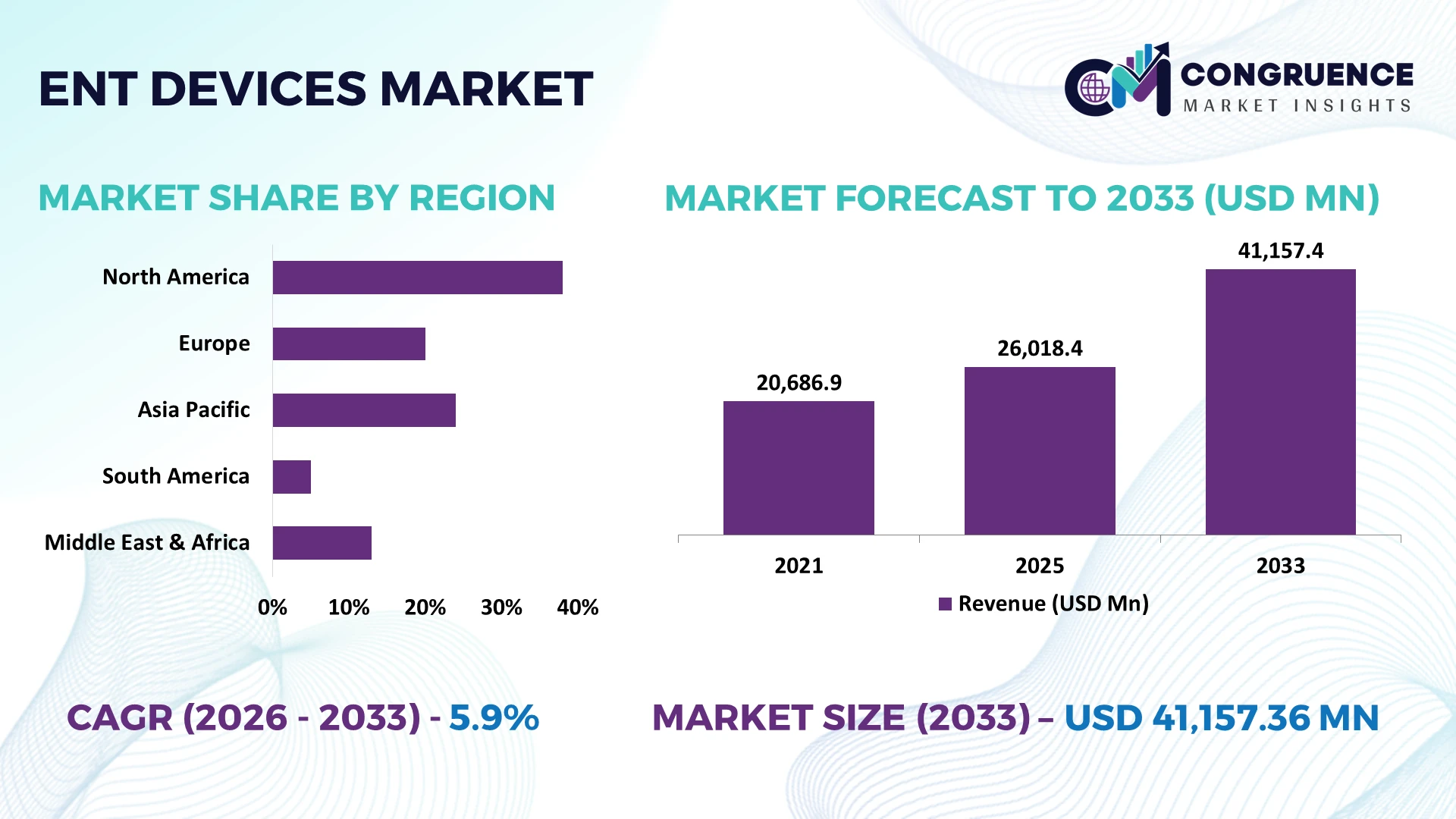
The United States remains the dominant country, accounting for approximately 38% of global ENT device demand in 2026, supported by advanced hospitals, high healthcare expenditure, and rapid adoption of digital diagnostics. Europe follows with strong cochlear implant and endoscopic technology penetration, while India and China are expanding ENT infrastructure and device procurement. U.S. adoption of digitally integrated surgical platforms exceeds 30% in major tertiary-care centers.
Strategically, manufacturers should prioritize AI-enabled navigation, connected hearing technologies, and minimally invasive platforms while expanding production and distribution across high-growth Asian markets.
Market Size & Growth: USD 26.02 billion in 2025 to USD 41.16 billion by 2033 at 5.9% CAGR, driven by minimally invasive technologies.
Top Growth Drivers: Hearing-loss treatment 31.3%, minimally invasive procedures 18%, digital diagnostics 15%.
Short-Term Forecast: By 2028, automated workflows are expected to improve procedural efficiency by 10–15%.
Emerging Technologies: AI imaging, robotic navigation, smart implants, and advanced endoscopy are accelerating clinical precision.
Regional Leaders: North America USD 14.96 billion, Europe USD 8.75 billion, Asia Pacific USD 8.33 billion by 2033.
Consumer/End-User Trends: Hearing devices represent over 30% of product demand, led by digitally connected solutions.
Pilot/Case Example: 2026 robotic ENT platforms target 15% faster procedure planning through integrated imaging and navigation.
Competitive Landscape: Medtronic, Stryker, Olympus, Cochlear, and Sonova maintain strong positions across surgical and hearing-device segments.
Regulatory & ESG Impact: Connected devices increasingly require cybersecurity and lifecycle controls, raising compliance requirements by approximately 5–10%.
Investment & Funding: Medical robotics investment exceeded USD 700 million in recent funding activity, strengthening precision-ENT development.
Innovation & Future Outlook: AI-assisted surgery, miniaturized sensors, robotic systems, and connected hearing platforms will define the next competitive cycle.
The ENT Devices Market is increasingly shaped by hearing-loss management, sinus and airway procedures, advanced endoscopy, and image-guided interventions. Approximately 5% of the global population requires hearing rehabilitation, creating a substantial addressable patient base. In 2026, hospitals are prioritizing interoperable systems that connect diagnostics, surgical planning, navigation, and post-procedure monitoring. Supply-chain localization and tighter regulatory oversight are also encouraging manufacturers to develop standardized, digitally connected devices with stronger operational reliability, creating a clear transition toward integrated ENT technology platforms.
The ENT Devices Market is becoming strategically important as hospitals shift from standalone instruments toward digitally integrated diagnostic, surgical, and hearing-care platforms. Competition increasingly depends on procedural precision, workflow economics, and interoperability rather than device availability alone. In 2026, healthcare infrastructure modernization and tighter controls for AI-enabled medical technologies are accelerating investment in connected ENT systems while encouraging manufacturers to localize critical components and strengthen regulatory capabilities.
Advanced image-guided and AI-assisted ENT platforms can reduce procedure-planning time by approximately 15% and improve workflow efficiency by 10% compared with conventional manual planning. The United States leads in high-end navigation, robotic integration, and connected hearing technologies, while China and India emphasize hospital expansion, localized manufacturing, and broader access to cost-efficient ENT equipment. Over the next 2–3 years, deployment of digitally connected ENT platforms across major hospitals is expected to increase by 10–15%.
A practical deployment pathway involves integrating endoscopy, imaging, surgical navigation, and patient monitoring into a unified workflow. Companies are responding by increasing R&D allocations, forming hospital partnerships, expanding localized production, and acquiring specialized technology capabilities. Competitive positioning will increasingly depend on interoperable platforms that deliver measurable clinical efficiency while reducing lifecycle costs and supply-chain exposure.
Demand is shifting toward minimally invasive ENT procedures supported by digital visualization, navigation, and connected diagnostics. Advanced endoscopic systems can improve procedural efficiency by approximately 10–15%, while AI-assisted image interpretation can reduce diagnostic workflow time by around 10%. In the United States, tertiary hospitals are expanding integrated ENT operating-room capabilities, while Indian private hospital networks are adding advanced endoscopy and hearing-care infrastructure. The resulting shift from standalone instruments to connected platforms is increasing recurring demand for software-enabled upgrades, accessories, and compatible components. Manufacturers are responding through R&D partnerships, platform acquisitions, and integrated product launches. The non-obvious advantage is higher customer retention: interoperable platforms create switching costs and encourage hospitals to standardize multiple ENT procedures around one technology ecosystem.
High acquisition costs, imported components, and specialized servicing requirements continue to constrain adoption in price-sensitive healthcare systems. Premium navigation and robotic ENT platforms can carry 20–40% higher upfront costs than conventional surgical equipment, while imported electronic and optical components can represent more than 30% of system input value. India remains particularly exposed to foreign component availability and exchange-rate fluctuations, increasing procurement uncertainty for smaller hospitals. Regulatory documentation and device interoperability requirements also add implementation costs. Manufacturers are reducing exposure through dual sourcing, regional assembly, longer supplier contracts, and modular product architectures. The key operational constraint is not device demand but the total cost of ownership, making service networks and component localization increasingly important competitive differentiators.
AI-assisted diagnostics, smart hearing devices, robotic navigation, and cloud-connected monitoring create high-value opportunities beyond traditional ENT equipment sales. AI-supported workflows can target 10–15% reductions in diagnostic or planning time, while connected hearing technologies can increase remote-adjustment and follow-up efficiency by approximately 15%. India, China, and Southeast Asian healthcare systems offer expanding opportunities as new hospitals adopt digital operating-room infrastructure rather than retrofitting legacy systems. By 2028, manufacturers integrating software, analytics, and remote service capabilities can capture additional value from post-installation workflows. Strategic partnerships with hospital chains, diagnostic networks, and software developers will be particularly important. The strongest opportunity lies in converting equipment into connected clinical platforms with recurring service and software revenue streams.
ENT technology portfolios are becoming harder to integrate as hospitals combine endoscopes, imaging systems, navigation platforms, hearing devices, electronic records, and AI software. Integration failures can increase workflow delays by 5–10%, while cybersecurity controls add further requirements for connected equipment. Japan and Germany face additional pressure from aging clinical workforces, whereas rapidly expanding healthcare systems in India require accelerated specialist training to operate advanced platforms consistently. Regulatory requirements for AI-enabled medical devices are also evolving, forcing manufacturers to maintain stronger validation, monitoring, and documentation processes. Companies must invest in standardized interfaces, cybersecurity architecture, simulation-based training, and lifecycle software support. Long-term competitiveness will depend on making sophisticated ENT technology easier to deploy and operate, not simply adding more technical capabilities.
AI-Assisted Clinical Workflows: AI-enabled visualization and automated image analysis are moving from pilot projects toward practical ENT deployment, with surgical AI training participation rising from 12.9% in 2021 to 23% in 2024. Hospitals are investing in validated software, structured training, and interoperable imaging systems to reduce interpretation workload and improve workflow consistency.
Connected Hearing Ecosystems: Hearing devices are shifting toward software-linked platforms combining remote programming, smartphone connectivity, and continuous patient support. More than 5% of the global population requires rehabilitation for disabling hearing loss, creating pressure for scalable digital delivery. Manufacturers are expanding remote-care capabilities and partnerships to reduce follow-up burden and widen access.
Outpatient Procedure Migration: ENT procedures are increasingly moving toward ambulatory settings as minimally invasive techniques require shorter recovery and lower infrastructure intensity. ASC adoption is strengthening, while U.S. reimbursement and authorization changes introduced from late 2025 are reshaping procurement workflows. Manufacturers are developing compact, modular equipment suited to faster room turnover and lower operating costs.
Localized Supply Chain Models: Medical-device producers are restructuring sourcing as optical, electronic, and precision components face tighter availability and geopolitical exposure. Regional assembly and dual sourcing are expanding, with localization programs targeting 10–20% reductions in component lead times. Companies are increasingly combining supplier diversification with long-term contracts and standardized components to improve delivery reliability and protect margins.
Hearing Devices represent the leading type, accounting for approximately 31.3% of market demand, supported by recurring replacement cycles, broad clinical applicability, and increasing digital functionality. Diagnostic Devices remain essential for screening, audiometry, and visualization, while Surgical Devices benefit from minimally invasive procedures and image-guided intervention. Endoscopy Devices maintain strong relevance in high-volume examination and operative workflows, particularly where reusable visualization systems support multiple procedures. Companies are prioritizing connected hearing portfolios, higher-resolution imaging, and modular surgical platforms to improve utilization and reduce equipment replacement friction.
Hearing Devices remain more mature and scalable, whereas Surgical and Endoscopy Devices are gaining investment through workflow automation and interoperability. Hearing implants represent the faster-moving technology area, supported by advanced signal processing and broader clinical adoption. Approximately 10–15% improvement in workflow efficiency is increasingly targeted through digitally integrated systems, shifting investment toward platforms that combine hardware, software, and clinical analytics.
Ear Disorders represent the leading application, accounting for approximately 40–45% of ENT device utilization, driven by hearing loss, chronic ear conditions, audiological assessment, and implant procedures. Nose Disorders form another high-volume application, particularly through sinus diagnostics and minimally invasive interventions. Throat Disorders maintain steady demand across endoscopic assessment and voice-related treatment, while Head & Neck Surgery requires higher-value navigation, imaging, and precision instruments. Companies are increasingly tailoring portfolios toward integrated diagnostic-to-treatment pathways rather than isolated devices.
Ear-focused applications remain the largest operational base, while Nose Disorders are among the fastest-expanding use cases as balloon dilation, advanced endoscopy, and image-guided procedures gain acceptance. Digitized workflows can reduce procedure preparation and documentation time by approximately 10–15%. Manufacturers are therefore expanding sinus platforms, integrating visualization with navigation, and partnering with hospital networks to improve utilization.
Hospitals remain the dominant end-user, representing approximately 50% of demand because they concentrate complex ENT procedures, specialist teams, advanced imaging, and multidisciplinary care. ENT Clinics serve high-frequency diagnostic and follow-up needs with lower infrastructure requirements, while Diagnostic Centers increasingly deploy automated audiometry and visualization systems. Ambulatory Surgical Centers are the fastest-expanding buyer group, benefiting from minimally invasive procedures, shorter recovery periods, and lower facility intensity. Companies are responding with compact systems, procedure-specific configurations, service contracts, and hospital-to-ASC product adaptations.
Hospital procurement remains focused on comprehensive platforms and capital efficiency, whereas ASCs increasingly prioritize rapid setup, standardized workflows, and lower equipment footprints. ASC deployment can target 10–20% faster room turnover through modular instrumentation and streamlined reprocessing. Diagnostic Centers are also becoming important entry points for hearing screening and early detection, encouraging manufacturers to build scalable, remotely supportable equipment portfolios.
North America accounted for the largest market share at 36% in 2025 however, Asia-Pacific is expected to register the fastest growth, expanding at a CAGR of 7.2% between 2026 and 2033.

Advanced Surgical Integration Strengthens Market Leadership
North America holds the leading position in the ENT Devices Market, supported by sophisticated hospital infrastructure, high specialist density, advanced surgical centers, and established reimbursement systems. The United States contributes more than 80% of regional demand, with major healthcare networks deploying endoscopy, hearing implants, surgical navigation, and digital diagnostic systems. More than 30% of leading U.S. hospitals are integrating digitally connected surgical technologies into specialist workflows. Manufacturers are increasing investment in AI-assisted visualization, robotic platforms, connected hearing systems, and hospital partnerships. Canada is strengthening demand through healthcare modernization and expanded access to specialized diagnostic equipment. Supply-chain diversification is also becoming a priority as manufacturers reduce dependency on concentrated sources for optical and electronic components.
United States Market Outlook: The United States remains the primary technology and commercialization hub, supported by extensive ENT infrastructure, specialized surgical centers, and strong medical-device innovation. More than 30% of leading hospitals are adopting digitally integrated clinical technologies, supporting continued deployment of advanced navigation, visualization, hearing, and diagnostic platforms.
Precision Care and Regulatory Modernization Reshape Demand
Europe maintains a mature ENT device ecosystem supported by sophisticated hospitals, specialist clinics, established medical-device manufacturing, and stringent regulatory requirements. Germany, France, the United Kingdom, and Italy represent major deployment centers for hearing devices, endoscopy, diagnostics, and precision surgical equipment. Approximately 25% of healthcare procurement increasingly emphasizes interoperability, cybersecurity, and lifecycle efficiency. Manufacturers are responding with connected platforms, modular equipment, stronger post-market monitoring, and localized service networks. Aging populations continue supporting hearing-device utilization, while minimally invasive procedures strengthen demand for advanced visualization and navigation systems. Sustainability requirements are also influencing equipment design, encouraging longer product lifecycles, modular components, and reduced maintenance intensity. Competitive advantage increasingly depends on combining clinical performance with regulatory readiness and efficient lifecycle management.
Germany Market Outlook: Germany combines advanced medical-device manufacturing with sophisticated hospital infrastructure and strong engineering capabilities. The country remains strategically important for precision endoscopy, surgical instruments, and hearing technologies, while hospital modernization increasingly favors interoperable equipment with improved lifecycle efficiency and lower maintenance requirements.
Manufacturing Scale Accelerates Advanced Device Deployment
Asia-Pacific combines large patient populations, expanding healthcare infrastructure, manufacturing capacity, and rising adoption of advanced ENT technologies. China, Japan, South Korea, and India represent important demand and production centers, with China holding a substantial share of regional medical-device manufacturing. Private hospital expansion in India is increasing procurement of endoscopy, diagnostic, and hearing systems, while Japanese hospitals maintain strong demand for precision technologies. Digital diagnostic deployment across major private healthcare networks is increasing by approximately 10–15% annually in selected high-volume facilities. Manufacturers are responding through local assembly, distributor partnerships, regional R&D, and cost-optimized product configurations. The competitive advantage is shifting toward suppliers capable of combining advanced technology with localized pricing, servicing, and component availability.
China Market Outlook: China holds a strategically important position through large-scale medical-device manufacturing, extensive hospital infrastructure, and expanding domestic technology development. Local production of diagnostic and surgical equipment is strengthening, while major hospitals increasingly deploy advanced imaging and endoscopic systems, creating opportunities for integrated domestic and international suppliers.
Private Healthcare Expansion Strengthens Specialized Demand
South America's ENT Devices Market is concentrated around Brazil, Argentina, Chile, and Colombia, with private hospitals and specialist clinics representing important procurement channels. Brazil provides the largest commercial base, supported by extensive healthcare infrastructure and specialized medical facilities. Imported advanced equipment remains prominent in premium applications, while local distributors increasingly provide installation, maintenance, and technical support. Approximately 10% of procurement activity across major private healthcare networks is shifting toward digitally enabled diagnostic and surgical equipment. Manufacturers are strengthening distributor partnerships, localized servicing, and cost-optimized product portfolios to address price-sensitive procurement. Currency volatility and uneven infrastructure continue influencing purchasing decisions, making equipment reliability and service availability important differentiators. Companies with flexible financing and strong technical support are better positioned to expand beyond major metropolitan centers.
Brazil Market Outlook: Brazil offers the strongest commercial platform in South America because of its large healthcare system, established private hospital networks, and concentration of specialist services. Demand is increasingly centered on endoscopy, hearing equipment, and diagnostic platforms, while distributor-led servicing remains essential for maintaining equipment utilization outside major cities.
Healthcare Modernization Drives Premium Technology Deployment
The Middle East & Africa market is increasingly shaped by hospital modernization, private healthcare investment, medical-tourism infrastructure, and specialist-care expansion. Saudi Arabia and the United Arab Emirates lead premium technology deployment, particularly across newly developed hospitals and specialized medical centers. Digitally enabled equipment deployment in leading Gulf hospitals is increasing by approximately 10% annually as providers modernize operating rooms and diagnostic departments. Companies are responding through hospital partnerships, regional distribution agreements, clinical training, and expanded service capabilities. African markets remain more price-sensitive and infrastructure-dependent, creating demand for durable and modular equipment. The competitive shift is toward suppliers offering complete deployment ecosystems rather than standalone devices, particularly where hospitals require installation, training, maintenance, and technology integration from a single partner.
Saudi Arabia Market Outlook: Saudi Arabia represents the strongest modernization market, supported by large hospital development programs, healthcare digitization, and investment in specialist medical infrastructure. ENT manufacturers are targeting advanced endoscopy, surgical visualization, and hearing technologies while expanding technical training and local service capabilities to support higher equipment utilization.
Global leaders such as Medtronic, Stryker, Olympus, Cochlear, and Sonova compete with specialized regional manufacturers and technology-focused ENT suppliers across surgical, visualization, diagnostic, and hearing segments. The top five players collectively account for approximately 30–35% of the market, leaving meaningful space for specialized competitors. Competition centers on technology, clinical performance, service coverage, customization, and procurement economics, with integrated systems delivering approximately 10–15% workflow efficiency improvements over fragmented equipment. Leading companies are expanding through hospital partnerships, product launches, acquisitions, and localized service networks, while regional suppliers compete through 10–20% lower equipment costs, faster customization, and localized support. The competitive structure is shifting from standalone hardware toward interoperable platforms combining devices, software, analytics, and services. Regulatory validation, clinical evidence, specialist distribution networks, and service infrastructure remain key entry barriers. Winning players will combine technological differentiation, dependable supply, responsive servicing, and competitive lifecycle economics.
Medtronic
Stryker
Olympus Corporation
Cochlear Limited
Sonova Holding AG
Demant A/S
Smith & Nephew
KARL STORZ SE & Co. KG
Ambu A/S
GN Store Nord A/S
Richard Wolf GmbH
Natus Medical Incorporated
Interacoustics A/S
Starkey Laboratories, Inc.
AI-assisted endoscopy, high-definition imaging, digital audiology, and image-guided navigation now anchor ENT technology upgrades. Advanced visualization platforms improve diagnostic and procedural efficiency by 10–15%, while connected audiology systems reduce follow-up workload by around 5–10%. Adoption is strongest in tertiary hospitals, where integrated imaging and navigation increasingly replace isolated equipment and improve operating-room utilization.
Emerging technologies include robotic navigation, cloud-linked diagnostics, smart cochlear implants, and AI-supported anatomical mapping. Compared with conventional manual surgical planning, integrated navigation platforms can improve workflow efficiency by approximately 10–15% and reduce planning steps by 10%. Smart implants with upgradeable firmware extend device functionality without immediate hardware replacement, strengthening lifecycle economics. Global OEMs with established software, imaging, and service ecosystems benefit most from this shift.
From 2026–2028, interoperability will become a competitive requirement as hospitals connect endoscopy, imaging, navigation, hearing devices, and clinical data systems. Deployment of digitally integrated ENT workflows is positioned to increase by 10–15% across advanced hospital networks, while automation targets another 5–10% efficiency gain. Manufacturers that combine AI, robotics, modular hardware, cybersecurity, and remote support will gain stronger procurement positioning, whereas suppliers dependent on standalone devices face increasing pressure to modernize portfolios and service integration.
March 2026 Medtronic received U.S. FDA clearance for Stealth AXiS for cranial and ENT procedures, integrating navigation, imaging, and robotics. The expansion strengthens one-platform procurement and supports broader connected surgical workflows across major hospital systems and procurement standardization. Source: reuters.com
July 2025 Cochlear launched Nucleus Nexa, a smart cochlear implant with upgradeable firmware and internal memory. Its processor is 9% smaller and 12% lighter, improving lifecycle flexibility and patient convenience while strengthening premium implant differentiation globally over time. Source: cochlear.com
September 2024 Olympus launched VISERA S, an integrated ENT imaging platform combining stroboscopy and narrow-band imaging. Initial availability covered Europe and selected Asian markets, expanding advanced diagnostic capabilities across outpatient and private-practice settings with streamlined workflows and standardization. Source: olympus-global.com
February 2026 Neurent Medical secured $74 million in Series C funding following FDA clearance for its Neuromark chronic-rhinitis system. The financing supports commercialization, manufacturing scale-up, and U.S. expansion, increasing competitive pressure in minimally invasive ENT treatment markets quickly. Source: massdevice.com
The ENT Devices Market Report covers Diagnostic Devices, Surgical Devices, Hearing Devices, and Endoscopy Devices across Ear Disorders, Nose Disorders, Throat Disorders, and Head & Neck Surgery applications. End-user analysis includes Hospitals, ENT Clinics, Ambulatory Surgical Centers, and Diagnostic Centers, providing a structured view of purchasing intensity, deployment concentration, technology adoption, and evolving care-delivery models.
Geographically, the report evaluates North America, Europe, Asia-Pacific, South America, and Middle East & Africa, with country-level assessment of infrastructure, manufacturing capability, regulatory conditions, and technology deployment. The analysis covers AI-enabled diagnostics, advanced imaging, surgical navigation, robotic platforms, connected hearing systems, and interoperable clinical workflows. With digitally integrated deployments increasing across major hospital networks, the report supports investment planning, market-entry decisions, partnership strategies, capacity expansion, competitive positioning, and technology prioritization from 2026 through 2033.
| Report Attribute/Metric | Report Details |
|---|---|
Market Revenue in 2025 | USD 26018.35 Million |
Market Revenue in 2033 | USD 41157.36 Million |
CAGR (2026 - 2033) | 5.9% |
Base Year | 2025 |
Forecast Period | 2026 - 2033 |
Historic Period | 2021 - 2025 |
Segments Covered | By Type
By Application
By End-User
|
Key Report Deliverable | Revenue Forecast, Growth Trends, Market Dynamics, Segmental Overview, Regional and Country-wise Analysis, Competition Landscape |
Region Covered | North America, Europe, Asia-Pacific, South America, Middle East, Africa |
Key Players Analyzed | Medtronic, Stryker, Olympus Corporation, Cochlear Limited, Sonova Holding AG, Demant A/S, Smith & Nephew, KARL STORZ SE & Co. KG, Ambu A/S, GN Store Nord A/S, Richard Wolf GmbH, Natus Medical Incorporated, Interacoustics A/S, Starkey Laboratories, Inc. |
Customization & Pricing | Available on Request (10% Customization is Free) |




