
Reports
The Global Electric Fracturing (E-Frac) Fleet Market was valued at USD 45462 Million in 2025 and is anticipated to reach a value of USD 85401.72 Million by 2033 expanding at a CAGR of 8.2% between 2026 and 2033. Growth is driven by natural gas powered electric pumping systems, replacement of diesel hydraulic fracturing equipment, and increasing adoption of automated high pressure pumping technologies across unconventional oil and gas operations.
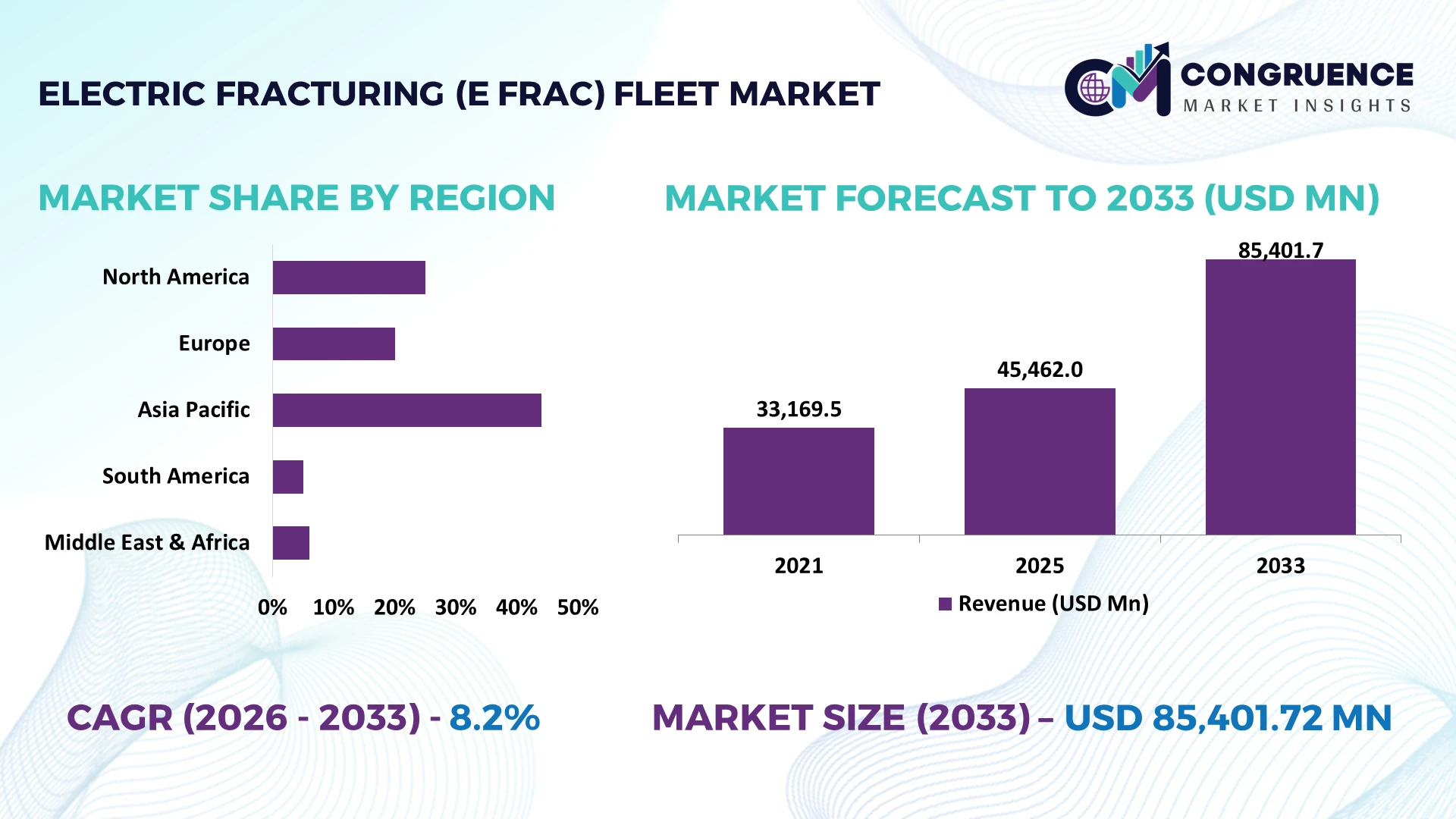
The United States dominates electric fracturing fleet deployment, with an estimated 85% share of global operational electric fracturing capacity, concentrated across the Permian Basin, Eagle Ford, and Appalachian Basin. Advanced electric fleets incorporate pumping configurations exceeding 40,000 hydraulic horsepower, supported by natural gas turbines and grid connected power systems. Compared with Canada, where electric fracturing adoption remains concentrated in selected shale formations, the United States benefits from larger deployment networks and established equipment manufacturing capabilities. Texas leads investments in integrated electric pumping and automated well completion technologies.
Strategically, operators deploying 40,000 horsepower electric fleets and targeting modeled fuel savings of 20% to 30% strengthen completion economics, equipment utilization, and competitiveness across high intensity shale development programs.
Market Size & Growth: USD 45,462 million in 2025, reaching USD 85,401.72 million by 2033 at 8.2% CAGR, driven by electric pumping adoption.
Top Growth Drivers: Modeled demand weighting assigns 40% to diesel displacement, 35% to completion efficiency, and 25% to emissions reduction.
Short Term Forecast: By 2028, optimized electric fleets target 15% lower maintenance expenditure and 20% improved equipment availability.
Emerging Technologies: AI diagnostics, variable frequency drives, and automated pumping controls target 10% to 15% higher operational efficiency.
Regional Leaders: Illustrative 2033 allocations place North America at USD 72,591.46 million, Asia Pacific at USD 6,832.14 million, and the Middle East at USD 3,416.07 million.
Consumer / End User Trends: Estimated 70% of electric fracturing demand originates from unconventional shale operators prioritizing continuous high pressure pumping.
Pilot / Case Example: In 2024, Liberty Energy's digiFrac technology demonstrated electric pumping configurations targeting 25% lower fuel consumption versus conventional diesel systems.
Competitive Landscape: Liberty Energy holds an indicative 25% position in electric fleet activity; competitors include Halliburton, ProFrac, Evolution Well Services, and NexTier.
Regulatory & ESG Impact: Electric pumping configurations target 30% lower operational greenhouse gas emissions when supplied by optimized natural gas generation.
Investment & Funding: An illustrative USD 2 billion fleet modernization scenario prioritizes electric pumps, gas turbines, and automated power distribution infrastructure.
Innovation & Future Outlook: Next generation fleets exceeding 50,000 horsepower integrate digital twins, predictive maintenance, and modular power generation for scalable completions.
The Electric Fracturing (E-Frac) Fleet Market is undergoing a structural transition toward electrically powered hydraulic fracturing systems across unconventional oil and gas basins. Demand concentrates in the Permian Basin, where operators prioritize continuous pumping, reduced diesel logistics, and improved equipment reliability. Advanced electric fleets combine variable frequency drives, natural gas generation, automated pressure controls, and predictive maintenance software. Under modeled operating conditions, these technologies target 20% to 30% lower fuel expenditure compared with conventional diesel pumping systems. Increasing integration of field gas into power generation strengthens operational independence from diesel supply chains, establishing new priorities for fleet modernization and service provider differentiation.
Electric fracturing fleets are becoming strategically important as unconventional oil and gas operators prioritize completion efficiency, energy security, and equipment modernization. The transition from diesel powered pumping toward electrically driven hydraulic fracturing systems is restructuring field energy supply chains across the United States. Advanced fleets exceeding 40,000 hydraulic horsepower integrate natural gas generation, variable frequency drives, and automated pressure management. Under modeled operating conditions, electric pumping systems deliver 20% to 30% lower fuel expenditure than conventional diesel fleets, strengthening completion economics.
The United States leads commercial deployment through the Permian Basin, Eagle Ford, and Appalachian Basin, while Canada advances electrification across selected unconventional formations. Electric pumping architectures reduce mechanical complexity and enable centralized power management. During 2026 to 2028, optimized fleet configurations target 15% lower maintenance requirements and 10% higher equipment availability. These improvements strengthen pumping consistency, particularly during extended multistage hydraulic fracturing operations.
Liberty Energy's digiFrac platform demonstrates practical deployment through electrically driven pumping equipment integrated with digital controls. Halliburton and ProFrac are similarly advancing fleet modernization and power generation capabilities. Operators increasingly favor integrated service contracts combining pumping, energy management, and predictive maintenance. Competitive leadership depends on reliable electrical infrastructure, lower completion costs, and sustained pumping performance.
The transition toward electrically driven hydraulic fracturing systems is accelerating as United States shale operators prioritize fuel efficiency and uninterrupted pumping performance. Conventional diesel fleets require extensive fuel transportation, engine servicing, and mechanical maintenance, increasing operational complexity across the Permian Basin. Under modeled operating conditions, electric fracturing configurations target 20% to 30% lower fuel expenditure and 15% lower maintenance requirements. Centralized electrical power distribution also supports approximately 10% higher equipment availability when generation reliability is maintained. Liberty Energy and ProFrac are responding through electric pumping investments, natural gas generation integration, and digital fleet management. The strategic advantage extends beyond fuel savings because reduced servicing interruptions improve completion scheduling and equipment utilization.
Electric fracturing deployment faces substantial upfront equipment expenditure, specialized electrical infrastructure requirements, and dependence on reliable natural gas or grid supplied power. High capacity pumping fleets require generators, transformers, variable frequency drives, and extensive power distribution systems. In illustrative project sensitivity scenarios, 20% higher electrical infrastructure costs and 15% lower fleet utilization materially weaken investment returns. Texas operators also face regional grid congestion and variable natural gas availability, complicating power procurement decisions. Service companies are reducing exposure through modular generation systems, dedicated fuel supply contracts, and phased fleet conversions. The decisive commercial constraint is matching power infrastructure investment with sufficient contracted pumping activity to maintain equipment productivity.
Advanced power management platforms create opportunities to improve electric fracturing productivity through automated load balancing, predictive maintenance, and modular generation systems. United States operators increasingly evaluate natural gas turbines, battery supported power stabilization, and intelligent pumping controls for high intensity completion operations. Under modeled deployment scenarios, automated load management targets 12% lower energy losses, while predictive diagnostics support 15% fewer unplanned equipment interruptions. Hybrid energy architectures also offer potential fuel efficiency improvements of 8% through optimized generator loading. Equipment manufacturers and service providers are expanding digital control capabilities, developing standardized electrical modules, and strengthening technology partnerships. Integrated power management services provide an additional competitive advantage by linking pumping performance with energy optimization.
Scaling electric fracturing fleets introduces technical challenges involving high voltage distribution, equipment interoperability, cybersecurity, and specialized workforce requirements. Pumping spreads exceeding 40,000 hydraulic horsepower require synchronized control across generators, transformers, electric motors, and automated pressure systems. In operational stress scenarios, 10% lower electrical system availability and 15% longer fault recovery periods significantly disrupt completion schedules. United States shale operations face additional pressure from increasingly complex multistage well designs and continuous pumping requirements. Service providers must invest in standardized control architectures, electrical technician training, redundant power systems, and cybersecurity protection. Long term competitiveness depends on maintaining consistent pumping performance while integrating increasingly sophisticated electrical and digital technologies across geographically dispersed fleets.
Natural Gas Fuel Logistics Consolidation: Texas fracturing contractors are consolidating field gas procurement around centralized power generation facilities rather than individual pumping units. High capacity spreads exceeding 40,000 horsepower support coordinated energy distribution across multiple wells. Modeled logistics scenarios indicate 15% fewer fuel deliveries and 10% lower onsite transportation requirements. Contractors are negotiating dedicated gas supply agreements, reducing exposure to diesel delivery interruptions and improving completion scheduling reliability.
Continuous Pumping Schedules Gain Priority: Permian Basin operators increasingly prioritize longer pumping intervals to complete multistage horizontal wells within tighter development schedules. Advanced electric pumping systems support operating configurations exceeding 50,000 horsepower. Operational planning scenarios target 12% shorter completion cycles and 8% higher productive pumping time. Service companies are restructuring crew rotations, equipment servicing windows, and pad logistics to minimize interruptions between fracturing stages.
Electric Equipment Standardization Accelerates Procurement: United States equipment manufacturers are standardizing electric motors, power cables, transformers, and pumping modules across fleet platforms. Standardized component specifications target 15% fewer unique replacement parts and 10% shorter equipment servicing intervals in modeled procurement scenarios. Contractors are consolidating supplier relationships and introducing common equipment configurations, improving spare parts availability and reducing maintenance inventory complexity.
Remote Operations Centers Expand Oversight: Digital completion monitoring is shifting selected supervisory functions from wellsites toward centralized operating facilities. Integrated platforms consolidate pressure, flow rate, and equipment condition data across multiple fracturing spreads. Modeled deployment scenarios target 20% fewer manual reporting hours and 10% faster operational decision cycles. Contractors are expanding remote engineering support and digital workflow integration while retaining essential onsite safety personnel.
Hybrid E-Frac Fleets represent the leading segment, accounting for an estimated 48% of global electric fracturing fleet activity in 2025. Their dominance reflects the operational flexibility of combining natural gas generation, electrically driven pumping, and alternative power supply configurations. These systems support continuous hydraulic fracturing operations in Texas and Pennsylvania, where reliable power availability directly influences completion productivity. Grid-Powered E-Frac Fleets account for an indicative 32% share, benefiting from established electrical infrastructure and reduced dependence on onsite generation equipment. However, grid connection requirements limit deployment flexibility across remote shale formations.
Battery-Powered E-Frac Fleets represent approximately 20% of the modeled market and the fastest expanding segment as energy storage integration advances. Battery systems increasingly support peak load management, power stabilization, and temporary electrical backup rather than independently powering entire high capacity fracturing spreads. Contractors are evaluating modular storage configurations, advanced power electronics, and integrated energy management platforms. Investment priorities are shifting toward systems that improve power reliability while reducing generator cycling and supporting flexible deployment across unconventional drilling locations.
Tight Oil Extraction represents the leading application, accounting for an estimated 42% of global electric fracturing fleet demand in 2025. Its dominance reflects concentrated completion activity across the Permian Basin, where horizontal drilling and multistage hydraulic fracturing require substantial pumping horsepower. Multi-Well Pad Fracturing accounts for approximately 28% and represents the fastest expanding application as operators consolidate drilling and completion activities across larger development pads. Electric pumping systems support coordinated stage execution, centralized energy distribution, and reduced equipment relocation between adjacent wells.
Shale Gas Extraction represents an estimated 20% share, supported by completion activity in the Appalachian Basin and Canadian unconventional gas formations. Unconventional Well Stimulation contributes approximately 10%, serving specialized reservoir development and complex completion requirements. Contractors are adapting fleet configurations through modular pumping equipment, automated stage controls, and dedicated power distribution infrastructure. Commercial demand increasingly favors service providers capable of maintaining continuous pumping performance across multiple wells while coordinating high pressure equipment, proppant delivery, and onsite energy requirements.
Oil and Gas Operators represent the dominant end user segment, accounting for an estimated 38% of global electric fracturing fleet demand in 2025. Their leadership reflects responsibility for well development schedules, completion budgets, operational performance, and contractor selection. Exploration and Production Companies represent approximately 27%, particularly independent shale producers seeking predictable completion costs and flexible equipment deployment. Both groups prioritize reliable pumping capacity, energy efficiency, and contractual performance guarantees across unconventional oil and gas development programs.
Hydraulic Fracturing Contractors account for an estimated 25% share and represent the fastest expanding end user category as specialized service companies invest directly in electric pumping equipment and integrated power infrastructure. Oilfield Service Providers contribute approximately 10%, supplying engineering support, equipment maintenance, and completion technology integration. Liberty Energy, ProFrac, and Halliburton are strengthening electric fracturing capabilities through fleet modernization and specialized service offerings. Competitive differentiation increasingly depends on equipment availability, integrated power management, and contractual arrangements that align service pricing with pumping performance and operational efficiency.
North America accounted for the largest market share at an estimated 85% in 2025 however, South America is expected to register the fastest growth, expanding at a CAGR of an estimated 11.5% between 2026 and 2033.
Large Scale Shale Operations Accelerate Electric Fleet Deployment
North America dominates the global electric fracturing fleet market with an estimated 85% share in 2025, supported by extensive unconventional oil and gas development across the United States and Canada. The Permian Basin, Eagle Ford, and Appalachian Basin concentrate high horsepower fracturing operations requiring reliable pumping systems and integrated power generation. Electric fleets exceeding 40,000 hydraulic horsepower increasingly combine natural gas generation, variable frequency drives, and automated pressure management. Under modeled operating conditions, these systems target 20% to 30% lower fuel expenditure compared with conventional diesel equipment. Liberty Energy, Halliburton, and ProFrac are strengthening electrically driven completion capabilities through equipment modernization and integrated service offerings. Regional competitiveness increasingly depends on equipment availability, continuous pumping performance, and access to reliable natural gas infrastructure supporting large unconventional development programs.
United States Market Outlook: The United States leads electric fracturing technology development through established oilfield service companies, advanced equipment manufacturing, and concentrated shale completion activity. Texas provides strategic advantages through extensive natural gas infrastructure, specialized workforce availability, and high intensity hydraulic fracturing operations. The Permian Basin remains a major center for electric pumping deployment, while Pennsylvania supports natural gas powered completion systems. Fleet operators prioritize integrated power management and long duration service agreements to improve equipment utilization.
Regulatory Constraints Shape Selective Electrification Investment
Europe represents an indicative 2% of the global electric fracturing fleet market in 2025, reflecting limited unconventional hydrocarbon development and restrictive hydraulic fracturing regulations. The United Kingdom, Poland, and selected Eastern European countries possess unconventional gas resources, but commercial deployment remains constrained by permitting requirements and environmental opposition. Germany maintains restrictions on commercial unconventional hydraulic fracturing, limiting opportunities for specialized electric pumping fleets. Consequently, regional activity concentrates on engineering expertise, electric drive technology, and equipment manufacturing rather than extensive field deployment. European industrial suppliers contribute high voltage motors, variable frequency drives, automation systems, and electrical distribution components applicable to global fracturing operations. Modeled equipment optimization scenarios indicate potential 10% to 15% improvements in electrical system efficiency. Manufacturers are positioning through technology exports, specialized engineering partnerships, and advanced power management solutions serving international oilfield service providers.
United Kingdom Market Outlook: The United Kingdom possesses established offshore energy engineering capabilities, specialized electrical equipment suppliers, and advanced industrial automation expertise. However, the continuing moratorium on hydraulic fracturing in England restricts domestic commercial fleet deployment. British engineering companies remain relevant through high voltage power systems, equipment monitoring technologies, and technical services supporting international energy operations. Competitive opportunities concentrate on technology development and export oriented equipment supply rather than domestic shale fracturing expansion.
Domestic Shale Development Strengthens Electric Equipment Manufacturing
Asia Pacific accounts for an estimated 8% of the global electric fracturing fleet market in 2025, supported by unconventional gas development and domestic oilfield equipment manufacturing. China represents the principal regional deployment center through shale gas operations in the Sichuan Basin, where complex geological formations require high pressure pumping and advanced well stimulation technologies. Chinese manufacturers are developing electric fracturing equipment incorporating centralized power distribution, automated controls, and high capacity pumping systems. Domestic manufacturing strengthens equipment availability and reduces dependence on imported fracturing machinery. Australia and India provide additional opportunities through unconventional resource evaluation, although commercial electric fleet deployment remains limited. Modeled operational scenarios indicate potential 15% lower equipment maintenance requirements through electric drive adoption. Regional suppliers are expanding localized manufacturing, digital control integration, and partnerships with national energy companies to strengthen equipment competitiveness.
China Market Outlook: China leads regional electric fracturing development through Sinopec, PetroChina, and domestic oilfield equipment manufacturers. The Sichuan Basin remains a strategic center for shale gas extraction, supported by advanced horizontal drilling and multistage hydraulic fracturing technologies. Chinese electric fracturing equipment platforms include pumping systems exceeding 5,000 hydraulic horsepower per unit in certain configurations. Domestic engineering capabilities, integrated manufacturing, and established national energy infrastructure support continued technology localization and specialized equipment deployment.
Vaca Muerta Development Accelerates Fleet Modernization
South America represents an estimated 3% of the global electric fracturing fleet market in 2025, with Argentina providing the strongest demand concentration through unconventional oil and gas development in the Vaca Muerta formation. The Neuquén Basin requires extensive horizontal drilling, multistage completions, and high capacity hydraulic fracturing equipment. YPF and international energy operators are expanding shale development activities, strengthening requirements for reliable pumping services and efficient fuel management. Argentina's unconventional production infrastructure increasingly supports centralized well pad development and improved completion logistics. Modeled electric fleet deployment scenarios indicate potential 20% lower fuel expenditure and 10% higher pumping availability compared with conventional diesel configurations. However, electrical infrastructure limitations and imported equipment costs constrain deployment economics. Service providers are evaluating natural gas powered generation, localized maintenance capabilities, and equipment partnerships to support future fleet modernization.
Argentina Market Outlook: Argentina holds the region's strongest unconventional development advantage through Vaca Muerta, where YPF, Vista Energy, and international operators maintain extensive shale drilling programs. The Neuquén Basin benefits from established oilfield service infrastructure and increasing horizontal well development. Electric fracturing adoption depends on reliable onsite generation and specialized equipment availability. Companies are prioritizing completion productivity, domestic supply chain development, and long duration service arrangements to improve operational efficiency.
Unconventional Gas Investment Drives Advanced Completion Technologies
The Middle East and Africa represent an estimated 2% of the global electric fracturing fleet market in 2025, supported by unconventional gas development and oilfield service modernization. Saudi Arabia provides the strongest regional opportunity through its Jafurah unconventional gas development, which targets approximately 2 billion standard cubic feet of sales gas per day by 2030. The project requires advanced drilling, reservoir stimulation, and integrated field infrastructure. Electrically driven pumping technologies offer potential advantages where centralized power generation and natural gas infrastructure support continuous completion operations. Modeled deployment scenarios indicate potential 15% lower maintenance requirements compared with conventional diesel pumping equipment. The United Arab Emirates and Oman are also evaluating unconventional resource development opportunities. Oilfield service companies are strengthening equipment partnerships, localized technical capabilities, and integrated completion service offerings to support complex reservoir development.
Saudi Arabia Market Outlook: Saudi Arabia leads regional unconventional gas investment through Saudi Aramco's Jafurah development, supported by extensive energy infrastructure and established oilfield service capabilities. The project encompasses approximately 17,000 square kilometers, creating substantial requirements for specialized drilling and completion technologies. Domestic industrial localization initiatives encourage equipment manufacturing partnerships and technical workforce development. Electric fracturing suppliers can compete through integrated pumping systems, reliable power generation, and customized solutions for demanding reservoir conditions.
Liberty Energy, Halliburton, ProFrac, Patterson UTI, and Evolution Well Services compete through electric pumping technology, fleet availability, and integrated power management. Their combined market position is illustratively estimated at 65%, reflecting concentrated equipment capabilities rather than verified fleet ownership. Liberty emphasizes digiFrac electrification, while Halliburton integrates advanced completion services and automation. ProFrac and Patterson UTI compete through fleet modernization, operating scale, and customer relationships. Modeled electric pumping configurations target 20% lower fuel expenditure, 15% reduced maintenance requirements, and 10% higher equipment availability compared with conventional diesel systems. Companies are strengthening natural gas generation partnerships, digital monitoring capabilities, and specialized equipment procurement. Competition increasingly favors integrated pumping and energy services rather than standalone horsepower supply. High capital requirements, electrical engineering expertise, and reliable power infrastructure constrain entry. Winning requires dependable pumping performance, competitive lifecycle costs, and long duration contracts with unconventional operators across major shale development basins and markets.
Liberty Energy Inc.
Halliburton Company
ProFrac Holding Corp.
Patterson UTI Energy, Inc.
Evolution Well Services
STEP Energy Services Ltd.
Calfrac Well Services Ltd.
Trican Well Service Ltd.
GD Energy Products
NOV Inc.
Caterpillar Inc.
Baker Hughes Company
SLB N.V.
SANY Heavy Industry Co., Ltd.
Current electric fracturing fleets integrate high voltage motors, variable frequency drives, natural gas generators, and automated pumping controls. Liberty Energy's digiFrac platform demonstrates commercial deployment of electrically driven hydraulic fracturing equipment across United States shale operations. Compared with conventional diesel pumping, integrated electric systems target 20% lower fuel expenditure under modeled operating conditions. Automated pressure regulation targets 10% faster operational adjustments, improving pumping consistency during multistage completions. Centralized electrical distribution also reduces individual engine servicing requirements, strengthening equipment availability and completion scheduling reliability.
Emerging technologies include battery supported power stabilization, predictive diagnostics, and intelligent load management. Hybrid power architectures target 8% lower generator fuel consumption through optimized loading, while condition monitoring targets 15% fewer unplanned maintenance interruptions. Battery integration primarily supports transient loads rather than continuous fracturing horsepower. Contractors benefit from improved electrical stability, reduced equipment wear, and more predictable service intervals across demanding unconventional reservoirs.
Between 2026 and 2028, digital twins, autonomous pumping optimization, and integrated energy management will reshape fleet competitiveness. AI assisted equipment diagnostics target 12% faster fault identification, while coordinated power distribution supports 10% higher productive pumping availability. Service providers combining reliable generation, interoperable controls, and advanced maintenance capabilities gain advantages in contracted completion performance and fleet utilization.
June 2024: Hess launched Halliburton's electric fracturing system in North Dakota's Bakken formation, targeting 35% lower CO₂ emissions and 30% faster transitions between fracturing stages. Compressed natural gas powered generation improved completion efficiency while reducing reliance on diesel equipment. Source: hess.com.
November 2024: ProFrac partnered with Prairie Operating to introduce 25 electric pumps, each rated at 3,000 horsepower, for Colorado operations. The deployment supports fully electrified fracturing and pumpdown services, strengthening operational flexibility and reducing diesel equipment dependence. Source: pfholdingscorp.com.
December 2024: VoltaGrid, Halliburton, and Diamondback Energy announced an agreement deploying four electric simultaneous fracturing fleets across the Permian Basin. VoltaGrid committed approximately 200 megawatts of generation capacity, enabling integrated electrical pumping and supporting large scale completion operations. Source: voltagrid.com.
January 2025: Halliburton and Coterra Energy launched the Octiv Auto Frac service, integrating automated fracturing execution with the ZEUS electric pumping platform. The system enables one button execution of configured fracture designs, improving process consistency and operational control. Source: halliburton.com.
The Electric Fracturing (E-Frac) Fleet Market Report evaluates technology adoption, operational deployment, equipment modernization, and competitive developments between 2026 and 2033. Segmentation covers Battery Powered, Grid Powered, and Hybrid E-Frac Fleets; Shale Gas Extraction, Tight Oil Extraction, Unconventional Well Stimulation, and Multi-Well Pad Fracturing applications; and four end user categories. Indicative market modeling assigns Hybrid Fleets a 48% share and Tight Oil Extraction a 42% application share.
Regional analysis examines North America, Europe, Asia Pacific, South America, and the Middle East and Africa, emphasizing shale development and electrification infrastructure. Technology coverage includes electric motors, variable frequency drives, automated pumping, energy storage, and digital diagnostics. The report supports fleet investment decisions, equipment procurement, technology partnerships, contractor benchmarking, and long term operational planning.
| Report Attribute/Metric | Report Details |
|---|---|
Market Revenue in 2025 | USD 45462 Million |
Market Revenue in 2033 | USD 85401.72 Million |
CAGR (2026 - 2033) | 8.2% |
Base Year | 2025 |
Forecast Period | 2026 - 2033 |
Historic Period | 2021 - 2025 |
Segments Covered | By Type
By Application
By End-User
|
Key Report Deliverable | Revenue Forecast, Growth Trends, Market Dynamics, Segmental Overview, Regional and Country-wise Analysis, Competition Landscape |
Region Covered | North America, Europe, Asia-Pacific, South America, Middle East, Africa |
Key Players Analyzed | Liberty Energy Inc., Halliburton Company, ProFrac Holding Corp., Patterson UTI Energy, Inc., Evolution Well Services, STEP Energy Services Ltd., Calfrac Well Services Ltd., Trican Well Service Ltd., GD Energy Products, NOV Inc., Caterpillar Inc., Baker Hughes Company, SLB N.V., SANY Heavy Industry Co., Ltd. |
Customization & Pricing | Available on Request (10% Customization is Free) |




