
Reports
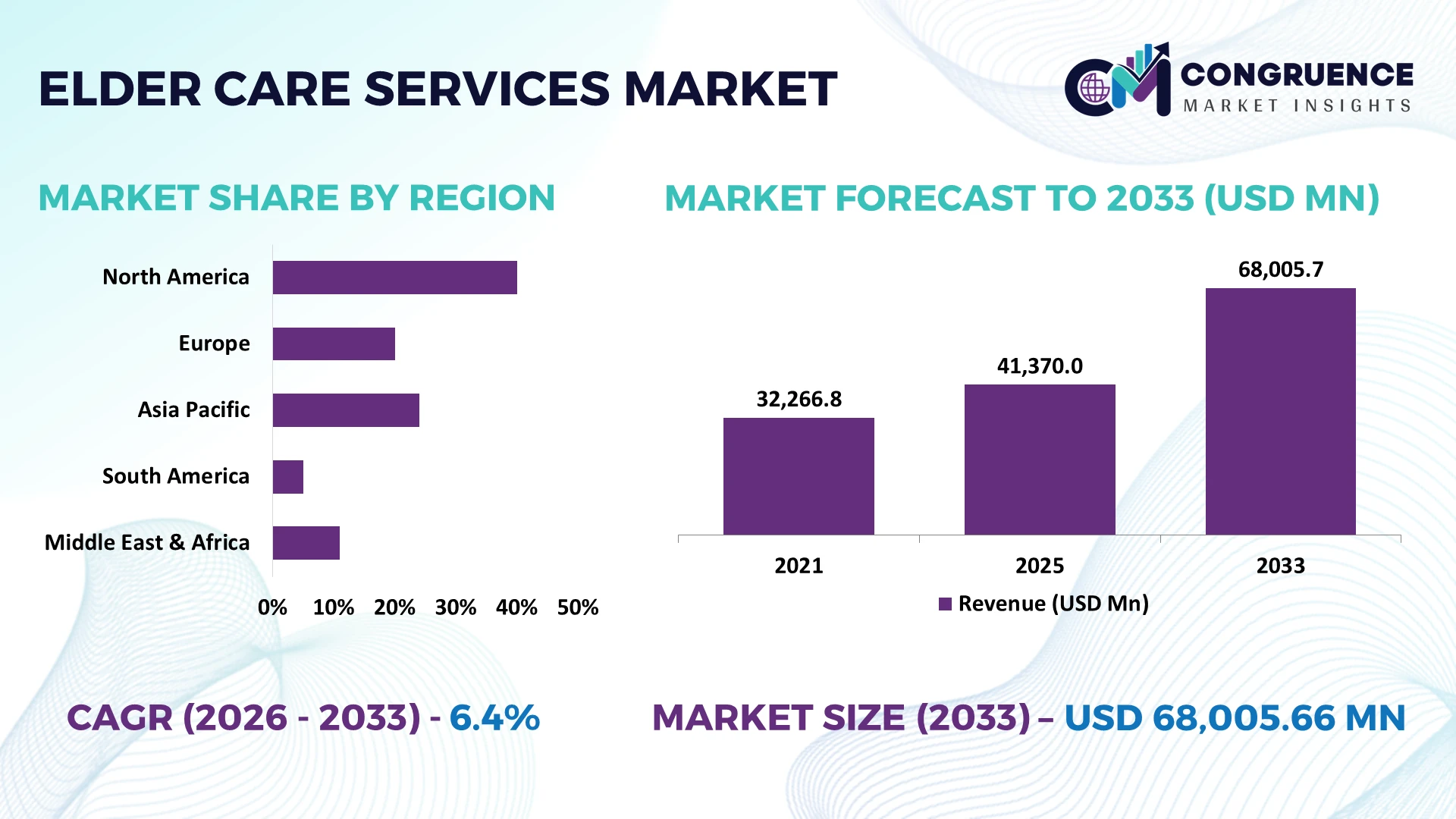
The Global Elder Care Services Market was valued at USD 41370 Million in 2025 and is anticipated to reach a value of USD 68005.66 Million by 2033 expanding at a CAGR of 6.41% between 2026 and 2033. Growth is being accelerated by expanding home-based care networks, AI-enabled remote health monitoring, workforce digitalization, and government-backed long-term care infrastructure programs addressing aging populations.
Japan remains the dominant country, accounting for approximately 29% of advanced elder care service capacity, supported by one of the world's oldest populations and sustained investments in smart care facilities, robotics, and digital monitoring. More than 68% of large care providers have integrated digital care management platforms, compared with around 45% in Germany, while demographic policy reforms across Asia continue to influence long-term service expansion and workforce planning in 2026.
Organizations prioritizing technology-enabled care delivery, workforce optimization, and scalable home-care models are positioned to secure stronger long-term market competitiveness.
Market Size & Growth: USD 41370 Million in 2025, reaching USD 68005.66 Million by 2033 at a CAGR of 6.41%, driven by AI-enabled home care and integrated digital health services.
Top Growth Drivers: Home healthcare adoption +18%, remote monitoring utilization +22%, long-term care workforce productivity +14%.
Short-Term Forecast: By 2027, AI-assisted scheduling and digital workflows reduce administrative costs by approximately 16% while improving caregiver efficiency by 20%.
Emerging Technologies: AI diagnostics, wearable health monitoring, and robotics support over 35% of advanced elder care operations across leading providers.
Regional Leaders: Asia-Pacific exceeds USD 24 billion with smart aging initiatives; North America surpasses USD 19 billion through home-care expansion; Europe approaches USD 16 billion with digital long-term care adoption.
Consumer/End-User Trends: Nearly 64% of seniors prefer aging-in-place services supported by connected monitoring and telehealth platforms.
Pilot/Case Example: A 2026 digital home-care deployment improved medication adherence by 24% and reduced avoidable hospital visits by 18%.
Competitive Landscape: Leading providers collectively hold approximately 27% market share alongside diversified regional operators expanding through acquisitions and integrated care partnerships.
Regulatory & ESG Impact: Updated long-term care standards improve compliance rates by 15% while accelerating technology adoption across licensed providers.
Investment & Funding: More than USD 4.5 billion supports facility modernization, digital platforms, strategic partnerships, and regional expansion amid healthcare infrastructure upgrades.
Innovation & Future Outlook: Predictive analytics, AI care coordination, and robotics-driven assistance strengthen personalized care delivery while supporting global expansion and resilient service ecosystems.
The Elder Care Services Market continues to advance through integrated home healthcare, AI-powered patient monitoring, and digital care coordination platforms that improve service continuity and caregiver productivity. Around 40% of newly deployed enterprise care solutions now include predictive analytics and remote engagement capabilities. Regulatory quality standards and workforce optimization initiatives are accelerating technology adoption, while regional capacity expansion is reshaping competitive strategies, setting the foundation for the strategic discussion.
The Elder Care Services Market has become strategically important as healthcare systems, insurers, and service providers shift from institution-centric models toward integrated care ecosystems. Competition is increasingly centered on care accessibility, workforce productivity, and digital service delivery rather than facility expansion alone. In 2026, long-term care reforms, home-based service funding programs, and digital health infrastructure modernization are reshaping investment priorities across major aging economies. Organizations capable of combining clinical care, monitoring technologies, and coordinated support services are strengthening their market position.
Technology adoption is creating measurable operational advantages. AI-assisted care management platforms reduce administrative workload by approximately 25% compared with legacy paper-based coordination systems while improving care scheduling accuracy by nearly 20%. Japan leads in robotics-assisted elder care deployment, whereas Germany focuses on digitally connected community care networks. In the United States, more than 60% of large elder care operators have expanded remote monitoring capabilities to improve service continuity and reduce avoidable facility admissions.
A practical example is the deployment of wearable monitoring systems integrated with telehealth services, enabling real-time health tracking and faster intervention. Providers are responding through technology partnerships, workforce training investments, and expansion of home-care networks. Over the next two to three years, digital care coordination adoption is expected to exceed 70% among large operators, making operational efficiency, service integration, and data-driven care delivery critical differentiators for long-term competitive advantage.
The strongest growth driver is the transition from institutional care toward technology-enabled home and community-based services. Approximately 64% of seniors in developed healthcare systems prefer aging-in-place models, while digital monitoring adoption among large care providers has surpassed 40%. Japan continues expanding robotics-assisted care programs, and the United States is increasing reimbursement support for home-centered healthcare delivery. This structural shift reduces pressure on hospital capacity and improves care continuity. Companies are responding by investing in remote monitoring platforms, caregiver workforce expansion, and integrated service networks. A notable operational insight is that providers combining home care, telehealth, and care coordination services report stronger client retention and more efficient resource utilization than standalone facility operators.
Labor availability remains a major structural limitation across elder care operations. Staff turnover rates frequently exceed 25% in labor-intensive care segments, while caregiver shortages in several developed economies continue to constrain service capacity. In Japan and Germany, aging workforces are creating recruitment challenges despite increased training initiatives. Rising labor expenses have increased operating costs by approximately 12–18% for many providers since recent workforce reforms. The direct impact is reduced scalability and pressure on service margins. Companies are mitigating risks through workforce localization, digital scheduling systems, and long-term staffing partnerships. A key strategic insight is that organizations with stronger workforce retention programs are achieving more stable service delivery than competitors focused primarily on facility expansion.
A significant opportunity lies in predictive healthcare technologies and connected care ecosystems. AI-driven risk assessment tools can improve early intervention efficiency by nearly 20%, while remote patient monitoring adoption has expanded by more than 30% among advanced care providers. In South Korea, smart healthcare infrastructure investments are accelerating digital elder care deployment, creating new service models beyond traditional caregiving. Companies are building partnerships with technology developers, healthcare networks, and insurance providers to create integrated care platforms. A less obvious opportunity is the use of predictive analytics to optimize caregiver allocation, reducing operational inefficiencies while improving service responsiveness. Organizations investing in interoperable digital ecosystems are positioning themselves to capture high-value long-term care contracts and differentiated service opportunities.
Long-term market sustainability depends on solving integration complexity across healthcare systems, care facilities, monitoring devices, and service platforms. More than 45% of providers still operate with partially disconnected data environments, creating workflow inefficiencies and limiting coordinated care delivery. As digital adoption accelerates, cybersecurity incidents targeting healthcare-related systems have increased by over 20% in several developed markets. The challenge extends beyond technology deployment to maintaining consistent service quality across expanding networks. Companies must invest in secure data architectures, interoperability standards, and workforce digital training programs. A critical operational insight is that providers unable to integrate clinical, behavioral, and home-care data effectively face reduced competitiveness as purchasers increasingly prioritize measurable outcomes and coordinated care performance.
• AI-Driven Care Coordination Expansion AI-enabled care coordination platforms are becoming standard across large elder care providers, with digital scheduling adoption exceeding 58% and administrative processing time declining by nearly 24%. Workforce shortages and reimbursement reforms are accelerating deployment, particularly in Japan and the United States. Companies are integrating predictive staffing tools with electronic care records, improving caregiver utilization while reducing service delays and strengthening operational resilience across distributed care networks.
• Home Monitoring Ecosystem Integration Connected wearables, smart sensors, and remote monitoring platforms now support more than 46% of advanced home-care programs, while emergency response times have improved by approximately 18%. Growing preference for aging-in-place and healthcare infrastructure modernization are reshaping service delivery models. Providers are expanding partnerships with digital health technology firms to create interoperable monitoring ecosystems that reduce unnecessary facility admissions and improve continuity of care without increasing workforce intensity.
• Care Workforce Digital Transformation Mobile workforce applications have increased field productivity by around 21%, while automated documentation has lowered reporting workloads by nearly 28%. Labor shortages remain a major operational trigger, encouraging providers to standardize digital workflows and competency-based training. Companies are restructuring operational models through centralized workforce management platforms, enabling faster resource allocation and more consistent care quality across geographically dispersed service locations.
• Outcome-Based Service Partnerships Healthcare providers and insurers are increasingly adopting outcome-focused service agreements, with integrated care programs reducing avoidable hospital readmissions by approximately 17% and improving medication adherence by nearly 22%. Germany and Singapore continue expanding coordinated community care initiatives. Organizations are responding through strategic partnerships, shared digital infrastructure, and multidisciplinary care delivery models, with data-driven performance measurement emerging as a key competitive differentiator beyond traditional service capacity.
Home Care remains the leading segment, accounting for approximately 43% of the Elder Care Services Market due to its lower operating costs, greater scalability, and alignment with aging-in-place preferences. Digital monitoring, telehealth integration, and coordinated caregiver platforms have increased operational efficiency by nearly 20%, allowing providers to expand service coverage without proportional infrastructure investment. Institutional Care continues serving high-acuity patients requiring continuous clinical supervision, while Assisted Living strengthens demand through hybrid residential-care models offering greater independence with structured support.
Assisted Living is the fastest-growing segment as smart facility technologies, digital medication management, and wellness monitoring improve resident outcomes and operational efficiency. Adult Day Care is also gaining strategic importance by reducing caregiver burden and supporting community-based healthcare delivery. Nearly 35% of large providers are expanding home-care networks through acquisitions and partnerships, while more than 30% are investing in assisted living modernization. These shifts are directing investment toward flexible care ecosystems capable of balancing clinical quality, workforce efficiency, and long-term service sustainability.
Personal Care represents the largest application, holding approximately 38% of market demand because it addresses daily living assistance, mobility support, nutrition, and continuous caregiver engagement. Strong utilization across home and residential settings makes it the foundation of integrated elder care delivery. Medical Care remains essential for chronic disease management, medication supervision, and post-hospital support, with digital health integration improving clinical coordination by approximately 19% across leading providers.
Rehabilitation is the fastest-growing application as recovery-focused care increasingly incorporates AI-assisted therapy planning, wearable monitoring, and personalized rehabilitation pathways. More than 33% of rehabilitation providers have expanded digital therapy capabilities to improve patient adherence and recovery outcomes. Palliative Care continues growing through multidisciplinary service coordination and improved quality-of-life management. Companies are scaling specialized care teams, integrating remote clinical support, and expanding partnerships with healthcare systems to strengthen application-specific service portfolios while improving care continuity.
Home Healthcare Providers lead the end-user landscape with approximately 40% market share, supported by expanding aging-in-place preferences, lower infrastructure requirements, and wider adoption of remote monitoring technologies. Operational flexibility and digital care coordination enable providers to manage larger patient populations efficiently. Hospitals remain major referral centers for post-acute care transitions, while Nursing Homes continue serving individuals requiring continuous supervision and specialized clinical support.
Home Healthcare Providers also represent the fastest-growing end-user group as telehealth integration, predictive care management, and mobile workforce platforms improve service responsiveness. Nearly 44% of providers have expanded digital home monitoring capabilities, while caregiver productivity has increased by approximately 18% through workflow automation. Rehabilitation Centers are strengthening their role by integrating recovery services with long-term care pathways. Companies are responding through customized care packages, payer partnerships, and ecosystem-based service models, positioning home-centered delivery as the primary competitive focus for future market expansion.
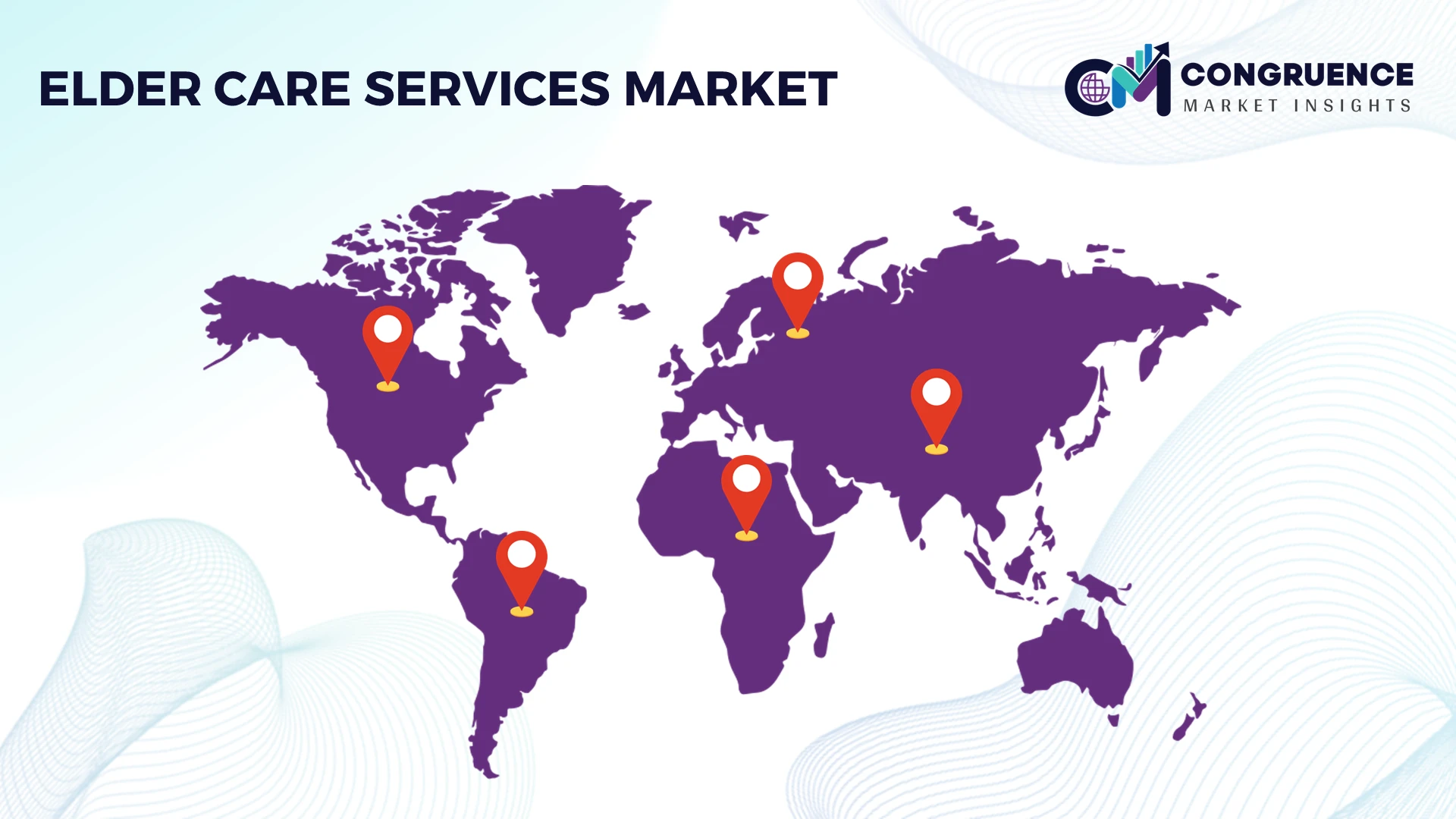
North America accounted for the largest market share at 36.8% in 2025 however, Asia-Pacific is expected to register the fastest growth, expanding at a 7.5% between 2026 and 2033.
Digital Home Care and Integrated Healthcare Networks Drive Market Leadership
North America maintains the highest concentration of organized elder care providers, supported by mature healthcare infrastructure, widespread home healthcare deployment, and advanced digital care ecosystems. The region contributes nearly 37% of global service deployment, with integrated care platforms and AI-enabled patient monitoring becoming standard among major providers. More than 62% of large organizations have adopted centralized digital care coordination systems, improving scheduling efficiency and reducing administrative workload. Strategic partnerships between healthcare systems, insurers, and technology companies continue expanding community-based care capacity. Workforce optimization, remote monitoring, and value-based care programs are strengthening operational performance while reducing unnecessary hospital utilization. Companies are prioritizing scalable home-care models, predictive analytics, and coordinated care pathways to improve service quality and long-term operational sustainability.
United States Market Outlook: The United States leads regional deployment through an extensive network of home healthcare providers, long-term care organizations, and digital health enterprises. More than 65% of large elder care organizations utilize integrated electronic care management systems, while AI-supported remote monitoring continues expanding across chronic care programs. Healthcare providers are investing in technology partnerships, caregiver training, and decentralized service delivery to improve patient outcomes, strengthen operational efficiency, and support the country's expanding aging population.
Technology-Enabled Community Care Reshapes Service Delivery
Europe continues strengthening elder care through integrated healthcare policies, digitally connected community services, and modernization of long-term care infrastructure. The region accounts for approximately 29% of global organized elder care deployment, supported by advanced public healthcare systems and increasing investment in digital health technologies. Nearly 57% of leading providers have implemented electronic care coordination platforms that improve multidisciplinary collaboration and operational transparency. Regulatory focus on quality standards and workforce modernization is encouraging providers to adopt smart monitoring systems and coordinated home-care models. Organizations are expanding partnerships with healthcare technology firms to improve care continuity while reducing operational complexity across aging populations.
Germany Market Outlook: Germany represents the region's strongest operational market due to its established long-term care insurance framework, advanced healthcare infrastructure, and rapid adoption of digital care technologies. Approximately 48% of major providers have integrated remote patient monitoring into community care services. Organizations continue modernizing care facilities, expanding home-based support programs, and investing in workforce digitalization to improve efficiency while maintaining high standards of clinical and social care delivery.
Rapid Infrastructure Expansion Accelerates Smart Elder Care
Asia-Pacific is rapidly transforming into the fastest-expanding elder care services hub through demographic shifts, healthcare infrastructure investment, and digital care deployment. The region accounts for nearly 28% of global organized elder care capacity while recording the highest rate of smart care facility expansion. More than 50% of newly developed premium elder care facilities now incorporate digital monitoring, AI-assisted care planning, and connected health technologies. Governments are supporting long-term care infrastructure modernization and community-based service expansion. Companies are increasing investments in technology-enabled home care, workforce training, and integrated healthcare ecosystems to address rising demand while improving operational scalability.
Japan Market Outlook: Japan remains the region's technology leader, combining robotics, AI-assisted caregiving, and advanced long-term care infrastructure. Over 68% of major care providers utilize digital care management systems, while robotics deployment continues expanding in residential facilities to support caregiver productivity. Enterprises are strengthening collaborations with healthcare technology developers and local governments to enhance operational efficiency and address persistent workforce shortages through intelligent automation.
Healthcare Modernization Expands Organized Care Networks
South America is strengthening elder care through healthcare modernization, expanding private care providers, and increasing adoption of home-based service models. The region contributes approximately 4.5% of organized global elder care deployment, with urban healthcare infrastructure driving service expansion. Digital appointment management and remote consultation adoption have increased by nearly 30% among larger providers. Private healthcare investment and public-private partnerships are improving service accessibility despite infrastructure disparities between metropolitan and rural areas. Companies are expanding regional networks, investing in caregiver training, and introducing technology-supported home care to improve operational consistency and service quality.
Brazil Market Outlook: Brazil represents the largest operational market in South America due to its extensive private healthcare sector and growing elderly population. Nearly 35% of organized elder care providers have expanded digital patient management capabilities over the past two years. Companies are strengthening partnerships with hospitals, insurers, and technology providers while investing in decentralized home-care services to improve accessibility and operational efficiency across major metropolitan areas.
Healthcare Infrastructure Investment Strengthens Long-Term Care
The Middle East & Africa market is advancing through healthcare infrastructure expansion, digital health investment, and increasing development of specialized long-term care facilities. The region contributes around 2.7% of organized global elder care deployment, with investment concentrated in high-income healthcare systems. More than 32% of newly established elder care facilities incorporate digital patient monitoring and integrated care management technologies. National healthcare transformation initiatives are encouraging private sector participation and operational modernization. Providers are focusing on specialized care centers, technology adoption, and workforce capability development to improve service quality and long-term care accessibility.
Saudi Arabia Market Outlook: Saudi Arabia is emerging as the region's leading market through healthcare transformation programs, smart hospital integration, and investment in specialized elder care infrastructure. Around 40% of newly commissioned long-term care facilities include connected health technologies and centralized digital management platforms. Healthcare organizations are expanding strategic partnerships, improving workforce capabilities, and integrating home-based services to support sustainable long-term care delivery under ongoing healthcare modernization initiatives.
The Elder Care Services Market is led by Brookdale Senior Living, Amedisys, LHC Group, Sunrise Senior Living, and Extendicare, competing against regional care networks and technology-enabled home healthcare providers. The top five participants collectively control approximately 24% of organized market activity, while fragmented local operators compete through localized service delivery. Competition increasingly depends on digital care coordination, workforce efficiency, and integrated home-based care rather than pricing alone. Providers using AI-enabled scheduling report nearly 20% higher caregiver utilization, while integrated remote monitoring lowers avoidable hospital transfers by about 18%. Companies are expanding through acquisitions, healthcare partnerships, and technology integration to strengthen referral networks and service continuity. The competitive landscape is shifting toward platform-enabled care ecosystems, making interoperability and operational scale more valuable than facility expansion alone. High workforce training requirements, regulatory compliance, and technology investment remain key entry barriers. Winning requires integrated care delivery, digital capability, reliable staffing, and strong healthcare partnerships.
Brookdale Senior Living Inc.
Sunrise Senior Living
Extendicare Inc.
Amedisys Inc.
LHC Group Inc.
Right at Home LLC
Home Instead
Visiting Angels
Senior Helpers
Care UK
Orpea Group
Korian Group
Genesis HealthCare
Encompass Health Corporation
Digital care management platforms, remote patient monitoring, and electronic health record integration define the current technology landscape in elder care. More than 62% of large providers have deployed centralized digital care coordination, improving caregiver scheduling efficiency by approximately 20% while reducing administrative effort by nearly 18%. Connected wearable devices and smart medication management systems enable continuous health monitoring, lowering avoidable emergency interventions by around 12%. Integration between telehealth, home-care services, and clinical records is creating unified care pathways that improve operational visibility and resource allocation across multi-site provider networks.
Emerging technologies are shifting competition toward predictive and personalized care. AI-powered risk assessment, ambient sensors, and robotics-assisted mobility support are now deployed in approximately 38% of advanced elder care facilities. Compared with legacy manual monitoring, AI-enabled care coordination improves response time by nearly 27% and reduces documentation workload by approximately 24%. Edge computing and interoperable IoT platforms further enhance real-time decision-making, allowing providers to optimize staffing levels while maintaining higher service quality across decentralized home-care networks.
Between 2026 and 2028, digital twins for care planning, generative AI assistants, and autonomous service robotics will redefine operational efficiency. Providers investing early in integrated technology ecosystems will benefit from faster service delivery, stronger workforce productivity, and improved clinical consistency. Organizations relying on fragmented legacy systems risk slower deployment, higher operating costs, and weaker competitive positioning as technology-led care models become the industry benchmark.
May 2026 Brookdale Senior Living reported first-quarter operational improvements, with weighted average occupancy increasing by 280 basis points year over year, reflecting stronger resident demand and portfolio optimization. The improvement strengthened operating efficiency and reinforced expansion capacity.
April 2025 Brookdale Senior Living announced that hundreds of its communities received "Best Senior Living" recognition for the fourth consecutive year, reinforcing quality leadership across multiple care categories and strengthening competitive brand positioning nationwide.
March 2025 Brookdale Senior Living raised USD 1.254 million through the Walk to End Alzheimer's campaign, extending cumulative fundraising beyond USD 23 million and strengthening long-term partnerships supporting dementia research, community engagement, and resident-centered care initiatives.
January 2026 Brookdale Senior Living announced it raised more than USD 1.2 million during its 2025 Alzheimer's fundraising campaign, bringing cumulative contributions since 2008 above USD 24 million and reinforcing long-term corporate commitment to dementia care advocacy. Source: Brookdale Senior Living
This report delivers a comprehensive assessment of the Elder Care Services Market across Home Care, Institutional Care, Adult Day Care, and Assisted Living, while evaluating Personal Care, Medical Care, Rehabilitation, and Palliative Care applications. End-user analysis covers Hospitals, Nursing Homes, Home Healthcare Providers, and Rehabilitation Centers across North America, Europe, Asia-Pacific, South America, and the Middle East & Africa. More than 40% of the assessment focuses on operational transformation, technology deployment, and evolving service delivery models influencing market competitiveness between 2026 and 2033.
The study examines adoption of AI-enabled care management, remote patient monitoring, robotics-assisted caregiving, predictive analytics, and digital health integration alongside deployment trends, provider strategies, and competitive positioning. It highlights regional infrastructure development, enterprise expansion priorities, partnership activity, and investment patterns, enabling stakeholders to evaluate market entry opportunities, portfolio optimization, operational efficiency improvements, and long-term strategic positioning within the evolving global elder care ecosystem.
| Report Attribute/Metric | Report Details |
|---|---|
Market Revenue in 2025 | USD 41370 Million |
Market Revenue in 2033 | USD 68005.66 Million |
CAGR (2026 - 2033) | 6.41% |
Base Year | 2025 |
Forecast Period | 2026 - 2033 |
Historic Period | 2021 - 2025 |
Segments Covered | By Type
By Application
By End-User
|
Key Report Deliverable | Revenue Forecast, Growth Trends, Market Dynamics, Segmental Overview, Regional and Country-wise Analysis, Competition Landscape |
Region Covered | North America, Europe, Asia-Pacific, South America, Middle East, Africa |
Key Players Analyzed | Brookdale Senior Living Inc., Sunrise Senior Living, Extendicare Inc., Amedisys Inc., LHC Group Inc., Right at Home LLC, Home Instead, Visiting Angels, Senior Helpers, Care UK, Orpea Group, Korian Group, Genesis HealthCare, Encompass Health Corporation |
Customization & Pricing | Available on Request (10% Customization is Free) |




