
Reports
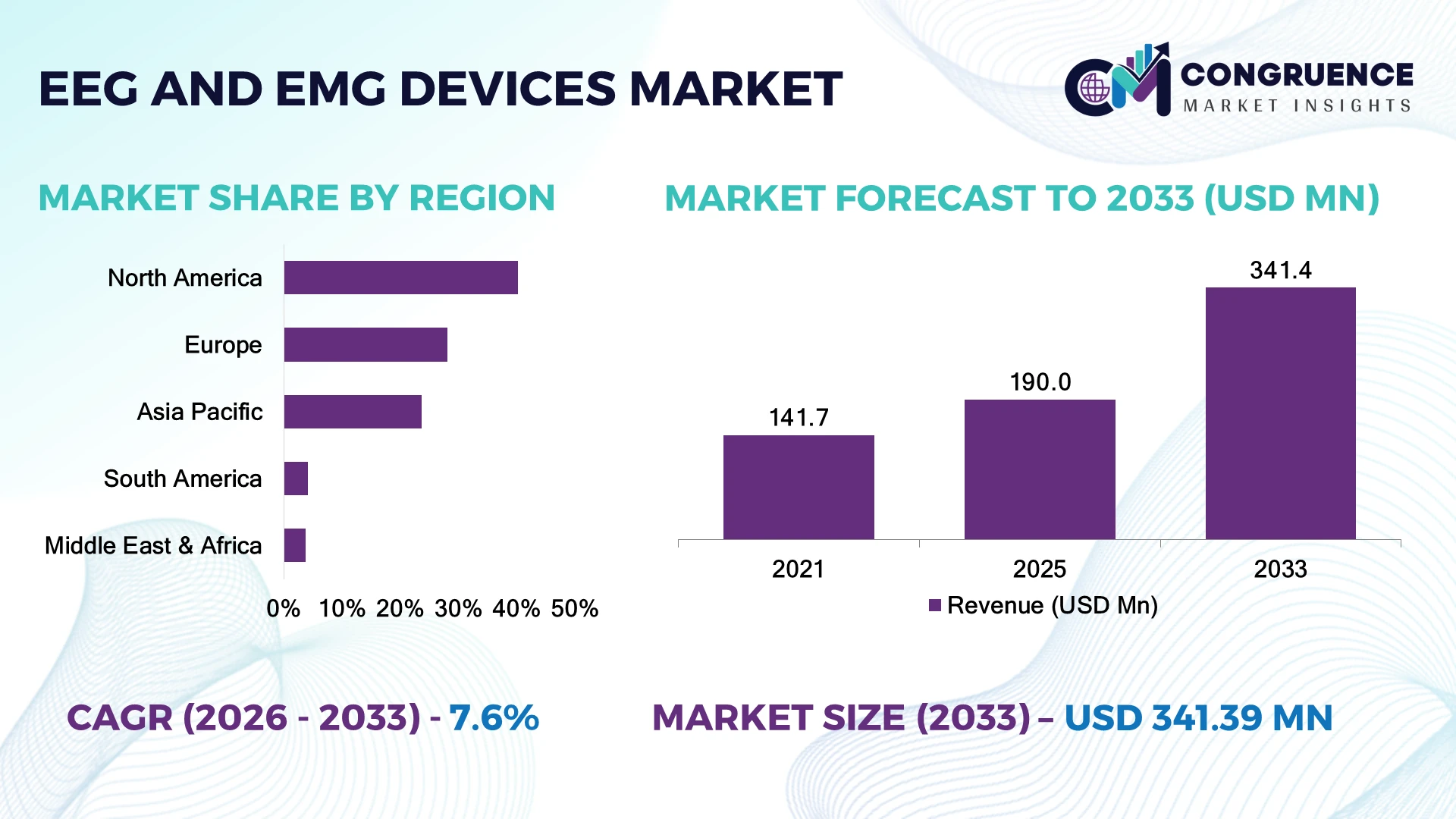
The Global EEG and EMG Devices Market was valued at USD 190.0 Million in 2025 and is anticipated to reach a value of USD 341.4 Million by 2033 expanding at a CAGR of 7.6% between 2026 and 2033. Growth is driven by AI-assisted EEG interpretation, portable neurodiagnostic systems, continuous monitoring, and faster seizure detection in acute-care settings.
The U.S. remains the leading technology hub, supported by advanced neurology infrastructure, AI-enabled device adoption, and hospital deployment; FDA records show multiple neurology-focused AI and remote-monitoring clearances, while Australia has advanced sub-scalp EEG monitoring. Signal-based AI devices represented 14.5% of FDA-authorized AI/ML devices reviewed through 2024, highlighting accelerating neurological signal analytics.
The strategic priority is shifting toward portable, AI-enabled, interoperable systems that reduce diagnostic bottlenecks and expand neurodiagnostic capacity beyond specialist centers.
Market Size & Growth: Market value reaches USD 341.4 Million by 2033 from USD 190.0 Million in 2025, expanding at 7.6%, supported by AI-assisted interpretation and portable monitoring.
Top Growth Drivers: AI-enabled diagnostics lead with 14.5% of FDA-authorized AI/ML devices using signal inputs, alongside rising remote monitoring and neurological-care digitization.
Short-Term Forecast: By 2028, portable and digitally connected systems are positioned to reduce setup and interpretation workflows by roughly 10–15% versus conventional multi-stage processes.
Emerging Technologies: AI seizure detection, wireless EEG, sub-scalp monitoring, cloud analytics, and automated EMG interpretation are reshaping high-growth neurodiagnostic workflows.
Regional Leaders: North America remains the technology leader, Europe strengthens digital neurology deployment, while Asia-Pacific accelerates hospital modernization and portable-device adoption.
Consumer/End-User Trends: Home and ambulatory monitoring is gaining traction as continuous neurological assessment moves beyond conventional hospital-based testing.
Pilot/Case Example: In 2024–2025, U.S. hospitals expanded AI-powered EEG deployment across multiple facilities, enabling faster seizure identification and reducing dependence on conventional specialist availability.
Competitive Landscape: Leading competition centers on Natus Medical, Nihon Kohden, Compumedics, Cadwell Industries, and Ceribell.
Regulatory & ESG Impact: FDA activity increasingly incorporates AI-enabled neurology and remote-monitoring technologies, strengthening requirements for validated algorithms, cybersecurity, and clinical performance.
Investment & Funding: Investment is concentrating on AI-enabled EEG, wireless sensors, remote monitoring, and software platforms, shifting competitive spending from hardware-only systems toward integrated diagnostic ecosystems.
Innovation & Future Outlook: Next-generation systems will combine AI interpretation, wearable electrodes, cloud connectivity, and longitudinal patient data to create faster, more decentralized neurodiagnostic pathways.
EEG and EMG Devices are increasingly concentrated in epilepsy monitoring, sleep diagnostics, neuromuscular assessment, intensive-care surveillance, and ambulatory neurology. AI-enabled signal processing is strengthening clinical workflows, with signal inputs accounting for 14.5% of FDA-authorized AI/ML devices through 2024. Regulatory movement toward AI-enabled neurology and remote monitoring is accelerating product redesign, interoperability, and decentralized deployment.
EEG and EMG devices are becoming strategically important because neurological diagnosis is moving from episodic testing toward continuous, software-assisted monitoring. Competitive advantage increasingly depends on combining high-fidelity physiological signals with automated interpretation, remote connectivity, and faster clinical decision support. This shift is particularly important as hospitals face specialist shortages and increasingly complex neurological workloads.
Technology architecture is also changing. AI-assisted signal classification can automate portions of waveform review that traditionally required manual screening, while portable systems reduce dependence on dedicated diagnostic rooms and fixed infrastructure. In the United States, signal-based AI represents 14.5% of FDA-authorized AI/ML devices, establishing a measurable technology pathway for EEG and related neurodiagnostic applications.
Regional deployment remains uneven: U.S. hospitals are advancing AI-supported acute-care EEG, while Australia has moved toward remote sub-scalp EEG monitoring. In 2025, U.S. hospitals continued expanding AI-powered EEG systems across multiple facilities, demonstrating practical movement from pilot deployment to multi-site implementation. Over the next 2–3 years, companies prioritizing portable platforms, interoperable software, AI validation, and hospital partnerships will gain stronger positioning.
AI-enabled neurological signal analysis is becoming the central technology catalyst, with signal inputs accounting for 14.5% of FDA-authorized AI/ML devices through 2024. Rapid seizure detection, automated waveform screening, and continuous monitoring are increasing the clinical value of EEG beyond conventional testing. U.S. hospitals are already deploying AI-powered EEG across multiple facilities, demonstrating operational acceptance of faster decision-support workflows. The FDA's expanding AI-device framework further reinforces investment in validated software and connected hardware. Companies are responding through algorithm development, cloud-enabled platforms, and hospital partnerships. The non-obvious advantage is workflow compression: vendors that integrate signal acquisition, automated interpretation, and reporting into one platform can compete on clinical throughput rather than hardware specifications alone.
High equipment costs, specialist requirements, interoperability gaps, and dependence on trained neurodiagnostic personnel constrain deployment outside advanced hospitals. Portable and remote systems address infrastructure limitations, but reimbursement structures and clinical validation requirements remain significant barriers. Conventional EEG workflows also require electrode preparation, monitoring infrastructure, and specialist interpretation, increasing operational complexity compared with simplified digital platforms. In the United States, only 14.5% of FDA-authorized AI/ML devices identified through 2024 used signals as their primary input, indicating that signal-based AI remains less mature than image-based applications. Companies are reducing exposure through modular systems, software upgrades, remote interpretation partnerships, and localized service networks. The key constraint is not hardware availability but the ability to integrate devices into existing clinical workflows without creating additional labor or IT burdens.
Remote and continuous EEG represents a high-value opportunity as neurodiagnostics expand beyond specialist centers. The FDA granted De Novo classification to a sub-scalp implanted EEG system for remote patient monitoring in 2025, establishing a regulatory pathway for longer-duration neurological surveillance. AI-based signal processing, wireless acquisition, and cloud analytics can reduce dependence on continuous bedside specialist review while supporting longitudinal datasets. Australia is emerging as an important innovation market for remote EEG technologies, while U.S. hospitals are expanding AI-enabled seizure-monitoring deployment. Companies are positioning through sensor miniaturization, software partnerships, and remote-care ecosystems. A particularly attractive opportunity lies in combining EEG with longitudinal patient monitoring, creating recurring software and analytics value rather than relying solely on one-time equipment sales.
Scaling advanced EEG and EMG platforms requires reliable interoperability across hospital information systems, neurological databases, cloud environments, and legacy diagnostic equipment. AI adds another layer of complexity because algorithm performance must remain clinically reliable across patient populations, signal quality conditions, and device configurations. FDA records show continued expansion of AI-enabled neurological technologies, including automated EEG analysis and remote monitoring, increasing the importance of regulatory evidence and lifecycle controls. Cybersecurity, workforce training, and algorithm governance will remain critical execution requirements as monitoring becomes increasingly connected. Companies must invest in standardized data architectures, validation programs, cybersecurity controls, and clinician partnerships. The strongest long-term position will belong to vendors that make advanced systems interoperable by design rather than treating connectivity as an aftermarket feature.
Wireless Neurodiagnostic Deployment: Hospitals are shifting from fixed EEG configurations toward portable and wireless systems, with portable/wearable EEG platforms projected to expand materially faster than stationary systems. U.S. providers are prioritizing mobility to extend monitoring across ICUs, emergency units, and ambulatory settings, while manufacturers are integrating wireless acquisition, cloud connectivity, and lighter electrode assemblies to reduce setup complexity and improve utilization.
AI-Enabled Signal Processing: Automated waveform interpretation is moving into routine neurodiagnostic workflows, with signal-based technologies representing 14.5% of FDA-authorized AI/ML devices. AI-supported seizure detection, artifact rejection, and automated EMG analysis are reducing manual review requirements and accelerating clinical triage. Companies are responding through software partnerships and embedded analytics, shifting competition toward algorithm accuracy, interoperability, and workflow efficiency rather than hardware specifications alone.
Home-Based Monitoring Expansion: Home and ambulatory neurological testing is gaining operational traction as providers address specialist shortages and demand for longer-duration recordings. Home-care EEG is projected to grow faster than hospital-centered deployment, while wearable and compact systems are gaining adoption for continuous monitoring. Companies are redesigning platforms around simplified electrode placement, remote data transmission, and centralized interpretation, creating new service models that reduce dependence on dedicated neurodiagnostic rooms.
Electrode Technology Transition: Electrode design is becoming a major differentiator as manufacturers move beyond conventional wet systems toward dry and semi-dry formats. Wet electrodes still represented about 48.1% of EEG electrode usage in 2025, while semi-dry technologies are advancing rapidly through improved application speed and patient comfort. Supply-chain pressure on consumables is also encouraging reusable and lower-maintenance designs, prompting companies to invest in advanced materials, disposable optimization, and integrated electrode-system architectures.
Electroencephalography remains the leading type, accounting for approximately 60% of combined EEG and EMG equipment installations, supported by broad use across epilepsy diagnosis, sleep medicine, critical-care monitoring, and neurological assessment. Electromyography represents roughly 40% and retains strong demand in peripheral nerve, neuromuscular, rehabilitation, and musculoskeletal evaluations. EEG's broader hospital deployment gives manufacturers greater scale advantages, while EMG continues to benefit from specialized diagnostic demand. Companies are therefore maintaining large EEG portfolios while expanding integrated EEG-EMG platforms.
The fastest-moving type is advanced portable and wireless EEG within the broader EEG category, driven by ambulatory monitoring and decentralized diagnostics. Portable systems can reduce room and infrastructure requirements by roughly 20–30% compared with conventional fixed workflows, strengthening adoption outside tertiary hospitals. EMG manufacturers are simultaneously improving surface and high-density acquisition to increase measurement precision. The strategic shift is toward modular platforms capable of supporting multiple neurophysiology studies rather than single-purpose equipment.
Hospitals and clinics remain the dominant application group, representing approximately 55–60% of global EEG and EMG equipment demand because these facilities combine high neurological case volumes, intensive-care monitoring, epilepsy services, sleep laboratories, and neuromuscular diagnostics. Diagnostic centers follow with roughly 20–25%, supported by outpatient testing and faster turnaround requirements. Research institutes and other applications occupy smaller shares but remain strategically important for advanced signal analysis, clinical trials, and emerging neurotechnology development.
The fastest operational shift is toward continuous and ambulatory neurological monitoring, particularly where hospitals need to extend specialist capacity without expanding dedicated diagnostic rooms. Portable deployment can lower infrastructure requirements by around 20%, while automated signal analysis can shorten review workloads by approximately 10–15% in suitable workflows. Companies are responding with integrated acquisition-and-analysis platforms, centralized monitoring software, and hospital partnerships. The key business implication is that application leadership increasingly depends on workflow integration and utilization rates rather than device placement alone.
Hospitals and clinics represent the leading end-user group, capturing approximately 57% of EEG-focused device demand because of their concentrated neurological workloads, specialist infrastructure, and ability to support high-value monitoring procedures. Diagnostic centers account for roughly 20%, while ambulatory surgery centers, research institutions, and homecare settings represent smaller but increasingly differentiated buying groups. Hospital purchasing remains specification-driven, emphasizing signal quality, interoperability, service support, and integration with electronic clinical systems.
Homecare settings are emerging as the fastest-shifting end-user category as portable EEG, wireless electrodes, and remote interpretation reduce dependence on hospital-based monitoring. Home-based deployment can lower facility requirements by approximately 20–30% for suitable monitoring pathways, while centralized review improves utilization of specialist expertise. Companies are responding with subscription-oriented monitoring services, simplified wearable systems, and partnerships with telehealth providers. The competitive implication is clear: vendors serving hospitals must simultaneously build decentralized platforms for homecare and ambulatory customers to capture the next wave of neurodiagnostic deployment.
North America accounted for the largest market share at 40.2% in 2025 however, Asia-Pacific is expected to register the fastest growth, expanding at a CAGR of 8.6% between 2026 and 2033.
North America held approximately 40.2% of the global EEG and EMG Devices Market in 2025, supported by dense hospital networks, established neurodiagnostic laboratories, strong reimbursement structures, and high utilization of EEG and EMG procedures. The United States represented roughly 85% of regional demand, making it the principal procurement and technology-development hub. Point-of-care EEG adoption is expanding across emergency departments, ICUs, and community hospitals, while established electrodiagnostic laboratories continue upgrading digital platforms. More than 20 FDA clearances for relevant electrodiagnostic technologies during 2024 reinforced the region's technology-led procurement environment. U.S. suppliers are increasingly combining hardware, AI analytics, remote monitoring, and service contracts, while Canadian providers are expanding decentralized diagnostic pathways. The strategic advantage is concentrated clinical infrastructure that enables faster validation and commercialization of advanced neurodiagnostic systems.
United States Market Outlook: The United States dominates North American deployment, accounting for approximately 85% of regional EEG and EMG activity. Its advantage stems from extensive epilepsy-monitoring capacity, mature EMG laboratories, advanced reimbursement infrastructure, and rapid adoption of portable EEG in emergency and intensive-care settings. Major hospital networks are prioritizing interoperable systems that connect neurophysiology equipment with electronic medical records and centralized monitoring platforms.
Europe represented approximately 28.1% of global EEG and EMG Devices Market activity in 2025, supported by established neurology services, structured public procurement, and strong replacement demand for aging diagnostic infrastructure. Germany, the United Kingdom, France, Italy, and Spain collectively account for a substantial portion of regional deployment, with Germany, France, and the UK contributing nearly 63% of European EEG equipment installations. Around 68% of European neurological hospitals have integrated digital EEG systems with electronic medical-record platforms, strengthening interoperability and workflow efficiency. EU procurement is also emphasizing lifecycle support, installation, training, and standardized digital connectivity. Companies are responding through modular architectures, longer service agreements, and software-enabled upgrades rather than relying solely on complete system replacement. The strategic shift favors vendors capable of meeting clinical interoperability requirements while reducing the operational burden associated with legacy equipment.
Germany Market Outlook: Germany is Europe's most strategically important manufacturing and clinical technology hub for EEG and EMG systems, supported by advanced neurological centers, established medical-device engineering, and structured hospital procurement. German neurological facilities are increasingly replacing legacy systems with digitally integrated platforms. Hospitals accounted for more than half of the country's brain-monitoring market in 2025, reinforcing the importance of institutional procurement and long-term service capability.
Asia-Pacific represented approximately 23.7% of global EEG and EMG Devices Market activity in 2025 and is emerging as the fastest-expanding deployment base. China, Japan, India, South Korea, and Australia account for the majority of advanced neurodiagnostic installations, with China, Japan, India, and South Korea representing nearly 72% of regional EEG equipment installations. Around 46% of hospitals upgraded conventional EEG systems to digital platforms during 2025, while portable EEG adoption increased approximately 38% as outpatient and rural diagnostic programs expanded. China is strengthening domestic medical-device manufacturing, Japan is emphasizing high-precision neurotechnology, and India is expanding cost-efficient neurological infrastructure. Companies are responding through local distribution partnerships, regional manufacturing, simplified portable systems, and software localization. The strategic opportunity lies in combining lower-cost hardware with cloud-enabled interpretation for capacity-constrained healthcare systems.
China Market Outlook: China represents the region's largest strategic manufacturing and deployment base, supported by extensive hospital modernization, domestic medical-device production, and large urban neurological-care networks. Government-backed healthcare infrastructure investment is accelerating digital diagnostic adoption, while domestic suppliers are increasingly competing on cost, localization, and service coverage. The country's manufacturing scale also provides an important platform for regional export and component supply.
South America accounted for approximately 4.2% of the global EEG and EMG Devices Market in 2025, with demand concentrated in Brazil, Argentina, Chile, and Colombia. Brazil represents the dominant procurement market because of its large hospital network, private diagnostic chains, and concentration of neurological specialists. Demand is increasingly shifting from basic fixed EEG systems toward digital and portable equipment as diagnostic centers modernize. Private healthcare networks are expanding specialized neurology services, while public hospitals remain more sensitive to procurement budgets and equipment replacement cycles. Portable systems are gaining importance because they reduce infrastructure requirements for smaller facilities and outreach programs. Companies are responding through distributor partnerships, localized technical support, financing arrangements, and modular equipment portfolios. The strategic constraint remains fragmented procurement, making local service capability and cost control more important than premium specifications in many secondary markets.
Brazil Market Outlook: Brazil is the largest South American opportunity, supported by its extensive private hospital network, concentration of specialist neurological services, and expanding diagnostic-center infrastructure. Large metropolitan areas such as São Paulo and Rio de Janeiro account for a significant portion of advanced neurodiagnostic activity. Private providers increasingly favor digitally connected systems, while public-sector procurement remains focused on equipment reliability, maintenance coverage, and acquisition cost.
The Middle East & Africa region represented approximately 3.8% of global EEG equipment activity in 2025, with Gulf countries driving a disproportionate share of advanced deployment. Saudi Arabia and the United Arab Emirates together accounted for approximately 58% of regional EEG installations, supported by hospital modernization, specialist-care expansion, and digital-health investment. Around 41% of tertiary hospitals in Saudi Arabia and the UAE adopted digital EEG systems, while portable EEG accounted for approximately 27% of regional installations. Gulf healthcare groups are increasingly deploying advanced neurology platforms through centralized procurement and international technology partnerships. African markets remain more fragmented, with equipment demand concentrated in major urban hospitals and specialist centers. Companies are responding through distributor networks, localized training, leasing models, and partnerships with hospital groups. The strategic priority is scalable equipment that can operate efficiently where specialist coverage and technical infrastructure remain uneven.
Saudi Arabia Market Outlook: Saudi Arabia is the leading strategic market in the region, supported by healthcare modernization, large tertiary hospital networks, and sustained investment in specialized neurological services. Digital EEG adoption is expanding across major hospitals as providers upgrade diagnostic infrastructure and integrate connected clinical systems. The country's centralized healthcare investment model creates opportunities for vendors offering multi-site deployment, long-term maintenance, clinician training, and interoperable neurodiagnostic platforms.
Natus, Nihon Kohden, Cadwell, Compumedics, and Masimo compete globally, while regional OEMs challenge them on price and localized service globally. The top five players collectively hold an estimated 42% share, leaving a fragmented field for specialist suppliers today. Competition centers on technology, workflow integration, service coverage, and procurement economics. AI-enabled platforms command roughly 15% premium positioning, while portable systems can cut setup requirements by 20% versus fixed configurations. Wireless and cloud-connected solutions are gaining preference as hospitals prioritize faster deployment and centralized monitoring. Natus is strengthening its portfolio through acquisitions, Nihon Kohden through specialized neurological integration, and Cadwell through partnerships and home-monitoring investments. The competitive shift is moving from hardware specifications toward software intelligence, interoperability, and recurring clinical workflows. Entry barriers remain high because regulatory validation, clinical datasets, specialist support, and hospital integration require substantial investment. Winning requires validated AI, dependable signal quality, broad service infrastructure, and flexible deployment economics.
Natus Medical Incorporated
Nihon Kohden Corporation
Cadwell Industries, Inc.
Compumedics Limited
Masimo Corporation
Neurosoft
EB Neuro S.p.A.
Micromed S.p.A.
Mitsar Co., Ltd.
Electrical Geodesics, Inc.
Epitel, Inc.
Ceribell, Inc.
EEG and EMG technology is moving from fixed, operator-intensive systems toward wireless acquisition, AI-assisted interpretation, high-density recording, and integrated ultrasound. AI-based EEG interpretation can reduce manual review workload by 10–20% in suitable workflows, while high-density EMG captures finer spatial information than conventional traces. By 2028, connected platforms will combine acquisition, analytics, reporting, and remote review, improving utilization across hospitals and diagnostic centers.
Wireless and wearable EEG systems are gaining traction because they reduce cabling, setup constraints, and movement restrictions. Compared with fixed configurations, portable workflows can reduce preparation requirements by approximately 20%. Cloud-connected monitoring also enables centralized specialist review across multiple sites, giving hospital networks a utilization advantage. Companies with software ecosystems benefit most because interoperability turns devices into recurring clinical platforms rather than isolated capital purchases.
Next-generation systems will integrate AI, neuromuscular ultrasound, automated reporting, and adaptive signal processing. Cadwell’s synchronized EMG-ultrasound workflow demonstrates the shift toward multimodal diagnostics, while AI-enabled EEG platforms are moving interpretation closer to real time. Through 2026–2028, technology leaders will compete on validated algorithms, cybersecurity, and interoperability. The gains will come from workflow automation rather than incremental hardware upgrades, making software integration and data architecture clear, decisive investment priorities now.
April 2025 Cadwell invested in Seer Medical to expand home-based epilepsy diagnostics, combining cloud and AI with video EEG. The investment strengthened Cadwell’s decentralized-care portfolio and extended neurodiagnostic reach beyond hospitals, supporting scalable ambulatory monitoring and home-care models. Source: cadwell.com
November 2024 Nihon Kohden acquired a 71.4% stake in NeuroAdvanced, parent of Ad-Tech Medical Instrument, expanding intracranial electrode capabilities. The transaction integrated EEG systems with epilepsy-focused consumables, strengthening Nihon Kohden’s position in diagnostics for drug-resistant epilepsy and procedures. Source: nihonkohden.com
June 2025 Masimo reported results for SedLine EEG-guided pediatric anesthesia: emergence was 53% faster and PACU discharge 48% faster, with 14% lower emergence-delirium incidence. The findings strengthened EEG-guided anesthesia as an operational efficiency tool for perioperative recovery workflows. Source: masimo.com
March 2025 Epitel’s REMI Remote EEG Monitoring System appeared in FDA digital-health clearances, supporting EEG monitoring. The system enables remote EEG using wearable sensors and cloud connectivity, strengthening decentralized seizure surveillance in underserved clinical settings where wired EEG limits access.
The EEG and EMG Devices Market Report covers device types, clinical applications, end-user groups, regional markets, technology transitions, competitive positioning, and deployment patterns across 2026–2033. Coverage includes hospitals and clinics, diagnostic centers, ambulatory settings, research institutions, and home-based monitoring, with emphasis on EEG, EMG, digital neurodiagnostics, wireless acquisition, AI-assisted interpretation, and integrated neurophysiology workflows.
The report evaluates North America, Europe, Asia-Pacific, South America, and Middle East & Africa, highlighting country-level adoption, infrastructure concentration, manufacturing capabilities, procurement behavior, and emerging niche opportunities. North America accounts for about 40.2% of 2025 market activity, while Asia-Pacific represents approximately 23.7% and shows stronger deployment momentum. Company profiling, technology benchmarking, market dynamics, and strategic developments support investment planning, expansion decisions, partnership targeting, competitive positioning, and technology prioritization through 2033.
| Report Attribute / Metric | Details |
|---|---|
| Market Revenue (2025) | USD 190.0 Million |
| Market Revenue (2033) | USD 341.4 Million |
| CAGR (2026–2033) | 7.6% |
| Base Year | 2025 |
| Forecast Period | 2026–2033 |
| Historic Period | 2021–2025 |
| Segments Covered |
By Type
By Application
By End-User
|
| Key Deliverables | Revenue Forecast; Market Trends; Growth Drivers & Restraints; Technology Insights; Segmentation Analysis; Regional Insights; Competitive Landscape; Regulatory & ESG Overview; Recent Developments |
| Regions Covered | North America; Europe; Asia-Pacific; South America; Middle East & Africa |
| Companies Profiled | Natus Medical Incorporated; Nihon Kohden Corporation; Cadwell Industries, Inc.; Compumedics Limited; Masimo Corporation; Neurosoft; EB Neuro S.p.A.; Micromed S.p.A.; Mitsar Co., Ltd.; Electrical Geodesics, Inc.; Epitel, Inc.; Ceribell, Inc. |
| Customization & Pricing | Available on Request (10% Customization Free) |




