
Reports
The Global Drug Storage Equipment Market was valued at USD 3,016.7 Million in 2025 and is anticipated to reach a value of USD 4,918.1 Million by 2033 expanding at a CAGR of 6.3% between 2026 and 2033. Growth is being driven by expanding biologics production, stricter pharmaceutical storage regulations, increasing vaccine distribution capacity, and rising adoption of temperature-monitored storage infrastructure across hospitals, pharmacies, and life science facilities.
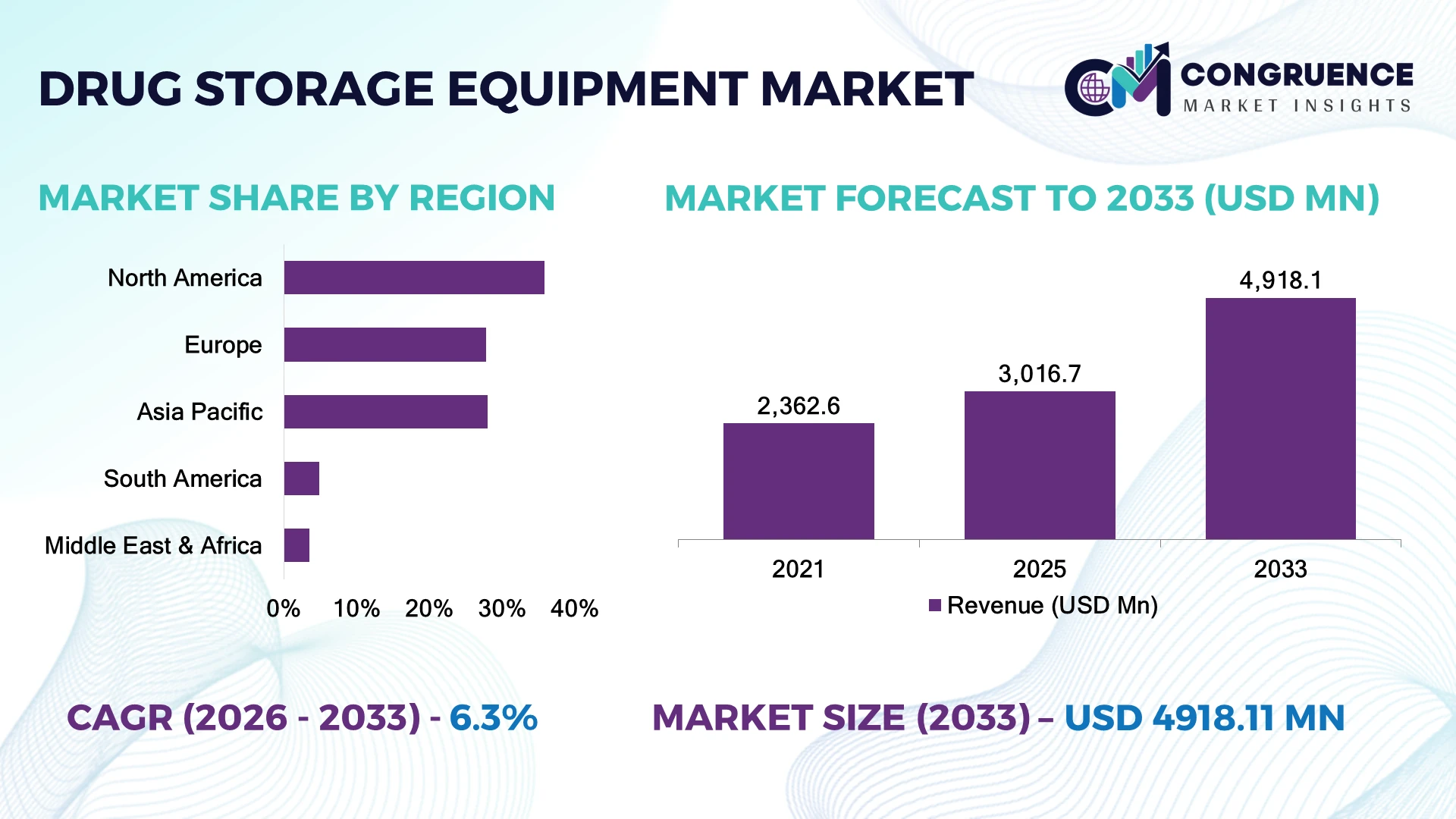
The United States dominates the market with approximately 34% global demand, supported by large pharmaceutical manufacturing capacity, over 6,000 hospital facilities, expanding specialty pharmacy networks, and continuous investment in cold-chain modernization. Compared with Germany, where pharmaceutical storage automation adoption exceeds 48%, the U.S. benefits from broader deployment across healthcare and biopharma manufacturing. Supply-chain resilience initiatives following global pharmaceutical disruptions continue accelerating investment in intelligent storage systems with real-time monitoring and compliance capabilities.
Strategic investments increasingly favor digitally connected, regulation-compliant storage equipment that improves inventory integrity while reducing operational risk across pharmaceutical supply chains.
Market Size & Growth: USD 3,016.7 million in 2025 reaching USD 4,918.1 million by 2033 at 6.3% CAGR, supported by expanding biologics storage infrastructure.
Top Growth Drivers: Cold-chain expansion (+31%), biologics demand (+27%), automated inventory systems (+24%).
Short-Term Forecast: By 2028, automated temperature monitoring improves storage compliance by nearly 30% while reducing manual inspections.
Emerging Technologies: AI monitoring, IoT sensors, RFID tracking, and cloud-based inventory management accelerate intelligent pharmaceutical storage.
Regional Leaders: North America, Europe, and Asia-Pacific strengthen deployment through healthcare modernization and pharmaceutical manufacturing expansion.
Consumer/End-User Trends: Nearly 62% of hospitals prioritize connected storage equipment supporting continuous environmental monitoring.
Pilot/Case Example: 2025 hospital pharmacy modernization projects reduced medication retrieval time by approximately 22% using automated cabinets.
Competitive Landscape: Top manufacturers collectively account for nearly 46% market share through integrated compliance and cold-storage solutions.
Regulatory & ESG Impact: Energy-efficient refrigeration lowers electricity consumption by nearly 18% while supporting pharmaceutical compliance standards.
Investment & Funding: Healthcare infrastructure investment increasingly prioritizes digital pharmacy storage and compliant cold-chain facilities amid regional supply-chain expansion.
Innovation & Future Outlook: Predictive maintenance, remote diagnostics, and smart inventory analytics strengthen operational resilience across advanced pharmaceutical storage networks.
Drug storage equipment demand continues expanding across hospitals, pharmaceutical manufacturing, research laboratories, and specialty pharmacies as temperature-sensitive medicines and biologics require increasingly precise environmental control. Smart cabinets equipped with IoT monitoring improve inventory visibility by nearly 25%, while stricter pharmaceutical compliance standards encourage automated storage validation. Healthcare providers are prioritizing digitally connected storage ecosystems, setting the foundation for broader strategic market transformation.
Drug storage equipment has become a strategic component of pharmaceutical operations as biologics, specialty medicines, vaccines, and personalized therapies require tighter environmental control and continuous regulatory compliance. Healthcare providers, pharmaceutical manufacturers, and distribution networks are modernizing storage infrastructure to improve product integrity while reducing inventory losses. Supply-chain resilience initiatives are accelerating investments in digitally connected storage systems capable of supporting real-time monitoring across complex healthcare ecosystems.
Smart drug storage equipment delivers measurable operational improvements compared with conventional refrigeration systems. IoT-enabled monitoring and automated inventory platforms reduce temperature excursions by approximately 35% while improving inventory accuracy by nearly 28%. North America emphasizes regulatory compliance and digital pharmacy automation, whereas Asia-Pacific focuses on expanding pharmaceutical manufacturing capacity and hospital infrastructure to accommodate rising healthcare demand. During the next two to three years, intelligent storage platforms are expected to become standard across high-value pharmaceutical supply chains.
Healthcare systems increasingly deploy automated dispensing cabinets integrated with centralized inventory software to improve medication security, traceability, and workflow efficiency. Manufacturers continue expanding digital monitoring capabilities, predictive maintenance services, and strategic partnerships with healthcare providers. Organizations investing in intelligent, compliant, and scalable storage infrastructure will strengthen operational resilience while maintaining long-term competitive advantage in an increasingly regulated pharmaceutical environment.
The rapid expansion of biologics, cell therapies, and specialty pharmaceuticals is accelerating demand for advanced drug storage equipment across hospitals, pharmaceutical manufacturers, and distribution facilities. Nearly 58% of newly approved specialty medicines require controlled-temperature storage, while automated pharmacy storage deployment has increased by approximately 24% in large healthcare institutions. In the United States, continued investment in pharmaceutical manufacturing under domestic supply-chain initiatives is strengthening cold-storage capacity and inventory resilience. This shift directly improves product integrity, minimizes wastage, and strengthens regulatory compliance. Equipment manufacturers are responding through smart refrigeration platforms, IoT-enabled monitoring, strategic partnerships with healthcare providers, and expanded production of validated storage systems designed for high-value pharmaceutical inventories. The strongest competitive advantage increasingly comes from integrated monitoring capabilities rather than standalone refrigeration performance.
Stringent pharmaceutical storage standards significantly increase equipment acquisition and operational costs, particularly for mid-sized healthcare providers and regional distributors. Energy expenses account for nearly 18% of total operating costs in pharmaceutical cold-storage facilities, while validation and qualification activities can increase installation expenditure by approximately 20%. India and several emerging healthcare markets continue facing uneven cold-chain infrastructure, limiting deployment consistency outside major metropolitan areas. These structural constraints delay modernization projects, reduce procurement flexibility, and pressure operational margins. Manufacturers are mitigating risks through localized assembly, long-term maintenance contracts, modular storage systems, and energy-efficient refrigeration technologies that lower lifecycle costs while maintaining compliance with evolving pharmaceutical storage regulations.
Digital pharmacy transformation is creating substantial opportunities for intelligent drug storage ecosystems combining automated dispensing, RFID tracking, predictive maintenance, and cloud-based inventory management. Smart inventory platforms improve stock accuracy by nearly 30%, while predictive monitoring reduces unexpected storage failures by approximately 22%. Japan is accelerating adoption of AI-assisted pharmacy automation to address workforce shortages and improve medication traceability across healthcare facilities. Manufacturers are expanding R&D investments into connected storage cabinets, robotic retrieval systems, and interoperable software platforms that integrate directly with hospital information systems. A particularly attractive opportunity lies in subscription-based monitoring services that generate recurring revenue while improving compliance, operational efficiency, and equipment utilization across pharmaceutical supply chains.
Successful deployment increasingly depends on integrating storage equipment with hospital information systems, pharmacy management platforms, and enterprise compliance software without disrupting clinical operations. Approximately 27% of healthcare facilities report interoperability challenges during digital pharmacy upgrades, while cybersecurity requirements increase implementation timelines by nearly 18%. Germany's highly regulated healthcare environment demonstrates that digital validation and system compatibility are becoming as important as refrigeration performance itself. Companies must invest in standardized communication protocols, cybersecurity architecture, workforce training, and scalable software ecosystems to ensure reliable long-term deployment. Organizations capable of delivering fully interoperable, secure, and easily upgradeable storage platforms will sustain stronger competitive positioning as healthcare digitalization accelerates.
Smart Storage Expansion: IoT-enabled storage equipment now represents nearly 38% of new pharmaceutical storage installations, while automated environmental monitoring reduces manual inspections by approximately 35%. Hospitals increasingly integrate remote monitoring into centralized pharmacy operations, prompting manufacturers to scale cloud connectivity and predictive diagnostics as compliance requirements become more stringent.
Energy-Efficient Refrigeration Designs: Advanced variable-speed compressors and natural refrigerants lower electricity consumption by nearly 18% while extending equipment lifespan by approximately 15%. Rising energy costs across Europe encourage healthcare providers to replace conventional refrigeration systems, leading manufacturers to prioritize environmentally efficient product portfolios and modernization partnerships.
Automation in Hospital Pharmacies: Automated dispensing cabinets improve medication retrieval efficiency by approximately 28% and reduce inventory discrepancies by nearly 20%. Healthcare labor shortages in Japan and North America are accelerating workflow automation, encouraging suppliers to integrate robotic dispensing, barcode verification, and centralized inventory management into storage infrastructure.
Modular Cold-Chain Infrastructure: Modular pharmaceutical storage systems reduce installation time by nearly 25% while improving facility expansion flexibility by approximately 30%. Growing vaccine production and specialty drug distribution require scalable storage capacity, leading manufacturers to develop configurable equipment platforms that simplify deployment across hospitals, research laboratories, and pharmaceutical distribution centers without interrupting ongoing operations.
The Drug Storage Equipment market is segmented into Refrigerators, Freezers, Ultra-Low Temperature (ULT) Freezers, Controlled Room Temperature (CRT) Storage Cabinets, and Automated Drug Storage Systems. Refrigerators accounted for approximately 39.6% of the market in 2025, supported by their extensive deployment across hospitals, pharmacies, diagnostic laboratories, and pharmaceutical distribution centers. Their ability to maintain stable storage conditions for vaccines, injectable medicines, and temperature-sensitive pharmaceuticals at relatively low operating costs makes them the preferred solution. Freezers continue serving frozen plasma and biologics storage requirements, while CRT storage cabinets remain strategically important for medicines requiring controlled ambient conditions.
Automated Drug Storage Systems represent the fastest-growing segment as healthcare organizations accelerate pharmacy automation, inventory traceability, and compliance monitoring. Ultra-Low Temperature Freezers are also expanding rapidly with biologics and cell therapy production, recording deployment growth of nearly 19% across advanced pharmaceutical facilities. Approximately 34% of newly commissioned pharmaceutical storage projects now incorporate digital temperature monitoring, prompting manufacturers to expand IoT-enabled refrigeration platforms, predictive maintenance capabilities, and integrated monitoring software. Investment priorities are steadily shifting toward intelligent storage ecosystems that improve compliance, operational efficiency, and lifecycle performance.
According to a 2025 International Society for Pharmaceutical Engineering (ISPE) industry assessment, pharmaceutical manufacturers are accelerating investment in digitally monitored cold-storage infrastructure to strengthen product traceability, data integrity, and regulatory compliance throughout the supply chain.
The Drug Storage Equipment market is segmented into Hospital Pharmacies, Retail Pharmacies, Pharmaceutical & Biotechnology Companies, Research Laboratories, and Blood Banks & Vaccine Storage Facilities. Hospital Pharmacies accounted for approximately 37.8% of total demand in 2025 due to continuous medication handling, stringent storage compliance requirements, and increasing deployment of automated dispensing infrastructure. Large healthcare systems continue integrating refrigerated storage with pharmacy management platforms, improving inventory visibility while reducing medication wastage. Retail pharmacies remain significant users as vaccine administration expands, whereas research laboratories require specialized storage for clinical samples and investigational therapeutics.
Pharmaceutical & Biotechnology Companies represent the fastest-growing application as biologics manufacturing, contract drug production, and specialty therapeutics continue expanding. Automated inventory platforms have improved storage accuracy by approximately 27%, while digital environmental monitoring adoption has exceeded 42% across newly established pharmaceutical facilities. Blood banks and vaccine storage facilities remain strategically important for national immunization programs and emergency preparedness initiatives. Equipment suppliers are responding through modular cold-storage solutions, cloud-based compliance software, and integrated automation platforms that strengthen operational reliability and product integrity.
Findings published during 2025 by the International Pharmaceutical Federation (FIP) indicate that healthcare providers continue expanding automated pharmacy infrastructure to improve medication safety, inventory accuracy, and cold-chain compliance across hospital operations.
The Drug Storage Equipment market is segmented into Hospitals, Pharmaceutical Companies, Pharmacies, Research Institutes, and Blood Banks. Hospitals accounted for approximately 41.7% of total demand in 2025 because of extensive pharmaceutical inventories, continuous medication availability requirements, and strict storage compliance obligations. Large hospital networks increasingly invest in connected storage infrastructure supporting automated dispensing, centralized inventory management, and continuous temperature validation. Pharmaceutical companies remain major purchasers for manufacturing and quality assurance facilities, while pharmacies continue upgrading refrigeration infrastructure to accommodate expanding specialty drug portfolios.
Research Institutes represent the fastest-growing end-user segment as biologics development, clinical trials, and precision medicine research accelerate worldwide. Automated monitoring deployment has increased by nearly 24% among research facilities, while pharmaceutical manufacturers have expanded investment in validated storage infrastructure by approximately 21%. Equipment suppliers are strengthening competitive positioning through customized storage solutions, preventive maintenance programs, and integrated software ecosystems designed for highly regulated healthcare environments. Future demand is increasingly shifting toward intelligent, compliance-driven storage platforms that support end-to-end pharmaceutical traceability.
A 2026 Healthcare Information and Management Systems Society (HIMSS) enterprise survey highlighted continued growth in connected hospital pharmacy infrastructure, with healthcare organizations prioritizing digitally monitored medication storage to strengthen inventory visibility, patient safety, and regulatory compliance.
North America accounted for the largest market share at 35.8% in 2025 however, Asia-Pacific is expected to register the fastest growth, expanding at a CAGR of 7.5% between 2026 and 2033.
Strategic healthcare modernization accelerates smart pharmaceutical storage
North America maintains market leadership through its advanced pharmaceutical manufacturing ecosystem, mature healthcare infrastructure, and stringent drug storage regulations. The region accounts for nearly 36% of global deployment, supported by widespread adoption of intelligent refrigeration systems, automated pharmacy storage, and validated cold-chain infrastructure. Expansion of specialty pharmaceuticals and biologics has significantly increased demand for digitally monitored storage platforms across hospitals and distribution centers. More than 45% of newly installed pharmaceutical storage equipment integrates remote monitoring and automated compliance reporting. Equipment suppliers continue strengthening market presence through service partnerships, software-enabled monitoring platforms, and expansion of energy-efficient refrigeration technologies that improve operational reliability while reducing maintenance costs.
United States Market Outlook: The United States leads regional demand through its extensive pharmaceutical manufacturing base, hospital network, and biotechnology ecosystem. More than 55% of pharmaceutical cold-storage investments across North America are concentrated in the country, driven by biologics manufacturing, vaccine logistics, and specialty drug distribution. Healthcare providers continue upgrading pharmacy automation, while manufacturers invest in connected storage systems supporting regulatory compliance, predictive maintenance, and end-to-end inventory visibility.
Regulatory compliance drives pharmaceutical storage modernization
Europe remains a major market supported by strict pharmaceutical quality regulations, expanding biologics production, and modernization of healthcare logistics. Approximately 29% of global pharmaceutical cold-storage installations are located across the region, where validated temperature control and digital traceability remain procurement priorities. Pharmaceutical manufacturers increasingly replace legacy storage infrastructure with energy-efficient refrigeration systems incorporating automated monitoring and environmental reporting. Strategic investments in pharmaceutical manufacturing capacity and vaccine distribution continue strengthening demand for high-performance storage equipment throughout regulated healthcare environments.
Germany Market Outlook: Germany serves as Europe's largest pharmaceutical manufacturing hub for drug storage equipment deployment. The country's advanced pharmaceutical production facilities, research organizations, and healthcare institutions continuously invest in validated refrigeration and automated pharmacy storage. Nearly one-third of Western Europe's pharmaceutical production capacity operates within Germany, encouraging widespread deployment of digitally integrated storage equipment supporting quality assurance, serialization, and regulatory compliance.
Healthcare expansion and pharmaceutical manufacturing reshape demand
Asia-Pacific represents the fastest-expanding regional market as pharmaceutical manufacturing, healthcare infrastructure, and vaccine production continue accelerating. The region contributes approximately 28% of global market demand, supported by rapid expansion of pharmaceutical exports, contract manufacturing, and hospital infrastructure. Government investments in healthcare modernization and cold-chain development continue increasing deployment of intelligent storage systems. More than 22% of newly established pharmaceutical facilities now incorporate automated environmental monitoring and centralized storage management, encouraging suppliers to expand localized manufacturing and technical support capabilities.
China Market Outlook: China leads regional expansion through its large pharmaceutical manufacturing industry, growing biotechnology sector, and continuous investment in healthcare infrastructure. Pharmaceutical industrial parks continue expanding advanced cold-storage capacity to support biologics production and export activities. Domestic manufacturers increasingly adopt intelligent refrigeration equipment, while multinational suppliers strengthen partnerships with local healthcare providers to improve technology adoption and after-sales support.
Healthcare infrastructure upgrades strengthen pharmaceutical storage demand
South America is steadily expanding through modernization of pharmaceutical logistics, immunization programs, and healthcare infrastructure investments. Approximately 7% of global demand originates from the region, where hospitals and pharmaceutical distributors increasingly replace outdated refrigeration equipment with digitally monitored systems. National healthcare initiatives continue improving vaccine storage capabilities and pharmaceutical supply-chain resilience. Equipment suppliers are expanding regional distribution partnerships and localized service networks to improve maintenance responsiveness while addressing infrastructure variability across developing healthcare markets.
Brazil Market Outlook: Brazil represents the region's largest pharmaceutical market, supported by extensive public healthcare programs, vaccine manufacturing capabilities, and expanding pharmaceutical distribution infrastructure. More than 45% of South America's pharmaceutical manufacturing activity is concentrated in Brazil, encouraging continued investment in validated storage systems, automated pharmacy solutions, and temperature-controlled logistics supporting nationwide medicine distribution.
Healthcare investment accelerates pharmaceutical cold-chain transformation
The Middle East & Africa market is advancing through healthcare modernization, pharmaceutical localization, and expansion of temperature-controlled medical logistics. Regional governments continue investing in hospital infrastructure, vaccine storage, and pharmaceutical manufacturing to strengthen healthcare resilience. Nearly 18% of newly commissioned tertiary healthcare facilities incorporate centralized pharmaceutical storage systems with digital monitoring capabilities. Equipment manufacturers increasingly establish regional partnerships, technical service centers, and localized support operations to improve equipment reliability and regulatory compliance across expanding healthcare networks.
Saudi Arabia Market Outlook: Saudi Arabia leads regional investment through healthcare transformation initiatives, pharmaceutical manufacturing expansion, and large-scale hospital development. Modern healthcare projects continue deploying advanced refrigerated storage, automated pharmacy systems, and digitally monitored pharmaceutical warehouses. Strong government investment in domestic pharmaceutical production is encouraging broader adoption of intelligent storage technologies that enhance medication quality assurance, operational efficiency, and long-term supply-chain resilience.
Competition is led by Thermo Fisher Scientific, PHC Holdings, Haier Biomedical, Helmer Scientific, and Eppendorf, while regional refrigeration specialists compete aggressively on pricing and localized service. Global technology leaders compete against cost-focused regional manufacturers, whereas automated pharmacy solution providers challenge conventional refrigeration OEMs through integrated monitoring platforms. The top five companies collectively control approximately 49% of the market. Technology differentiation, validation capability, after-sales service, and supply reliability outweigh price alone, although energy-efficient systems reducing operating costs by nearly 18% and smart monitoring improving compliance by about 30% increasingly influence purchasing decisions. Leading manufacturers are expanding production, forming healthcare partnerships, introducing IoT-enabled storage platforms, and vertically integrating monitoring software with cold-chain equipment. Competition is shifting toward intelligent storage ecosystems rather than standalone hardware, raising entry barriers through regulatory certification, software integration, and validation expertise. Winning requires proven compliance, connected technologies, responsive lifecycle support, and scalable pharmaceutical cold-chain solutions.
Thermo Fisher Scientific Inc.
PHC Holdings Corporation
Haier Biomedical
Helmer Scientific
Eppendorf SE
B Medical Systems
Azenta Life Sciences
Kirsch Medical GmbH
EVERmed S.r.l.
Follett Products LLC
Liebherr Group
Migali Scientific
Angelantoni Life Science
Aucma Co., Ltd.
Drug storage equipment is rapidly evolving from temperature-controlled hardware into intelligent compliance platforms. IoT-enabled sensors, cloud-based monitoring, and AI-driven predictive maintenance now improve temperature stability by nearly 25% while reducing unexpected equipment downtime by approximately 20%. More than 45% of newly installed pharmaceutical storage systems incorporate remote monitoring, automated alarm notifications, and continuous audit trails, enabling healthcare providers to strengthen regulatory compliance while lowering operational risks.
Advanced inverter compressors, natural refrigerants, and automated pharmacy storage systems are replacing conventional refrigeration technologies. Compared with legacy fixed-speed equipment, next-generation systems reduce energy consumption by approximately 18% while improving temperature recovery by nearly 30% following frequent door openings. Hospitals, pharmaceutical manufacturers, and biotechnology laboratories benefit most because integrated storage platforms combine inventory visibility, environmental monitoring, and predictive diagnostics within a single operating environment, creating stronger operational resilience and reducing manual intervention.
Between 2026 and 2028, edge computing, digital twins, RFID-enabled inventory management, and interoperable pharmacy software will accelerate intelligent cold-chain deployment. Manufacturers investing in cybersecurity, modular automation, and AI-assisted equipment diagnostics will strengthen competitive positioning as pharmaceutical facilities increasingly prioritize connected ecosystems instead of standalone refrigeration assets. Early technology adoption will deliver measurable compliance, maintenance, and lifecycle cost advantages across regulated healthcare operations.
April 2024 Haier Biomedical supplied 11 intelligent IoT walk-in cold rooms for Madagascar's National Vaccine Storage and Logistics Center, strengthening one of Africa's largest vaccine storage facilities and improving cold-chain resilience. Business impact: expanded international deployment footprint. Source: haiermedical.com
June 2025 Haier Biomedical partnered with UNICEF to train Madagascar's Ministry of Health personnel on intelligent vaccine cold-storage operations using LoRa monitoring technology across 11 cold rooms. Business impact: improved operational reliability and technical capability. Source: haiermedical.com
March 2025 PHCbi introduced a new generation of energy-efficient ultra-low temperature freezers featuring natural refrigerants and cloud connectivity, improving sustainability and digital monitoring for pharmaceutical laboratories. Business impact: strengthened smart cold-storage portfolio. Source: novaoneadvisor.com
January 2025 Thermo Fisher Scientific launched TSX Universal biomedical refrigeration with AI-enabled predictive analytics and enhanced data logging, improving equipment monitoring and laboratory operational efficiency. Business impact: accelerated adoption of intelligent pharmaceutical storage systems.
The report provides comprehensive analysis of drug storage equipment across Refrigerators, Freezers, Ultra-Low Temperature Freezers, Controlled Room Temperature Storage Cabinets, and Automated Drug Storage Systems. It evaluates applications across hospital pharmacies, retail pharmacies, pharmaceutical and biotechnology companies, research laboratories, and blood banks, together with end-user demand spanning hospitals, pharmaceutical manufacturers, pharmacies, research institutes, and blood banks. Regional assessment covers North America, Europe, Asia-Pacific, South America, and the Middle East & Africa while examining deployment trends, technology adoption, and competitive positioning.
The study evaluates smart monitoring platforms, automated pharmacy storage, IoT-enabled refrigeration, energy-efficient cooling technologies, and integrated compliance systems. More than 45% of recent equipment deployments incorporate digital monitoring capabilities, reflecting the industry's transition toward intelligent pharmaceutical storage. Strategic insights support investment planning, product development, regional expansion, competitive benchmarking, supply-chain optimization, and long-term positioning between 2026 and 2033, enabling stakeholders to identify high-opportunity segments and evolving technology priorities.
| Report Attribute/Metric | Report Details |
|---|---|
|
Market Revenue in 2025 |
USD 3,016.7 Million |
|
Market Revenue in 2033 |
USD 4,918.1 Million |
|
CAGR (2026 - 2033) |
6.3% |
|
Base Year |
2025 |
|
Forecast Period |
2026 - 2033 |
|
Historic Period |
2021 - 2025 |
|
Segments Covered |
By Type
By Application
By End-User
|
|
Key Report Deliverable |
Revenue Forecast, Growth Trends, Market Dynamics, Segmental Overview, Regional and Country-wise Analysis, Competition Landscape |
|
Region Covered |
North America, Europe, Asia-Pacific, South America, Middle East, Africa |
|
Key Players Analyzed |
Thermo Fisher Scientific Inc., PHC Holdings Corporation, Haier Biomedical, Helmer Scientific, Eppendorf SE, B Medical Systems, Azenta Life Sciences, Kirsch Medical GmbH, EVERmed S.r.l., Follett Products LLC, Liebherr Group, Migali Scientific, Angelantoni Life Science, Aucma Co., Ltd. |
|
Customization & Pricing |
Available on Request (10% Customization is Free) |




