
Reports
The Global Drainage Catheter Market was valued at USD 108.0 Million in 2025 and is anticipated to reach a value of USD 163.2 Million by 2033 expanding at a CAGR of 5.3% between 2026 and 2033. Growth is driven by wider use of image-guided percutaneous drainage, pigtail catheter adoption, and expansion of minimally invasive interventional radiology for pleural, biliary, abscess, and postoperative fluid management.
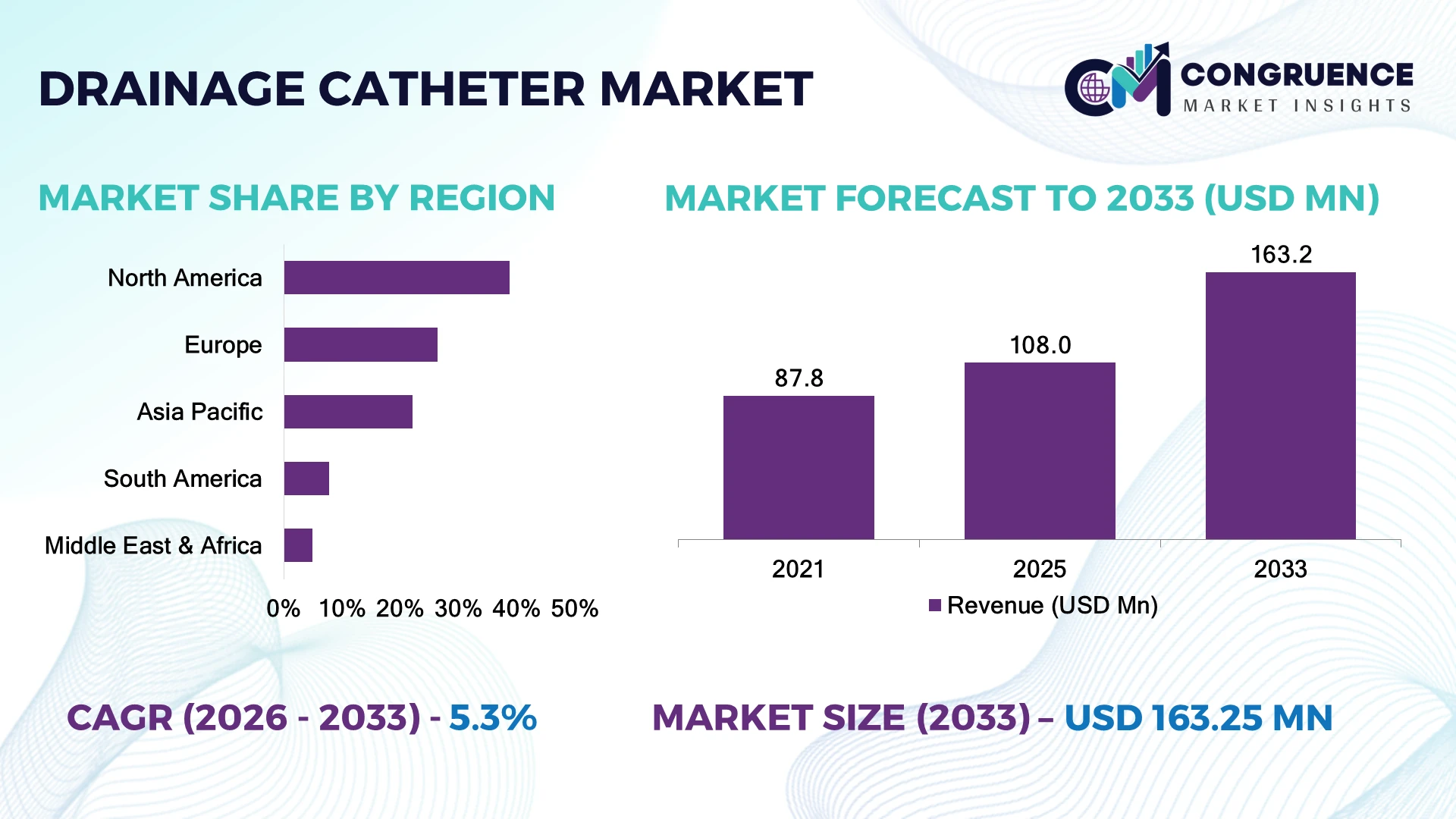
North America held approximately 38.8% of the global market in 2025, supported by advanced interventional radiology infrastructure and high procedural volumes, while the U.S. remains the dominant country-level market. China and India are expanding hospital capacity and minimally invasive procedure adoption, with Asia-Pacific positioned for faster deployment. Healthcare modernization following COVID-19 has accelerated investment in outpatient and image-guided care.
Strategically, manufacturers should prioritize multipurpose, image-compatible, infection-conscious systems and strengthen supply chains across high-volume U.S. and emerging Asian healthcare markets.
Market Size & Growth: Market value stands at USD 108.0 Million in 2025 and is projected to reach USD 163.2 Million by 2033 at a 5.3% CAGR, supported by minimally invasive drainage and image-guided procedures.
Top Growth Drivers: Minimally invasive procedures account for a key demand shift; geriatric-care expansion, chronic disease management, and interventional radiology adoption represent the top 3 growth drivers.
Short-Term Forecast: By 2028, broader multipurpose catheter adoption is expected to improve procedural efficiency by approximately 8–12% through easier positioning, fewer device exchanges, and streamlined drainage workflows.
Emerging Technologies: AI-assisted imaging, hydrophilic catheter surfaces, radiopaque markers, and advanced polyurethane designs are improving placement accuracy, visualization, and patient handling.
Regional Leaders: North America is projected at approximately USD 62 Million, Europe near USD 42 Million, and Asia-Pacific near USD 38 Million, with Asian hospitals accelerating image-guided procedure adoption.
Consumer/End-User Trends: Hospitals account for more than 50% of utilization, while ambulatory and home-care settings are gaining traction as portable drainage systems support shorter stays and follow-up management.
Pilot/Case Example: 2024 hospital programs using pigtail drainage approaches reported procedural workflow improvements of approximately 10% through smaller access profiles and reduced dependence on conventional large-bore drainage systems.
Competitive Landscape: Cook leads the competitive field with an estimated 15% share, alongside Merit Medical Systems, B. Braun, Teleflex, and Argon Medical Devices, competing through product breadth, clinical performance, and distribution reach.
Regulatory & ESG Impact: Increasing emphasis on infection prevention and material safety is accelerating latex-free and biocompatible product development, while standardized manufacturing can reduce material waste by approximately 5–8%.
Investment & Funding: Healthcare providers and device manufacturers are directing more than USD 100 Million collectively toward catheter innovation, interventional platforms, manufacturing expansion, and strategic partnerships across established and emerging markets.
Innovation & Future Outlook: Next-generation drainage systems are shifting toward multipurpose designs, smarter monitoring, and patient-friendly configurations, moving competition from basic catheter supply toward integrated procedural and post-procedure value.
Drainage Catheter Market demand is increasingly concentrated in biliary obstruction, pleural effusion, abscess drainage, and postoperative fluid management, where pigtail and multipurpose configurations improve procedural flexibility. Approximately 32.8% of 2025 demand is associated with biliary drainage applications. Hospitals are also shifting selected procedures toward outpatient pathways, while manufacturers are redesigning devices around easier insertion, radiopacity, and material biocompatibility amid tighter medical-device quality controls and supply-chain localization.
The drainage catheter market is becoming strategically important because hospitals are prioritizing minimally invasive intervention, shorter procedural pathways, and more efficient fluid-management protocols. Biliary drainage represented approximately 32.8% of market demand in 2025, making product specialization important for manufacturers targeting high-volume hepatobiliary procedures. The shift toward outpatient care is also increasing demand for compact and patient-friendly systems.
Technology differentiation is increasingly measurable. Pigtail and multipurpose designs can reduce access complexity and device exchanges by approximately 8–12% compared with conventional large-bore approaches in suitable procedures. North America maintains stronger infrastructure and procedural maturity, while China and India are expanding deployment through hospital modernization and interventional-radiology capacity building.
Over the next 2–3 years, manufacturers are positioned to prioritize multipurpose platforms, antimicrobial-conscious materials, enhanced radiopacity, and digital procedure support. A practical deployment model combines catheter supply with imaging equipment partnerships and clinician training, improving utilization consistency. Companies that align product development with outpatient workflows and localized manufacturing will gain stronger operational positioning and more resilient clinical-market access.
Minimally invasive drainage is the strongest structural driver, as image-guided procedures expand across biliary obstruction, pleural collections, abscesses, and postoperative complications. Biliary drainage alone represented approximately 32.8% of market demand in 2025, while multipurpose drainage systems are tracking faster adoption at around 6.5%. Hospitals increasingly favor pigtail configurations where clinically appropriate because smaller access profiles support streamlined procedural workflows. The United States continues to lead technology adoption, while India is expanding interventional radiology capacity. The shift toward outpatient management following healthcare-system modernization is reinforcing demand for compact, easy-to-manage devices. Companies are responding through multipurpose product launches, clinician training, and partnerships that connect catheter portfolios with image-guided intervention platforms.
High procedural costs, specialized imaging requirements, and dependence on imported medical-device components constrain adoption in price-sensitive healthcare systems. Device procurement and procedure-related expenses can represent a 10–15% budget premium in facilities lacking established interventional workflows, while imported components expose manufacturers to currency and logistics pressures. India and several Southeast Asian markets remain particularly sensitive to procurement economics and availability. Regulatory compliance for sterility, biocompatibility, and device performance adds additional commercialization requirements. Global logistics disruptions have encouraged manufacturers to diversify component sourcing and establish regional inventories. Companies are increasingly using multi-year supply contracts, localized packaging, and dual-source procurement to reduce disruption exposure. The strategic priority is controlling delivered cost without compromising catheter performance or regulatory consistency.
Next-generation drainage systems create opportunities through multipurpose designs, smart monitoring, and advanced biomaterials. Multipurpose catheters are expanding at approximately 6.5%, reflecting their ability to address several drainage indications with fewer product configurations. Digital imaging integration can improve placement workflow efficiency by approximately 8–12%, while advanced polyurethane and hydrophilic surfaces support smoother insertion and handling. China and India offer particularly strong expansion opportunities as interventional radiology infrastructure develops and hospitals upgrade procedural capabilities. Remote monitoring and home-based drainage management provide an additional avenue for manufacturers to move beyond single-use device sales toward connected care pathways. Companies are positioning through R&D partnerships, clinician-led product development, and regional manufacturing ecosystems that combine device production with imaging and procedural-support technologies.
Long-term market expansion faces execution challenges involving imaging integration, clinician training, infection-control protocols, and consistent deployment across different healthcare environments. Facilities with limited interventional radiology capacity can experience 10–20% workflow inefficiencies when catheter selection, imaging, and drainage management are poorly coordinated. Workforce shortages further complicate standardized adoption, particularly across rapidly expanding hospital networks in emerging markets. Cybersecurity becomes relevant as connected monitoring capabilities enter drainage management, creating additional data-protection requirements. Companies must invest in standardized training, interoperable procedural platforms, and robust quality-control systems rather than relying solely on product availability. The strongest competitive position will come from manufacturers that integrate catheter design with clinical workflow, training infrastructure, and dependable regional service networks.
Multipurpose Designs Gain Ground: Hospitals are increasingly standardizing multipurpose drainage catheters across abscess, pleural, and postoperative procedures, with the segment tracking approximately 6.5% growth and reducing the need for multiple specialized SKUs. Manufacturers are responding with broader size ranges, improved side-hole configurations, and image-compatible designs. The non-obvious shift is toward portfolio consolidation, allowing procurement teams to reduce inventory complexity while maintaining procedural flexibility.
Silicone Adoption Accelerates: Silicone-based drainage catheters are gaining traction at approximately 7.5% growth as clinicians prioritize flexibility, biocompatibility, and prolonged placement. Adoption is particularly relevant for long-duration drainage pathways, where material performance directly affects patient comfort and device stability. Companies are increasing investment in softer silicone formulations and surface engineering. This trend is also reinforced by tighter device-quality expectations and sterile single-use requirements, pushing manufacturers toward more controlled material and production processes.
Outpatient Drainage Expands: Selected drainage procedures are moving beyond conventional inpatient pathways as hospitals pursue shorter stays and lower bed utilization. Home-based and ambulatory management is gaining operational relevance, with outpatient-oriented workflows targeting approximately 10–15% reductions in avoidable facility utilization for suitable cases. The shift is strongest where nursing follow-up and imaging access are established. Manufacturers are responding with compact drainage systems, secure fixation mechanisms, and clinician-training partnerships designed for decentralized care.
Supply Chains Become Localized: Medical-device manufacturers are restructuring catheter sourcing as logistics volatility and regulatory scrutiny increase. Regional inventory buffers and dual sourcing are increasingly used to reduce component-related disruption by approximately 10–20%, particularly for polymers, connectors, and sterile packaging. In the United States, evolving device standards are reinforcing tighter quality-control documentation. Companies are consequently expanding regional manufacturing, qualifying alternative suppliers, and redesigning procurement contracts around continuity rather than lowest unit cost.
The drainage catheter market is segmented into Chest Drainage Catheter, External Ventricular Drainage Catheter, Biliary Drainage Catheter, Abscess Drainage Catheter, Percutaneous Transhepatic Biliary Drainage Catheter, Pleural Effusion Drainage Catheter, Multipurpose Drainage Catheter, and Others. Biliary Drainage Catheters represented approximately 32.8% of 2025 demand, supported by their role in malignant obstruction, benign strictures, and post-procedural drainage. Their established clinical protocols and strong integration with hepatobiliary intervention keep them ahead of several specialized categories. Multipurpose Drainage Catheters are the fastest-moving type, tracking approximately 6.5% growth as hospitals seek versatile devices for multiple fluid-collection indications.
Chest and pleural drainage products retain substantial procedural relevance, while abscess and percutaneous transhepatic systems remain concentrated in specialized intervention. Companies are shifting investment toward multipurpose platforms, broader catheter sizing, and improved drainage-hole configurations. This strategy allows suppliers to capture multiple procedures with fewer product configurations while strengthening procurement efficiency.
By application, the market is segmented into Chest Drainage, Biliary Drainage, Cerebrospinal Drainage, and Others. Chest Drainage led with approximately 45% share in 2025, reflecting its broad use for evacuating air, blood, and fluid from the pleural space. High procedural volume across thoracic surgery, emergency care, and postoperative management supports its established position. Biliary Drainage is the fastest-growing application, advancing at approximately 6.7% as image-guided interventions expand for malignant obstruction, strictures, leaks, and post-procedural complications.
Cerebrospinal Drainage remains a specialized, high-value application because catheter placement requires stringent neurological monitoring and controlled drainage. Other applications provide additional demand diversity but remain smaller in volume. Hospitals are increasingly prioritizing catheter designs that integrate with imaging and closed drainage systems, while manufacturers are adapting product portfolios toward application-specific configurations. The business implication is a shift from volume-only competition toward clinical workflow performance and procedural reliability.
By end-user, the market is segmented into Hospitals, Specialty Clinics, Ambulatory Surgical Centers, and Home Healthcare Settings. Hospitals represented approximately 65% of drainage catheter demand, reflecting their concentration of complex surgeries, interventional radiology, critical-care procedures, and catheter-management infrastructure. Their procurement scale favors standardized product portfolios and long-term supplier relationships. Ambulatory Surgical Centers are the fastest-expanding end-user group as selected drainage procedures migrate toward shorter-stay pathways and streamlined intervention.
Specialty Clinics are gaining importance in pulmonology, gastroenterology, and neurology, while Home Healthcare Settings are emerging as a targeted channel for patients requiring continued drainage after hospital discharge. Ambulatory deployment is increasingly associated with approximately 8–12% workflow-efficiency gains where standardized catheter protocols and follow-up systems are established. Companies are responding with smaller-profile devices, secure fixation systems, training programs, and distributor partnerships. The strategic shift is toward matching catheter design with the care setting rather than relying on a single hospital-centric product model.
North America accounted for the largest market share at 38.8% in 2025 however, Asia-Pacific is expected to register the fastest growth, expanding at a CAGR of 5.3% between 2026 and 2033.
North America held approximately 38.8% of global demand in 2025, supported by mature interventional radiology infrastructure, high procedure volumes, and established hospital procurement networks. The United States accounts for the overwhelming majority of regional demand, while Canada contributes through expanding image-guided intervention capacity. Hospitals increasingly favor multipurpose and radiopaque catheter systems that integrate with ultrasound, CT, and fluoroscopic workflows. Outpatient migration is also changing procurement requirements, particularly for pleural and postoperative drainage. U.S. manufacturers and distributors are strengthening inventory resilience through dual sourcing and regional stock positioning, reducing exposure to international logistics disruptions. The region's established reimbursement structures and specialist workforce continue to support adoption of advanced drainage technologies.
United States Market Outlook: The United States remains the principal country market because of its large hospital network, high interventional procedure intensity, and strong medical-device innovation base. More than 6,000 hospitals operate across the country, providing a broad deployment base for chest, biliary, abscess, and cerebrospinal drainage systems. Manufacturers are prioritizing physician-led innovation, integrated product portfolios, and ambulatory-care distribution.
Europe represented approximately 26.4% of the global market in 2025, with Germany, the United Kingdom, France, and Italy forming the principal demand centers. The region's mature healthcare infrastructure supports extensive use of image-guided drainage, while the EU Medical Device Regulation is increasing emphasis on traceability, clinical evidence, sterility, and post-market surveillance. Germany contributes strongly through its medical-device manufacturing base and advanced hospital infrastructure. Hospitals are increasingly evaluating products on lifecycle performance rather than unit price alone, strengthening demand for biocompatible materials, secure fixation, and reliable drainage performance. Approximately 31% of European suppliers have faced additional certification or compliance requirements under the evolving regulatory framework. Companies are responding through quality-system investment, portfolio rationalization, and localized regulatory capabilities.
Germany Market Outlook: Germany is the region's most strategically significant market because it combines strong hospital infrastructure with one of Europe's largest medical-device manufacturing ecosystems. The country operates more than 2,000 hospitals, creating substantial procedural demand while supporting rapid clinical evaluation and commercialization of advanced catheter systems. Manufacturers benefit from domestic engineering expertise, established distribution channels, and proximity to major European healthcare markets.
Asia-Pacific represented approximately 22.1% of global demand in 2025 and is positioned as the fastest-expanding market as China, India, Japan, and South Korea strengthen interventional-care infrastructure. China provides the largest scale advantage, while India is rapidly expanding tertiary hospitals and image-guided procedure capacity. The region is increasingly adopting multipurpose, biliary, nephrostomy, and pleural drainage systems as minimally invasive procedures become more accessible. A 2024 Chinese clinical study involving 445 patients with pyogenic liver abscess reported a 90.1% primary cure rate following ultrasound-guided percutaneous treatment, illustrating the clinical relevance of image-guided drainage. Companies are responding through localized manufacturing, distributor partnerships, clinician training, and price-optimized catheter portfolios.
China Market Outlook: China offers the strongest combination of patient volume, hospital expansion, domestic manufacturing, and medical-technology localization. The country has more than 38,000 hospitals, creating substantial deployment potential for drainage systems. Local production and technology-transfer strategies are allowing manufacturers to reduce procurement costs while adapting catheter designs to high-volume tertiary-care procedures.
South America accounted for approximately 7.8% of the global market in 2025, with Brazil representing the primary demand center because of its population scale, private hospital infrastructure, and concentration of advanced tertiary-care facilities. Demand remains centered on chest, biliary, and abscess drainage, while access to interventional radiology is less uniform outside major metropolitan hospitals. Public procurement remains price-sensitive, increasing the importance of dependable, standardized catheter configurations. Brazil's private healthcare sector is increasingly adopting minimally invasive technologies to reduce inpatient resource utilization, while public facilities are upgrading imaging and surgical infrastructure. Manufacturers are responding through local distributors, tender-oriented pricing, and regional inventory strategies. The key constraint is uneven access rather than underlying clinical demand, making metropolitan hospital networks the most attractive near-term deployment targets.
Brazil Market Outlook: Brazil is the dominant South American market because it combines the region's largest healthcare system with extensive private hospital networks and specialized tertiary-care centers. More than 6,000 hospitals provide a substantial clinical base, although procurement fragmentation remains significant. Companies are increasingly targeting São Paulo, Rio de Janeiro, and other major healthcare hubs through distributor partnerships and application-specific product portfolios.
The Middle East & Africa accounted for approximately 4.9% of global drainage catheter demand in 2025, with Gulf healthcare systems representing the strongest commercial opportunity. Saudi Arabia and the United Arab Emirates are investing heavily in hospital modernization, advanced imaging, and specialist-care capacity, supporting adoption of image-guided drainage technologies. Saudi Arabia's healthcare transformation agenda is encouraging private-sector participation and technology modernization, while the UAE continues to develop internationally oriented tertiary-care facilities. Demand remains concentrated in major metropolitan hospitals because specialist interventional-radiology services are less evenly distributed across African markets. Companies are responding with regional distributor agreements, clinical training programs, and centralized procurement partnerships. The commercial opportunity is strongest where new hospitals are being designed around advanced procedural infrastructure rather than retrofitting older facilities.
Saudi Arabia Market Outlook: Saudi Arabia represents the region's strongest strategic market because healthcare modernization is closely linked to national infrastructure investment and Vision 2030 objectives. The country's expanding specialist-hospital network is increasing access to interventional radiology and minimally invasive procedures. Manufacturers are positioning through government-linked procurement, local distribution partnerships, and technology-focused hospital collaborations.
The market pits global interventional-device leaders such as Cook Medical, Merit Medical, BD, Teleflex, and Argon Medical against regional manufacturers competing on price, customization, and local distribution. The top five players collectively control an estimated 55% of global sales, leaving room for suppliers. Competition centers on catheter design, radiopacity, locking mechanisms, procedural speed, supply continuity, and physician familiarity. Performance commands 8–12% workflow advantages, while localized sourcing can reduce delivered costs by roughly 5–10%. Leaders are expanding multipurpose portfolios, partnering with imaging and hospital networks, and integrating securement, drainage bags, and procedure kits. Regional players counter with lower-cost configurations and faster tender fulfillment. The competitive shift is moving from standalone catheter sales toward integrated procedural ecosystems and supply-chain resilience. Entry barriers remain high because regulatory validation, clinical acceptance, sterilization controls, and hospital contracts require investment. Winning requires reliable products, differentiated workflow performance, localized availability, and partnerships that convert trust into repeat procurement.
Cook Medical
Merit Medical
BD
Teleflex
Argon Medical Devices
Boston Scientific
B. Braun
Terumo Corporation
Cardinal Health
Medtronic
AngioDynamics
Rocket Medical
Drainage catheter technology is shifting from conventional single-function designs toward multipurpose, radiopaque, hydrophilic, and kink-resistant platforms. Nitinol reinforcement improves crush resistance while maintaining larger lumens, and advanced polyurethane surfaces support smoother placement. Current multipurpose and image-compatible systems are estimated to improve procedural workflow efficiency by 8–12% versus conventional configurations. Adoption is strongest in tertiary hospitals, where image-guided drainage is standardized across biliary, pleural, abscess, and postoperative procedures.
The next transition is toward integrated catheter kits, securement systems, and home-drainage platforms. Procedure kits can reduce preparation steps and inventory handling by approximately 10%, while securement technologies target fewer displacement-related interventions. Connected monitoring remains emerging rather than mainstream, but digital follow-up is gaining traction in decentralized care. Companies with broad accessory portfolios benefit because hospitals increasingly evaluate procedural workflows rather than individual catheter prices.
From 2026–2028, AI-assisted imaging, advanced biomaterials, and smarter drainage monitoring will become more commercially relevant. AI-supported positioning can shorten image-review and targeting tasks by approximately 5–8% in suitable workflows, while newer surface treatments improve insertion consistency. Cook, Merit, BD, and Argon benefit from scale, clinical familiarity, and integrated portfolios. The competitive priority is moving toward interoperable, lower-trauma systems supporting faster procedures, outpatient management, and resilient supply chains.
September 2025 Cook Medical secured a Vizient contract covering products including percutaneous access and drainage devices. The agreement expanded hospital access and streamlined ordering, supporting supply reliability and institutional adoption across the United States, strengthening Cook’s position in hospital procurement. Source: cookmedical.com
July 2025 Argon Medical opened a 20,000-square-foot Distribution & Education Centre in Derby, creating a logistics and training hub serving more than 80 countries. The investment improves regional responsiveness, strengthens distributor support, and expands clinical education for interventional products. Source: argonmedical.com
April 2026 Argon Medical opened a Singapore facility serving 20 Asia-Pacific countries. The regional hub supports distributors and product rollouts, strengthening local responsiveness and positioning the company to scale interventional solutions, including its established SKATER drainage catheter portfolio. Source: argonmedical.com
January 2025 BD announced USD 30 million of investment in Utah IV-line manufacturing, following a 2024 investment that lifted IV-catheter output by more than 40 million units annually. The expansion strengthens domestic supply resilience and supports catheter availability. Source: bd.com
The Drainage Catheter Market Report covers product types including chest, external ventricular, biliary, abscess, percutaneous transhepatic biliary, pleural effusion, multipurpose, and other drainage catheters. Application coverage spans chest, biliary, cerebrospinal, and other drainage procedures, while end-user analysis evaluates hospitals, specialty clinics, ambulatory surgical centers, and home healthcare settings. The report assesses mature and niche use cases across major healthcare systems.
Geographic coverage includes North America, Europe, Asia-Pacific, South America, and the Middle East & Africa, with country-level assessment of deployment, infrastructure, procurement, and technology adoption. Technology analysis addresses radiopaque designs, hydrophilic coatings, locking mechanisms, advanced polymers, image-guided placement, securement systems, and emerging digital workflows. Competitive analysis profiles 10–14 influential participants and evaluates product positioning, partnerships, manufacturing localization, and expansion priorities. The coverage supports investment planning, market-entry decisions, portfolio optimization, procurement strategy, and competitive positioning through 2026–2033.
| Report Attribute / Metric | Details |
|---|---|
| Market Revenue (2025) | USD 108.0 Million |
| Market Revenue (2033) | USD 163.2 Million |
| CAGR (2026–2033) | 5.3% |
| Base Year | 2025 |
| Forecast Period | 2026–2033 |
| Historic Period | 2021–2025 |
| Segments Covered |
By Type
By Application
By End-User
|
| Key Deliverables | Revenue Forecast; Market Trends; Growth Drivers & Restraints; Technology Insights; Segmentation Analysis; Regional Insights; Competitive Landscape; Regulatory & ESG Overview; Recent Developments |
| Regions Covered | North America; Europe; Asia-Pacific; South America; Middle East & Africa |
| Companies Profiled | Cook Medical; Merit Medical; BD; Teleflex; Argon Medical Devices; Boston Scientific; B. Braun; Terumo Corporation; Cardinal Health; Medtronic; AngioDynamics; Rocket Medical |
| Customization & Pricing | Available on Request (10% Customization Free) |




