
Reports
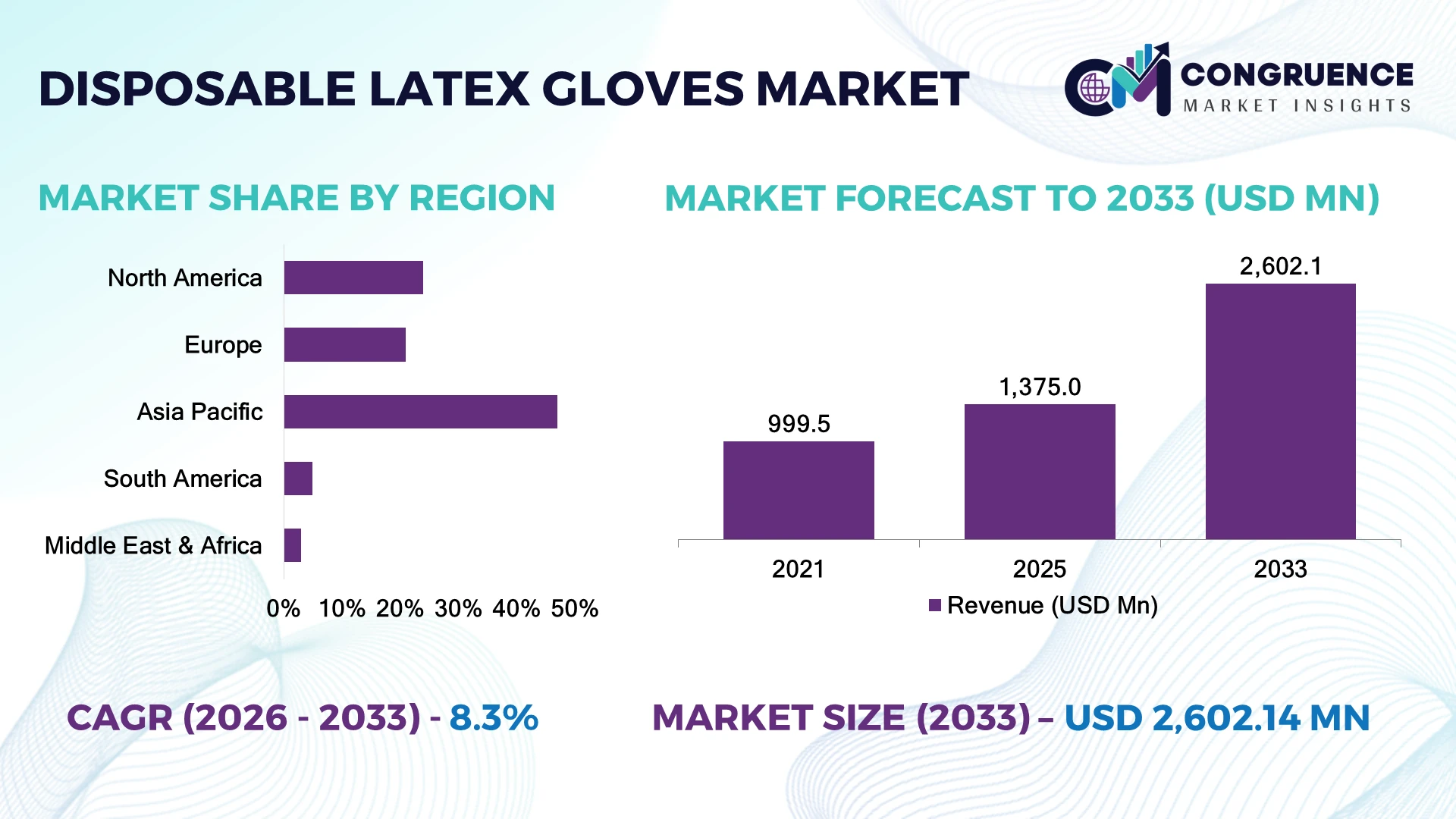
The Global Disposable Latex Gloves Market was valued at USD 1,375.0 Million in 2025 and is anticipated to reach a value of USD 2,602.1 Million by 2033 expanding at a CAGR of 8.3% between 2026 and 2033. Growth is being driven by stricter infection-control protocols, expanding healthcare infrastructure investments, and accelerated automation in glove manufacturing across major production hubs.
Malaysia remains the dominant country in the global disposable latex gloves industry, accounting for approximately 60% of worldwide production capacity and supplying over 180 billion gloves annually. The country benefits from strong rubber feedstock availability, advanced automated production lines exceeding 80% automation rates, and continuous investments in export-oriented manufacturing. In comparison, Thailand contributes nearly 18% of global output, while Malaysia maintains a stronger presence in premium medical-grade glove production. Ongoing healthcare procurement programs and resilient trade networks further reinforce its leadership despite evolving global sourcing strategies.
This concentration of production highlights the importance of supply-chain diversification, strategic sourcing partnerships, and capacity resilience planning for market participants.
Market Size & Growth: USD 1,375.0 million in 2025, reaching USD 2,602.1 million by 2033 at 8.3% CAGR, supported by advanced healthcare procurement and automated manufacturing expansion.
Top Growth Drivers: Hospital glove consumption up 22%, laboratory safety compliance up 18%, and industrial hygiene adoption up 15%.
Short-Term Forecast: By 2028, automated production lines are expected to reduce manufacturing defects by 20% and improve throughput by 25%.
Emerging Technologies: AI-enabled quality inspection, robotic dipping systems, and advanced low-protein latex formulations are improving consistency and safety.
Regional Leaders: Asia-Pacific exceeds USD 1,100 million, North America surpasses USD 650 million, and Europe approaches USD 500 million, driven by healthcare modernization and supply-chain localization.
Consumer/End-User Trends: More than 70% of hospitals prioritize premium examination gloves with enhanced barrier protection and tactile sensitivity.
Pilot/Case Example: In 2024, automated inspection deployment at major glove facilities reduced defect rates by nearly 30%.
Competitive Landscape: Top Glove holds approximately 22% share alongside Hartalega, Kossan Rubber, Supermax, and Ansell.
Regulatory & ESG Impact: Sustainable manufacturing initiatives reduced energy consumption by nearly 15% across several large facilities.
Investment & Funding: More than USD 400 million has been directed toward capacity upgrades, automation, and regional expansion projects.
Innovation & Future Outlook: Smart manufacturing and protein-reduction technologies are strengthening product differentiation and operational resilience.
Disposable latex gloves remain essential across healthcare, pharmaceutical manufacturing, diagnostics, food processing, and laboratory environments where contamination control is critical. Recent innovations include low-allergen latex formulations, AI-based quality inspection systems, and highly automated production lines. More than 35% of new manufacturing investments target process automation and defect reduction. Ongoing supply-chain diversification and stricter workplace safety regulations are also reshaping procurement strategies, setting the stage for deeper strategic evaluation.
Disposable latex gloves have evolved from a basic consumable product into a strategic component of healthcare resilience, industrial safety, and global supply-chain security. Rising compliance requirements across hospitals, pharmaceutical facilities, and food-processing operations are elevating product specifications and procurement standards. Simultaneously, supply-chain restructuring initiatives are encouraging buyers to diversify sourcing beyond traditional manufacturing centers.
Technology is becoming a critical differentiator. Modern automated glove production lines achieve defect reductions of nearly 30% compared with conventional inspection-intensive processes while increasing output efficiency by more than 20%. Manufacturers are also deploying AI-powered quality monitoring systems that improve consistency and reduce wastage. Malaysia continues to lead large-scale production, while Thailand and Vietnam are expanding investments to strengthen regional manufacturing competitiveness and reduce supply concentration risks.
Over the next two to three years, procurement contracts are expected to place greater emphasis on traceability, quality assurance, and production reliability. For example, several major glove manufacturers are expanding automation programs and entering long-term healthcare supply partnerships to secure stable demand. Companies that combine manufacturing scale, advanced quality systems, and diversified production networks will strengthen competitive positioning and achieve greater operational resilience in a rapidly evolving global market.
Healthcare systems worldwide are strengthening infection-prevention protocols, creating sustained demand for high-quality disposable latex gloves. More than 75% of acute-care procedures require glove usage, while hospital-acquired infection reduction programs have increased protective equipment procurement by over 20% in several developed healthcare systems. Regulatory agencies continue tightening compliance requirements for medical examination and surgical gloves, pushing manufacturers toward higher-performance product portfolios. This shift directly increases demand for low-protein and high-barrier latex gloves. In response, leading manufacturers are investing in automated production facilities, expanding capacity, and forming long-term healthcare procurement partnerships. A notable operational insight is that hospitals increasingly prioritize supplier reliability and quality consistency over unit price, encouraging manufacturers to focus on automation-driven quality assurance and premium product differentiation.
Natural rubber latex pricing remains one of the most significant structural constraints affecting market stability. Raw material costs can account for nearly 40% of total glove production expenses, while fluctuations exceeding 15% within a single procurement cycle can significantly impact margins. Thailand and Malaysia, key rubber-producing nations, remain vulnerable to weather disruptions and agricultural supply variations. Rising labor and energy costs further pressure manufacturing economics. These factors complicate long-term pricing strategies and contract negotiations with healthcare buyers. To mitigate exposure, companies are diversifying supplier networks, adopting energy-efficient manufacturing technologies, and increasing regional warehousing capacity. A critical strategic insight is that firms with vertically integrated sourcing structures maintain stronger pricing flexibility and supply continuity during periods of market disruption.
Significant opportunities are emerging through smart manufacturing adoption and healthcare infrastructure expansion in countries such as India, Indonesia, and Vietnam. Automated production systems can improve throughput by more than 25% while reducing defect rates by nearly 30%. Meanwhile, healthcare facility expansion programs across emerging economies are increasing demand for examination and procedural gloves. Manufacturers are also developing next-generation low-allergen formulations that improve user comfort and regulatory compliance. Strategic partnerships between healthcare providers and glove manufacturers are accelerating product validation and deployment. A less obvious opportunity lies in digital production analytics, where predictive maintenance systems can lower equipment downtime by approximately 15%. Companies investing in automation ecosystems and product innovation are positioning themselves to capture premium market segments and improve operational efficiency.
Maintaining consistent product quality across expanding global manufacturing networks remains a major long-term challenge. Medical-grade gloves require stringent defect-control thresholds, and quality failures can result in recalls, reputational damage, and procurement restrictions. Automated facilities may achieve inspection accuracy improvements above 25%, yet implementation costs remain substantial. Workforce training requirements have also increased as digital quality systems become more sophisticated. In addition, varying regulatory standards across the United States, Europe, and Asia create compliance complexity for exporters. Companies must invest in advanced testing infrastructure, digital traceability platforms, and workforce development programs to ensure consistent performance. A key operational insight is that quality assurance capability is increasingly becoming a competitive differentiator rather than simply a regulatory requirement, influencing supplier selection and long-term contract retention.
Automation Reshaping Production Efficiency Manufacturers are accelerating deployment of robotic dipping lines, AI-driven visual inspection systems, and automated packaging workflows. Production facilities in Malaysia and Thailand report throughput improvements of 20–25% while defect rates have declined by nearly 30%. Labor shortages and rising compliance requirements are driving this transition. Companies are scaling smart-factory investments to reduce operating costs, improve consistency, and secure long-term healthcare contracts requiring strict quality benchmarks.
Supply Chain Localization Accelerates Healthcare providers and industrial buyers are restructuring procurement models to reduce dependency on single-country sourcing. More than 35% of large procurement contracts now include supplier diversification requirements, while localized inventory programs have improved delivery reliability by approximately 18%. Strategic warehousing expansion and multi-country manufacturing footprints are becoming standard. Leading producers are establishing regional distribution hubs and forming long-term partnerships to strengthen resilience against geopolitical disruptions and logistics bottlenecks.
Premium Low-Protein Gloves Expand Demand for advanced low-protein and allergy-reduced latex gloves continues to rise across hospitals, laboratories, and pharmaceutical facilities. Premium product adoption has increased by nearly 22%, while healthcare organizations report up to 15% fewer glove-related sensitivity incidents. Companies are expanding specialized product portfolios and investing in material engineering capabilities. This shift supports higher-value product positioning and strengthens differentiation in increasingly quality-focused procurement environments.
Digital Traceability Gains Priority End users increasingly require batch-level visibility, compliance documentation, and quality verification throughout procurement workflows. Digital tracking implementation has increased by more than 28%, while audit preparation times have fallen by nearly 20%. Regulatory scrutiny and enterprise risk-management initiatives are reinforcing this trend. Manufacturers are integrating cloud-based traceability platforms and digital certification systems, creating a non-obvious competitive advantage through transparency, procurement efficiency, and stronger contract retention.
Powder-free disposable latex gloves represent the leading segment, accounting for approximately 68% of total market demand. Their dominance stems from superior safety performance, lower contamination risk, and broad acceptance across hospitals, diagnostic laboratories, and pharmaceutical facilities. Healthcare procurement policies increasingly favor powder-free products because they reduce airborne particle exposure and support stricter infection-control protocols. Manufacturers continue expanding powder-free production capacity, with automated coating technologies improving consistency and reducing processing variability. In contrast, powdered gloves maintain relevance in selected industrial and low-cost applications where cost efficiency remains a priority.
The fastest-growing segment is low-protein powder-free latex gloves, supported by rising occupational safety requirements and allergy-reduction initiatives. Adoption of specialized low-allergen products has increased by nearly 20% across healthcare facilities. Meanwhile, standard examination gloves continue representing a substantial installed base, while surgical-grade variants maintain strategic importance in high-acuity care environments. Companies are prioritizing advanced formulations, quality certifications, and premium product development to strengthen margins and address evolving procurement preferences. Investment priorities increasingly favor differentiated glove technologies over high-volume commodity production.
Medical and healthcare applications dominate the disposable latex gloves market, representing approximately 62% of overall demand. Hospitals, outpatient clinics, diagnostic laboratories, and surgical centers require consistent glove consumption to support infection-prevention workflows and patient safety protocols. High procedural volumes and regulatory compliance standards reinforce demand concentration within this segment. Manufacturers continue prioritizing healthcare-focused production lines and quality assurance investments to maintain supply reliability. Pharmaceutical manufacturing and laboratory testing applications also contribute significantly due to strict contamination-control requirements. The fastest-growing application is pharmaceutical and life-sciences manufacturing, where glove utilization has increased by nearly 18% as sterile production environments expand. Food processing facilities are also strengthening glove deployment programs, driven by enhanced hygiene monitoring and operational audits. Industrial safety applications remain an established segment, particularly in chemical handling and precision manufacturing operations. Companies are adapting through specialized product offerings, automated fulfillment capabilities, and application-specific product certifications. Demand is increasingly shifting toward environments where contamination prevention directly influences operational continuity and regulatory compliance.
Hospitals represent the largest end-user segment, accounting for approximately 55% of global disposable latex glove consumption. Their dominance is driven by continuous patient-care activities, surgical procedures, emergency services, and stringent infection-control requirements. Large healthcare networks maintain high procurement intensity due to round-the-clock operations and extensive staff utilization. Healthcare providers increasingly seek suppliers capable of delivering consistent quality, traceability, and dependable inventory availability. Manufacturers are responding through long-term supply agreements, customized procurement programs, and dedicated healthcare distribution channels. The fastest-growing end-user group is pharmaceutical and biotechnology companies, where glove consumption has increased by nearly 17% due to expansion of sterile manufacturing, research, and quality-control operations. Diagnostic laboratories are also strengthening procurement volumes as testing activity and laboratory automation continue expanding. Food-processing enterprises remain a stable buyer group focused on hygiene compliance and workforce protection. Companies are targeting these segments through differentiated product portfolios, specialized packaging solutions, and strategic partnerships. Future demand is steadily shifting toward highly regulated operating environments where glove performance directly influences productivity, compliance, and operational reliability.
Asia-Pacific accounted for the largest market share at 47% in 2025 however, North America is expected to register the fastest growth, expanding at a CAGR of 9.1% between 2026 and 2033.

North America represents approximately 24% of the global disposable latex gloves market, supported by advanced healthcare infrastructure, high procedural volumes, and stringent workplace safety requirements. Hospitals, outpatient facilities, pharmaceutical manufacturers, and diagnostic laboratories maintain substantial glove consumption due to rigorous infection-control standards. Procurement strategies are increasingly shifting toward long-term supply agreements and diversified sourcing models to reduce supply disruptions. Automated inventory management systems have improved supply visibility by nearly 20% across major healthcare networks. In parallel, healthcare organizations are emphasizing quality assurance, traceability, and supplier resilience when evaluating procurement contracts. Enterprise adoption of digital compliance platforms and centralized purchasing programs is further strengthening operational efficiency and inventory optimization throughout the region.
United States Market Outlook: The United States remains the dominant market within North America due to its extensive healthcare ecosystem, advanced pharmaceutical manufacturing base, and large-scale procurement infrastructure. More than 6,000 hospitals and thousands of laboratory facilities require continuous glove supply to support clinical and operational workflows. Institutional buyers increasingly prioritize supplier diversification and quality-certified products. Investments in healthcare logistics and digital procurement systems have enhanced inventory accuracy and contract management, positioning the country as a key driver of premium glove adoption and supply-chain modernization.
Europe accounts for approximately 21% of global market demand, supported by strong healthcare systems, pharmaceutical production capabilities, and comprehensive occupational safety regulations. Regulatory compliance remains a primary purchasing factor, encouraging healthcare providers and industrial users to adopt high-performance disposable latex gloves. Procurement frameworks increasingly emphasize product certification, traceability, and sustainability performance. Several healthcare systems have expanded centralized procurement programs, improving purchasing efficiency and inventory coordination by more than 15%. Manufacturers are responding through advanced quality-control investments and expansion of premium glove portfolios. The region also benefits from a growing focus on workforce safety standards across healthcare, food processing, and laboratory environments.
Germany Market Outlook: Germany serves as the most strategically important market in Europe due to its extensive healthcare infrastructure, advanced industrial base, and strong pharmaceutical manufacturing sector. The country maintains one of the largest concentrations of hospitals and medical technology facilities in the region. Adoption of digital procurement platforms and quality-driven purchasing frameworks continues to strengthen operational efficiency. Enterprise buyers increasingly favor premium, low-protein glove products, while healthcare institutions maintain stringent product performance requirements that support sustained demand for advanced disposable latex gloves.
Asia-Pacific leads the global disposable latex gloves market with approximately 47% share, supported by unparalleled manufacturing capacity, integrated supply chains, and abundant natural rubber resources. The region serves as the primary production hub for global healthcare and industrial glove demand. Manufacturing facilities continue adopting automation technologies, improving production efficiency by nearly 25% while reducing defect rates. Export-oriented operations remain a key strength, with large-scale production networks supplying hospitals, laboratories, and industrial users worldwide. Investments in smart manufacturing, automated inspection systems, and capacity expansion projects are reinforcing the region’s leadership position. The concentration of raw materials and specialized production expertise creates significant competitive advantages for regional manufacturers.
Malaysia Market Outlook: Malaysia remains the most influential country in the global disposable latex gloves industry, accounting for roughly 60% of worldwide glove production capacity. The country's integrated natural rubber supply chain, advanced automation infrastructure, and export-focused manufacturing ecosystem support its leadership position. Leading producers continue investing in robotic production systems, digital quality monitoring, and capacity optimization programs. Strong manufacturing expertise and established international distribution networks enable Malaysian companies to maintain operational efficiency and respond rapidly to evolving global procurement requirements.
South America accounts for approximately 5% of global disposable latex glove consumption, driven primarily by healthcare modernization initiatives and improving workplace safety standards. Demand is concentrated within hospitals, clinical laboratories, and food-processing industries where hygiene compliance requirements continue strengthening. Public healthcare investments and expanding private healthcare networks are supporting procurement growth across major economies. Regional distribution infrastructure remains uneven, creating logistical challenges for suppliers; however, inventory management improvements and strategic partnerships are enhancing product availability. Several healthcare providers have increased centralized purchasing activities, improving procurement efficiency and reducing supply variability. Market participants continue expanding local distribution capabilities to strengthen responsiveness and service quality.
Brazil Market Outlook: Brazil represents the largest market in South America due to its extensive healthcare network, growing pharmaceutical industry, and large industrial workforce. The country maintains significant demand from hospitals, diagnostic laboratories, and food-processing facilities. Healthcare infrastructure investments and modernization initiatives continue supporting procurement activity. Large institutional buyers increasingly favor standardized purchasing programs and long-term supply agreements, creating opportunities for suppliers capable of delivering consistent product quality, inventory reliability, and regulatory compliance across diverse end-user environments.
The Middle East & Africa region accounts for approximately 3% of global market demand but is experiencing increasing adoption driven by healthcare infrastructure development and institutional modernization programs. Governments and healthcare operators are expanding hospital capacity, diagnostic services, and infection-control capabilities to improve healthcare outcomes. Procurement frameworks increasingly prioritize quality-certified disposable protective products. Several healthcare expansion initiatives have increased procurement volumes by more than 15% across major urban healthcare networks. Market development is also supported by investments in logistics infrastructure, regional warehousing, and healthcare supply-chain optimization. Suppliers are strengthening regional partnerships to improve distribution coverage and product accessibility.
Saudi Arabia Market Outlook: Saudi Arabia is the leading market within the Middle East & Africa region due to substantial healthcare investments, hospital expansion projects, and modernization initiatives. The country continues developing advanced medical infrastructure and expanding specialized healthcare facilities. Procurement programs increasingly emphasize international quality standards, supply reliability, and operational resilience. Growing adoption of centralized healthcare purchasing systems has improved inventory coordination and procurement efficiency, while ongoing healthcare transformation initiatives continue creating opportunities for premium disposable latex glove suppliers and strategic distribution partnerships.
The disposable latex gloves market is led by Top Glove Corporation, Hartalega Holdings, Kossan Rubber Industries, Supermax Corporation, and Ansell, with the top five players collectively controlling approximately 58% of global market activity. Competition is defined by global manufacturing leaders versus regional suppliers, premium technology-focused producers versus cost-driven volume manufacturers, and vertically integrated operators versus contract-dependent competitors. Top Glove and Hartalega compete aggressively on automation and production scale, while Ansell differentiates through premium healthcare and industrial safety solutions. Automated facilities deliver up to 25% higher throughput and nearly 30% lower defect rates, creating significant cost and quality advantages. Manufacturers are expanding production networks, strengthening healthcare procurement partnerships, investing in AI-based inspection systems, and increasing vertical integration of raw-material sourcing. The competitive shift is moving from pure capacity competition toward quality assurance, supply-chain resilience, and product specialization. High capital requirements, regulatory compliance, and customer qualification processes remain major entry barriers. Winning requires scale, automation, trusted quality performance, and resilient global supply networks.
Hartalega Holdings Berhad
Kossan Rubber Industries Bhd
Supermax Corporation Berhad
Ansell Limited
Semperit AG Holding
Riverstone Holdings Limited
Dynarex Corporation
Unigloves (UK) Limited
Sri Trang Gloves (Thailand) Public Company Limited
Ammex Corporation
Medline Industries, LP
Cardinal Health, Inc.
Mölnlycke Health Care AB
Manufacturing automation is the most influential technology shaping the disposable latex gloves market. Advanced robotic dipping systems, automated stripping units, and AI-powered inspection platforms are being deployed across large production facilities. Automated production lines improve throughput by 20–25% while reducing defect rates by nearly 30%. More than 60% of new production investments are now directed toward automation-enabled manufacturing environments. This directly improves production consistency, lowers labor dependency, and strengthens supply reliability for healthcare and industrial buyers.
Material innovation is creating the next competitive frontier. Low-protein latex technologies and advanced surface-treatment processes reduce allergen exposure by approximately 15–20% compared with conventional formulations. Modern digital inspection systems identify microscopic defects up to 25% faster than traditional manual quality-control methods. Premium manufacturers benefit most because performance differentiation increasingly influences procurement decisions. Adoption of smart quality-monitoring platforms continues expanding across major manufacturing hubs.
Between 2026 and 2028, digital traceability, predictive maintenance, and connected manufacturing systems will become core operational requirements. Deployment of predictive analytics can reduce unplanned equipment downtime by nearly 15%, while cloud-based traceability systems improve audit readiness and inventory visibility. Companies adopting integrated smart-factory ecosystems will gain stronger operational agility, lower compliance costs, and superior contract retention in increasingly quality-focused procurement markets.
July 2024 – Ansell completed the acquisition of Kimberly-Clark’s Personal Protective Equipment business for approximately USD 640 million, adding the Kimtech™ and KleenGuard™ brands to its portfolio. The transaction significantly expanded Ansell’s scientific and industrial protection footprint while strengthening global distribution capabilities. Source: www.ansell.com
April 2024 – Ansell announced a binding agreement to acquire Kimberly-Clark’s PPE business, with expected annual cost synergies of approximately USD 10 million through combined supply-chain and organizational efficiencies. The move strengthened Ansell’s position in cleanroom, laboratory, and industrial protection markets. Source: www.ansell.com
April 2025 – Major Malaysian glove manufacturers including Top Glove, Hartalega, Kossan Rubber, and Supermax benefited from widening tariff differentials between Malaysian and Chinese exports, improving competitive positioning in key international markets and supporting stronger export utilization rates.
2025 – Leading glove manufacturers accelerated deployment of AI-enabled quality inspection systems and higher levels of production automation, achieving defect reductions approaching 30% and throughput improvements exceeding 20%, reinforcing competitiveness in healthcare procurement and regulated industrial applications.
This report provides comprehensive coverage of the global disposable latex gloves market across major product categories, applications, end-user industries, and regional markets. The analysis evaluates powder-free and powdered glove segments, key application areas including healthcare, pharmaceutical manufacturing, laboratories, food processing, and industrial safety, as well as demand patterns across hospitals, diagnostic centers, pharmaceutical companies, and commercial enterprises. Regional assessments examine operational dynamics, manufacturing concentration, procurement trends, and deployment intensity across North America, Europe, Asia-Pacific, South America, and the Middle East & Africa.
The study also assesses technology adoption trends including manufacturing automation, AI-driven quality inspection, low-protein latex formulations, digital traceability platforms, and smart-factory integration. Competitive benchmarking covers leading global manufacturers representing more than half of market activity. Strategic insights support investment planning, supply-chain optimization, capacity expansion decisions, partnership development, and competitive positioning. The report highlights emerging demand clusters, procurement transformation trends, production localization strategies, and operational priorities expected to influence market direction between 2026 and 2033.
| Report Attribute / Metric | Details |
|---|---|
| Market Revenue (2025) | USD 1,375.0 Million |
| Market Revenue (2033) | USD 2,602.1 Million |
| CAGR (2026–2033) | 8.3% |
| Base Year | 2025 |
| Forecast Period | 2026–2033 |
| Historic Period | 2021–2025 |
| Segments Covered |
By Type
By Application
By End-User
|
| Key Deliverables | Revenue Forecast; Market Trends; Growth Drivers & Restraints; Technology Insights; Segmentation Analysis; Regional Insights; Competitive Landscape; Regulatory & ESG Overview; Recent Developments |
| Regions Covered | North America; Europe; Asia-Pacific; South America; Middle East & Africa |
| Companies Profiled | Top Glove Corporation Berhad; Hartalega Holdings Berhad; Kossan Rubber Industries Bhd; Supermax Corporation Berhad; Ansell Limited; Semperit AG Holding; Riverstone Holdings Limited; Dynarex Corporation; Unigloves (UK) Limited; Sri Trang Gloves (Thailand) Public Company Limited; Ammex Corporation; Medline Industries, LP; Cardinal Health, Inc.; Mölnlycke Health Care AB |
| Customization & Pricing | Available on Request (10% Customization Free) |




