
Reports
The Global Disposable Incontinence Products Market was valued at USD 1,162.0 Million in 2025 and is anticipated to reach a value of USD 2,119.1 Million by 2033 expanding at a CAGR of 7.8% between 2026 and 2033. Growth is anchored in technology-enabled care delivery, with smart moisture-sensing systems reducing unnecessary product changes by up to 20% in long-term care settings.
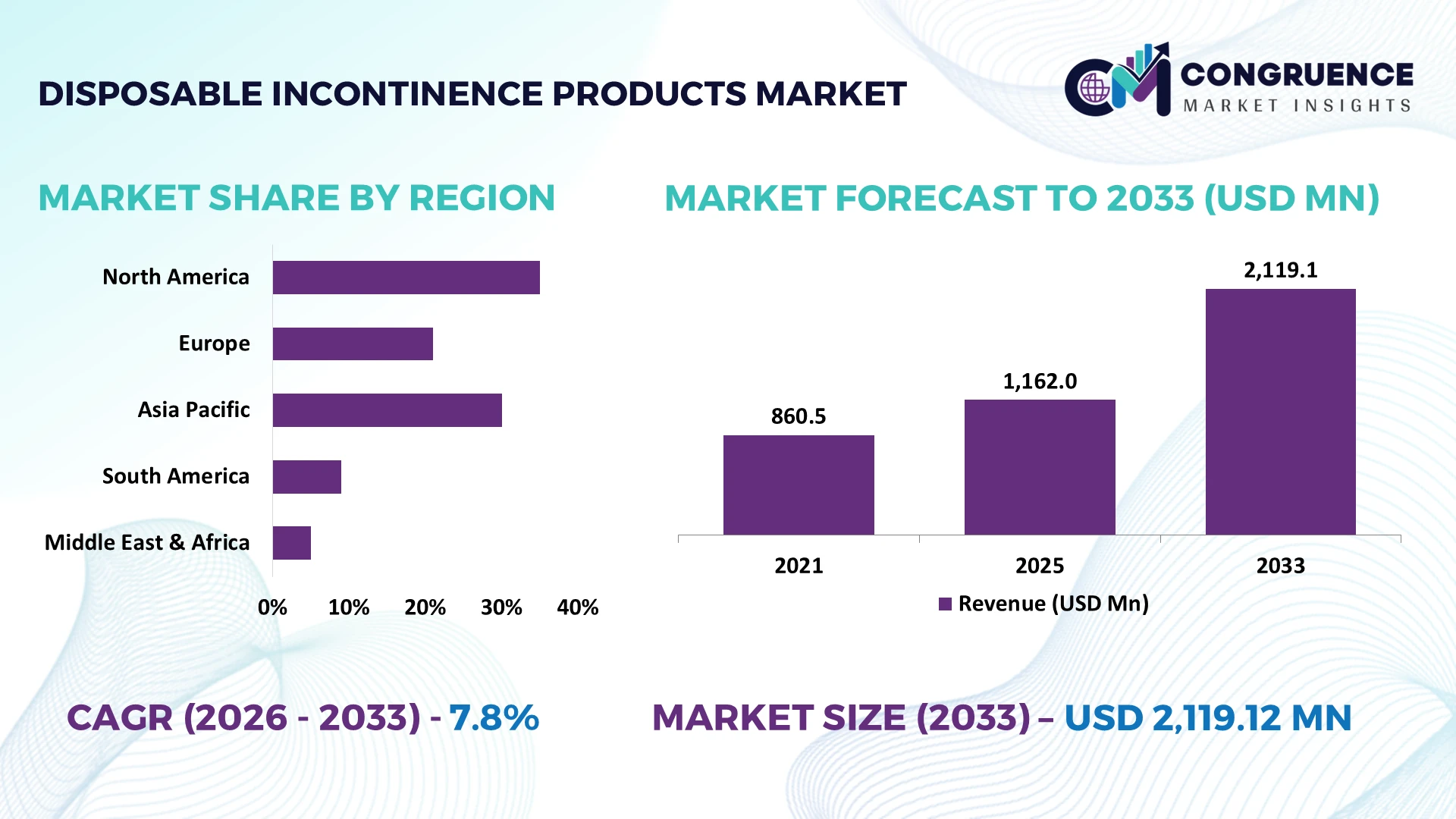
North America commands approximately 35% of global value, supported by USD 5.20 billion in U.S. institutional and retail demand in 2025 and reimbursement-linked procurement structures that favor premiumized protective garments. Germany's statutory reimbursement system, meanwhile, channels USD 1.03 billion annually into adult incontinence products, representing 21% of European value and creating a benchmark market for sustainability and clinical evidence standards. Canada's USD 459 million market illustrates a contrasting scale dynamic, with centralized provincial procurement favoring suppliers that meet consistent logistics and contract requirements.
For decision-makers, the implication is clear, scale advantages accrue to suppliers capable of pairing institutional contract execution with sensor-enabled care workflows that demonstrably lower operational waste.
Market Size & Growth: The market stands at USD 1.16 billion in 2025, with smart incontinence systems cutting material consumption by up to 20% in care facilities, reshaping procurement economics toward value-based purchasing.
Top Growth Drivers: Aging demographics (65+ population exceeding 25% in Japan), rising stress urinary incontinence prevalence (80% of affected American women), and institutional demand for workflow-efficient care solutions drive 7.8% expansion.
Short-Term Forecast: By 2028, sensor-integrated product adoption in European long-term care is positioned to reduce unnecessary nighttime checks by 30% or more, directly lowering per-resident labor costs.
Emerging Technologies: Conductive graphite-based moisture sensors, gender-specific absorbent architectures, and skin-friendly nanofiber nonwovens are transitioning from pilot to scaled deployment across high-acuity care settings.
Regional Leaders: North America (USD 5.66 billion, reimbursement-driven procurement), Europe (Germany at USD 1.03 billion, statutory tender systems), and Asia Pacific (Japan's 36.4 million elderly driving premiumization) anchor global volume.
Consumer/End-User Trends: Over 60% of men aged 50–70 report urinary leakage experiences, yet stigma-driven under-adoption persists, creating a latent demand pool for discreet, retail-friendly formats.
Pilot/Case Example: In 2026, Henkel and Ontex deployed Orizon smart incontinence sensors across European care facilities, achieving 8 working hours saved per resident monthly and up to 20% material reduction.
Competitive Landscape: Essity holds approximately 17% global share, followed by Kimberly-Clark (11.5%) and Coloplast (9%), with the top five suppliers controlling 52.5% of market value.
Regulatory & ESG Impact: EDANA's 2025 warning on U.S. fluff pulp trade measures underscores supply concentration risk, while EU sustainability pressure pushes bio-based absorbent R&D investment upward.
Investment & Funding: The European Investment Bank committed €400 million to Essity's sustainable materials and digital solutions R&D in January 2026, signaling institutional capital alignment with ESG-compliant absorbent innovation.
Innovation & Future Outlook: Next-generation discreet solutions integrate with healthcare ecosystems, shifting competitive advantage from absorbent capacity alone toward data-connected care management platforms and gender-specific precision engineering.
The Disposable Incontinence Products Market is pivoting from a volume-driven absorbent category toward a technology-enabled care economy. Demand concentrates in institutional long-term care and home-health channels, where smart moisture detection and gender-specific designs are gaining traction. In Japan, ultra-thin pants have redefined premiumization, with retail volume rising 3% and value climbing 6% in 2025 as manufacturers target dignity-conscious older consumers. A notable operational signal: Henkel and Ontex's Orizon rollout demonstrates that sensor-enabled products can cut material waste by up to 20%, aligning sustainability targets with caregiver labor savings. This convergence of clinical workflow efficiency and ESG compliance reframes procurement decisions around total care cost rather than unit price.
The disposable incontinence market is transitioning from a commoditized absorbent category into a strategic battleground where care-delivery economics, supply-chain resilience, and digital integration determine competitive standing. Procurement is shifting from unit-price tenders toward total cost of care models, driven by labor shortages in European and Japanese long-term care facilities and reimbursement reforms that reward measurable outcomes over volume consumption.
Technology comparison reveals the operational gap: sensor-enabled incontinence systems deliver up to 20% material reduction and approximately eight labor hours saved per resident monthly, whereas legacy scheduled-check protocols generate unnecessary product changes and nighttime disruptions that inflate both waste and caregiver burden. Regionally, North America's USD 5.20 billion U.S. market operates through reimbursement-linked institutional contracts favoring premiumized protective garments, while Japan's 36.4 million elderly population drives retail-led premiumization with ultra-thin formats gaining share through dignity-focused design. Over the next two to three years, expect sensor adoption to move from pilot facilities into tendered European contracts, with material efficiency becoming a scored procurement criterion.
Henkel and Ontex's 2026 European Orizon rollout exemplifies practical deployment: conductive graphite-printed sensors pair with reusable clip-on wearables to alert caregivers via app when change is clinically necessary, and the partnership leverages Ontex's manufacturing scale with Henkel's printed-electronics expertise. Competitors are responding by accelerating digital-hygiene partnerships and restructuring R&D budgets toward connected care platforms. The strategic conclusion is unambiguous: long-term relevance belongs to suppliers that pair reliable absorbent manufacturing with data-driven care workflow integration, turning incontinence products from consumable cost centers into operational efficiency levers.
Long-term care facilities across Germany and Japan face mounting caregiver shortages, with routine incontinence checks consuming disproportionate staff time and generating unnecessary product waste. Sensor-enabled moisture detection systems address this structural inefficiency directly: Orizon deployments demonstrate up to 20% material reduction and eight working hours saved per resident monthly, translating into tangible labor cost relief. Japan's 65+ population reached 36.4 million in 2025, intensifying institutional demand for workflow-efficient continence management as facility operator margins compress. Manufacturers are responding by embedding printed-electronics sensing into absorbent substrates rather than treating digitization as an add-on. The strategic insight: products that generate actionable care data command procurement preference over undifferentiated absorbent capacity, shifting competitive moats toward software-hardware integration.
Fluff pulp and superabsorbent polymer sourcing remains geographically concentrated, exposing manufacturers to trade-policy volatility and cost spikes that compress institutional contract margins. EDANA's July 2025 warning to the European Commission highlighted that proposed U.S.-origin fluff pulp trade measures could jeopardize affordability and supply continuity for absorbent hygiene production. North American and European manufacturers reliant on imported raw materials face the sharpest cost exposure, while Asia-Pacific export-oriented producers absorb tariff-related margin pressure. Facilities serving Germany's USD 1.03 billion statutory-reimbursed market cannot easily pass through input cost increases, forcing suppliers into multi-year fixed-price contracts with thinner profitability. Companies are countering through regional supplier qualification, dual-sourcing agreements, and reformulations that reduce dependency on single-origin inputs. The operational reality: supply diversification is no longer a procurement preference but a contract-qualification requirement.
Male light-incontinence care represents a materially underserved demand pool, with over 60% of men aged 50–70 reporting leakage experiences yet avoiding dedicated products due to stigma and design mismatch. Japan's market illustrates the opportunity: Unicharm's 2026 launch of incontinence pads featuring world-first friction-reduction technology targeting skin comfort achieved 30% lower skin friction, capturing premium positioning among dignity-conscious consumers. The strategic opening lies in formats that resemble ordinary underwear rather than clinical products—Gunze and Kao's 2026 SmaShee boxer-brief system with disposable insert pockets demonstrates how apparel partnerships can normalize adoption. Companies investing in gender-specific absorbent architectures and retail-friendly discretion are positioned to unlock demand that institutional-focused portfolios systematically miss.
Scaling smart incontinence systems beyond pilot facilities introduces execution barriers that absorbent-only manufacturers are ill-equipped to manage. Orizon's architecture requires conductive ink printing consistency, reusable wearable durability, secure data transmission to caregiver apps, and integration with facility electronic health record workflows—each a distinct technical and compliance domain. European care facilities operate under stringent data protection regimes that constrain cross-border sensor data flows, while Japanese facilities demand device reliability standards aligned with medical device regulations. The workforce dimension compounds the challenge: caregiver adoption of app-based monitoring requires training investment that smaller operators cannot absorb. Companies must solve these integration layers through partnerships—as Ontex did with Henkel—rather than internal capability building. Deployment consistency, not sensor novelty, determines whether smart incontinence transitions from pilot success to scaled operational standard.
Sensor-Enabled Care Economics Reshape Procurement European long-term care operators are shifting from scheduled product replacement to sensor-triggered change protocols, with Orizon deployments demonstrating 20% material reduction and eight labor hours saved per resident monthly. Facilities in Germany and Belgium are incorporating these metrics into tender specifications, pressuring suppliers to provide care-workflow data alongside absorbent performance. Manufacturers are responding by embedding moisture-detection printed electronics directly into product substrates and partnering with electronics specialists to accelerate time-to-scale.
Ultra-Thin Premiumization Targets Dignity-Conscious Consumers Japan's retail adult incontinence volume rose 3% in 2025 while value climbed 6%, signaling successful premiumization through ultra-thin formats that reduce visual bulk and skin friction. Unicharm's 2026 friction-reduction launch achieved 30% lower skin contact resistance, establishing a dermatological differentiation axis beyond absorbency. Companies are reallocating R&D toward material science and fit ergonomics, recognizing that consumer adoption hinges on product normalcy rather than clinical performance claims.
Gender-Specific Architectures Move from Niche to Mainstream Male light-incontinence care is transitioning from repurposed unisex pads to purpose-engineered systems, driven by survey data showing over 60% of men aged 50–70 experience leakage yet resist dedicated products. Gunze and Kao's 2026 SmaShee boxer-brief platform exemplifies the apparel-integrated approach, pairing disposable insert pockets with ordinary-looking underwear to reduce stigma barriers. This shift expands the addressable consumer base beyond institutional users and creates retail channel opportunities that traditional medical-supply distribution cannot capture.
Supply-Chain Regionalization Accelerates Raw Material Qualification Fluff pulp trade policy uncertainty has triggered active supplier diversification among European and North American manufacturers, with EDANA formally flagging concentration risk to the European Commission in 2025. Companies are qualifying alternative pulp sources across Southeast Asia and expanding regional superabsorbent polymer procurement to insulate institutional contract margins. The non-obvious consequence: smaller absorbent producers lacking leverage to dual-source are losing tender eligibility, concentrating contract awards among scale players with verified supply resilience.
Adult diapers and briefs represent the largest disposable incontinence product type, commanding approximately 42.5% of market value in 2025, with their dominance rooted in institutional care protocols where tab-style briefs remain the standard for non-ambulatory and cognitively impaired patients requiring caregiver-assisted application. Protective underwear and pull-ups constitute the fastest-growing format, driven by ambulatory consumers who prioritize dignity and self-application, with the segment benefiting from designs that mimic everyday underwear while delivering comparable absorbency.
Pads and liners hold roughly 22.0% share and serve the lighter-leakage ambulatory population, while cloth diapers retain a niche 5.5% position shaped by value-conscious purchasing and sustainability preferences. Companies are responding by reallocating R&D toward pull-on architectures and anatomically tailored garments that bridge institutional performance with consumer discretion, while simultaneously defending brief-format share through absorbency innovations for high-acuity applications.
Urine incontinence constitutes the dominant application at approximately 62% of market value, spanning the full continuum from light consumer self-management to clinically supervised urinary dysfunction, making it the principal demand foundation for both protective garments and catheter systems. Fecal incontinence accounts for roughly 20% share, with demand concentrated in long-term care settings where specialized containment and skin-care protocols drive higher per-patient product consumption. Dual incontinence represents the fastest-evolving application, requiring higher-performance products and more frequent changes that elevate care planning complexity and procurement sophistication.
Companies are adapting by developing differentiated absorbent architectures that address the distinct containment challenges of fecal versus urinary output, while dual-incontinence formulations command premium positioning through combined odor control and skin-protection features. The operational implication is clear: suppliers capable of engineering application-specific performance rather than generic absorbency capture disproportionate value in high-acuity segments.
Women represent the leading end-user group at approximately 55–60% of market value, reflecting physiological prevalence factors including pregnancy, childbirth, and menopause that produce incontinence rates roughly twice those of men, alongside higher care-seeking behavior and product adoption rates. Home care and individual consumers constitute the fastest-expanding end-user channel, driven by aging-in-place preferences, reimbursement constraints favoring outpatient management, and direct-to-consumer distribution models that reduce stigma barriers to purchase.
Hospitals and long-term care facilities remain operationally intensive buyers, with institutional procurement favoring standardized brief formats and bulk contracting, while ambulatory surgical centers represent a smaller but steady demand node tied to post-procedural recovery protocols. Companies are targeting the home-care shift through discreet e-commerce fulfillment, subscription replenishment models, and retail packaging that normalizes rather than medicalizes the purchase experience.
North America accounted for the largest market share at 35% in 2025 however, Asia-Pacific is expected to register the fastest growth, expanding at a CAGR of 8% between 2026 and 2033.
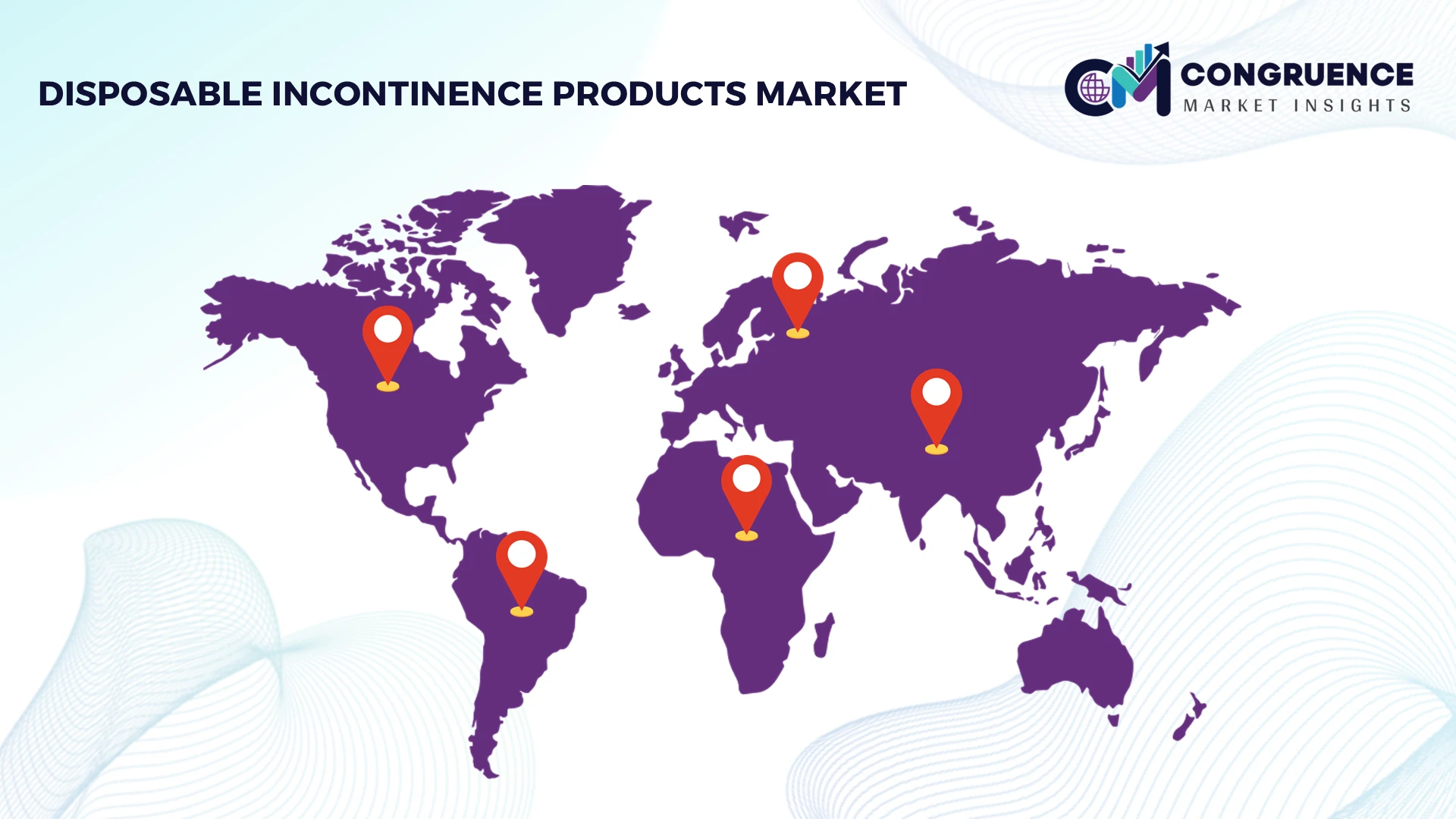
North America retains command by 35% of the global market through a reimbursement architecture that channels institutional demand into predictable, high-frequency procurement cycles. Medicare enrollment reached 67.8 million in 2024, with Medicare Advantage covering 34.1 million beneficiaries by March 2025, sustaining baseline volume for briefs, underpads, and barrier products across long-term care settings. The United States absorbs 84.7% of regional value, supported by offline distribution capturing 74.7% of sales through pharmacy and medical-supply networks. Reusable apparel substitutes are gaining ground, projected to rise from 15% of market value in 2025 to 22% by 2035, prompting incumbents to acquire leakproof-apparel brands rather than cede light-incontinence demand .
United States Market Outlook: The U.S. market operates as the global benchmark for reimbursement-linked procurement discipline, with institutional buyers prioritizing supply reliability and clinical evidence over unit price alone. Subscription-based direct-to-consumer channels are expanding rapidly, enabling suppliers to bypass retail margin compression while building recurring revenue streams that stabilize volume forecasting.
Europe’s market is structured around divergent national reimbursement regimes that reward suppliers capable of navigating country-specific tender specifications. Germany commands USD 1.03 billion, equal to 21% of regional value, underpinned by a statutory framework that channels prescribed products through institutional procurement. Essity leads with 33.0% regional share, followed by Paul Hartmann at 14.0% and Ontex at 11%, with the top five suppliers controlling 55.8% collectively. The United Kingdom and France contribute USD 930 million and USD 760 million respectively, though Italy is positioned as the fastest-growing named country, reflecting expanding institutional coverage in southern Europe .
Germany Market Outlook: Germany’s reimbursement structure functions as a demand stabilizer, insulating prescribed product volumes from discretionary spending fluctuations while imposing rigorous clinical documentation requirements. Manufacturers with established statutory tender relationships enjoy procurement continuity that smaller, retail-focused competitors cannot replicate, making Germany the definitive proving ground for value-based incontinence care contracts.
Asia-Pacific operates as the market’s most dynamic manufacturing and consumption theater, with Japan and China representing distinct strategic poles. Japan’s mature long-term care insurance system and 36.4 million elderly population drive premiumization through ultra-thin, dignity-focused formats, while China’s manufacturing scale and expanding domestic healthcare access create volume-led demand. The region contributes approximately 30% of global value, with Japan’s Unicharm and Daio Paper expanding professional product lines to meet institutional demand . India remains an early-stage market where awareness, stigma, and distribution reach continue to constrain realized demand despite substantial demographic potential .
Japan Market Outlook: Japan’s market rewards precision engineering and material science innovation, with consumers and institutional buyers alike prioritizing skin compatibility and discretion over absorbent capacity alone. The country’s long-term care insurance infrastructure provides predictable institutional volume, while retail premiumization offers margin expansion opportunities that commodity-focused suppliers cannot access.
South America’s market operates through retail and pharmacy channels rather than institutional reimbursement, creating a demand profile shaped by price sensitivity and distribution reach. Brazil anchors regional volume at USD 350 million in 2025, with pharmacy networks serving as the primary access point for consumers managing incontinence without public reimbursement support. Private-label and value-tier products command disproportionate share as macroeconomic volatility pushes consumers toward lower-priced alternatives, while urban online platforms are gradually expanding access beyond traditional retail footprints. The region accounts for approximately 9% of global value, with infrastructure limitations and uneven healthcare coverage constraining institutional procurement scale.
Brazil Market Outlook: Brazil’s market rewards distribution efficiency and price-tier portfolio breadth, with suppliers leveraging pharmacy partnerships and value-focused product lines to reach price-sensitive consumers. The absence of broad public reimbursement means brand loyalty is earned through consistent availability and affordable pricing rather than clinical specification alone.
The Middle East and Africa market is characterized by import-dependent supply chains and healthcare infrastructure investment that varies sharply across sub-regions. The region contributes approximately 5% of global value, with adult diapers dominating product mix and protective underwear positioned as the fastest-growing format. Gulf Cooperation Council states exhibit higher institutional procurement sophistication, while sub-Saharan markets rely on urban pharmacy networks and humanitarian supply channels. Egypt is identified as the fastest-growing market within the region, reflecting expanding healthcare infrastructure and population growth. Manufacturers face elevated logistics costs and currency volatility that compress margins across distribution layers.
Saudi Arabia Market Outlook: Saudi Arabia’s market benefits from healthcare infrastructure modernization under Vision 2030, with institutional procurement standards increasingly aligned with European clinical specifications. Import-dependent supply chains create opportunities for suppliers offering reliable logistics and localized warehousing, while domestic manufacturing investment remains limited but expanding.
Essity, Kimberly-Clark, Unicharm, Ontex, and Coloplast constitute the competitive core, with the top five controlling approximately 52.5% of global value. Competition fractures along strategic lines: global brand leaders defend institutional reimbursement relationships against regional cost competitors and private-label pharmacy suppliers, while material-science innovators pursue sensor integration and gender-specific architectures. Price competition dominates mature brief segments, but technology differentiation commands premiumization—protective underwear now captures 46% of North American revenue, growing at 6.5% annually. Ontex exemplifies the partnership route, leveraging retailer own-brand collaboration to scale multi-liquid protection across European pharmacy networks. The competitive shift is unmistakable: supply-chain resilience and digital care-workflow integration are displacing absorbent capacity as the decisive advantage. Entry barriers are rising, with reimbursement qualification, clinical evidence requirements, and dual-sourcing mandates now gating institutional access. Winning requires pairing manufacturing scale with care-data platforms that make products operationally indispensable.
Essity (TENA)
Kimberly-Clark
Unicharm
Ontex
Coloplast
Paul Hartmann
First Quality Enterprises
Daio Paper
Kao
Procter & Gamble
Medline Industries
Abena
Domtar
Hengan International
Sensor-integrated moisture detection represents the current technology frontier, with conductive printed electronics enabling change-on-demand protocols that cut unnecessary product replacements by approximately 20%. Adoption remains concentrated in European pilot facilities and Japanese premium care settings, where labor savings justify system costs. The business case is operational, not clinical: caregiver time recovery and material waste reduction drive procurement decisions.
The disruptive trajectory belongs to multi-liquid absorbent architectures and gender-specific core engineering. Ontex's X-Core channel technology, deployed across multi-liquid pants, addresses overlapping protection needs affecting 54% of women using absorbent products . This shifts competitive advantage toward material-science precision rather than commodity absorbency, rewarding suppliers with proprietary core designs and retailer partnership depth.
Between 2026 and 2028, expect sensor integration to move from pilot validation into tendered European contracts, with material efficiency becoming a scored procurement criterion. Suppliers without connected-care capabilities will compete on price alone in increasingly commoditized brief segments. The action imperative is clear: technology investment now determines institutional contract eligibility, not merely product differentiation.
November 2026 – Ontex Expanded multi-liquid protection range with adult pants using patented X-Core technology, addressing the 78% of women reporting bladder changes during perimenopause or menopause; 54% experience overlapping protection needs. Business impact: positions retailer own-brand portfolios for premium feminine-adjacent demand. Source: ontex.com
April 2026 – Unicharm Partnered with MTG's SIXPAD to launch next-generation femcare combining Charm Nap absorbent products with EMS pelvic-floor training, targeting Japanese women's incontinence management through a "protect and strengthen" dual approach. Business impact: creates cross-category wellness channel beyond traditional absorbent retail. Source: unicharm.co.jp
August 2026 – Essity (TENA) Launched TENA multi-purpose sheet in Japan featuring 20% faster absorption speed versus prior products, designed for medical care, portable toilet use, and furniture protection. Business impact: extends TENA's institutional care portfolio into adjacent surface-protection applications. Source: tena-academy.jp
2025 – North America Market Protective underwear/pull-ups captured 46% of regional adult incontinence revenue, projected to reach 50% by 2035 at 6.5% annual growth, while adult diapers/briefs decline from 25% to 21% share. Business impact: format migration reshapes manufacturing priorities toward underwear-style production lines.
This report delivers comprehensive coverage across product types including adult diapers, protective underwear, pads and liners, and underpads, alongside application segmentation spanning urine, fecal, and dual incontinence. End-user analysis encompasses hospitals, long-term care facilities, home care, and individual consumers, with regional breakdowns across North America, Europe, Asia-Pacific, South America, and Middle East & Africa.
Quantitative indicators include segment distribution—protective underwear commanding 46% of North American revenue and women representing 56% of regional consumer value —alongside adoption patterns in sensor-enabled care protocols and emerging market penetration. The report supports investment planning through competitive positioning analysis of top players controlling 52.5% of value, expansion strategy via country-level reimbursement and infrastructure assessment, and future direction mapping for 2026–2033. Strategic insights address format migration, supply-chain regionalization, and technology integration pathways relevant to manufacturing and portfolio decisions.
| Report Attribute / Metric | Details |
|---|---|
| Market Revenue (2025) | USD 1,162.0 Million |
| Market Revenue (2033) | USD 2,119.1 Million |
| CAGR (2026–2033) | 7.8% |
| Base Year | 2025 |
| Forecast Period | 2026–2033 |
| Historic Period | 2021–2025 |
| Segments Covered |
By Type
By Application
By End-User
|
| Key Report Deliverables | Revenue Forecast; Market Trends; Growth Drivers & Restraints; Technology Insights; Segmentation Analysis; Regional Insights; Competitive Landscape; Regulatory & ESG Overview; Recent Developments |
| Regions Covered | North America; Europe; Asia-Pacific; South America; Middle East & Africa |
| Key Players Analyzed | Essity (TENA); Kimberly-Clark; Unicharm; Ontex; Coloplast; Paul Hartmann; First Quality Enterprises; Daio Paper; Kao; Procter & Gamble; Medline Industries; Abena; Domtar; Hengan International |
| Customization & Pricing | Available on Request (10% Customization Free) |




